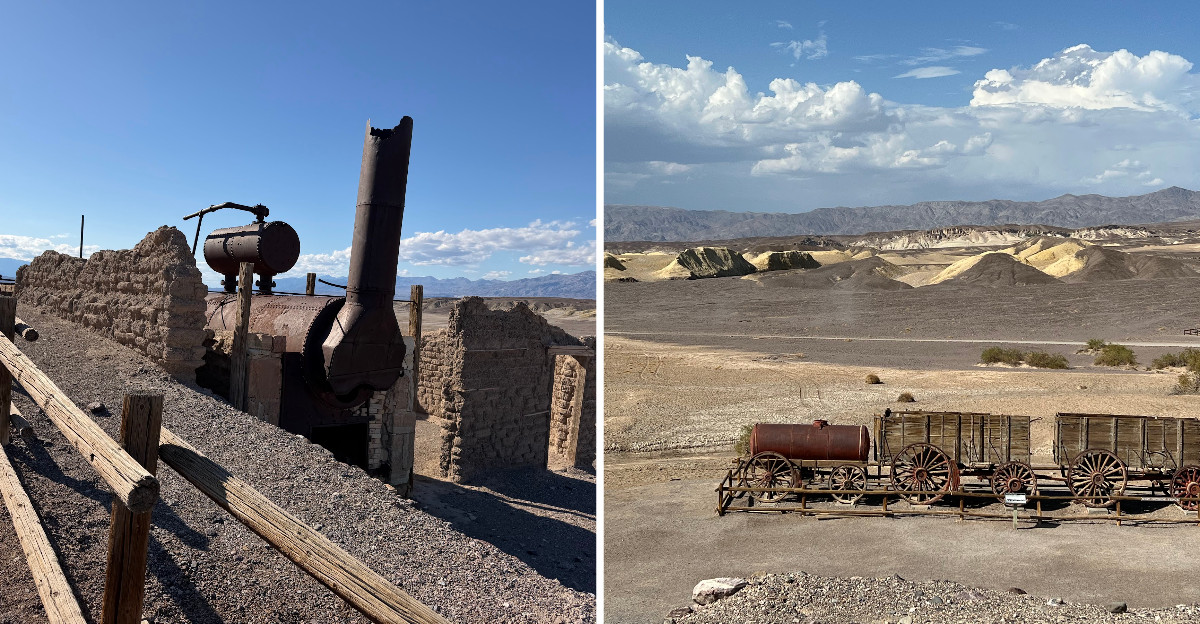
Enormous wooden wagons sit in a quiet parking lot, looking like they belonged to giants. Behind them, adobe walls slump into the gravel, the last bones of a factory that ran for only five years in the 1880s.
A brown sign along a California highway pointed the way, and the stop lasted far longer than planned. The math of it all is what got me: forty workers, three tons of borax a day, and a 165-mile haul to the railroad by mule.
The short loop was walked twice, once for the signs and once just to look at the salt flats stretching west. This place is small, free to wander, and one of the most quietly powerful stops in the state.
The silence out there is heavy, broken only by wind and the crunch of gravel underfoot.
The Discovery That Started It All in 1881
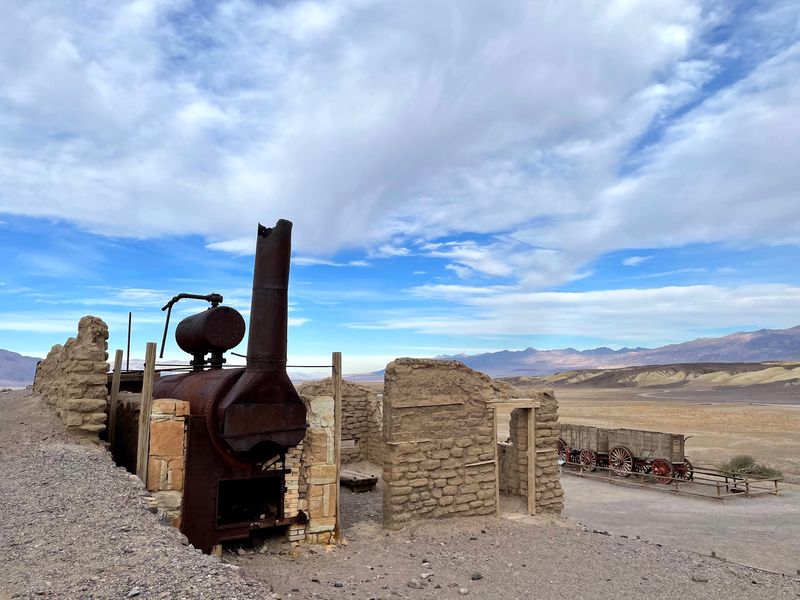
Aaron and Rose Winters found borax on the marsh near this spot in 1881, back when the area was called Greenland rather than Furnace Creek Ranch. That single discovery cracked Death Valley open to business.
San Francisco businessman William T. Coleman bought the Winters claims for $20,000 and moved fast.
He set up the Greenland Salt and Borax Mining Company, which later took on the Harmony name, and built the plant that still crumbles here today.
Reading the plaque made me realize how odd the timing was. All of this happened before Las Vegas existed as a town, in a valley with no railroad, no reliable water supply, and summer temperatures that regularly pass 120 degrees.
Borax itself earned the nickname white gold. People used it for cleaning, softening water, glassmaking, and preserving, so demand back east was real and growing.
Standing where the marsh spreads out below the site, I could see the pale crust that once held the raw material. It looks like frost, though nothing about this ground is cold.
Harmony became the valley’s first large-scale borax operation that actually turned a profit, and everything that followed in local mining traced back to it. For a place this empty, that is a surprisingly big origin story to carry.
Adobe Walls Slowly Melting Back Into the Desert
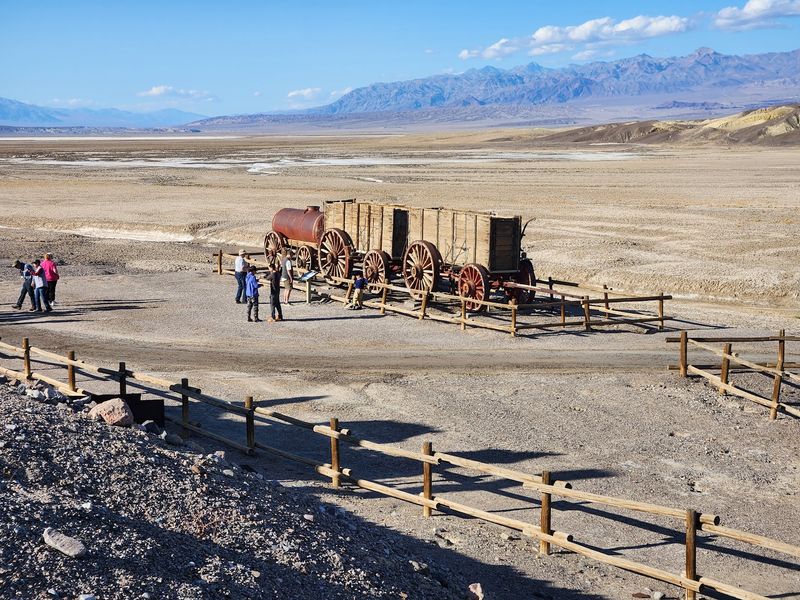
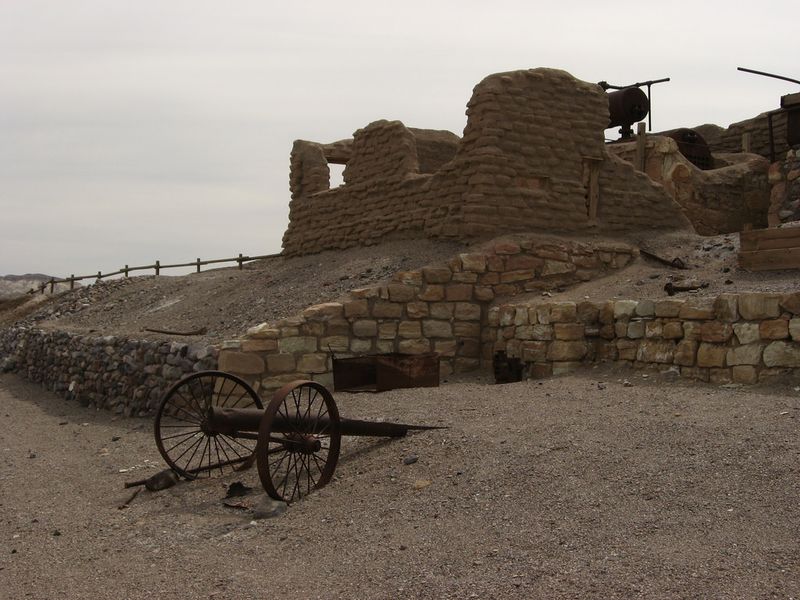
My first thought at the ruins was how fragile they look. The adobe walls have rounded off at the edges, softened by more than a century of rare rain and constant wind, and they sit low enough that you could mistake them for natural mounds.
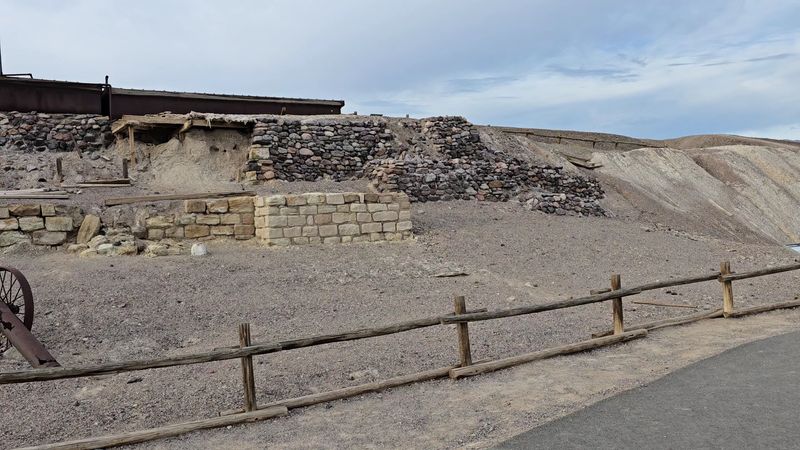
What survives are the remains of the processing plant and a few associated structures from the old townsite. Foundations, stone bases, and a partially standing building mark where the refining happened.
The dry climate here is the only reason anything is left. In wetter country, mud brick would have dissolved into nothing decades ago.
I liked how honest the ruins feel. Nothing is rebuilt or dressed up for visitors, so what you see is genuinely what time left behind.
Look closely and you notice the old boiler foundations and the layout of the vats where workers dissolved the raw ore. Once you spot those shapes, the site stops looking random and starts reading like a floor plan.
Harmony Borax Works joined the National Register of Historic Places on December 31, 1974, and it was named California Historical Landmark No. 773 back on August 16, 1962. Two separate honors for a factory that operated fewer years than most people stay at a job.
Those Giant Wagons Up Close Are Genuinely Startling
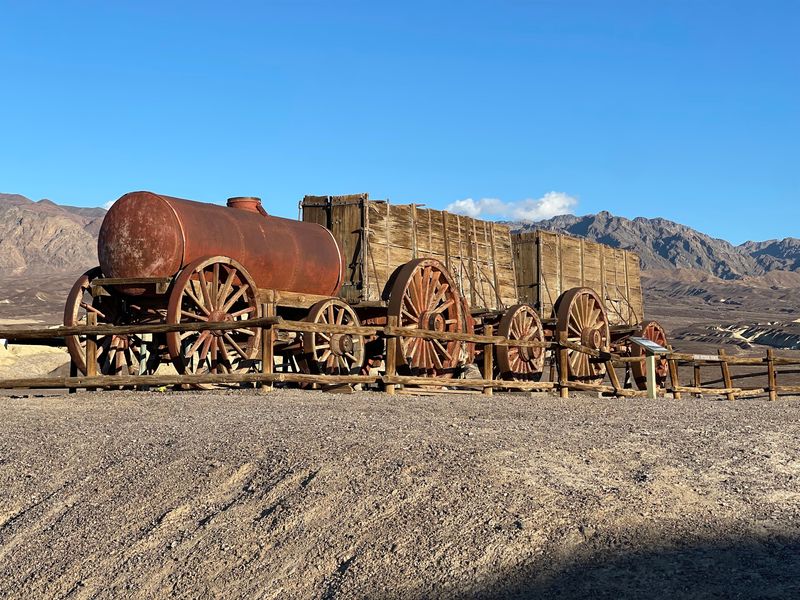
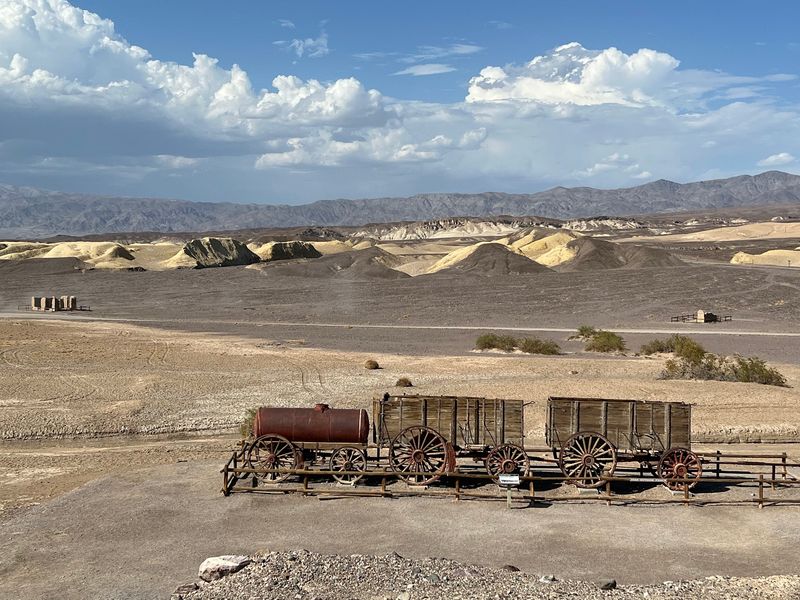
Photos do not prepare you for the scale. The rear wheels stand seven feet high, wrapped in iron tires an inch thick, and the solid oak beds measure 16 feet long by 6 feet deep.
Each rig could carry up to 10 short tons of borax ore, and they ran in pairs behind a single team. Company superintendent J.W.S.
Perry designed them specifically for this brutal route.
I walked a slow circle around one and kept noticing details: the massive brake lever, the iron reinforcing straps, the sheer thickness of the timber. Nothing here was built delicately.
Only one complete original set of these wagons survives intact, and it sits right here in the open desert air where it worked.
Standing beside a wheel that reaches above your head does something to your sense of the past. Suddenly the 1880s stop being abstract.
Bring a camera. Early light makes the wood grain glow.
Forty Men, Three Tons a Day, and Cottonball Borax
Forty men worked here when the plant ran at full capacity, and together they turned out roughly three tons of refined borax every single day. That number sounds modest until you picture the conditions.
Most of the labor force was Chinese, and their job was scraping impure chunks of mineral known as cottonball straight off the salt flats. They loaded it into one-horse carts and hauled it to the plant for refining.
The interpretive panels do not soften this part of the story. The work was punishing, the pay was low, and the heat was relentless.
I read that section of the trail twice. It felt important to sit with the fact that the famous wagons and the celebrated brand name rested on labor that history rarely credited by name.
Cottonball itself is strange stuff, a fluffy, fibrous crust that grows on the marsh surface. Workers gathered it by hand and by scraper, bent over the flats for hours.
Looking out at that same marsh now, empty and bright, the contrast is sharp. There is no shade anywhere, no water, no relief.
Harmony’s output reached American households, but the hands that gathered it stayed largely anonymous. Visiting feels like a small correction to that.
Why Summer Heat Shut the Whole Plant Down
Here is the detail that surprised me most: the desert heat literally broke the chemistry. Refining borax required water that could cool enough for the dissolved mineral to crystallize out, and Death Valley summers refused to cooperate.
When temperatures climbed, the processing water simply stayed too warm. No cooling meant no crystals, and no crystals meant no product.
Coleman’s workaround was to relocate his crew seasonally. During the hottest stretch, operations shifted to the Amargosa Borax Plant near present-day Tecopa, California, where conditions allowed the process to continue.
A factory that had to migrate like a bird is not something you hear about often. It says a lot about how thin the margin for success was out here.
I visited in cooler weather and still felt the sun pressing down within minutes of leaving the car. The idea of tending boiling vats in triple-digit heat is hard to hold in your head.
Modern visitors face a much smaller version of the same problem. After about 10 in the morning during summer months, the site becomes genuinely uncomfortable.
Fall through spring is the sensible window, and early morning or late afternoon works beautifully year-round. The desert rewards people who pay attention to timing.
Five Short Years, Then the Money Vanished
Late 1883 or early 1884 to 1888. That is the entire operating life of Harmony Borax Works, which somehow feels shorter each time I say it out loud.
Two things ended it. William T.
Coleman’s business empire collapsed financially, and richer borax deposits turned up elsewhere in California, making this remote and difficult site unnecessary.
Francis Marion Smith picked up Coleman’s holdings afterward. The property eventually folded into the borax reserves of the Pacific Coast Borax Company and its successors, where it sat quietly for decades.
The mule teams never hauled borax from Harmony to Mojave again after the plant closed. Their working chapter lasted barely longer than a presidential term.
Something about that short run makes the ruins hit harder. All that planning, engineering, and physical labor, and the whole enterprise lasted five years.
I sat on a rock near the wagons thinking about how many businesses leave nothing behind at all. Harmony left adobe walls, iron tires, and a nickname the entire country would recognize.
Standing in an empty valley at a factory that failed, you get a clear-eyed view of how boom towns actually worked. Most of them ended exactly like this one.
Valley Views That Sneak Up on You
Nobody drives here for the scenery, and then everybody stops mid-loop to stare. The site sits slightly elevated above the valley floor, which opens up long views both north and south.
Salt flats spread out in pale sheets to the west, with the Panamint Range rising behind them. To the east, the Funeral Mountains catch late light and turn a warm rust color.
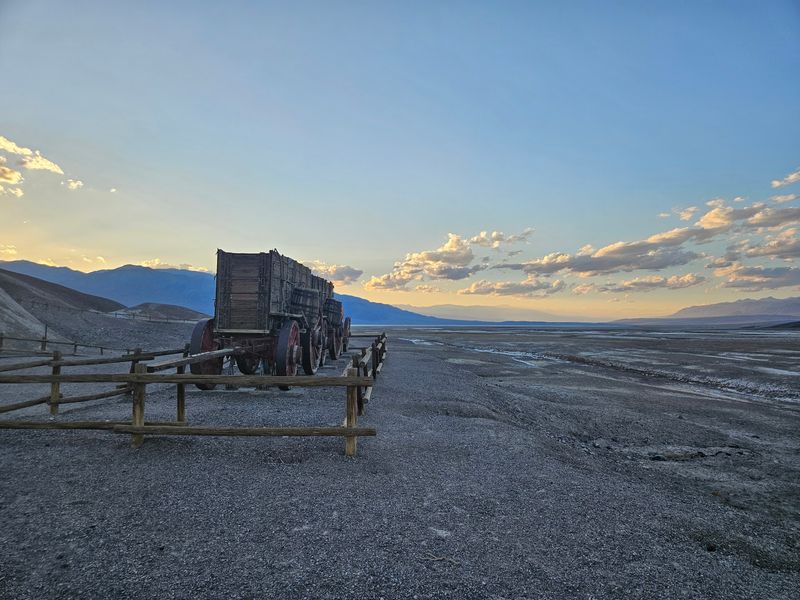
I hit it near sunset once and the whole basin went gold, then violet, in about fifteen minutes. The ruins looked completely different in that light.
During rare wet years, wildflowers push up around the site and the contrast against bare ground is striking. Visitors have caught superblooms here in late February.
Photographers should know this stop stays relatively quiet compared to Zabriskie Point or Badwater. Fewer people means more room to set up a tripod and take your time.
The wagons make excellent foreground subjects, especially with the valley stretching behind them. Wide angles work well here.
Morning offers cleaner air and softer shadows, while evening delivers drama. Honestly, either works.
What I did not expect was how much the view changes the story. Seeing the emptiness the wagons crossed makes the history land far harder than any sign could.
After Dark, the Sky Takes Over
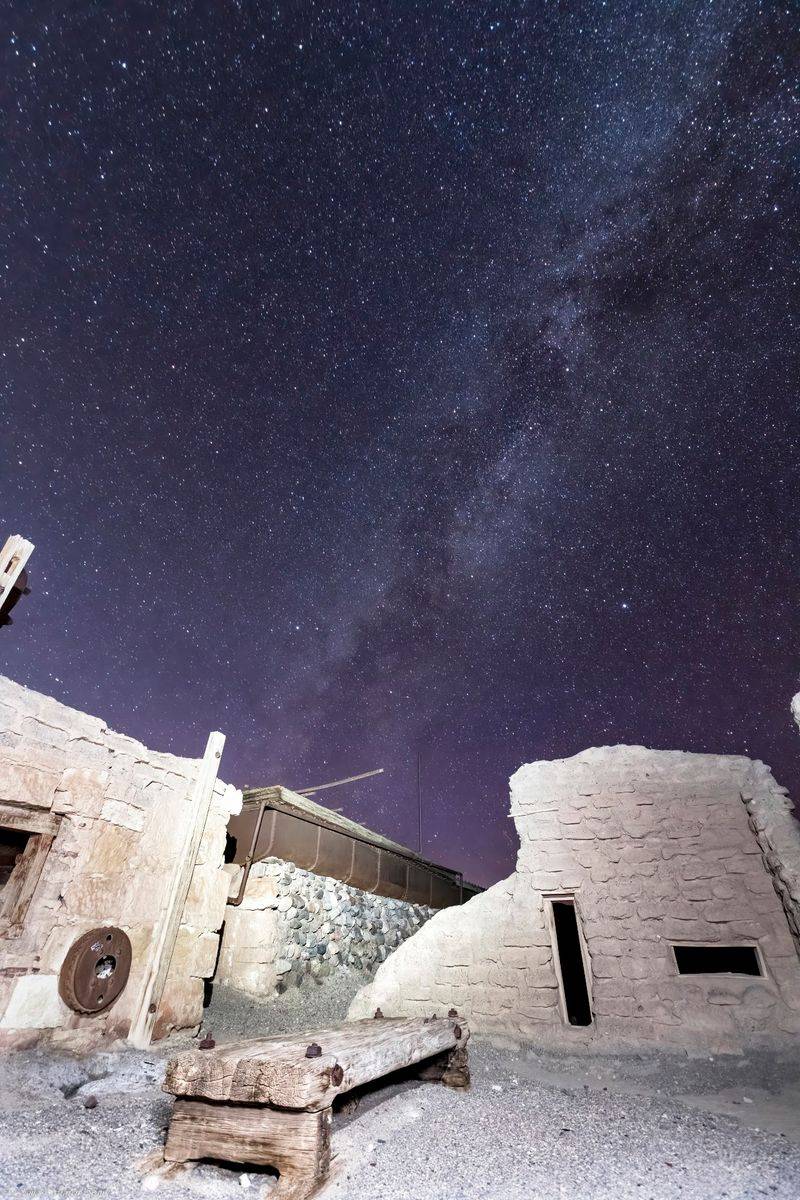
Come back after sunset and the place transforms completely. Death Valley holds some of the darkest skies in the country, and this parking area is close to Furnace Creek lodging while still feeling remote.
Visitors return here specifically for stargazing, sometimes multiple nights in a row. The wagons silhouetted against the Milky Way is a shot worth planning for.
On a moonlit night, the adobe walls glow faintly and the salt flats reflect enough light to walk by. It is eerie in the best possible way.
Small desert animals get bold once the heat drops. Kangaroo rats bounce around the edges of the parking area, and spotting one always makes me grin.
Bring a red-filter flashlight if you have one, since it preserves night vision and keeps things pleasant for other stargazers. A regular headlamp ruins the effect fast.
The site stays open 24 hours, which makes late visits easy. Just be aware there is no lighting whatsoever beyond what you carry.
Temperatures drop quickly after dark, even in warm months, so a layer helps more than you would guess.
Between the history at ground level and the sky overhead, nighttime here delivers two attractions for the price of one short drive.
Planning Notes Before You Pull In
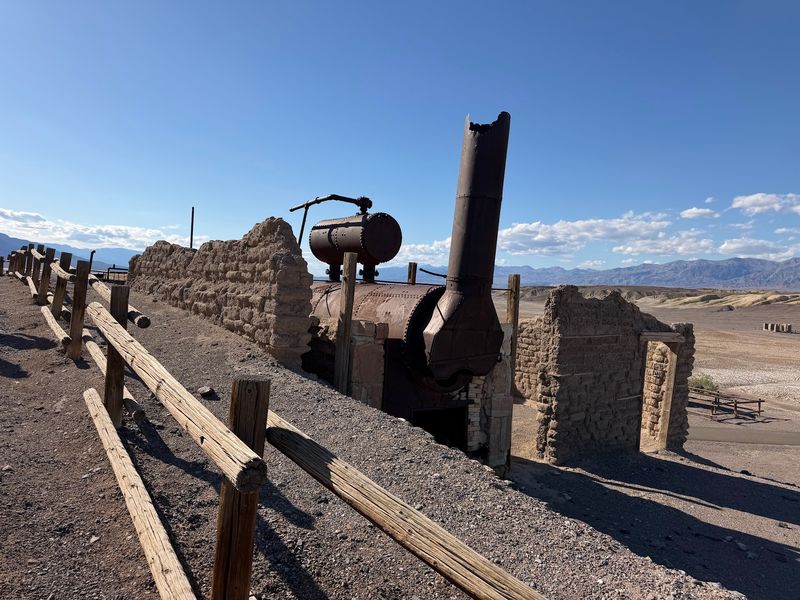
Logistics are refreshingly simple here. The site sits about a mile west of Furnace Creek on California Highway 190, with a short access road and a paved lot that handles cars, RVs, and buses.
Wandering the ruins costs nothing, though Death Valley National Park does charge an entrance fee. Keep your park pass handy.
There are no restrooms and no water at the site itself. The nearest facilities and visitor services are roughly a mile east at the Furnace Creek Visitor Center, which is also where you can ask about ranger programs.
I carry more water than seems reasonable whenever I am in this park, and I have never regretted it. Sunscreen, a hat, and real shoes round out the list.
Plan 20 to 40 minutes if you read the panels, longer if you wander toward the flats or linger for photos. It pairs nicely with the visitor center or a nearby breakfast stop.
Cell service is patchy throughout the area, so download maps beforehand. The park information line is +1 760-786-3200 if you need it.
Cooler months make everything easier, but any season works with early or late timing.
Address: Harmony Borax Works Interpretive Trail, Death Valley, CA 92328
