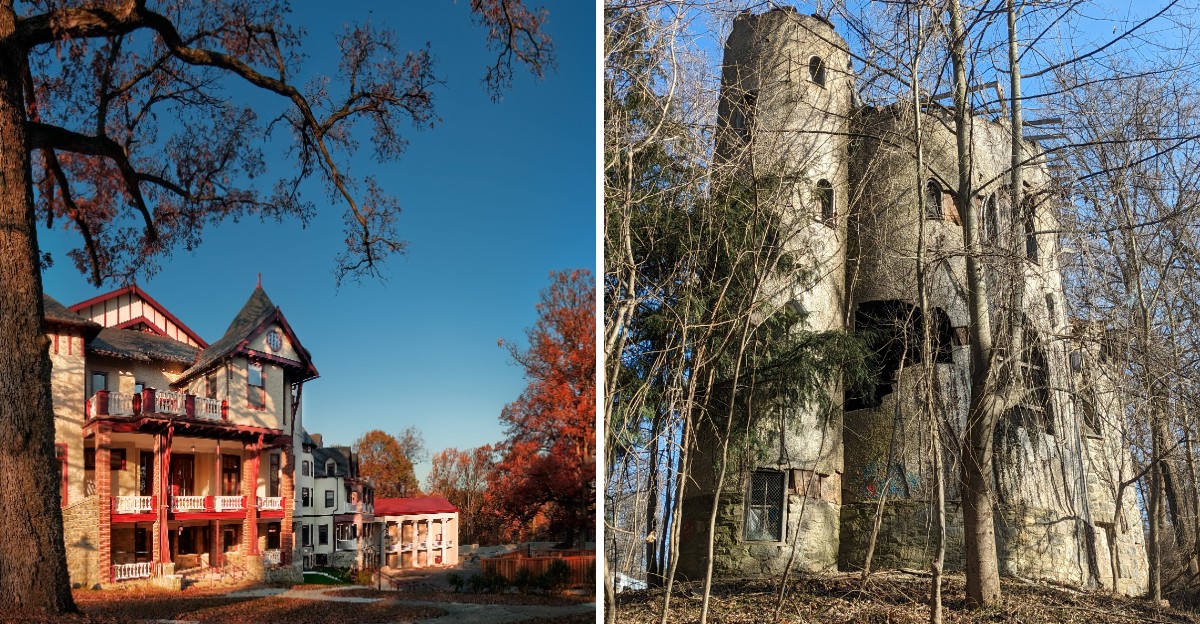
A Dutch windmill, a Japanese pagoda, and a Swiss chalet once served as sorority houses at the same girls’ school. They weren’t movie sets or carnival props.
Students actually met in them, surrounded by architecture inspired by faraway places.
The Maryland property began as a resort hotel that failed financially. New owners turned it into a school, adding unusual buildings, garden sculptures, and winding walkways.
Decades later, the Army used the grounds to help recovering soldiers, before neglect nearly destroyed the collection.
Of all the buildings, the windmill is the one I’d stop to study. What did an ordinary school meeting feel like inside that thing?
Today, a self-guided walking route leads past historic photographs and signs explaining the buildings, now part of a residential community. The grounds still have surprises around nearly every corner.
The Summer Hotel That Couldn’t Find Its Guests
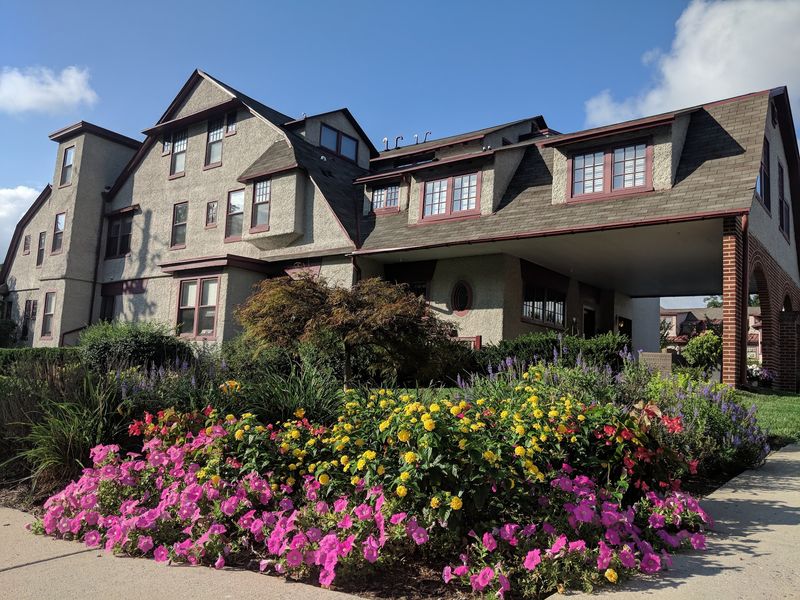
Back in 1887, developers built a summer hotel called Ye Forest Inn in the woods of Forest Glen. The goal was simple.
Wealthy Washington families would pay to escape the steamy city heat.
Washington architect T. F.
Schneider designed the hotel. Sadly, guests never showed up in big enough numbers.
Part of the problem was getting there at all. The site was hard to reach at first, though streetcar service arrived later.
The building even tried life as a casino for a short time. That plan failed too, which made the property look like a pretty shaky bet.
Still, the hotel left a lovely souvenir behind. The words Ye Forest Inne remain in stained glass at the main entrance today.
That old sign is a fun thing to spot. It reminds you the whole National Park Seminary Historic District began as a business flop.
I like that the failure became the foundation for something far more memorable. Plenty of grand plans fizzle out, but few fizzle into something this wonderful.
So when you look at that glass, give the hotel a little credit. Without its rough start, the strange story ahead would never have happened.
Two Educators Saw Potential Where Others Saw a Mess
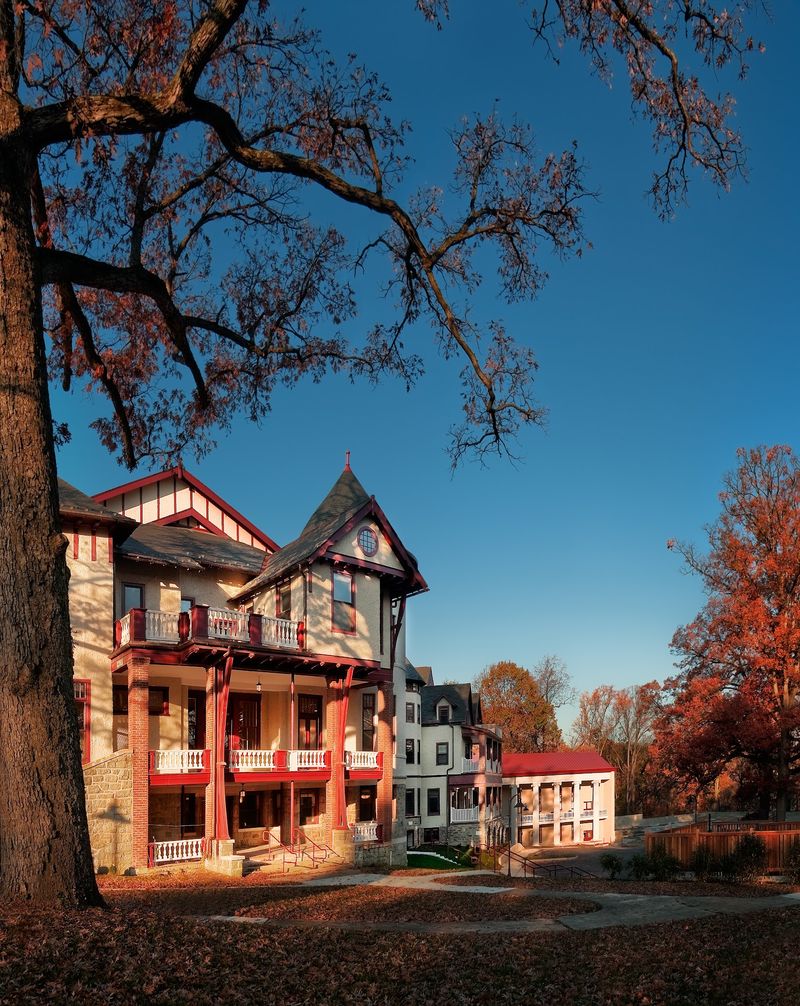
In 1894, John and Vesta Cassedy bought the struggling hotel. They turned it into the National Park Seminary, a boarding and finishing school for young women.
The school was not religious. Students took regular academic classes plus music, drama, elocution, and art.
Manners mattered here in a big way. Students learned posture, conversation skills, and etiquette for all kinds of social situations.
The dress code was strict, too. Proper clothes were required for class, and evening gowns were expected at dinner.
Trips into Washington were chaperoned, so nobody wandered off alone. The school also stressed moral training and an idea it called Soul Power.
That sounds like a superhero name, honestly. It was really about building strong character along with good grades.
The school drew daughters from famous wealthy families. Names linked to students include Hershey, Chrysler, Heinz, Kraft, and Maytag.
Picture the lunch table conversations there. Chocolate, cars, ketchup, cheese, and washing machines all in one room.
The school ran until 1942 and was later renamed National Park College. Its mix of learning, culture, and polish made it unlike anything else in Maryland.
You’ll Do a Double Take at This Three-Story Pagoda
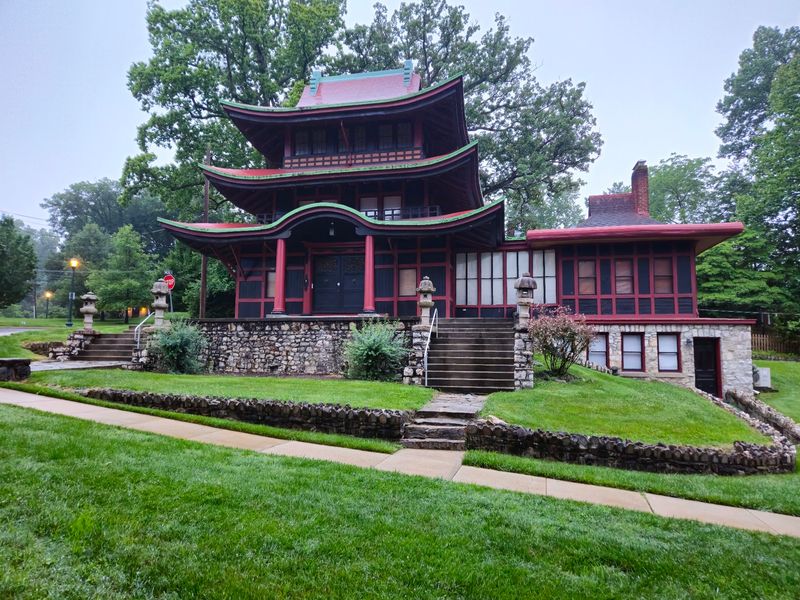
Of all the buildings on campus, the Japanese Pagoda is the showstopper. Many consider it the most elaborate structure in the whole district.
It was built around 1904 or 1905 for the Chi Psi Epsilon sorority. Its design may have been modeled after the Toji Temple in Kyoto, Japan.
The pagoda sits on a raised platform. It rises three stories, and each level is smaller than the one below.
Wide eaves stretch out and curl up at the corners. You can see the exposed rafters underneath, which adds to the temple feel.
A sloping gable roof with a decorative crest tops it all off. The outside walls use vertical wood laid in a neat grid pattern.
Two stairways lead up to the entry. Japanese lanterns stand beside them and frame the doorway like a temple gate.
Here’s a key fact about all eight clubhouses. They were for meetings and social events, not bedrooms.
The founders wanted students to learn about world cultures through buildings. That’s a much cooler lesson than a textbook chapter.
Bring a camera and look closely at those corners. The details reward anyone who slows down.
A Windmill That Hands Out Friendly Advice
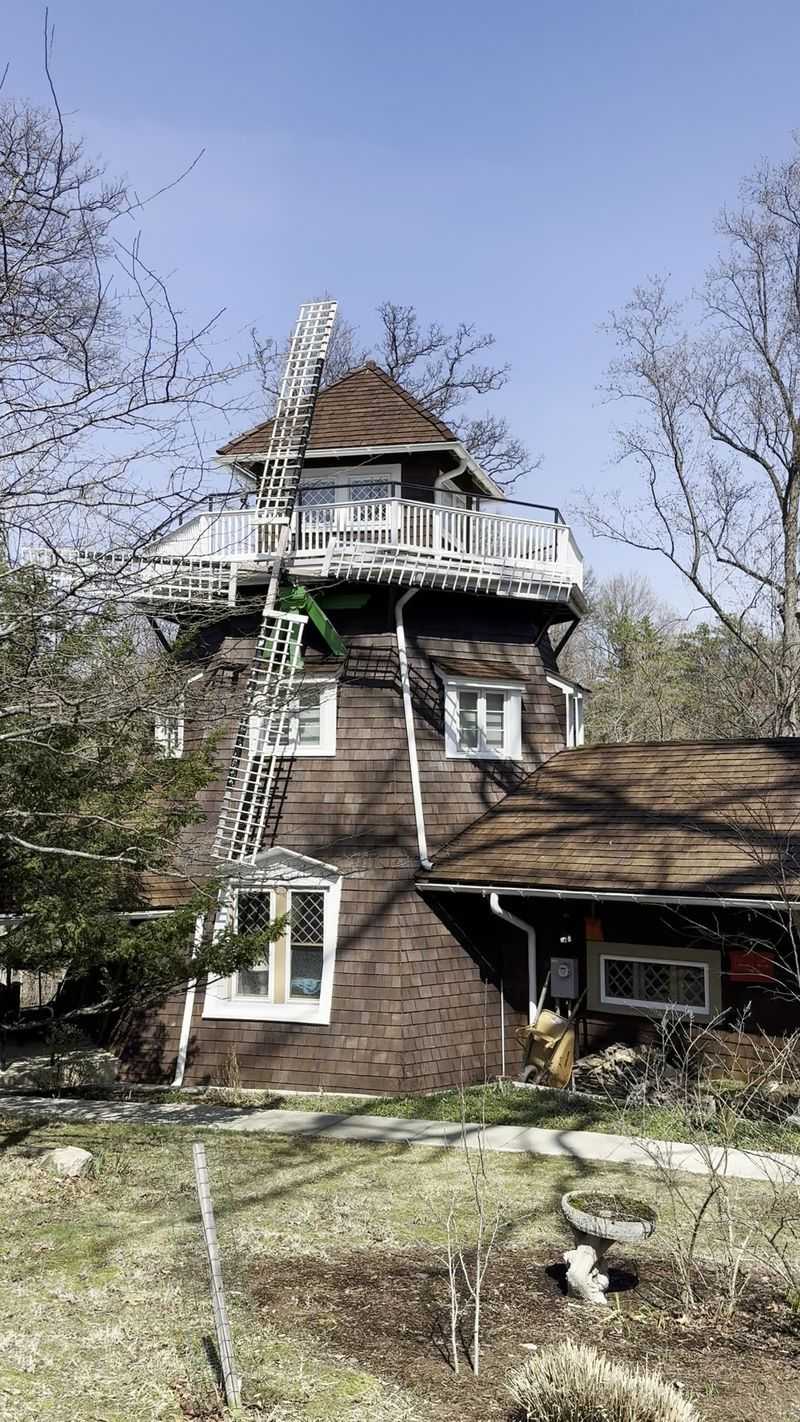
A cheerful host makes cheerful guests. That saying is painted on a beam inside the Dutch Windmill, and it might be the best house rule ever.
The Windmill went up around 1899 for the Kappa Delta Pi sorority. It’s one of the most charming buildings in the National Park Seminary Historic District.
Inside the living room, four beams carry hand-painted Dutch sayings. They’ve been carefully restored so their messages still shine.
The outside has its own fun backstory. The windmill originally had arms on its top railing, though they never actually turned.
So it was a windmill that didn’t mill anything. Think of it as the decorative cousin of a working Dutch farm building.
The current owners plan to bring those arms back. That would return the building to its original look from more than a century ago.
I love that someone lives here now and cares about these details. Restoring old sayings and missing windmill arms takes real patience.
Since it’s a private home, admire it from the sidewalk. A friendly wave works better than knocking on the door, cheerful host or not.
Even the Swiss Government Got a Say in This Chalet
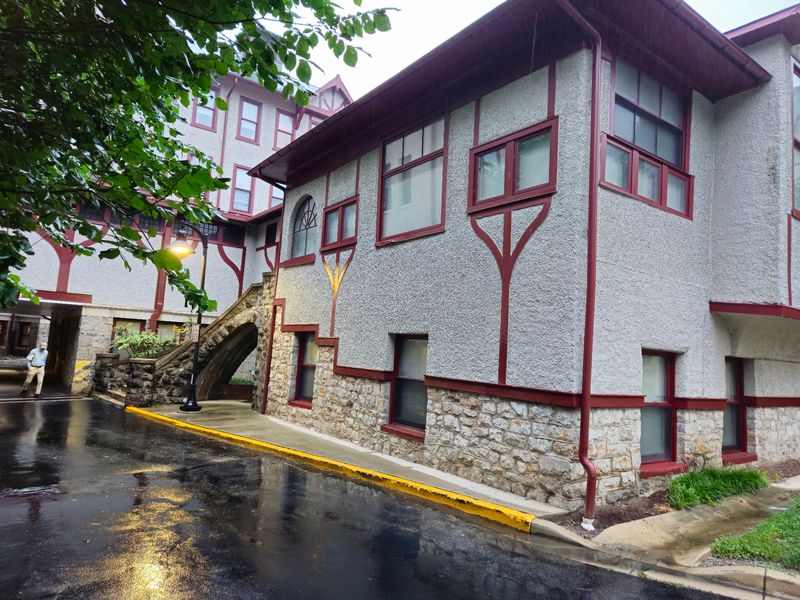
Talk about doing your homework. Before the Swiss Chalet was built, its plans were reportedly reviewed by the Swiss legation in Washington.
The legation was basically Switzerland’s diplomatic office in the capital. They checked the design to make sure it looked truly Swiss.
The chalet dates to around 1899. It served as the clubhouse for the Zeta Eta Theta sorority.
The sorority students reportedly researched the traditional style themselves. That turned the building into a real school project, not just a pretty place to hang out.
Inside, the chalet has high ceilings and large windows. Those features let in plenty of light and make the rooms feel open.
It’s a great example of the school’s big idea. Students learned about other countries by spending time in buildings from those cultures.
Most school clubs today get a classroom after hours. These students got a chalet approved by a foreign government.
When you see it, notice how it fits with the trees around it. The wooded Maryland setting suits a mountain-style house surprisingly well.
It’s proof that a little research can lead to something lasting. Over a century later, the chalet still stands proud.
A Castle, a Mission, and a Bungalow Round Out the World Tour
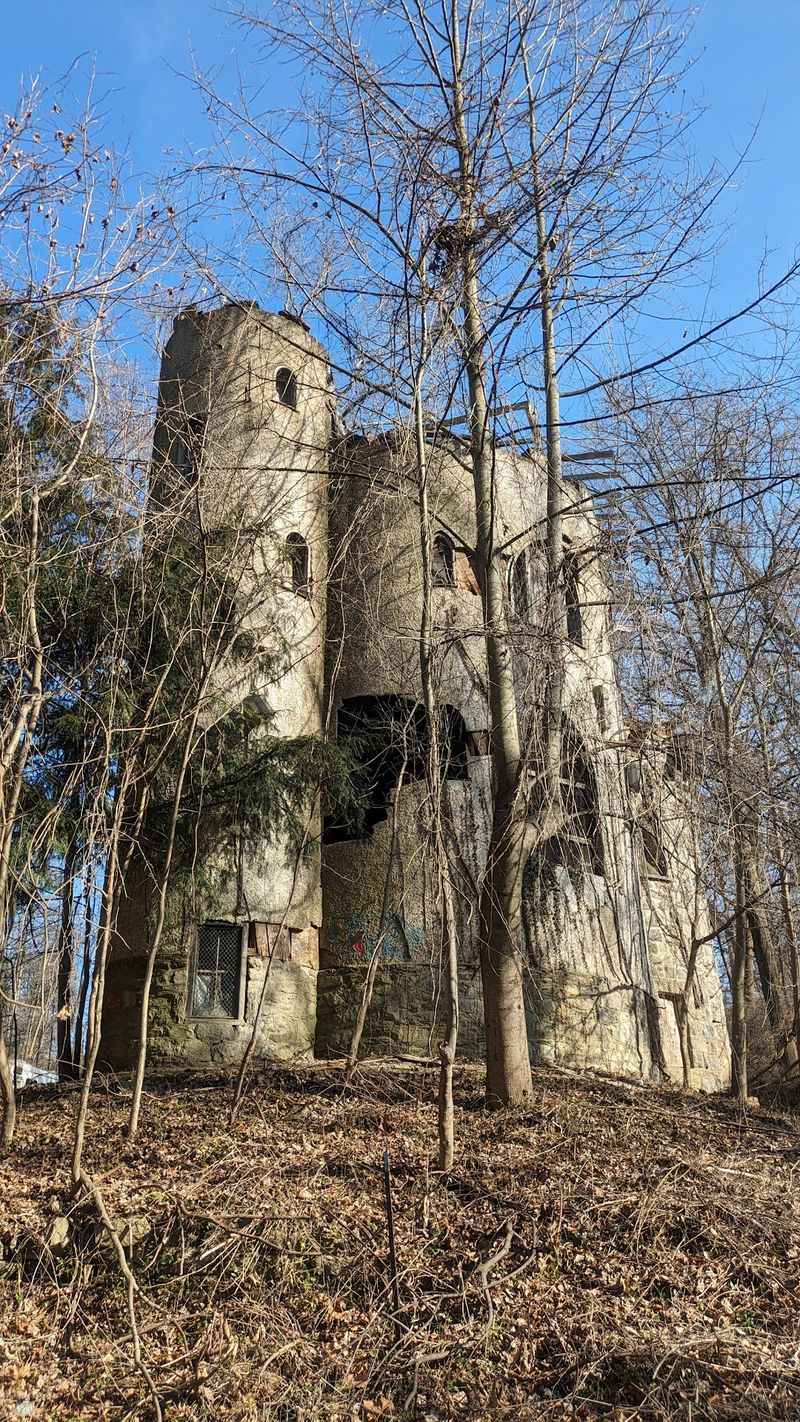
Eight clubhouses went up between 1896 and 1905, and the famous three are only part of the lineup. The others deserve a look too.
The English Castle belonged to the Beta sorority. It’s covered in vines and once had its own drawbridge.
Yes, a drawbridge for a school club. That has to be the most dramatic way to arrive at a meeting.
The Spanish Mission House was built around 1903 for Theta Sigma Rho. It was first furnished with items reflecting the American Southwest.
Later, the Army removed many of its mission-style features. The good news is that those details are now being restored.
The American Bungalow is the oldest of the bunch, built in 1896. It housed the Alpha Epsilon Pi sorority.
Philadelphia architect Emily Elizabeth Holman designed it. Native oak trees from the campus were used in its foundational structure.
Holman designed several of the clubhouses, which was remarkable for a woman architect of that era. Her work gave the campus much of its character.
Walking past these buildings feels like flipping through a travel scrapbook. Each one tells a different story in wood and stone.
Chandeliers and Gothic Arches Made Every Dance Feel Royal
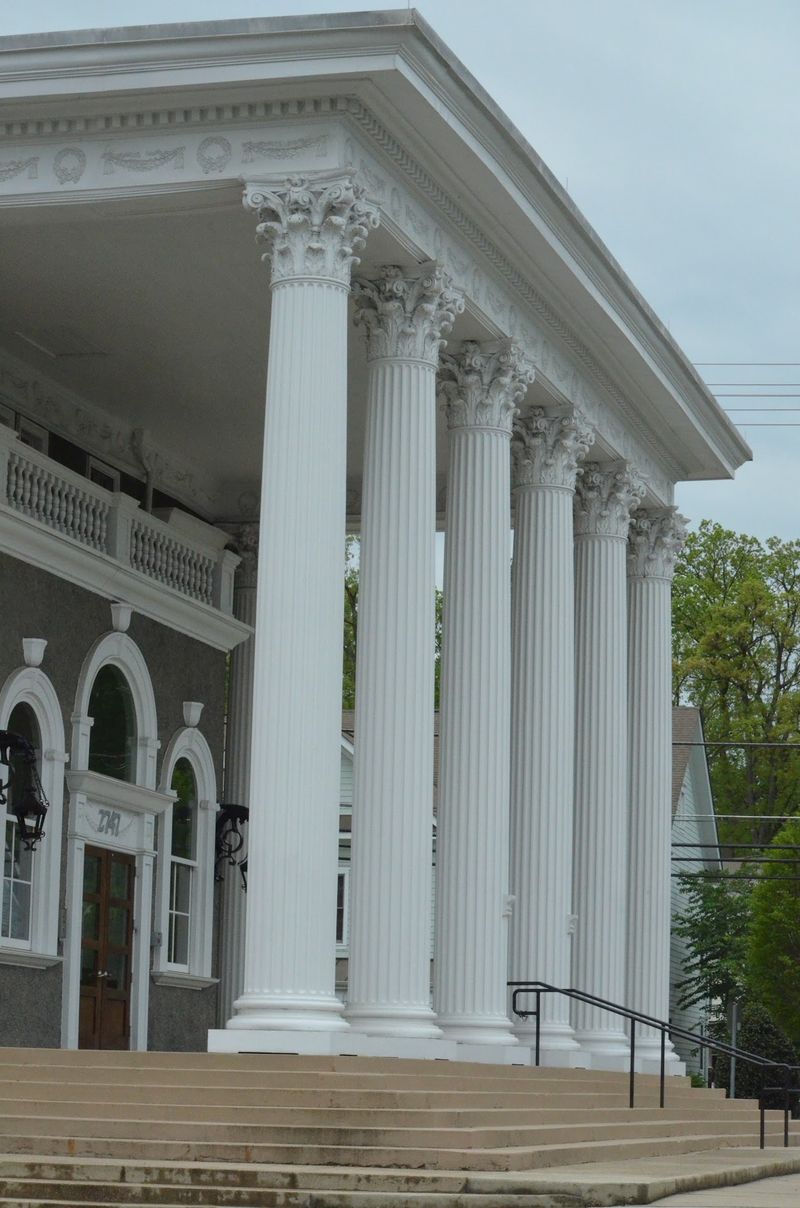
Daily dance practice was part of student life here. And the room for it was absolutely stunning.
The Ballroom sits in Ament Hall and was completed in 1927. Its design came from Dr. James Ament, the school’s second president.
Gothic arches sweep across the space. Stained glass windows, balconies, and crystal chandeliers complete the fancy look.
During the school years, the room had a theater-sized Orthophonic speaker system. That was serious sound power for practice sessions and formal dances.
I can’t imagine a cooler place to learn the waltz. Even stepping on a partner’s toes would feel elegant in here.
The Ballroom still plays a role today. Save Our Seminary hosts quarterly lectures about the school’s history in this very room.
The space is also available for community use and rental. So the chandeliers still get to sparkle over real events.
If you want to see it, a lecture is a smart option. You get the history lesson and the gorgeous room together.
It’s one of the best spots in the National Park Seminary Historic District. Few Maryland ballrooms carry this much charm and backstory.
Soldiers, Silence, and a Comeback Nobody Expected
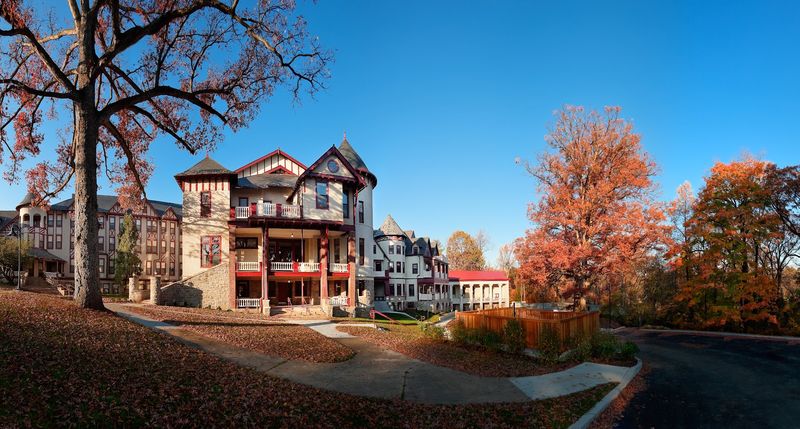
In 1942, the government required the school to sell the property. The campus then became an annex to Walter Reed Army Hospital.
It served mainly as a rehabilitation center for soldiers, including many who had lost limbs. Patient care continued here until the late 1970s.
The buildings suffered during those years. Some were changed or torn down, and original woodwork was covered or painted over.
After the Army mostly left in 1978, things got worse. Vandalism, water damage, and near collapses threatened the whole campus.
Local residents refused to let it go. In 1989 they formed Save Our Seminary, a nonprofit that stopped Army plans to tear the site down.
Not every building survived. The Odeon Theater, built in 1907, was destroyed by arson in 1993.
Then came a real turning point. In 2003, Montgomery County picked The Alexander Company to redevelop the site.
The plan turned historic buildings into homes while protecting their architecture. Today the district includes apartments, condos, townhouses, and single-family houses.
Some residences feature historic details restored to period style. It’s a true second act for buildings that once seemed doomed.
Plan Your Visit Around a Tour and Respect the Neighbors
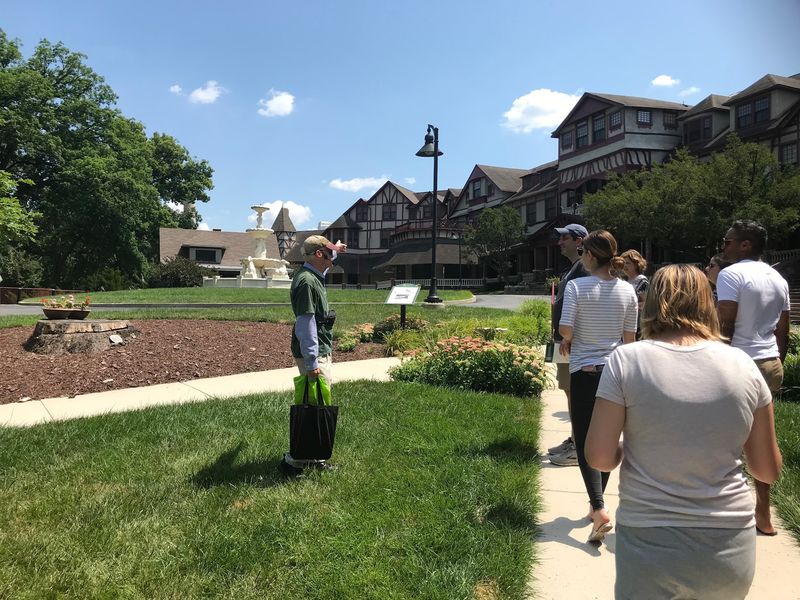
Here’s the most useful tip of all. Save Our Seminary offers guided walking tours, usually on the fourth Saturday of each month from March through November.
Tours last about two hours. They often begin near 2755 Cassedy Street.
The district’s mapped address is 20 Dewitt Ct, Silver Spring, MD 20910. Keep in mind that these are private homes, so stay on public paths and be polite.
Parking can be tricky since this is a residential neighborhood. Taking transit is a smart move if you can.
The Forest Glen Metro Station on the Red Line is about one mile away. Montgomery County Ride On Route 4 also serves the area.
Don’t miss the Glen, a 13-acre wooded ravine on the property. It has a stream, low stone bridges, statuary, and a grand stone staircase.
The campus once held more than 100 statues. Save Our Seminary now works with conservators to clean and protect the ones that remain.
Rock Creek Park is nearby for extra hiking or biking. Pair it with a tour for a full Maryland day.
The National Park Seminary Historic District proves weird ideas can last. Go see the pagoda for yourself.
