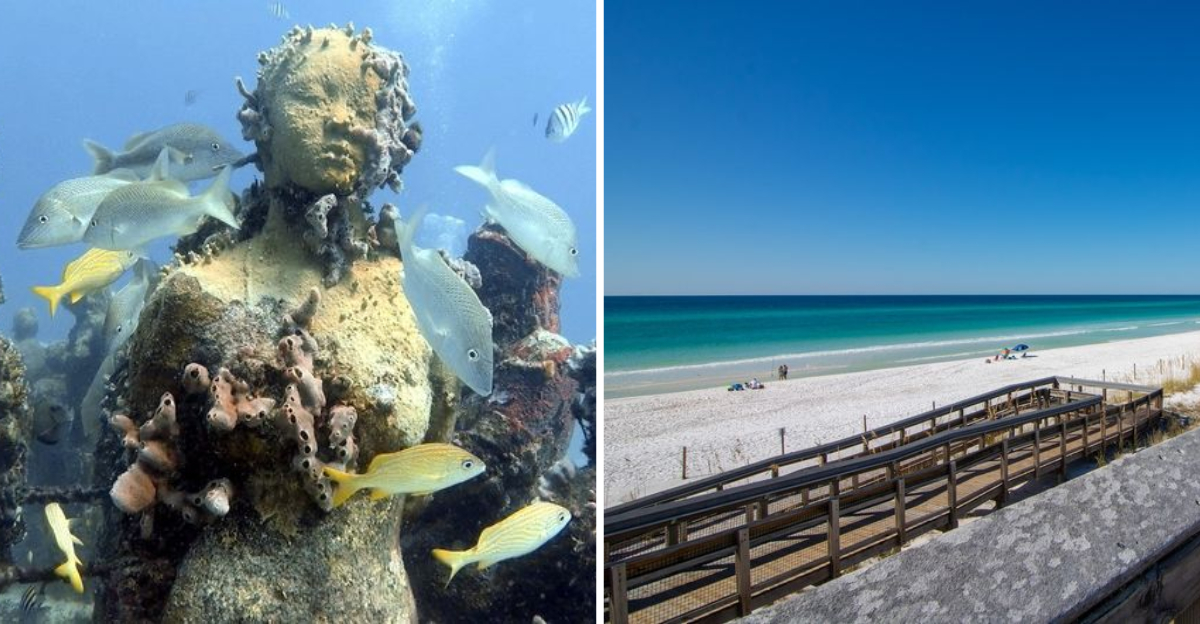
A museum where you need a tank of air and a pair of fins to see the artwork. That is what someone told me about a spot off the Florida coast, and I laughed before I started planning the trip.
It sits in the Gulf, roughly a mile off the shore, about sixty feet straight down. Sculptures rest on the sandy floor down there, slowly turning green and fuzzy with life as fish move in and claim them as home.
I remember the moment the boat engine cut and the water went quiet, and how strange it felt to know an entire gallery was hiding beneath that glassy emerald surface. You drop below the surface and suddenly you are floating through a forest of concrete figures, each one slowly being reclaimed by the ocean.
Coral is growing. Fish are nesting.
And the whole thing is doing real work for the marine ecosystem. What I love most is that this place is not just pretty.
It is purposeful. It is art that gives back to the water it sits in.
And it is one of the most unusual stops on the coast.
America’s First Permanent Underwater Sculpture Garden
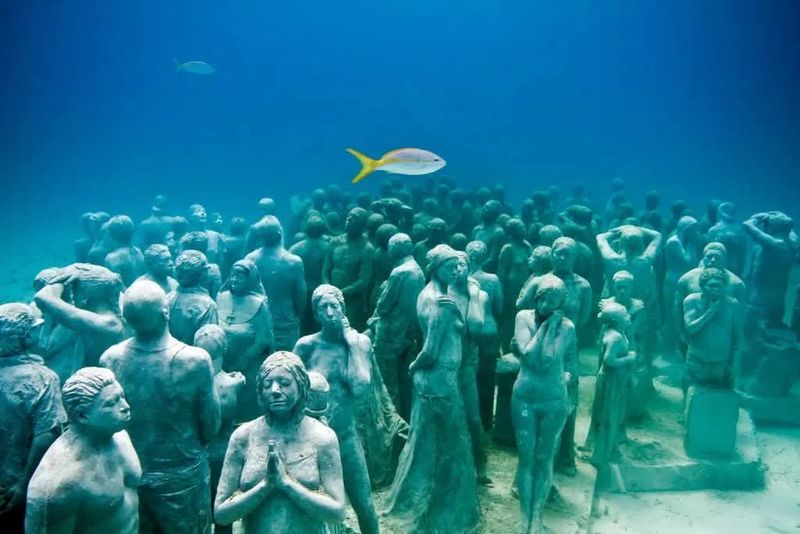
Plenty of places claim to be first at something. In this case the title actually holds up, because the Underwater Museum of Art opened in 2018 as the first permanent underwater sculpture exhibit in the United States and in North America.
Seven pieces went down that first year, lowered into the Gulf about a nautical mile off Grayton Beach State Park. Since then a new group has been added nearly every summer.
The seventh deployment was planned for summer 2025, which brings the collection to 53 works spread across the sandy bottom.
What surprised me is how young the whole thing still feels. Newer sculptures look crisp and clean, while the older ones wear a thick coat of algae, barnacles, and coral-like growth that softens every edge.
So the museum you visit this year genuinely looks different from the one someone saw three years ago, and that is not marketing talk, it is just biology doing its thing.
TIME Magazine named it one of the World’s Greatest Places back in 2018, and in 2023 it picked up a CODA Award for Collaboration of the Year. Recognition aside, it remains a quiet patch of seafloor most beachgoers walk right past.
Why Scuba Certification Is Your Ticket In
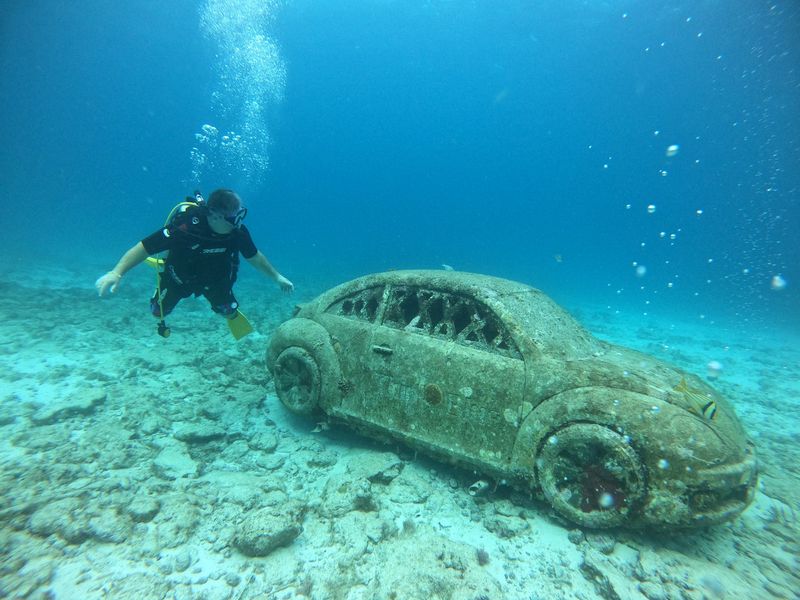
There is no lobby, no gift shop, and definitely no elevator. To actually see this collection up close, you need to be a certified scuba diver who feels genuinely comfortable in open water.
The sculptures sit around 58 to 60 feet down, which puts them well within open water certification limits but still deep enough that you want your skills to be solid. Visibility in the Gulf here can be beautiful, though it shifts with weather and swell.
Snorkelers are not shut out entirely. From the surface you can float above the site and catch shapes and shadows below, and on the clearest days you can make out a few of the larger pieces.
Gear and boat transportation are your responsibility, so this is not a walk-up attraction. Dive30A and Emerald Coast Scuba both run trips out to the site, and going with an operator saves you the trouble of finding coordinates yourself.
My honest advice is to book early in your trip. Gulf conditions change fast, and having a spare day or two in your schedule means a canceled charter does not end your plans entirely.
Sculptures That Double as Living Reefs
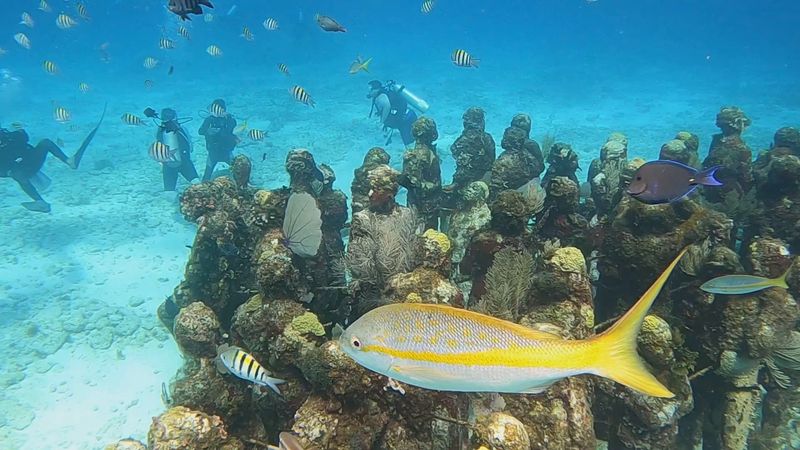
Art with a job description. Every piece in this collection was designed with eco-friendly materials like concrete, metal, or stone so marine life can settle in and grow.
The waters off Walton County were historically about 95 percent barren sand flats, which sounds pretty but means very little shelter for fish. Artificial reefs change that math.
Holes, arches, tunnels, and rough textures give small creatures somewhere to hide from bigger ones, and juvenile fish use those spaces to grow up safely.
Watching it happen is genuinely fun. A sculpture that started as a clean gray shape becomes a fuzzy, colorful apartment building within a couple of seasons.
The artists know this going in, which changes how they design. Instead of smooth surfaces meant to stay pristine, they build in nooks and crannies specifically so nature can move in and take over.
I came away thinking of it less as a museum and more as a long-term experiment where the ocean gets final say on the finished piece. Nobody polishes anything here.
The growth is the point, and the fish are both residents and unpaid co-creators.
Standout Pieces You Will Want on Your List
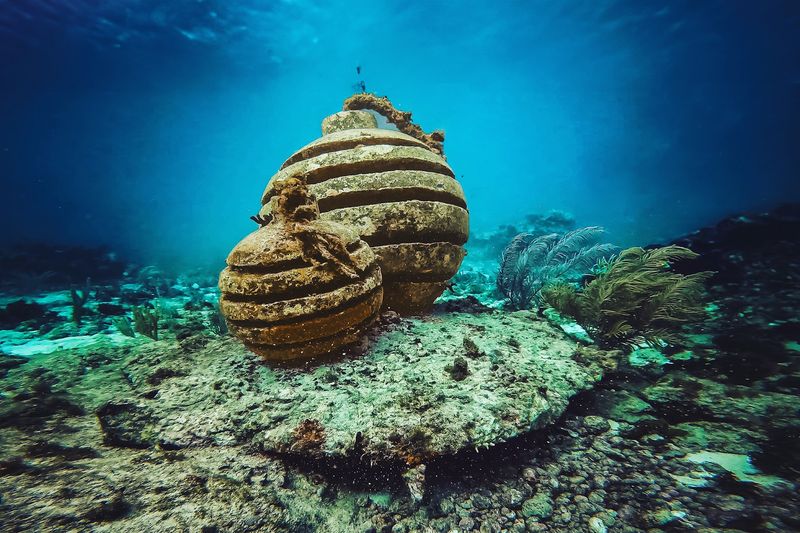
The lineup down here is wonderfully odd. There is a giant octopus, a life-size seashell, a pirate shipwreck, and an eight-foot-tall steel pineapple sitting on the seafloor like a joke you have to swim to.
The SWARA Skull is the site’s central marker, a gigantic skull that divers use to orient themselves. Nearby you will find Poseidon’s Throne and A Common Chord, which is a large guitar.
Three Wishes is a magical genie lamp, and divers can purge air into it to create a shimmering silver genie that floats upward.
I Found It is a giant diamond ring, and Cetacean Remains forms a swimmable tunnel from the arched rib cage of a prehistoric marine mammal.
Other favorites include OPUS with its curling tentacles, Aqua Lung shaped like a scuba mask, a winding propeller in motion, plus a bee, a rabbit, and a deer.
Reef Goddess, Seahorse, Concretion, and The Lost Kingdom of Artemis round things out. Photographers, bring a wide lens, because these pieces are bigger in person than any picture prepares you for.
The Marine Neighbors Who Moved In
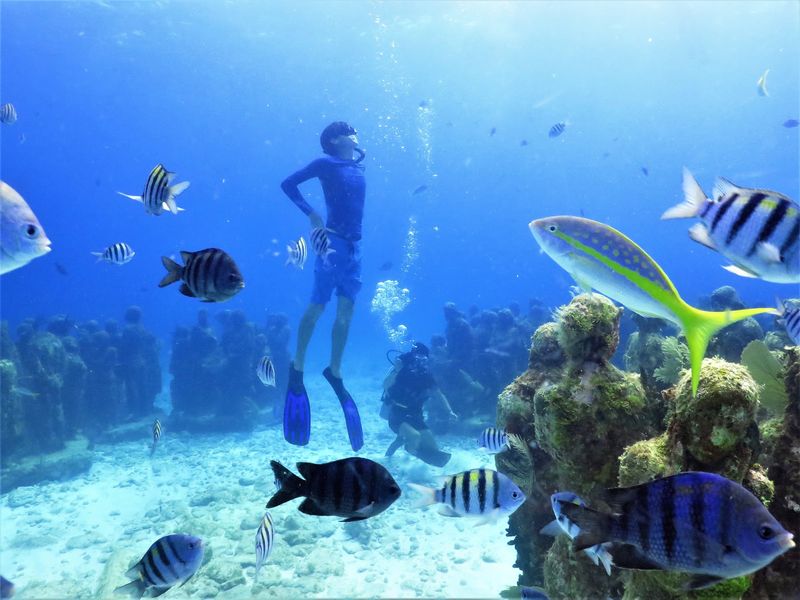
Fish stole the show for me, not the art. More than 100 species of animal and plant life have been observed and documented at the site since it opened, and on a good dive you feel completely outnumbered.
Triggerfish patrol the sculptures like they own them. Goliath groupers hang in the shadows, huge and unbothered, and nurse sharks sometimes rest along the sand.
Loggerhead and green sea turtles pass through, and dolphins occasionally show up while you are still on the boat.
Smaller invertebrates cover the surfaces in a slow-moving carpet of color, and if you hover still for a minute the whole scene gets busier.
The museum works as a nursery too. Those protected pockets in each sculpture let young fish develop before they head into open water, which helps keep the local ecosystem balanced.
That is what shifted my thinking about the whole project. It looks like a novelty from above, but underneath it is functioning habitat, and the artwork is basically the scaffolding.
Bring a camera with a good macro setting if you have one, because the tiny stuff clinging to the sculptures is honestly as interesting as the big shapes.
Grayton Beach State Park, Your Launch Point on Land
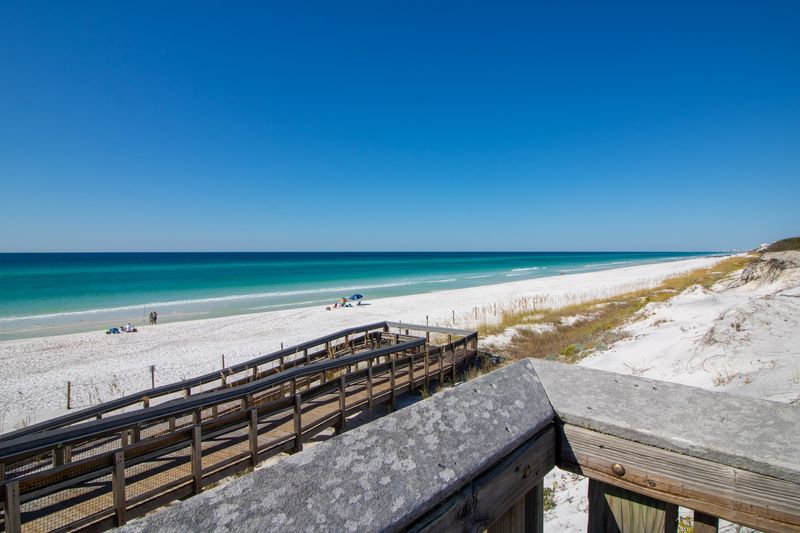
Before or after the dive, the park itself deserves a few hours. Grayton Beach State Park covers roughly 2,000 acres, and the sand is so white and fine it genuinely looks like snow drifted onto the coast.
A raised boardwalk carries you over roped-off dunes and down to the water, which glows in shades of teal and emerald depending on the light.
Practical stuff is all here: parking, restrooms, changing rooms, and outdoor showers, which you will appreciate after peeling off a wetsuit.
The park opens daily at 8 a.m. and closes at sunset. Arriving early matters more than you would think, because the lot fills and the gate closes once capacity is reached.
There is a one-mile coastal dune trail worth walking, plus a coastal dune lake, a boat ramp, kayak rentals, and a campground with shaded sites.
My favorite move is to walk a few minutes down the beach away from the main access point, where the crowd thins out and it feels like an older, quieter version of Florida.
Address: 357 Main Park Road, Santa Rosa Beach, Florida
The Partnership That Sank Art on Purpose
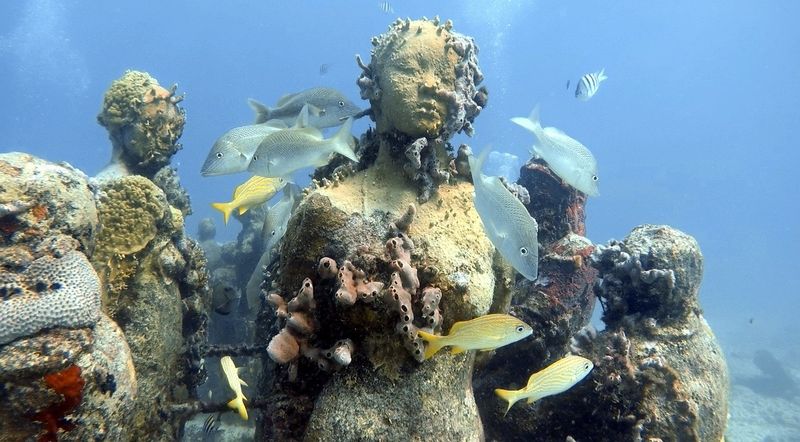
Two local groups made this happen, and neither one is a museum in the traditional sense. The Cultural Arts Alliance of Walton County teamed up with the South Walton Artificial Reef Association to build something that serves art and the ocean at the same time.
Their goal was to replenish coastal waters that were mostly empty sand, while also creating educational and cultural opportunities for the community.
Sinking sculptures on purpose sounds backwards until you see the fish counts. Then it makes complete sense.
Artists submit work, pieces get approved, and each summer a new group is lowered to the seafloor at coordinates near the SWARA Skull, which sits at the heart of the site.
What I appreciate is how local the whole thing feels. This was not dropped in by a big institution, it grew out of a small coastal county deciding its water deserved more life.
If you dive it, you are swimming through a collaboration between sculptors, marine scientists, and volunteers who wanted something lasting.
Come back in five years and the same sculptures will look nothing like they did on your first visit. That slow transformation is the real exhibit.
