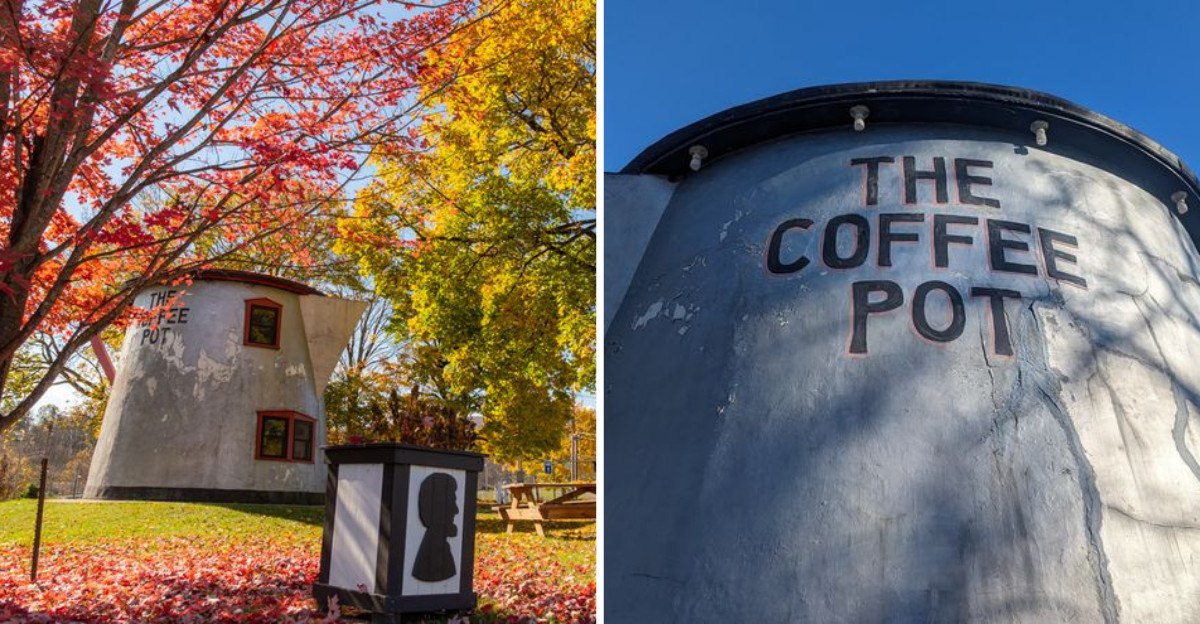
That shape on the right side of the road made me slow down without thinking, a giant coffee pot taller than a house sitting beside the entrance to a Pennsylvania fairgrounds. I had been driving the old highway with a lukewarm thermos in the cup holder, not expecting much beyond the usual fields and farm stands.
Then there it was, complete with a spout, a handle, and a lid, looking like it had every right to be there. I pulled into the gravel patch, got out, and laughed at the sheer size of it.
Built in 1927 to pull travelers off the road, it still does exactly that job almost a hundred years later, drawing curious drivers who cannot resist a photo beside a piece of roadside architecture that has somehow survived a century of weather, road widenings, and changing tastes.
The pot stands about eighteen feet tall and has been restored more than once, its paint bright and its shape unmistakable against the tree line.
Here is everything I noticed, learned, and enjoyed during my stop at one of the state’s strangest and most charming roadside survivors.
The First Glimpse From Route 30
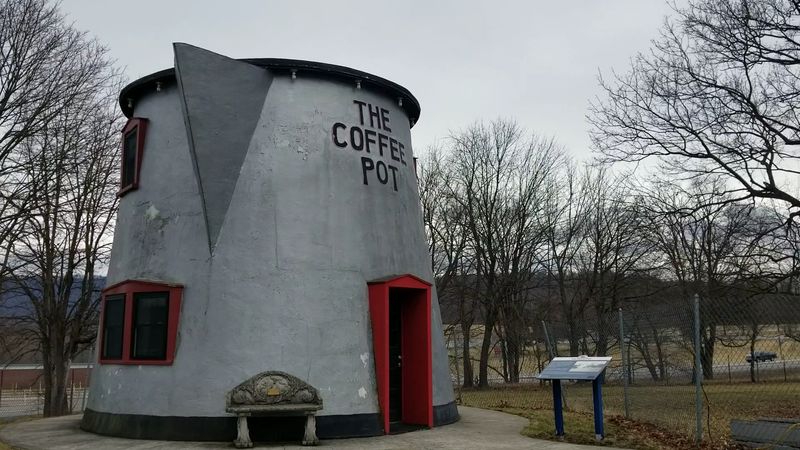
My first reaction was disbelief, followed immediately by reaching for the camera. The Coffee Pot sits close enough to the road that you spot it while still moving, and there is a split second where your brain tries to explain it away as a water tower or a silo.
Then the spout registers. Then the handle.
Then you realize somebody actually built a building shaped like something from a kitchen counter.
It stands 18 feet tall and 22 feet wide, which does not sound enormous on paper but feels genuinely oversized when you are standing next to it. The proportions are what sell it, since the lid, the base, and the curve of the body all match a real percolator almost exactly.
Parking is tight, so plan for that. There is only room for maybe two or three cars along the side, and the gate into the fairgrounds itself leads to private property, so it is better to stay in the small pull-off area.
Traffic on Business Route 30 moves steadily but not fast, and the noise fades quickly once you step onto the grass. I gave myself ten minutes and ended up staying closer to half an hour, circling the thing and finding new angles I had not noticed from the car.
David Berton Koontz and His 1927 Marketing Idea
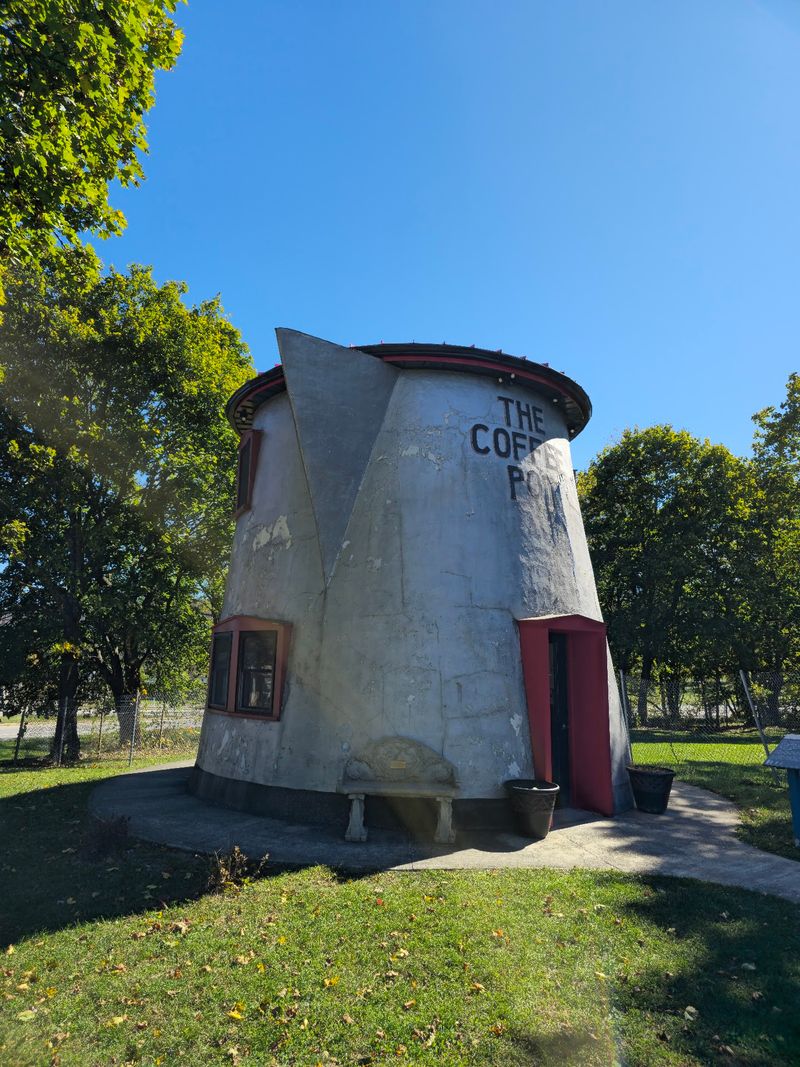
Long before billboards blanketed American highways, a man named David Berton Koontz figured out a simpler way to get attention. He built a coffee pot.
Koontz ran a service station along the Lincoln Highway, which by the 1920s carried a steady stream of drivers crossing Pennsylvania. Competition between stations was real, and a plain building with a sign blended into everything else.
So in 1927 he put up something nobody could ignore. The structure was made of brick and then covered in sheet metal, shaped and painted to look like an actual kitchen coffee pot rather than a rough approximation.
What I find clever about the idea is how honest it was. The building told you exactly what was inside, no reading required, which mattered a great deal when drivers were passing at speed.
Here is a number worth sitting with for a second. If the Coffee Pot could actually hold coffee, it would fit roughly 819,000 cups, or about 51,000 gallons.
That figure gets quoted often, and standing beside the structure you understand why it stuck. Koontz probably never imagined his advertising stunt would outlive the gas station, the highway’s golden age, and nearly a century of changing travel habits.
When It Poured Real Coffee and Scooped Ice Cream
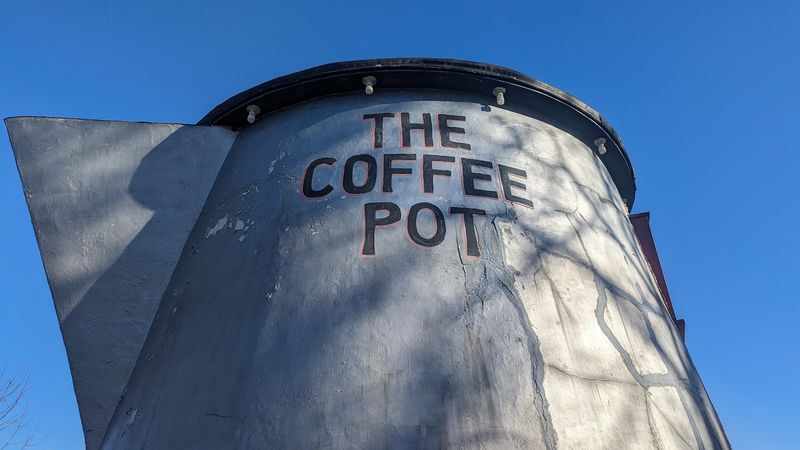
Picture pulling off a dusty road in 1930, stiff from hours of driving, and ordering a sandwich inside a giant coffee pot. That was the whole point of the place.
Originally it worked as a small luncheonette, serving coffee, ice cream, and light lunches to travelers who needed a break. The menu was simple because the building was small and the customers were passing through.
Its purpose shifted over time, as roadside businesses tend to do. By 1937 the operation had changed hands and function, and a hotel was attached alongside it to catch overnight travelers.
There was also a Greyhound bus depot nearby, which turned the Coffee Pot into a natural waiting spot for passengers between connections. I like imagining people sitting there with a paper cup, watching for their bus, completely unbothered by the fact that they were inside a novelty building.
One review I read summed up what a lot of visitors wish for now, which is somebody selling ice cream inside again. That thought crossed my mind too while standing at the locked door.
The food service era ended long ago, but knowing it existed changes how the building feels. It was never just decoration.
The Quiet Decades of Neglect
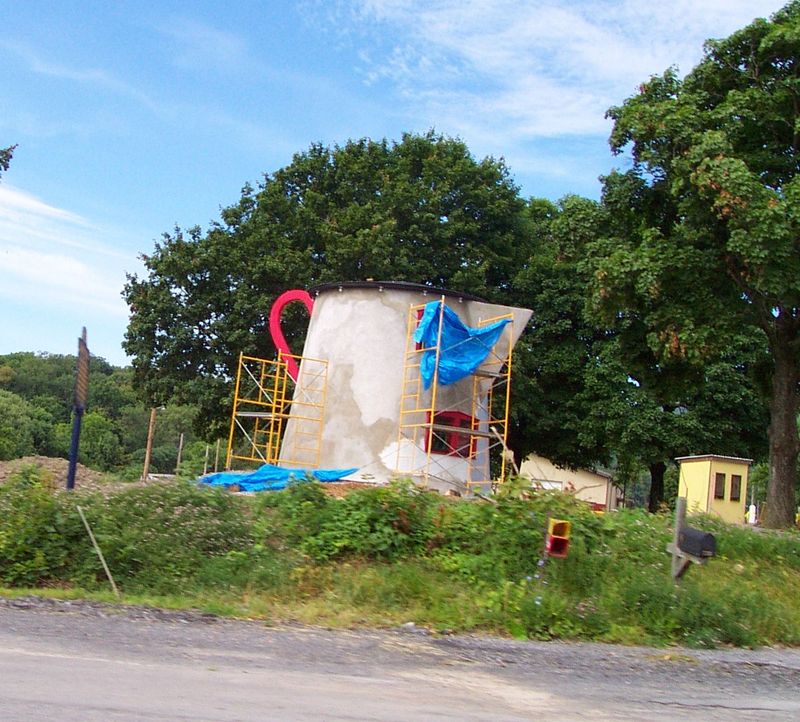
Not every chapter of this story is cheerful. The Coffee Pot closed sometime in the 1980s, and after that it simply sat there.
Weather did what weather does. Paint peeled, the metal skin rusted through in spots, and a building that once welcomed hungry drivers became something people drove past without slowing.
By the 1990s the situation had turned serious enough that demolition was a genuine possibility. Old roadside structures rarely have legal protection, and when land gets redeveloped, the odd little buildings usually go first.
What strikes me is how close Pennsylvania came to losing it entirely. Dozens of similar novelty buildings across the country disappeared during those same decades, replaced by parking lots and chain signage nobody photographs.
The interstate highway system played a role too. Once travelers could bypass towns like Bedford at seventy miles per hour, the businesses that depended on curious drivers lost their reason to exist.
I think about that whenever I take an exit ramp instead of staying on the turnpike. Those older routes still hold plenty worth seeing, but only if enough people keep pulling off to look.
The Coffee Pot survived that stretch of neglect mostly through stubbornness and luck, which makes what happened next feel earned.
Programmatic Architecture, Explained Simply
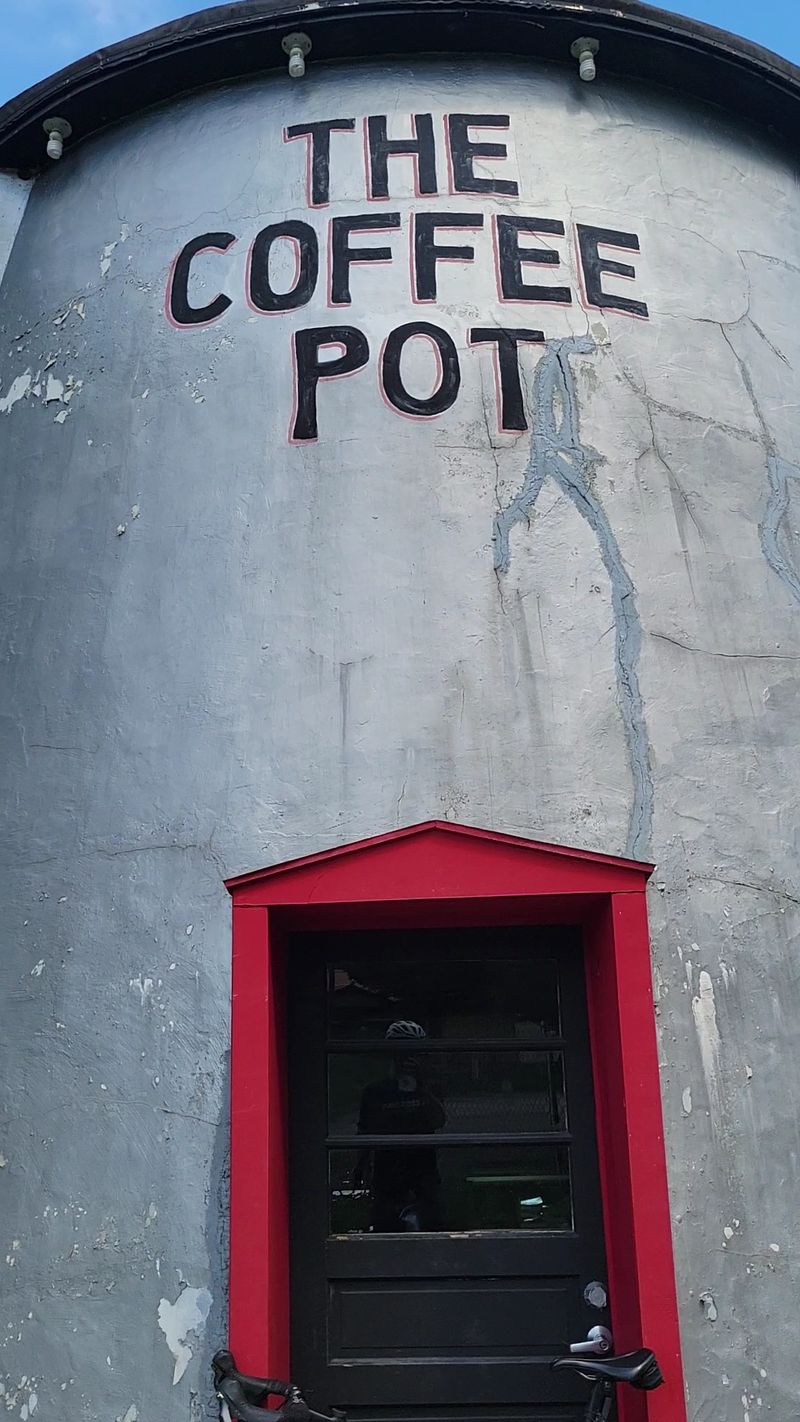
There is an actual name for buildings like this, and it sounds far too formal for something so playful. Architects call it programmatic architecture, or sometimes mimetic architecture.
The concept is straightforward. You build a structure shaped like whatever it sells, so a coffee shop becomes a coffee pot and a shoe store becomes a shoe.
America went through a real wave of this in the 1920s and 1930s, driven almost entirely by car culture. Drivers made split-second decisions about where to stop, and a building that announced itself visually beat any painted sign.
Bedford County actually has more than one example, which is part of what makes the area fun for a detour. The Coffee Pot gets most of the attention, though visitors regularly mention the giant shoe elsewhere in the region as a companion stop.
Most of these buildings vanished as advertising moved to billboards, television, and eventually phone screens. The survivors tend to be the ones somebody fought for.
Knowing the category made me appreciate the craftsmanship more. Getting a brick building to convincingly resemble a household object takes real skill, especially the curved body and the proportional spout that make it read instantly as a coffee pot rather than an abstract shape.
What You Can Actually See Inside
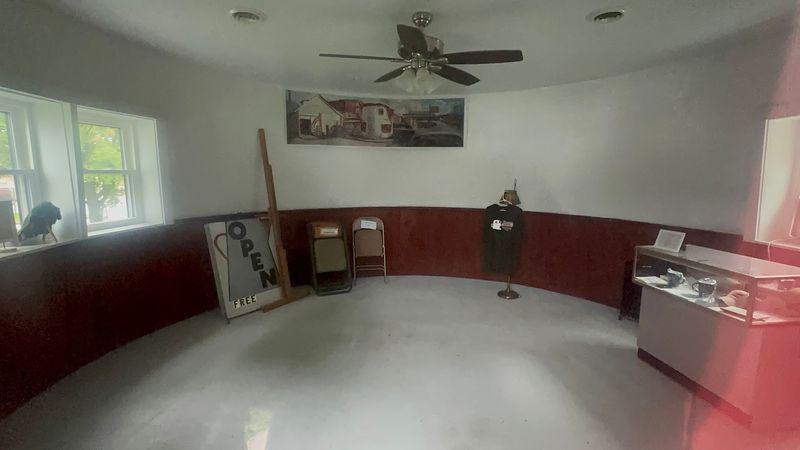
The door was locked when I visited, which is the usual situation. That is worth knowing before you drive out of your way expecting a tour.
These days the interior functions as a small museum space with artifacts and information connected to the Bedford Fair. It opens occasionally during fairground events, with the annual Bedford Fall Foliage Festival in October being the most reliable opportunity.
Even locked, you can peer through the windows and get a decent sense of the space. Visitors often mention a mural painted on the back wall opposite the door, which is easy to miss if you only glance in quickly.
I pressed my face to the glass like a kid outside a candy store and felt zero shame about it. The inside is smaller than the exterior suggests, since the walls are thick and the shape curves inward as it rises.
If seeing the interior matters to you, timing your visit around October gives the best odds. Otherwise, treat the outside as the main event and consider any glimpse inside a bonus.
Honestly, most people who stop here are satisfied within fifteen minutes. It is a leg-stretch landmark, not an afternoon activity, and that is perfectly fine.
Getting the Photo Everyone Comes For
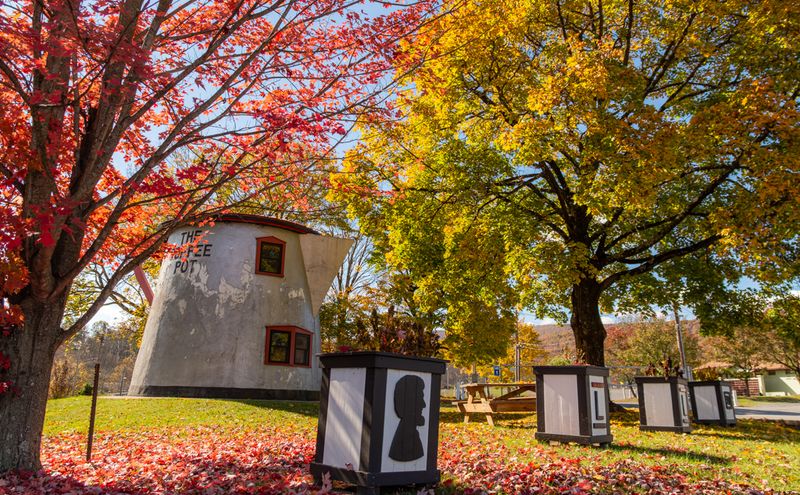
Photography is the number one reason people pull over here, and the structure cooperates beautifully. Its shape is instantly readable from almost any angle.
Morning and late afternoon light work best, since midday sun flattens the curves and washes out the color. I shot in the late afternoon and got long shadows stretching across the grass that gave the whole scene more depth.
For scale, put a person in the frame. The Coffee Pot photographs deceptively small on its own, and standing someone beside the base immediately communicates how tall 18 feet really is.
The informational sign nearby is worth including in at least one shot too. It provides context for anyone you show the pictures to later, and it saves you from explaining the whole story every time.
A wide lens or the wide setting on a phone helps if you want the full pot plus some sky. Backing up too far pulls the road into the frame, which is not necessarily bad since it emphasizes the roadside setting.
Watch your footing near the road edge while lining up shots. Traffic is not heavy, but drivers here are not expecting people standing in the grass with cameras raised.
Wilder Ideas for What Comes Next
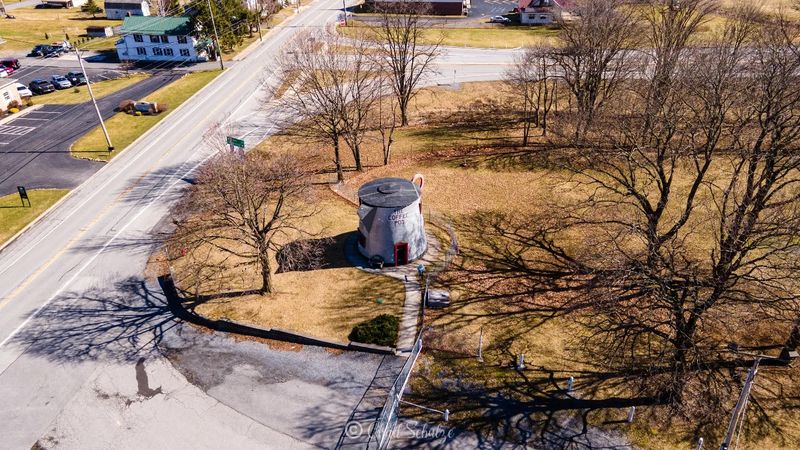
Let me indulge in some daydreaming, because plenty of visitors do the same. What if the Coffee Pot opened again?
The most common wish I encountered involves ice cream. Given that the original luncheonette served exactly that, reviving it would be historically accurate rather than gimmicky.
Souvenirs come up frequently too. Several travelers mentioned wanting magnets, postcards, or small keepsakes to mark the stop, comparing it to other novelty landmarks that operate little shops.
Now for a genuinely wild thought. Imagine the world’s largest coffee tasting held in its shadow, one cup poured for every thousand the pot could theoretically hold.
Or picture the interior fitted with a rotating exhibit of miniature roadside buildings from across America, a tiny museum inside a giant object. There is something delightfully recursive about that.
Realistically, the museum function it currently serves fits the space and the volunteers who maintain it. Big dreams need big budgets, and this landmark survives on grants and goodwill.
Still, dreaming costs nothing while you stand in the grass beside it. If you visit, bring your own coffee, raise the cup toward the spout, and enjoy the small absurdity of the moment.
Address: 714 W Pitt St, Bedford, PA 15522
