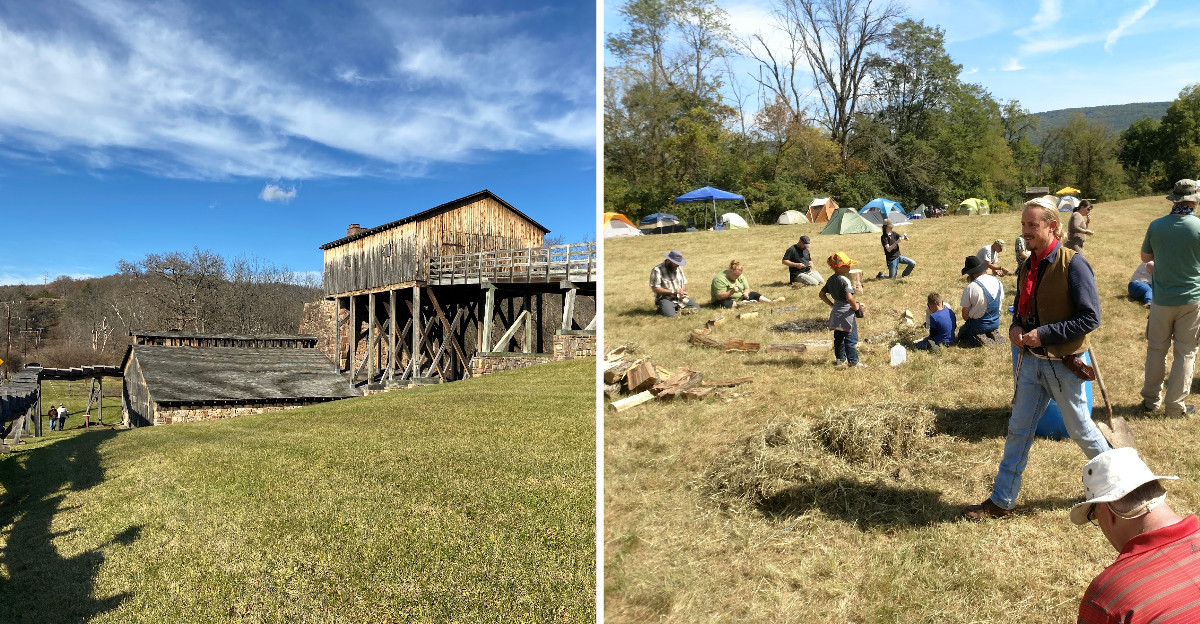
Stone buildings lining a quiet road look like they have been waiting for someone to notice them. Wandering down a quiet road in Pennsylvania led to a place where iron was made for well over a century using charcoal, water power, and human muscle.
What surprises most is how much is still standing: a towering stone furnace stack, a waterwheel, a fifteen-room mansion, and little log homes where workers and their families lived. Poking at chunks of glassy black slag in the grass with a paper brochure in hand feels like collecting treasure.
The views across the valley are worth the drive on their own. Sitting at a picnic table stretched the visit longer than planned.
History you can walk through rather than just read about is rare, and this small site punches way above its size.
The 1810 Start of an Iron Empire
Two names started it all back in 1810: Roland Curtin and Moses Boggs, business partners who saw opportunity in the ore-rich hills of Centre County. By 1815 Curtin had bought out Boggs’ share, and the family name stuck to this valley for generations.
What floored me while reading the plaques was the sheer length of the run. The Curtins kept iron production going here for 107 years, and the site produced iron from 1810 all the way until 1921.
That is 112 years of operation, which makes Eagle Iron Works the last surviving charcoal-fueled iron furnace in Pennsylvania and one of the final cold-blast charcoal iron operations anywhere in the United States.
It earned a spot on the National Register of Historic Places in 1971, which is part of why so much of it still stands today.
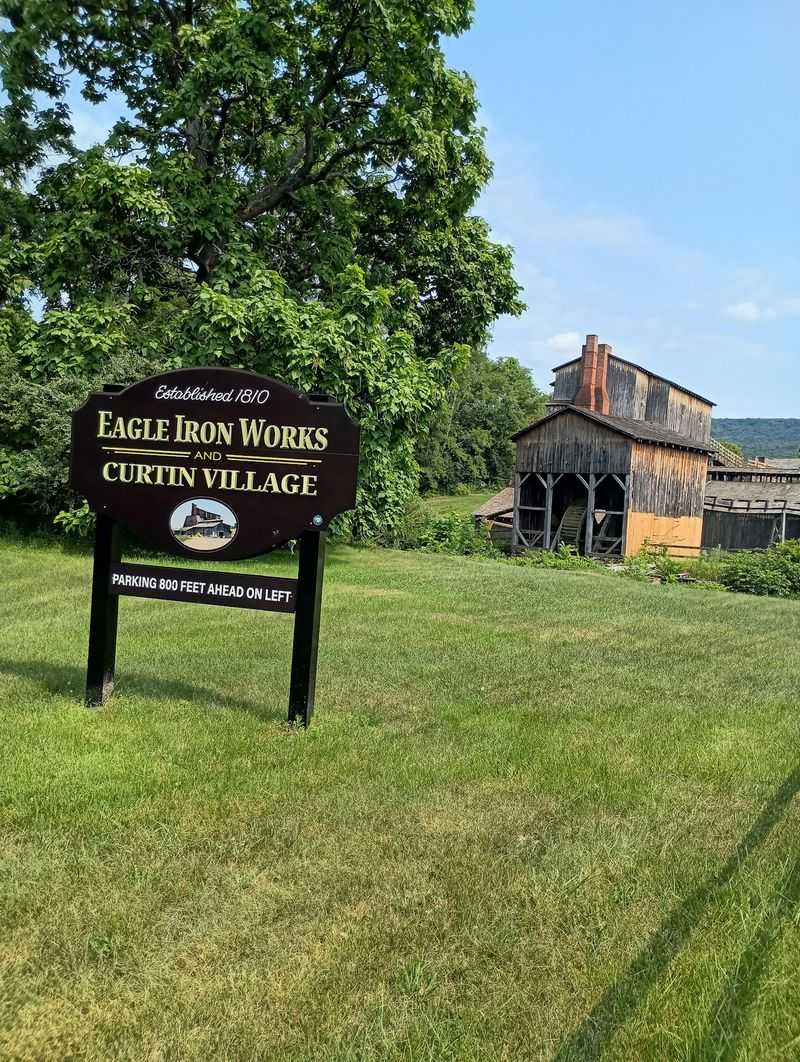
I like starting a visit right here, near the entrance signage, because the dates give everything else context. Once you understand that families worked, ate, and raised children in this valley for over a century, the mansion and the cabins stop feeling like props and start feeling like somebody’s actual neighborhood.
Pleasant Furnace and Its Massive Stone Stack
The stone stack is the thing you see first, and it is bigger in person than any photo suggests. The original Eagle Furnace went up in 1818, and it was later replaced by the Pleasant Furnace in 1848, which is the structure visitors walk around today.
Fire ended its working life in 1921, closing the book on iron making here.
Standing beside those thick stone walls, I kept thinking about heat. Local iron ore, limestone, and charcoal were layered in from above, and the whole thing had to reach temperatures hot enough to melt rock into flowing metal.
Because it was a cold-blast furnace, the air pumped in was not preheated, which made the process even more demanding and the ironmaster’s skill even more important.
Small details are what sold me: the arched openings, the soot-darkened stone, the sense that something enormous used to roar inside.
Bring a phone or camera, because the angles around the stack are genuinely great, especially in late afternoon when shadows stretch across the masonry and the hills behind turn gold.
Waterwheel, Flume, and the Blast House
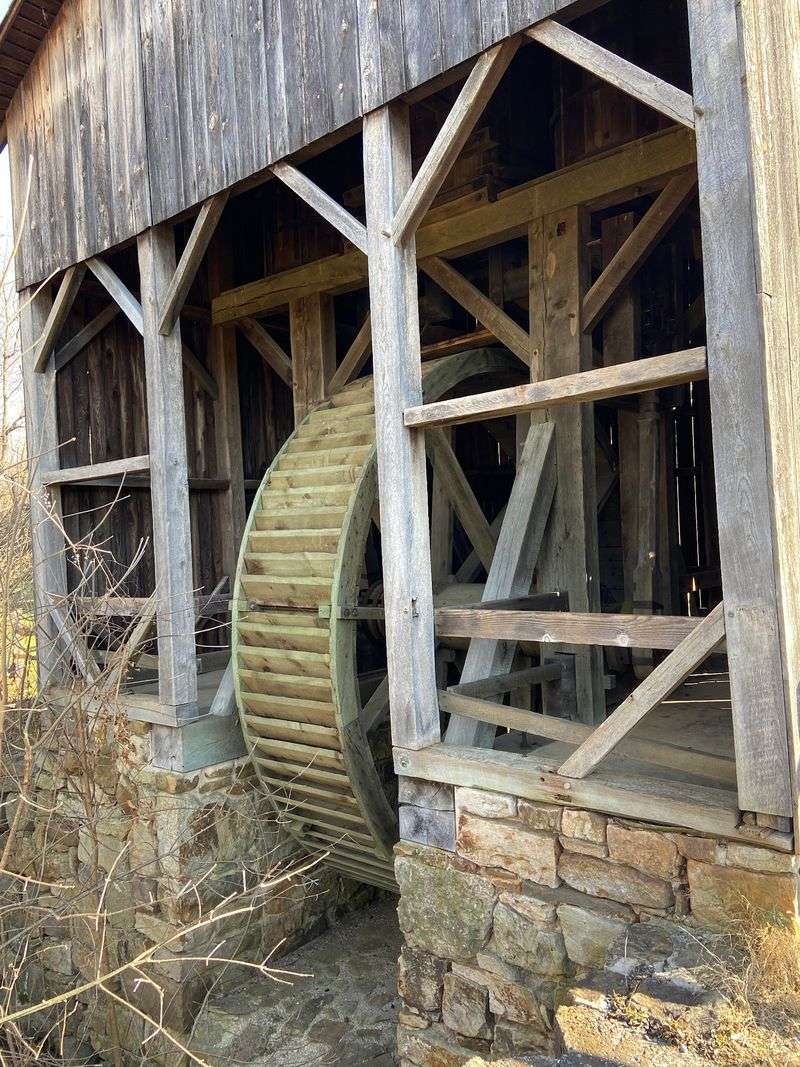
My favorite structure on the whole site is not the mansion. It is the big wooden overshot waterwheel tucked beside the blast house, connected to a long wooden flume that once carried water in from the creek.
Water hit the wheel, the wheel turned, and bellows pushed air into the furnace so the fire could reach smelting temperature.
No electricity, no engines, just gravity and clever carpentry doing industrial work.
The restored complex around it includes a charging house up top, casting rooms where molten iron was poured into molds, and a tapping shed where the metal was drawn off.
Reading the interpretive plaques in order helped me follow the whole sequence, from raw ore to finished pig iron, and honestly it made me appreciate how brutal the labor must have been.
One review I saw mentioned the plaques specifically, and I agree they carry the tour when no guide is around.
Give yourself time here. Peek under the timber frames, look at the joinery, and notice how the flume follows the land’s natural slope rather than fighting it.
Inside the Curtin Family Mansion
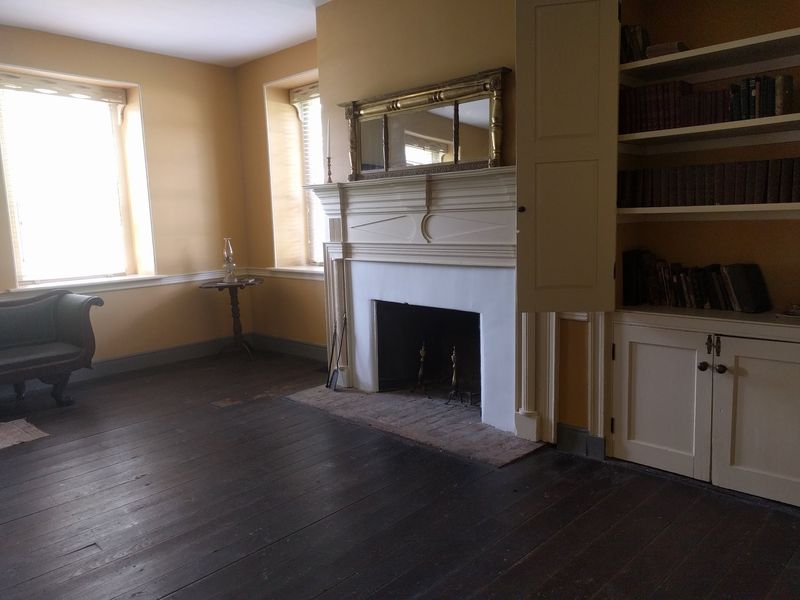
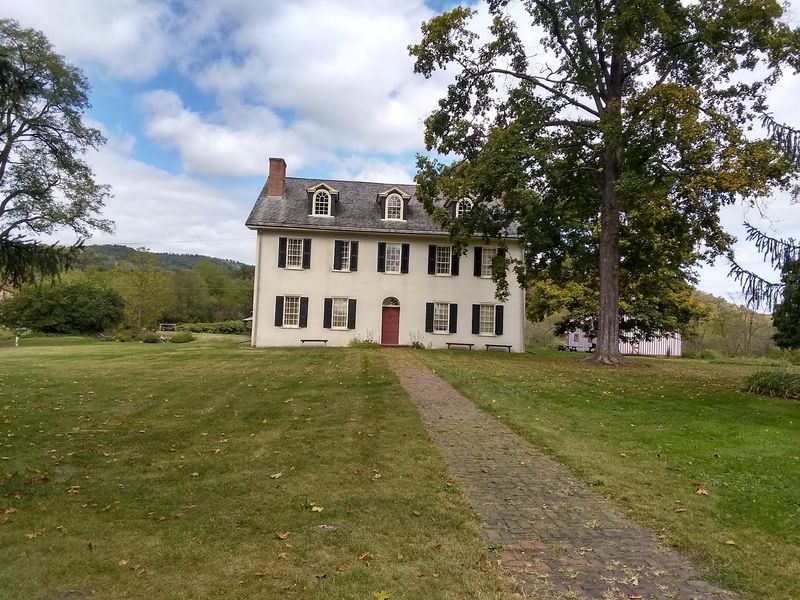
Roland Curtin built his home between 1830 and 1831, and it is the kind of house that quietly shows off. Federal in style, built from native field stone, with walls a full two feet thick.
Fifteen rooms total, ten of them furnished with period antiques and open to visitors.
I counted fireplaces as I went, because there are ten of them and all are still operable. The original woodwork, flooring, and hardware survived too, which is rare in a house this old.
During the 1970s it was restored to look the way it did in the 1850s, so what you see reflects the mansion at the height of the family’s iron-making years.
Curtins lived here continuously from 1830 until the early 1950s, which explains the lived-in feeling rather than a museum stiffness.
House tours run by appointment or during guided tour days, so plan ahead if interiors are your priority.
If you have kids, the furnishings and the sheer scale of the rooms tend to hold their attention better than you would expect.
The Governor Who Was Born Here
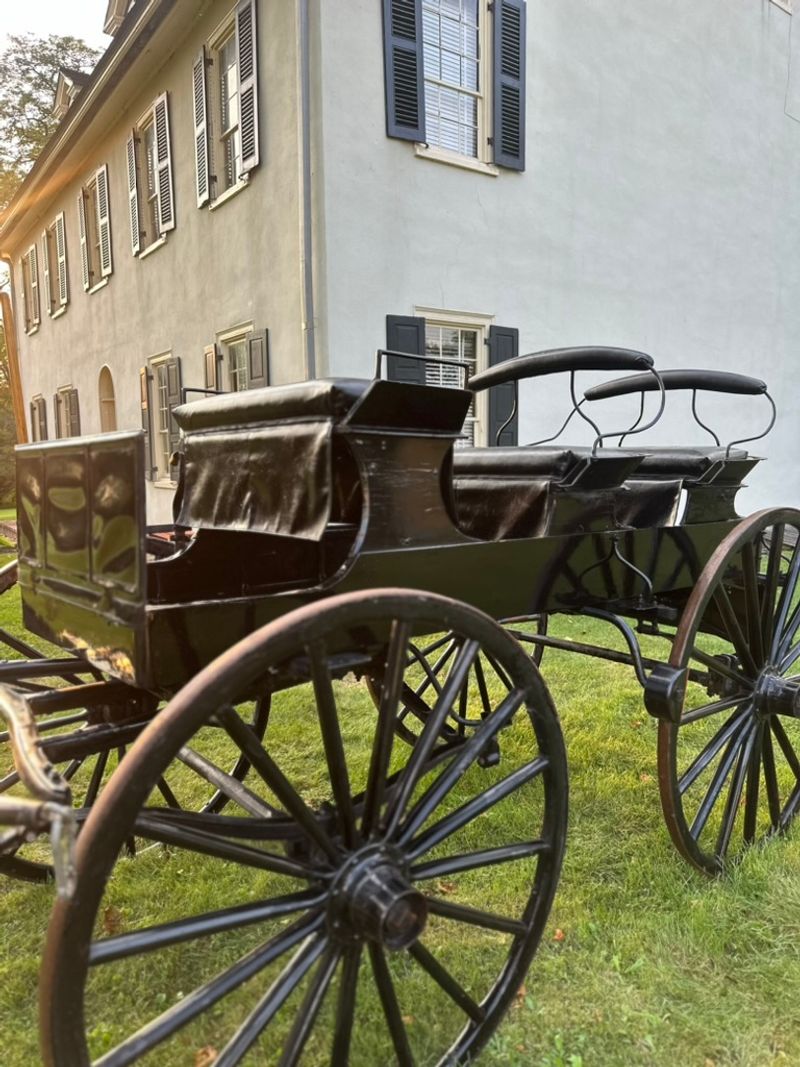
Here is the detail that made me pause mid-tour: Pennsylvania’s Civil War governor grew up in this house. Andrew Gregg Curtin, son of Roland, was born at the mansion, and his personal carriage is displayed on site.
Seeing an actual carriage that belonged to a wartime governor, parked a short walk from the furnace where the family fortune was made, connects two very different stories.
One is industrial, all charcoal and sweat. The other is political, playing out in Harrisburg and Washington during the 1860s.
A volunteer review I came across pointed out something fun: Penn State students walk down a campus road named Curtin without realizing it honors this family. That kind of small-world trivia sticks with you.
When you look at the carriage, notice the craftsmanship in the wheels and the upholstery, because these vehicles were built by hand to last decades.
It is a good reminder that iron villages were not isolated backwaters. Money and influence flowed out of places like this one, shaping decisions far beyond Centre County.
Workers’ Cabins Around the Village Green
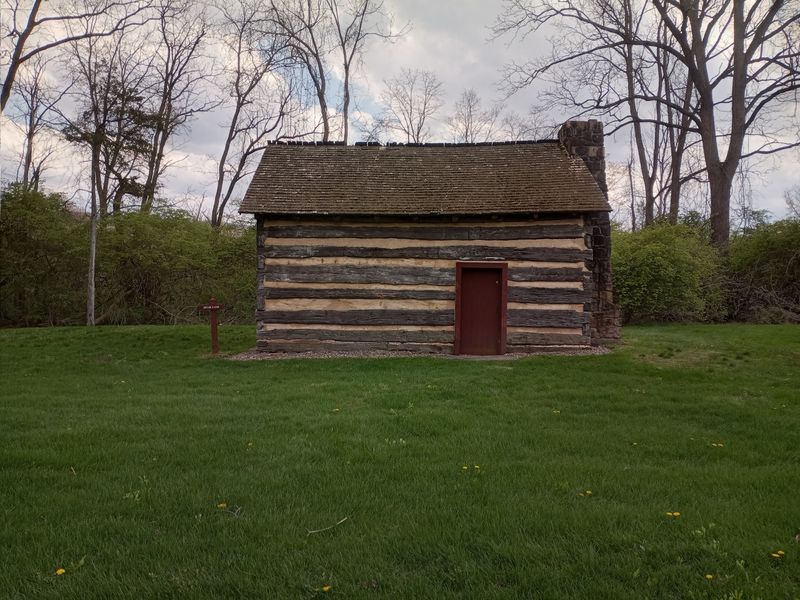
Behind the grand house sits the part of the site I found most moving. Workers at Eagle Iron Works lived in company housing, often single-family log cabins, arranged around a shared open space known as the village green.
By the middle of the 1800s, this self-sufficient iron plantation included more than 60 structures.
One log cabin has been carefully restored to show how it looked around 1825, and stepping close to it gives you a real sense of scale. These were small, snug homes with a stone chimney and not much extra room.
Families lived their whole lives within a short walk of the furnace fires.
Restoration work on the workers’ village has picked up in recent years, so more of the residential side of the story keeps coming into view.
Take the loop slowly. The contrast between the two-foot stone walls of the mansion and the chinked logs of a laborer’s cabin says more about 19th century life than any textbook chapter I have read.
A Town That Supplied Itself
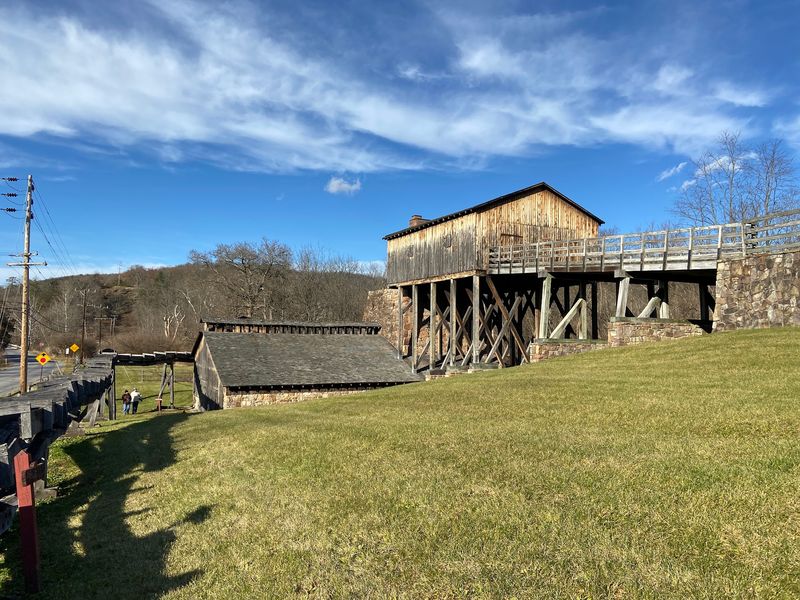
Something clicked for me when I learned this valley functioned as its own little town. Along with houses, the village historically had a company store, a gristmill, and a school.
Workers could buy goods, grind grain, and send their children to lessons without ever leaving the property.
That setup is exactly what historians mean by an iron plantation. Everything the operation needed was produced or provided close by, from charcoal burned in the surrounding woods to ore dug from nearby ground.
Limestone came from local sources too, which cut down on hauling costs in an era before trucks.
Walking the grounds, I kept trying to picture the noise. Wagons, hammers, livestock, kids, and the constant rumble of the furnace all layered together in one narrow valley.
The quiet you get today is a complete reversal, and it makes the site feel almost meditative.
If you enjoy geocaching, the Centre County GeoTour has brought plenty of visitors here, which is a nice excuse to explore corners of the property you might otherwise skip.
Self-Guided Wandering and Slag Hunting
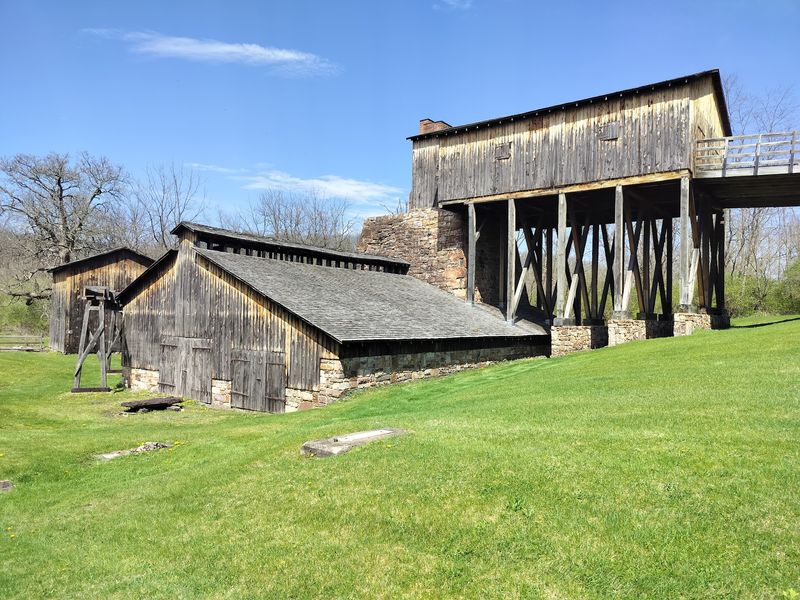
Grab a brochure and you are set. The grounds are open year-round from dawn to dusk for self-guided touring, which means you can show up early on a weekday morning and have the place nearly to yourself.
I did exactly that and it was blissfully quiet.
Signage does a solid job explaining the iron-making process step by step, so nobody needs a guide to follow the story. There are picnic tables too, positioned with views across the valley that I genuinely did not want to leave.
One longtime volunteer mentioned going slag hunting on every visit, and now I understand why. Slag is the glassy leftover waste from smelting, and small dark pieces still turn up in the grass as physical proof of what happened here.
Wear shoes you do not mind getting dusty, since paths are grass and gravel rather than pavement. Autumn is spectacular for color, and sunsets over the ridges are the kind you stop and watch without talking.
Guided Tours, Events, and Planning Your Visit
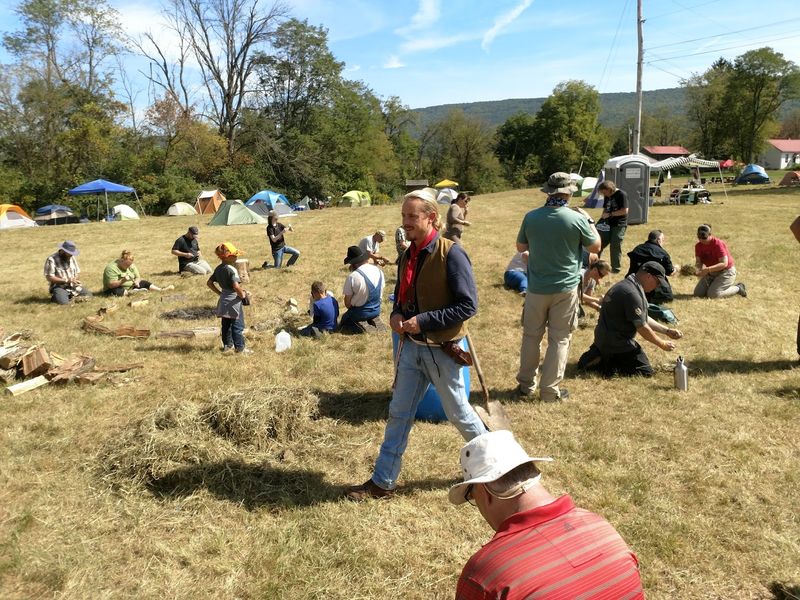
Timing matters if you want the full experience. Guided tours run on the second and fourth Sundays of each month from June through September, starting at 2 PM and lasting roughly 75 to 90 minutes.
Volunteers often dress in period clothing and cover iron making, mansion architecture, Curtin family history, and everyday worker life.
Visitors consistently praise these guides, and after reading about a homeschool group’s field trip here, I would say families get the most out of a led tour.
Seasonal events fill the calendar too, including Heritage Days and a holiday celebration when the mansion gets decorated.
Ownership sits with the Pennsylvania Historical and Museum Commission, while the Roland Curtin Foundation operates the site and recently took ownership of the village itself.
Weekend hours are generally Saturday 10 am to 4 pm and Sunday 11 am to 5 pm, with the site closed midweek, so call ahead at 814-355-1982 before driving out. Off-season means grounds only.
Address: 251 Curtin Village Road, Howard, PA 16841
