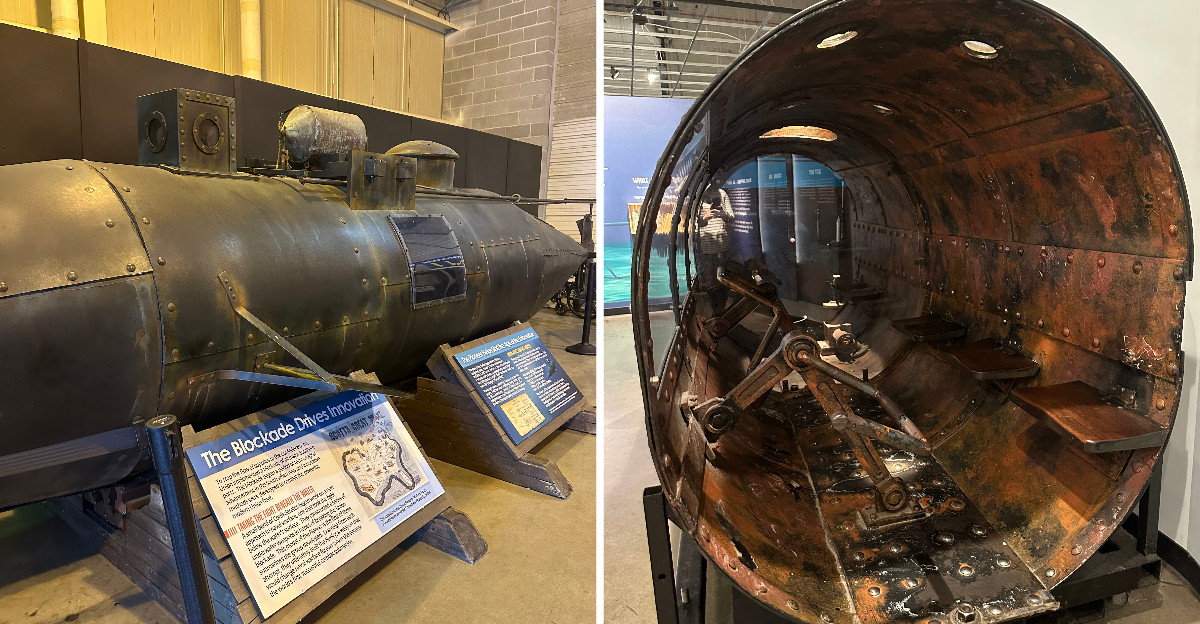
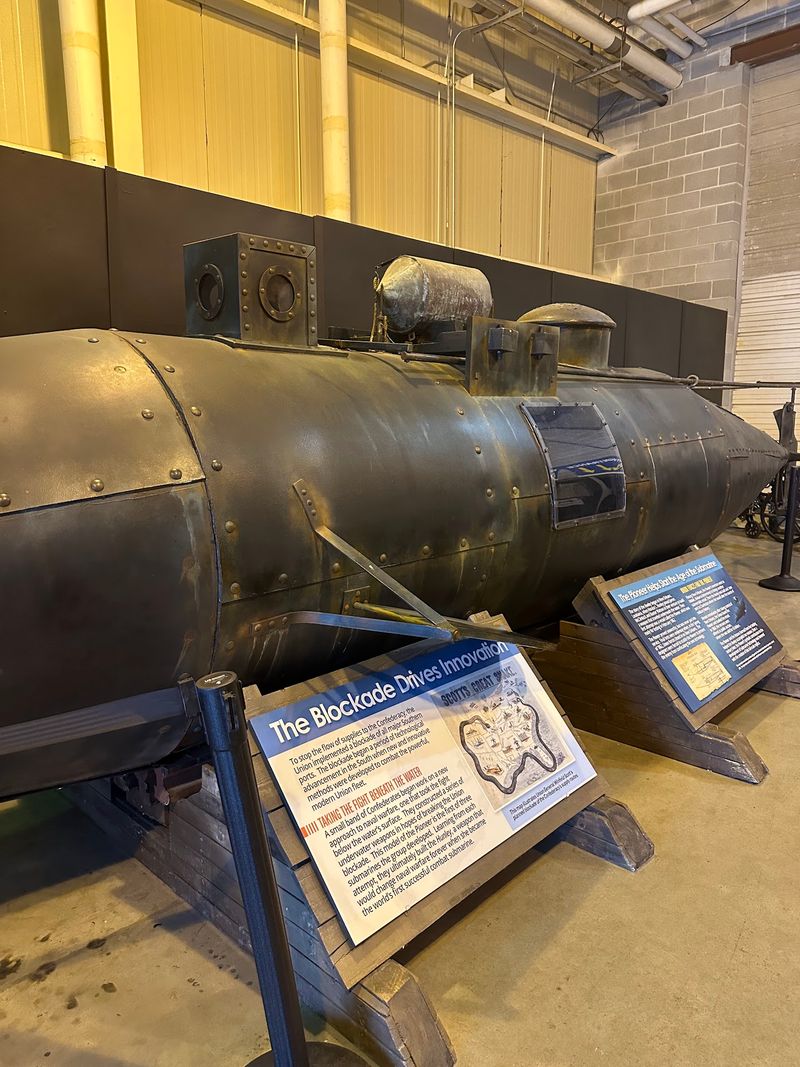
Real Civil War submarines are not supposed to float in tanks of treated water, yet one does, still being cleaned inch by inch by scientists who have been at it for years. The tank is enormous, and the submarine rests inside it like a sleeping creature.
The conservation center sits in a quiet old Navy yard, and on the outside it gives almost nothing away. Fifteen minutes north of a South Carolina city, the surprise is total.
What waits inside is a vessel that sank a warship in February 1864, then vanished with its whole crew, and nobody found it until 1995. In August 2000 it finally came up off the seafloor, 136 years after the night it disappeared.
Three hours disappeared while staring through the glass, thinking about eight men who never made it home. Plenty of museums exist in the state, but few places make history feel this close to your own hands.
An Iron Boiler That Became a Submarine
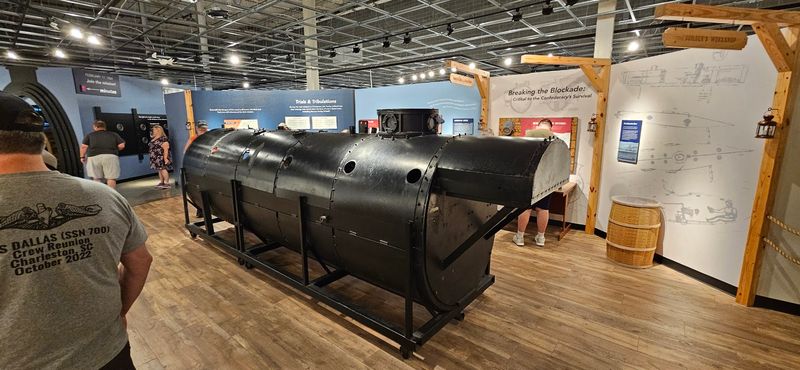
What surprised me most was how humble the beginnings were. The Hunley started life as a modified iron boiler, reworked in Mobile, Alabama, during the American Civil War.
Measurements at the center put the finished vessel at roughly 39.5 to 40 feet long and barely four feet tall. That number stopped me cold.
Four feet means no standing, no stretching, no easy way to turn around once you were inside.
Seven men sat shoulder to shoulder along a hand-cranked shaft that turned the propeller, while an eighth man piloted and steered from the forward conning tower. There was no engine, no motor, no help from anything but muscle and nerve.
Its only weapon was a spar torpedo, a charge of black powder somewhere between 90 and 135 pounds, fixed to the end of a long pole jutting from the bow. The idea was simple and terrifying.
Drive the pole into an enemy hull and set off the charge.
Reading the construction panels here changed how I think about 1860s engineering. People often picture the era as slow and clumsy, yet this was genuinely experimental technology, built fast and under pressure.
I left that first gallery with a strange mix of admiration and unease, which honestly sets the tone for the whole visit.
Charleston Under Blockade and the Gamble That Followed
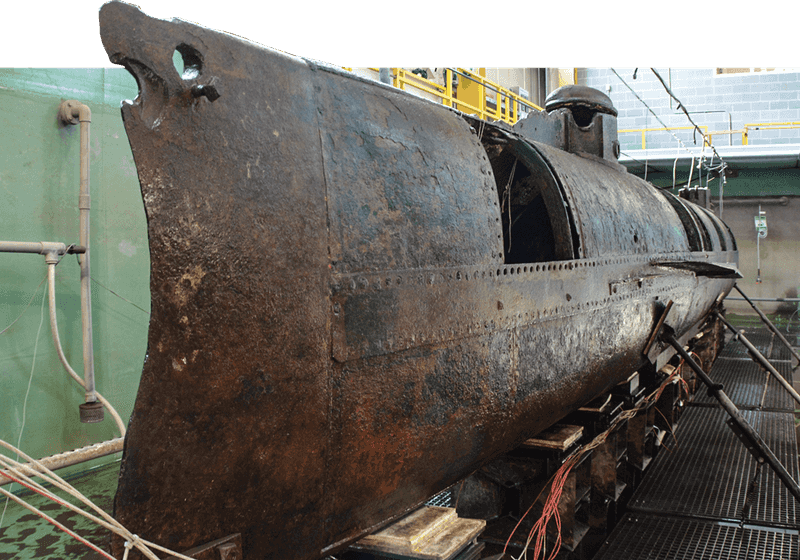
The exhibit panels about Charleston pulled the story out of the water and put it back on land, which I appreciated. The city spent much of the war ringed by Union warships, and that blockade choked off shipping and supplies.
Desperation breeds strange inventions. The Hunley was shipped by rail from Alabama to Charleston with one job, to break that ring of ships from underneath.
What the museum does not soften is the cost before the famous night. The submarine sank twice during trials, taking away crew members both times, including Horace L.
Hunley himself, the man who financed the project and gave it his name.
I stood in front of that section for a while. Two sinkings, real funerals, and men still volunteered to climb back in and crank.
Docents here explain those earlier accidents carefully, not as trivia but as context for what came next. The vessel was raised, cleaned, and crewed again, which says something about how badly the blockade was hurting the city.
Knowing Charleston and South Carolina geography helps too. The harbor you can visit today, with its ferries and pleasure boats, is the same stretch of water where all this played out in the cold dark.
That overlap between then and now stuck with me all afternoon.
February 17, 1864, The Night Everything Changed
A short film inside the museum walks you through the attack, and the room goes very quiet while it plays. On the night of February 17, 1864, Lieutenant George E.
Dixon took the Hunley out toward the USS Housatonic, a 1,240-ton Union sloop-of-war anchored off Charleston.
The spar torpedo struck the warship’s hull and detonated. Housatonic went down in minutes.
With that single strike the Hunley became the first submarine in history to sink an enemy ship in combat, a fact that still shapes naval history books today. Signals were reportedly exchanged toward shore after the attack, suggesting the crew survived the blast itself.
Then nothing. The submarine never came home, and eight men disappeared along with it.
I had read about the sinking before visiting, but hearing it laid out in the same building where the actual vessel sits changes the weight of it. Victory and disappearance happened within the same hour.
The museum handles that moment without theatrics, which I think is the right call. No dramatic reenactments, just dates, distances, and what the evidence supports.
Watching the film, I kept thinking about how ordinary the harbor looks on a calm morning today. Same water, completely different night.
A Century of Searching, Then a 2000 Lift
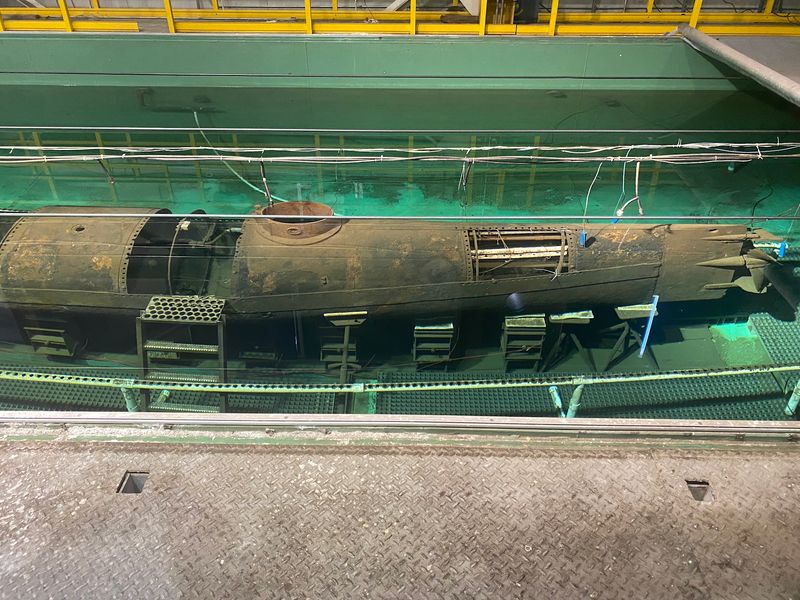
Ask anyone in Charleston about the day the submarine came up and you will usually get a story about watching it on television. The recovery is almost as famous locally as the attack itself.
Decades of searching turned up nothing. Expeditions came and went, theories piled up, and the wreck stayed hidden under sand offshore.
The breakthrough came in 1995, when the National Underwater and Marine Agency, led by author Clive Cussler, located the submarine on the seafloor. News of the find traveled worldwide almost overnight.
Raising it was another problem entirely. The hull was fragile, filled with sediment, and had spent well over a century in saltwater, so engineers designed a custom truss and sling system to cradle it rather than grab it.
On August 8, 2000, the Hunley broke the surface for the first time in 136 years. Photos and video of that lift play in the museum, and honestly they hit harder than I expected.
One detail I liked learning: the sediment packed inside actually helped protect the contents, sealing artifacts and remains in place like a time capsule.
Standing near the tank afterward, knowing this object had been underwater longer than most countries have had cars, gave the whole visit a different scale.
Theories About What Went Wrong Down There
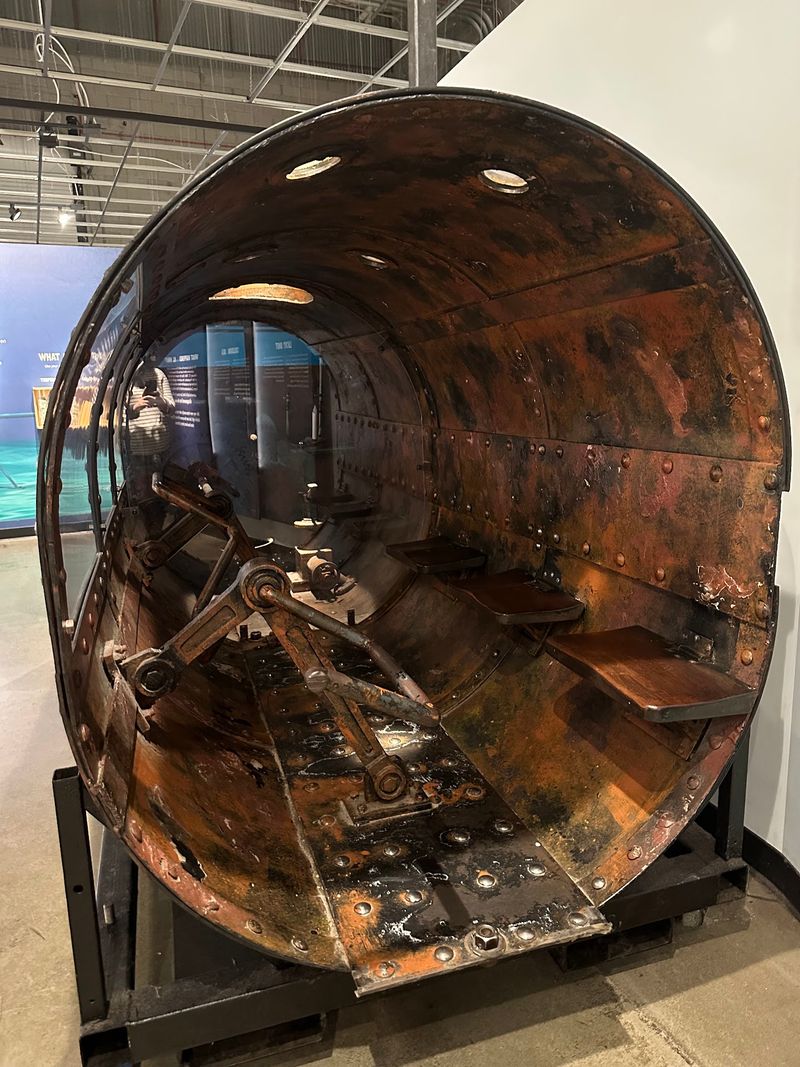
Here is the part that turns a history museum into a detective story. Nobody knows for certain why the Hunley sank after its successful attack, and researchers at the center are still working on it.
The leading idea is often called the shockwave theory. Studies suggest the submarine sat perhaps 20 feet from its own torpedo when it went off, close enough that the underwater blast wave could have traveled through the hull and injured the crew badly.
Supporting that idea is a haunting detail from the excavation. All eight men were found at their stations, with no sign anyone tried to reach a hatch or escape.
Other explanations get a fair hearing too. A lucky shot theory proposes small arms fire from Housatonic’s defenders struck a weak point such as a conning tower viewport, letting water in.
There is also the possibility of a collision, the trapped by tides theory where the crew rested on the bottom and ran short of air, and the swamped by wake idea, where an open hatch let a passing wave flood the low vessel.
I enjoyed how the docents present these as competing evidence rather than settled fact. It felt less like being lectured and more like being handed the case file.
Dixon’s Gold Coin and Other Small Treasures
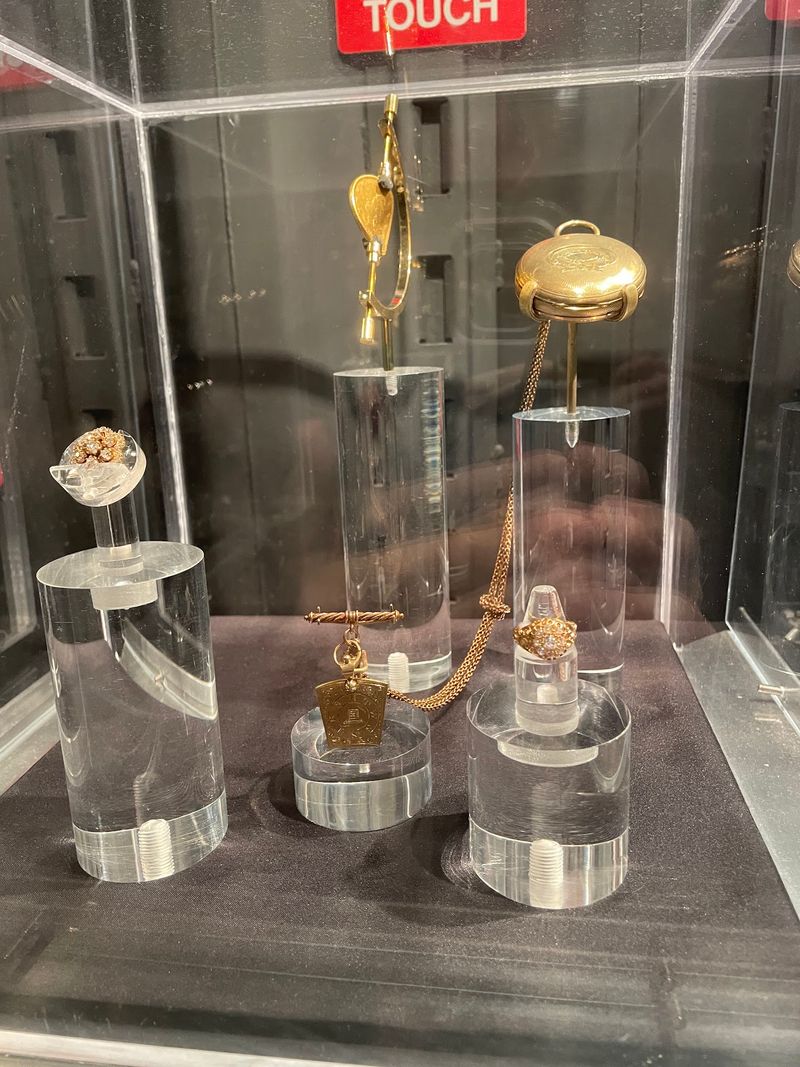
Small objects can hit harder than big ones, and this museum proves it. Before you reach the submarine itself, you pass cases holding what was recovered from inside the hull.
The star is a gold coin carried by Lieutenant George E. Dixon, famously credited with deflecting a bullet at the Battle of Shiloh and saving his life.
Seeing the damaged surface up close, years after reading about it, was a genuine moment for me.
Around it sit everyday things. Buttons, suspender hardware, a knife, binoculars, items that belonged to men who had no idea they were making history.
Facial reconstructions of the crew are displayed as well, built from skeletal evidence, and they give faces to names that were once just a list. I found myself lingering there longer than anywhere else.
The story reached a proper ending in 2004, when the remains of all eight crew members were buried in a public funeral at Magnolia Cemetery after extensive identification work. Plenty of visitors, myself included, drive over afterward to see the graves.
Staff at the front desk will happily give directions and a few tips for that stop.
Between the artifacts and the burial site, the submarine stops being a machine and becomes a crew.
Planning Your Visit to the Warren Lasch Conservation Center
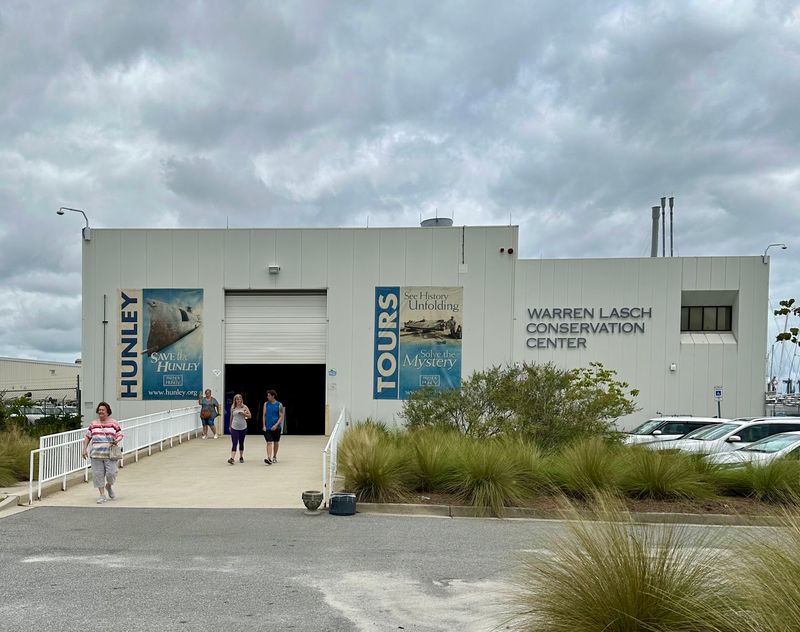
Practical stuff matters here, because this is not a drop-in-anytime kind of place. The center opens to the public on weekends only, Saturday from 10 am to 5 pm and Sunday from 10 am to 3 pm, so plan around that before you head north from downtown.
Getting there took me roughly fifteen minutes from the peninsula, and parking was free and easy.
Arriving right at opening is smart advice I would repeat to anyone. Presentations run throughout the day, and the docents who give them are the reason this museum punches above its size.
The submarine sits in a 75,000-gallon tank filled with a sodium hydroxide solution that slowly pulls salt and chlorides out of the iron. You view it from a raised platform behind glass, which does limit the angle, so manage expectations there.
Hands-on displays make it worthwhile for kids. There are crank replicas to turn and a partial full-size model you can climb into to feel how tight and dark it really was.
Give yourself a couple of hours inside, more if you add the cemetery trip.
Address: 1250 Supply Street, North Charleston, South Carolina 29405
