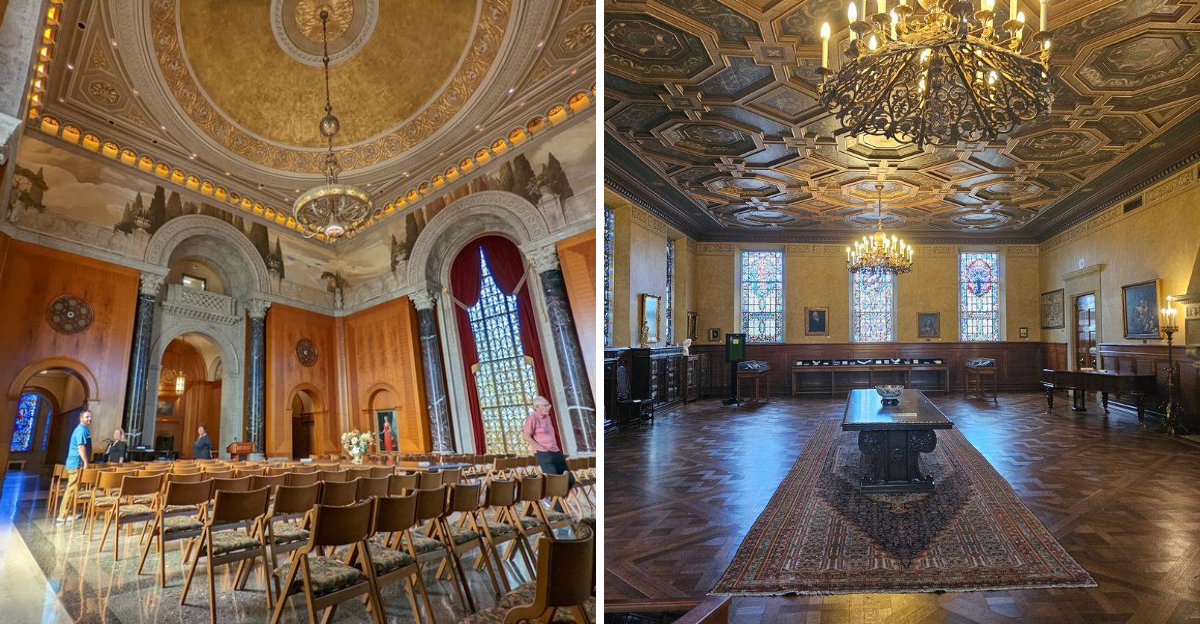
Libraries are not usually where you expect marble columns, enormous bronze doors, elaborate ceilings, and 62 stained-glass windows to start showing off.
This Texas building was created to house the world’s largest collection of materials connected to poets Robert and Elizabeth Barrett Browning, but the architecture has become an attraction in its own right.
The three-story Italian Renaissance-style structure took years of craftsmanship and includes limestone walls, walnut paneling, terrazzo floors, decorative motifs, and enough visual detail to make quietly staring at the ceiling feel completely reasonable.
Even the entrance doors weigh three-quarters of a ton each and were inspired by famous Renaissance doors in Florence.
Texas has plenty of beautiful libraries, but this one seems determined to make returning a book feel unnecessarily grand.
The Limestone Exterior That Fools Everyone
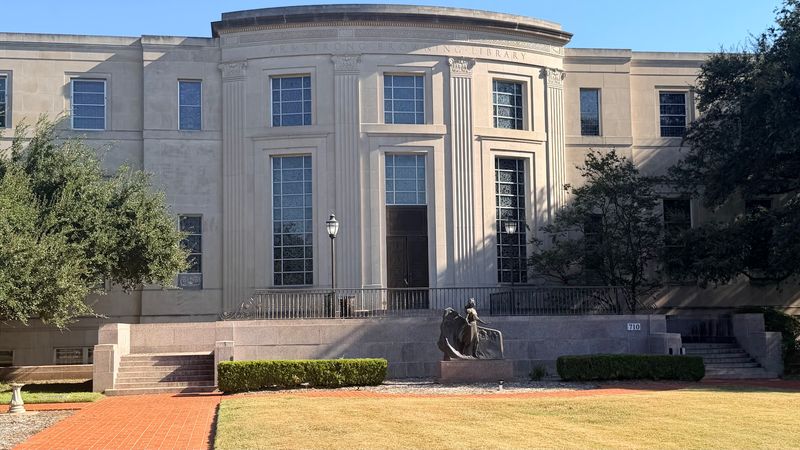
My first reaction outside was to check the address twice. Nothing about the building suggests a campus library.
Three stories of Indiana limestone rise behind a granite terrace, with wide steps that practically invite a slow, dramatic walk upward. The style is Italian Renaissance, though plenty of visitors describe it as Spanish palace energy, and both descriptions land somewhere close to the truth.
Symmetry does a lot of the work here. Arched openings, carved detailing, and a pale stone surface that shifts color as the sun moves across it throughout the day.
Late afternoon is the sweet spot for photos, when the limestone warms to a soft honey tone and shadows sharpen every carved edge. Morning light works too, just cooler and cleaner.
A bronze statue of Pippa stands on the front terrace, drawn from Robert Browning’s poem Pippa Passes. Small figure, big presence, and an easy landmark for meeting friends.
Baylor University surrounds the building, so the walk over usually includes shaded sidewalks and student traffic. Parking nearby fills up during class hours, which is worth planning around.
Something about approaching on foot makes the reveal better. The structure grows taller with each step, and the scale only registers once the steps are underfoot.
Budget a few minutes outside before heading in. Once those doors open, attention shifts entirely indoors, and the exterior deserves its own quiet moment first.
Bronze Doors Modeled After A Florence Masterpiece
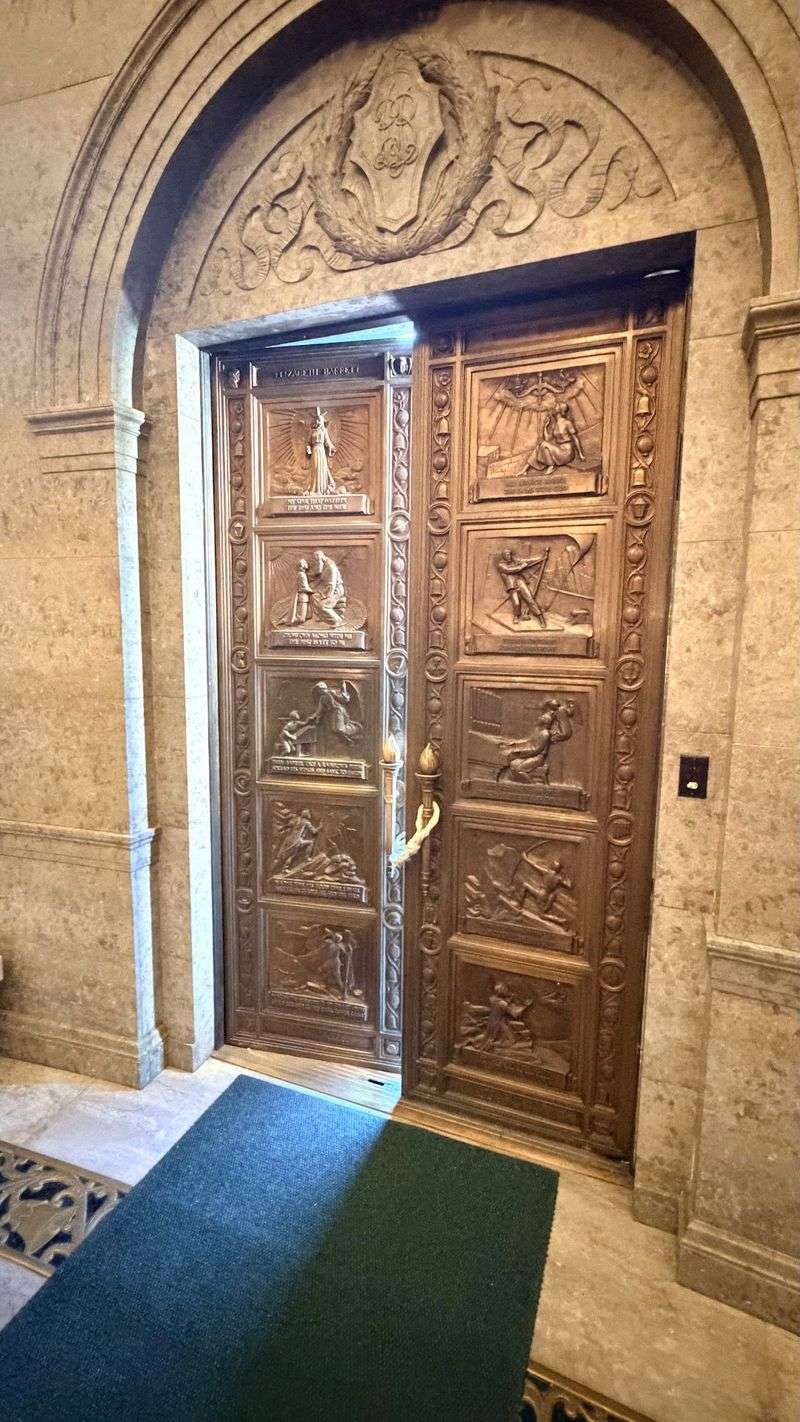
Three-quarters of a ton. Each door.
That weight fact stopped me cold, mostly because the doors swing with far less drama than the number suggests. Solid bronze, and modeled after Ghiberti’s fifteenth-century baptistry doors in Florence, which explains the sculptural richness packed into every square inch.
Ten bas-relief panels cover the surface, each one drawn from themes in Robert Browning’s poems. Faces, figures, and flowing fabric emerge from the metal in shallow relief.
Getting close is the whole point. From a distance the panels read as decorative texture, but a few steps forward reveals tiny hands, folded robes, and expressions that took real patience to shape.
Look for bells and pomegranates while examining the panels. That pairing shows up again and again throughout the building, borrowed from Browning’s poem series of the same name and carrying older religious associations from Exodus.
Once spotted, the motif becomes impossible to unsee. Terrazzo floors, ceilings, stained glass, and yes, these doors.
Photographers should know the entryway light shifts constantly, so a slightly overcast day can actually help by softening the harsh contrast on the metal.
Pausing at the threshold feels natural here. The doors act as a kind of announcement, letting anyone entering know the interior will not be ordinary, and they deliver on that promise almost instantly.
Take the extra minute. Rushing past bronze this good would be a shame.
Sixty-Two Stained Glass Windows Telling Poems In Color
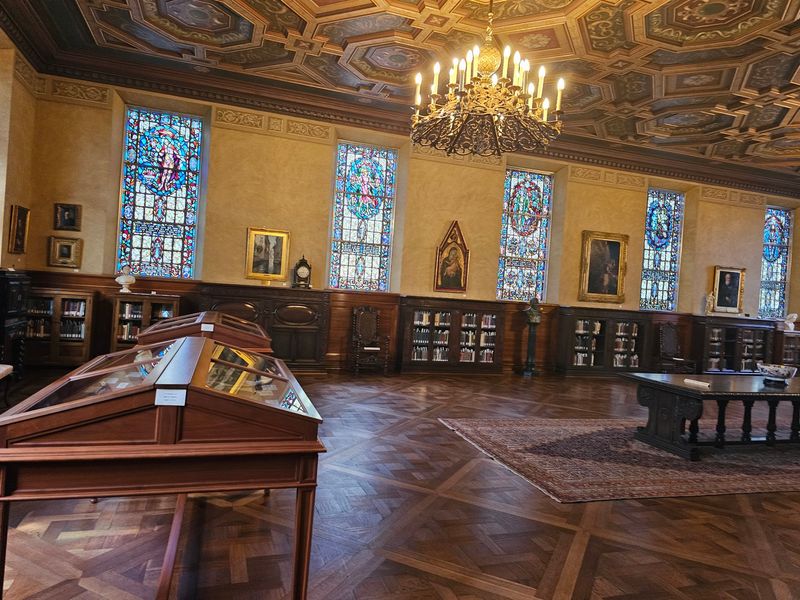
Color hits first, before any of the details register.
Sixty-two stained glass windows fill the building, and together they form what is considered the largest collection of secular stained glass anywhere in the world. Not saints and cathedral scenes, but poems.
Scenes from the works of Robert and Elizabeth Barrett Browning appear across the glass, some illustrating specific verses, others capturing broader themes. A handful depict Italian cities that mattered deeply to the couple, complete with quotations woven into the design.
Three of the windows date to 1924 and originally lived in the Browning Room of Baylor’s former Carroll Library before being moved here. Oldest of the bunch, and still glowing.
Several respected studios contributed over the decades, including Jacoby Studios, Charles J. Connick Associates, Haskins Studio, and Willet Hauser Architectural Glass.
Different hands, different eras, one remarkably cohesive effect.
Timing changes everything with glass like this. Bright midday sun pushes bold color onto the floors and walls, while softer light brings out subtle shading in faces and skies.
My advice is simple. Walk the corridors twice, once quickly and once slowly, because the second pass catches details the first one completely misses.
Reading the accompanying labels helps connect a window to its poem, which turns pretty glass into an actual story. Suddenly a random figure becomes a character with a plot.
Few interiors reward patience this generously.
The McLean Foyer Of Meditation And Its Golden Dome
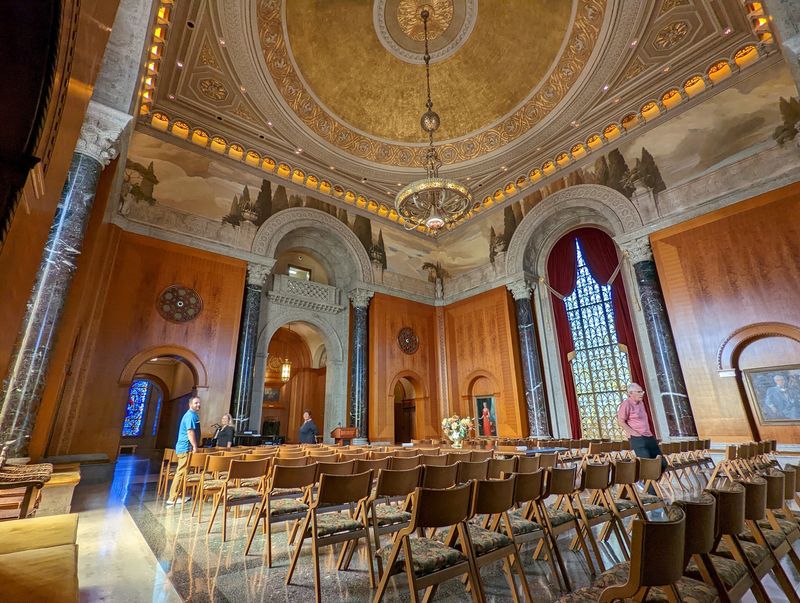
Voices drop automatically in this room. Nobody asks them to.
The McLean Foyer of Meditation sits at the heart of the building, a forty-foot cube crowned by a five-foot recessed dome finished in 23-carat gold leaf. Dr. Armstrong wanted a retreat of compelling beauty, and the design took cues from Leighton House in London.
Three cathedral windows anchor the space, colored to suggest the light of sunrise or sunset depending on where the eye lands. The effect is warm rather than showy.
Harriet Hosmer’s bronze cast of the clasped hands of Robert and Elizabeth Barrett Browning rests inside, a small object with outsized emotional weight. Two hands, one gesture, decades of devotion.
Carved into the wall nearby is a line from Elizabeth’s Sonnet 43, the famous opening about counting the ways of love. Reading it in person hits differently than reading it in a textbook.
Acoustics here are genuinely excellent, which is why the space hosts weddings, recitals, and lectures throughout the year. A single spoken sentence carries beautifully.
Baylor couples treat the foyer as prime engagement territory, and the reasoning becomes obvious after thirty seconds inside.
Sit for a while if a bench is free. The gold ceiling keeps changing as clouds pass outside, and rushing through would waste the best quiet moment the building offers.
Turn the phone to silent first.
Marble, Walnut, And Floors Fit For Versailles
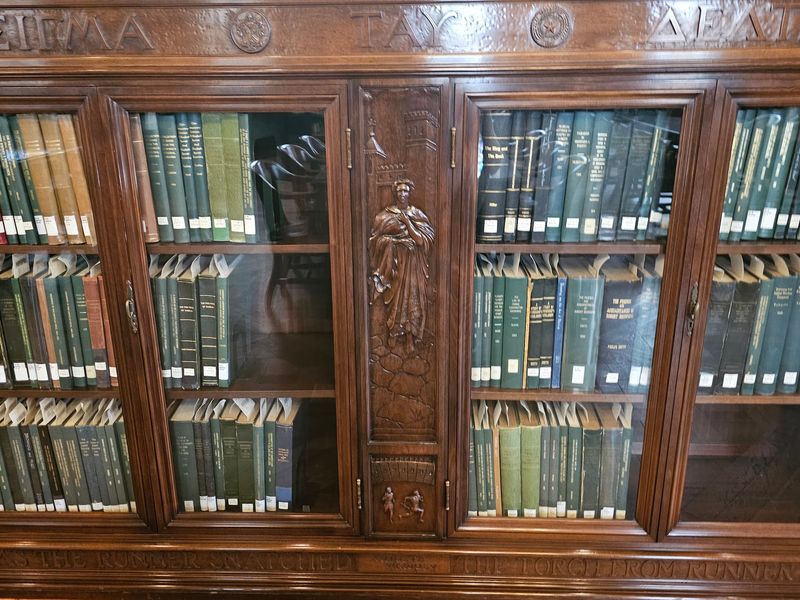
Craftsmanship carries this place as much as the collections do.
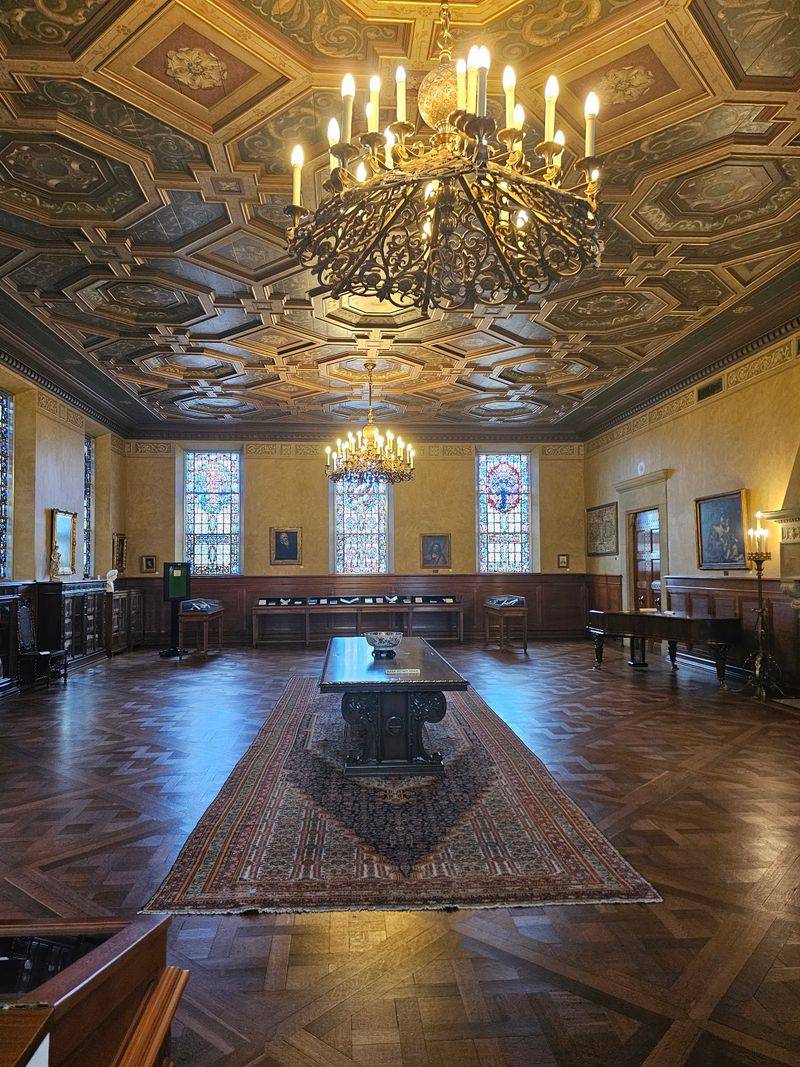
Marble columns climb toward molded ceilings, while black walnut marquetry paneling wraps entire walls in patterned wood so precise it looks machine-made. It was not.
Parquet floors run underfoot, polished to a shine that reflects window light in long streaks. Shoes squeak a little, which somehow adds to the fun.
The Hankamer Treasure Room takes the detailing furthest. Gothic oak floors follow the Marie Antoinette pattern borrowed from the Palace of Versailles, and the hand-painted ceiling above uses an Italian Renaissance style.
Cox Reception Hall offers a different flavor with rich walnut paneling and polished terrazzo underfoot. A 300-piece Wedgwood Collection is displayed here, along with six newer stained glass windows showing Italian scenes tied to the Brownings’ lives.
Total construction cost reached roughly two million dollars, and the building was dedicated on December 3, 1951. That figure explains a great deal about the materials.
Looking down matters as much as looking up in this building. Floor patterns shift from room to room, and the transitions are worth noticing.
Anyone interested in woodworking or architecture should slow way down here. Details like inlay seams and ceiling coffers reveal choices made by people who clearly cared.
Photography is allowed in most areas, though the ceilings challenge phone cameras. Sometimes memory works better than a lens.
Letters, First Editions, And The Brownings’ Own Books
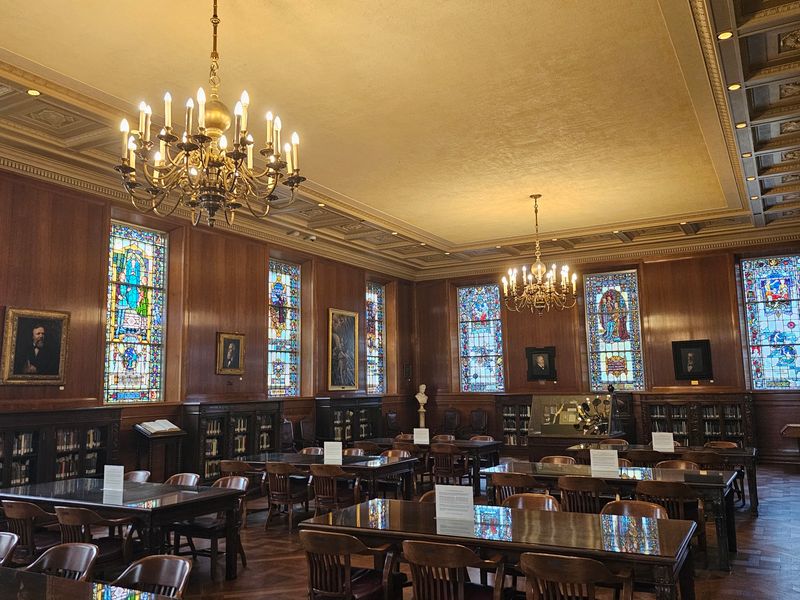
Roughly 2,000 original letters live in this building.
The Armstrong Browning Library holds the world’s largest collection of materials connected to Victorian poets Robert and Elizabeth Barrett Browning. Manuscripts, correspondence, and every first edition of both poets’ works fill the shelves and cases.
Counting broadly, that adds up to more than 27,000 books and around 10,000 manuscripts. None of it circulates, so this is a place to read and study rather than borrow.
About a third of the volumes from the Brownings’ personal library ended up here. Their actual books, from their actual shelves.
Artifacts round out the story in unexpected ways. Jewelry, furniture, household objects, and small mementos give the poets a physical presence that pages alone cannot manage.
Collections stretch beyond the Brownings too, covering nineteenth-century literature and culture broadly. Contemporaries such as Charles Dickens and Matthew Arnold are represented, and sections devoted to nineteenth-century women poets and theological pamphlets continue to grow.
Rotating exhibits in the Hankamer Treasure Room mean repeat visits rarely look identical. Something new usually sits in the cases.
Reading a handwritten letter through glass creates an odd closeness. Ink loops, crossed-out words, and hurried lines make long-dead writers feel briefly present.
Ask at the front desk about current displays before wandering. Staff know exactly what came out of storage recently, and that tip alone can shape the whole visit.
Rooms Worth Hunting Down Upstairs And Out Back
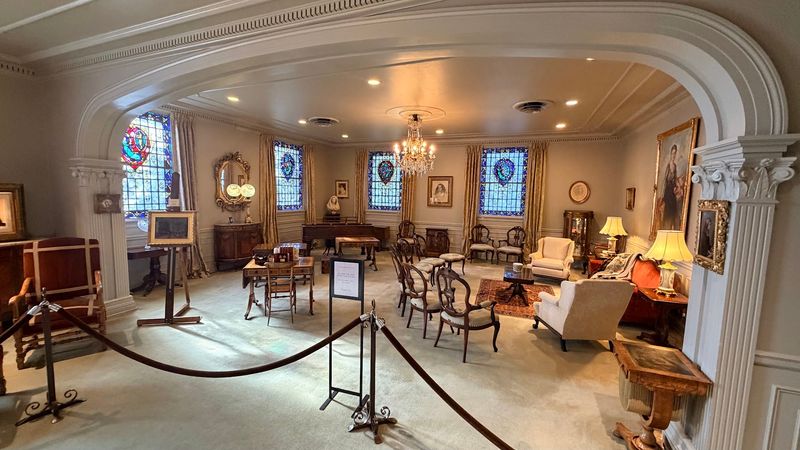
Skipping the upper floors would be a mistake, and plenty of visitors nearly do it.
The Leddy-Jones Research Hall holds the Pied Piper window, a nod to one of Browning’s best-known poems. Windows around the hall illustrate ten of his poems in total, creating a walkable tour through his writing.
Upstairs, the Austin Moore-Elizabeth Barrett Browning Salon offers a more intimate, elegant room. Quieter than the grand spaces below.
The Browning Corridor deserves a slow pass as well, since it displays over twenty-five different likenesses of Robert Browning. Paintings, busts, and prints, all of the same man, aging across decades.
Down in the Martin Entrance Foyer sit busts of both Brownings, their son Pen, and their close friend John Kenyon. The centerpiece is a life-sized portrait of Robert Browning painted by Pen himself, framed by carved pomegranates bursting open.
Outdoors, the Garden of Contentment was added in 2012 and makes a fine finish to any visit. Crushed granite paths, teak benches, a fountain, and old oak trees provide shade and a place to sit.
Fresh air after all that gold and glass feels surprisingly welcome. The garden resets the senses.
Consider ending outside rather than starting there. Stepping from the palace interior into leafy quiet gives the whole experience a satisfying close, and the fountain sound covers campus traffic nicely.
Planning A Visit Without Overthinking It
Free admission still surprises people, and it should be said plainly up front.
No ticket is required, though donations are welcomed. Hours generally run Monday through Friday, 9 a.m. to 5 p.m., with closures on major holidays.
Self-guided touring works well here thanks to a detailed handout available at the front desk. Grab one before wandering, because it explains windows and rooms that would otherwise stay mysterious.
Staff have a reputation for being welcoming and genuinely helpful. Questions are fine, and asking one often leads somewhere interesting.
Weekday mornings tend to feel calmest, which suits a building built around beauty and quiet. Students also use the space to study, so keeping voices low is simply good manners.
Comfortable shoes help more than expected, since the floors are hard and the temptation to linger in every room is strong. An hour is a reasonable minimum, and two goes by easily.
Photographers should bring a phone or camera that handles low light, because interiors are dim in places despite all that glass.
Dr. Andrew Joseph Armstrong chaired Baylor’s English Department from 1912 to 1952 and wanted to build the most beautiful building in Texas. He and his wife, Mary Maxwell Armstrong, raised funds for years to make it happen.
Judge the result personally. Most first-timers leave impressed and slightly stunned.
Address: 710 Speight Avenue, Waco, Texas.
