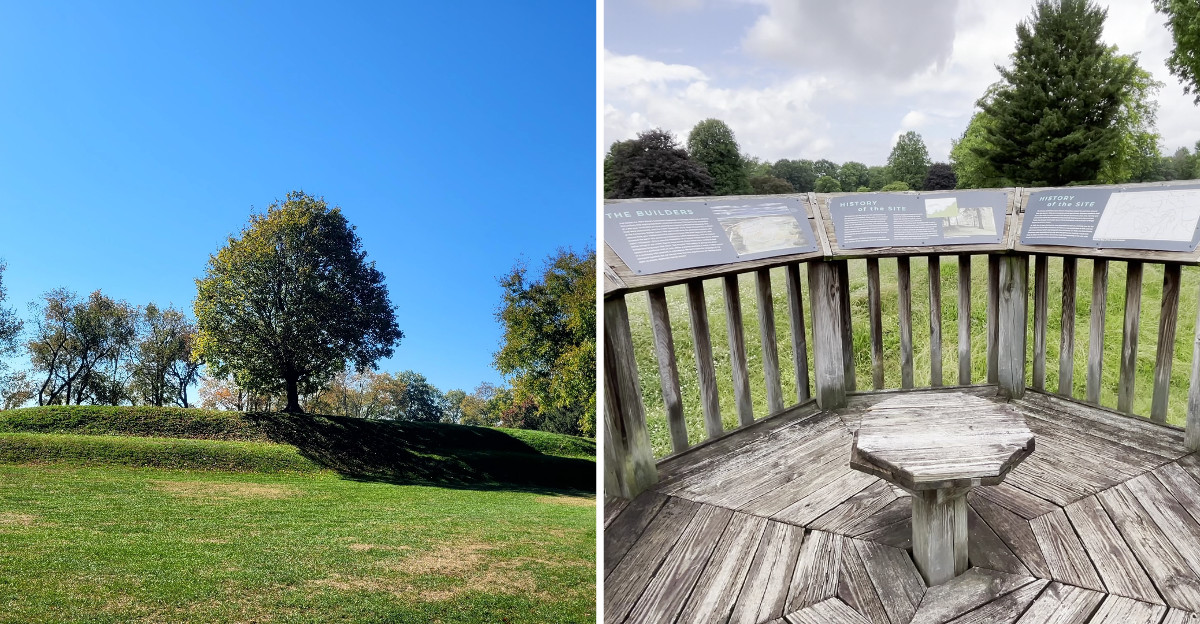
Long grassy walls roll across a quiet Ohio neighborhood, their smooth green ridges shaped by Hopewell people around 2,000 years ago. The earthworks still line up with the moon, a feat of engineering that has survived for millennia.
For more than a century, most visitors could only peek at them because a private golf course sat right on top. Golfers chipped balls across a sacred place while the public waited on the edges.
A long legal fight changed everything, and on January 1, 2025, the gates finally swung open for everyone. Walking those grounds now, the weight of all those years settles in slowly.
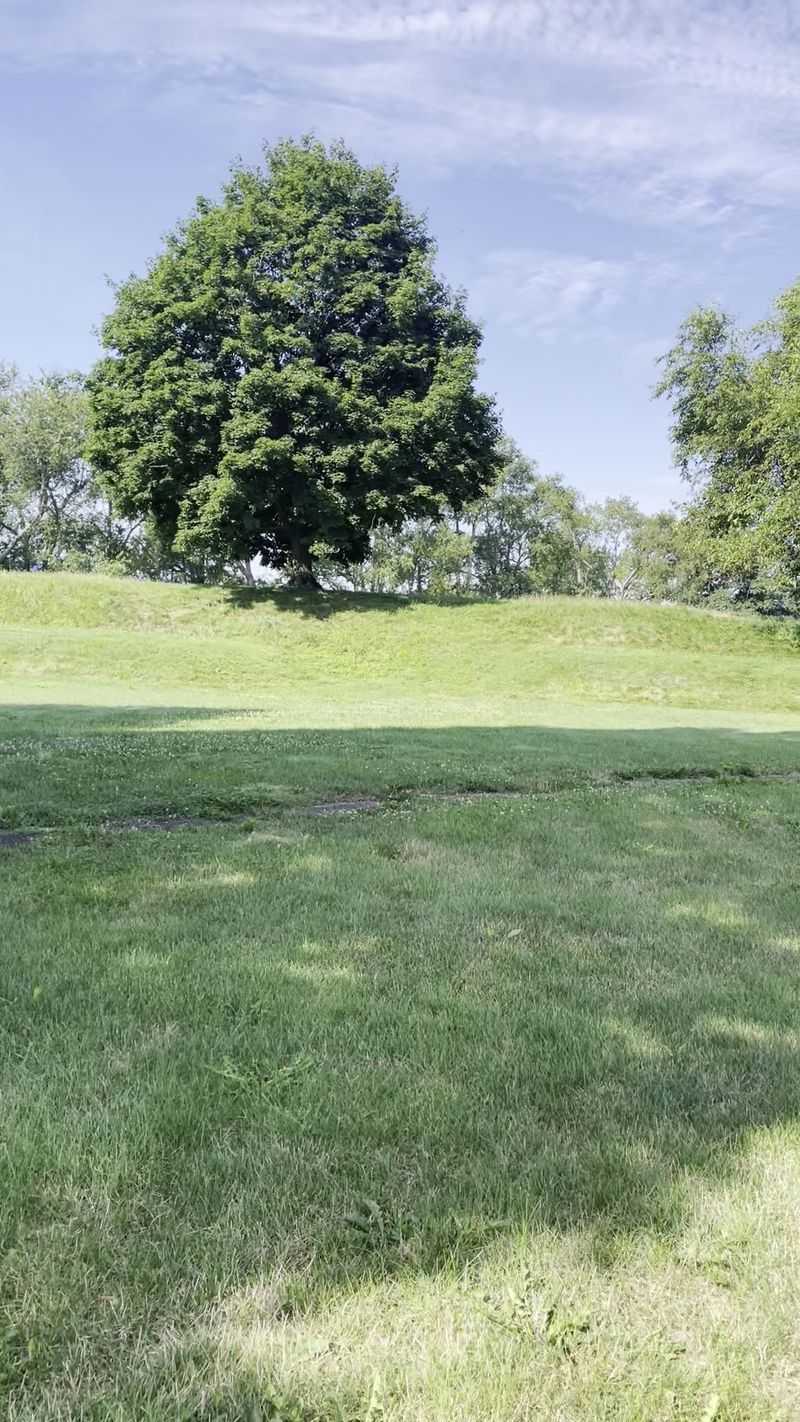
The ridges rise and fall with the landscape, and the sky stretches wide overhead. The place feels both ancient and newly accessible, a rare combination.
Ohio keeps this treasure in plain sight, and it rewards anyone who walks its paths.
A Hilltop Platform With a View Worth the Climb

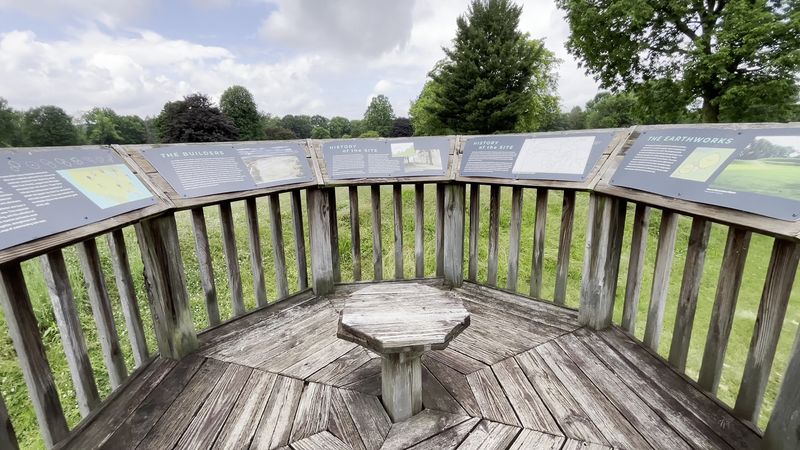
My first move was heading straight for the small wooden observation deck, and I am glad I did. From up there, the earthen walls stretch out in clean lines, and suddenly the shape makes sense in a way photos never quite manage.
The octagon covers about 50 acres, which is roughly the size of 38 football fields. Each of its eight walls runs around 550 feet long and stands 5 to 6 feet tall.
That is about eye level for most adults, so on the ground you feel surrounded, but from above you see the full pattern.
Off to one side sits a 20-acre circle, joined to the octagon by parallel earthen walls. I kept tracing the passage with my eyes, wondering how many people once moved through it during ceremonies.
A small tip from my visit is to arrive early. Some visitors have noticed that the grounds feel nearly empty before the visitor center opens, and that quiet made the view feel even bigger to me.
Bring a light jacket, too, because the open field catches every breeze. There is not much shade on the walls, so a hat helps on sunny afternoons.
Who Built It, and Why It Still Amazes Me
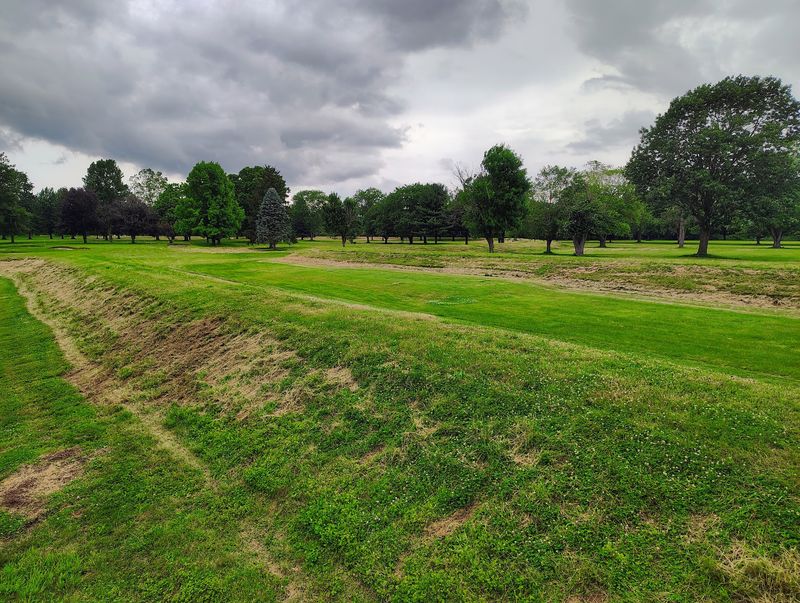
Picture moving tons of soil with no trucks, no metal shovels, and no machines at all. The Hopewell culture, a group of American Indians, did exactly that between about 100 BCE and 400 CE.
They carried earth basket by basket and shaped it into walls so even that modern surveyors still praise the precision. Standing beside one of those walls, I tried to imagine the patience and teamwork it took.
It probably took many years of steady effort, passed from one group to the next.
Scholars believe the site was used for far more than one thing. It hosted ceremonies, social gatherings, and religious observances, and it was also a place to honor the passed ones.
People may have traveled long distances to come together here.
That idea stuck with me as I walked. This was not a fort or a village but a gathering place built with care and meaning.
If you have kids along, ask them to guess how long it would take your family to build one wall by hand. My own rough math came out to forever, which made the whole project feel even more impressive and human.
Moon Tracking on a Massive Scale
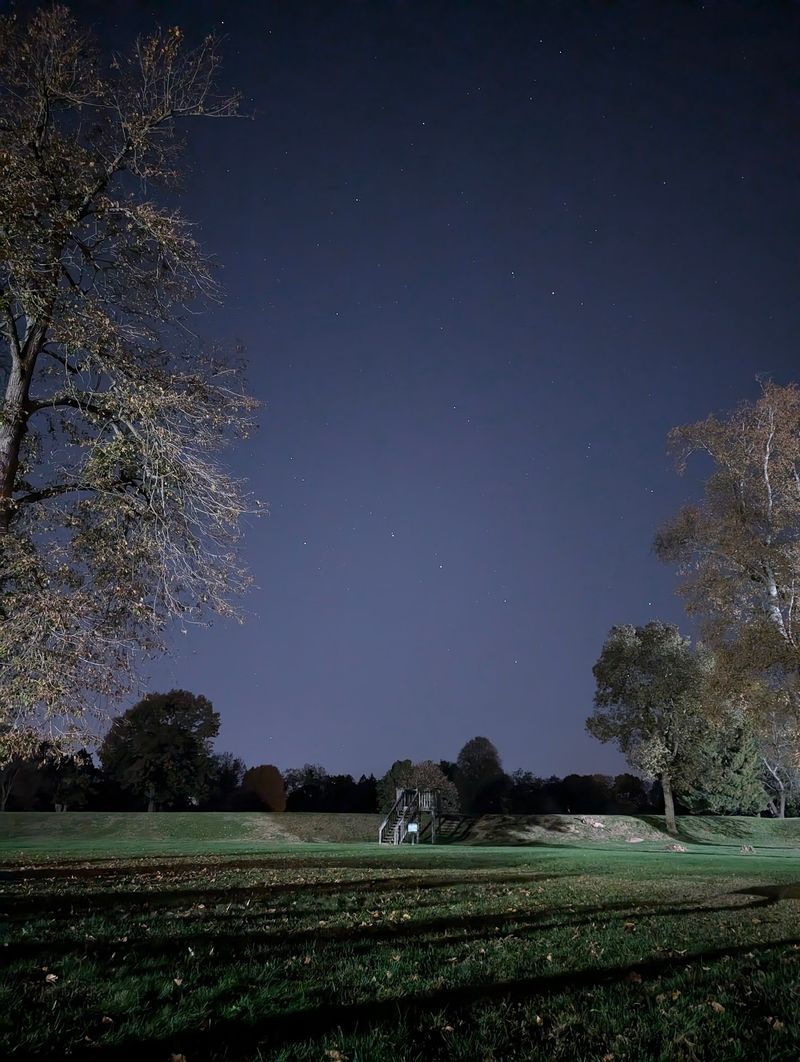
Here is the fact that made my jaw drop. The Octagon Earthworks works like a giant lunar observatory, lined up to track the moon across an 18.6-year cycle.
Every 18.6 years, the moon reaches its farthest rising and setting points on the horizon. Experts call this the lunar standstill, and the walls of the octagon point right toward those spots.
Catching that pattern meant watching the sky carefully for generations, which is a pretty wild thought.
I am no astronomer, but I can barely remember where I parked. The Hopewell people tracked moonrises over decades and then built a structure the size of a neighborhood to match them.
While I walked, I kept glancing at the horizon and lining up the walls with distant trees. It turned into a fun little game, even though I knew I would not see the alignment that afternoon.
For a deeper look, consider joining one of the guided tours. Visitors have praised staff and guest experts for explaining the moon connection clearly, and having someone point out the sightlines turns a grassy field into a sky calendar you can almost read.
Bring curiosity and good walking shoes.
A Century of Tee Times on Sacred Ground
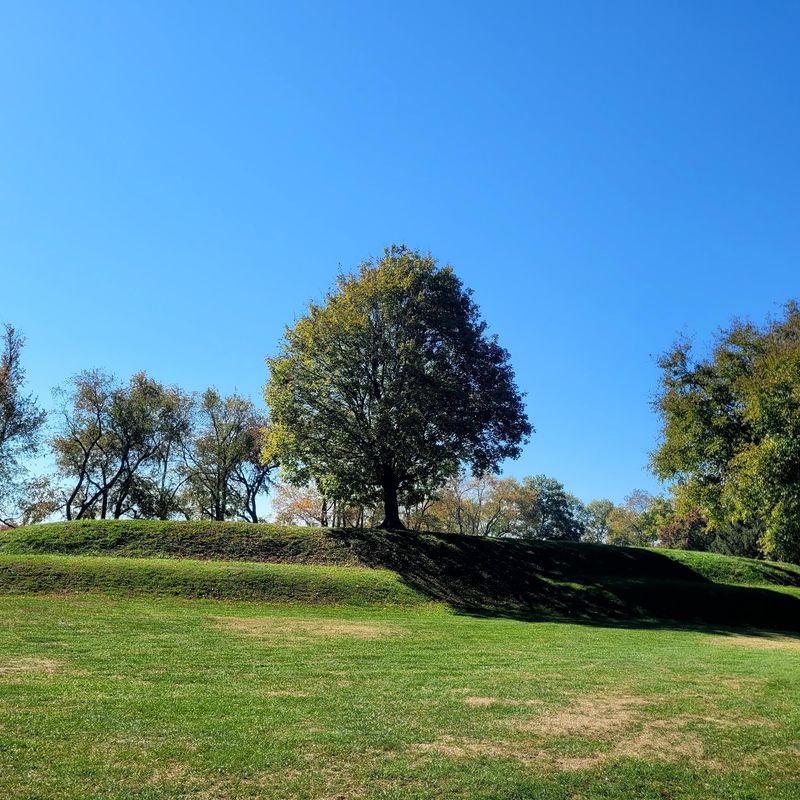
Some history sounds made up until you see the proof with your own eyes. Starting in 1910, the Octagon Earthworks was leased to Moundbuilders Country Club, which turned the ancient site into a private golf course.
Golfers played right across the walls and the open spaces inside them. In 1933, the Ohio History Connection became the owner of the land, but the lease kept going for decades afterward.
That meant most people could only visit in small windows. For years, the public could walk the grounds mainly on certain Mondays, and the rest of the time the site belonged to the golf game.
Fairness matters, so I will share this too. Some longtime locals feel the club kept the mounds well cared for during those years, and the walls did survive in good shape.
Even so, I could still spot leftovers from the golf era during my visit. Flat greens, old sand trap outlines, and cart paths stood out against the softer ancient shapes.
Workers are now removing those leftovers to restore the land. Seeing both layers side by side tells a story you will not find in a textbook, and it made me think about how places change hands over time.
The Courtroom Fight That Changed Everything
Nobody expects a travel story to include court dates, yet this one really does. In January 2013, the Ohio History Connection began talks with the country club about opening the site fully to the public.
Those talks stalled. So in 2018, the organization filed a lawsuit to take over the lease through eminent domain, a legal tool that lets the government acquire property for public use.
In May 2019, a Licking County Common Pleas Court judge ruled in favor of the Ohio History Connection. The Fifth District Court of Appeals agreed, and then the case climbed all the way to the top.
On December 7, 2022, the Ohio Supreme Court upheld those decisions. A jury trial was planned to decide how much the lease was worth, since the two sides had very different numbers in mind.
Instead of a long trial, both sides reached a confidential settlement. After more than a century, the path to full access was finally clear.
Knowing that backstory changed how I walked the grounds. Every step felt a little earned, like I was enjoying something many people worked hard and waited patiently to share with all of us.
Honors From Ohio to the Whole World
Few places collect this many shiny titles, and the Octagon has earned every single one. It is a U.S.
National Historic Landmark, which already puts it in very good company.
In 2006, Ohio named it the official prehistoric monument of the state. I love that a state picked a set of grassy walls as its symbol, and honestly it fits.
The biggest moment came in September 2023. The Hopewell Ceremonial Earthworks, including the Octagon, joined the UNESCO World Heritage List, which recognizes places with outstanding universal value.
That puts this Newark field on the same global list as famous wonders around the world.
UNESCO praised these earthworks as masterpieces of human creative genius and landscape design. Reading that while looking across the walls gave me goosebumps, not going to lie.
A fun fact to share on the drive home is that the Octagon ranks among the largest earthen enclosures anywhere on the planet. Most people have no idea this is tucked into a residential part of Ohio.
If you enjoy collecting World Heritage sites, this one is an easy and rewarding stop. It is also a great way to get kids excited about history close to home.
Planning Your Own Visit Today
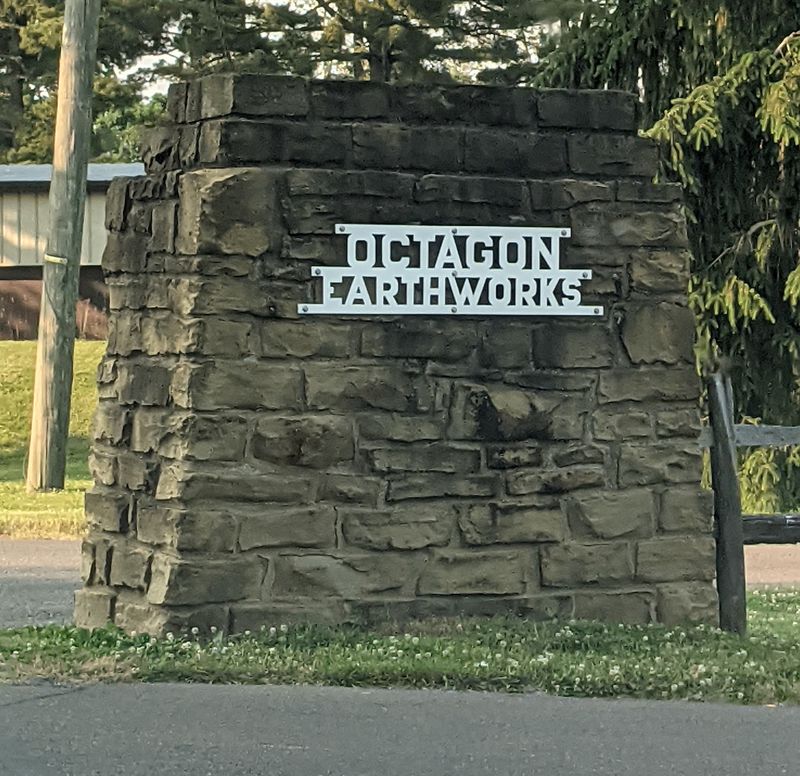
My favorite part of the day was simply wandering with no golf carts zooming past. Since January 1, 2025, the Octagon Earthworks has been fully open to the public, and admission is free.
The grounds are open year-round during daylight hours, though the visitor center keeps its own schedule. It typically opens Wednesday through Sunday from 10 AM to 5 PM and stays closed on Mondays and Tuesdays, so check before you go.
The walking areas are easy, and the open field gives you a real sense of scale. I noticed how quickly the walls hide the outside world once you stand between them.
Free public tours have been offered on select days, and visitors often rave about the guides. A tour adds stories and details you would likely miss on your own.
Think about pairing your trip with the nearby Great Circle Earthworks, about a mile away. Seeing both on the same day helps you picture how big the whole Newark complex once was.
Plans for an interpretive center and other upgrades are moving forward, so each visit may look a bit different. I already want to go back.
Address: 125 N 33rd St, Newark, OH 43055
