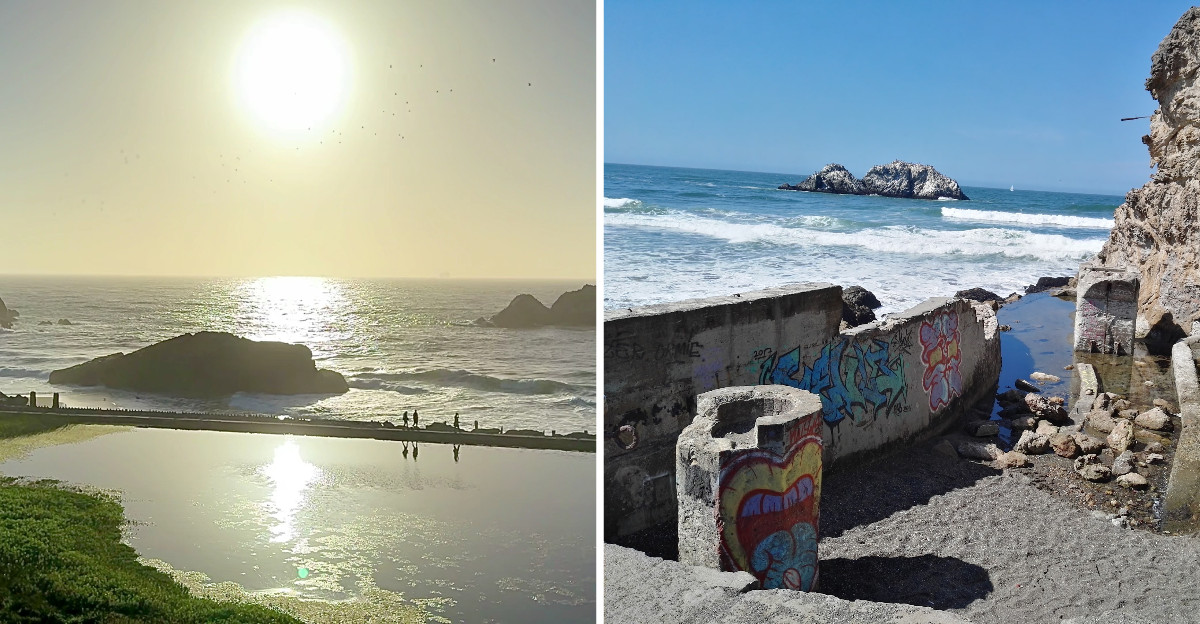
Concrete walls filled with green water sit below a California coastal path, waves smashing against rocks just beyond, gulls hanging in the wind like they are on strings. Walking down those steps feels like wandering out of the city and onto some forgotten coastline.
This was once the largest indoor swimming complex in the world, built to hold thousands of swimmers under a roof made of glass. Standing there with salt spray on a jacket, that fact feels almost impossible.
A fire in 1966 wiped out what was left, and what remains now is something between a ruin and a park. Several visits later, it never looks the same twice.
The tide moves in and out of the basins, and the concrete crumbles a little more each year. History here is not behind glass.
It is open to the weather, to the birds, and to anyone willing to walk down the stairs.
Adolph Sutro’s Wild Idea for a Seaside Swimming Palace
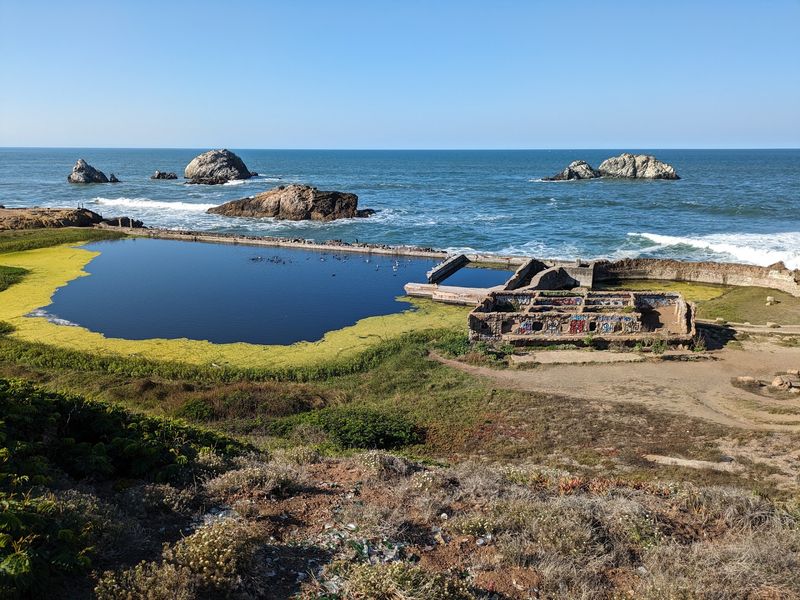
Money can buy a lot of things, and in the 1890s a self-made millionaire named Adolph Sutro decided his money should buy San Francisco, California a swimming palace. He had already served as mayor, and he owned a large chunk of the city’s western edge.
Construction started in 1894, and the doors opened to the public in 1896.
What he built covered roughly three acres of rocky shoreline. The structure rose five stories and was capped with a glass roof made of thousands of panes, which is why people started calling it a glass palace.
On sunny afternoons it must have glowed like a lantern above the surf.
Sutro’s goal was not just showing off, though there was plenty of that. He wanted regular working families to have somewhere clean, healthy, and affordable to swim, which was a genuinely progressive idea at the time.
He even built his own railroad line so people could get out there without paying high fares to rival companies.
I find that detail the most telling part of the whole story. The man was so determined to make his baths accessible that he constructed the transportation to reach them.
Standing among the foundations today, you can still trace the outlines of his ambition in the concrete.
Seven Pools, 1.7 Million Gallons, and an Ocean That Did the Filling
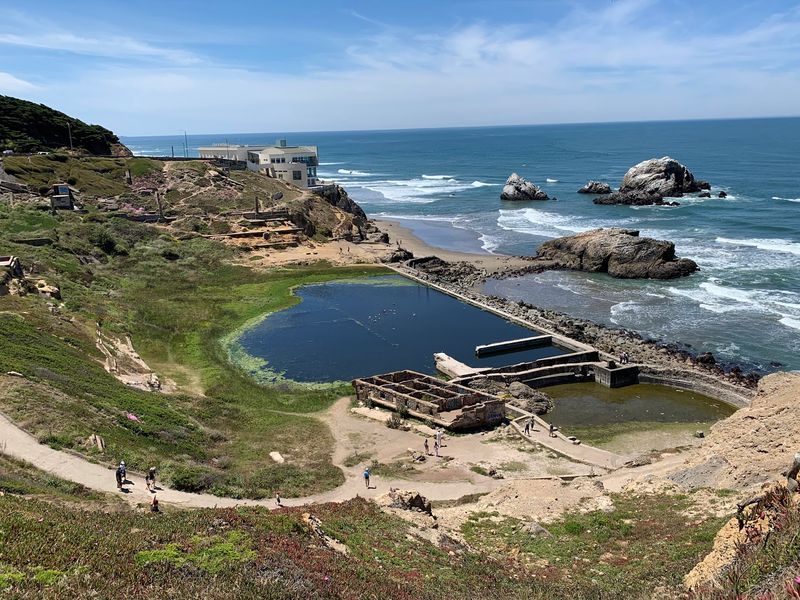
Here is the number that stopped me cold on my first visit: 1.7 million gallons. That is how much water filled the pool system, and the Pacific Ocean handled the job itself during high tide, taking about an hour to do it.
No pumps straining, no bills for water. Just tides and clever engineering.
There were seven pools altogether. Six held saltwater and one held fresh, and each sat at a different temperature so swimmers could pick whatever suited them that day.
The complex could hold up to 10,000 people at once, with some accounts putting the figure closer to 25,000 visitors on a busy day.
To keep everyone outfitted, the baths kept 20,000 bathing suits and 40,000 towels available for rent. Imagine the laundry operation behind that.
Swimmers also had slides, springboards, trapezes, and a high dive to throw themselves off of, which sounds delightfully unsupervised by modern standards.
When I walk the pool foundations now, I try to line up the shapes in my head. The rectangles still hold rainwater and seawater, dark green and rippling, and birds paddle around where kids once cannonballed.
It is the closest thing to a full-scale floor plan you will ever get to stand inside.
Mummies, Polar Bears, and a Museum Nobody Expected
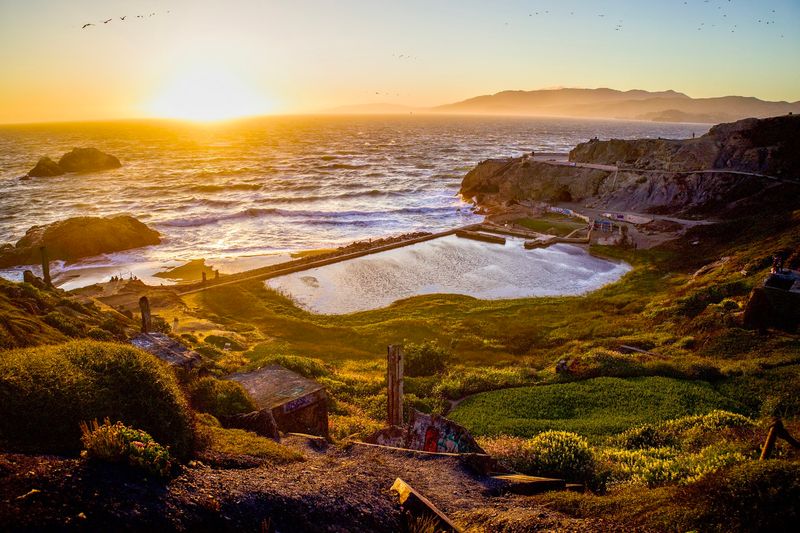
Swimming was only half the attraction, which I did not realize until I read the history boards near the parking area. Sutro filled the upper levels with an enormous collection of oddities that had nothing to do with water at all.
Egyptian mummies sat in cases. Stuffed polar bears and apes stared out at swimmers below.
Totem poles stood along the galleries, alongside sculptures, paintings, tapestries, and artifacts gathered from Mexico, China, other parts of Asia, and the Middle East. A family could spend an entire day there and never touch the water.
Bands played concerts. Talent shows drew crowds.
Several restaurants kept everyone fed between events.
It was essentially a museum, a concert hall, a food court, and a swimming complex stacked into one glass-topped building on a cliff.
Knowing all this changes how the ruins read. Those broken walls did not just hold pools, they held display cases and dining rooms and stages.
I remember pausing near a crumbling stairway and trying to picture a polar bear in a glass case somewhere above my head.
The visitor center up by the parking lot has photographs that help, and it is worth stopping in before you head down. Just go early, because it closes well before sunset does.
How a Beloved Landmark Slowly Ran Out of Luck
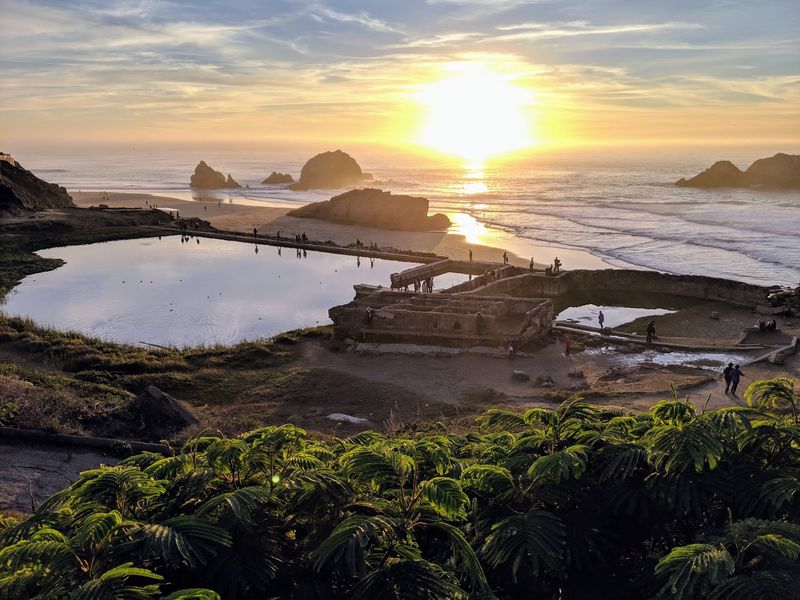
Popularity and profit turned out to be two very different things. The baths drew enormous crowds, but the cost of heating, cleaning, and maintaining a glass building perched over crashing surf was brutal.
Adolph Sutro passed away in 1898, only two years after the doors opened.
Without him, the finances got harder. The Great Depression hit attendance badly, public transportation to the western edge of the city shrank, and new public health codes added requirements the aging structure struggled to meet.
Management tried to adapt. At one point much of the complex was converted into an ice-skating rink, which is a strange image when you think about all that ocean water sloshing just outside.
None of it was enough, and the baths closed to the public in 1964 after almost seventy years.
What I appreciate about this chapter is how ordinary the decline feels. There was no single disaster, just decades of rising costs and shifting habits slowly wearing the place down.
Developers bought the site and planned high-rise apartments in its place.
Walking the ruins with that timeline in mind, the whole scene reads less like a tragedy and more like something that quietly outlived its moment. Then came the part nobody planned for.
June 26, 1966, The Fire That Wrote the Ending
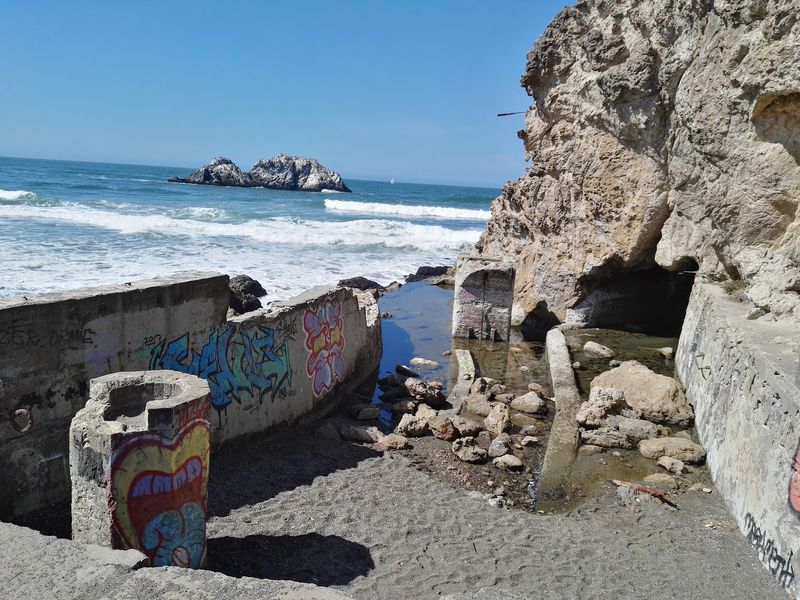
Demolition crews were already at work when flames tore through what remained on June 26, 1966. The fire consumed the structure completely, leaving nothing above the concrete foundations.
Some accounts describe the blaze as suspicious, with arson raised as a possibility.
What followed did not help the rumors. Reports say the developers collected insurance money and then walked away from their apartment plans entirely, leaving the scorched site sitting empty above the surf.
The high-rises were never built.
In an odd way, that fire is the reason anyone can visit today. Had the towers gone up, this stretch of coast would be private property and the pool outlines would be buried under parking garages.
Instead the ruins stayed, weathered by wind and salt, until the land became part of the Golden Gate National Recreation Area in the following decades.
I always find that twist a little haunting. A building meant for joy ended in smoke, and the wreckage accidentally preserved a piece of the shoreline for everyone.
You can see fire-marked concrete in a few spots if you look closely.
Graffiti covers a fair amount of the walls now, and opinions about that vary, but the bones of the place are unmistakably original.
Climbing Down Into the Ruins, Caves and All
About a hundred steps separate the parking area from the pool floor, and honestly, the climb back up is where you feel it. There is also a gentler ramp path if stairs are not your thing, and most people make the round trip in fifteen minutes or so.
Good shoes matter more than you would expect.
Once you are down among the walls, the scale hits differently. You can walk the tops of old dividers, peer into water-filled basins, and follow paths that lead right out toward the rocks.
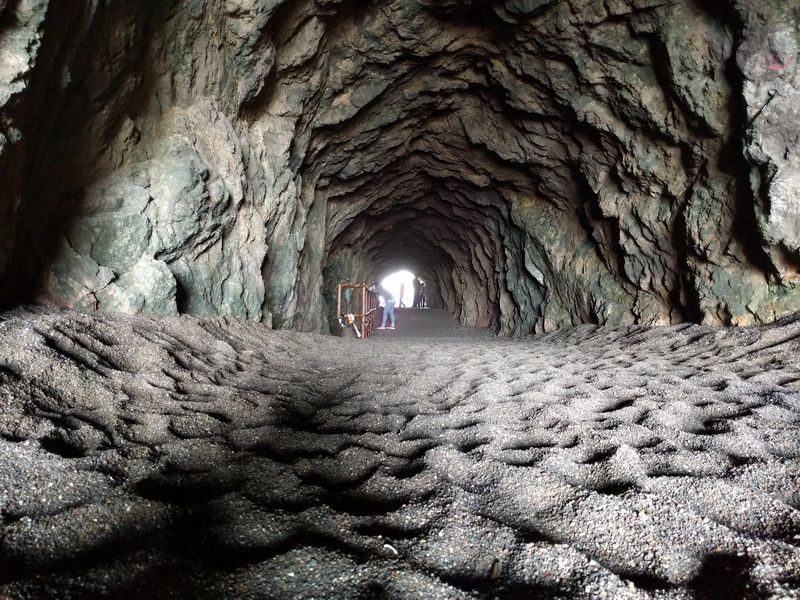
The big sea cave at the far end is the highlight for a lot of visitors. You can walk it end to end, listening to waves boom through the tunnel, and the framed view of the ocean from inside is genuinely one of the best photo spots in San Francisco.
Caution is real here, though. The ledges are narrower and slipperier than they look, and rogue waves are not a myth on this coastline.
I keep well back from the edges and time my cave visit around low tide.
Plan on an hour or two if you want to wander properly, and bring water. Snacks are a good call too, since there is no food down in the ruins.
Fog, Wind, Sunsets, and the Best Time to Show Up
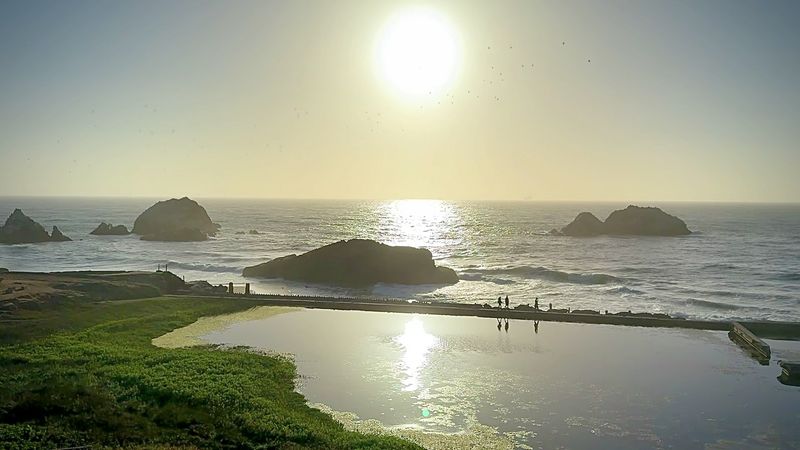
Weather here has a personality. Fog rolls in fast, wind shifts through the day and across seasons, and I have arrived in bright sun only to lose the horizon within twenty minutes.
A hoodie or windbreaker is not optional, even in summer.
Sunrise and sunset are the standout windows. Low light catches the pool water and the coastline in a way midday sun flattens completely, which is why photographers keep coming back here year after year.
Weekdays are noticeably calmer than weekends, and sunset hours draw the biggest crowds.
The site stays open around the clock, but after dark it gets genuinely hard to see, so bring a light and ideally a companion if you go late.
Beyond the ruins, the Lands End trails run north toward more viewpoints, and near the Battery Lobos entry point you can spot the Golden Gate Bridge. Seal Rocks sit just offshore, usually noisy.
Parking is free and generally available, though patience helps on busy days. Do not leave anything visible in your car.
Restrooms sit by the visitor center near the lot, and it closes earlier than you might expect.
Address: 1004 Point Lobos Ave, San Francisco, California 94121
