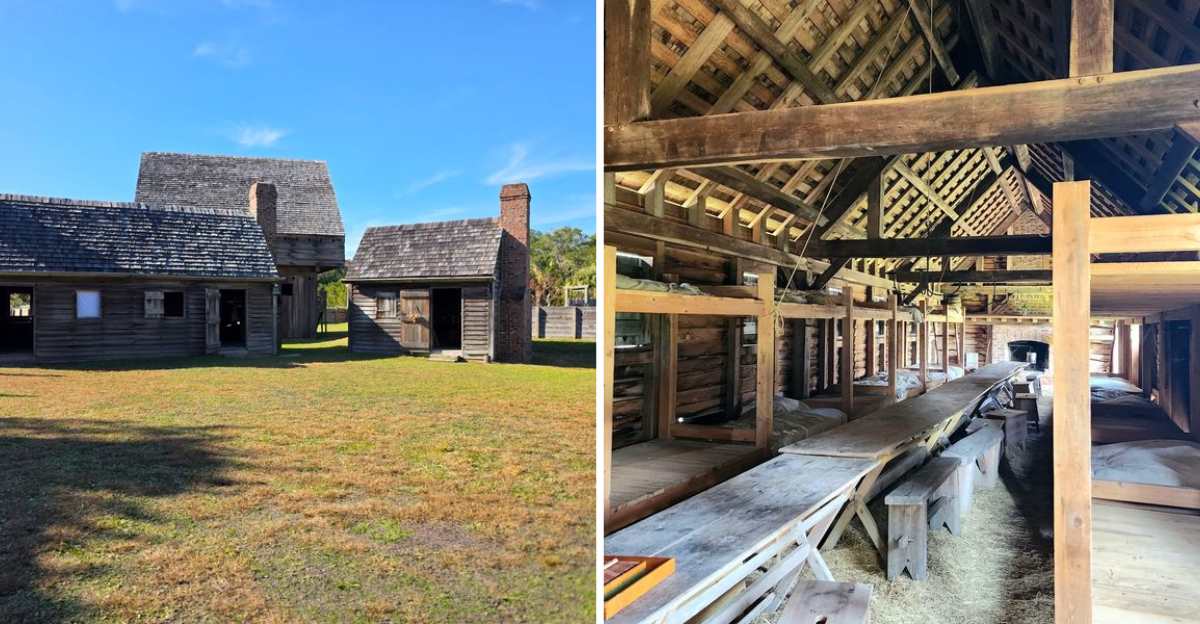
Walking through the reconstructed blockhouse and barracks of an 18th-century frontier fort in Georgia, the same humid breeze that greeted British soldiers over 300 years ago still rolls in off the river. The site is not just a historical marker on the side of a road.
It is a fully rebuilt outpost, reconstructed so carefully that you can walk through the same rooms that once sheltered His Majesty’s soldiers at the southernmost edge of the British Empire in North America. I had no idea how layered this place was until I actually showed up and started exploring.
The grounds cover Native American history, early colonial struggles, Scottish Highland settlers, and the rise of the lumber trade, all in one compact, fascinating location. The blockhouse stands two stories tall, with the original design replicated down to the firing steps and the wooden pegs that hold the beams together.
I stood on the upper floor and looked out over the river, trying to imagine the soldiers watching for Spanish ships or French privateers.
A stop that punches way above its weight is exactly what this Georgia site delivers, and it is ready to deliver for anyone who makes the trip.
The Story Behind Georgia’s Oldest English Fort
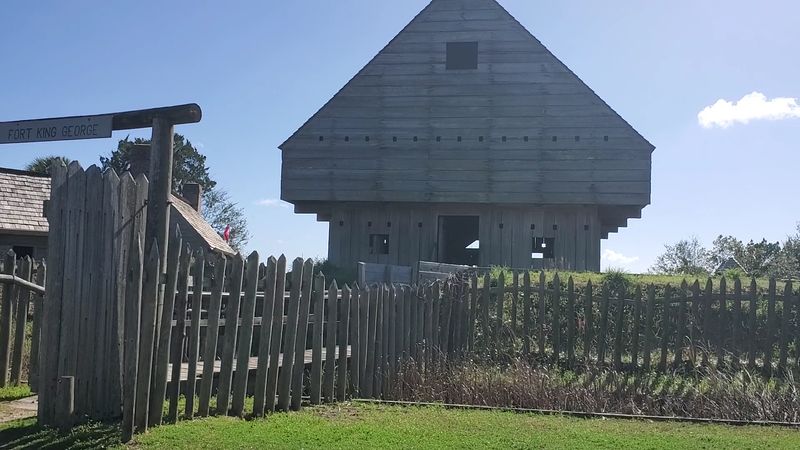
Few places in the American South carry a birthdate as early as 1721. Fort King George was established that year on the northern bank of the Altamaha River, making it the southernmost outpost of the British Empire in North America at the time.
Colonel John “Tuscarora Jack” Barnwell led the scoutmen who built it, and the name alone tells you this was not a desk job.
The fort was designed to protect British interests in a region that both Spain and various Native American groups considered their own territory. It featured a cypress blockhouse, barracks, and a palisaded earthen perimeter.
Life here was brutal. Disease, harsh coastal weather, and the constant threat of Spanish and Indigenous attacks made garrisoning the fort an exhausting and dangerous assignment.
The fort burned in 1726 and was rebuilt the following year, only to be abandoned by 1727. But its legacy did not disappear with the soldiers.
The site was added to the National Register of Historic Places in 1971, and Georgia eventually committed to reconstructing it for public tours using original records and period drawings. The result is one of the most authentic colonial reconstructions in the entire Southeast.
The Blockhouse, Three Stories of Frontier Defense
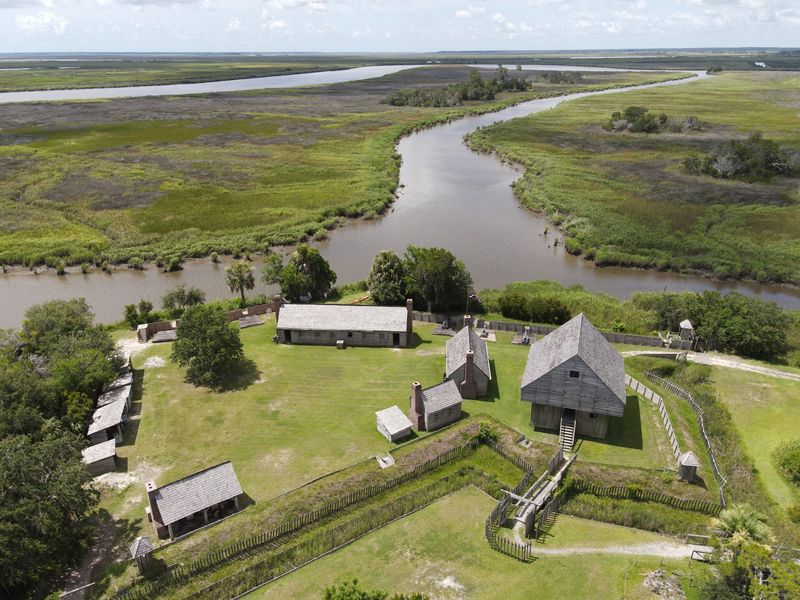
The blockhouse is the centerpiece of Fort King George, and the moment you spot it rising above the treeline, you understand why soldiers felt a little safer with it nearby. Built from cypress logs and measuring 26 feet on each side, the original structure stood roughly 40 feet high.
That is a serious piece of frontier engineering for 1721.
Each of the three levels served a specific purpose. The lower level stored powder, ammunition, and supplies.
The second floor was equipped with gun ports and cannonports, giving defenders a commanding field of fire in multiple directions. The top level functioned as a lookout post, offering a sweeping view of the Altamaha River and the surrounding marshland.
The current blockhouse was reconstructed in 1988, built to match the original as closely as historical records allowed. Climbing through its levels gives you a real sense of how compact and practical colonial military design was.
Nothing was wasted. Every inch of space had a job to do.
I found myself genuinely impressed by how much strategic thinking went into what is essentially a wooden tower on a Georgia riverbank. It is easy to see why this structure became the symbol of the entire site.
The Saw Mill Ruins and the Birth of Darien’s Lumber Trade
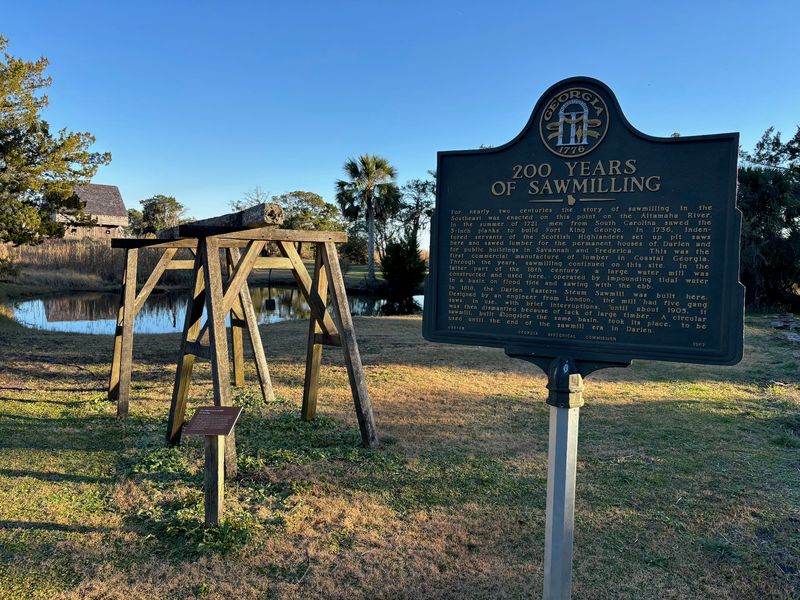
Not every fascinating feature at Fort King George involves a musket or a cannon. The sawmill history here is just as gripping, and honestly, it surprised me.
The site preserves remains of three separate sawmills, along with tabby ruins that speak to a time when this stretch of Georgia coastline was an industrial hub as much as a military one.
The surviving portions of the first sawmill are considered rare examples of early colonial industry in the region. Lumber was the lifeblood of this area for generations.
Darien eventually grew into one of the most significant seaports for timber on the entire Georgia coast, and the Darien Eastern Steam Sawmill Company, established in 1818, played a major role in that rise.
Seeing the physical remains of that industry sitting right next to a reconstructed colonial fort is a striking combination. It reminds you that this place was never just about military strategy.
It was about resources, economics, and survival in a very literal sense. The Altamaha River gave settlers a highway to the interior, and the forests surrounding it gave them something worth shipping.
The sawmill ruins are easy to overlook, but they tell a story that shaped this entire region.
The Museum, From Guale Indians to Scottish Highlanders
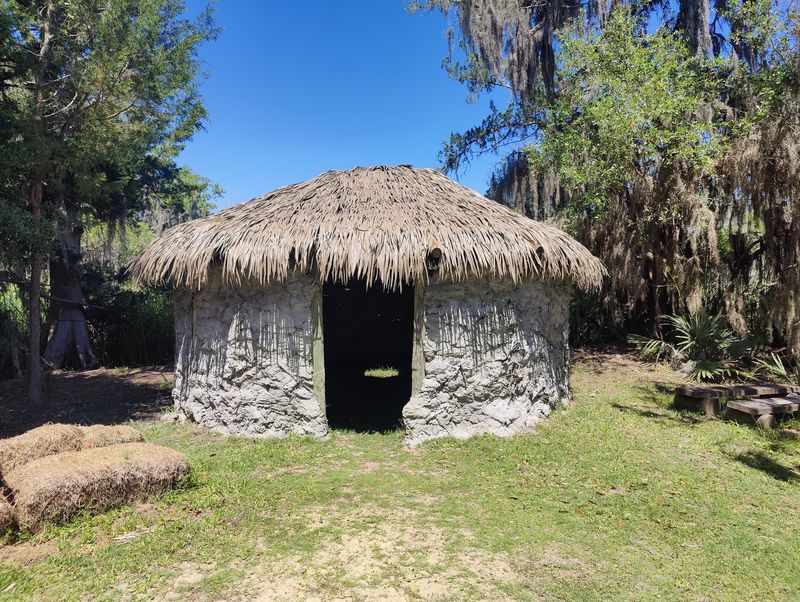
Before a single British soldier arrived on the Altamaha River, the Guale people had already called this land home for centuries. The museum at Fort King George does not skip over that history.
It opens with the story of the Guale Indians and the Spanish mission Santo Domingo de Talaje, giving visitors a layered picture of who was here long before the Union Jack was raised.
From there, the exhibits move through the fort’s colonial period, covering the hardships faced by His Majesty’s Independent Company and the strategic importance of this coastal location. Then comes one of the more surprising chapters in the story: General James Oglethorpe brought Scottish Highlanders to the site in 1736, and they established the settlement of Darien right here.
The museum covers all of it, including the 19th-century sawmilling boom that followed. For a relatively compact exhibit space, the range of stories is genuinely impressive.
I spent more time in there than I expected, partly because the displays are well-organized and partly because the history kept connecting in ways I did not anticipate. Each chapter leads naturally into the next, making the whole arc of this place feel coherent and human rather than like a dry timeline on a wall.
The Reconstructed Barracks and Officers’ Quarters
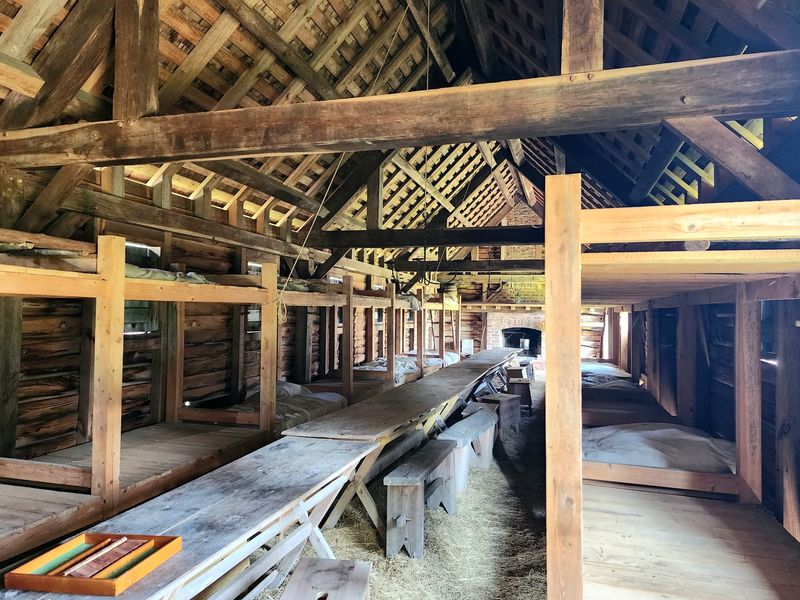
Life inside Fort King George was nothing like the romantic image of redcoat soldiers standing at attention. The barracks tell a more honest story.
Soldiers lived in tight, uncomfortable quarters, sharing space with damp coastal air, insects, and the constant anxiety of being stationed at the edge of a contested empire. Seven years of that would test anyone.
The reconstructed barracks and officers’ quarters give visitors a tangible sense of the daily grind. Officers had slightly more space and privacy, but not by much.
The gap between enlisted life and officer life was real, but in a fort this size, everyone was close to everyone else, for better or worse.
What strikes me most about these buildings is how honest the reconstruction feels. There is no attempt to make things look comfortable or glamorous.
The spaces are functional, spare, and clearly designed for people who had one primary job: hold this position. Georgia put real effort into getting these structures right, using period records and drawings to guide every detail.
Paired with the guardhouse and moat that still define the fort’s perimeter, the barracks help complete a picture of colonial military life that is far more grounded and human than most history textbooks manage to convey.
The Altamaha River Setting and Its Strategic Importance
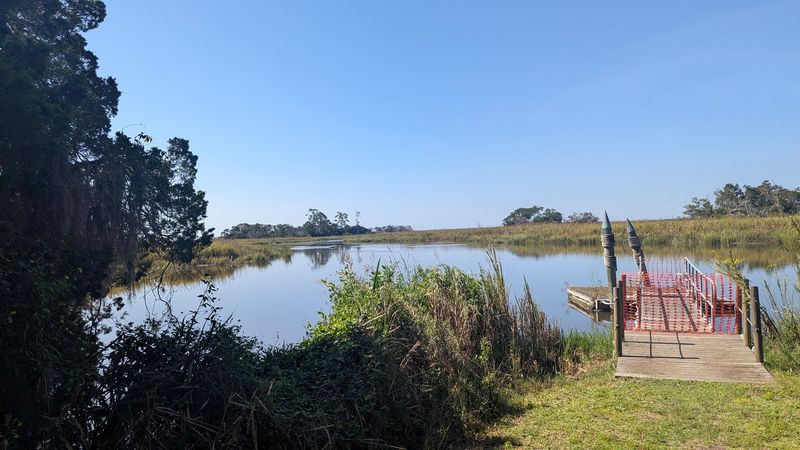
You cannot fully appreciate Fort King George without looking at the river it was built to command. The Altamaha River is wide, tidal, and surrounded by the kind of marsh landscape that defines coastal Georgia.
From the fort’s position on the northern bank, soldiers had clear sightlines in multiple directions, which was exactly the point.
The river was not just a defensive asset. It was a highway into the Georgia interior, giving the British access to trade routes, timber resources, and movement corridors that the Spanish and various Native American nations also wanted to control.
Placing a fort here was a calculated move, not just a random choice on a map.
Even today, the river setting gives the site a mood that no museum exhibit can fully replicate. The water moves slowly, the marsh grasses shift in the breeze, and the whole scene feels genuinely old in a way that is hard to put into words.
I found myself just standing at the bank for a few minutes, not trying to process anything, just taking it in. That kind of quiet, atmospheric moment is something Darien and this stretch of the Georgia coast do exceptionally well.
The landscape itself is part of the history here.
Visiting Fort King George, What to Know Before You Go
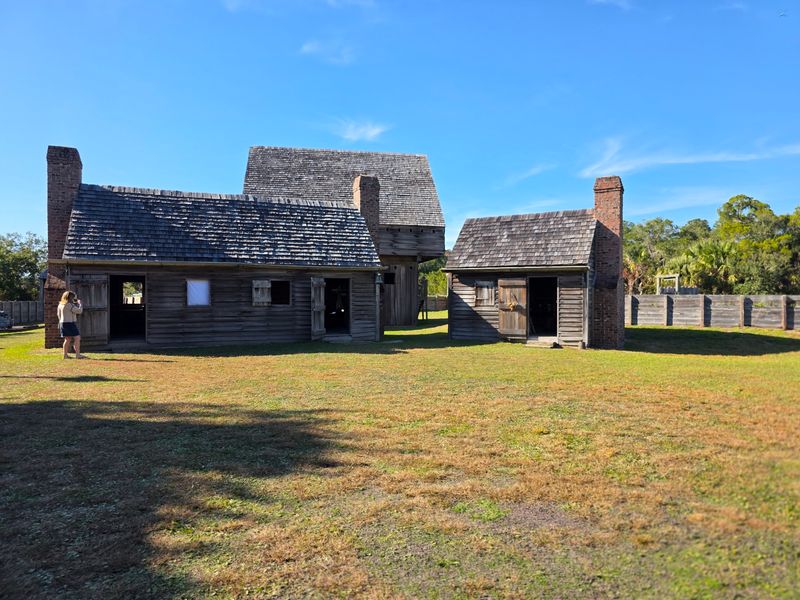
Fort King George State Historic Site is the kind of place that rewards visitors who show up with a little curiosity and a comfortable pair of shoes. The site is compact enough to cover in a few hours, but rich enough that you will not feel rushed.
Families, history enthusiasts, and casual travelers all tend to find something worth their time here.
The reconstructed structures are spread across a manageable footprint, and the museum is a smart first stop before exploring the grounds. Rangers and interpretive signage help connect the dots between the different historical periods covered at the site.
Bringing water is a good idea, especially in the warmer months, because coastal Georgia in summer is genuinely humid.
Darien itself is a small, quiet town with a lot of character. After visiting the fort, taking a short drive through the historic district or down to the waterfront is an easy way to extend the experience.
The town’s deep ties to the lumber trade and Scottish Highland heritage give it a personality that feels distinct from other Georgia coastal communities. Fort King George fits naturally into a broader coastal Georgia road trip, pairing well with visits to nearby Brunswick or the Golden Isles.
Address: 302 McIntosh Road SE, Darien, GA 31305.
