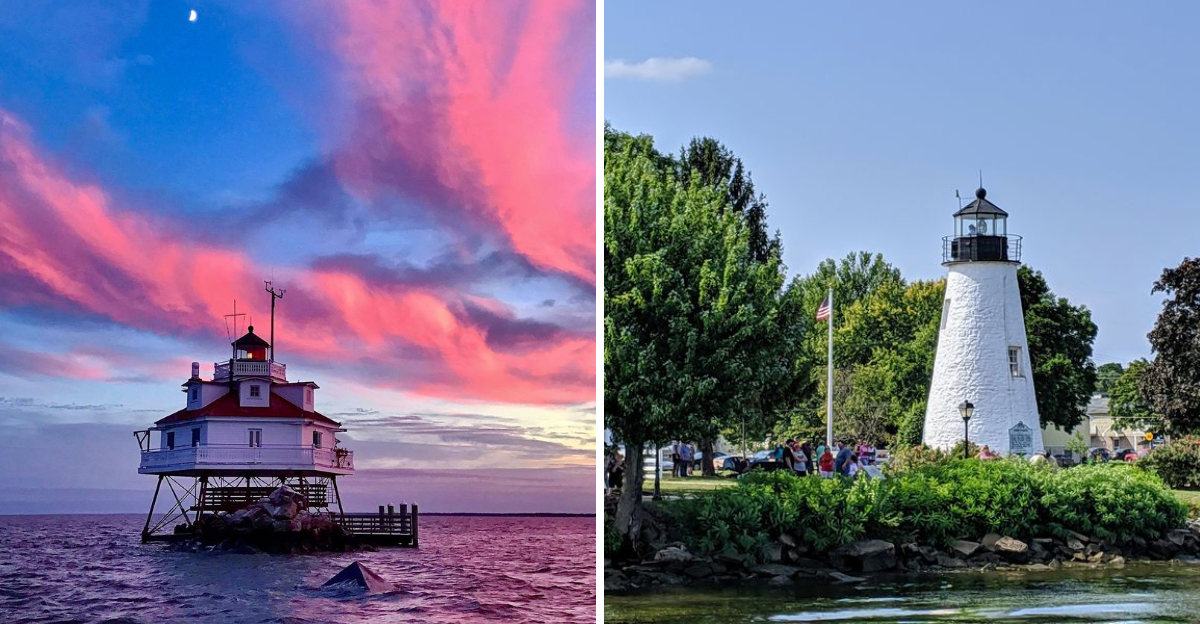
Maryland’s coastline has seen a lot more than beach umbrellas and weekend traffic jams.
Scattered along the water are old towns, lighthouses, waterfront districts, forts, maritime landmarks, and other places that have managed to hang onto pieces of the past while everything around them kept changing.
Some come with centuries of stories, while others make history surprisingly easy to appreciate because you can explore them without feeling like you accidentally signed up for a three-hour museum lecture.
The best part is how different these places can feel from one another, even though they all share a connection to Maryland’s waterfront history.
For anyone who prefers day trips with a little substance behind the scenery, these nine coastal spots prove that getting older can actually make a destination considerably more interesting.
1. Point Lookout State Park
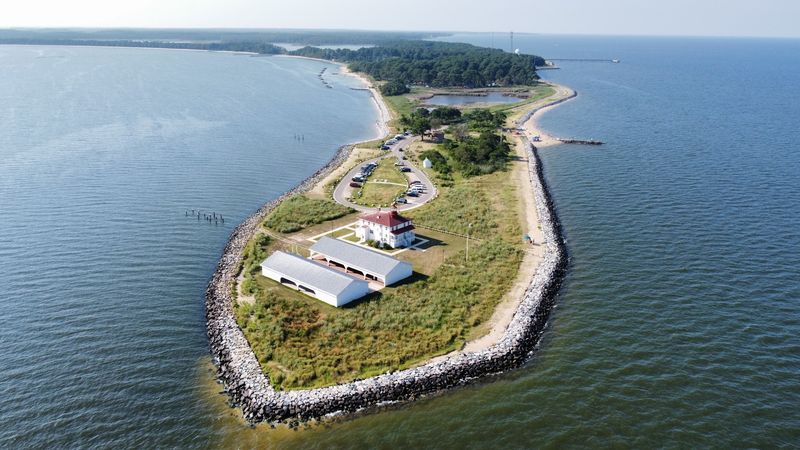
There is something quietly overwhelming about reaching the southernmost tip of Maryland’s western shore, where the Chesapeake Bay and the Potomac River meet in a wide, glittering embrace. The landscape feels almost too peaceful for the weight of history it carries.
Captain John Smith explored this very point in 1612, and centuries later, British troops used it as an encampment during the War of 1812.
During the Civil War, Point Lookout became the site of Hammond General Hospital, established in 1862 to treat Union soldiers.
As the war deepened, the point transformed into Camp Hoffman, one of the largest Confederate prisoner-of-war camps in the country, where thousands of soldiers were confined in tents within a forty-acre compound.
A “contraband camp” nearby offered shelter to enslaved people who crossed the Potomac seeking freedom under federal protection.
The earthworks of Fort Lincoln still exist near Cornfield Harbor, and reconstructed barracks offer a tangible sense of that complicated era. The Point Lookout Lighthouse, first commissioned in 1830, has witnessed every chapter of this transformation.
It is a constant presence against the shifting tides of history.
Coastal erosion has reshaped the park’s shoreline over the years, and riprap barriers now protect what remains. Despite these changes, the park retains its rare combination of natural beauty and layered historical significance.
I found myself standing at the water’s edge longer than planned, not quite ready to leave a place that asks so much of your imagination.
Address: 11175 Point Lookout Rd, Scotland, MD 20687
2. Piney Point Lighthouse Museum
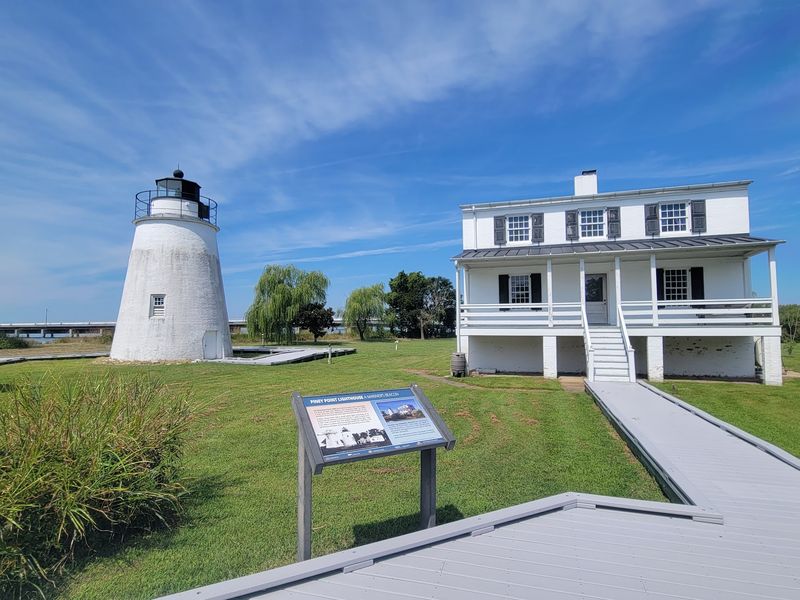
The oldest lighthouse on the Potomac River has a personality that sneaks up on you. Piney Point Lighthouse, built in 1836 by the renowned lighthouse builder John Donahoo, carries itself with a modest elegance that belies the fascinating history packed into its thirty-five-foot circular tower.
It earned the informal title “Lighthouse of Presidents” because several early U.S. Presidents visited or stayed on its grounds during their time in office.
Deactivated in 1964, the lighthouse was eventually deeded to St. Mary’s County by the federal government in 1980 and reopened as a museum after careful restoration in the 1990s.
Visitors can climb the spiral staircase and look out over the Potomac, imagining the solitary vigil of keepers who once scanned this same horizon through every season.
The museum inside the keeper’s quarters explores their daily lives and the broader history of the U.S. Coast Guard’s presence on the river.
One of the most unexpected highlights is the story of the German U-1105 submarine, nicknamed the “Black Panther,” which was sunk in the Potomac and now serves as Maryland’s first historic shipwreck dive preserve.
The Potomac River Maritime Exhibit adds to the experience with a collection of historic wooden vessels that reflect the lives of local watermen.
It is the kind of place where every building seems to have its own story to tell.
The surrounding six-acre park includes a kayak launch, boardwalk, and pier. The combination of open water, tall trees, and quiet history makes this a genuinely restorative stop.
Address: 44720 Lighthouse Rd, Piney Point, MD 20674
3. Rackliffe House
Perched on a ridge above Sinepuxent Bay with Assateague Island shimmering in the distance, Rackliffe House carries a quiet authority that you feel before you even reach the front door.
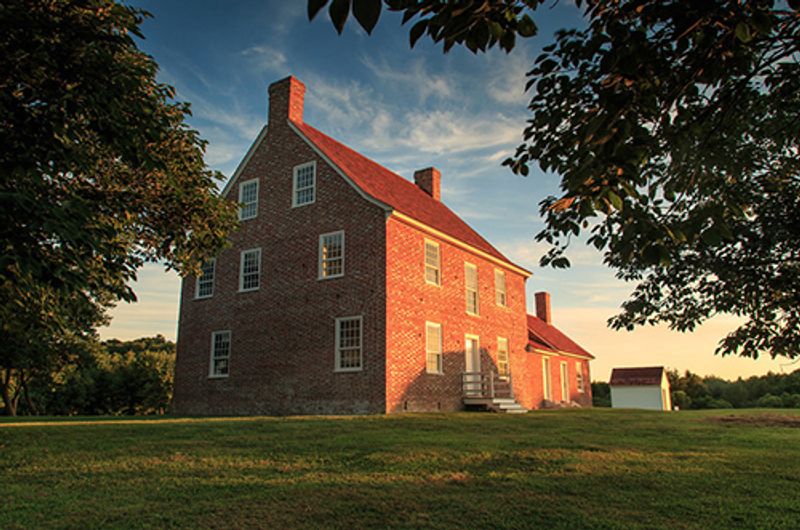
Built in the 1740s by Captain Charles Rackliffe, a merchant-planter of considerable ambition, this colonial tidewater dwelling is one of the oldest properties in Northern Worcester County.
It is also one of the rare examples of such a home open to the public in the entire Mid-Atlantic region.
The architecture speaks of both craft and status. Flemish bond brickwork with random glazed headers, a steeply pitched gabled roof, and large multi-paned sash windows all suggest a builder who wanted to impress.
The oversized window at the top of the central staircase, designed to frame sweeping views of the bay and Assateague, confirms that instinct entirely.
The plantation’s economy depended on tobacco, corn, and wheat, and the labor of enslaved African Americans was central to its operation. The house survived the Revolutionary War, the War of 1812, and the Civil War, though a fire in 1928 gutted its interior.
After Maryland acquired the surrounding land in 1996, the Rackliffe House Trust undertook a painstaking restoration, opening the property to visitors in 2011.
Exploring the reconstructed rooms, I noticed how the natural setting still feels very much alive, the pine and live oak pressing in close, the salt air drifting up from the bay. This is history that has not been sanitized or softened.
It asks you to sit with its complexity, and that makes the visit all the more worthwhile.
Address: 11800 Marsh View Lane, Berlin, MD 21811
4. Concord Point Lighthouse
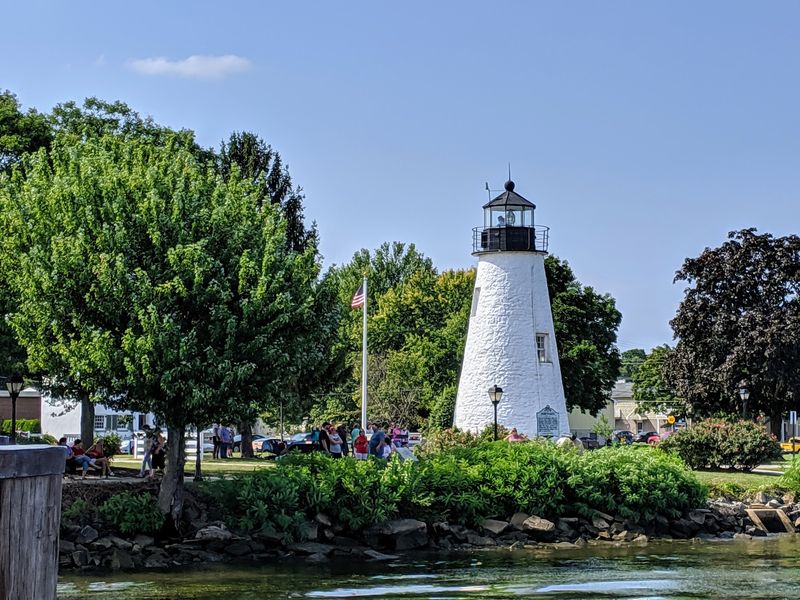
At the mouth of the Susquehanna River, where freshwater finally gives way to the broad expanse of the Chesapeake Bay, Concord Point Lighthouse rises with a quiet stubbornness that feels entirely appropriate.
Constructed in 1827 from locally quarried Port Deposit granite, this thirty-six-foot conical tower is the second oldest lighthouse in Maryland and the northernmost on the Chesapeake Bay.
Its thick stone walls have outlasted storms, wars, and decades of technological change.
The story of its first keeper adds real human texture to the structure. John O’Neill was a local hero who single-handedly defended Havre de Grace during the British attack in the War of 1812, and his presidential appointment as lighthouse keeper was a direct acknowledgment of that courage.
It is the kind of biographical detail that makes an old building feel inhabited again, even centuries later.
Originally lit by whale oil lamps, the lighthouse was later upgraded with Fresnel lenses to extend its reach across the Bay. It was automated in 1920 and decommissioned in 1975, at which point it was believed to be one of the oldest lights in continuous service in the United States.
The Friends of Concord Point Lighthouse stepped in afterward, funding a restoration that brought the keeper’s dwelling and the tower itself back to life.
The surrounding park sits within a designated historic district, and the views from the water’s edge are genuinely spectacular. A breeze off the river carries the faint smell of the Bay, and the whole scene has a calm, unhurried quality that makes it easy to linger.
I did not rush here, and I was glad for it.
Address: 700 Concord St, Havre de Grace, MD 21078
5. Thomas Point Shoal Lighthouse
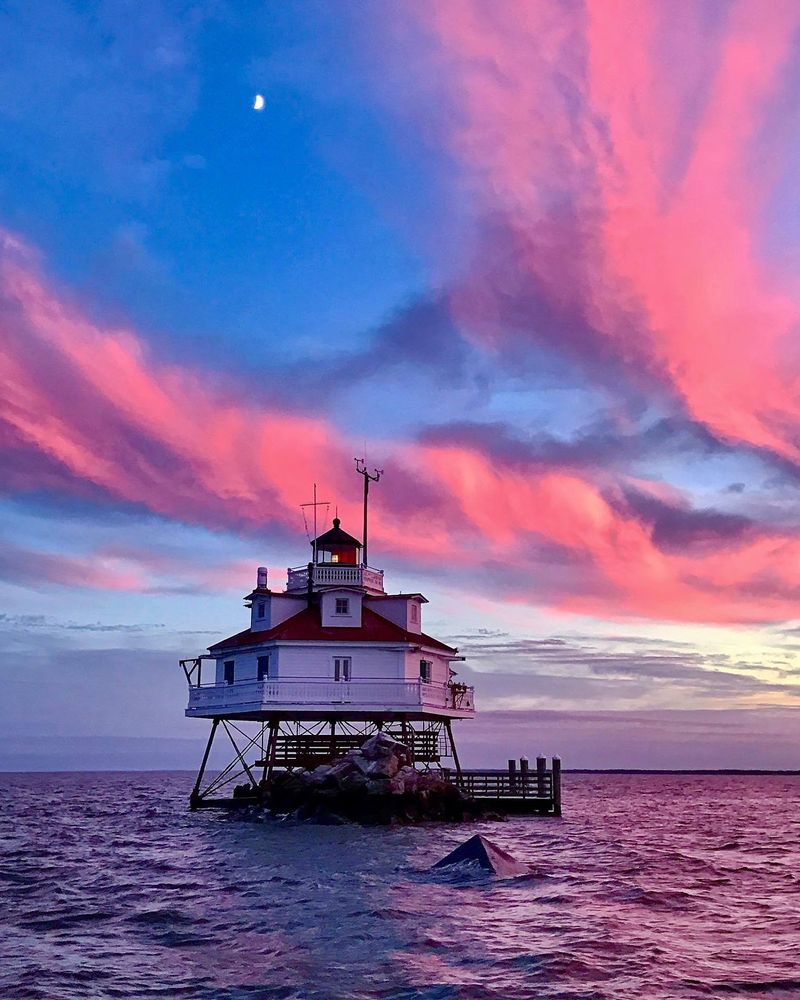
Out on the open water of the Chesapeake Bay, the Thomas Point Shoal Lighthouse appears like something out of a dream, a small white cottage perched impossibly above the waves on iron legs.
Built in 1875, it is the last screw-pile lighthouse in the Chesapeake Bay still sitting in its original offshore location and still actively guiding navigation.
That combination of longevity and function makes it genuinely remarkable.
Earlier land-based lighthouses from 1825 and 1840 had struggled against relentless shoreline erosion, which made the offshore screw-pile design both clever and necessary.
The hexagonal structure features Italianate brackets, molded wood siding, a standing-seam metal roof, and six gabled dormers that give it an almost residential warmth despite its exposure to open water.
It earned National Historic Landmark status in 1999, a recognition that feels well deserved.
Inside, exhibits recount the lives of the keepers who once lived here in remarkable isolation, their routines shaped entirely by the rhythm of the Bay. The displays also touch on the Oyster Wars of the 19th century, adding another layer of regional history to the experience.
Taking a boat out to this lighthouse feels like a genuine pilgrimage rather than a casual outing.
The panoramic views from the water stretch wide in every direction, with nothing but sky and Bay surrounding you. I kept thinking about what it must have felt like to spend a winter month out here, with the wind pushing hard against those wooden walls.
It is a perspective that changes how you see the whole region.
6. Drum Point Lighthouse
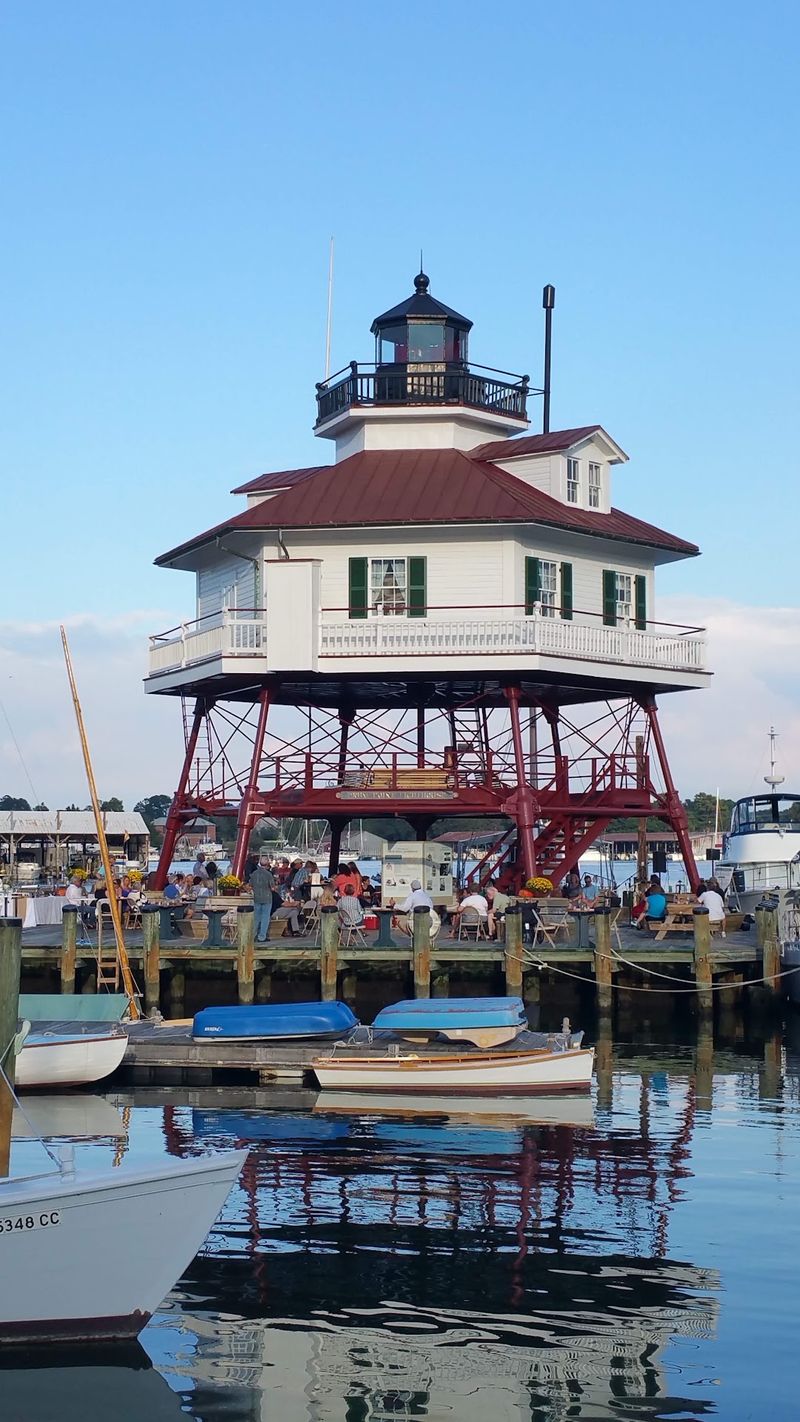
The Drum Point Lighthouse has lived two very different lives, and both of them are worth knowing.
Originally commissioned in 1883 to mark the treacherous shoals at the mouth of the Patuxent River, this hexagonal screw-pile cottage lighthouse spent decades offshore, guiding ships through one of the Bay’s more demanding stretches of water.
It is one of only three such structures still surviving from the many lights that once dotted the Chesapeake.
Over time, shifting sands and silting gradually moved the shoreline closer to the lighthouse until it was nearly on dry land by the 1970s. Automated in 1960 and decommissioned in 1962, the structure fell into neglect and vandalism before its future became genuinely uncertain.
Then, in 1975, the Calvert County Historical Society organized one of the more impressive preservation efforts in the region’s history, carefully moving the entire lighthouse two nautical miles upriver to its current home at the Calvert Marine Museum.
Today, the lighthouse is beautifully restored with furnishings that evoke the early 20th century, giving visitors a surprisingly intimate sense of what life looked like for a keeper and their family.
The open galleries wrapping around each story and the compact lantern room still suggest long hours of quiet watchfulness.
I appreciated the care put into each detail, from the cooking implements to the narrow bunks.
The lighthouse now stands as a centerpiece of the museum’s waterfront, a monument to both maritime ingenuity and the kind of community dedication that saves things worth saving.
Address: 14150 Solomons Island Rd S, Solomons, MD 20688
7. Cove Point Lighthouse
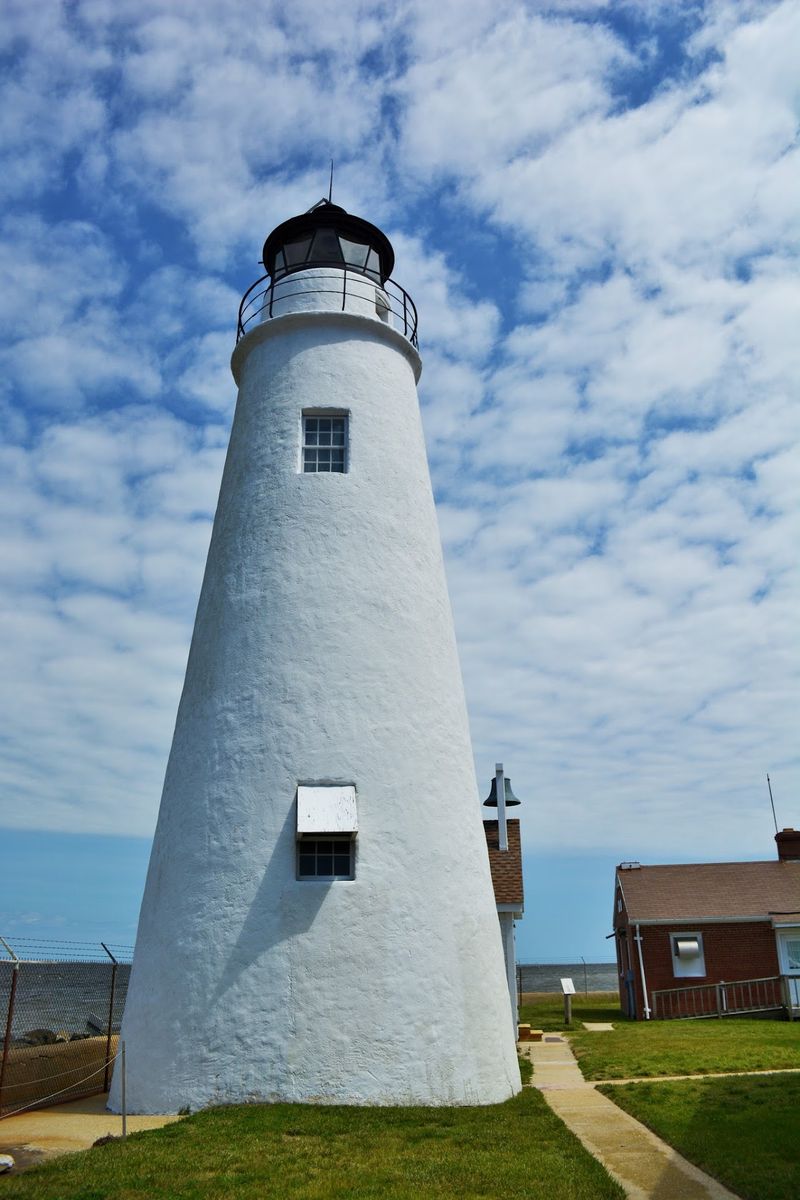
Some places earn their reputation through sheer persistence, and Cove Point Lighthouse is exactly that kind of place.
Built in 1828 by John Donahoo, this forty-five-foot conical brick tower is the oldest continuously operating lighthouse in Maryland and the sixth oldest extant lighthouse on the Chesapeake Bay.
Nearly two centuries of service is not a small achievement for any structure, let alone one exposed to the Bay’s seasonal extremes.
The lighthouse has adapted steadily over the decades, shifting from kerosene lamps to electrification in 1928, and eventually moving to full automation in 1986.
The keeper’s dwelling was enlarged over time and even converted into a duplex to house multiple keepers and their families, reflecting how the needs of the operation changed through the years.
A fog bell, first added in 1837, has also been a constant companion to the tower’s light.
Erosion has been one of the most persistent challenges here, with seawalls constructed and reinforced across multiple eras to protect the point from the Bay’s gradual encroachment. In 2000, ownership transferred from the U.S.
Coast Guard to Calvert County, with the Calvert Marine Museum now managing public access and tours. That handoff helped ensure the lighthouse remained both preserved and accessible.
The seven-acre grounds offer beautiful views of the Calvert Cliffs, and visitors can explore the exterior of the tower and the surrounding property. There is a particular satisfaction in visiting a lighthouse that still operates, still serves a purpose beyond nostalgia.
Cove Point earns that feeling honestly.
Address: 3500 Lighthouse Blvd, Lusby, MD 20657
8. Annapolis City Dock
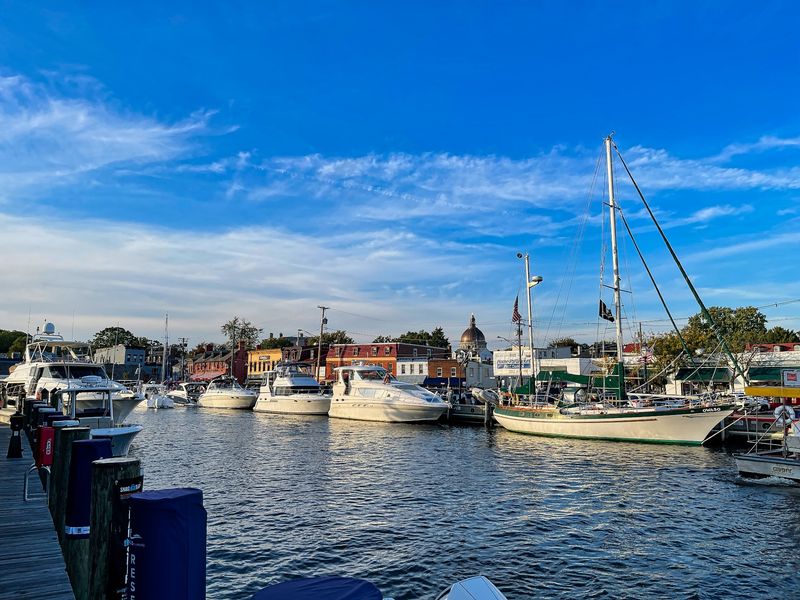
Annapolis City Dock is one of those rare places where history and everyday life have figured out how to coexist without either one crowding the other out.
The waterfront has been a hub of trade and activity since the early 1600s, and the energy here still feels genuinely alive rather than performed for tourists.
Sailboats, working vessels, and weekend cruisers all share the same water, which gives the dock a democratic, unhurried character.
In the 18th and 19th centuries, this dock thrived as a center for shipbuilding and seafood processing, its piers constantly busy with commerce. Today, as part of the Colonial Annapolis National Register Historic District, City Dock connects the city’s historic brick streets directly to the open Bay.
The stretch famously known as “Ego Alley” draws crowds who come specifically to watch boats parade slowly past, which turns out to be more entertaining than it sounds.
The dock also carries a profound and sobering history as one of the Chesapeake region’s earliest slave ports.
A powerful memorial honoring Kunta Kinte, an enslaved African brought to Annapolis, and author Alex Haley, who chronicled his ancestor’s story in “Roots,” stands near the water as a solemn and necessary presence.
It is the kind of memorial that stops you mid-step and asks you to pay attention.
Throughout the year, the dock hosts sailboat shows, community festivals, and various public gatherings that keep the waterfront animated. I found it easy to spend several hours here without any particular agenda, simply absorbing the mix of old and new that defines this corner of Annapolis.
9. Hooper’s Island
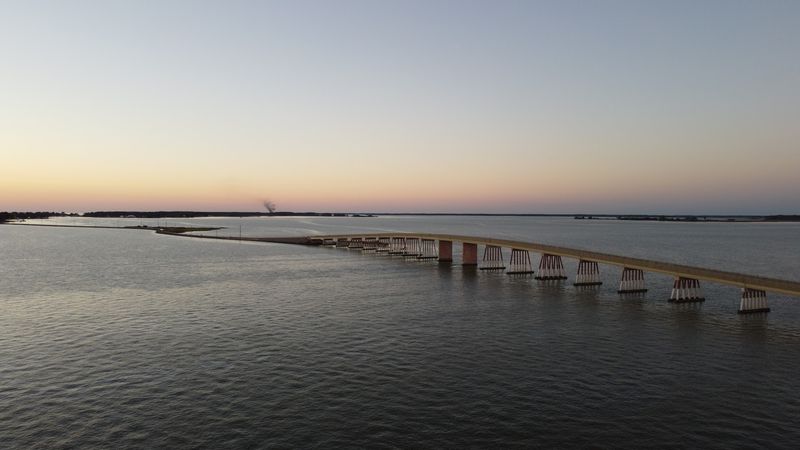
The drive to Hooper’s Island is part of the experience.
A nearly two-mile causeway carries you out across the water, with the Chesapeake Bay opening wide to the west and the Honga River spreading out to the east, and by the time you arrive, it genuinely feels like you have crossed into a different version of Maryland.
This chain of three small islands in Dorchester County, known as Upper, Middle, and Lower Hooper, has been settled since 1669, when Henry Hooper’s family first put down roots here.
That long history of isolation has shaped a community unlike almost anywhere else in the region. Families have stayed for generations, and the culture of self-sufficiency that developed out of necessity has become a point of quiet pride.
The tradition of working the water is still very much alive, with watermen heading out daily to crab, oyster, and fish the same Bay their great-grandparents worked before them.
Historic churches anchor the community’s sense of continuity.
Hosier Memorial United Memorial Church, built in 1896, and Hoopers Memorial Methodist Church from the late 1800s both reflect the enduring faith that has held these island communities together through storms, economic changes, and the slow retreat of the water itself.
The wooden bridge to Lower Hooper Island was washed out years ago and never replaced, which says something about the pace of change here.
Visiting Hooper’s Island feels less like tourism and more like a genuine encounter with a living community. The views are sweeping, the pace is slow, and the sense of place is unlike anything else along Maryland’s coast.
