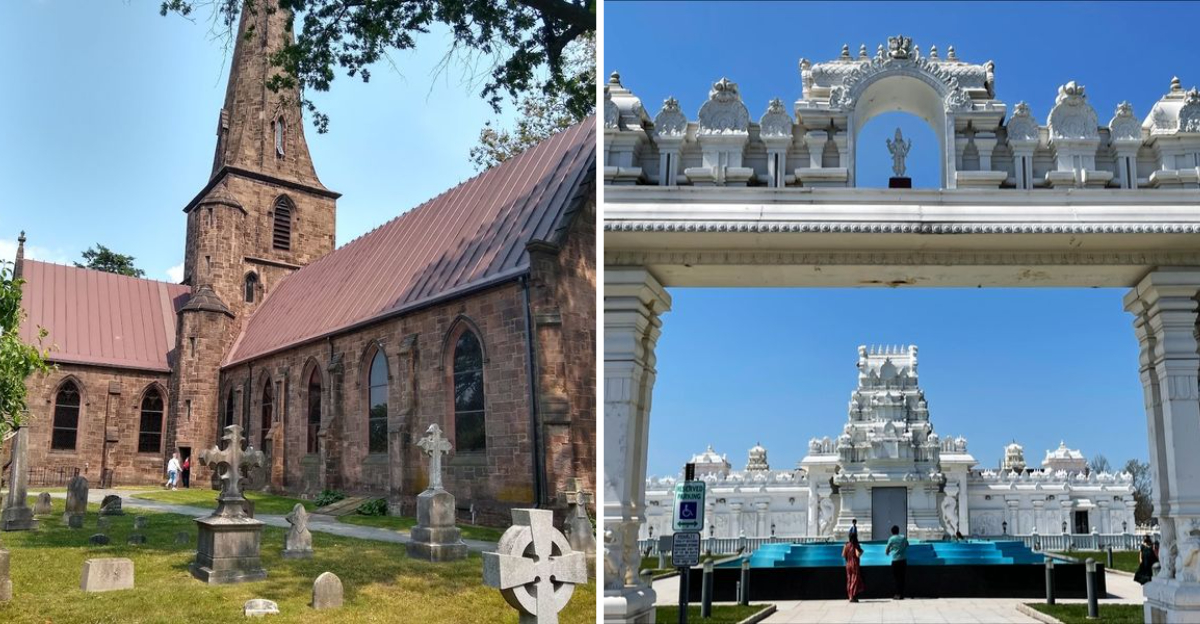
History has a way of lingering in certain places, and these sacred sites practically vibrate with it.
New Jersey holds a collection of holy spaces where the past is not just remembered, it is still alive.
You can stand beneath soaring stained glass that took decades to complete or step into a modest stone church where congregants have worshipped for over two centuries.
Their footsteps are worn into the floorboards, a quiet testament to generations of faith.
These are not just buildings, they are time capsules filled with stories of sacrifice, artistry, and devotion.
The architecture alone will transport you, but the silence inside these walls speaks even louder.
Who knew that a state famous for boardwalks and diners held this much quiet history?
1. Cathedral Basilica of the Sacred Heart
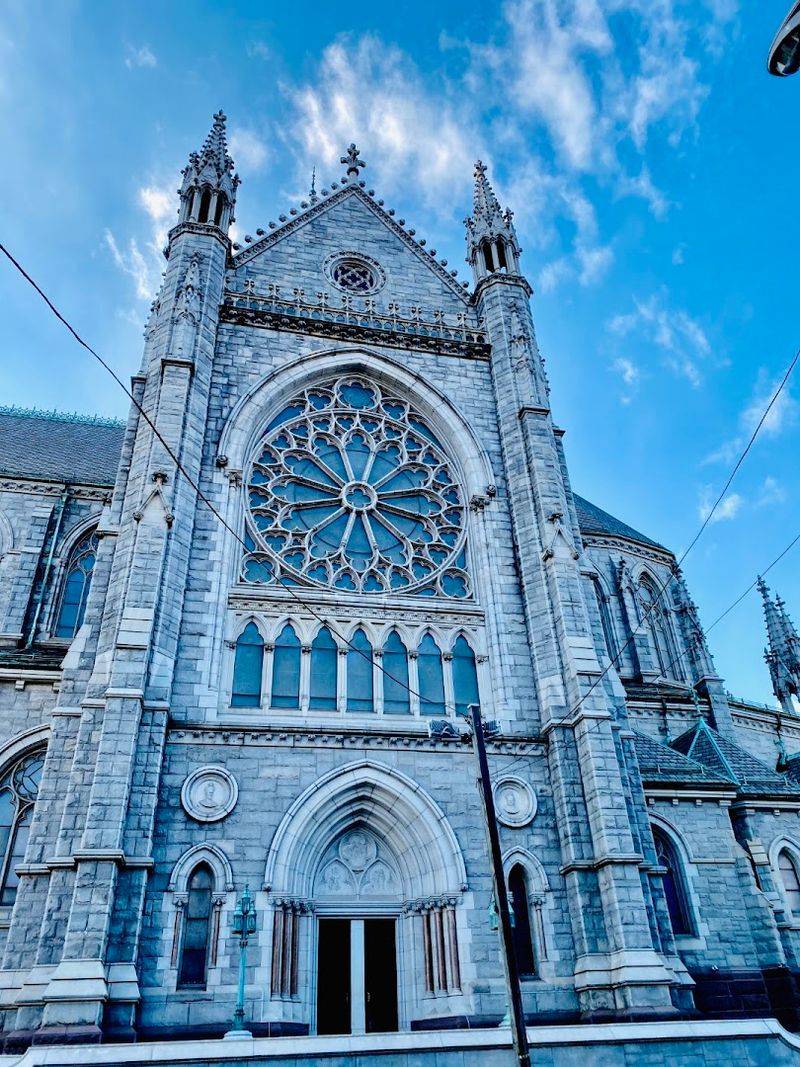
Few buildings in the entire country stop you cold the way this one does. Proposed back in 1859 and finally completed in 1954, the Cathedral Basilica of the Sacred Heart took nearly a century to bring to life.
That kind of patience is almost unimaginable today.
Designed in the French Gothic Revival style, it draws direct inspiration from the grand Rheims Cathedral in France. The cathedral ranks as the fifth-largest in all of North America, covering roughly 45,000 square feet, a footprint comparable to London’s Westminster Abbey.
Its towers actually rise higher than those of Notre-Dame in Paris.
The stained glass here is considered among the finest in the world. Its 36-foot rose window above the main entrance holds the title of the largest such window in any Catholic church in the Western Hemisphere.
Bronze doors imported from Rome, an Italian marble altar, and hand-carved wood and stone decorations sourced from around the globe fill the interior with extraordinary detail.
The basilica also houses the largest pipe organ ever built by the Schantz Organ Company, making it the biggest church organ in all of New Jersey. Six ambulatory chapels inside honor the many ethnic Catholic communities that contributed to its creation.
Address: 89 Ridge Street, Newark, NJ 07104
2. Congregation Ahavas Sholom
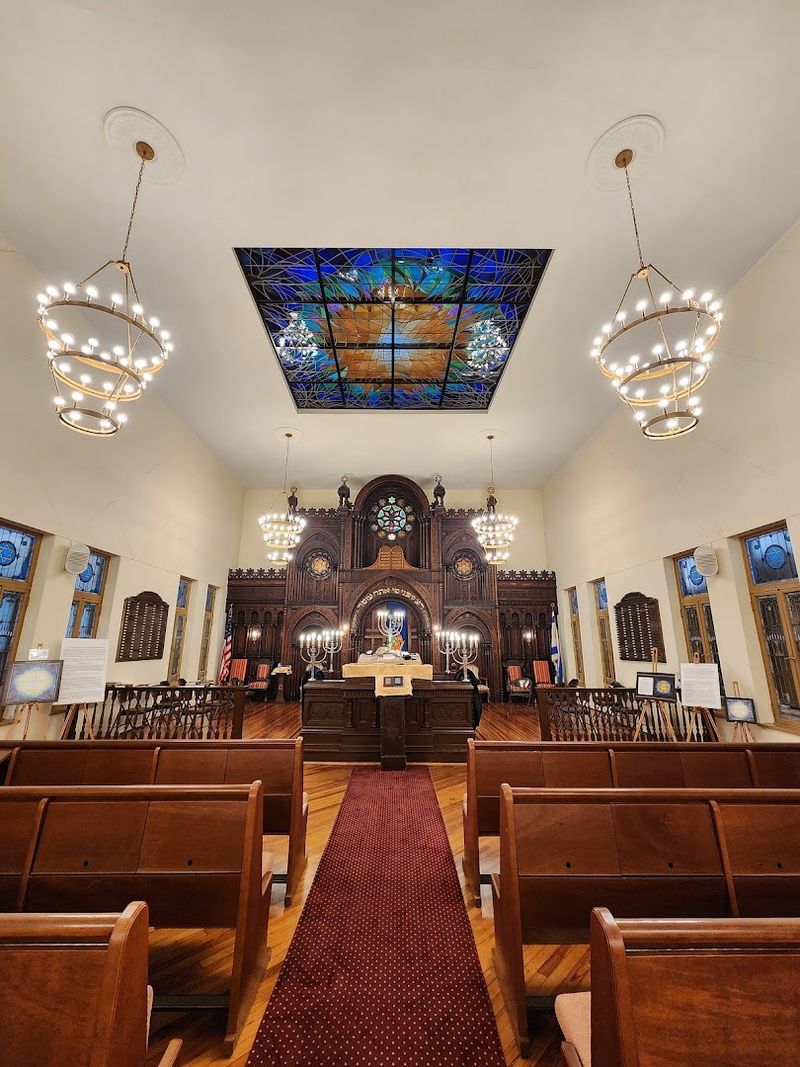
Walking past Congregation Ahavas Sholom feels like flipping back the pages of Newark’s history to a time when the city buzzed with Eastern European immigrant communities building new lives.
Built between 1921 and 1923, this synagogue stands as the oldest continuously operating one in Newark.
It is one of only two active Jewish congregations remaining within the city today.
The exterior showcases a Classical Revival design, with balanced symmetry and clean architectural lines that communicate both dignity and permanence. Step inside and the sense of history becomes even more tangible.
The oldest surviving Ark in all of New Jersey lives here, an intricately crafted mahogany screen dating back to 1872.
That Ark was originally created for a New York City synagogue before being donated to Ahavas Sholom in 1929. Every carved detail tells a story of craftsmanship that simply does not exist in the same way anymore.
This place is a quiet but powerful reminder of Newark’s once-thriving Jewish community in the early twentieth century.
Visiting here connects you to layers of American immigrant history that textbooks rarely capture with this kind of emotional weight. It is small, understated, and absolutely unforgettable.
Address: 145 Broadway, Newark, NJ 07104
3. St. Lucy’s Church and National Shrine of St. Gerard
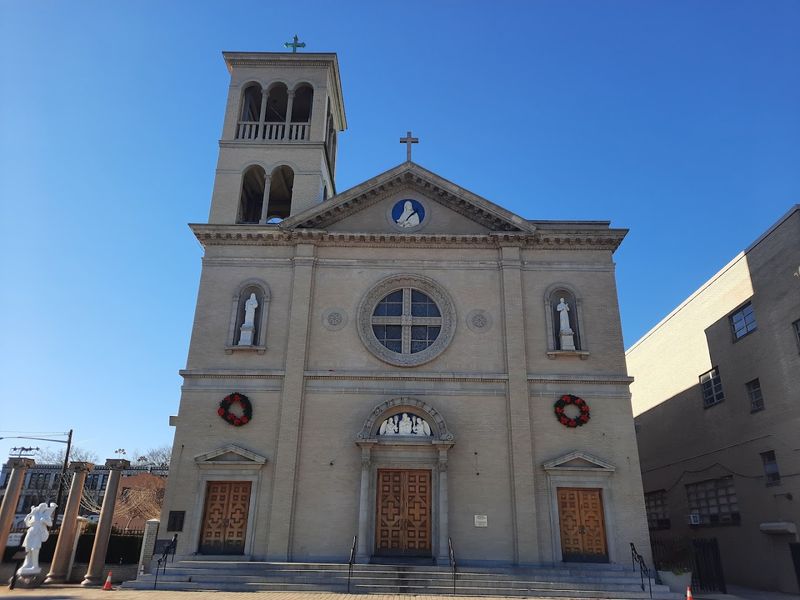
St. Lucy’s carries the kind of warmth you feel before you even cross the threshold. Founded in 1891 as Newark’s third Italian parish, the current brick and stone church was built between 1925 and 1926.
It has served as a spiritual anchor for the Italian community here for well over a century.
In 1977, the National Conference of U.S. Bishops officially designated St. Lucy’s as the National Shrine of St. Gerard Majella.
That recognition came largely because of the church’s famous annual October procession honoring the patron saint of childbearing, an event that draws devoted visitors from across the region every single year.
The architecture blends Neo-Renaissance grandeur with deep Romanesque influences.
Inside, the sanctuary glows with Renaissance and Baroque motifs, including remarkable murals painted by Gonippo Raggi, the same artist who contributed work to the Cathedral Basilica of the Sacred Heart nearby.
Ornate altars, imported statues, and beautiful stained-glass windows fill every corner with color and reverence.
St. Lucy’s continues to celebrate its Italian heritage proudly, functioning as a living cultural gathering place for Newark’s Italian diaspora. The layered history here, artistic, spiritual, and communal, makes it one of the most richly textured sacred sites in the entire state.
Address: 118 Seventh Avenue, Newark, NJ 07104
4. BAPS Swaminarayan Akshardham
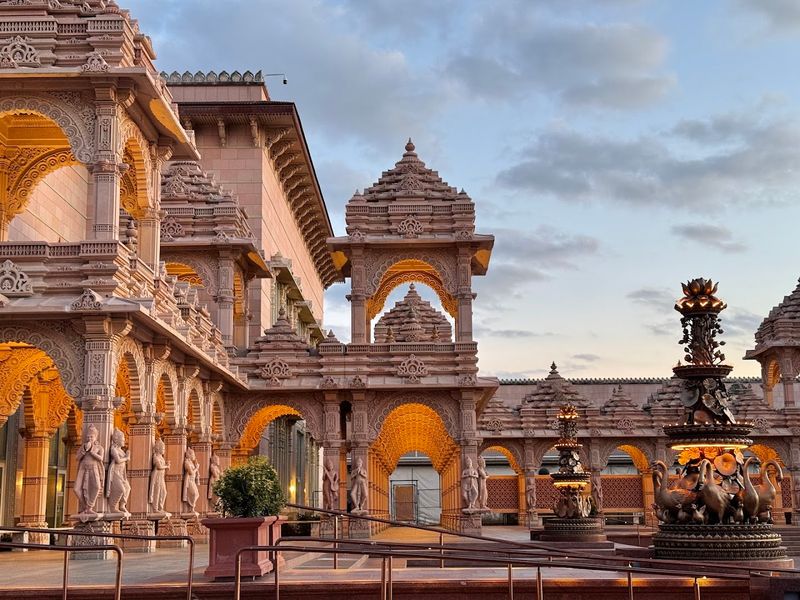
Nothing quite prepares you for the moment Akshardham comes into view. Built between 2011 and 2023 by 12,500 dedicated volunteers, this is the largest Hindu mandir in the entire Western Hemisphere and the second-largest in the world.
The word Akshardham itself translates to a timeless place, and standing before it, that name feels absolutely right.
The main shrine contains no steel or concrete. Instead, massive stone blocks of limestone from Bulgaria, marble from Italy, sandstone from India, and granite from China are stacked and interlocked using ancient traditional methods.
The entire structure spans 255 feet wide, 345 feet long, and soars 191 feet into the sky.
Over 10,000 statues, statuettes, and carved motifs decorate the complex, including all 108 poses of Bharatanatyam classical dance. Inside, 548 elaborately carved marble pillars create an interior that feels both ancient and otherworldly.
The complex covers more than 183 acres and includes one central shrine, twelve sub-shrines, and nine towering shikhars.
Perhaps the most moving feature is the Brahm Kund stepwell, filled with water drawn from 300 rivers in India and all 50 U.S. states. Every detail here was built to last for centuries.
Address: 112 North Main Street, Robbinsville, NJ 08561
5. Princeton University Chapel
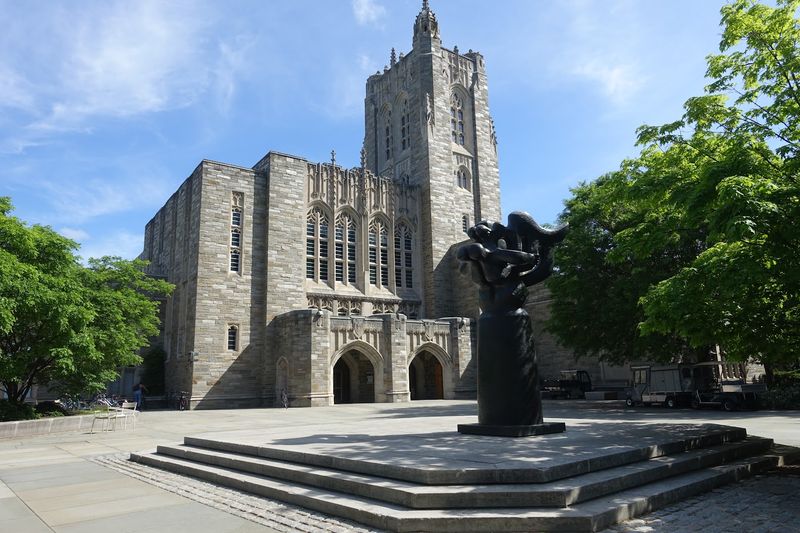
Some buildings feel like they belong to a different century entirely, and the Princeton University Chapel is absolutely one of them.
Completed in 1928 after its predecessor was destroyed by fire in 1920, this chapel was designed by Ralph Adams Cram, a leading figure of the Gothic Revival movement.
Its soaring stone arches and vaulted ceilings recall the great English cathedrals of the Middle Ages.
Upon completion, it held the title of the largest university chapel in the United States. Only King’s College Chapel at Cambridge University exceeded it in size.
That is remarkable company for a building sitting on a university campus in New Jersey.
The stained glass inside is genuinely spectacular, depicting scenes of vice, virtue, and Bible stories alongside Christian figures, Greek philosophers, and figures Cram considered modern secular saints. The intricate stonemasonry and detailed wood carvings throughout reward slow, careful observation.
Every corner holds something worth lingering over.
Princeton’s religious heritage stretches back to the university’s founding in 1746, and the chapel sits at the heart of that long tradition. The campus itself is beautiful, and spending time inside this breathtaking space makes the whole visit feel like a genuine journey into history.
Address: Washington Road, Princeton, NJ 08544
6. Sri Venkateswara Temple
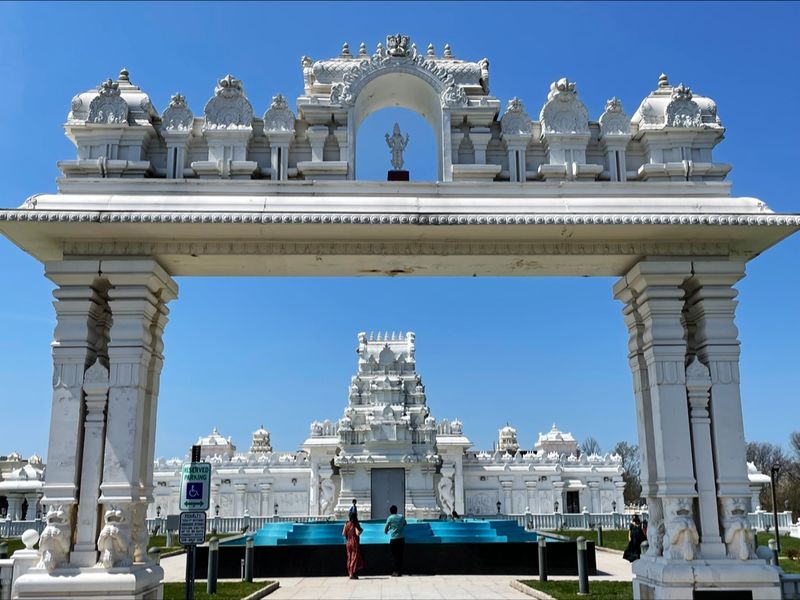
The Sri Venkateswara Temple rises from the New Jersey landscape in a way that genuinely surprises first-time visitors. A group of practicing Hindus established the Hindu Temple and Cultural Society in 1989, land was acquired in Bridgewater in 1992, and construction began in 1996.
The temple opened its doors in 1998 and has since earned recognition as the largest Hindu temple on the entire East Coast.
Every inch of this sacred site was built following the Vastu Shastras, ancient Indian architectural principles governing proportion, spatial harmony, and spiritual alignment. The result is a stunning example of Dravidian architecture, the style associated with South Indian temple building traditions.
A towering golden gopuram dominates the skyline, covered in intricate stone carvings that depict stories from Hindu epics.
Inside, sixteen shrines dedicated to various deities create a devotional landscape that feels both intimate and grand simultaneously. Vibrant murals line the walls, bringing ancient stories to life with remarkable color and detail.
The craftsmanship throughout reflects generations of accumulated knowledge passed down through skilled artisans.
Visiting here connects you not just to a beautiful building but to a living spiritual tradition observed by thousands of worshippers. The peaceful grounds and the extraordinary architecture make this one of New Jersey’s most genuinely awe-inspiring sacred destinations.
Address: 1 Balaji Temple Drive, Bridgewater, NJ 08807
7. New Jersey Buddhist Vihara and Meditation Center
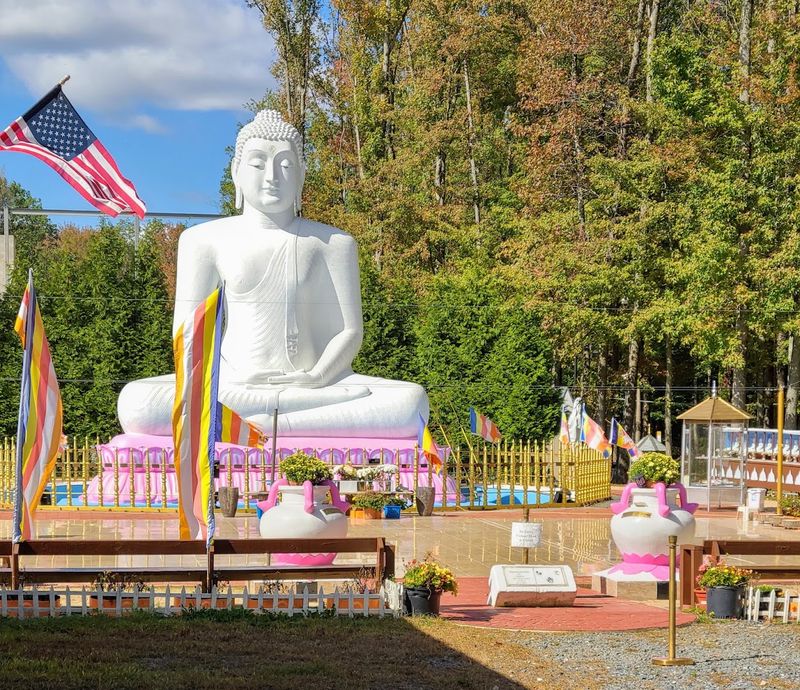
Tucked near Princeton in Franklin Township, this meditation center has a way of making the noise of daily life feel very far away.
Founded in 2003, the New Jersey Buddhist Vihara and Meditation Center operates under the guidance of a Sri Lankan monk trained in Theravada, one of the oldest surviving forms of Buddhist practice.
The spiritual lineage here stretches back thousands of years.
In 2009, the center unveiled its most striking landmark: a 30-foot-tall, all-white Samadhi Buddha statue. Built from cement, brick, and steel, it holds the distinction of being the largest statue of its kind in the entire Western Hemisphere.
Seeing it rise above the surrounding landscape for the first time is a genuinely memorable experience.
The center functions as an interfaith hub, welcoming visitors from all backgrounds who come seeking meditation guidance, quiet reflection, or simply a deeper understanding of Buddhist traditions.
A new 11,000-square-foot building began construction in May 2017 and is nearing completion, adding a library, a meditation hall, and a clergy residence to the campus.
Even if you arrive knowing very little about Buddhism, the atmosphere here teaches something. The stillness is intentional.
The space invites a kind of slow, unhurried attention that feels rare and genuinely restorative.
Address: 4299 Route 27, Princeton, NJ 08540
8. Old Tennent Presbyterian Church
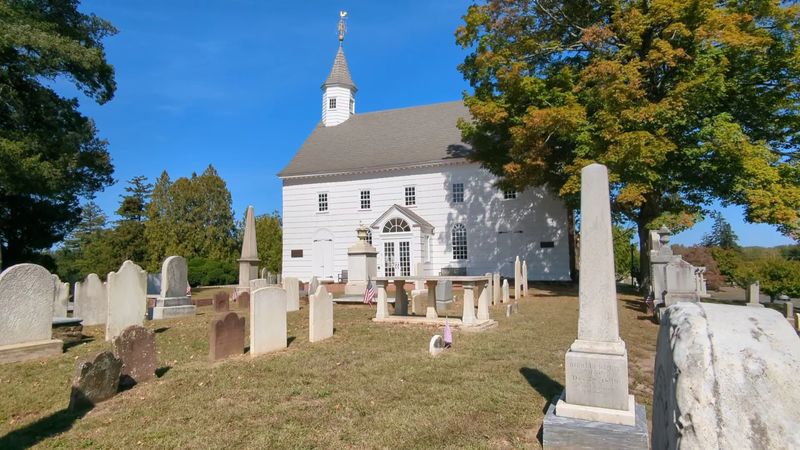
Old Tennent Presbyterian Church has witnessed American history in the most literal sense possible. The congregation was established in 1692 by Scottish Dissenters, and the current building, a textbook example of full English Georgian style, was completed in 1753.
It has remained almost entirely unchanged since then, which is part of what makes visiting it feel so genuinely eerie and wonderful at the same time.
During the Battle of Monmouth on June 28, 1778, the church became a field hospital as fierce fighting raged all around it. General George Washington himself passed by during the battle.
The church walls still bear visible holes left by cannonballs, and the pews carry faint but unmistakable scars from surgeons’ saws used on wounded soldiers.
Standing inside and knowing exactly what happened here creates a kind of emotional weight that no museum exhibit can fully replicate.
The ancient cemetery adjacent to the church holds the graves of Revolutionary War soldiers, including a mass grave for those who did not survive their injuries in the makeshift hospital.
This is one of the least-altered colonial churches remaining anywhere in New Jersey. Every weathered board and worn pew feels like a direct, unfiltered connection to the founding of a nation.
Address: 448 Tennent Road, Manalapan, NJ 07726
9. St. Mary’s Episcopal Church
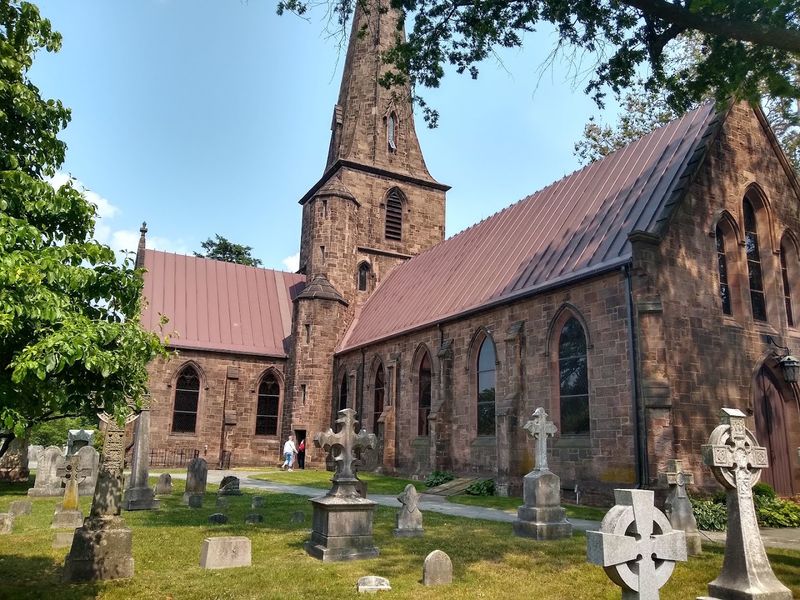
St. Mary’s Episcopal Church in Burlington holds a record that few places of worship in the entire state can claim: it is the first and oldest continuously active Episcopal parish in New Jersey. The original church building was completed in 1703.
As the congregation outgrew that space, a new and considerably more ambitious structure was commissioned from architect Richard Upjohn.
Built between 1846 and 1854 on adjoining land, the newer church was designated a National Historic Landmark in 1986. Upjohn drew his inspiration from St. John’s Church in Shottesbrooke, England, and the result firmly established his reputation as a master of Gothic Revival design.
The building is constructed of rich brownstone, with a long nave and a towering stone spire that immediately commands attention from the street.
Eight bells hang in that spire, cast in England in 1865 by Thomas Mears II. Inside, the atmosphere feels unmistakably English, with aisle lanterns, choir stalls, carved woodwork, and an ornate wrought-iron rood screen dating from 1883.
Every detail was chosen with extraordinary care and has been preserved with equal dedication.
The historic campus also encompasses the original burial ground and the site of the first 1703 church building. Burlington itself is a lovely, walkable city, and St. Mary’s is its most spectacular landmark.
Address: 145 West Broad Street, Burlington, NJ 08016
10. Historic Cold Spring Presbyterian Church
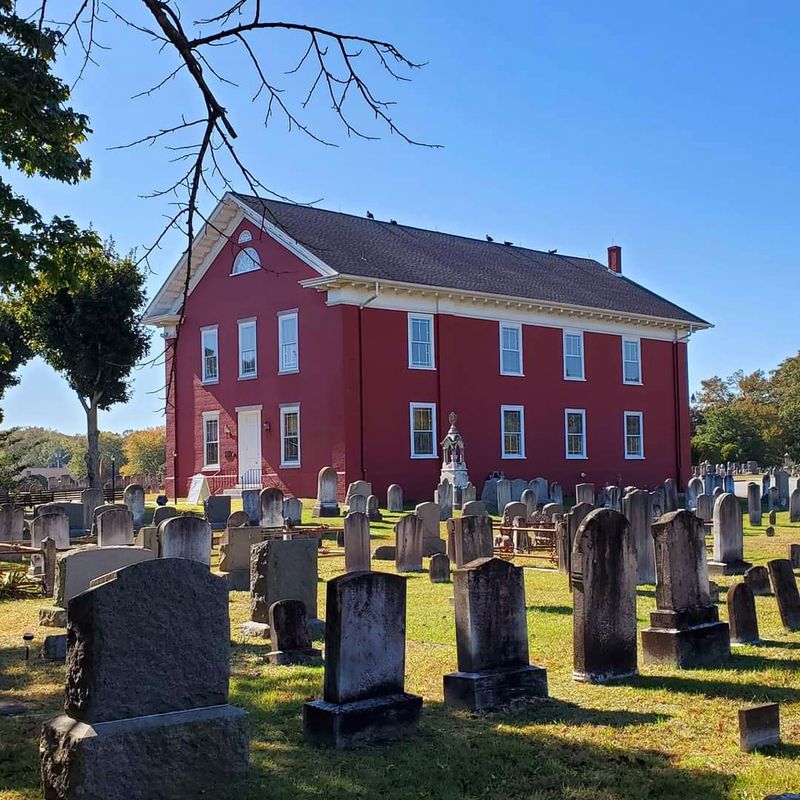
Cape May is famous for its Victorian architecture and ocean breezes, but tucked just outside the resort buzz sits one of the most historically significant sacred sites in all of South Jersey.
The Historic Cold Spring Presbyterian Church congregation was established in 1714, and services have been held continuously on this site ever since.
That is an unbroken run of over 300 years.
The current building, affectionately known as the Old Brick church, was erected in 1823 by Thomas H. Hughes.
It replaced a frame and shingle church from 1764, which itself had replaced the original log meetinghouse built in 1714. The Federal architectural style of the 1823 structure gives it a clean, dignified appearance that feels timeless rather than dated.
The adjacent Cold Spring Presbyterian Cemetery is arguably as compelling as the church itself. It holds a grave dating back to 1742 and contains a higher concentration of Mayflower descendants than almost any other location outside Massachusetts.
Revolutionary War soldiers are buried here as well, resting beneath simple stones in the shade of old trees.
This church is recognized as one of the three oldest religious bodies in Cape May County and one of the oldest in New Jersey overall. Visiting feels like uncovering a quiet, profound piece of American history that most people drive right past without ever stopping.
Address: 780 Seashore Road, Cape May, NJ 08204
