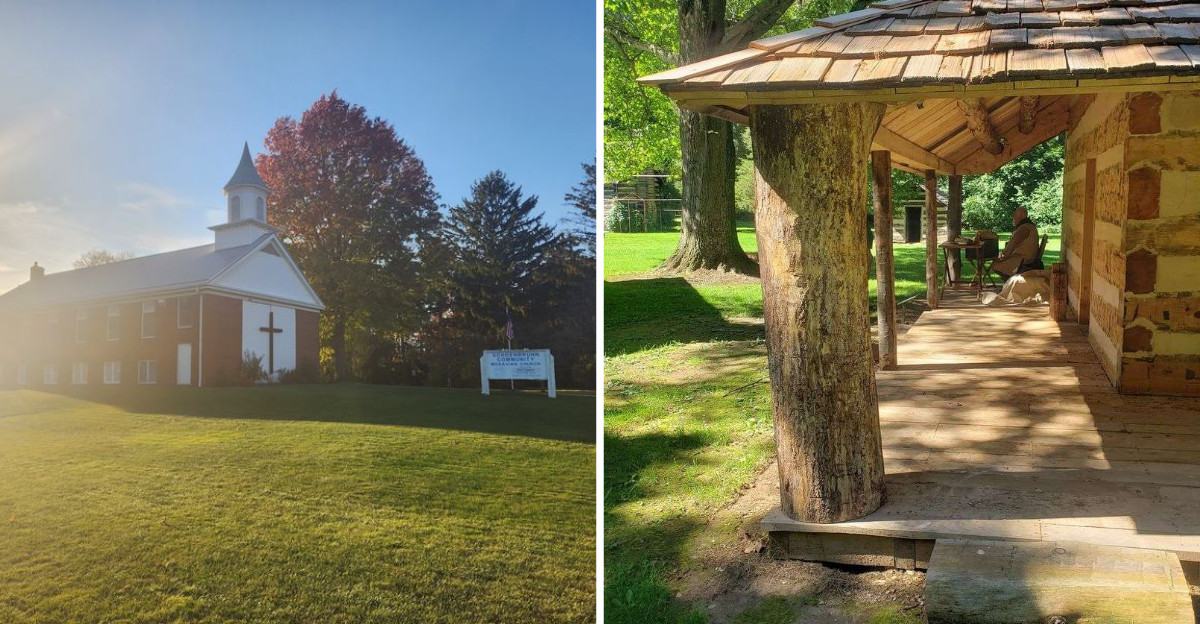
A field of log cabins in eastern Ohio stuck with me for weeks after I first walked through it, and I did not expect that to happen. The village sits just off the highway, and the moment I stepped past the visitor center doors I could feel the story waiting.
The name means beautiful spring in German, and once you see the grassy slope and the wooded edges, that name makes complete sense.
What surprised me most was learning that this whole community, home to hundreds of people at its peak, existed for only five years before its residents took it apart with their own hands and walked away.
The cabins are simple and spare, and the old cemetery holds the stones of people who lived and passed away in that short window.
I wandered through open doorways, stood quietly on the grass, and kept thinking about the lives that fit into five years, the gardens they planted, the church they built, the school they ran.
The history here feels human rather than dusty, and the place deserves an afternoon of your time.
A Village Born in 1772 With a Name That Fits
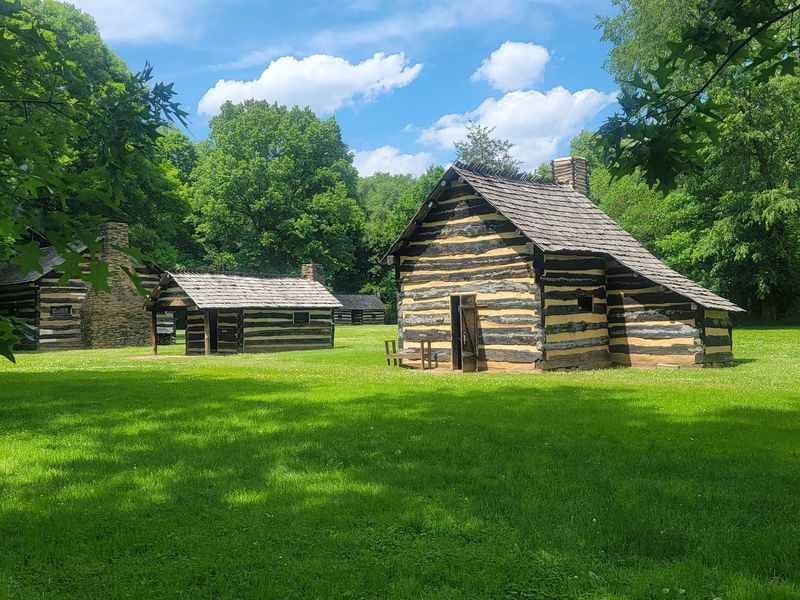
The first thing that struck me was the setting itself. Rolling grass, a tree line, and the kind of quiet that makes you lower your voice without meaning to.
Moravian missionary David Zeisberger arrived in 1772 with a group of Christian Delaware, also known as Lenape, along with a few white companions. They chose this spot because of the fresh spring water and fertile ground, and they named it Schoenbrunn, German for beautiful spring.
Ohio had no towns like it at the time. This became the first Christian settlement in what would later be the state, planted west of the Allegheny Mountains where very few European settlers had ventured.
What I appreciated while walking the paths is how deliberate the layout feels. Cabins line a central street, gardens sit nearby, and the church anchors the community.
Nothing looks accidental.
At its busiest, the village held roughly 60 cabins and more than 300 residents, most of them Delaware. That is a real town by 1770s frontier standards.
Give yourself time to just stand in the middle of the street and look both directions. The scale sinks in faster that way, and you start picturing smoke from chimneys, children running between doorways, and the ordinary noise of a place people genuinely called home.
Ohio’s First Schoolhouse, Where Girls Learned Too
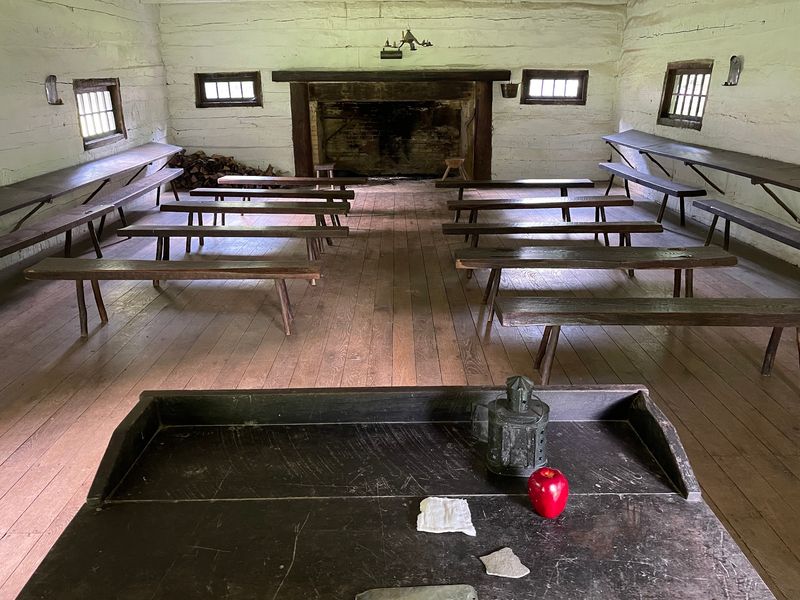
Small wooden benches, a plain room, and a doorway low enough that I ducked out of habit. That was the schoolhouse, and it happens to be the first one built in Ohio.
Here is the part that impressed me most: both boys and girls attended classes. In the 1770s, that was genuinely ahead of its time, and it was not treated as unusual here.
Lessons covered reading, writing, and religious instruction, and children learned in their own language as well as German. Zeisberger himself worked on Delaware language materials, which says a lot about how the mission approached teaching.
Sitting on one of those benches for a minute, I tried to imagine a full room of kids on a cold morning with one small window for light. Not exactly comfortable, but clearly valued.
The village also produced Ohio’s first civil code, a set of rules the residents wrote for themselves covering daily conduct and community responsibility.
If you visit with kids, this building tends to be the one that lands. Comparing a bench and slate to a modern classroom does more teaching than any placard could.
Read the signs posted inside before you move on. They explain how education, faith, and community rules worked together as one system rather than separate ideas.
The First Church West of the Alleghenies
Pushing open the door of the meetinghouse felt different from the cabins. Rows of simple wooden benches, bare walls, and a stillness that had nothing to do with the temperature outside.
Built as the first church west of the Allegheny Mountains, the structure was the beating heart of village life. Services, hymn singing, and community decisions all happened under this roof.
Moravian worship leaned heavily on music, and hymns were often translated so Delaware residents could sing in their own language. I like that detail because it shows exchange rather than one-way instruction.
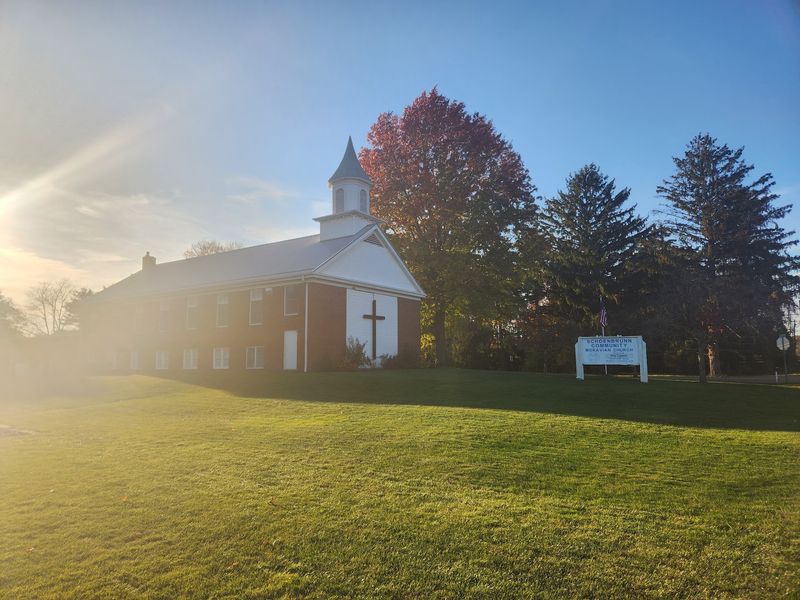
A staff member mentioned that the reconstructed church still holds a connection to the Moravian Church today, which makes the building feel less like a display and more like a continuation.
Sit down for a moment if the room is empty. The acoustics are surprisingly warm for something built from logs.
What stayed with me was the plainness. No gold, no decoration, nothing designed to impress a visitor.
The focus was entirely on gathering.
For a settlement that only lasted five years, building something this substantial says a lot about intent. These residents were not passing through.
They were planting roots they fully expected to keep, which makes what happened next hit harder.
Everyday Life Inside the Cabins
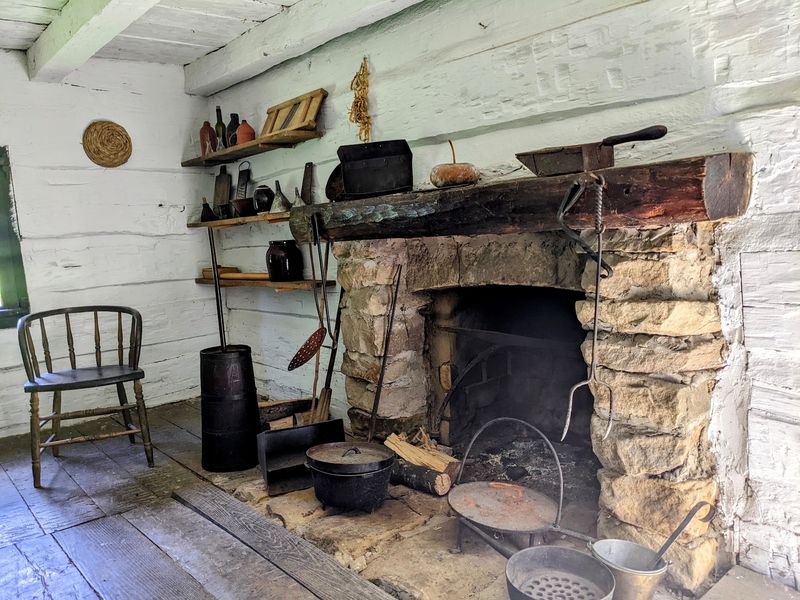
Almost every cabin door was open, and I loved that. You can step inside, look around, and take your time without a rope holding you back.
Inside, the setups vary. Some show cooking hearths with iron pots, others display baskets, pottery, tools, and stacked firewood.
A few feel like someone stepped out and will return shortly.
Daily life here ran on farming, tending livestock, hunting, and craftwork, all wrapped around school and worship. Corn, beans, and squash grew in the community gardens you can still see laid out on the grounds.
Ceilings are low, floors are packed, and the rooms are far smaller than you expect. That contrast between cramped space and 300 residents reframed the whole visit for me.
Bring shoes you do not mind getting damp. Much of the walk crosses a mowed field, and there is a fair amount of ground to cover between buildings.
During special events, costumed interpreters demonstrate old trades and cooking. I have heard about bean soup and johnnycake making appearances, which sounds like the ideal way to experience it.
Even on a quiet weekday without demonstrations, the open cabins do the work. Small details, like a worn wooden bowl or a hanging pelt, carry more weight than a display case ever would.
Caught Between Two Sides in 1777
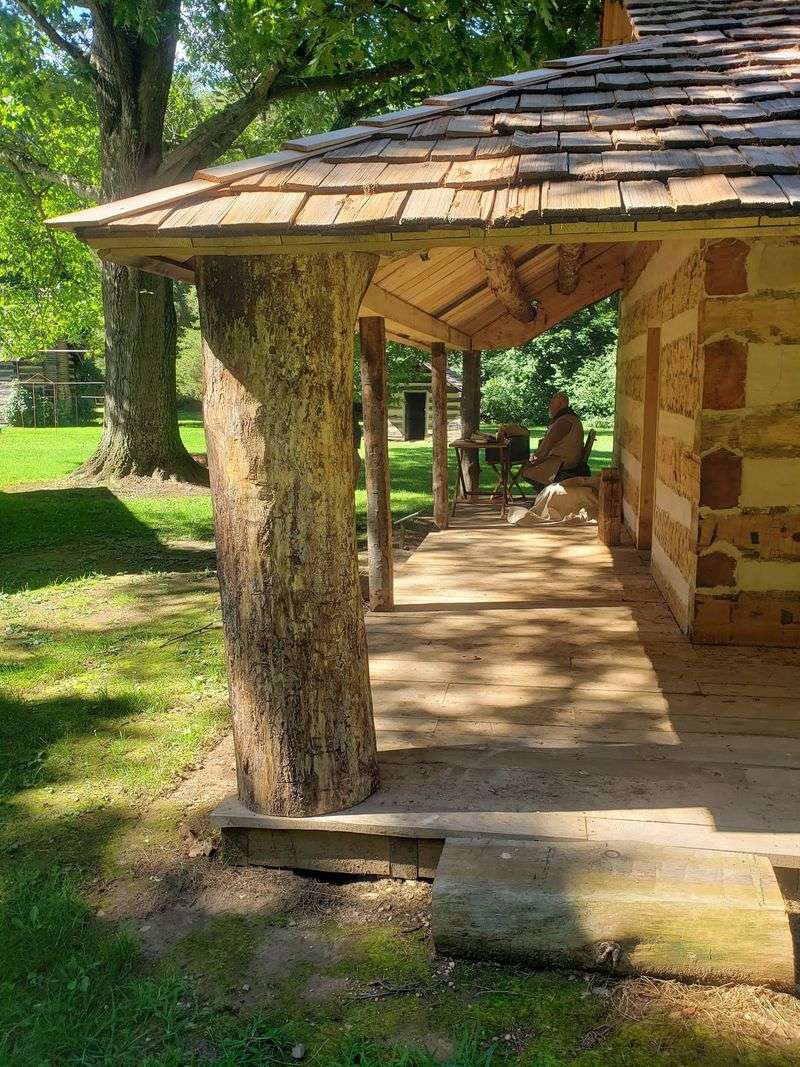
Five years. That is the entire lifespan of Schoenbrunn as a living village, and understanding why still bothers me a little.
The American Revolution turned the Ohio country into dangerous ground. Moravian residents held pacifist beliefs and refused to take up arms for anyone, which sounds noble and turned out to be perilous.
British-allied Native groups did not trust them. American frontiersmen did not trust them either.
Being peaceful in the middle of a war left them with no protectors at all.
By 1777, staying was simply not safe. The residents made the call to leave, and here is the part that gets me: they dismantled their own homes and the meetinghouse before going.
They tore it down so neither side in the conflict could occupy or use it. A community erasing its own town to keep it from becoming a battleground.
Reading that on a placard while looking across an open field changed how the whole site felt. The emptiness suddenly made sense.
Take a few minutes with this section of the interpretive signage before finishing your loop. The reconstruction is beautiful, but the reason it needed reconstructing at all is the real story here, and it deserves your attention more than any single building does.
God’s Acre and the Rediscovery After 140 Years
The cemetery is the one authentic piece of the original village still in place, and it is easily the quietest corner of the grounds.
Known as God’s Acre, the mission burial ground holds simple markers laid flat in rows. Some inscriptions have weathered nearly smooth, which somehow makes them more affecting than polished monuments would be.
After 1777, the exact location of the settlement was lost. Fields grew over it, memory faded, and for more than 140 years nobody could say precisely where Schoenbrunn had stood.
In the early twentieth century, Reverend Joseph Weinland pushed to find it. Archaeological digs in the 1920s confirmed the site, and reconstruction followed.
What made accurate rebuilding possible were the Moravian records. Diaries, letters, and an original village map were detailed enough to place buildings where they actually belonged.
Standing among those grave markers, I kept thinking about the gap. Generations passed with this place completely forgotten under the grass.
Walk the cemetery slowly and read the main interpretive sign at the entrance, since individual stones are hard to decipher. It is a short detour from the cabin loop and, honestly, the emotional center of the whole visit.
Nothing else on the property connects you as directly to the people who lived here.
Planning Your Visit, From the Intro Video to Lantern Tours
Start in the visitor center. There is a roughly ten minute introductory video, and skipping it would be a mistake because everything outside makes more sense afterward.
The attached museum is compact but genuinely good. Artifacts from the village predate the American Revolution, including Bibles dated to 1765, and a small gift shop sits alongside it.
Staff here are the standout. Every review I read and my own experience point the same direction: ask a question and you get a thoughtful answer rather than a recited script.
Hours run Wednesday through Saturday from 10 AM to 5 PM, with Sunday from noon to 5 PM. Mondays and Tuesdays are closed, so plan accordingly.
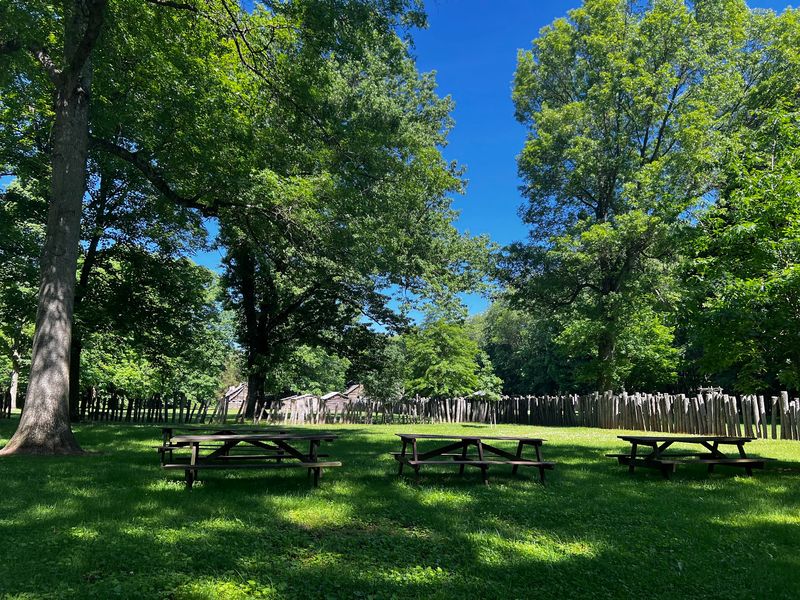
Restrooms are clean, parking is easy, and there is a picnic area if you want to stretch the trip into a longer afternoon.
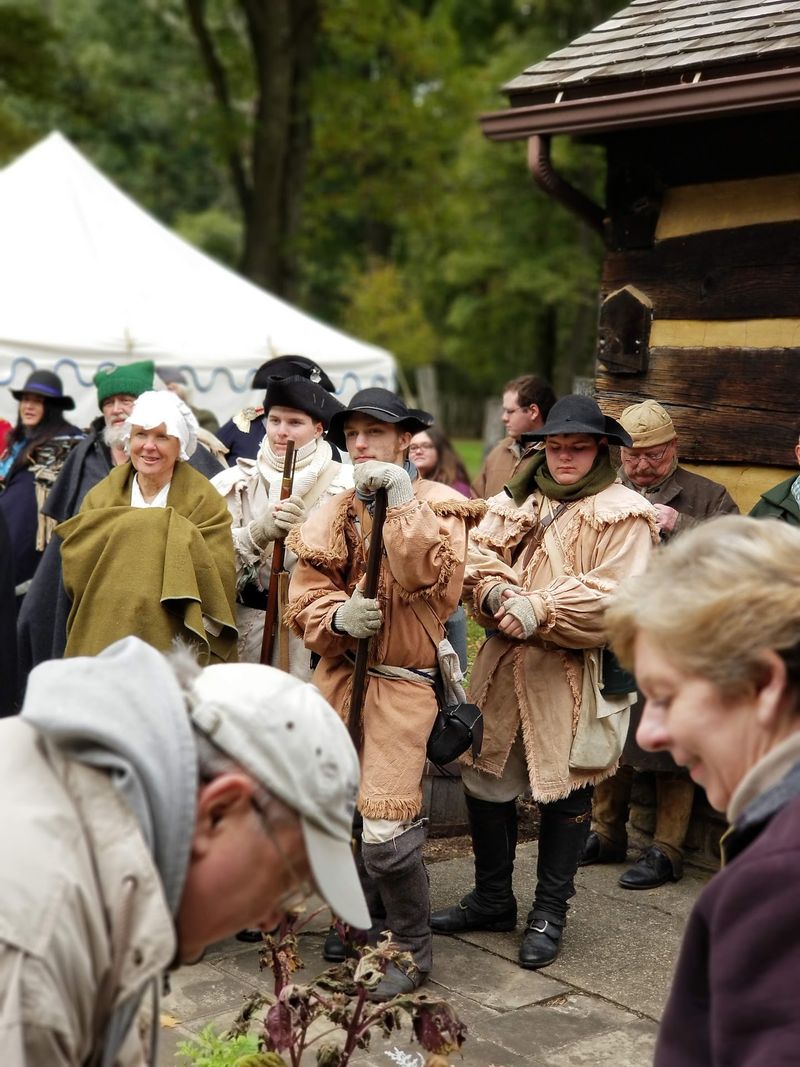
Special events are worth timing your visit around. Lantern tours in the fall bring reenactors into the village after dark, and the colonial trades fair adds demonstrations and craft work.
Address: 1984 East High Avenue, New Philadelphia, OH 44663
