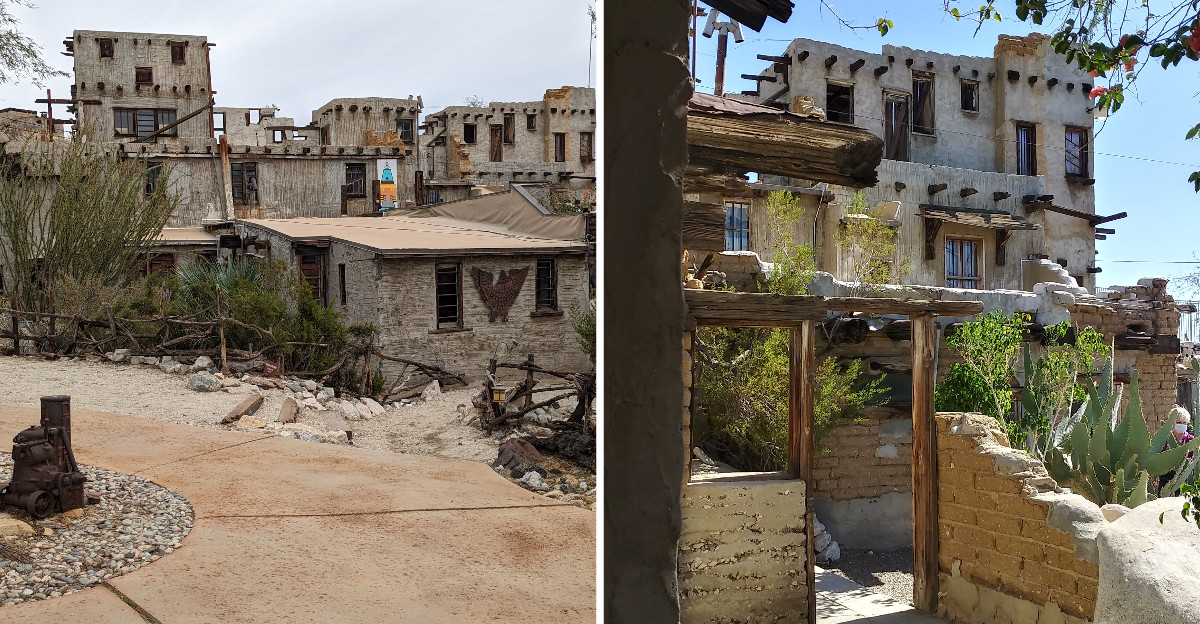
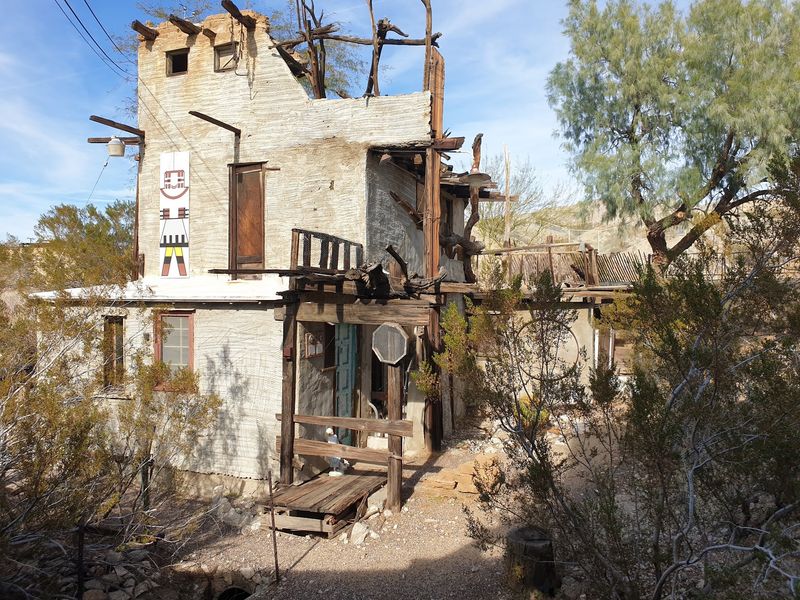
Scrap wood, salvaged doors, and adobe bricks dried in a courtyard came together over decades to form a four-story pueblo that looks like a pile of sun-baked boxes stacked by someone with a very loose idea of straight lines.
California hides this hand-built structure in plain sight, and the road almost carried me past without stopping.
What waited inside was 24 years of one man’s work, started at age 58 and continuing until his passing in 1965. Crooked hallways lead to mismatched windows and rooms that defy easy description.
Two hours disappeared while wandering and squinting, and half of it still felt missed. The fingerprints of the builder are everywhere, on every surface and in every corner.
Places with this much personality do not come along often, and this one stays with you long after the drive home.
Cabot Yerxa, The Man Who Never Stopped Wandering
Long before he mixed a single brick of adobe, Cabot Yerxa had already lived about four lifetimes. He was born in 1883 on a Lakota Sioux reservation in North Dakota, and that early exposure to Native American culture stuck with him permanently.
As a teenager, he headed north to Alaska during the Klondike Gold Rush. While he was there, he picked up the Inupiat language and later sold a translated word list to the Smithsonian, which is not a typical résumé line for a kid that age.
His travels kept going from there. Paris, where he studied art.
Cuba and South America, where he collected experiences and objects that would eventually line the walls of his desert home.
In 1913 he landed in the Coachella Valley and homesteaded 160 acres on a spot he named Miracle Hill. Armed with a pick and a shovel, he located two separate aquifers, one hot and mineral-rich, the other cold and clean, split by the Mission Creek Fault.
That discovery helped shape the town of Desert Hot Springs, and he is credited as one of its founders. He also spoke up for Native American legal and cultural rights throughout his life, which makes the pueblo feel less like a hobby and more like a statement.
Twenty-Four Years, One Pair of Hands
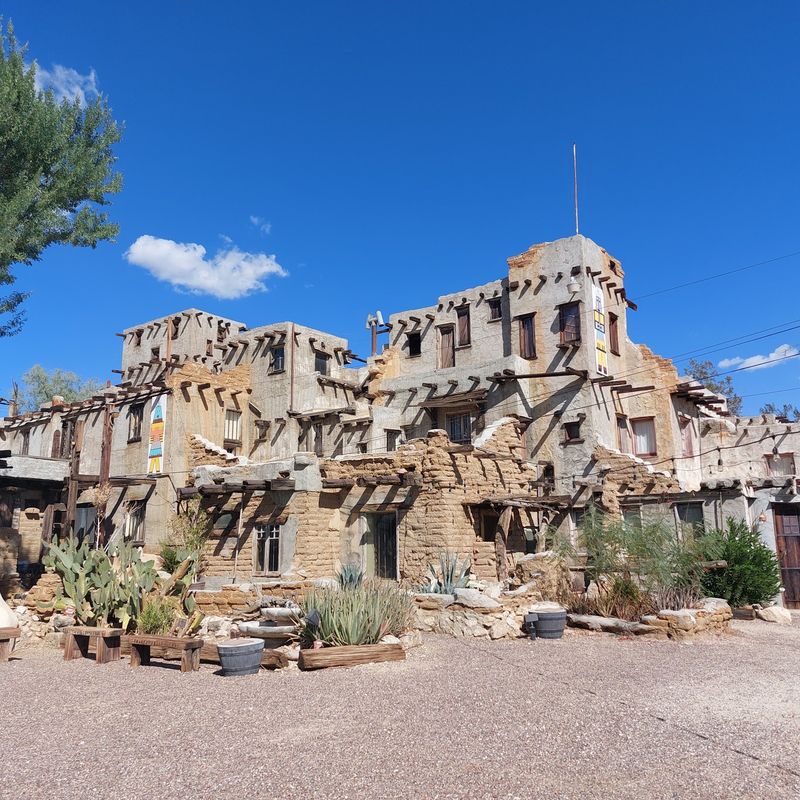
Here is the detail that genuinely stopped me: he began construction in 1941, at 58 years old. Most people are thinking about slowing down at that age.
Cabot picked up a trowel instead.
He worked on the pueblo until his end in 1965, which adds up to 24 straight years of building. No crew, no blueprints in the modern sense, no contractor rolling up with a truckload of lumber.
The materials came from wherever he could find them across the Coachella Valley. Old railroad ties, discarded telephone poles, sheet metal, odd scraps of wood that someone else had given up on.
He bought abandoned cabins just to take them apart and reuse the lumber. He even straightened bent nails so they could go back to work, which tells you everything about how he thought.
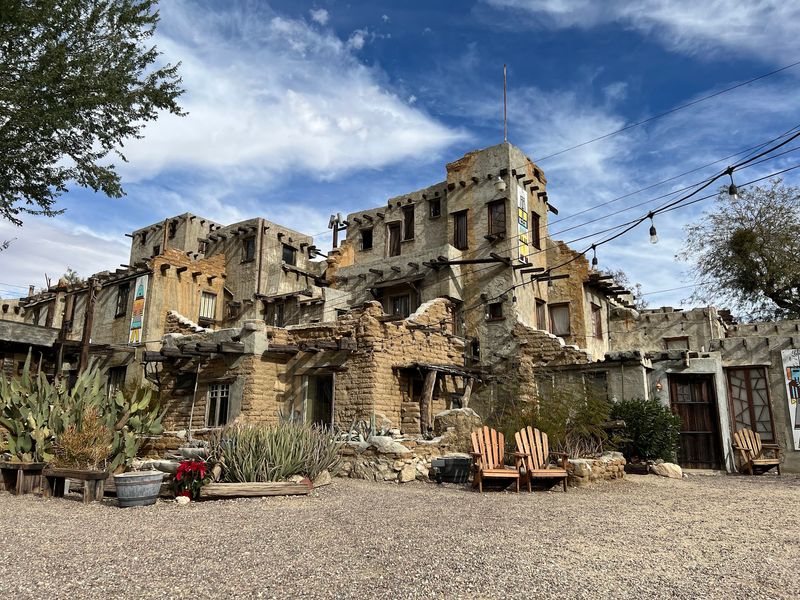
Much of the adobe-style brickwork was made by his own hands and dried in the courtyard under desert sun. Standing near those walls, you can see the slight irregularities where one batch differs from the next.
The architecture leans on Hopi and Pueblo Revival traditions, but the execution is pure improvisation. It is a building that grew slowly, one salvaged piece at a time, and you can feel that patience in every corner.
Thirty-Five Rooms, 150 Windows, and Zero Matching Doors
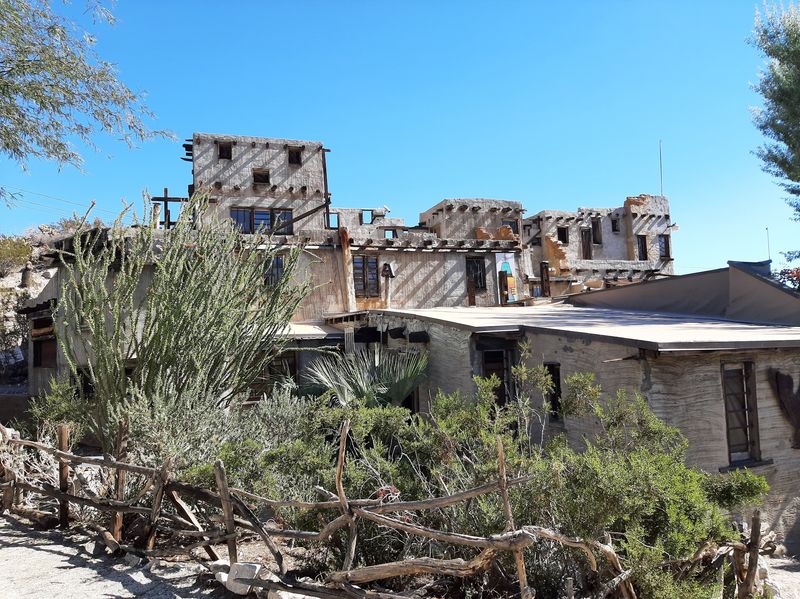
The numbers sound made up until you see them stacked in front of you. Four stories.
Roughly 5,000 square feet. Thirty-five rooms, 150 windows, 65 doors, and 30 separate roof levels.
My favorite part was realizing that almost no two windows match. Different sizes, different frames, different eras, each one salvaged from somewhere and fitted into whatever gap needed filling.
The doors follow the same logic. Some are tall and narrow, others short enough that taller visitors instinctively duck, and a few are placed at angles that seem to serve no purpose at all until you notice the light they catch.
Staircases twist in unexpected directions and ceilings shift height from room to room. Several reviewers mention narrow stairs, and they are right, so flat shoes are a genuinely good call here.
The roofline is the real showstopper from outside. Thirty different levels create a stepped silhouette that changes completely depending on where you stand on the grounds.
Photographers love it for exactly that reason, and late afternoon light throws long shadows across the textured walls. There is no symmetry to find, no repeated pattern to latch onto, and honestly that is the charm.
The building refuses to behave, and it is far more interesting because of it.
Desert Smart Before It Had a Name
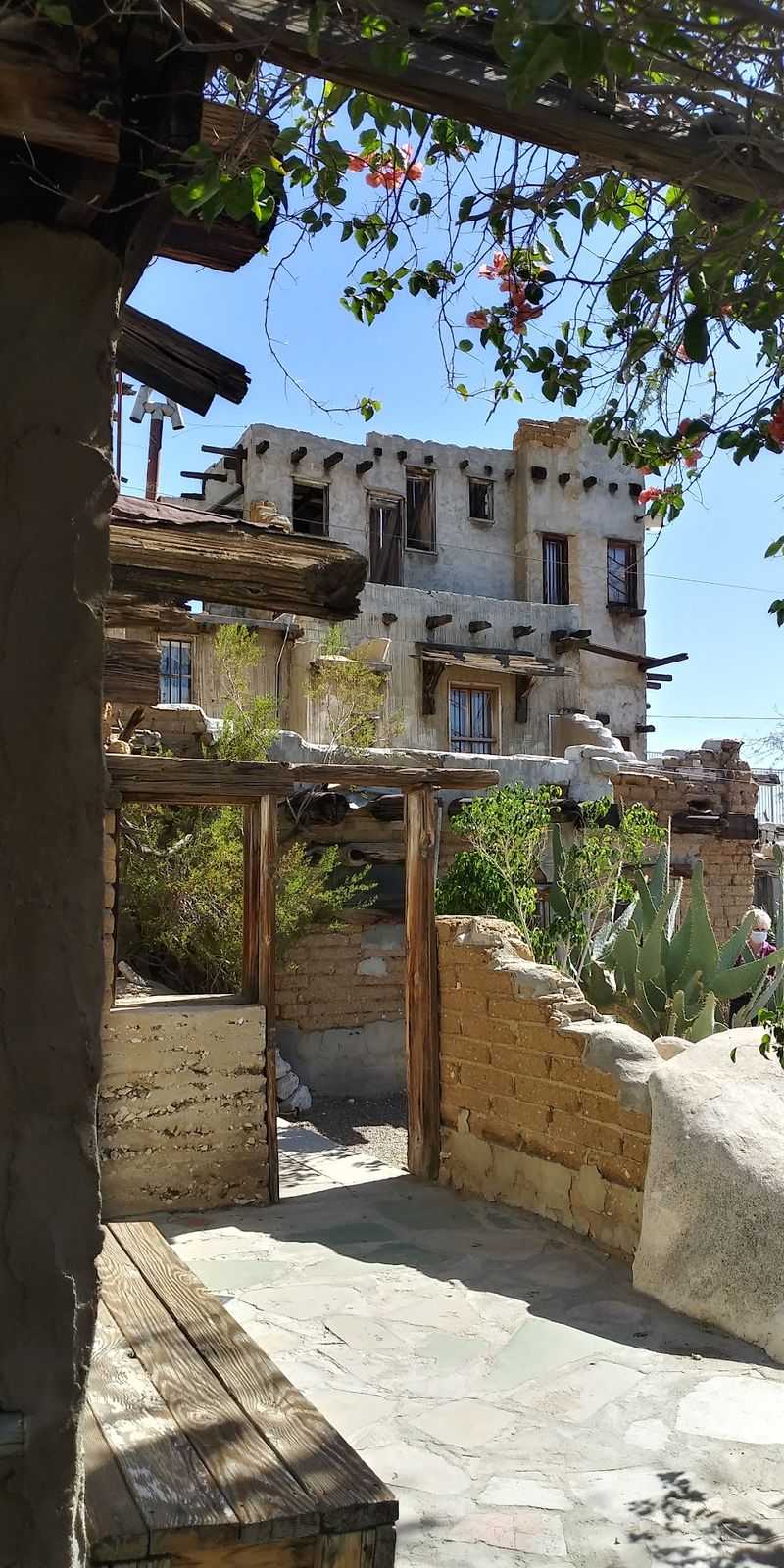
Something I did not expect was how cool the inside felt compared to the blazing yard outside. Cabot built with the climate in mind decades before anyone was using the word sustainable in casual conversation.
A good portion of the pueblo is tucked into the side of a hill, which gives the structure natural insulation from both summer heat and winter chill. Thick adobe walls handle the rest.
Inside the walls, he built a network of vents and shafts designed to move air through the building. Paired with carefully placed windows, the system creates cross-ventilation that pulls hot air out and draws cooler air in.
The whole structure sits on an east-west axis with most windows facing west, a deliberate choice that improves airflow. None of this was accidental.
He even packed discarded newspaper presses from the Los Angeles Times into the walls as insulation, which is possibly the most Cabot solution imaginable.
Learning all of that changed how I looked at the place. It stops being a quirky pile of found objects and starts reading as a carefully engineered response to a harsh environment.
Modern desert architects chase these same goals with expensive materials. He got there with scrap paper, dirt, and a very good sense of where the wind goes.
Rooms Packed With Pottery, Paintings, and Souvenirs
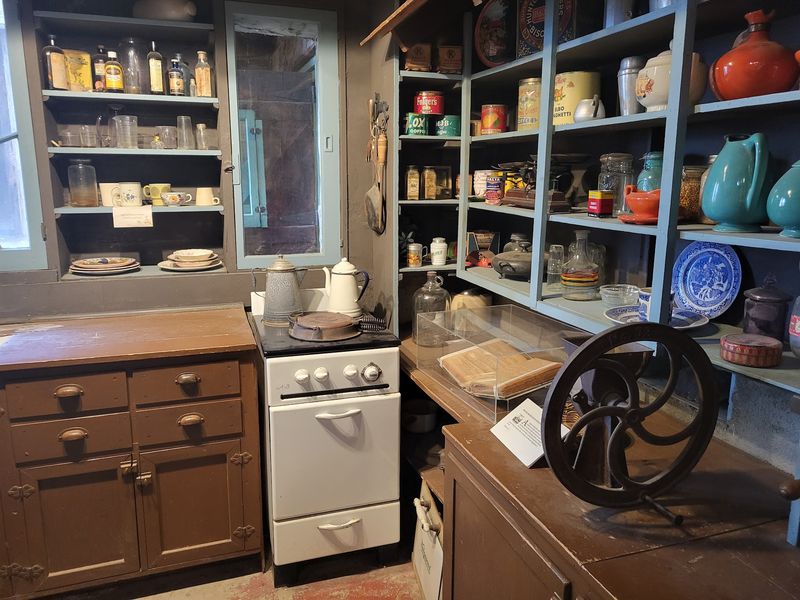
Every room hides something. Pottery on a shelf, a basket tucked into a nook, a black and white photograph of the valley back when it was mostly sand and ambition.
The collection leans heavily toward Native American artifacts, with a particular focus on Hopi work. Pottery, baskets, and textiles appear throughout, echoing the Hopi-inspired architecture wrapped around them.
There is a room specifically dedicated to Native American culture, and it is worth slowing down for. Handcrafted pieces sit close enough that you can study the detail without a wall of glass between you.
Beyond that, the museum holds historic photographs documenting early life in the Coachella Valley. Seeing the region before development is a strange and grounding experience.
Cabot was also a painter, and his own artwork hangs throughout the pueblo. Some pieces are landscapes, others portraits, and all of them add another dimension to a man already hard to summarize.
Scattered among everything are souvenirs from his travels, vintage tools, old kitchenware, and even presidential letters and documents.
A practical tip from my visit: the audio tour assigns clips to specific rooms, and it genuinely helps. Without it, you are looking at beautiful objects with no context.
With it, each room turns into a chapter.
Waokiye, the 43-Foot Giant Watching the Valley
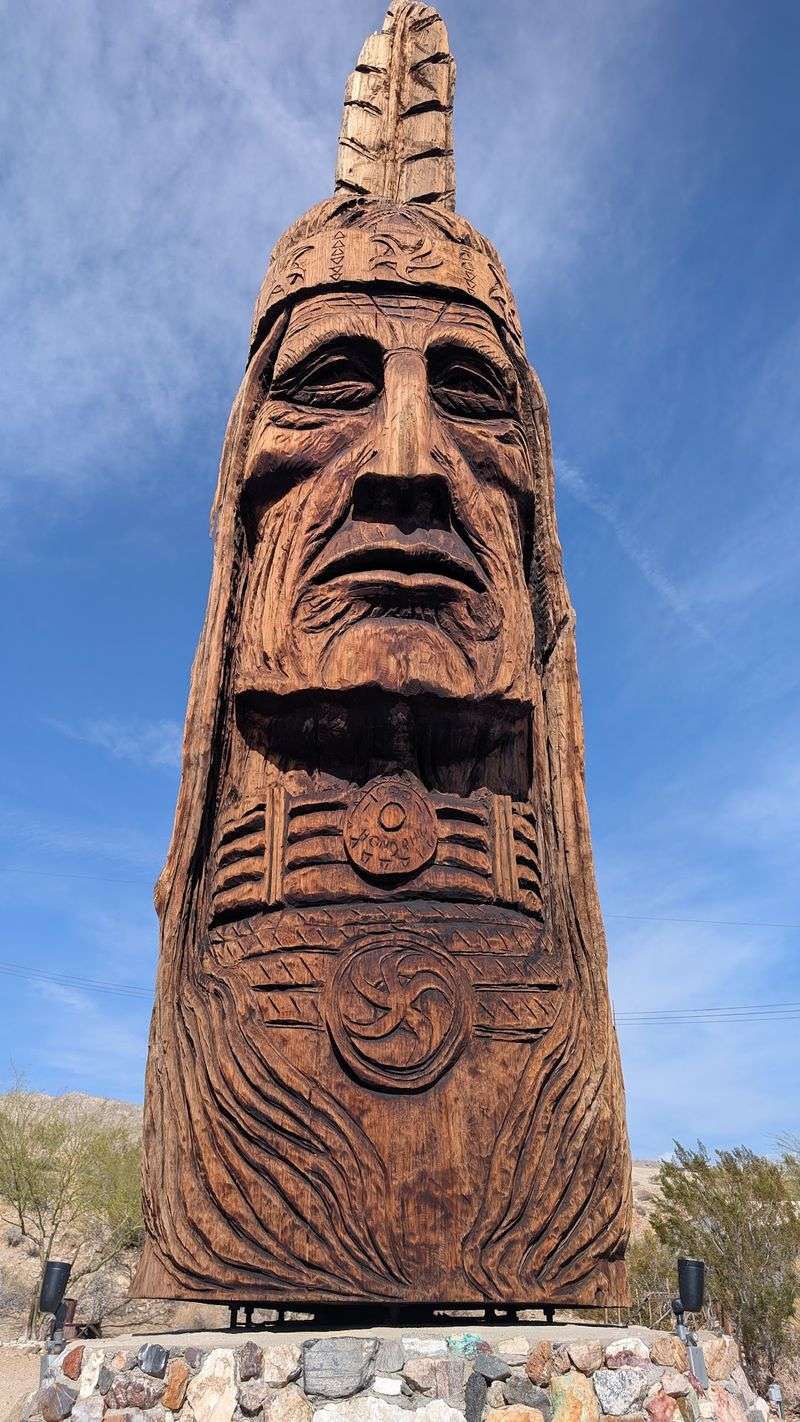
You spot it before you reach the entrance. A carved wooden head rising 43 feet above the desert ground, face turned toward the valley, weathered by decades of sun.
The sculpture is called Waokiye, pronounced Way-OH-kee-yay, and it was carved in 1978 by Hungarian-born artist Peter Toth.
Waokiye belongs to Toth’s Whispering Giants series, a collection of monumental sculptures he placed across every U.S. state and into Canada as a tribute to Indigenous peoples. This one is the only Whispering Giant in California.
Getting close to it gives you a real sense of scale. The grain of the wood, the depth of the carving, the sheer size of the piece all land differently in person than in photos.
It pairs naturally with Cabot’s own respect for Native American culture, which makes its placement here feel intentional rather than decorative.
Around the giant, the grounds open up into shaded courtyards and pockets of desert plants. I found a bench in the shade and just sat for a while, which is not something I usually do at museums.
Walk behind the pueblo too. The view stretches across the valley toward the mountains, and it is easily one of the best free vistas in the area.
Saved From Ruin, How the Pueblo Survived
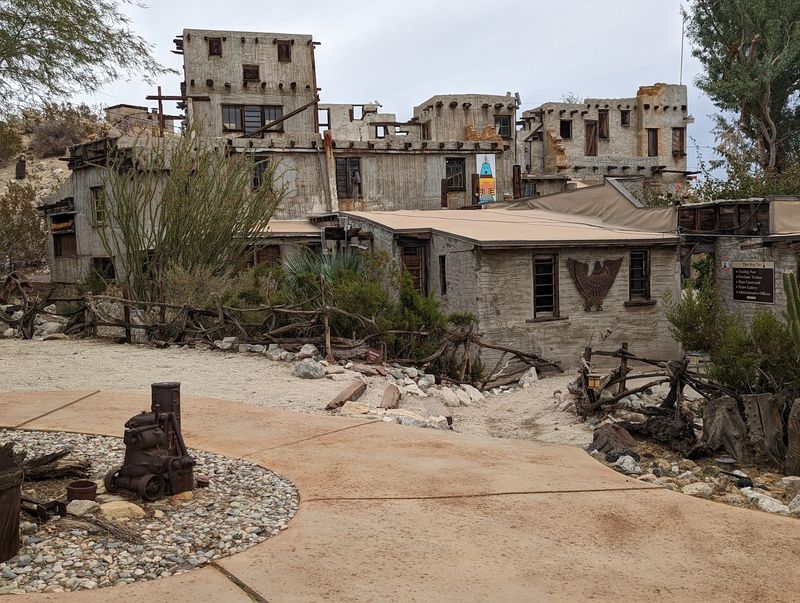
The pueblo came very close to being lost. Cabot always intended it to serve as both his home and a museum, and it opened to the public in some form between the mid-1940s and early 1950s.
After he passed away in 1965, his wife Portia eventually moved back to her native Texas. The building sat empty.
What followed was a rough stretch of abandonment and vandalism, the kind of slow decay that swallows a lot of unusual old structures in the desert.
A friend of Cabot’s named Cole Eyraud stepped in. He purchased the property, restored it, and later donated it to the City of Desert Hot Springs, which is the only reason any of us can walk through it today.
The city now owns the site, and the Cabot’s Museum Foundation, a non-profit, operates it. The pueblo is recognized as an American historic house museum and listed on the National Register of Historic Places.
Knowing that history added weight to my visit. Every restored beam and patched wall represents somebody deciding this thing mattered enough to save.
There is also an art gallery on site and a Trading Post shop, where purchases help fund ongoing upkeep of the pueblo and the surrounding land.
Planning Your Visit Without the Guesswork
A little planning saves a lot of frustration here, so learn from my near-miss. The museum keeps limited hours: Thursday through Saturday from 9 AM to 1 PM, and Sunday from noon to 4 PM.
It is closed Monday through Wednesday.
Interior access requires a ticket, and guided or timed tours can fill up. Booking ahead is the smart move, especially on weekends.
Much of the grounds can be explored without a ticket, which is great if you only have twenty minutes. The inside, though, is where the real story lives.
The self-guided audio tour runs on your phone, with clips tied to individual rooms. Bring headphones, and if you are with a group, a small speaker helps everyone hear.
Docent-led tours are also offered, and the guides share details about Cabot’s travels, the building process, valley history, and his advocacy work.
Wear closed shoes rather than sandals. The floors are dusty, the stairs are narrow, and the hillside construction means uneven footing in places.
Budget one to two hours. There are restrooms, a water fountain, easy parking, and a gift shop with Mata Ortiz pottery worth a browse.
Address: 67616 Desert View Ave, Desert Hot Springs, California 92240
