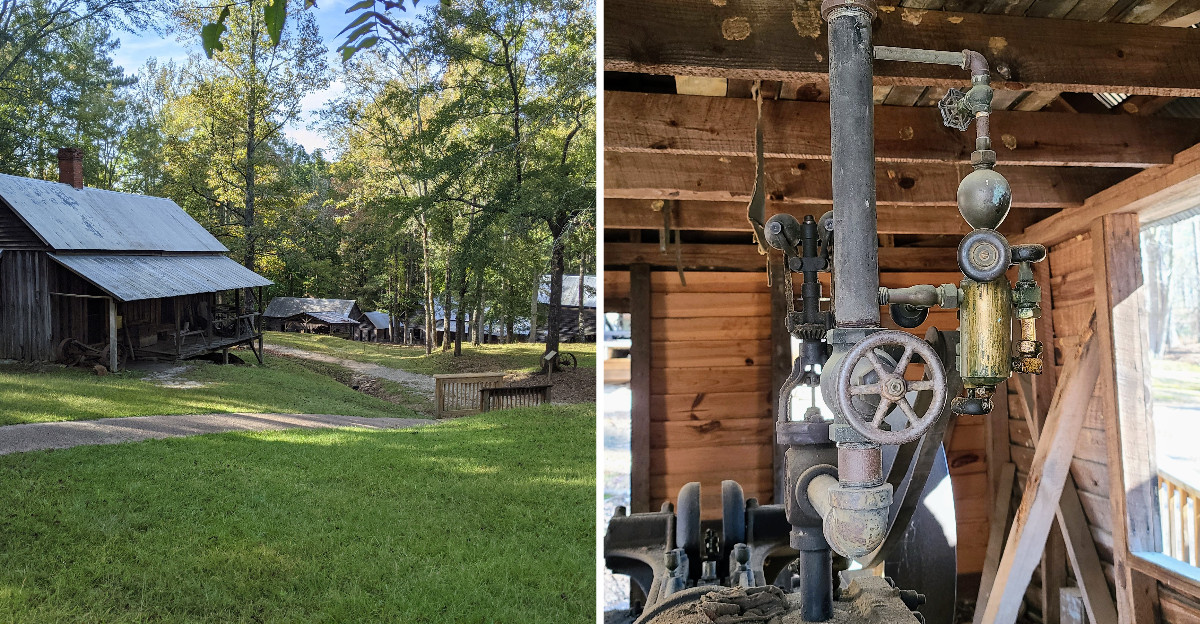
Iron machines that still look ready to run cover a hillside in Georgia where a quiet farmhouse was expected. The road in is narrow and shaded, red clay showing through the pine needles, and the parking lot is small enough that you feel like you stumbled onto something private.
Scale got me, because one family did not just grow cotton here. They built their own sawmill, gristmill, cotton gin, and syrup operation and powered the whole thing with steam.
Twenty buildings sit scattered across the slope, most of them original, and you can walk right up to the belts and boilers that made it all work. One rooster patrolled the path ahead like he owned the deed.
By the time I reached the bottom of the hill, it had stopped being a farm and become a small factory town run by one stubborn, clever family.
The Heart Pine House That Started It All in 1847
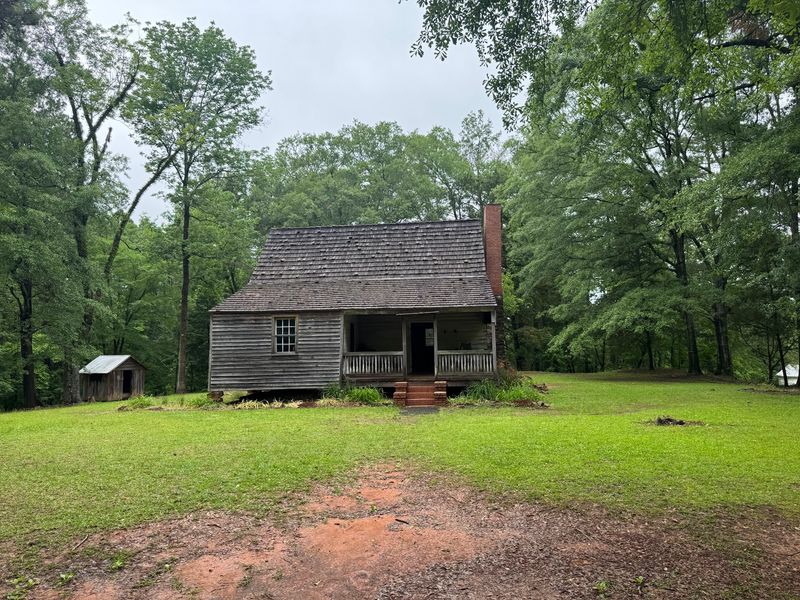
My first stop was the oldest structure on the property, the plain plank house John Fitz Jarrell raised in 1847 out of heart pine cut nearby. There is no grand columned portico here, no sweeping staircase.
What you get instead is honesty. The boards are wide, the rooms are small, and the whole thing feels built by people who measured twice and had no interest in showing off.
By 1863 the surrounding land had grown to roughly 600 acres, farmed by 42 enslaved African laborers, and that fact sits heavily over everything you see afterward. The site acknowledges it on its signage, though several visitors have noted they wish the interpretation went deeper, and I understood why.
Only a brick chimney remains from the tenant and slave housing that once stood here.
Standing inside the old house, I kept noticing details like the worn door frames and the low ceilings that trapped heat in winter. The family survived Sherman’s March, typhoid fever, and eventually the boll weevil while living in rooms this modest.
Go slowly through this building. It sets up the entire story that unfolds downhill.
Dick Jarrell’s Big Idea: Steam Power Changes Everything
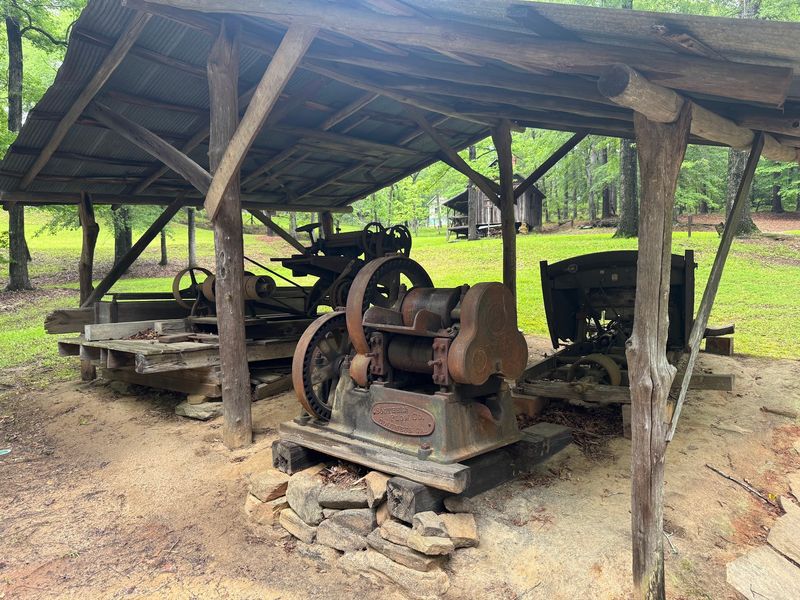
Here is the turning point of the whole place. After his father passed, Benjamin Richard Jarrell, known as Dick, came back to the farm in 1895 with a plan that had nothing to do with planting more cotton.
He bought steam engines.
With steam, one family could run a sawmill, a cotton gin, a gristmill, a shingle mill, a planer, a sugar cane press, and a syrup evaporator. Neighbors brought their corn, their logs, and their cane, and the Jarrells earned income from processing instead of only from crops in the ground.
That shift is the reason this site matters so much to historians of Middle Georgia. It captures the exact moment a farm economy started borrowing tools from industry, and it happened on a hillside in the middle of nowhere.
Seeing the engine houses in person made the idea click for me faster than any museum panel ever could. Belts, pulleys, shafts, and gears all radiate out from one source of heat and water.
Read the diagrams posted inside. They show how power traveled from boiler to blade, and suddenly the scattered buildings look like one connected machine.
An 1895 Cotton Gin Still Standing in Its Own Building
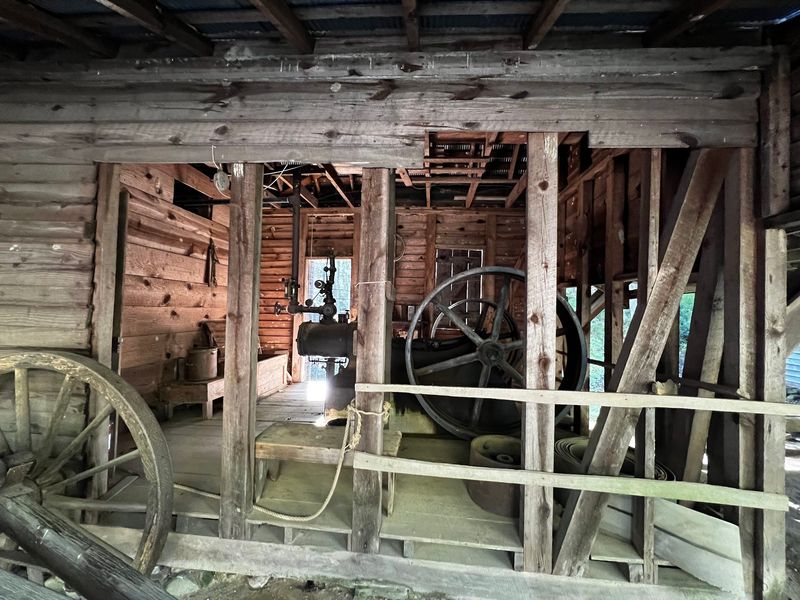
Cotton built this place, and the gin is where you can actually see how. The Jarrells used a Franklin Loomis gin, built in Juniper, Georgia, installed here in 1895 and driven by steam rather than by mules or muscle.
Before machines like it, separating seed from lint was brutally slow work.
What surprised me was how wooden it all looks. I expected heavy cast iron, but much of the frame is timber, with the metal saving its strength for the saw teeth and shafts that do the tearing.
You can lean in close and see the whole mechanism.
The gin sits in its own building along the trail, and on demonstration days rangers and volunteers bring parts of the operation to life, which is absolutely worth timing your visit around if you can. Call ahead to ask, because the schedule is not always posted clearly online.
Even quiet, it is a striking object.
I stood there thinking about how a single machine changed how much land a family could farm, and how much labor it took to feed it in the first place.
Sawmill, Shingle Mill, and the Planer Nobody Expects
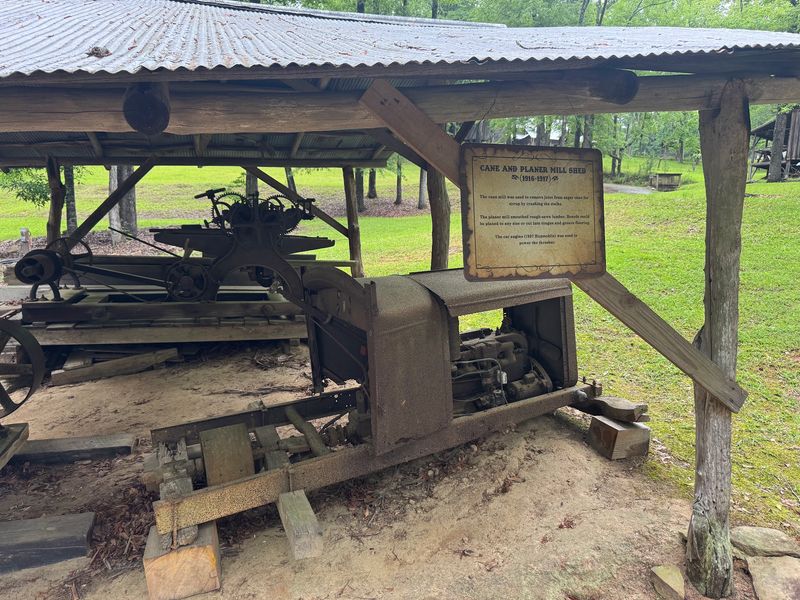
Lumber was the sneaky second business on this hill, and I think it might be the most impressive part of the site. The Jarrells ran a sawmill, a shingle mill, and a planer, meaning they could take a standing pine tree and turn it into finished boards and roof shingles without leaving home.
Look at the buildings around you and it clicks.
Much of what you are walking through was likely cut, sawn, and smoothed right here. A family that owns a sawmill builds differently than a family that has to buy every plank.
The blade housing and carriage track are still in place, and standing beside them you get a real sense of the noise and danger involved.
There were no guards, no shields, no safety switches, just fast steel and careful hands. Rangers explain that reality well if you catch one on the trail.
Bring decent shoes for this section. The paths near the lower work buildings turn to packed dirt and loose rock, and the slope down from the houses is steeper than the map suggests.
Take your time and look up at the roof lines.
The Cane Mill That Got a Car Engine Transplant
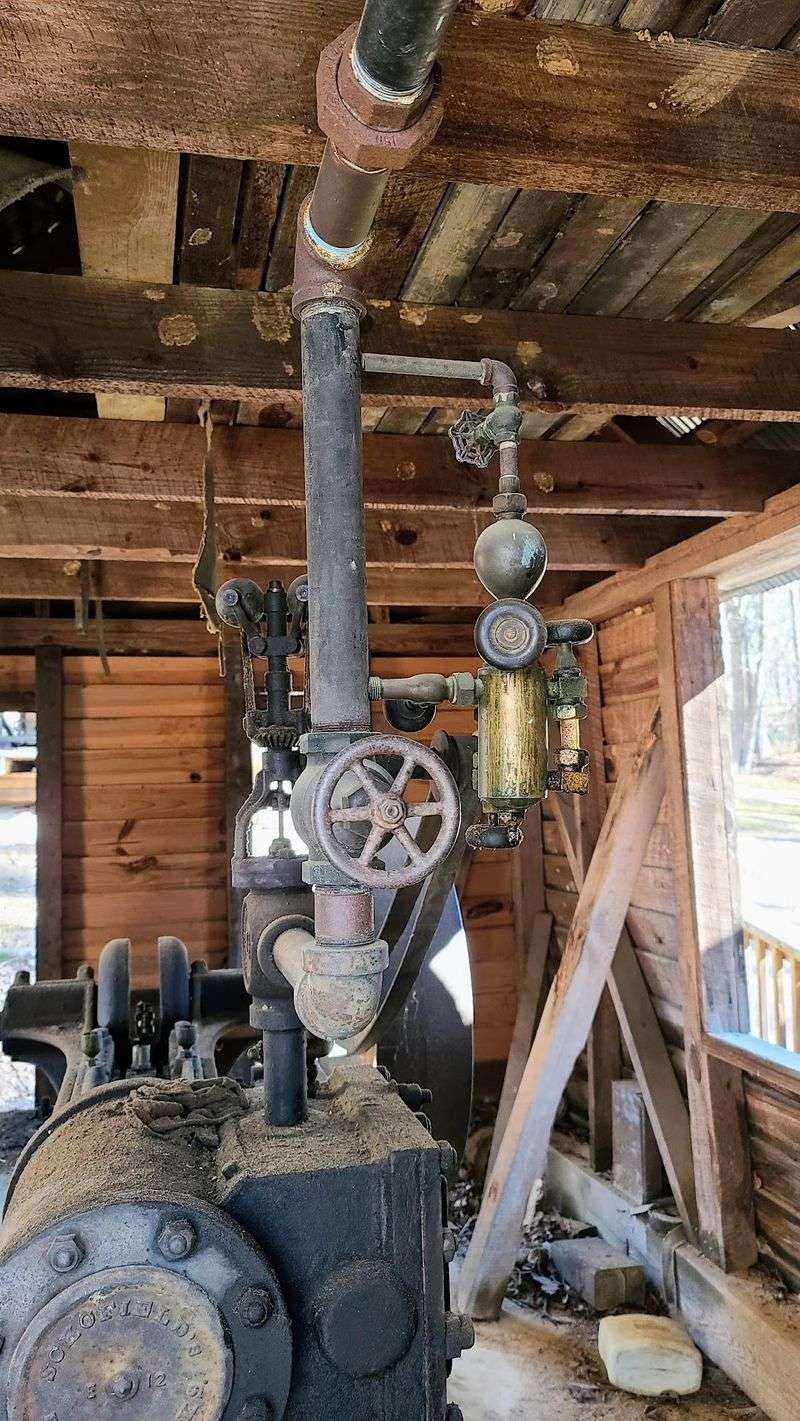
My favorite quirky detail on the property involves a car. The cane mill here is a Columbus No. 20, originally turned by steam, and at some point the family adapted it to run off a 1927 Hupp Motor Car engine instead.
That is pure farm ingenuity.
Rather than replace the whole setup, they bolted on whatever power source made sense at the time and kept crushing cane. Next to the mill sits the evaporator house, where the juice was boiled down into syrup over long, sticky, smoky days.
Syrup making was a social event as much as a chore, tied to cool weather and harvest timing.
Walking between the rollers and the evaporator pan, I could almost picture the steam rising and the smell of hot cane hanging in the air. The equipment is worn in all the right places, the kind of patina you only get from decades of real use.
Look for the mismatched parts and repairs. Those small improvisations tell you more about how this family actually lived than any polished exhibit could, and they made me grin every time I spotted one.
Blacksmith Shop and Workbenches Loaded With Tools
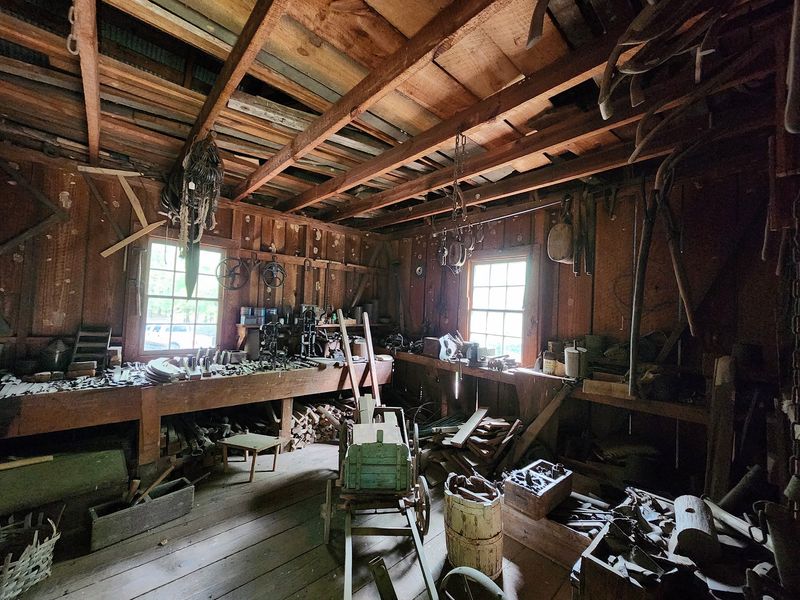
If you like tools, budget extra time for the blacksmith shop and the work sheds beside it. The collection inside is remarkable, hand tools hanging in rows, tongs and hammers near the forge, benches crowded with the odds and ends of constant repair.
Nothing here was decorative.
A place running this much machinery needed someone who could shape metal on demand, because a broken shaft in the middle of ginning season could not wait for a delivery from town. That self-reliance is really the theme of the entire site.
I found myself trying to guess what half the implements were for, which turned into a fun game.
A ranger passing by cleared up two of my wrong guesses, and that kind of casual conversation is genuinely one of the best parts of visiting. Staff here know the property deeply and seem happy to open doors and explain things when the trail is quiet.
Weekdays are quieter than weekends, so your odds of a long chat go up.
Ask questions freely. The answers turn a shed full of rusty iron into a working story about problem solving.
The Half-Mile History Trail Through Twenty-Odd Buildings
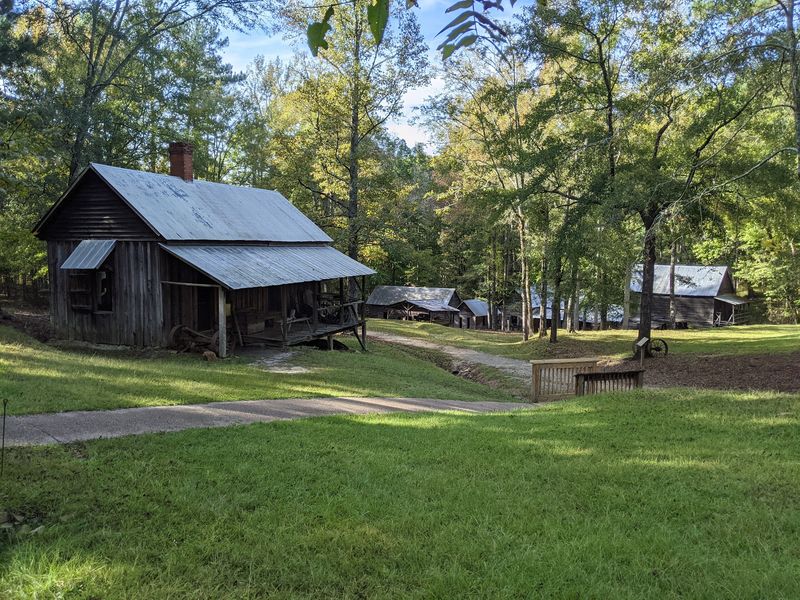
Getting around the site is its own small adventure. A half-mile history trail links the buildings, dropping downhill from the houses toward the work structures, with interpretive panels along the way that explain what you are looking at.
Some sections are paved. Others are not.
The lower stretches get steep and rocky, which matters if anyone in your group uses a scooter or a walker, since reaching the bottom buildings can be difficult. Wear real shoes and pack bug spray, because the woods here are thick and the mosquitoes do not read hours of operation.
Start at the visitor center first.
There is a short film covering the family and the property, plus exhibits and artifacts that give context before you set out on your own. Tours are self-guided, but rangers often appear along the trail and will sometimes unlock a building or two.
Picnic tables sit under the trees out front, and since there is no food service, bringing a lunch is smart.
I ended up circling back to two buildings for a second look. Plan on roughly two hours to see everything without rushing.
How a Family Farm Became a State Historic Site
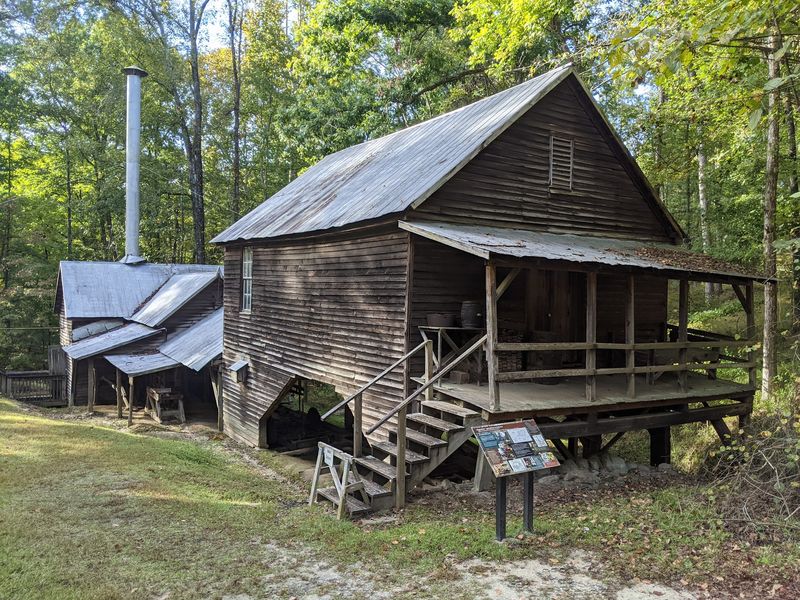
Something worth appreciating is that this place survived because the family wanted it to. Jarrell descendants donated the buildings in 1974 so the property could become a state historic site, and it had already landed on the National Register of Historic Places in 1973.
That is more than 140 years of one family holding the same ground.
Most farmsteads like this got sold off, burned, or slowly collapsed into the woods. Instead, the machines stayed in their buildings and the buildings stayed on their hillside, which is why you can still see a complete picture rather than scattered pieces.
Occasional special events bring extra life to the grounds.
Farm heritage days, lantern tours, and demonstration weekends turn the static equipment into something moving and loud, and visitors who catch those days tend to rave about them. Checking the state parks website or phoning ahead is the best way to line up your trip with one.
Goats and chickens wander the grounds, adding an unexpected barnyard charm.
Location matters too, roughly fifteen miles north of Macon, tucked well off the main roads.
Address: 711 Jarrell Plantation Road, Juliette, Georgia
