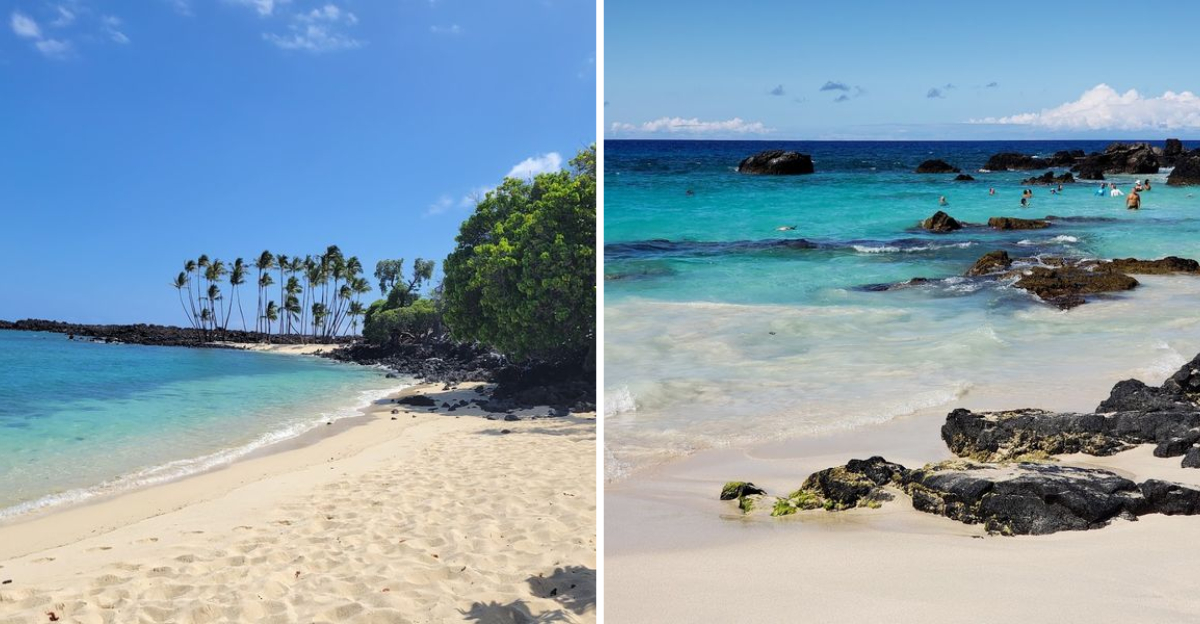
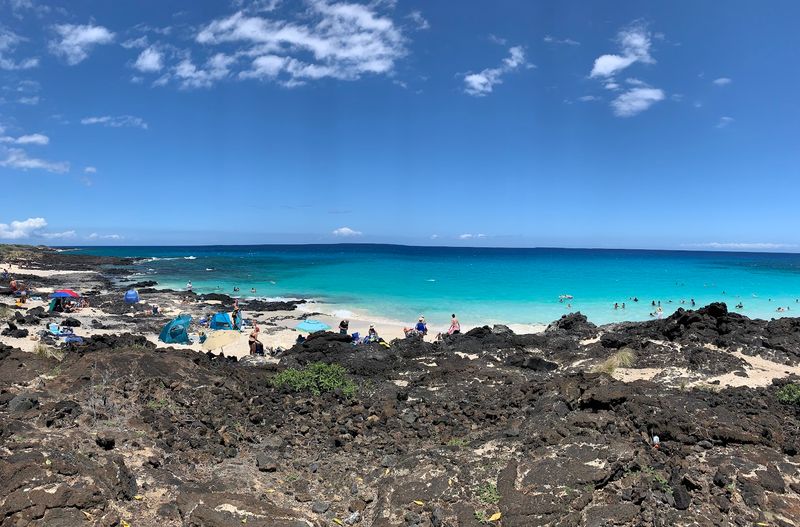
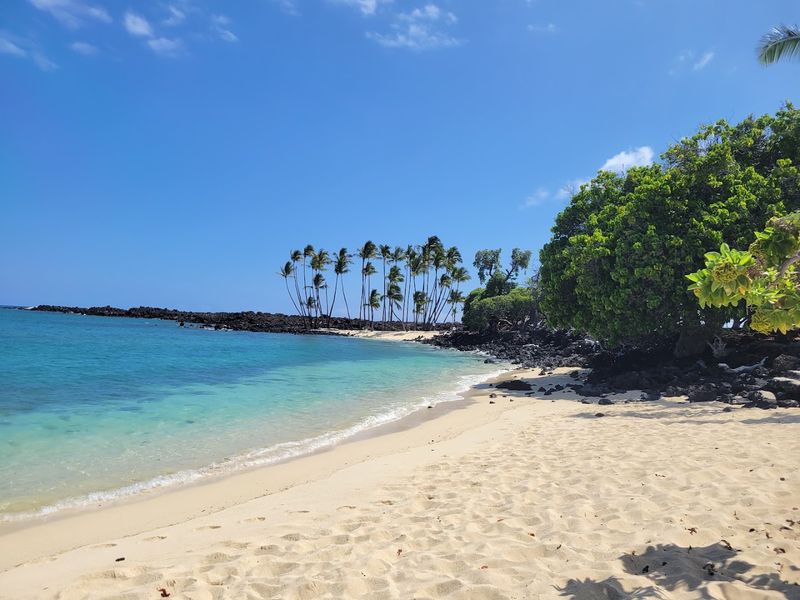
White sand glows against black lava rock in Hawaii, and the water hits in a shade of turquoise that honestly looks photoshopped. I stood there for a solid minute just trying to take it all in before even thinking about setting my bag down.
That beach sits along the rugged west coast of the Big Island and has earned a reputation as one of the most photographed beaches in all of Hawaii. After one visit, you completely understand why.
The contrast between the bright sand, the dark rock, and the impossible blue water makes every angle look like a postcard. I found a spot on the sand and watched the waves roll in, the sound of the ocean drowning out everything else.
The sun was warm on my skin, and the water was so clear I could see the rocks beneath the surface from where I sat. This is the kind of place that makes you cancel your afternoon plans and stay until the gate closes.
The Sand and Water That Make Every Photo Look Unreal
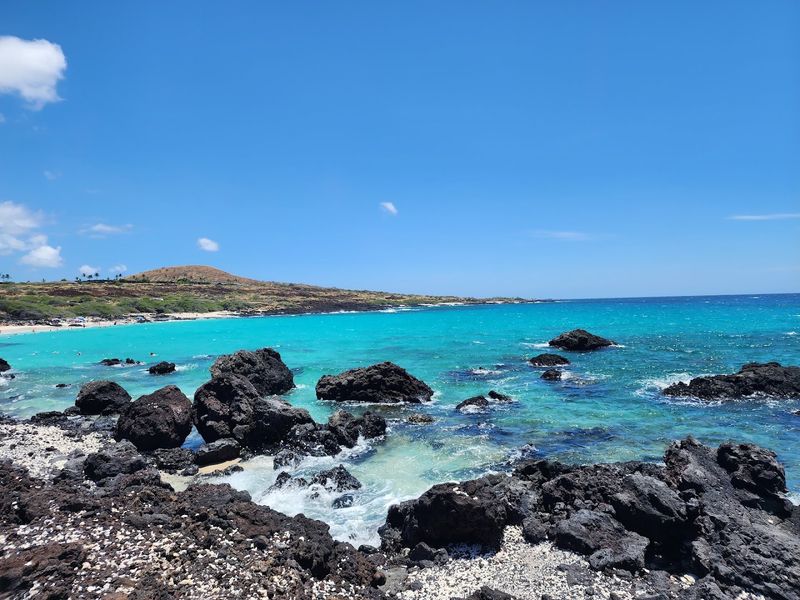
Most beaches have sand. Kua Bay has something else entirely.
The grains here are crushed shell and coral, so fine and so white that they almost squeak when you walk across them, and the contrast against the surrounding black lava rock creates a visual that stops people mid-sentence.
The water color is the other half of the equation. Depending on the time of day and the angle of the sun, the bay shifts between a pale aqua near the shore and a deep, saturated turquoise further out.
It genuinely looks like someone turned up the saturation slider on reality. Photographers, both professional and casual, tend to plant themselves at the edges where the lava meets the sand, because that contrast is simply stunning.
Interestingly, the sand itself contains tiny flecks of black lava, which you notice once you look closely. It adds texture and character rather than taking anything away.
The beach is relatively compact, which means the whole scene fits into a single frame beautifully. Early morning light is particularly flattering here, casting long golden shadows across the sand before the crowds arrive.
Afternoon brings a different energy, with the sun turning the water almost neon. Honestly, no filter is needed.
The combination of soft white sand, electric water, and volcanic rock edges is exactly what most people picture when they imagine Hawaii, and Kua Bay delivers it without any exaggeration.
Swimming, Snorkeling, and Watching the Ocean Do Its Thing
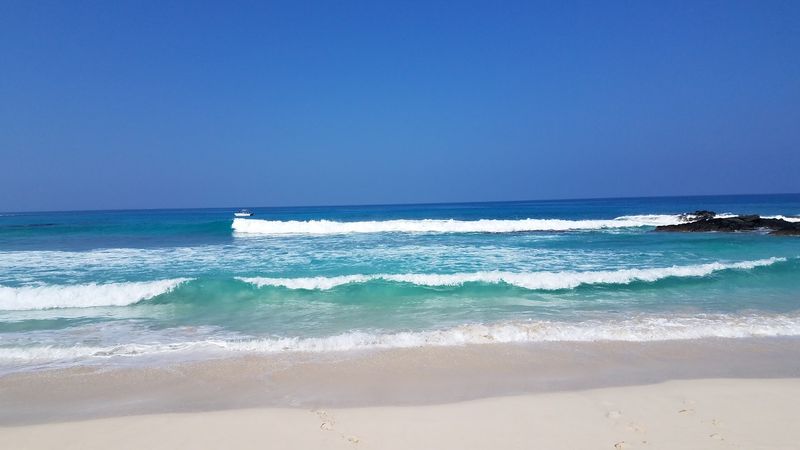
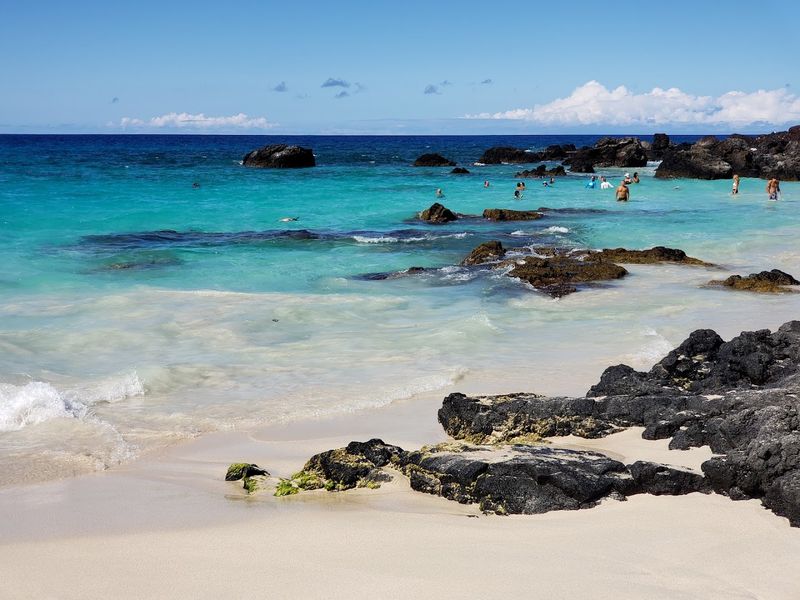
Summer mornings at Kua Bay feel like the ocean is doing you a favor. The water calms down considerably between June and August, making it genuinely ideal for swimming and snorkeling.
Visibility underwater can be exceptional on those calm days, with tropical fish darting around the rocky edges and coral formations just offshore.
Green sea turtles are a regular presence here. They tend to cruise through the bay without much concern for the humans nearby, which is always a memorable encounter.
Spinner dolphins have also been spotted, particularly during summer months, and on rare occasions Hawaiian Monk Seals have hauled themselves onto the sand for a rest. The marine life here is not guaranteed on any given day, but the odds are genuinely good.
Winter changes the mood significantly. Stronger swells roll in from November through April, which draws bodyboarders and boogie boarders who love the challenge.
Swimming in those conditions is not recommended for most visitors, and the lifeguard on duty will let you know when conditions shift. The lifeguard presence, added in July 2019, makes a real difference for families and less experienced swimmers.
Water shoes are worth bringing since navigating the lava rock edges to reach the sandy bottom can be a little tricky. Once you are in the water, though, the effort feels completely worth it.
The ocean here has personality, and every visit plays out a little differently depending on the season and the swell.
Sunsets That Photographers Plan Their Whole Day Around
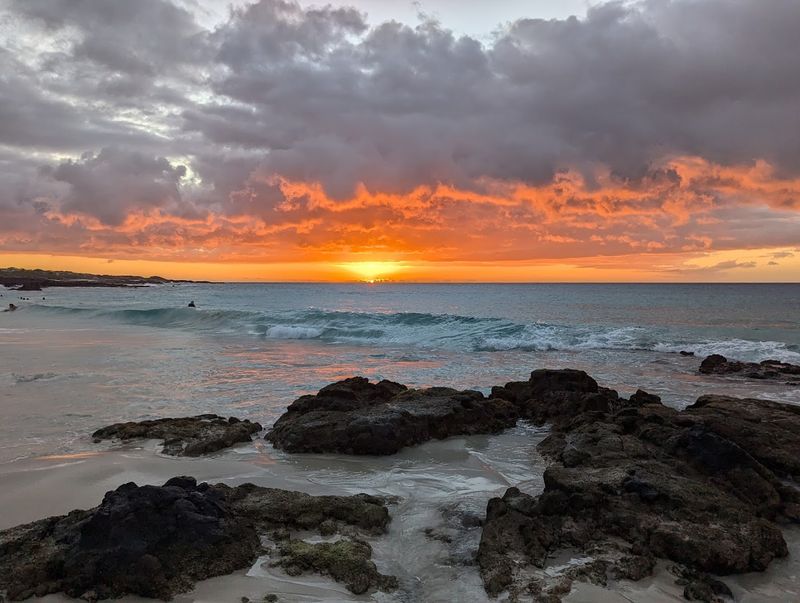
Arriving at Kua Bay in the late afternoon with no particular agenda is one of the better decisions a person can make on the Big Island. The west-facing orientation of the beach means sunsets unfold directly over the water, painting the whole bay in shades of orange, pink, and deep red.
It is the kind of light that makes amateur photographers look like professionals.
The park access road closes at 7 PM, which means the crowd thins out naturally as evening approaches. Those who time their visit to catch the final hour of sunlight often find a noticeably quieter beach than the midday rush.
The lava rock formations along the edges catch the warm light in a dramatic way, creating layers of shadow and color that shift quickly as the sun drops. You have maybe twenty minutes of peak golden light, so having your camera ready before it starts pays off.
On clear days, the distant outline of Maui is visible on the horizon, which adds an unexpected depth to sunset photos. The combination of that soft glow on white sand, the darkening turquoise water, and the volcanic coastline framing everything is genuinely hard to replicate anywhere else.
Some visitors come specifically in the evening, skip the midday heat entirely, and spend the last couple of hours just watching the sky change. It requires no special equipment and no particular photography skill.
The view does most of the work on its own, and it never quite looks the same twice.
Getting There and What to Expect When You Arrive
Finding Kua Bay is straightforward once you know what to look for. Heading north on Highway 19 from Kailua-Kona, the paved access road appears between mile markers 88 and 89, directly across from the West Hawaii Veterans Cemetery.
The cemetery sign is easier to spot than the beach sign, so use it as your landmark.
The access road runs about 1.2 to 1.5 miles down to a small parking lot with roughly 30 spaces. It fills up fast, especially on weekends and during peak season.
Arriving by 8 AM when the gate opens gives you the best shot at a spot. Weekday visits are noticeably less crowded, and a Thursday or Friday morning can feel almost peaceful compared to the weekend scene.
A small roundabout near the lot allows you to drop gear and family members before hunting for a parking spot if needed.
As of January 2026, a parking and entrance fee applies for non-residents. Payment is handled entirely through a QR code system on-site, so a phone with data and a credit card are necessary.
Hawaii residents with a valid state ID are exempt. The beach has restrooms, outdoor showers, and picnic tables near the entrance, all well maintained.
There is almost no natural shade on the sand itself, so an umbrella and strong sunscreen are genuinely essential, not optional suggestions. A short walk from the lot leads down to the beach, with a few lava rocks to navigate near the entry point.
Water shoes make that stretch much easier.
The Cultural History Woven Into the Beach’s Hawaiian Name
The name Maniniowali carries more weight than most visitors realize when they first arrive.
Translated, it means something close to “the god’s pathway,” a reference that hints at the deep cultural and spiritual significance this stretch of coastline held for Native Hawaiians long before it became a destination on travel blogs.
That history does not disappear just because there are now restrooms and a QR code payment system at the entrance.
Kua Bay sits along the route of the Ala Kahakai National Historic Trail, an ancient Hawaiian trail that once connected communities along the entire western coast of the Big Island. The trail follows the shoreline through lava fields, passing sacred sites, fishing grounds, and places of rest that were central to daily life for generations of Hawaiian people.
Walking the edges of the park, even briefly, gives a sense of how purposeful and intentional that relationship with the land and ocean was.
The lava fields surrounding the beach are not just dramatic scenery. They are part of a living landscape shaped by volcanic activity over centuries.
The Big Island is still geologically active, and that energy feels present at Kua Bay in a way that is hard to articulate but easy to feel. Respecting the environment here goes beyond leaving no trace.
It means recognizing that this place has a story far older than tourism. Spending a quiet moment with that in mind, before jumping into the water, adds something real to the experience that no photograph can fully capture.
Tips for Making the Most of Your Day at Kua Bay
A little planning goes a long way at Kua Bay. The parking lot only holds about 30 vehicles, and on busy days it reaches capacity well before mid-morning.
Showing up close to the 8 AM opening on a weekday gives you the best combination of available parking, calm water, and elbow room on the sand. Weekends and holidays are a different story entirely.
Shade is essentially nonexistent on the beach itself. The lava rock surrounding the bay does not provide cover, and the Hawaiian sun at this latitude is intense even on overcast days.
A beach umbrella is worth every bit of the effort to carry it down from the parking lot. Reef-safe sunscreen is both a personal necessity and a responsibility here, given the marine life just offshore.
Bringing your own food and plenty of water makes a full day far more comfortable since there are no food vendors on site.
Snorkeling gear is worth renting or buying before you arrive if you plan to explore the water. The rocky edges of the bay are where most of the marine life congregates, and having a mask and fins makes a real difference in what you see.
The lifeguard is on duty during park hours, which run from 8 AM to 7 PM, but once the park closes the lifeguard leaves too. Timing your exit before 7 PM is important since the access road gate closes then.
One last thing: a quick rinse at the outdoor showers before leaving removes sand that would otherwise end up everywhere in your car.
Address: Kua Bay Access Rd, Kailua-Kona, HI 96740
