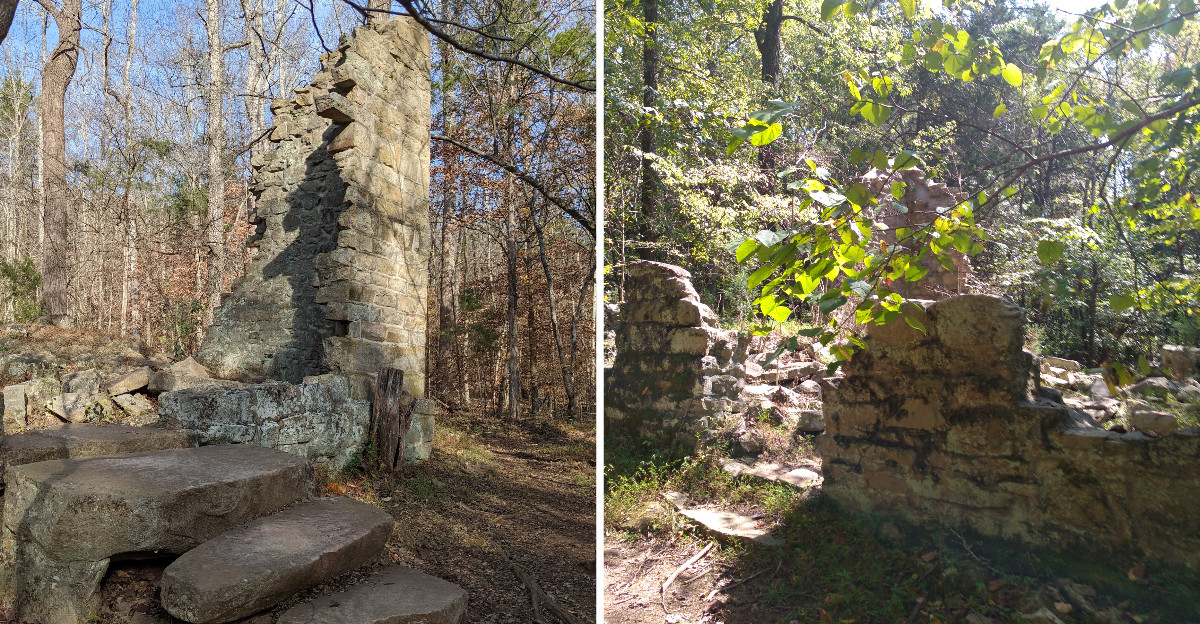
Damp leaves and cool dirt fill the air along a quiet trail, and the only sounds are birds and footsteps crunching over fallen twigs. In North Carolina, the trees open up, and thick stone walls appear, hand-cut and stacked more than two centuries ago, standing alone in the forest.
No roof, no floors, no windows, just stone and a giant fallen elm sprawled across the back. Standing there longer than planned, trying to picture a family living out here when this was all frontier, is easy.
History you can actually touch is rare, and these ruins offer that hour outdoors. The walls still hold their shape, and the forest has grown up around them.
Moss creeps along the base of the stones, and sunlight filters through the canopy in shifting patches. Visiting here feels like stepping into a forgotten chapter, one that rewards curiosity and a willingness to walk a little farther than most.
The path back feels different, quieter, as if the woods have shared something.
Where the Stones Sit Inside Reedy Creek Park
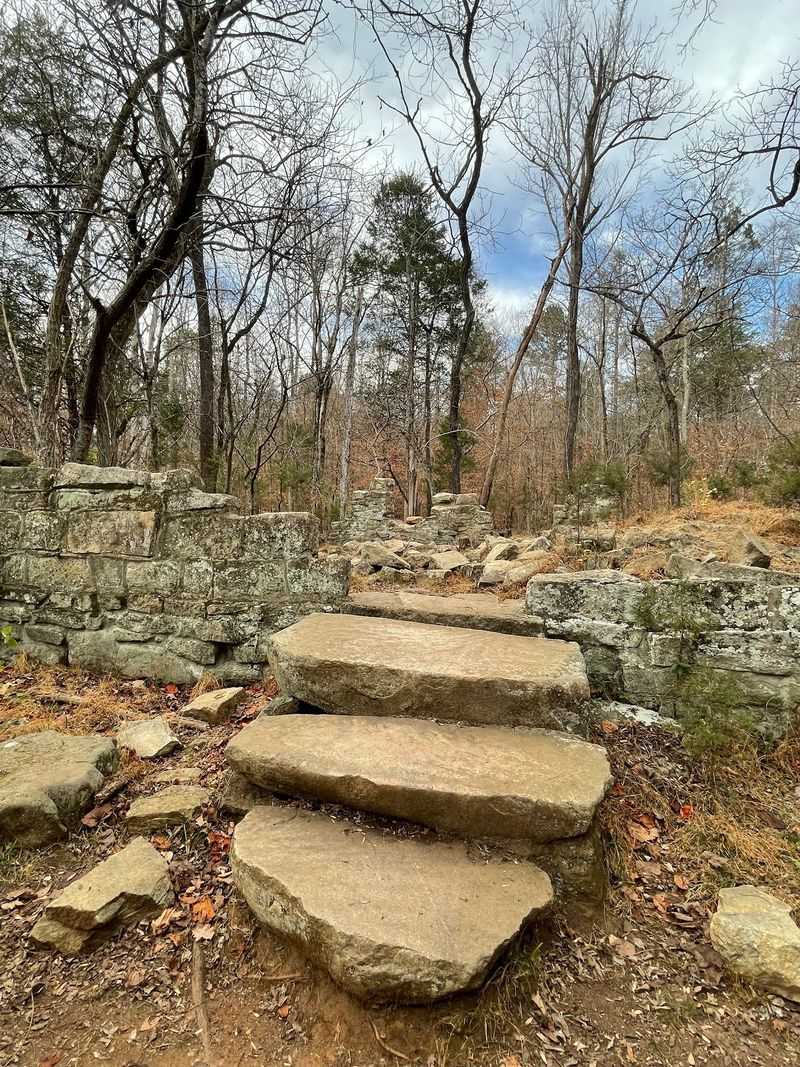
Reedy Creek Park surprised me first, before the ruins ever did. The land stretches wide and green, with woods thick enough that you forget you’re inside city limits.
The Robinson Rock House Ruin and Plantation Site covers roughly 80 acres within the park, which makes it far more than a single pile of rocks. Charlotte, North Carolina acquired the site in 1979, a smart move that kept bulldozers away from something irreplaceable.
The original land grant came from King George III in 1769 to Robert Robison, and the tract was later divided among family members. The portion holding the house site went to his son John.
Knowing that history changed how I walked the trail. Every dip in the ground started to feel like it might mean something, and honestly, some of those dips probably do.
What I like most is how quietly the park holds all of this. There’s a playground near the start, families pushing strollers, dogs on leashes, and somewhere back in the trees sits one of the oldest dwellings in Mecklenburg County.
Ordinary and extraordinary sharing the same address.
Following the Colored Markers to the Ruins
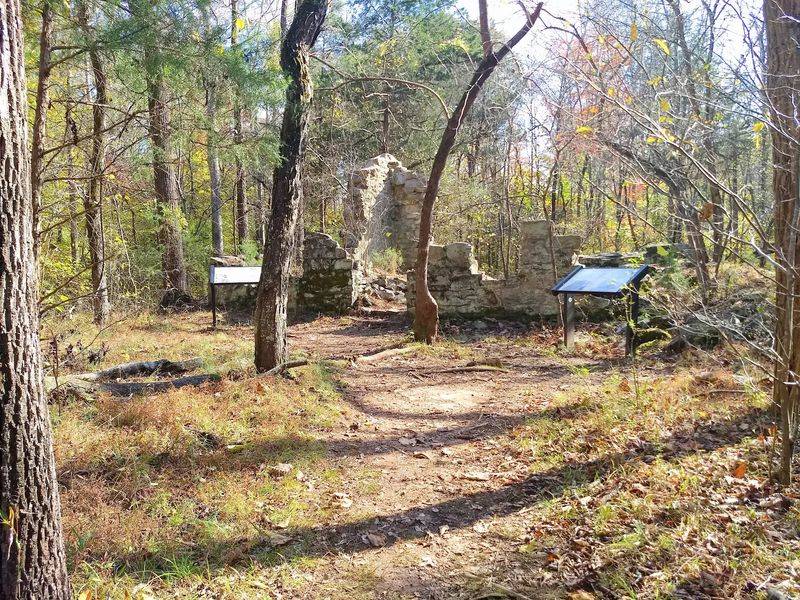
Here’s the tip I wish I’d read sooner: start at the Reedy Creek Nature Center, not wherever your phone tries to send you. Some visitors get routed toward a highway trailhead and end up confused before they even begin.
From the nature center, the walk runs about 0.9 miles to the ruins, which makes a round trip of roughly two miles. Hikers usually string together a few marked routes, following the yellow dot to the red square to the orange circle.
The blazes are painted on tree trunks, and while most people find them easy enough, a few have mentioned junctions where the markings aren’t obvious. I’d photograph the big trail map at the parking area before setting off.
Elevation change is mild. Kids handle it fine, and I passed toddlers who were more interested in sticks than stones.
The forest does a lot of the entertaining on the way out. Shade covers most of the path, the air stays cooler than the parking lot, and the murmur of other walkers drifts through the trees without ever feeling crowded.
A Stone House Built When Wood Was the Norm
Most pioneer families around here built with timber, because trees were everywhere and free. So stone tells you something right away.
John Robison is widely believed to have built this house in the 1780s, with construction likely falling somewhere between 1780 and 1810. Choosing stone meant hauling, shaping, and stacking material by hand, and it signaled that the owner had real resources for the time.
The masonry was hand-cut, probably from a nearby quarry, then fitted without any of the machines a modern crew would reach for. Running my palm along one of those blocks, I kept thinking about how many hours that represents.
Architecturally, the house reflects a wilderness building style that immigrants carried south from Pennsylvania and Maryland. It was substantial but not showy, practical rather than grand.
Fun detail worth knowing: stone construction from this era is genuinely rare in Mecklenburg County, which is a big part of why the site matters. Wooden homes from the same decades mostly rotted, burned, or got replaced.
Stone simply stayed put and waited.
Reading the Walls That Are Still Standing
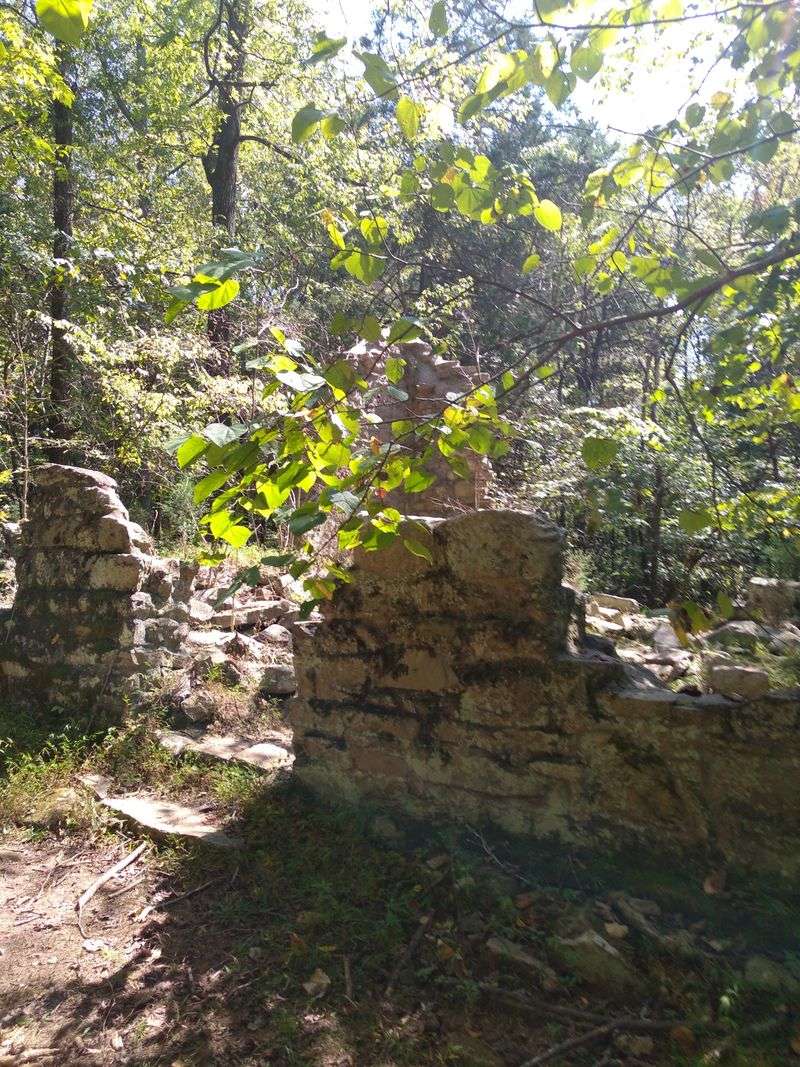
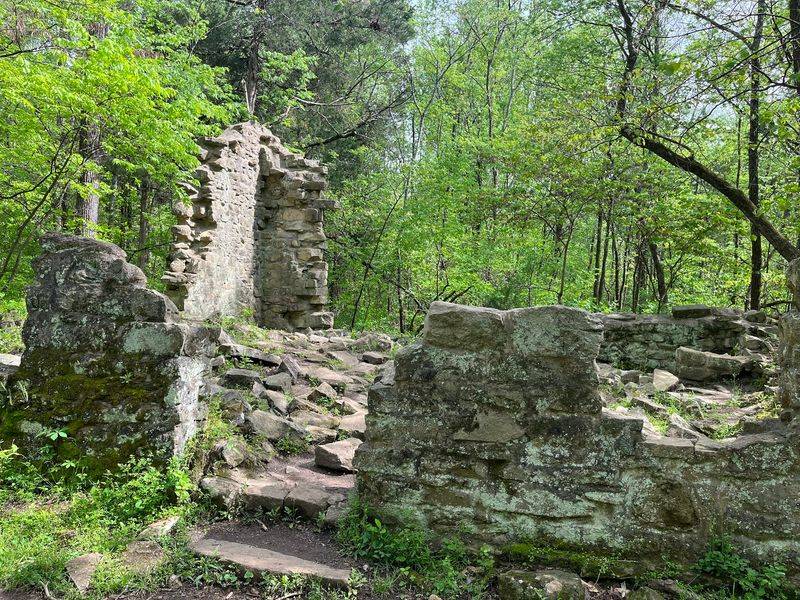
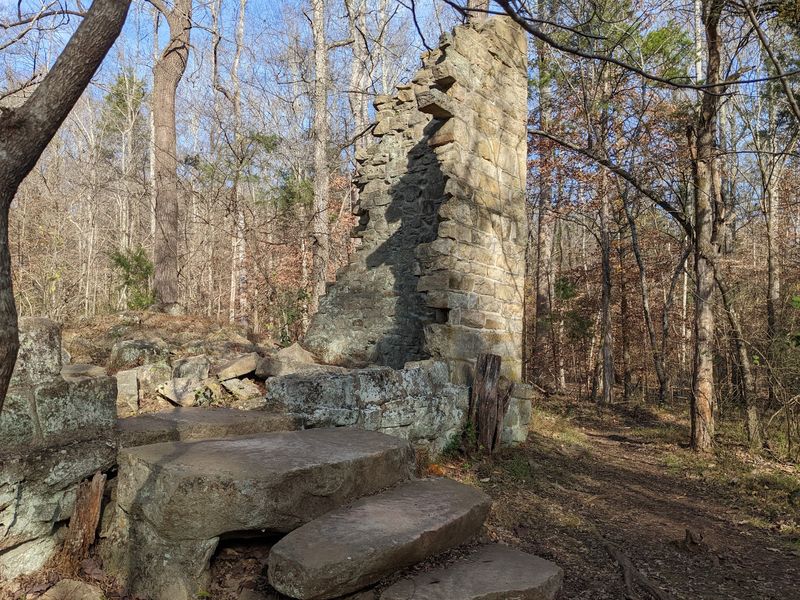
The first thing that struck me was the outline. Even without a roof or floors, you can trace the footprint of the house clearly through the remaining masonry.
One section of original stonework rises noticeably higher than the rest, hinting at the two-story shape the building once had. It gives your imagination something solid to work with.
A large hearth stone still sits among the rubble, which for me was the most human part of the whole site. That was the warm center of the home, where meals happened and winter nights got survived.
Walking inside the walls takes a little care. Loose rocks cover the ground, so ankles deserve attention and decent shoes help.
Visitors who’ve explored similar sites elsewhere often point out how unusual it is to be able to step right through the ruins. There are currently no fences or barriers here, which makes the experience unusually close and personal.
That freedom comes with responsibility, though. Climbing on the rock walls damages them, and these stones have already survived more than enough weather without extra help from us.
How the House Emptied Out in 1899
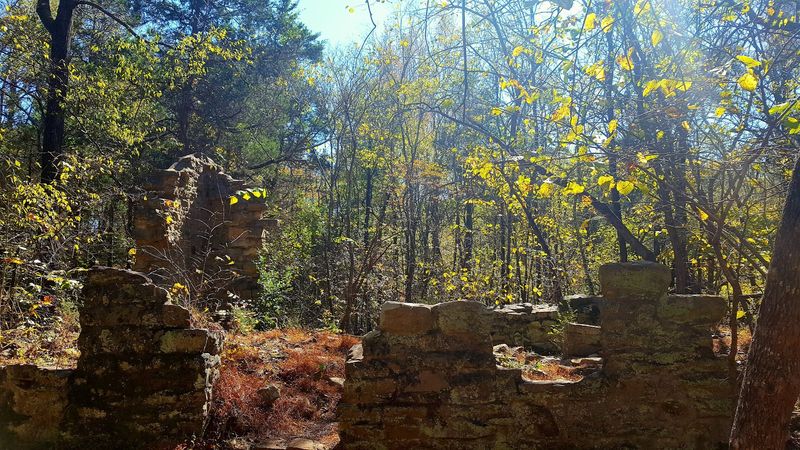
Every abandoned place has a last day, and this one has a date. George Jordan, the final resident, passed away in May 1899, and his widow moved out afterward.
The property passed to their three children, but the site was never occupied or cultivated again. That’s a strange thing to absorb while standing in what used to be someone’s living space.
Later the land was sold to N. W.
Wallace, a former Mecklenburg County sheriff who bought it strictly as an investment. Under his ownership the house was neglected and slid steadily into ruin.
Wallace passed away in 1928, and the site eventually went to Beulah W. Grier.
Through all of it, the building just sat in the woods.
For most of the 20th century, hardly anyone visited. Being tucked away offered some protection from vandalism, though it was no defense at all against storms and falling trees.
I found that stretch of silence oddly moving. More than a hundred years of nobody coming home, while the walls kept standing anyway, stubborn and patient.
Rediscovery, Stabilization, and National Recognition
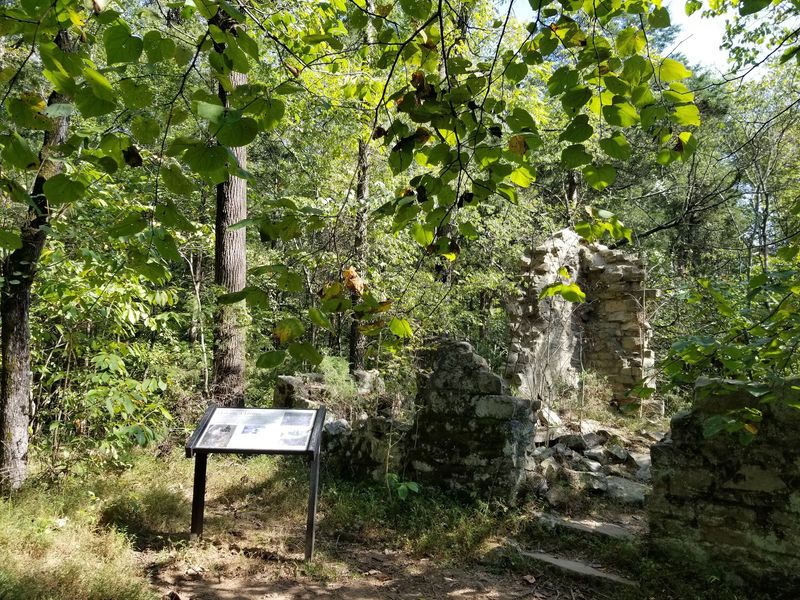
The comeback story starts in the 1980s. UNC Charlotte archaeologists officially rediscovered the site in 1982, though some accounts point to 1981 for the initial find.
Researchers then carried out a thorough study, documenting the history and architecture in detail. That work is the reason we know as much as we do about who built the house and when.
In 1985, one corner of the structure was stabilized and partially restored. Without that intervention, there’s a real chance the walls would have kept collapsing until there was nothing left to visit.
Recognition followed in 2009, when the site was added to the National Register of Historic Places. The listing acknowledges both its age and its rarity as early stone construction in the county.
Preservation here depends heavily on visitor behavior, since the ruins sit open with no barriers. Staying off the walls is the simplest way to help.
Seeing that repaired corner gave me a small lift. Someone decided this mattered enough to save, and now anyone willing to walk a mile can see why.
An Easy Outing That Works for Families
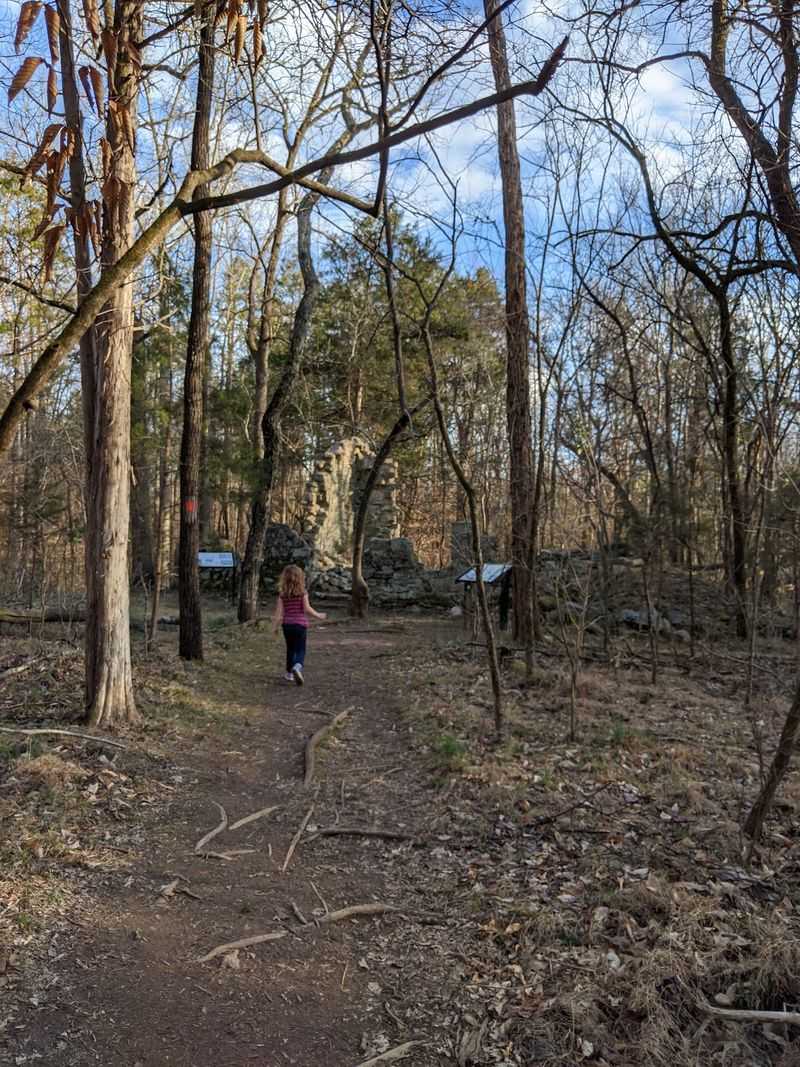
Parents seem to love this one, and I get why. The distance is short, the grade is gentle, and there’s a genuine payoff at the end instead of just another bend in the trail.
Families report toddlers around one and a half and three years old handling the walk fine, mostly because everyone stops constantly to look at things. A two-hour outing is common when you factor in all the detours.
The playground near the start is a useful bonus, either as a warm-up or a reward. It has saved more than one drive home from a meltdown, I’d guess.
Older kids get hooked on the history, especially with the illustration showing the finished house. Six-year-olds have been known to declare the whole thing awesome, which is high praise.
The fallen elm remains the undisputed favorite for climbing, so build in extra time there.
Pack snacks, let the pace be slow, and treat the ruins as a destination rather than a checkpoint. The trip works best when nobody’s in a hurry.
Sitting With the Quiet Before Heading Back
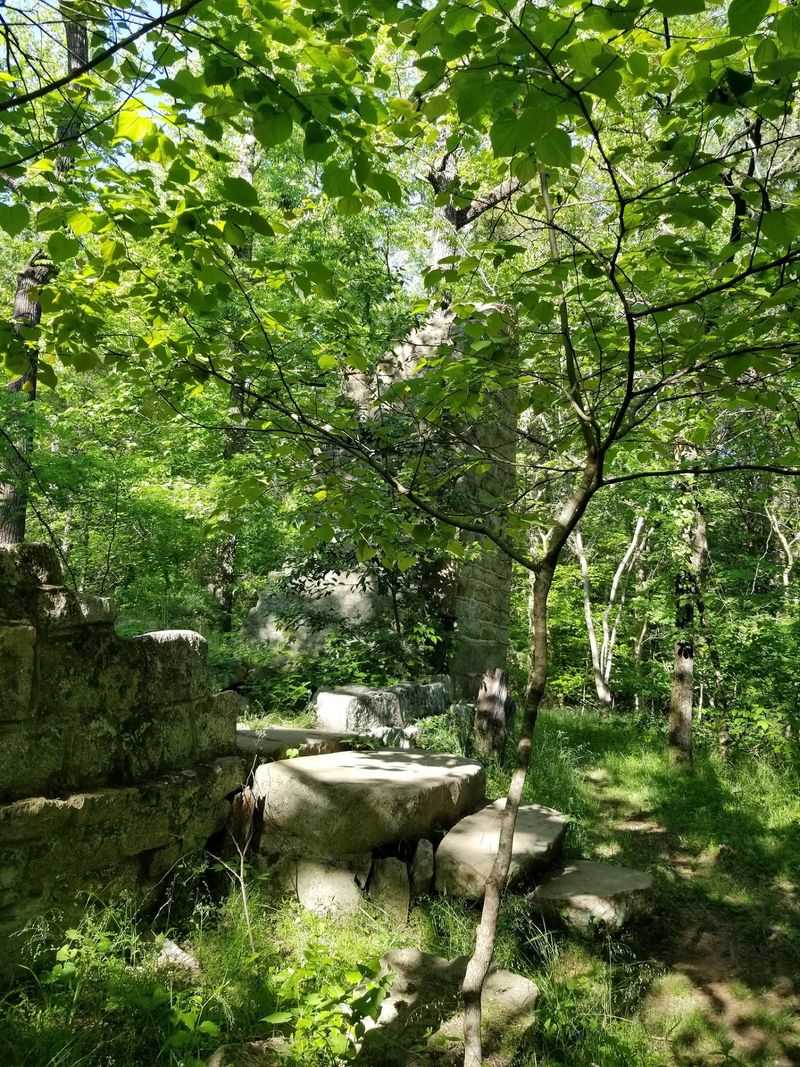
Before turning around, I found a spot on the edge of the clearing and just stayed put for a while. The woods around the ruins are genuinely quiet, and the stillness invites a slower kind of attention.
Visitors often leave wondering about the people who lived here, what their days looked like, whether children played in this same patch of ground. I had all those same thoughts.
Touching the cool, rough stone did something I didn’t expect. Someone set that block in place more than two centuries ago, and it hasn’t moved since.
Photographers get rewarded here, especially when light filters through the canopy onto the grey walls. Morning tends to be softest.
What stayed with me most was the contrast. Human work crumbling on one side, trees growing tall and steady on the other, both sharing the same small clearing.
It’s a modest site, and some describe the ruin as small. That never bothered me.
Old, honest, and still standing counts for plenty in my book.
Address: 2900 Rocky River Rd, Charlotte, NC 28215
Planning Your Visit to the Ruins
A little planning makes this trip smooth. Park near the nature center, since navigation apps sometimes point people toward a trailhead off a highway instead.
Once you’re there, find the large trail map posted at the parking area. It shows the marked routes leading out to the house, and studying it for a minute saves confusion later.
Directional signage within the park has frustrated some visitors, so a screenshot or photo of the map is genuinely useful. Trail blazes on trees carry you the rest of the way.
Budget between one and two hours depending on how long you linger. The hike itself is not strenuous, and most people describe it as easy.
Restrooms and the nature center sit at the start, which is handy before heading into the woods.
Leashed pets are fine on the trails, and the route sees steady, friendly foot traffic.
I’d rank this among the better short history walks near Charlotte, particularly for anyone who has visited Reedy Creek before without realizing the ruins were back there waiting.
Address: 2900 Rocky River Rd, Charlotte, North Carolina 28215
