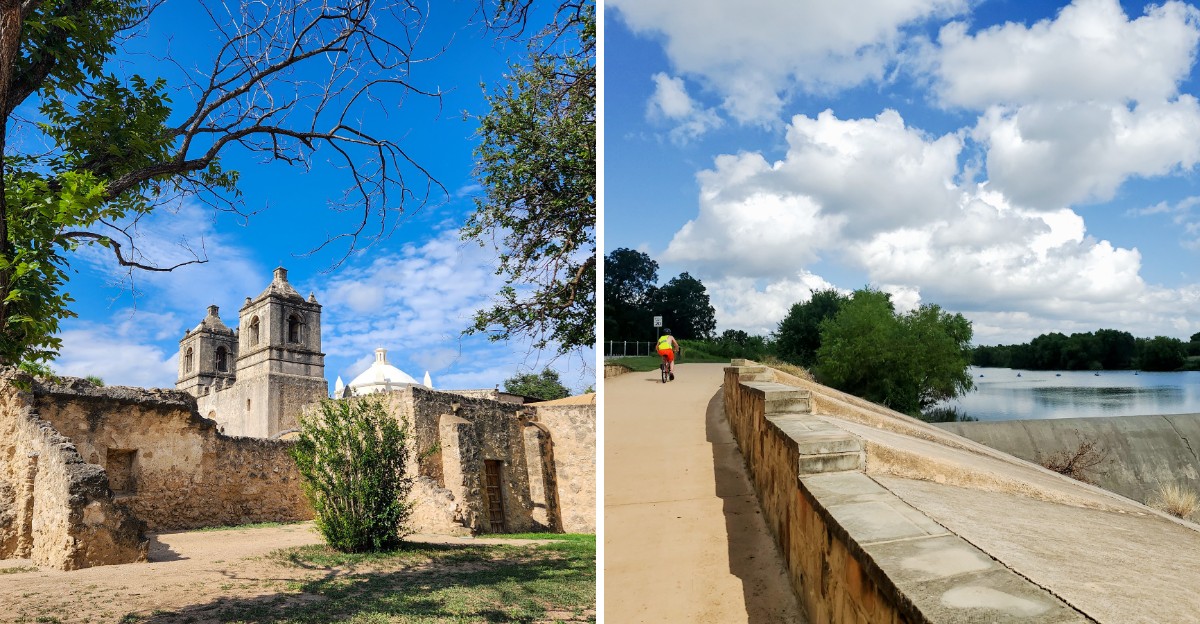
Most people who visit San Antonio never make it past the Alamo, which is a shame because just a few miles south sits a chain of four more Spanish missions that together form one of the most remarkable historic landscapes in the entire country.
This trail is definitely the best way to see them all in a single trip.
The route stretches roughly fifteen miles and connects each mission by way of a paved path that works just as well for cyclists as it does for walkers, winding past old stone churches, acequias, and stretches of river that feel far removed from the city around them.
You can start early, take your time at each stop, and finish the day with a much better understanding of what this part of Texas looked like centuries ago. Whether you choose to bike the whole thing or drive between missions and stroll the grounds, this is history you can actually feel under your feet.
A River Path Built for Easy Wandering
Some trails make visitors work for every mile. Not this one.
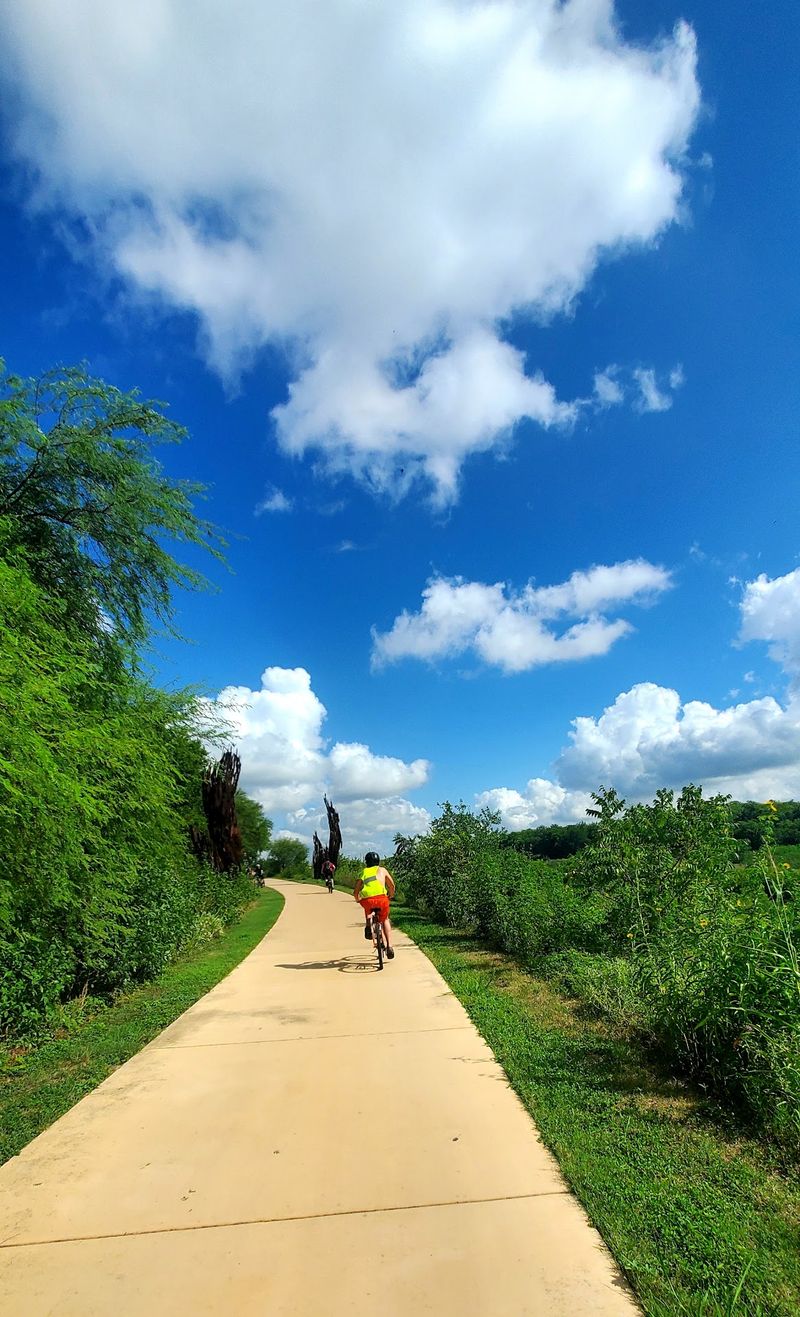
The Mission Reach stretches about eight miles along the San Antonio River, and it holds more than 16 miles of paved path for walking and biking on both sides of the water.
Most of the route is flat and wide, so there is room for families pushing strollers, runners chasing a personal best, and slow cruisers who just want to watch the river roll by. The path is separated from car traffic.
That alone makes it a relaxing choice for younger riders who are still learning to steer in a straight line.
A few small inclines show up near bridges and dams, and beginners might notice them. Nothing is too tough, though, and a quick breather on one of the many benches fixes tired legs fast.
The trail is open daily from 6 AM to 9 PM, which gives plenty of flexibility. Early mornings bring cool air and soft light.
Evenings bring golden sunsets that glow across the water, and some spots near the dams are especially nice for watching the sky change colors.
Weekends and outdoor holidays like Easter or Memorial Day can get busier, so a weekday visit offers a quieter feel. Either way, the mood stays friendly.
People wave, cyclists call out when passing, and nobody seems to be in much of a hurry. For a city trail, it has a surprisingly calm, laid-back rhythm that encourages lingering.
The Alamo, Where the Story Begins
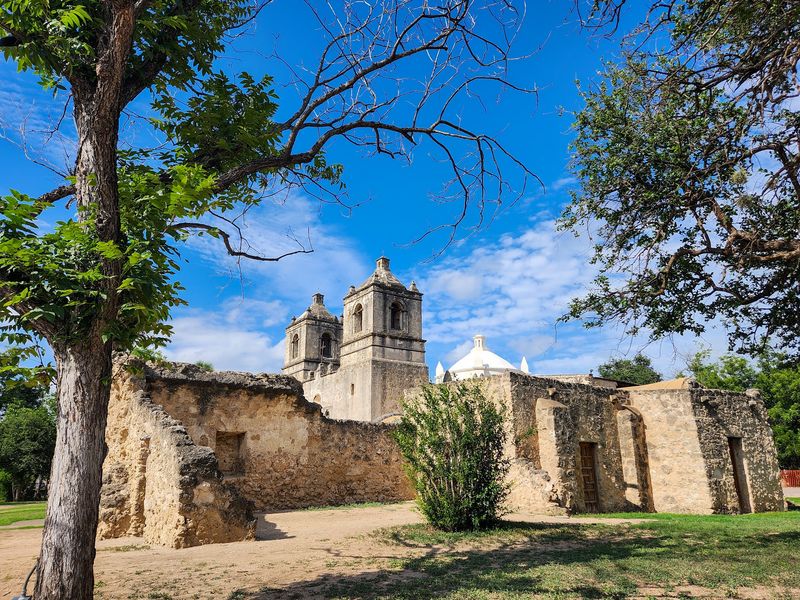
Plenty of mission trips start with a famous name, and few names in Texas carry more weight than the Alamo. Officially called Mission San Antonio de Valero, it was founded in 1718 and became the first mission in San Antonio.
Originally, Spanish Franciscans built it as a religious community. Later, it turned into a military fort.
In 1836, during the Texas Revolution, a small group of Texian defenders held out for 13 days against a much larger Mexican army, and that siege made the Alamo a lasting symbol of courage.
Today the site works as a museum and memorial in the heart of downtown. The stone church front, with its curved top, is instantly recognizable.
Photos really do not capture how much smaller and more personal it feels in real life, which surprises many first-time visitors.
Fun fact time. The Alamo is managed separately from the San Antonio Missions National Historical Park, yet it still shares the UNESCO World Heritage title with the four other missions.
It also holds National Historic Landmark status and several Texas landmark honors.
For trail planning, the Alamo sits north of the Mission Reach, so many visitors see it as a bonus stop before or after the ride. Connecting through the downtown River Walk adds scenery, shops, and plenty of people-watching.
Leave enough time to read the exhibits, because the history here is packed tight into a small space, and rushing through would miss the best parts.
Twin Towers of Mission Concepción
Old buildings usually get patched, painted, and rebuilt over time. Mission Concepción mostly skipped that step, and the result is something rare.
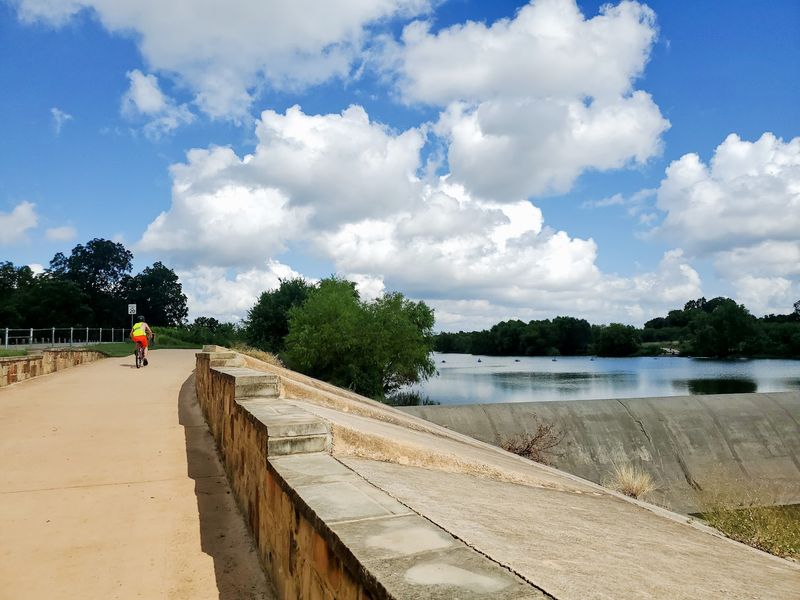
Dedicated in 1755, it is known as the oldest unrestored stone church in America.
The mission first began in East Texas in 1716, then moved to San Antonio in 1731. Its twin bell towers and balanced front show off a Baroque style that looks both grand and a little mysterious, like it has kept a few secrets to itself.
Inside, look closely at the walls and ceilings. Faded hand-painted frescoes still appear in places, giving a peek at the colorful designs that once covered much of the church.
It is a quiet thrill to spot a pattern painted by hands from centuries ago.
History did not stay peaceful here, either. The Battle of Concepción took place nearby during the Texas Revolution, adding another layer to the site’s long story.
Concepción is still an active parish, so respectful behavior matters. Keep voices low inside the church, and check for services before wandering in.
The address is 807 Mission Rd, San Antonio, TX 78210, and it sits close to the northern part of the Mission Reach.
Tip for riders. Lock bikes in designated spots and take a slow walk around the outside first.
The stone changes color as the sun moves, turning from pale gray to warm honey. A camera helps, but a few quiet minutes on the grass might be even better.
Mission San José, Queen of the Bunch
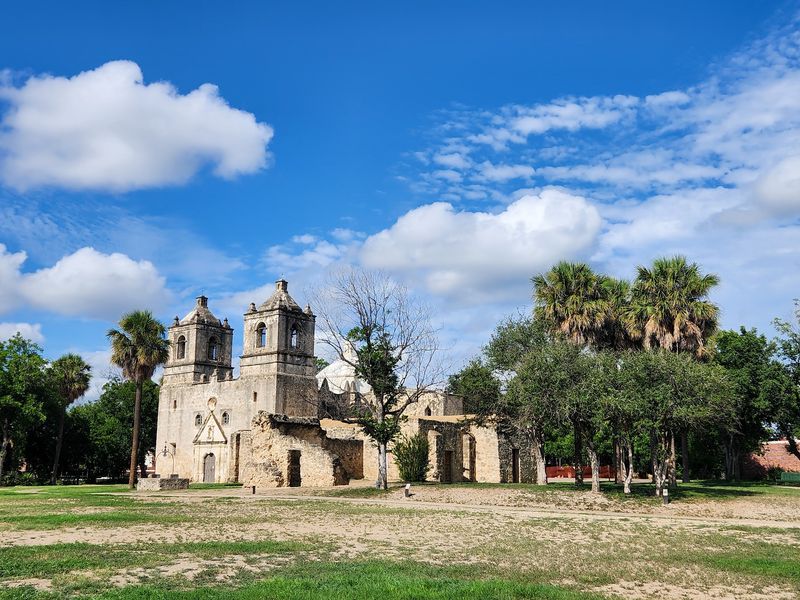
If the missions held a royalty contest, San José would probably win the crown without much debate. People have called it the Queen of the Missions for years, mostly because of its large size and excellent condition.
Founded in 1720 by Franciscan missionary Father Antonio Margil de Jesús, it grew into a model community. Its church was built between 1768 and 1782, and the carved stonework still looks sharp today.
The star of the show is the Rose Window. Delicate carvings swirl around it, and it is often named one of the finest examples of Spanish Colonial decoration in the United States.
Local legends swirl around it too, which makes it fun to study up close.
Beyond the church, San José lets visitors see how daily life worked. Restored family quarters line the outer walls, and there are soldier quarters, a granary, a grist mill, and the arches of the old convento.
Walking the grounds feels like reading a history book with the pages spread out on the grass.
Here is a lesser-known detail. During the 1800s, San José served as a temporary refuge on the Underground Railroad for people seeking freedom in Mexico, where slavery was not allowed.
The main visitor center for the national historical park is located here. Grab a map, ask rangers questions, and watch the orientation materials before heading out.
Since San José sits near the middle of the trail, it makes a smart starting point for a day of exploring in either direction.
Farm Country at Mission San Juan
After the grandeur of San José, Mission San Juan Capistrano feels like a deep breath. The pace slows down.
The crowds usually thin out, and the whole place seems to hum along at its own gentle speed.
San Juan moved to its current spot in 1731 after starting in East Texas in 1716. Once settled, it became a busy farming and ranching center.
Crops grew in the rich soil nearby, and the mission helped feed and supply the wider mission communities.
That farming past is easy to imagine while looking out over the open land. Spanish friars and Indigenous people worked side by side to build a community that could support itself, and the skill behind that effort is impressive even now.
The chapel has a simple, clean look, with a bell wall that stands out against the sky. It does not try to show off.
Its charm comes from that plain, honest style, and many visitors find it one of the most peaceful stops of the whole trip.
San Juan is still an active parish, linking modern worship with a very old past. Visitors should keep that in mind when stepping inside.
Practical advice here is simple. Bring snacks and water, since this stretch can feel a bit remote, and find a shady spot to rest.
Look for birds in the trees and along the river nearby. Kids might enjoy spotting turtles, while adults may just enjoy a quiet moment away from the city buzz.
Water Magic at Mission Espada
Water flowing through a ditch built centuries ago? It sounds unlikely, yet that is exactly what makes Mission Espada so fascinating.
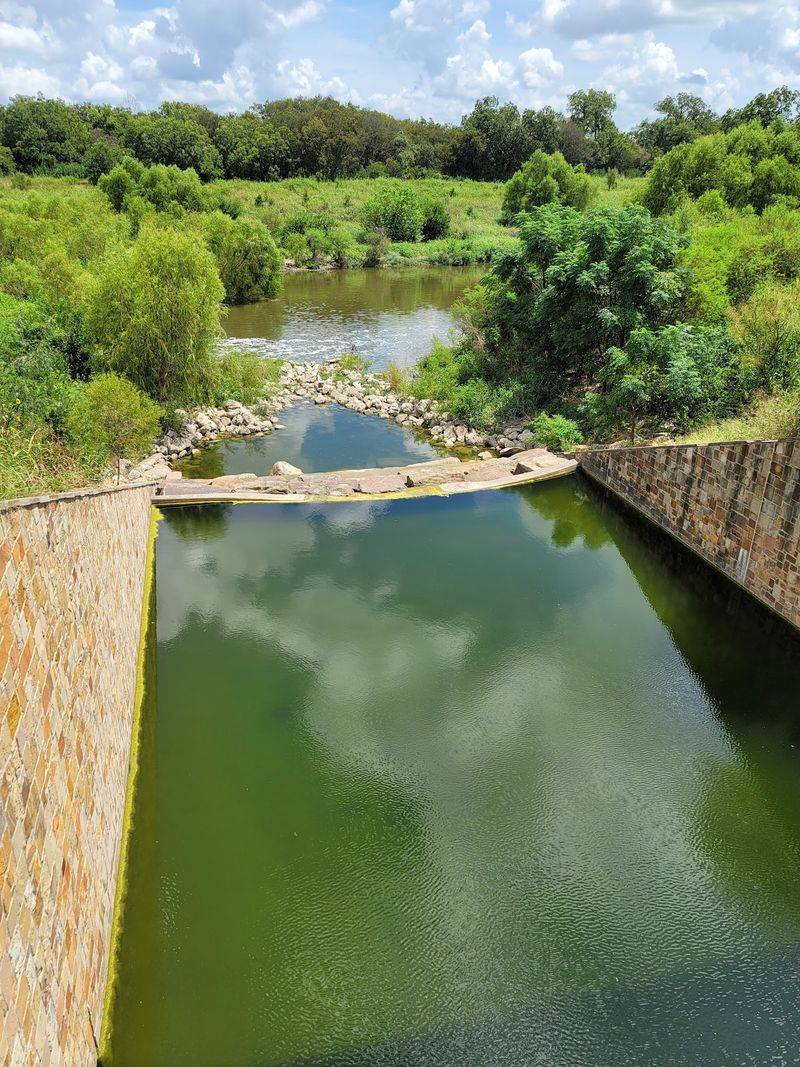
This southernmost mission is famous for its acequia, an old irrigation system that still carries water today.
Espada traces its roots to 1690, when it began as San Francisco de los Tejas in East Texas. It moved to San Antonio in 1731.
The community here takes part in the oldest continually operating irrigation system in the United States, which is a pretty amazing claim for a quiet rural corner.
Engineering fans will love seeing how gravity moves water through the channels. No pumps, no motors.
Just smart planning by the Spanish and Indigenous builders who shaped the land long ago.
The chapel itself has a rustic charm, with an unusual brick archway doorway that makes for great photos. The walls feel humble and sturdy at the same time.
Long ago, the mission was protected by a wall and gate, a reminder of how tough frontier life could be.
Espada remains an active parish, and its grounds stay calm most of the day. It is the kind of place where the loudest sound might be a mockingbird.
Since it sits at the far southern end, some visitors start here and work their way north. That plan saves the bigger crowds for later.
Either way, give the acequia area some time, and watch the water slip quietly along the same path it has followed for generations.
Wild Green Spaces Between the Stones
Honestly, the stretches between missions might steal the spotlight. The river corridor was once a straight, plain channel, but a huge restoration project changed everything.
More than 400 acres of riverside habitat have been brought back to life, and over 23,000 trees have been planted. The result is a green ribbon full of native plants and animals, right inside a major city.
Keep eyes open while moving along. Prickly pear cactus, agarita shrubs, and tall pecan trees line the banks.
Red-eared slider turtles stack up on logs like they are waiting for a group photo, and the occasional snake may slide by, so watch where feet land.
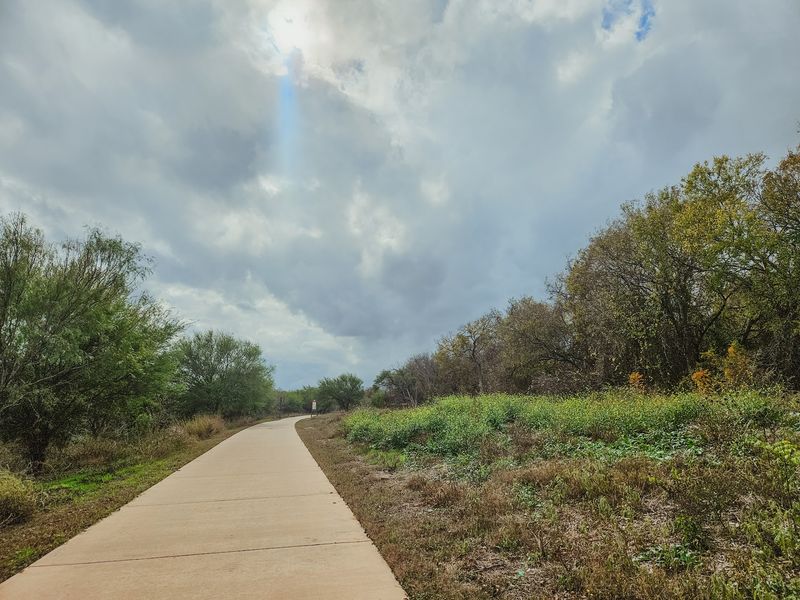
The scenery shifts with the weather and the seasons. A cloudy day brings soft, cool tones, while spring can burst with wildflowers.
There is always something new to notice.
Water fans have options too. A paddling trail invites canoes and kayaks, and paddleboarding is popular on breezy days.
Fishing is another favorite activity along the banks for those who prefer to sit and wait.
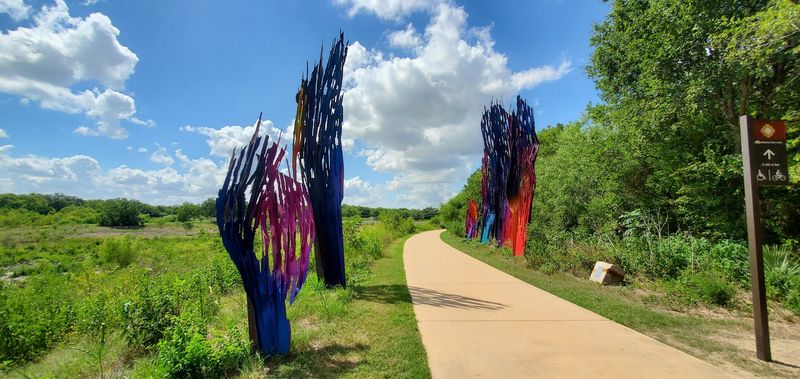
Along the path, large public art pieces called Mission Portals mark the gateways to the mission sites. They blend art and nature in a way that feels fresh and fun.
One honest note is that shade can be limited in some areas, since many trees are still young. Plan around the midday heat, wear a hat, and take breaks at picnic spots.
The general area address is San Antonio River Walk, San Antonio, TX 78214, near the southern trail sections.
Smart Moves for a Full Day Out
A little planning goes a long way on this trip. The missions sit about 2.5 miles apart, and the full bike-friendly route runs around 15 miles.
Remember that the trail is out and back, not a loop. Whatever distance gets covered heading south must also be covered heading home, so tired legs should be part of the math from the start.
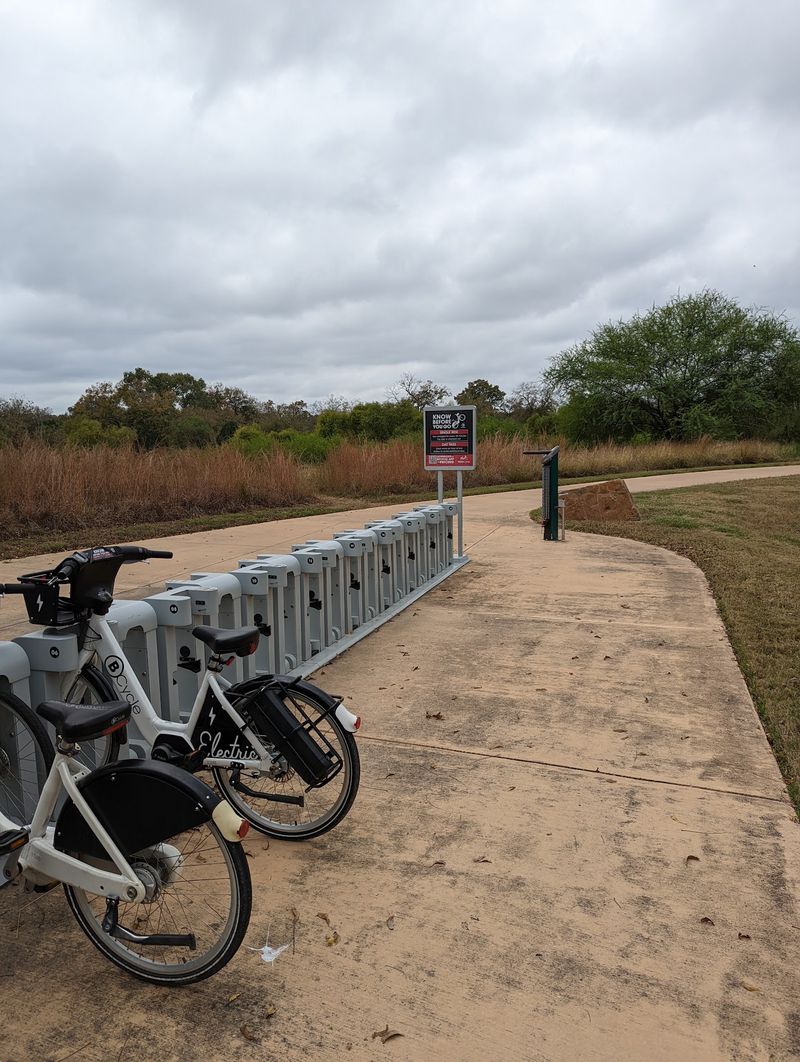
Renting a bike is easy. Stations along the route offer regular pedal bikes and electric bikes, which make the longer distances feel much lighter.
Some rental systems may require a card or mobile payment, so check ahead to avoid surprises.
Water is the most important item to pack. Texas sun can be strong, even in cooler months.
Refill stations and restrooms appear at some parking areas and trailheads, but carrying a full bottle is still wise.
Serious cyclists might want a spare inner tube, just in case. A few parts of the bike lanes on nearby roads have cracks or dips.
Minor stuff, but a flat tire far from a rental station is no fun at all.
Timing helps too. Start early, grab a map at the Mission San José visitor center, and leave room to linger.
Each mission rewards slow attention.
Finally, think about the bigger picture. In 2015, all five missions became a single UNESCO World Heritage Site, the only one in Texas.
That global honor makes this ride much more than exercise. It becomes a chance to trace a story shared by Spanish settlers, Indigenous communities, and the Texans who came later.
