The first thing I heard was the screech of bright green parrots echoing off the stonework above my head, and I laughed out loud because nothing about that felt like a cemetery. Then the noise of the city faded behind me, and I was standing on a hill with the skyline glinting in the distance.
The cemetery covers nearly 500 acres of glacial hills, ponds, and winding paths, and it has been collecting stories since the 1830s. Some of those stories are about famous painters, composers, and politicians, whose graves are marked by monuments that have become destinations in their own right.
Others are quieter, about ordinary people whose names have faded from memory but whose stones still stand among the trees. And then there are the legends, like the woman in a pale Victorian dress who visitors say appears in their photographs, standing quietly between the headstones.
I went for the views and the history, and I stayed because the place has a mood you can feel in your chest. The paths wind through old growth trees, and the light filters down in a way that makes you forget how close you are to the city.
A piece of history that holds its own kind of quiet is exactly what this New York landmark delivers.
The Woman in White Who Keeps Showing Up in Photographs
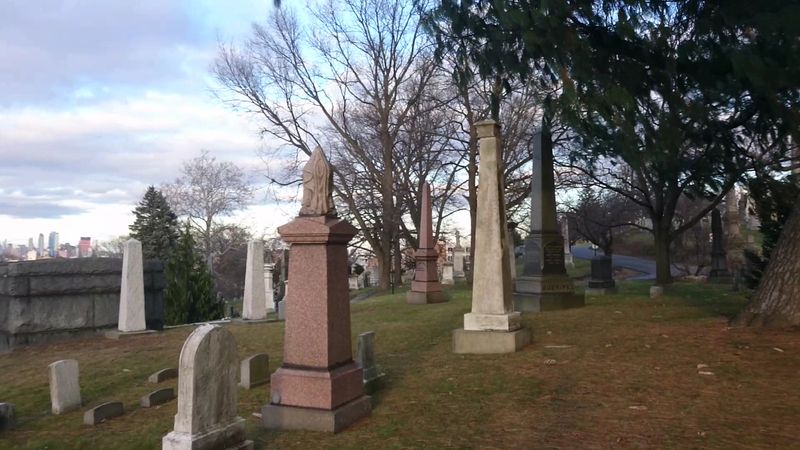
Ask around long enough at Green-Wood and someone will mention her. A woman in a long white dress, drifting between grave markers, usually spotted at a distance and usually gone by the time anyone gets closer.
She is the apparition visitors most often claim to have caught on camera, sometimes as a pale smudge near a monument, sometimes as a figure they swear was not there when they pressed the shutter. I heard the story before my first visit and assumed I would forget about it.
Then I found myself scrolling back through my own photos on the subway home, squinting at a blur near a marble angel.
Here is the practical part. Green-Wood is enormous and full of white stone, so morning fog, low sun, and old film cameras all play tricks with the eye.
That does not make the sightings less fun to chase.
If you want your own shot at it, come early on a damp weekday when the paths are almost empty. Bring a real camera if you have one, walk slowly, and let the hills do their work on your imagination.
Gothic Gates, Screeching Parrots, and a 106-Foot Clock Tower
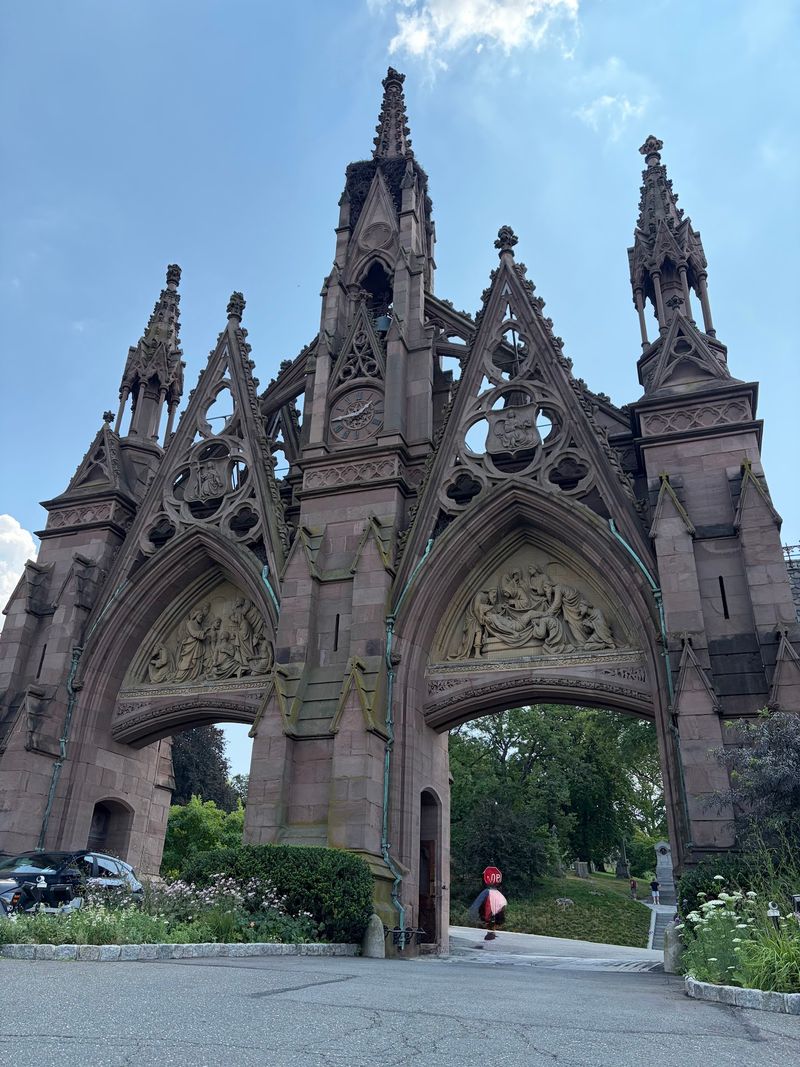
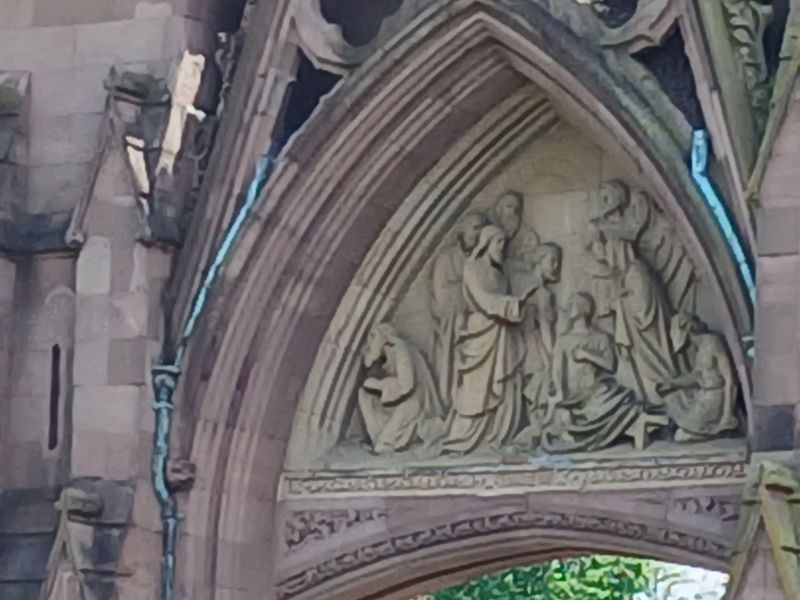
Nothing prepares you for the entrance. Richard Upjohn designed those brownstone arches, built between 1861 and 1865, and they look like something lifted out of a European cathedral town and dropped onto a Brooklyn avenue.
Carved biblical scenes by John M. Moffitt sit above the archways, and the clock tower climbs 106 feet into the sky.
My neck hurt from looking up.
Then came the sound. A colony of monk parrots, originally from Argentina, has built enormous nests directly into the spires, and their chatter is loud, constant, and completely absurd against all that solemn stone.
Locals treat them as unofficial mascots, and honestly they steal the show.
Give yourself ten minutes here before you walk in, because the light changes the carvings completely depending on the hour. Late afternoon brings out the texture in the brownstone.
Grab a paper map at the main entrance while you are standing there. The grounds are hilly and easy to get turned around in, and the map marks notable graves, trees, and viewpoints far better than squinting at your phone under a canopy of branches.
Battle Hill, Minerva, and the Best View in Brooklyn
The climb up Battle Hill is steeper than it looks on the map, and I stopped twice to catch my breath. Worth every step.
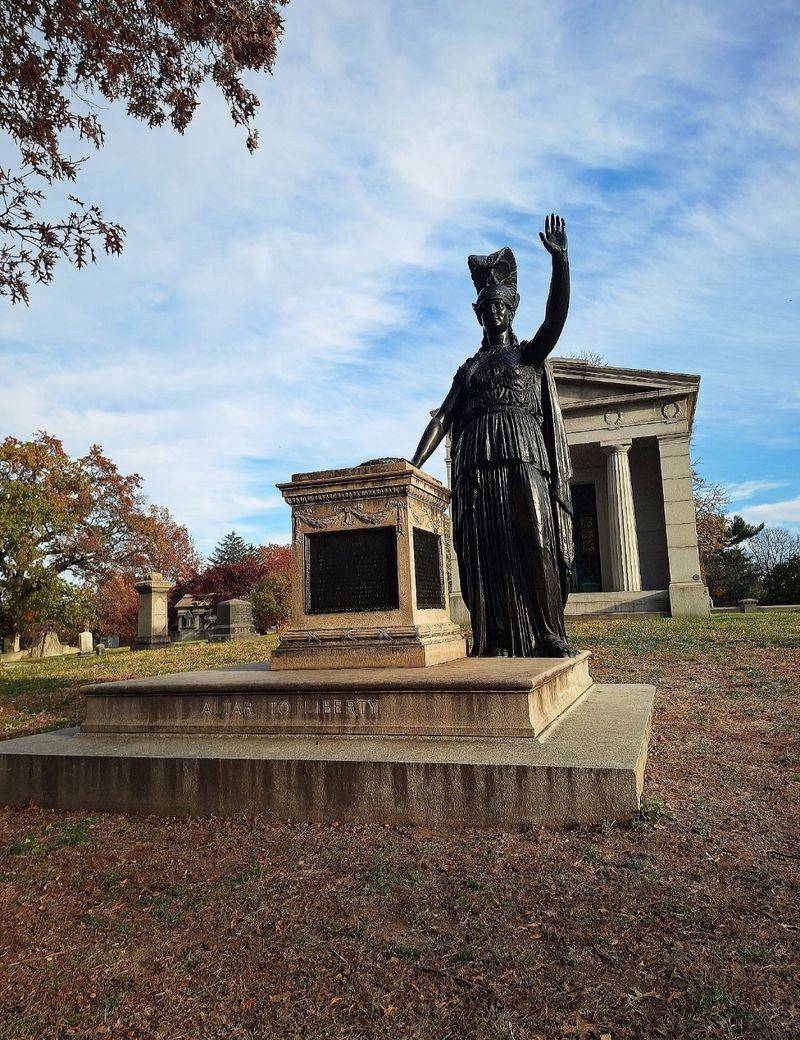
At the top stands the Altar to Liberty, a bronze Minerva erected in 1920, her arm raised toward the harbor. Line yourself up behind her and you get a direct sightline to the Statue of Liberty across the water, the two figures seeming to salute each other.
Battle Hill is also the highest natural point in Brooklyn, and it played a real role in the Battle of Brooklyn during the Revolutionary War. The site’s signage was updated in 2013 to reflect newer research.
Some visitors report seeing figures in old military dress near this part of the grounds, which fits the history a little too neatly.
Go in late afternoon when the harbor light turns gold. Wear shoes with grip, since the paths here are sloped and can be slick after rain.
Sit on the grass for a while. The city hums somewhere below, but up there it barely reaches you.
The Chapel Where Samuel Leggett Is Said to Pace
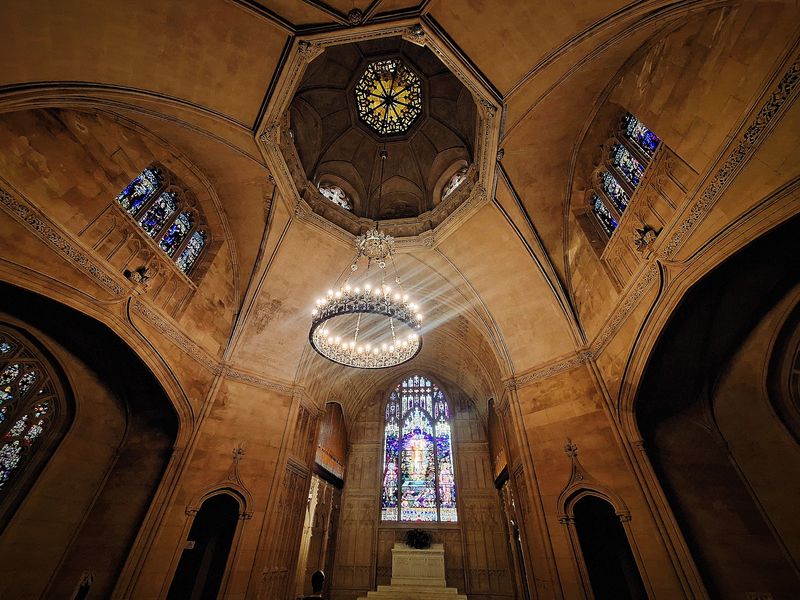
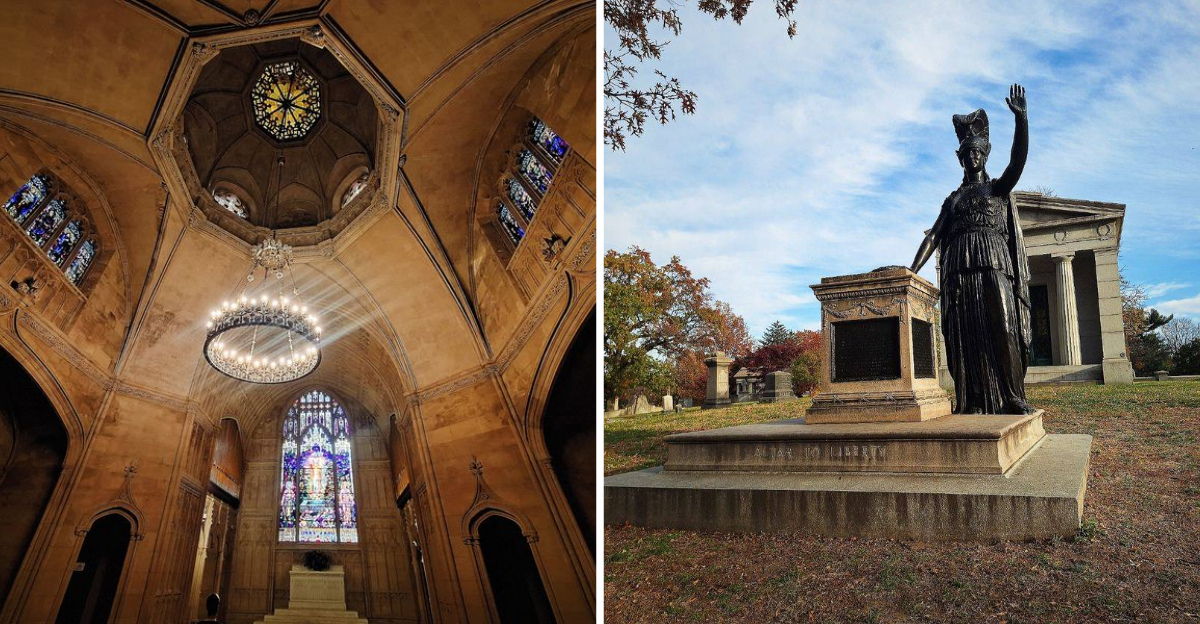
Built between 1911 and 1913 by the firm Warren and Wetmore, the Green-Wood chapel is a limestone showpiece with a central octagonal tower and four smaller turrets clustered around it. From certain angles it looks like a miniature castle that wandered in and decided to stay.
Inside, sound behaves strangely. Footsteps carry, voices soften, and there is a hush that settles over people without anyone asking for it.
Local lore attaches the chapel to Samuel Leggett, a wealthy nineteenth century merchant whose spirit is said to pace the space, wringing his hands. Whether or not you buy it, the story sticks with you once you have stood in that echoing room.
Photographers love the chapel for its light. Stained glass throws color across the stone floor on sunny mornings, and the exterior stonework looks best on grey days when the limestone goes soft and silvery.
Check the cemetery’s website before you visit, since the chapel occasionally hosts programs and concerts. Catching music inside those walls is a completely different experience from seeing it empty, and both are memorable in their own way.
Mollie Fancher, Mary Howe, and Brooklyn’s Spiritualist Past
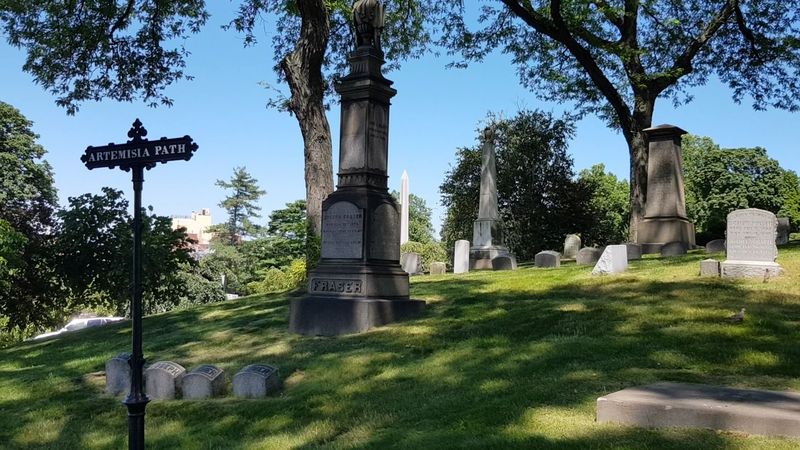
Green-Wood opened in 1838, and within a decade the Spiritualism movement was sweeping through American parlors. That timing matters, because the cemetery ended up holding the graves of mediums, clairvoyants, and people who spent their lives at the edge of the unexplained.
Leah Fox, sister and manager of the famous Fox sisters, rests here.
Two names come up constantly in ghost accounts. Mollie Fancher, known in her time as the Brooklyn Enigma, was a psychic whose grave is said to draw people looking for answers.
Mary Howe, another medium, fell into long trance states, and the grim tale attached to her is that she was buried during one of them. Visitors describe seeing a confused figure near her plot, lips moving without sound.
I found these graves harder to locate than the celebrity ones, which somehow made the search more interesting. Ask at the entrance office or use the cemetery app to pin them down.
Whatever you believe, the Victorian obsession with contacting the passed ones is real history, and Green-Wood is one of the few places where you can stand right on top of it.
Famous Residents You Will Recognize Immediately
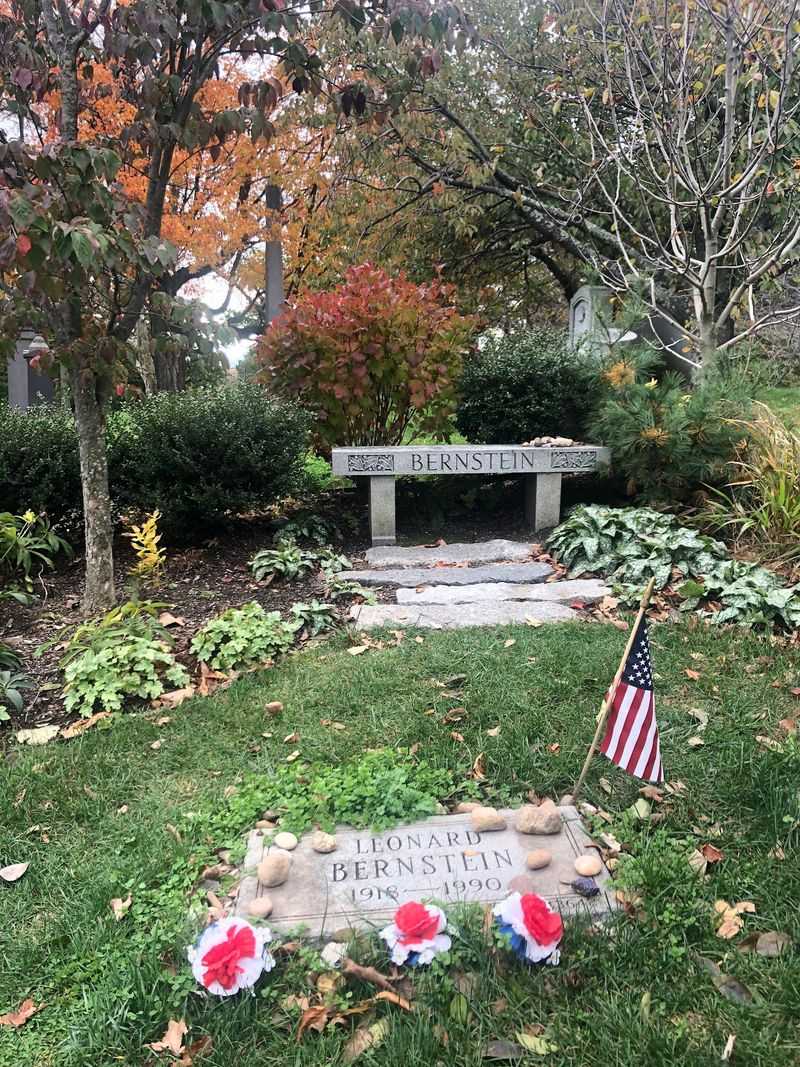
Roughly 600,000 people are buried across these New York grounds, and the guest list is wild. Leonard Bernstein.
Jean-Michel Basquiat. Louis Comfort Tiffany, whose glasswork you have almost certainly seen in a museum.
Boss Tweed is here too, along with Horace Greeley, Henry Ward Beecher, and DeWitt Clinton.
Business names you use without thinking about them are carved into the stone as well. Colgate.
Pfizer. Squibb.
Even Frederick August Otto Schwarz of toy store fame.
Printmakers Currier and Ives rest here, and so do architects James Renwick Jr. and Richard Upjohn, the man who designed the front gates he now lies behind.
Hunting these graves turns a long walk into a scavenger hunt, which is exactly how I got through five hours without noticing. The paper map marks many of them, and the free app fills in the rest.
Plan two to three hours minimum if you want to cover real ground. Bring water, especially in summer, because the hills are relentless and shade comes and goes without warning along the winding drives.
How to Plan a Visit That Feels Genuinely Worth It
Timing changes everything here. April into May brings blossoms across the rolling lawns, early June delivers roses and thick green, and autumn turns the whole place into a foliage postcard without the crowds you would fight in a regular park.
Gates open at 7 AM daily and close at 7 PM.
Wander down to the glacial ponds, Sylvan Water and Crescent Water, where snapping turtles bask and koi drift up to the edges. Birders love this cemetery, and I understand why after watching a hawk settle on a headstone like it owned the place.
A few ground rules keep things respectful. No jogging, no picnicking, and scooters are not allowed, so kids need to be up for real walking.
There are four entrances, and it is genuinely easy to exit somewhere you did not intend, so note where you came in. Guided tours run regularly and are worth booking if you want the history explained properly.
Comfortable shoes, a hat, and a full water bottle will carry you further than any app.
Address: 500 25th St, Brooklyn, New York11232
