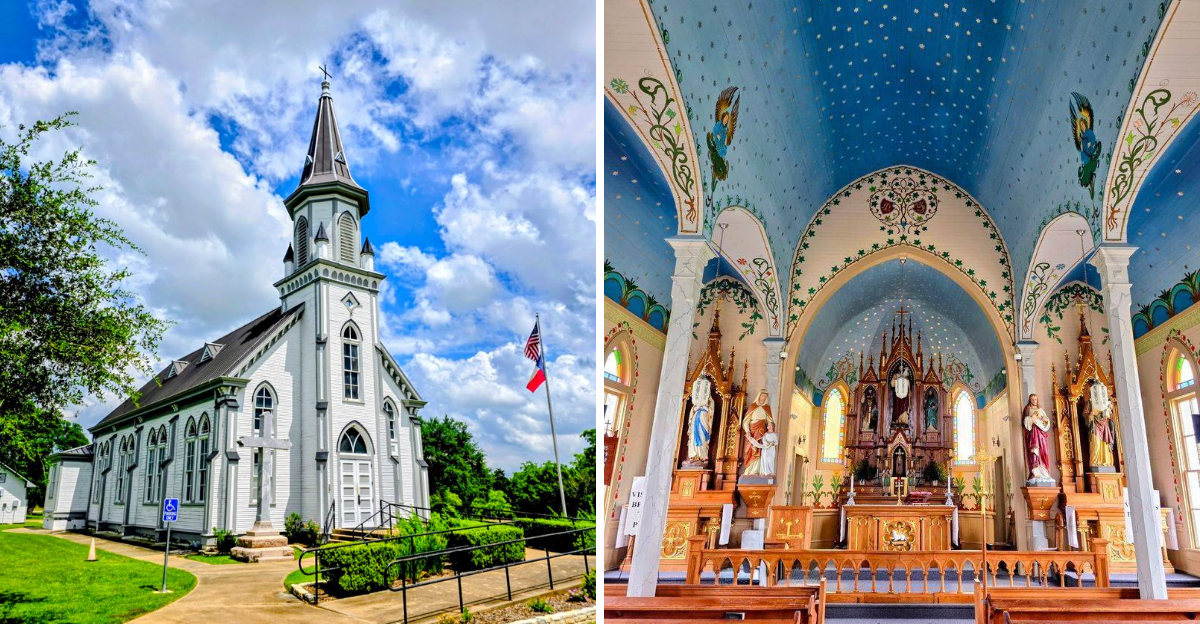
A tiny chapel in the middle of Texas. Its walls covered in thousands of hand painted frescoes.
It is a sight that belongs in Europe, but it is right here. The artwork is breathtaking, colors that are still vivid after decades, intricate details that reward a slow look, and religious scenes that feel alive.
You walk in and immediately look up, because you cannot help it. The ceiling, the walls, every surface is part of the story.
It is the kind of place that makes you stop and just stare. The church is small, but the art is massive in scale and ambition.
It is a hidden treasure for anyone who appreciates art, history, or quiet places of reflection. Well worth the detour.
A Community Built on Faith and Czech Roots
Long before the painted walls became a tourist attraction, this church was simply a home for people who had traveled an ocean to start over. Czech and German immigrants began arriving in this part of Texas in the mid-1800s, carrying their Catholic faith as one of the most important things they owned.
The tiny community of Dubina, whose name comes from the Czech word for “oak grove,” became one of the very first Czech settlements in the entire state of Texas.
Founded in November 1856 by Moravian families, Dubina grew slowly but with deep roots. These settlers endured harsh conditions, unfamiliar land, and the challenge of building something meaningful from almost nothing.
Their faith was the glue that held everything together, and the church became the center of community life almost immediately.
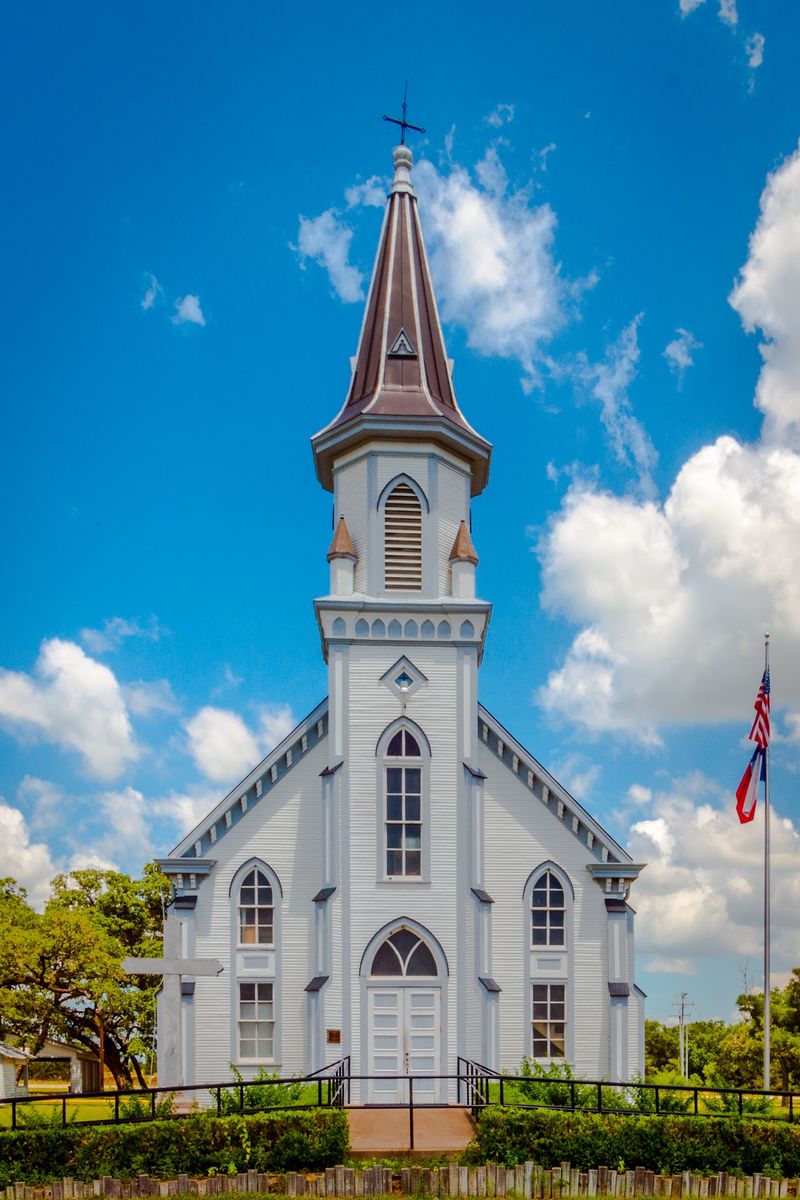
The first church structure went up in 1877, a milestone that represented years of sacrifice and determination. One detail that stands out in its history is the iron cross placed atop the steeple, forged by Tom Lee, a freed slave and skilled blacksmith.
That cross became a symbol of the community’s resilience. A devastating hurricane in July 1909 destroyed the original building, yet the community did not waver.
They raised more than five thousand dollars and commissioned architect Leo Dielmann to design a new church, which was completed in 1912.
That same iron cross, salvaged from the wreckage, was restored to its rightful place on the new steeple, a quiet but powerful statement about what this community valued most.
The Sky-Blue Ceiling Covered in Over Three Thousand Gold Stars
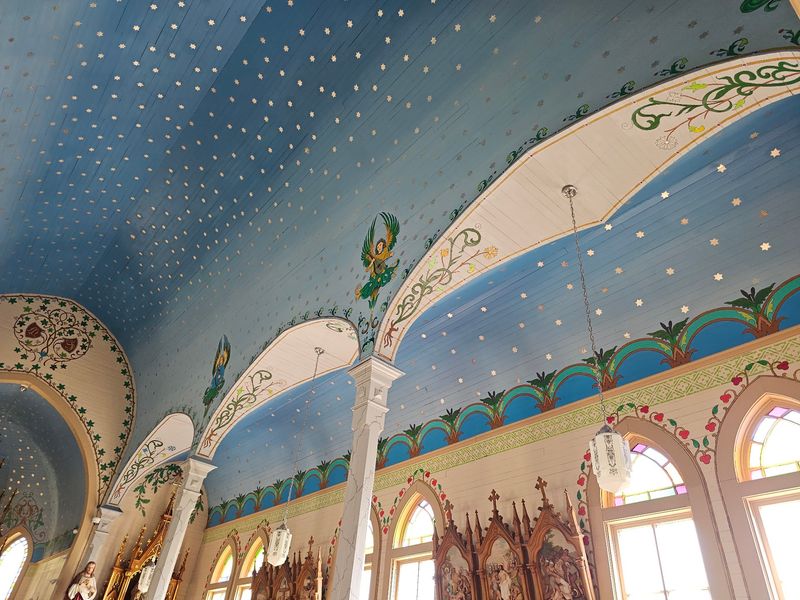
If there is one feature of this church that makes people audibly gasp, it is the ceiling. A vaulted sky-blue expanse stretches overhead, and embedded across every inch of it are 3,263 shimmering white gold leaf stars.
The effect is genuinely otherworldly. You look up and feel like you are gazing into a clear night sky, except this one has been carefully hand-crafted by devoted volunteers working to restore something nearly lost forever.
The original paintings were completed shortly after the church was finished in 1912, though the artist who created them has never been identified. Whoever they were, they had a clear vision: to make the interior feel like a sacred and celestial space.
The sky-blue background was not a random color choice. It evokes heaven, openness, and peace, all things that a community of hardworking immigrants likely found deeply comforting during their Sunday worship.
Sadly, sometime in the 1950s, a wave of modernization led to the entire painted interior being whitewashed over. The stars, the patterns, all of it disappeared under layers of plain white paint.
That loss sat quietly for decades until the 1980s, when community members led by Judge Ed Janeckas and Butch Koenig organized a restoration effort. Volunteers painstakingly uncovered the original designs, working from surviving stencils and careful observation.
Where patterns were unclear, restorers made thoughtful artistic choices to complete the work. Today, those stars shine again, and honestly, they feel like they never left.
The Romanesque Revival Architecture That Frames It All
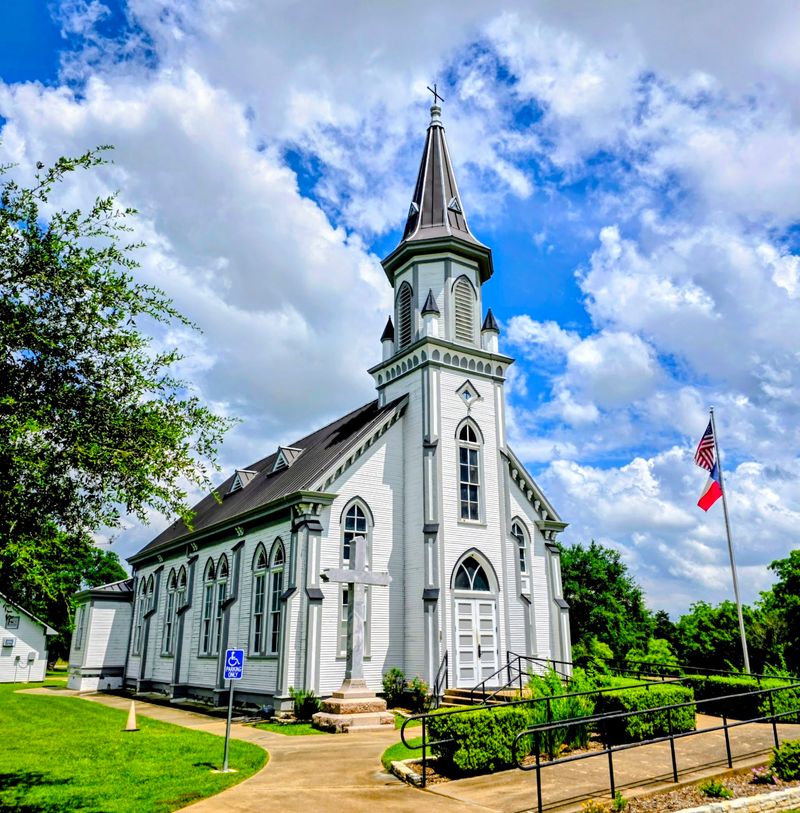
Before you ever see the painted interior, the outside of the church already hints that something special is waiting. The building follows a Romanesque Revival style, designed by architect Leo Dielmann, who brought a sense of classical European structure to the flat Texas countryside.
Rounded arches, a solid and symmetrical facade, and the tall steeple crowned with that historic iron cross give the building a dignity that feels both humble and grand at the same time.
The interior plan is basilical, meaning it follows a long rectangular layout with a barrel-shaped vaulted ceiling running down the center nave. Two side aisles run parallel beneath lower groin vaults, creating a layered sense of depth when you look up and across the space.
The pressed metal ceiling adds a subtle texture that catches the painted patterns beautifully in the light. It is one of those details that you might miss at first but cannot stop noticing once you spot it.
What makes the architecture so effective is how it serves as a canvas rather than competing with the decoration. Every arch, every curve, every column was designed in a way that invited embellishment.
The segmental arches leading toward the apse are painted with Greek crosses and gold fleur-de-lis motifs that feel completely at home within the structure. Dielmann clearly understood that this community wanted a church that honored both their European heritage and their new Texas home.
The result is a building that feels entirely of its place, modest from the road but magnificent up close.
Hand-Painted Frescoes, Vines, Angels, and Geometric Patterns
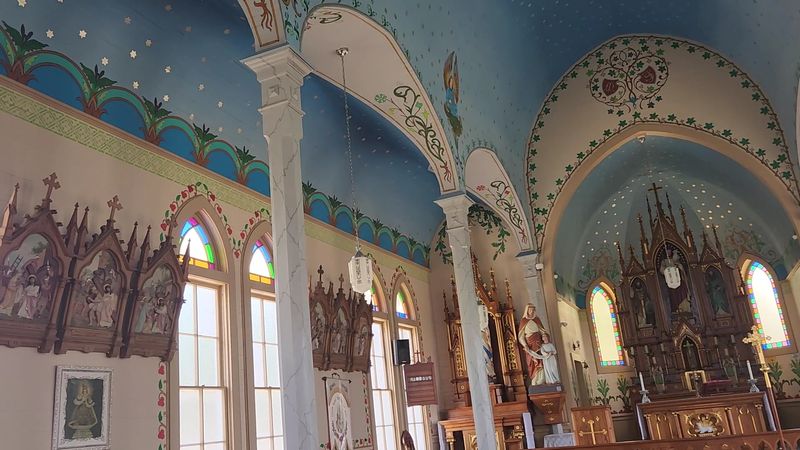
The ceiling is stunning, but the walls are where the real storytelling happens. Green ivy vines curl across the arched surfaces, interrupted by bursts of colorful flowers and intricate geometric motifs that feel both European and timeless.
Cloaked angels appear at intervals, painted with a softness that makes them feel like quiet guardians rather than dramatic religious statements. Every surface has been considered, layered, and brought to life with a consistency that is remarkable for a rural Texas church.
Over the entrance to the apse, there is a freehand painting of whimsical angels resting on clouds and surrounding a ciborium. This section stands out from the stenciled work because it feels more spontaneous, more personal.
It is the kind of image that makes you wonder about the person who painted it, what they were thinking, what they hoped visitors would feel when they looked up at it. That mystery adds something special to the experience.
The wooden columns throughout the nave have been painted to mimic the appearance of marble, a technique called faux marbre that was popular in European church decoration. Up close, you can see the brushwork, the careful layering of color that creates the illusion of polished stone.
It is a surprisingly convincing effect, and it adds a richness to the space that real marble might not have achieved in quite the same way. The whole interior feels like a labor of love, because it genuinely was.
Every brushstroke represents someone’s devotion, skill, and care for this small but extraordinary place.
Stained Glass Windows Imported From Munich, Germany
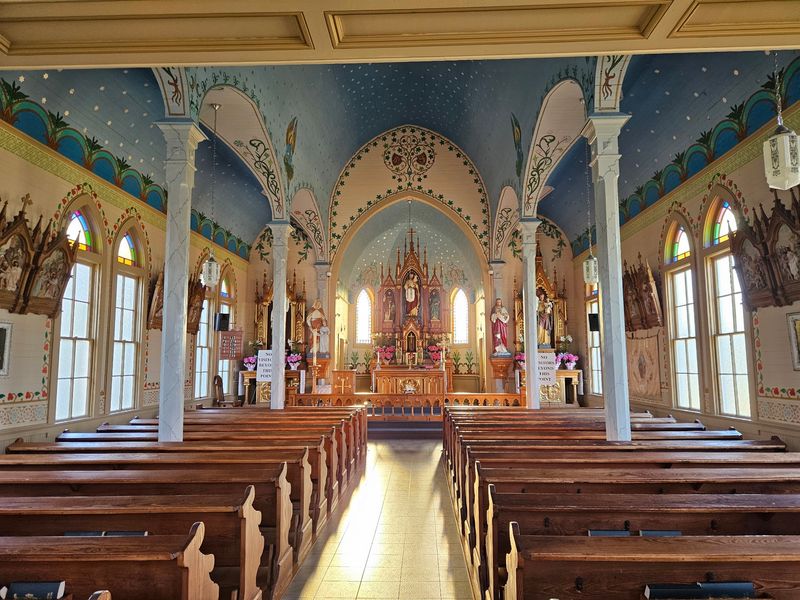
The painted surfaces get most of the attention, and rightfully so, but the stained glass windows deserve a moment of their own.
Installed in 1921, these windows were imported directly from Munich, Germany, and they bring a distinctly Old World quality to the interior that perfectly complements the frescoes surrounding them.
The colors are rich and saturated, the kind that cast jewel-toned light across the floor on a sunny afternoon.
What makes these windows particularly meaningful is the inscriptions they carry. Some are written in Czech, others in German, reflecting the dual heritage of the families who founded and sustained this parish.
Seeing those languages etched into glass inside a Texas church is a quiet but powerful reminder of how far these communities traveled and how much they wanted to preserve their identity in a new land. It is the kind of detail that hits differently once you know the history behind it.
The windows were clearly chosen to work in harmony with the overall decorative scheme of the interior. Their vertical lines and arched tops echo the architectural shapes of the nave, and the colors chosen, deep blues, warm golds, rich reds, feel intentional rather than accidental.
Natural light plays a big role in how this church feels at different times of day. Morning light through the eastern windows creates a completely different atmosphere than the afternoon glow through the western ones.
If you have the flexibility, visiting at different times of day would genuinely reward your patience with something beautiful every single time.
The Main Altar and the Lamb of God
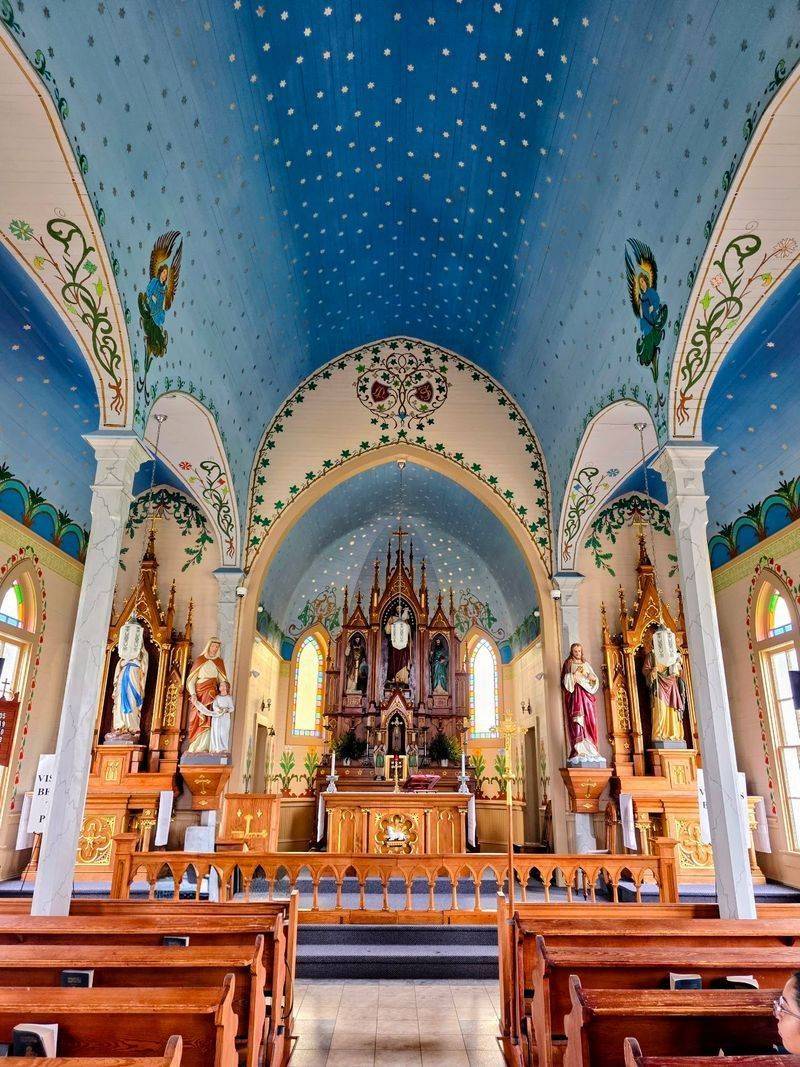
At the front of the church, the main altar draws your eye the moment you walk through the doors. It is framed by the painted apse and surrounded by the decorative richness of the frescoes, making it feel like the natural focal point of everything in the room.
The Lamb of God is prominently displayed here, a classic symbol of Christ in Catholic tradition, representing sacrifice and redemption. This particular representation was moved to its current position in 1968, following liturgical changes that came with the Second Vatican Council.
The altar itself feels appropriately solemn without being cold or distant. The painted backdrop behind it picks up the same sky-blue and gold tones found throughout the rest of the interior, creating a visual continuity that makes the whole space feel unified.
Nothing feels out of place or added as an afterthought. That kind of cohesion is rare and speaks to the care that went into both the original design and the later restoration efforts.
Spending a few quiet minutes near the altar, away from the entrance, gives you a different perspective on the entire interior.
From that vantage point, you can see how the barrel vault stretches back toward the main doors, how the stars seem to multiply the further they recede into the distance, and how the painted columns frame the nave like a ceremonial procession route.
It is a space designed to make you feel small in the best possible way, reminded of something larger than everyday life. That feeling is hard to manufacture.
Here, it just exists naturally.
The Restoration Story That Saved It All
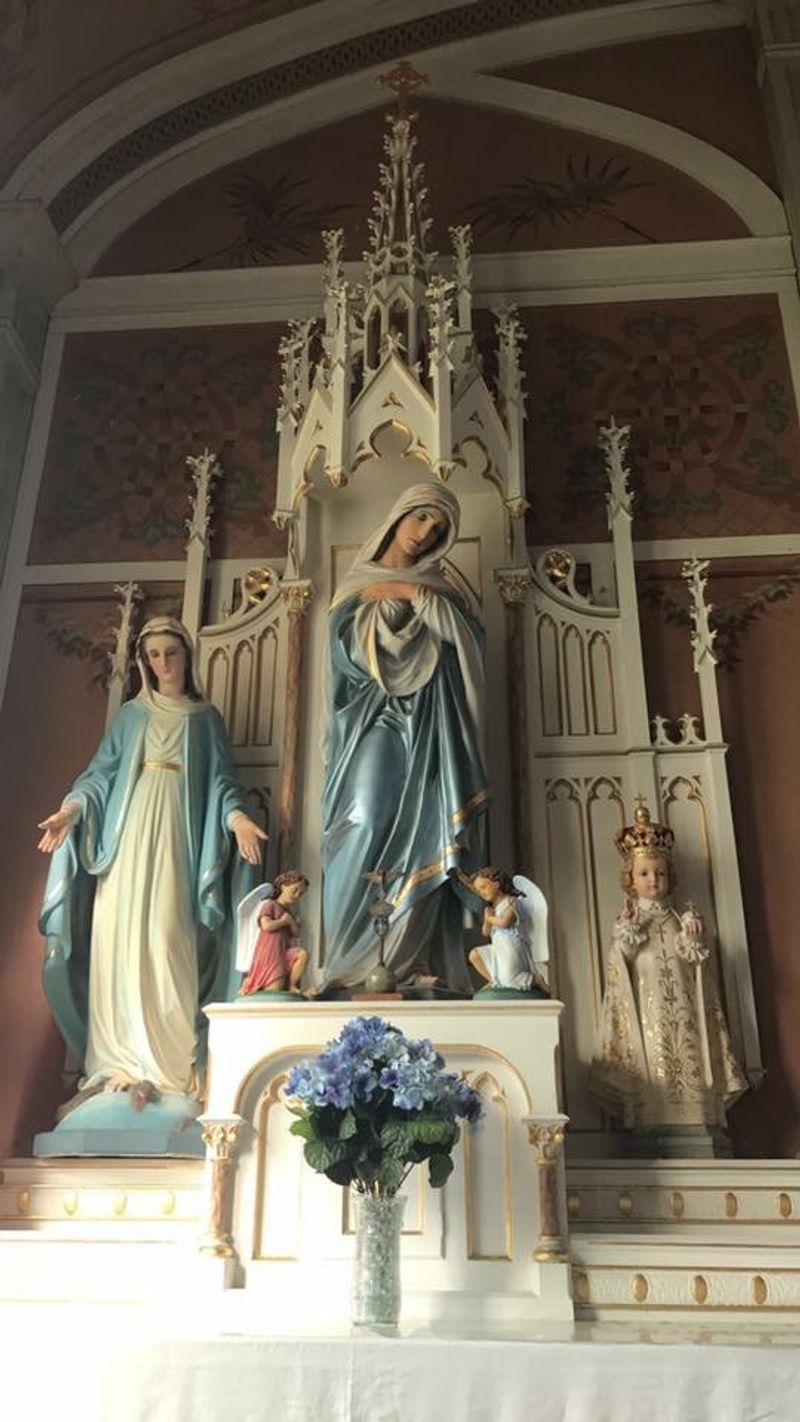
The story of how these frescoes survived is almost as compelling as the paintings themselves. In the 1950s, when many American churches were being updated and simplified, the painted interior of Saints Cyril and Methodius was whitewashed over entirely.
For decades, those intricate designs, the stars, the angels, the ivy, all of it sat hidden beneath layers of plain paint, unknown to most visitors and forgotten by many in the community.
Then in the 1980s, something shifted. Judge Ed Janeckas and Butch Koenig helped organize a community-driven restoration project that would take enormous patience and dedication to complete.
Volunteers began the careful process of uncovering the original artwork, using surviving stencils that the unknown original artist had left behind as their guide.
Where the stencils were incomplete or damaged, the restorers made thoughtful artistic decisions to fill in the gaps, staying as true as possible to the spirit of the original work.
The fact that community members, not professional conservationists from a big institution, led this effort makes it even more remarkable. These were local people who simply refused to let something irreplaceable disappear permanently.
The result of their labor is what visitors see today: a fully restored interior that feels authentic, alive, and deeply connected to its origins. It is a reminder that preservation does not always require massive resources or outside expertise.
Sometimes it just takes a group of people who care enough to show up and do the work. That spirit is woven into every inch of those restored walls.
Visiting the Painted Churches of Texas, What to Know Before You Go
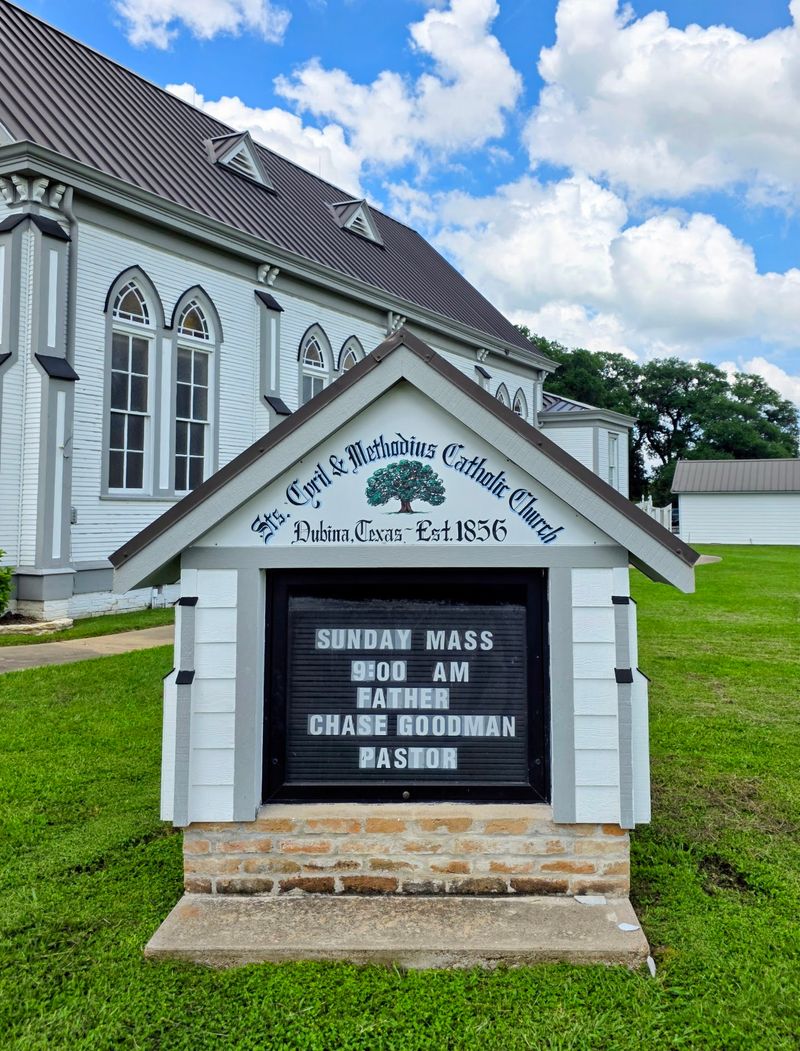
Saints Cyril and Methodius is part of a broader collection known as the Painted Churches of Texas, and Schulenburg has been officially designated as the home base for exploring them.
Several of these remarkable churches are scattered across Fayette and Lavaca counties, each with its own distinct character and history.
Making a day trip to visit more than one is absolutely worth the planning, and Schulenburg makes a convenient starting point for navigating between them.
The church at Dubina is generally open to the public for visits, which is a genuine gift. There is no elaborate ticketing system or timed entry.
You simply arrive, be respectful of the space, and take your time. Since this remains an active parish, it is always a good idea to check ahead if you are planning to visit on a Sunday or around a religious holiday, as services take priority and access for tourists may be limited on those days.
Bringing a camera is highly recommended, though using flash photography inside is something to approach with sensitivity and respect for the space and any other visitors present. The natural light inside the church is genuinely beautiful, especially on a clear morning.
Wear comfortable shoes since the surrounding grounds are worth a slow walk as well. The cemetery adjacent to the church holds the graves of many founding families, with headstones inscribed in Czech and German that tell their own quiet stories.
Plan to spend at least an hour here. Rushing through would mean missing the details that make this place so unforgettable.
Address: 4148 FM1383, Schulenburg, TX 78956
