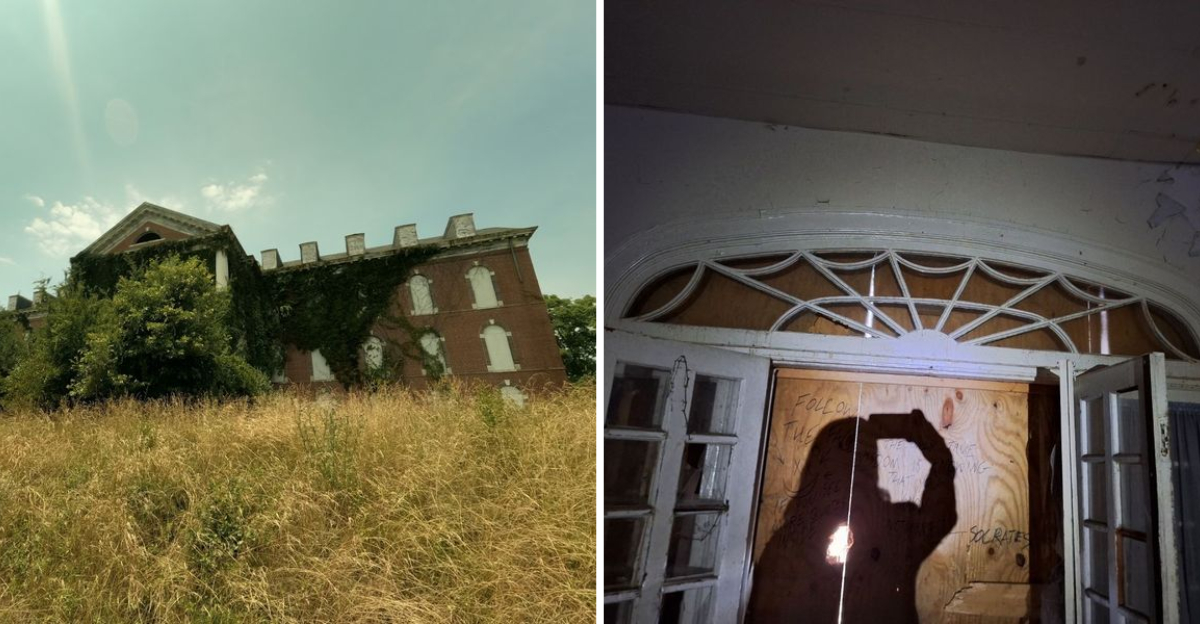
Massive brick walls rise from a hillside in Virginia, and the first time I saw them, something shifted in my chest. A feeling caught between fascination and unease.
That place was not just a hospital, it was the physical embodiment of one of the most troubling chapters in American medical history.
Founded in 1932 by a man who openly championed forced sterilization, the sanitarium carried a mission that still sends chills down your spine today.
Hundreds of lives were changed forever within those walls, many without consent, many without justice. I stood at the edge of the property, trying to reconcile the peaceful hillside with the weight of what had happened there.
If history has a heartbeat, you can almost hear it echoing through every crumbling corridor of that haunting, unforgettable landmark.
Whispers of a Controversial Past
The name DeJarnette carries a weight that most historic buildings simply do not.
Dr. Joseph DeJarnette, who founded this sanitarium in 1932, was also the superintendent of the nearby Western State Hospital from 1906 to 1943.
He was not simply a physician of his era; he was one of the most vocal and aggressive advocates for eugenics in the entire country.
His beliefs centered on the compulsory sterilization of people he labeled as defective. That included individuals with mental disabilities, those with epilepsy, and even people whose lifestyles he personally disapproved of.
His targets were often the most vulnerable members of society, disproportionately poor, African American, and Native American individuals who had little power to resist.
Virginia’s sterilization laws, which DeJarnette tirelessly pushed for, eventually became a model for similar legislation in at least twelve other states. The reach of his influence was staggering.
Most chillingly, he openly praised Nazi Germany’s sterilization program, reportedly remarking that they were outpacing American efforts. Hundreds of forced sterilizations were carried out under his direction at Western State Hospital alone.
The sanitarium he founded was technically a semi-private institution. It was designed for middle-income patients and operating separately from the publicly funded Western State Hospital nearby.
But the ideology driving both facilities came from the same deeply troubling source.
Standing anywhere near this building, you feel the gravity of what happened here. It is not a comfortable feeling, but it is a necessary one.
From Private Care to Public Scrutiny
The sanitarium’s story did not end with Dr. DeJarnette’s retirement. The facility kept operating long after its founder stepped away, and its purpose shifted significantly over the decades.
In 1975, the state of Virginia took control of the property, renaming it the DeJarnette Center for Human Development and converting it into a children’s psychiatric hospital.
That transformation represented a genuine attempt to redirect the institution’s mission toward something more humane. The focus moved away from adult patients and toward helping children with mental health challenges.
For a time, it seemed like the building might shed its darkest associations and build a new identity.
But the shadow of its origins proved difficult to escape. Public understanding of eugenics had shifted dramatically after World War Two, when the full horror of Nazi racial programs became widely known.
The ideology that DeJarnette had championed was now universally condemned as pseudoscience and a profound ethical failure. His name, still attached to the center, became increasingly uncomfortable.
By 1996, the decision was made to move the children’s program to a new, modern facility. The original sanitarium building was permanently closed.
Then, in 2001, the relocated center was officially renamed the Commonwealth Center for Children and Adolescents, a deliberate move to cut ties with DeJarnette’s name and legacy.
Virginia later issued a formal public apology for its sterilization program and worked to provide reparations to surviving victims.
That acknowledgment, though long overdue, marked an important step toward accountability.
Architectural Echoes of a Bygone Era
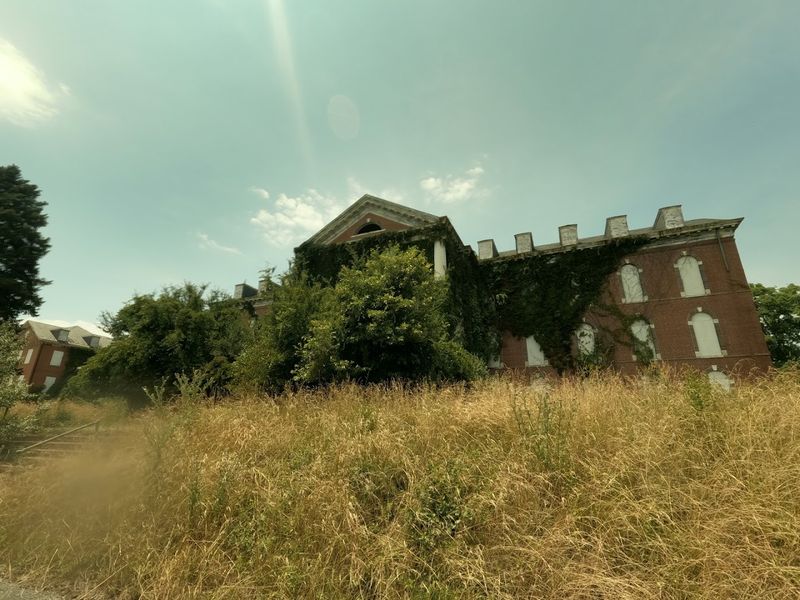
There is something almost contradictory about how beautiful this building looks from a distance.
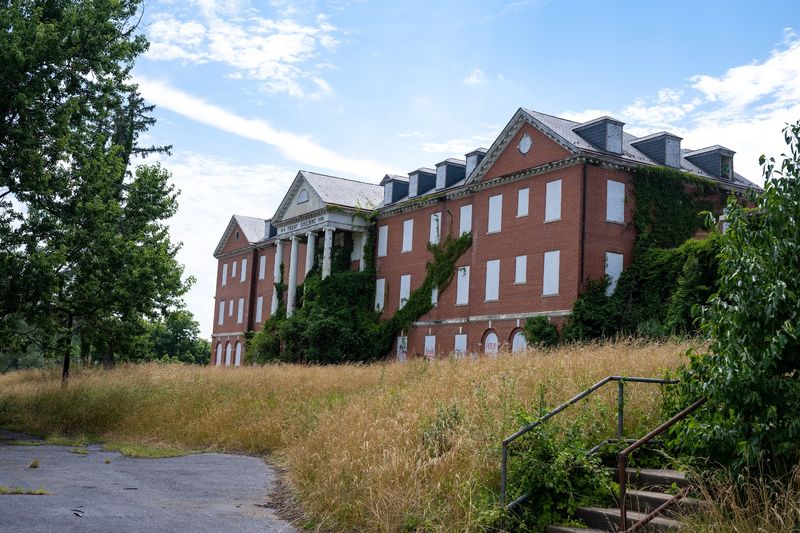
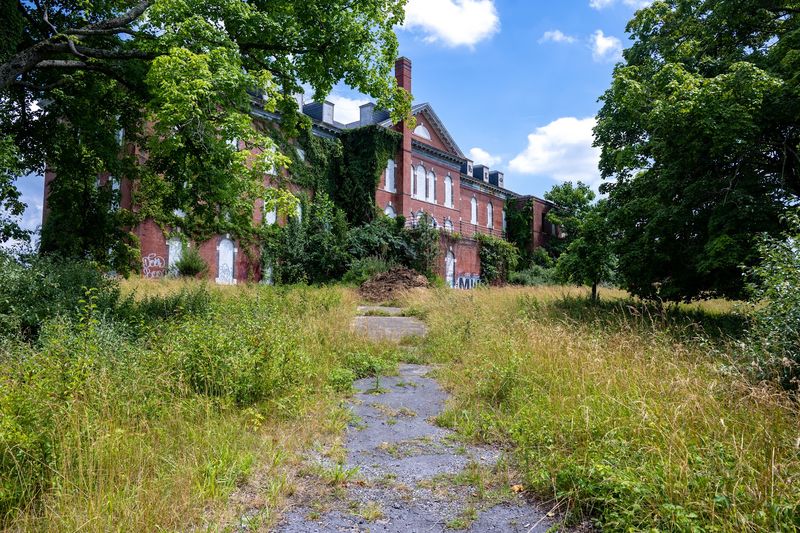
The sanitarium was constructed in the Georgian Revival and Classical Revival styles, featuring red brick facades, symmetrical wings, and stately classical porticos.
These design choices were common for institutional buildings of the early twentieth century, meant to project order, dignity, and authority.
Families bringing their loved ones here would have seen something that looked almost collegiate, even reassuring.
The architecture was meant to communicate that this was a serious, sophisticated place of care.
That contrast between appearance and reality is one of the most unsettling things about visiting the site today.
The buildings sit on a hill in Staunton, commanding a broad view of the surrounding landscape. In its prime, the complex must have looked genuinely impressive.
Now, the brick is weathered, the windows are dark and boarded, and the grounds have been swallowed by overgrown trees and tangled vegetation.
Despite what the title of this article might suggest, the sanitarium was not built in the Art Deco style. The Georgian Revival influence is far more prominent, with its emphasis on symmetry and classical detail.
That architectural language was chosen deliberately. Institutions of this era often used grand design to signal legitimacy.
The irony is that the grandeur of the building has outlasted the moral credibility of what happened inside it.
Every column and cornice now serves as an accidental monument to a deeply flawed vision of human progress.
The Weight of Abandonment
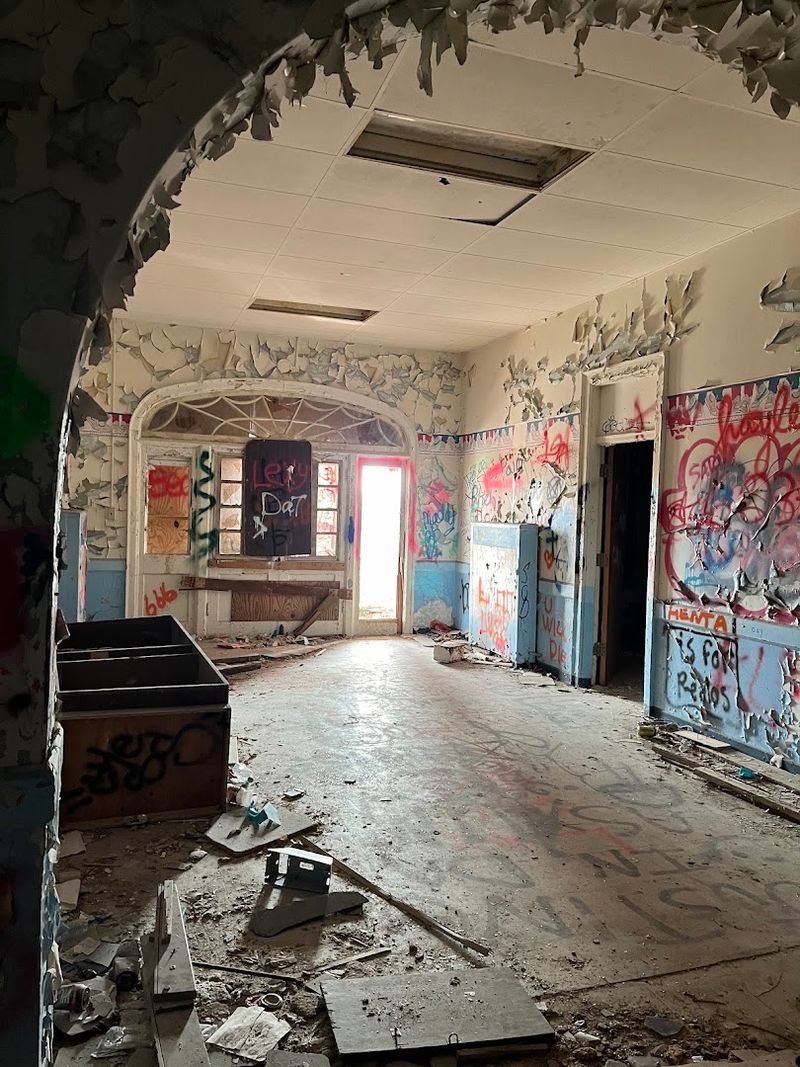
Few things communicate the passage of time quite like a massive building left completely to the elements.
The original DeJarnette Sanitarium has been sitting vacant since the mid-1990s, and nature has been steadily reclaiming the grounds ever since.
The surrounding vegetation has grown thick and wild, and the buildings themselves show serious signs of deterioration.
Urban explorers have been drawn to the site for years, captivated by its sheer size and the eerie atmosphere that hangs over the property.
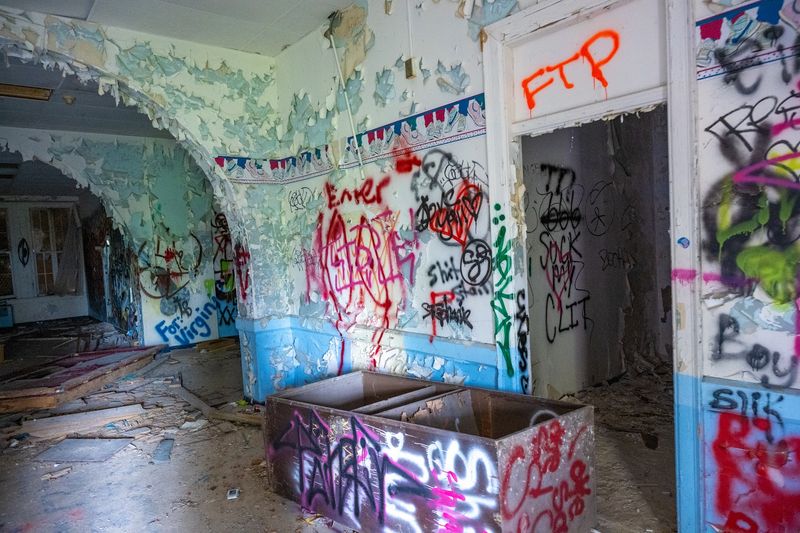
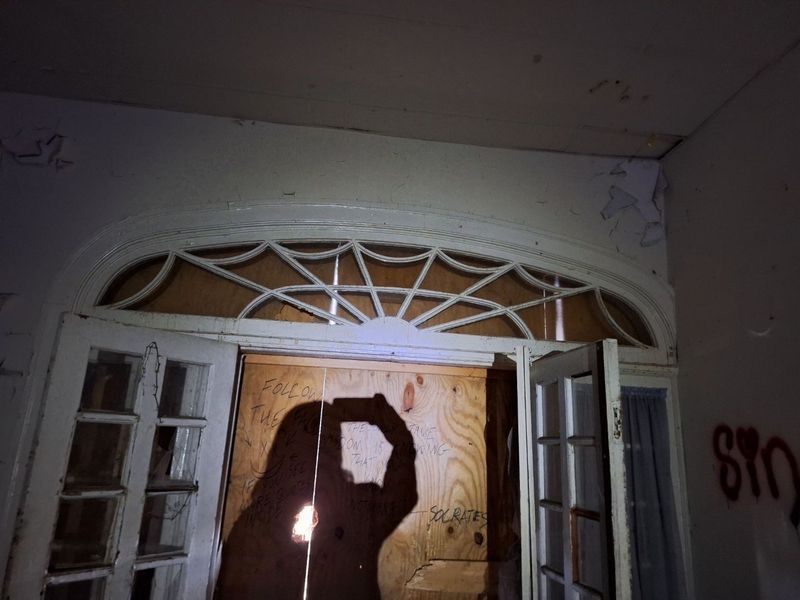
The interiors, from what has been documented by those who have visited, are heavily damaged.
Graffiti covers many of the walls, and debris litters the floors. It is a far cry from the orderly institution that once stood here.
Trespassing on the property is strictly prohibited, and local authorities have worked to restrict access. The structure has also been identified as containing asbestos, adding a serious safety concern to the legal one.
Local officials have described the decaying complex as a burden on the city, something that costs money and raises liability questions without offering any clear benefit.
Various proposals for demolition and redevelopment have been floated over the years, but none have moved forward in a definitive way.
The property passed out of state ownership and into private hands, which has made decisions about its future even more complicated.
For now, the sanitarium remains exactly as it has been for decades: massive, silent, deteriorating, and impossible to ignore. It exists in a kind of suspended state, waiting for a resolution that has not yet come.
Reflections on a Difficult Legacy
Some places demand a kind of emotional reckoning, and the DeJarnette Sanitarium is firmly in that category.
The building forces you to think about what happens when medical authority is handed over to ideology rather than compassion.
The eugenics movement was not some fringe idea operating in the shadows; it was mainstream, politically supported, and legally enforced in Virginia for decades.
The victims of forced sterilization at facilities connected to DeJarnette’s work were real people with real lives. Many were young.
Many had no one to advocate for them. The fact that what was done to them was legal at the time does not make it any less devastating.
Virginia’s eventual apology and reparations effort acknowledged that truth directly.
For some residents of Staunton, the abandoned building is simply an eyesore, a crumbling reminder of something the community would rather move past. That reaction is understandable.
But others argue that demolishing the structure would erase a physical record of harm that should not be forgotten so easily.
The tension between those two perspectives is genuinely meaningful. Memory is complicated when the thing being remembered is painful.
Preserving a building associated with suffering can feel wrong, but so can pretending that suffering never happened. The DeJarnette Sanitarium sits at exactly that crossroads.
It is not a comfortable symbol, but it is an honest one.
Confronting it honestly, rather than looking away, feels like the more courageous and ultimately more respectful choice for the people whose lives were changed here forever.
A Site of Historical Significance and Somber Beauty
There is a strange kind of beauty that settles over places that have been left behind. The DeJarnette Sanitarium has it in abundance.
The red brick buildings, still structurally present despite decades of neglect, hold a visual power that photographs struggle to fully capture.
The hillside setting gives the complex a dramatic quality, especially in the late afternoon light when shadows stretch long across the overgrown grounds.
Visiting the area around the sanitarium, even just viewing it from a respectful distance, leaves a lasting impression. It is the kind of place that stays with you after you have driven away.
Not because it is glamorous or exciting, but because it is genuinely significant. The history embedded in those walls touches something fundamental about how societies treat their most vulnerable members.
Staunton itself is a charming, walkable city with a lot to offer visitors beyond this sobering landmark. The downtown area features well-preserved Victorian architecture, independent shops, and a vibrant arts scene.
But the sanitarium, visible from various points around the city, adds a layer of historical depth that most towns simply cannot match.
Approaching this site thoughtfully means coming with some knowledge of its history, not just curiosity about its appearance. The building is more than a backdrop for photographs.
It represents real lives, real harm, and a real chapter of American history that is still being processed. Paying attention to that, even from the outside, makes the experience genuinely worthwhile and quietly unforgettable.
Address: Frontier Drive, Staunton, Virginia
