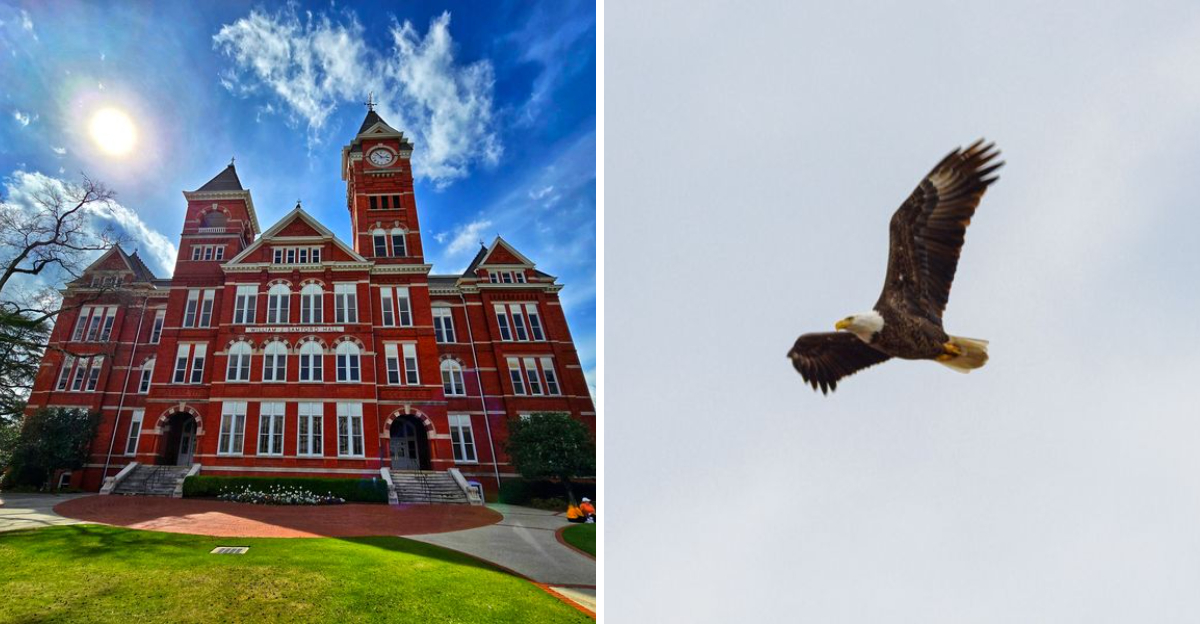
A university ranking does not usually make people want to buy fresh lemonade. This one might.
Somewhere on this Alabama campus, students run their own meat laboratory, eagles take to the sky, and a museum quietly houses more art than most people expect to find in a college town.
Then autumn arrives and the stadium fills with a crowd several times larger than the surrounding city, turning ordinary streets into something much louder and much more festive.
The national recognition is impressive, but it is the strange little details that make the place memorable. Brick walkways wind beneath old oaks.
A working farm carries on nearby. Even the trees have their own history after decades of football celebrations.
A top rating looks good on paper. The real surprise is how much personality comes with it.
Samford Hall and the Green Heart of Campus
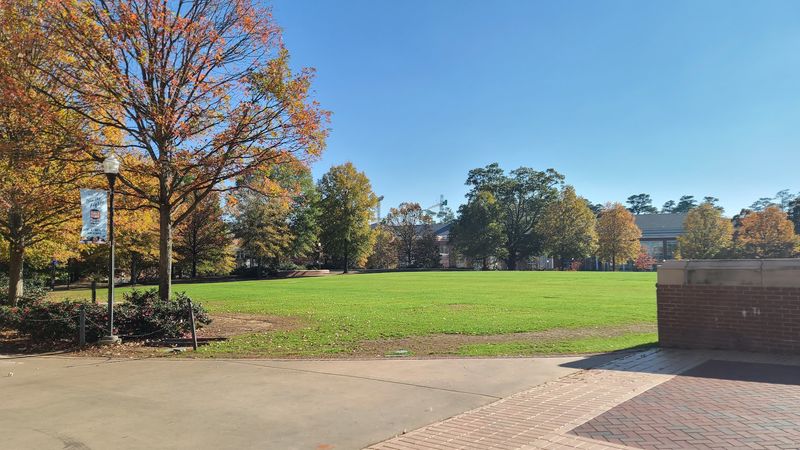
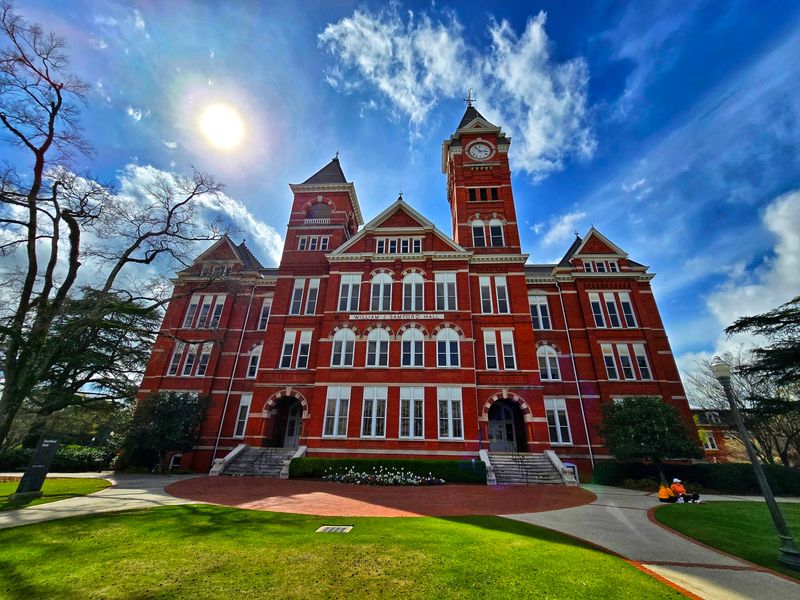
Few buildings anchor a town the way Samford Hall does. The clock tower rises above the oaks along South College Street, and the chimes reach clear across the lawn where students stretch out between classes.
Built in 1888 on the site of an earlier structure lost to fire, the Victorian brick landmark now holds administrative offices. Visitors are welcome to stroll the surrounding lawn, which locals simply call Samford Park.
Squirrels here are famously bold. Bring a book, pick a bench, and expect company within about four minutes.
The park doubles as the unofficial front porch of campus. Families take graduation photos under the trees, tour groups gather near the steps, and the whole scene shifts color dramatically in late October when the hardwoods turn.
Look for the two cannons on the lawn, relics with their own tangled campus legends, and the memorial markers tucked along the walkways.
Campus tours generally begin nearby, and self-guided walkers can loop from Samford to the concourse in under half an hour. Signage is clear, benches are plentiful, and shade is easy to find even in August.
For anyone trying to understand why Auburn keeps earning national recognition, the answer partly shows up here. A university that treats its center as a shared park rather than a fenced monument tends to feel welcoming, and that welcome is exactly what visitors notice first.
Toomer’s Corner, Where Celebrations Turn White
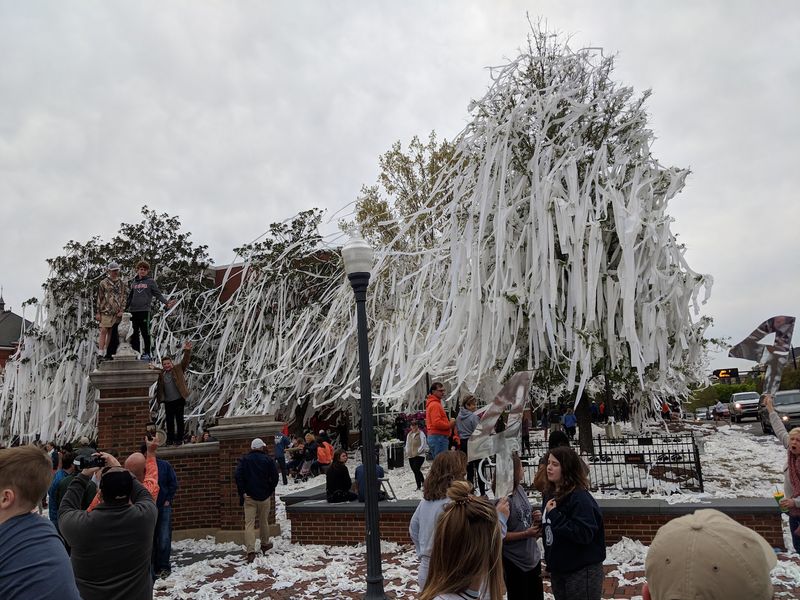
The corner of College Street and Magnolia Avenue looks perfectly normal on a quiet Tuesday. Then a big win happens, and within minutes the oaks disappear under thousands of white streamers.
Rolling Toomer’s Corner is one of the most recognizable traditions in American college sports. Fans of every age show up with rolls in hand, and the trees become a soft, fluttering snowdrift under the streetlights.
The original oaks were poisoned in 2010, replanted, and replanted again. Auburn refused to give up the ritual, which says plenty about the place.
Across the street sits Toomer’s Drugs at 100 North College Street, in business since 1896 and still squeezing lemonade the old way. The line moves fast, the cups sweat in summer, and the tile floor has seen more than a century of foot traffic.
Downtown radiates out from here in an easy walking grid of bookstores, boutiques, and casual restaurants. Everything sits within a few blocks, which makes parking once and wandering the smartest plan.
Even without a game on the schedule, the corner rewards a visit. Historical markers explain the tradition, the trees are worth admiring on their own, and the intersection functions as the seam where campus and city stitch together.
Stand there long enough and the town’s whole personality walks past.
Jordan-Hare Stadium on a Fall Saturday
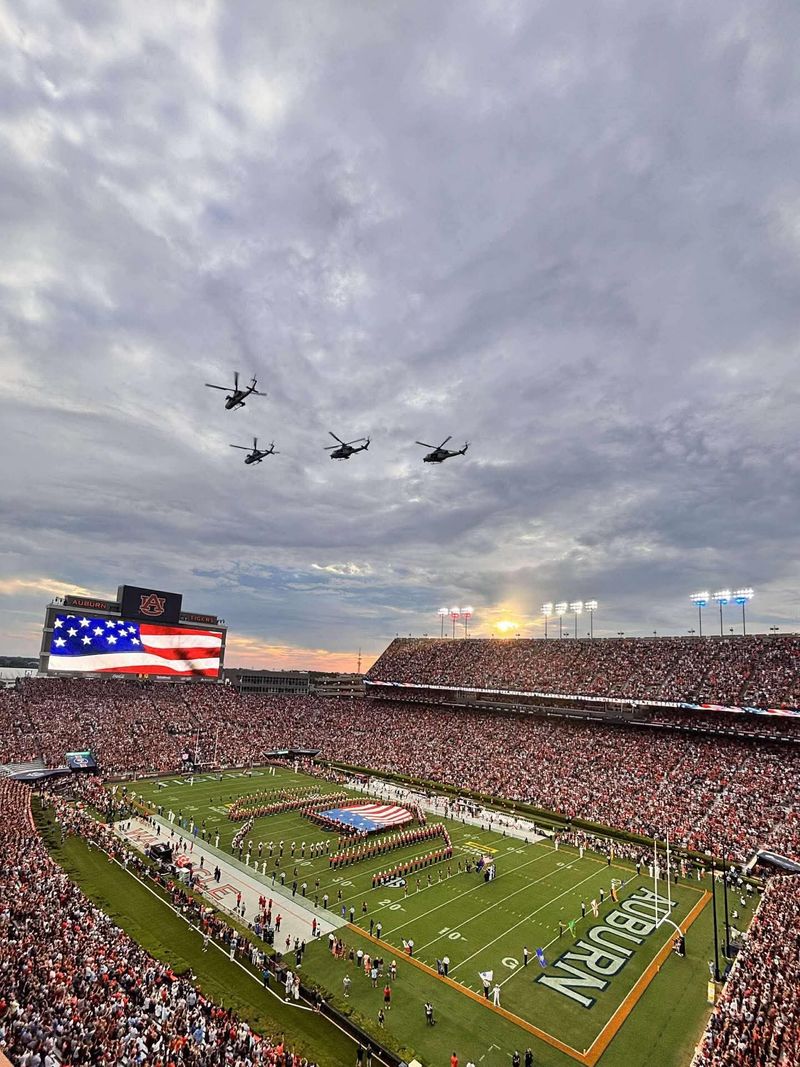
Autumn Saturdays here operate on their own calendar. Tailgate tents go up before sunrise, the smell of charcoal drifts across the intramural fields, and by kickoff more than 87,000 people are packed into Jordan-Hare Stadium.
The stadium sits right in the middle of campus at 251 South Donahue Drive, which is unusual and part of what makes game day feel so contained. No shuttle rides from distant lots.
Just walk.
Tiger Walk happens roughly two hours before kickoff, when players make their way down Donahue Drive through a corridor of fans. It started informally decades ago and grew into something enormous.
Non-game visits are possible too. The concourse area and surrounding plazas are accessible on most weekdays, and the statues honoring Auburn’s Heisman winners draw a steady stream of photographers.
What surprises first-timers is the noise. Sound bounces inside the bowl in a way that turns 87,000 voices into something closer to weather than crowd.
Tickets for marquee games sell out well ahead, so planning matters. Smaller matchups offer a gentler introduction and a much easier parking situation.
Athletic success and academic recognition tend to travel together at Auburn, and the stadium is where the school’s shared identity becomes physically obvious. Everyone wears the same two colors, and nobody seems to mind.
Watching a Real Eagle Fly Inside the Stadium
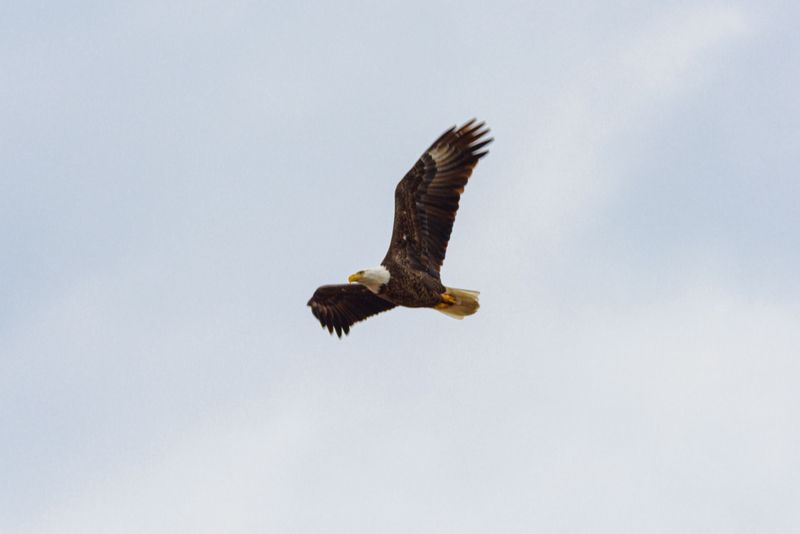
Nothing quite prepares a first-time visitor for the moment a live eagle circles overhead. Pre-game, the bird is released from the upper deck, spirals down over the field, and lands near midfield while the entire stadium holds one long note.
Auburn’s eagles live at the Southeastern Raptor Center, part of the College of Veterinary Medicine, located at 1350 Pratt-Carden Drive. The facility rehabilitates injured birds of prey and releases those that recover.
Birds that cannot survive in the wild become ambassadors. Education, not spectacle, is the primary mission.
Football Fridays in the Park run during the fall season, giving the public a chance to watch flight demonstrations up close. Hawks, owls, vultures, and eagles all take turns, and handlers explain each species while the birds swoop just above seated heads.
Kids tend to lose their minds a little. Adults do too, honestly.
The War Eagle battle cry predates the current birds by generations, wrapped in several competing origin stories that nobody has fully settled. Auburn leans into the mystery rather than picking one version.
Reservations are recommended for demonstrations, and the outdoor amphitheater setting means checking the weather beforehand is wise.
Programs like the raptor center are part of why Auburn’s veterinary and agricultural reputation carries so much weight nationally. Conservation work happens here in plain sight, and visitors get a front-row seat.
Fresh Lemonade, Historic Plots, and the Campus Farm Scene
Land-grant universities come with barns, and Auburn has kept its agricultural roots very much alive. The result is delicious.Instead of a campus dairy, the real student-driven flavor happens at the Lambert-Powell Meats Lab.
Here, animal sciences students master processing and retail, selling custom cuts and smoked sausages directly to the local community. For the sweet side of campus tradition, everyone walks to the edge of the university grounds to visit Toomer’s Drugs.
Squeezing legendary fresh lemonade since 1896, it remains the ultimate spot for a cool drink or a big scoop of ice cream on a warm southern afternoon.
Nearby, the Auburn University Teaching Garden and the Old Rotation research plot offer a quieter kind of interest. The Old Rotation, established in 1896, is the oldest continuous cotton experiment in the country and sits right beside campus traffic on South Donahue Drive.
Most visitors drive past without noticing a national historic landmark of agriculture. It is well worth a brief pause for photos.Fisheries research ponds, forestry plots, and greenhouses spread across the surrounding acreage, and several areas welcome the public during weekday hours.
The Donald E. Davis Arboretum adds another beautiful layer, featuring more than 200 distinct tree species native to Alabama arranged along shaded loop trails.
Admission is entirely free, and leashed dogs are always welcome here on campus.
The Jule Collins Smith Museum of Fine Art
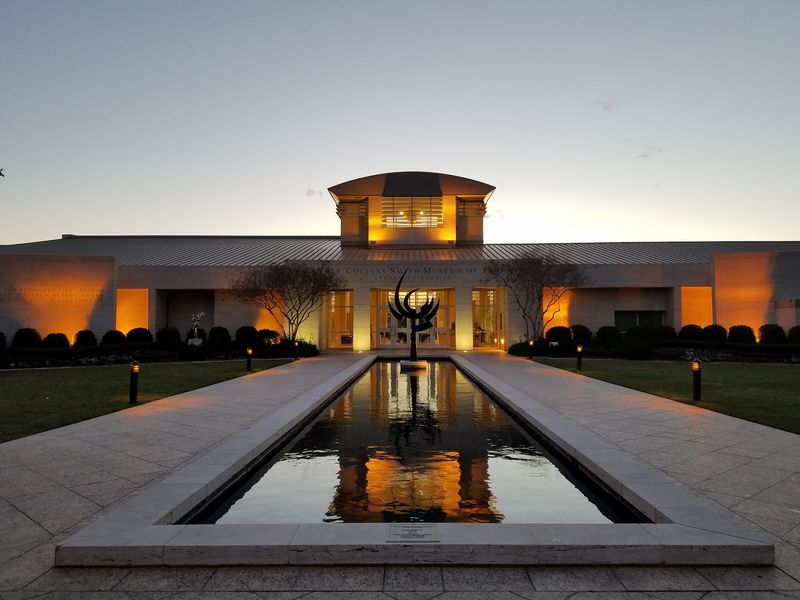
An art museum with a reflecting pond and a sculpture garden is not what most people expect from a football town. Auburn has one anyway, and it is excellent.
The Jule Collins Smith Museum of Fine Art sits at 901 South College Street, a short drive from the main campus core. Admission is free.
Inside, the permanent collection includes a notable group of Audubon prints, American works from the twentieth century, and rotating exhibitions that lean contemporary. Galleries are bright and manageable in size, which makes an hour feel like enough without feeling rushed.
Outside, the grounds do quiet work. A fountain, a pond ringed by walking paths, and large-scale sculptures scattered across the lawn turn the property into a park as much as a museum.
Benches face west. Sunset lighting on the water is genuinely lovely.
The museum hosts community programs, film screenings, and family art days throughout the year, drawing plenty of visitors who have no connection to the university at all.
Parking is free and rarely a struggle, a rare combination anywhere near a college campus.
Cultural resources like this one factor into national assessments of a university’s overall experience, and Auburn clearly understands that. A school known for engineering and agriculture invested in art, and the town got a peaceful, beautiful place out of the deal.
Chewacla State Park and the Woods Next Door
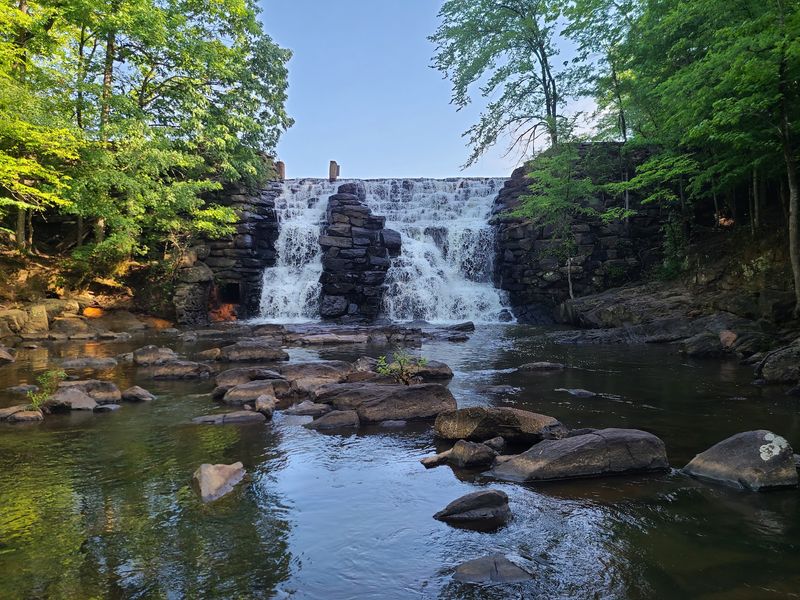
Five minutes from campus, the sidewalks give way to pine and granite. Chewacla State Park covers roughly 700 acres at 124 Shell Toomer Parkway, and it functions as Auburn’s backyard.
A stone dam built in the 1930s by the Civilian Conservation Corps spills water into a wide pool below, and the falls are the park’s most photographed feature. Swimming areas open seasonally around the 26-acre lake.
Mountain bikers know this place well. Volunteer-built singletrack winds through the hills with routes for beginners and technical sections for people who enjoy suffering.
Hikers get gentler options, including short loops to the falls and longer trails through hardwood forest. Trail maps are posted at the entrance and available at the park office.
Cabins, campsites, and picnic pavilions make overnight stays easy, and the park stays busy in spring when dogwoods bloom along the ridges.
Bring water shoes. The rocks near the falls are slick in a way that humbles the overconfident.
Autumn brings color, winter brings solitude, and summer brings families spread across every shaded table in sight.
A top-rated university surrounded by real wilderness gives students and visitors an unusual balance. Study hard, then go stand under a waterfall.
Auburn’s national recognition covers academics, but this park explains a good bit of why people fall for the place and never quite leave.
