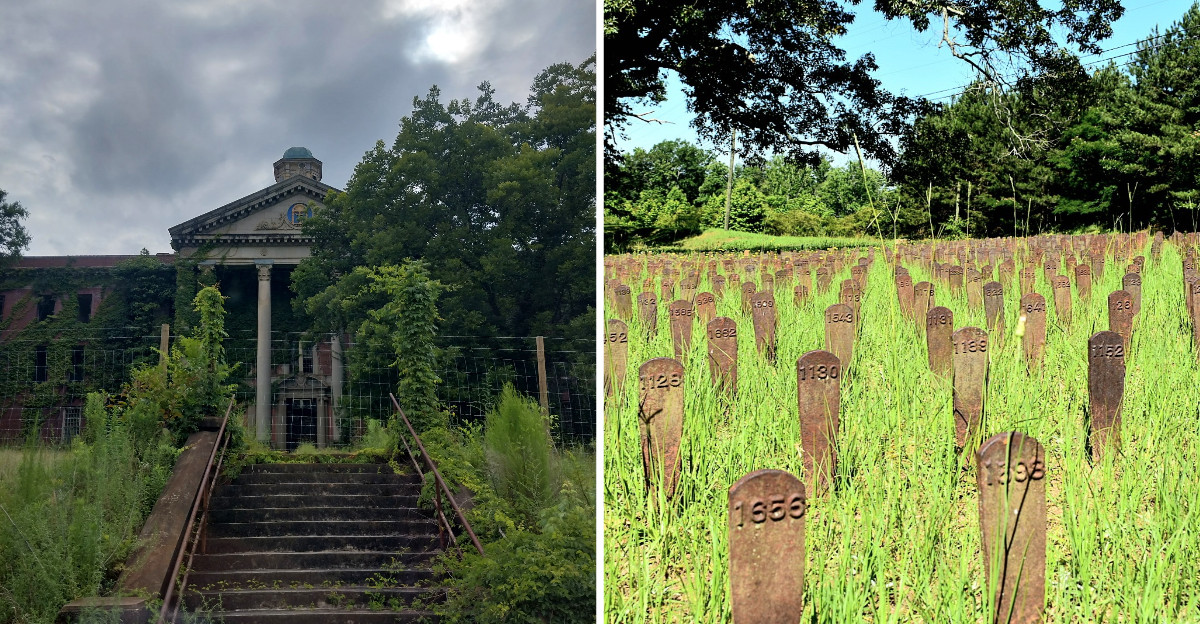
Brick buildings rising behind tall oaks on a Georgia campus look like their own small town, quiet and a little mysterious. What waits inside the grounds is harder to picture.
Back in the 1960s, thousands of patients lived here at the same time, making it one of the largest mental hospitals in the world. Patients lived entire lives here, and some never left.
Scattered across the fields are thousands of graves marked only by small stones or not marked at all. Learning about them changes the way you look at every path and every patch of grass.
This is a story about history, loss, and remembering, and it is one worth telling. The campus is still standing, and the stories still linger in the brick and the shade.
A Campus That Grew Into Its Own City
My first surprise came from the sheer size of the place. At its busiest, the campus stretched across about 2,000 acres and held more than 200 buildings.
Even today, it covers roughly 1,750 acres, so bring comfortable shoes and plan to drive between spots.
Back in the 1960s, somewhere between 12,000 and 14,000 patients lived here at once. That is more people than live in many Georgia towns.
The hospital had its own kitchens, laundry rooms, farms, and even power systems, which helped it run almost like a separate city.
I kept trying to imagine the daily noise of it all. Thousands of meals were cooked every day, and staff moved constantly between wards, offices, and fields.
Now the grounds are much calmer, with wide lawns, huge shade trees, and long empty roads that let you hear birds more than cars.
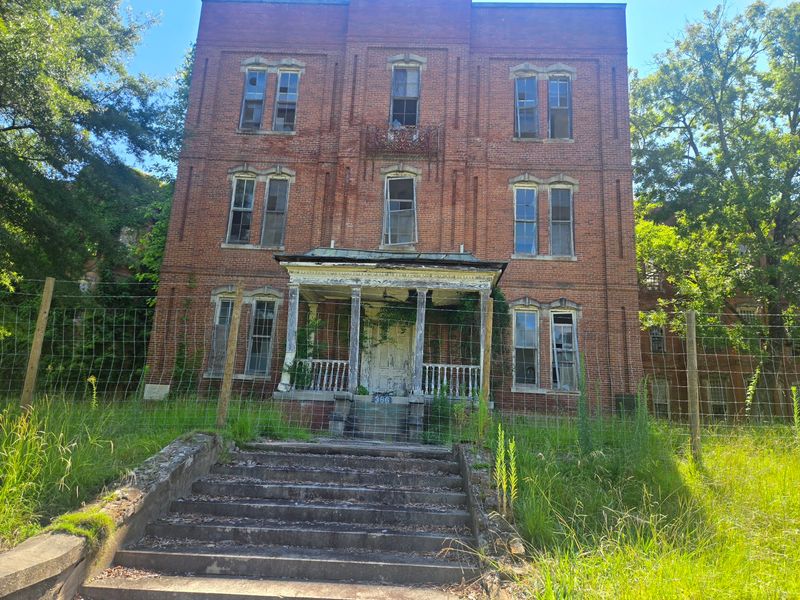
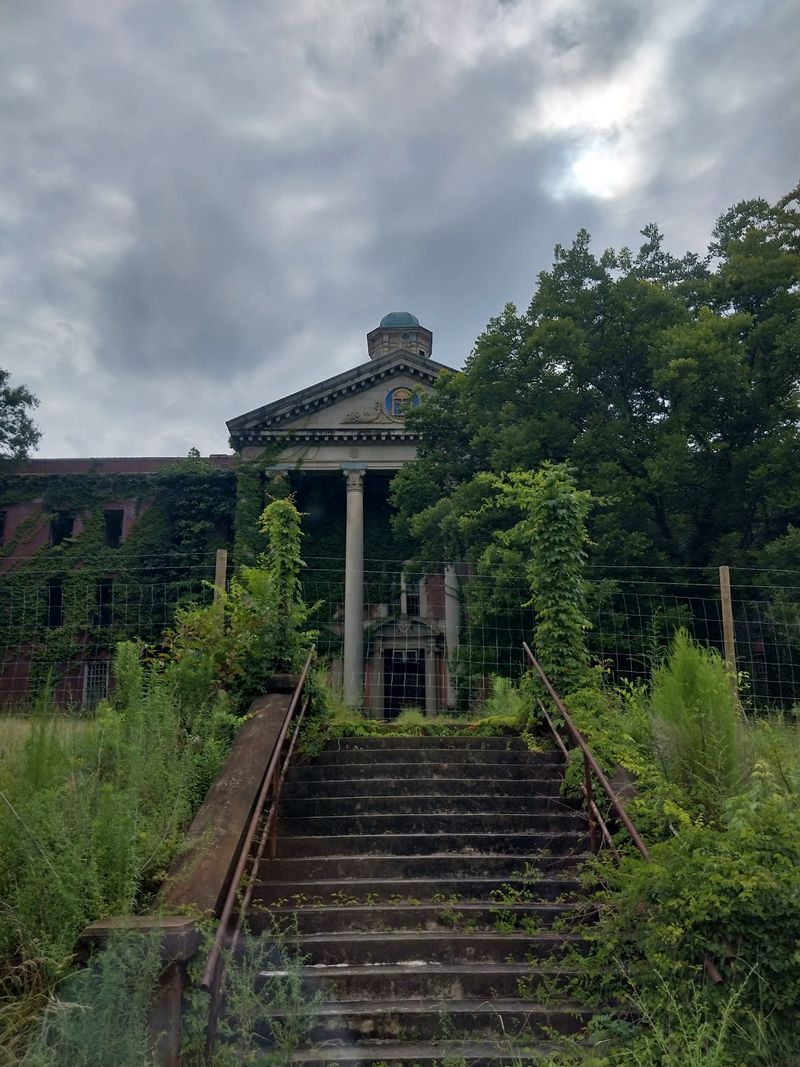
Many of the old buildings are closed and fenced off, and some are crumbling. For your safety and out of respect, stay out of any building that is not open to the public.
Photos from the road or sidewalk still capture the grand columns and tall windows beautifully.
My best tip is to start with a simple loop around the main roads. You will get a feel for the scale before learning the deeper story, and that order made everything else hit harder for me.
From a Harsh Old Name to Central State
Names tell stories, and the original one here stopped me cold. When the hospital opened in 1842, it was called the Georgia State Lunatic, Idiot, and Epileptic Asylum.
Words like those were common back then, but they sound cruel to our ears today.
Over time, the name changed several times as attitudes shifted. It became the Georgia State Sanitarium, then Milledgeville State Hospital.
Finally, in 1967, it took the name Central State Hospital, which it still carries now.
I found it helpful to think of each new name as a small step. People slowly started seeing mental illness as a health issue instead of something shameful.
The changes did not fix every problem, yet they show how language can shape the way a whole society treats people.
Georgia was one of many states building large asylums in the 1800s. The idea at first was hopeful, since leaders believed quiet country settings with fresh air and work could help patients heal.
Sadly, crowding and money troubles later got in the way of that dream.
If you visit, notice the older architecture with its columns and grand porches. Those buildings came from the early, more hopeful years, and they stand in sharp contrast to the harder chapters that followed.
Keeping that timeline in mind makes the whole campus easier to understand.
Rows of Iron Markers in Cedar Lane Cemetery
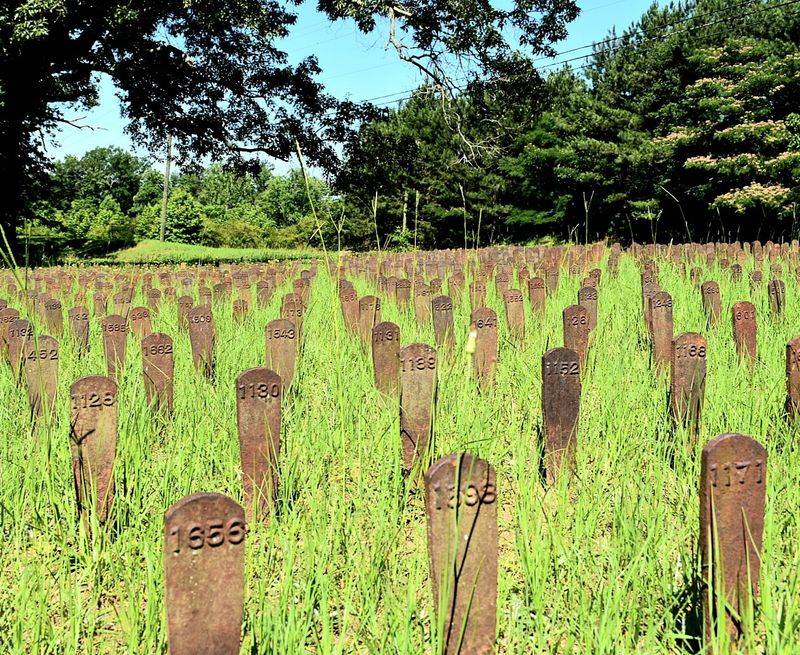
Nothing I saw on the grounds moved me more than the small iron stakes. Around 2,000 of them stand in Cedar Lane Cemetery, set in rows among the trees.
Each one carries only a number, and they serve as memorials for patients whose graves lost their names long ago.
Estimates of unmarked graves across the property vary a lot. Some sources say there could be around 25,000, while others count about 7,500 to 8,500 in one historic burial ground called Asylum Cemetery 2.
Either way, the numbers are huge and heavy to think about.
For many years, patients who passed away here were buried with simple metal markers. Over time, many markers were pulled up or moved, and the exact locations of graves were lost.
Families who wanted to find loved ones often had no way to do it.
In 1997, a restoration project began to honor these forgotten people. Volunteers and supporters worked to create memorials, and the iron markers were gathered and placed together as a tribute.
There is also a statue of an angel that watches over the area.
When you visit, move slowly and speak softly. Stay on paths, avoid stepping on markers, and skip any silly photos.
I spent a long time just standing quietly, and it felt like the right way to show respect.
The 1959 Reporting That Changed Everything
A single reporter helped pull back the curtain on this hospital. In 1959, journalist Jack Nelson wrote an investigative report that exposed serious problems inside.
His work shocked many readers across Georgia and beyond.
According to his reporting, the hospital had 48 doctors serving thousands of patients. None of those doctors were board-certified psychiatrists.
Even more alarming, some staff had been hired from the mental wards themselves.
By the 1960s, crowding made things even harder. Some reports describe a doctor-to-patient ratio as low as 1 to 100.
With that many people depending on so few caregivers, it is easy to see how patients could be neglected or mistreated.
I think this part of the story matters because it shows the power of honest reporting. Once people learned the truth, pressure grew for changes in how the state cared for people with mental illness.
Reforms did not happen overnight, but the spotlight made ignoring the problems much harder.
Reading about this before your trip adds real depth to the visit. Your local library or online newspaper archives may have more on this era.
As you look at the old wards, you will understand that the buildings are not only pretty architecture, they also hold stories of people who needed far more help than they got.
Artifacts and Stories at the Museum
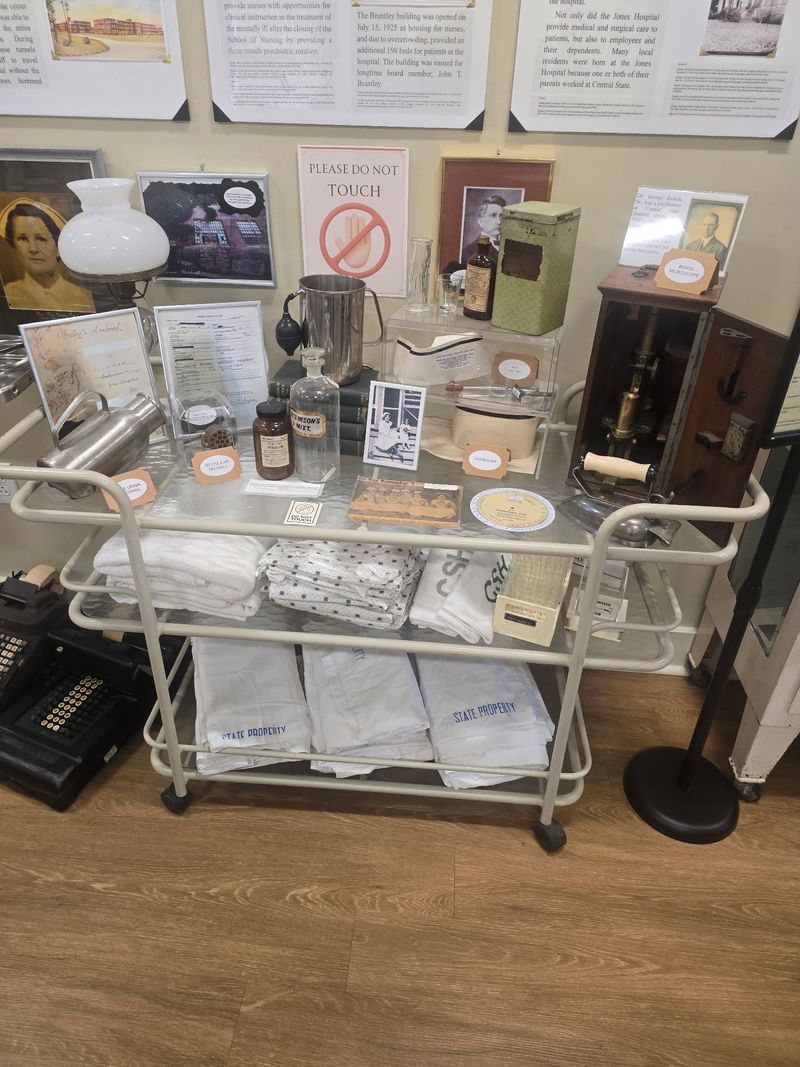
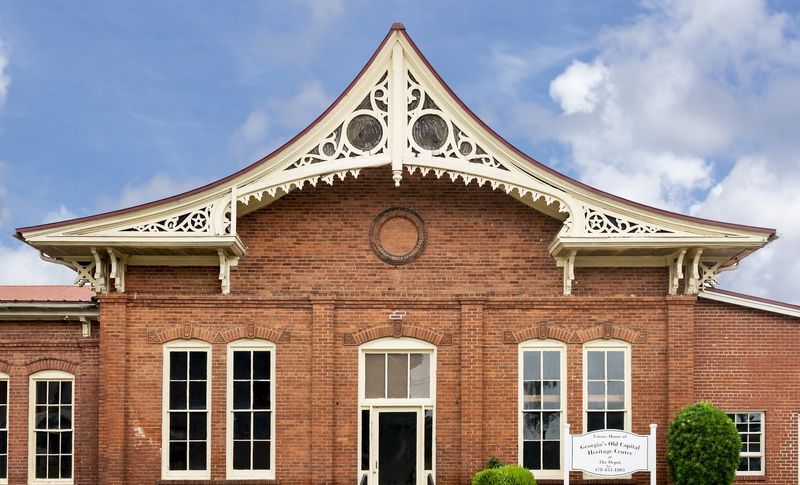
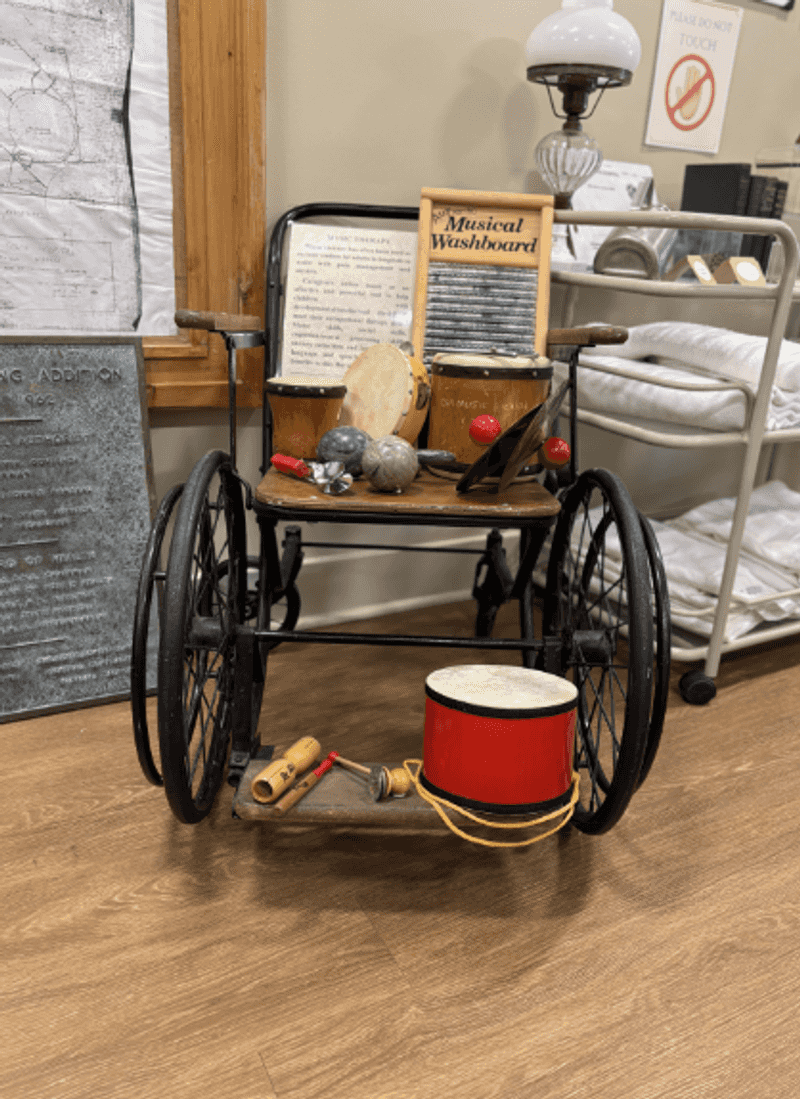
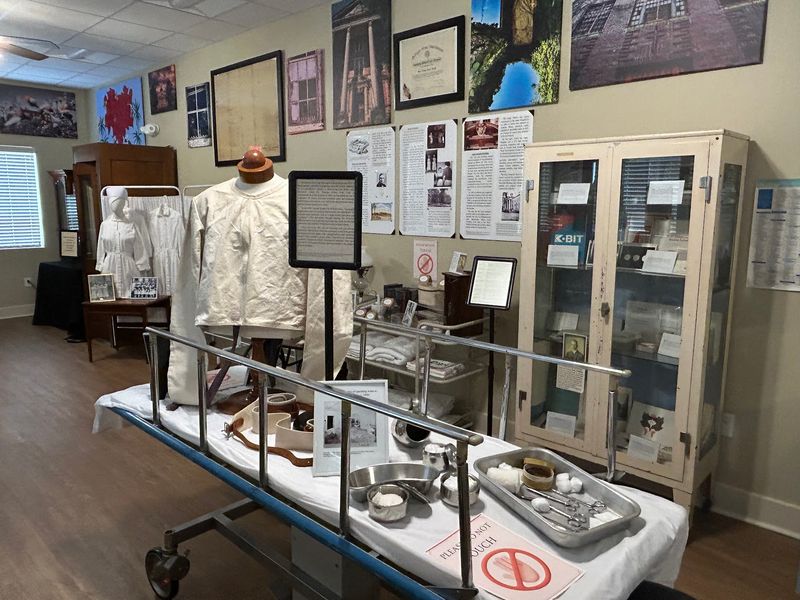
Small spaces can hold big stories, and the Central State Hospital Museum proves it. Housed at the historic depot in Milledgeville, it is packed with objects from the hospital’s long history.
I walked in expecting a quick stop and ended up staying much longer.
Inside, you will find old medical tools, photographs, records, and everyday items that once belonged to the hospital. The displays focus on keeping patient stories alive, not just showing strange equipment.
That careful approach makes the visit feel thoughtful instead of creepy.
One helpful thing to know is that the displays change from time to time. So even if you have been before, there may be something new to see.
The team running it clearly cares about sharing this history in a respectful way.
Timing is the tricky part. The museum is usually open only on Saturdays from 10 AM to 2 PM, so plan ahead.
If a weekday suits you better, you can call 478-453-1803 to ask about visiting by reservation.
I suggest visiting the museum before exploring the grounds. The background you gain makes the cemeteries and buildings much more meaningful.
It is also a great spot for students, history fans, and anyone curious about how mental health care has changed.
A Smaller Hospital Still Working Today
Plenty of visitors assume the whole place is abandoned, and I did too at first. Central State Hospital still operates, just on a much smaller scale than before.
It largely stopped taking new general patients around 2010.
Today, it serves mainly as a maximum-security forensic facility. That means it provides psychiatric evaluation, treatment, and recovery services for people referred by Georgia’s criminal justice system.
It also offers staff-supervised homes for people living with behavioral health disorders.
The working hospital now centers on three main buildings. The Payton Cook Building serves forensic inpatients, the Allen Building handles administration, and the Tharpe Building offers dental services.
It is a big change from the days of more than 200 buildings.
Knowing this helps you act wisely during your visit. Real patients and staff are still here, so stay away from active areas and follow any posted signs.
Treat it the way you would treat any working hospital in your own town.
I actually found this part hopeful. Instead of one giant crowded institution, care today is more focused and specialized.
The campus reminds you how far treatment has come, even though there is still work to do. Seeing old and new side by side gave me a clearer sense of that journey than any textbook could.
Tips for a Respectful and Memorable Visit
A little planning made my trip smoother, and it can help yours too. Start early in the day, since the campus is large and the Georgia sun gets strong by afternoon.
Pack water, a hat, and good walking shoes.
Spring and fall are lovely times to go. The trees look full and green, and cooler air makes wandering the grounds much more pleasant.
Summer works too, but take shade breaks often.
Remember that this is a place of memory, not a haunted attraction. Some people online call it spooky, but the real story is about human beings who lived and passed here.
Keep voices low near cemeteries and never take anything as a souvenir.
Stay out of fenced or closed buildings, even if doors look open. Old structures can have weak floors and falling debris.
The outside views are striking enough for photos anyway.
Pair your visit with time in downtown Milledgeville, a charming town that was once Georgia’s capital. Local streets have historic homes and friendly spots to grab a meal.
That mix of heavy history and small-town warmth balanced my day nicely.
I left feeling quieter and more thoughtful than when I arrived. That, to me, is the mark of a place truly worth seeing.
Address: 620 Broad Street, Milledgeville, GA 31062
