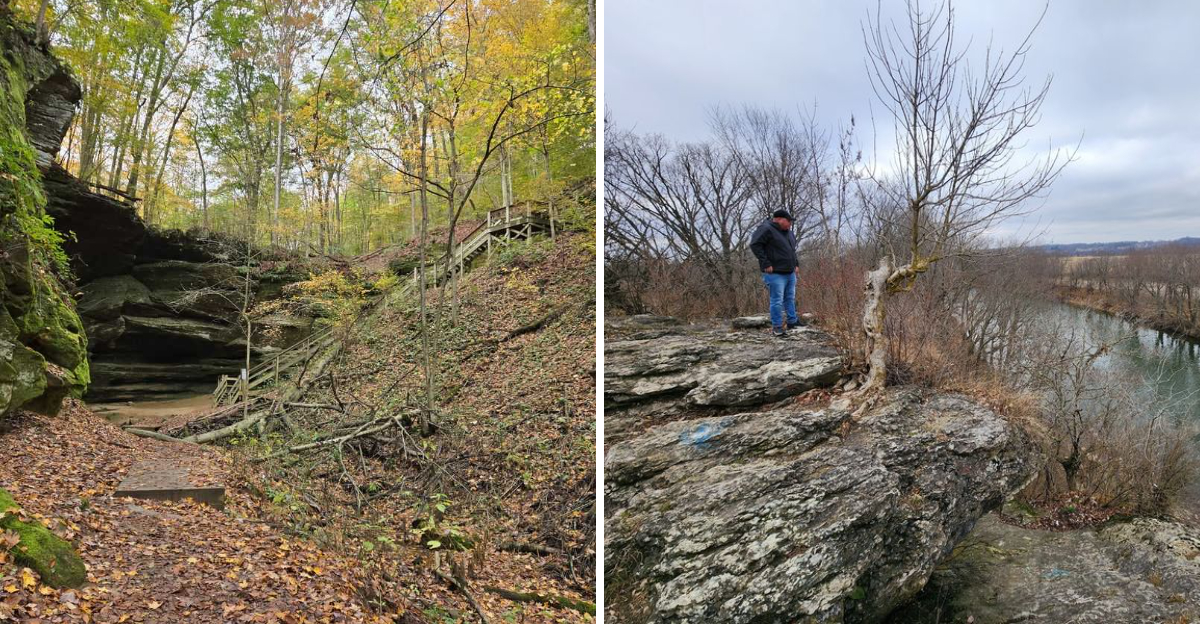
Watch your head. That limestone wall above the river leans out farther than it looks from a distance, and standing underneath it makes the whole thing feel slightly ridiculous.
Then comes the part that sounds even less believable. The rock is roughly 420 million years old and started life as a coral reef beneath a warm, shallow sea.
What is now Indiana was once underwater. Today, the reef stands 65 to 75 feet above the Wabash River, with fossils still trapped inside the stone.
The trail is short. The geology is ancient.
The cliff itself looks like it never got the memo about gravity.
A Coral Reef That Traded Its Ocean For A Cornfield State
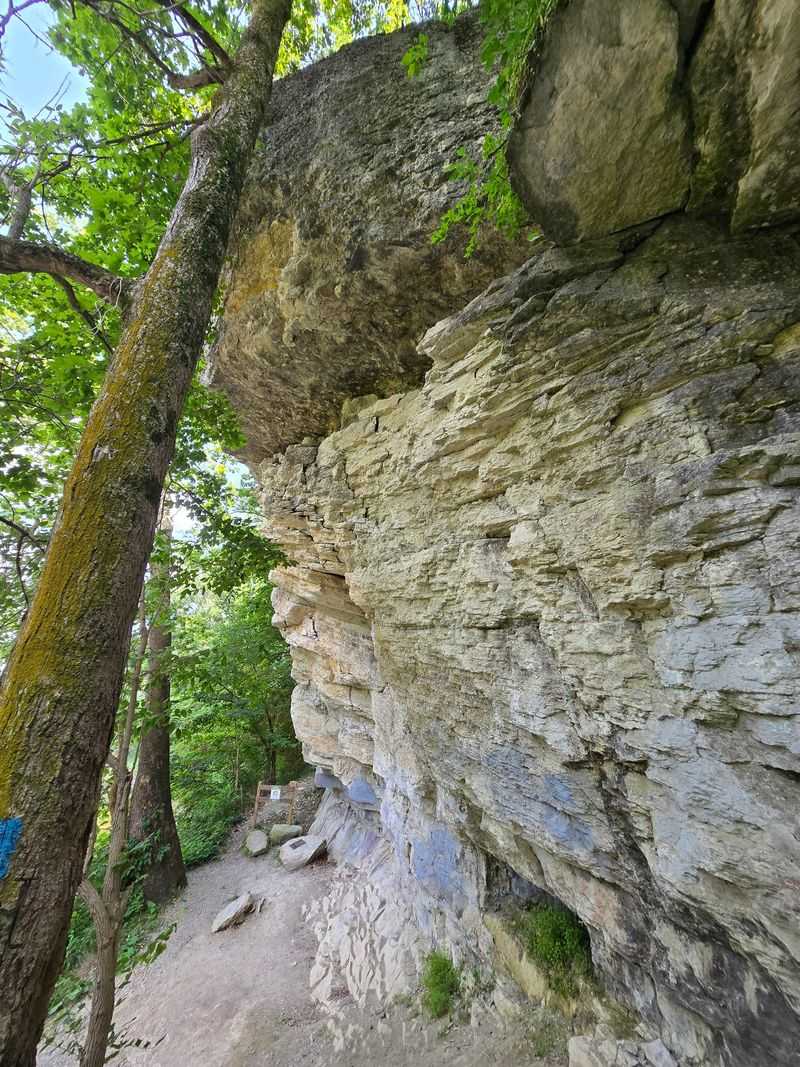
Fossil hunters get a little giddy at Hanging Rock, and for good reason. The cliff is a chunk of a Silurian reef, formed roughly 420 million years ago when a warm, shallow sea covered most of what is now Indiana and the wider Midwest.
Tiny marine animals, mostly corals, built the structure layer by layer. As generations died off, their skeletons piled up and were slowly buried under mud and sand.
Pressure and time turned that heap into hard limestone, locking the creatures inside as fossils.
Look closely at the exposed rock face and the texture changes from smooth to knobby and honeycombed in places. Those patterns are the remains of an underwater neighborhood that predates dinosaurs by a huge margin.
Bring a small hand lens if curiosity runs deep, since details show up better under magnification. Photos taken in soft morning light tend to reveal more texture than harsh midday sun.
Worth remembering: fossils and rock should stay exactly where they sit, because the preserve protects the formation for everyone who follows. Climbing the rock is not permitted either, which keeps both visitors and the cliff intact.
Standing beside a fossilized seabed in landlocked Indiana rearranges a person’s sense of scale. Oceans came and went here.
The evidence is still standing, quietly, above a river that had nothing to do with building it.
The Wabash River Has Been Carving This Cliff For Centuries
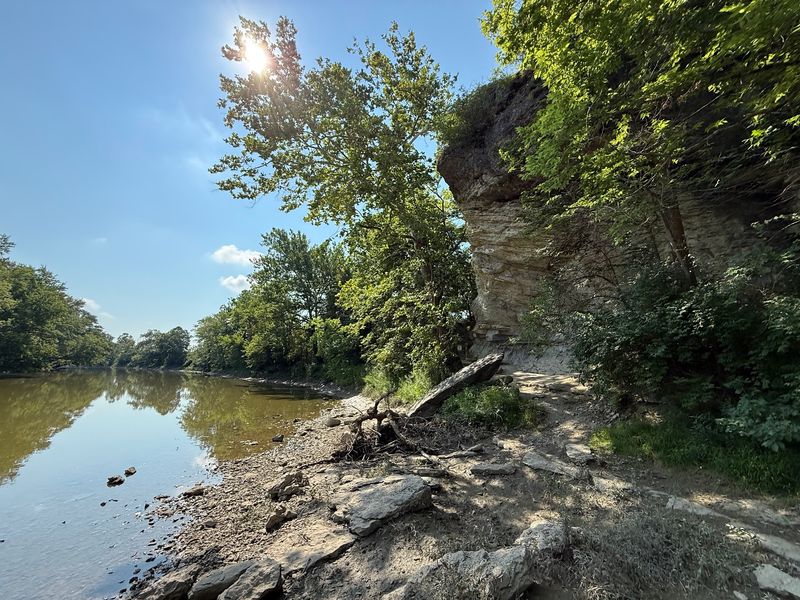
The name gives away the main attraction. Water has been chewing at the base of the limestone for an incredibly long time, wearing away softer material faster than the harder rock above it.
The result is an overhang that appears to lean out over the Wabash, as though the top of the cliff forgot to follow the bottom. From the riverbank the effect is striking, especially when the water sits low and the undercut section is fully visible.
Erosion is still happening, just far too slowly for human eyes to catch. Every rainstorm and spring flood nudges the process forward another fraction.
The best vantage point is down along the water where the trail meets the riverbank. Step out toward the open shoreline and the full height of the wall finally registers.
Footwear matters here. Riverbank rocks get slippery, and snow or rain makes the packed dirt path slick, so shoes with grip beat sandals every time.
Photographers often favor late afternoon, when sunlight skims across the river and lights the cliff face from the side. That angle brings out every crack and ledge.
Sitting quietly by the water, listening to the current work, delivers a strange satisfaction. Nature’s slowest sculptor is still on the job, and visitors get a front-row seat.
A Geological Oddball In A State Known For Flatness
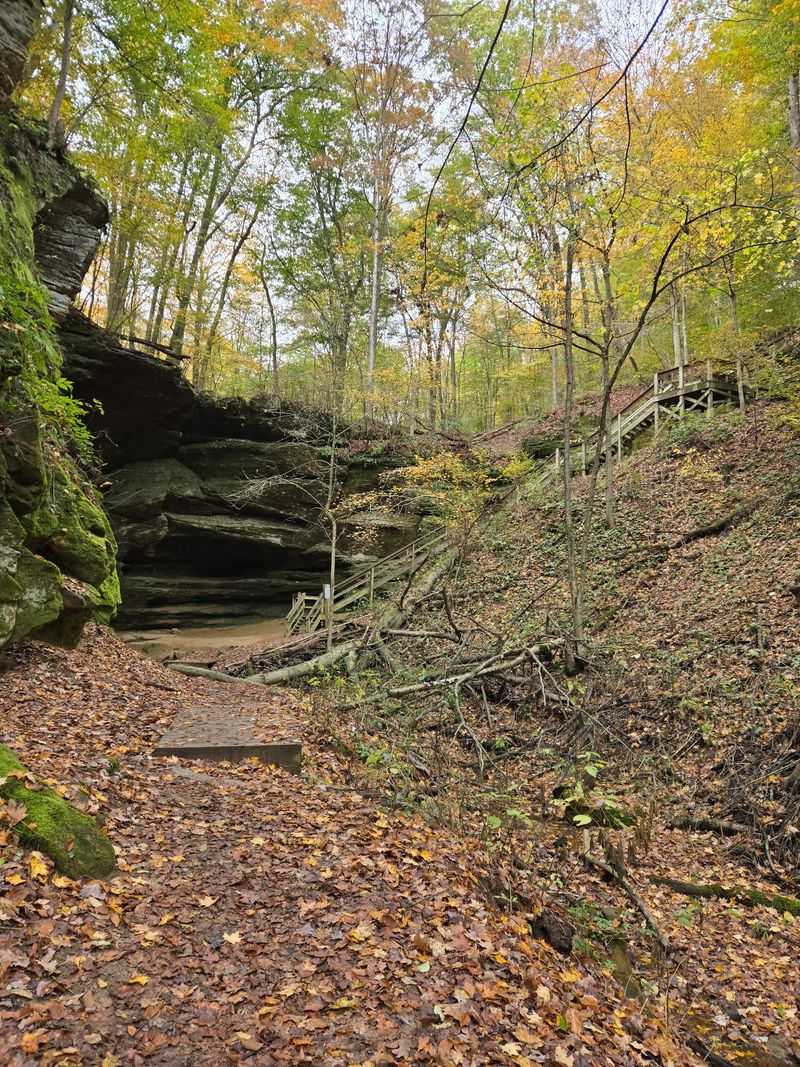
Drive through northern Indiana long enough and the terrain settles into a rhythm of level fields, straight roads, and gentle rises. Then Hanging Rock shows up and breaks the pattern completely.
Dramatic exposed rock is genuinely uncommon in this part of the state. Glaciers smoothed much of Indiana into rolling plains, so a tall limestone wall standing exposed along a river counts as a real anomaly.
Its position on the Wabash makes the contrast even sharper. Woods, water, and a sheer stone face all crowd into one small pocket of land.
Plenty of travelers stumble onto the site by accident, spotting the roadside parking area and pulling in out of curiosity. The surprise factor is half the fun.
Give it more than five minutes. Walking the length of the base, then heading toward the open riverbank, changes the sense of scale in a way a quick glance never will.
Trees along the top add another layer, their roots gripping stone that used to be a reef. In autumn the color above the gray rock makes the whole scene pop.
Indiana keeps a few secrets, and this is one of the better ones. Landscapes that look uniform from a car window sometimes hide something extraordinary just off the shoulder of a county road.
Officially Recognized As A National Natural Landmark Since 1986
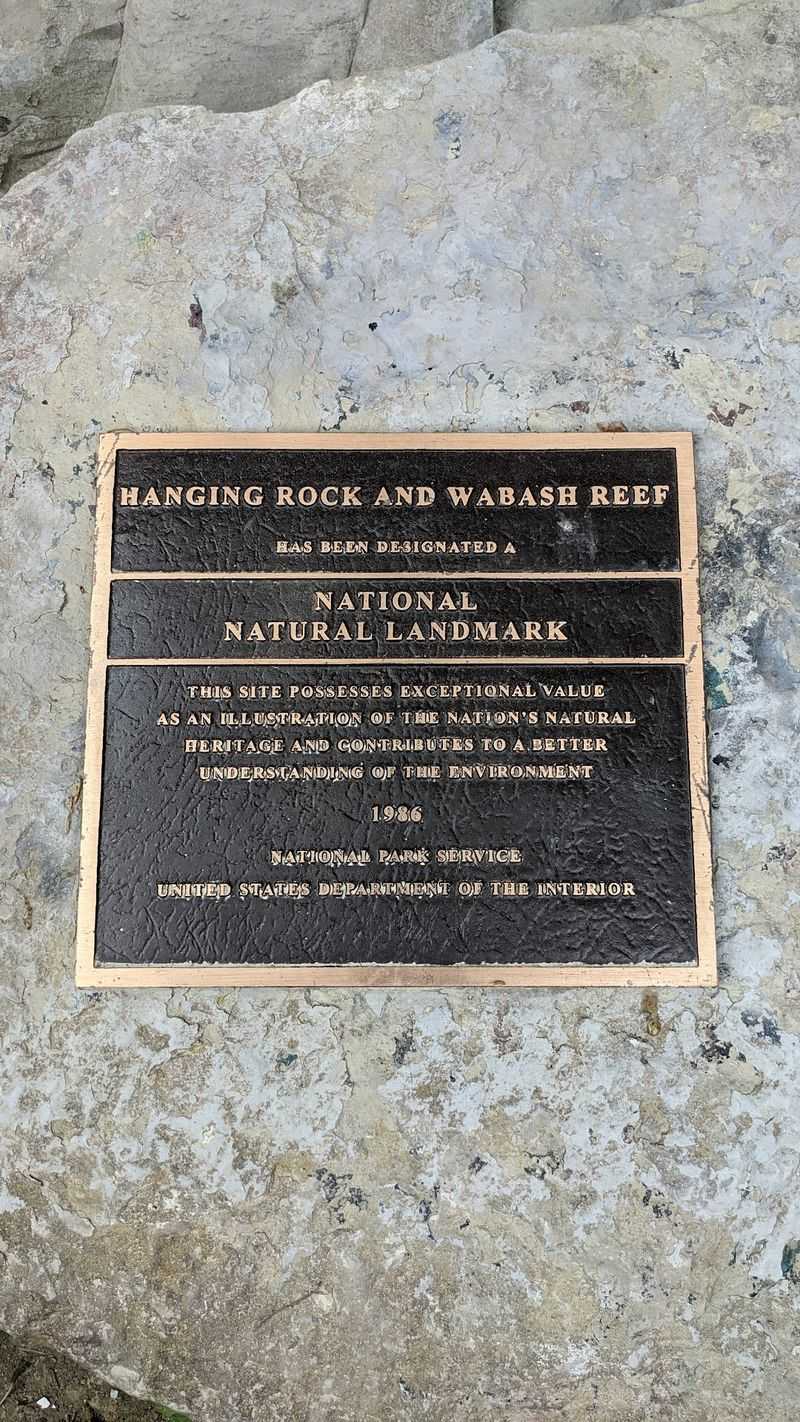
Not every roadside wonder earns federal attention. In May 1986, Hanging Rock received designation as a National Natural Landmark, a title reserved for sites that illustrate the geological or biological story of the United States especially well.
That recognition puts this Indiana cliff in the company of nationally significant natural features. Scientists value it as a clear, accessible example of a Silurian reef, and educators use it to explain how ancient seas shaped the Midwest.
ACRES Land Trust owns and manages the preserve, handling trail upkeep, signage, and protection of the formation itself. Their stewardship is the reason the site still looks the way it does.
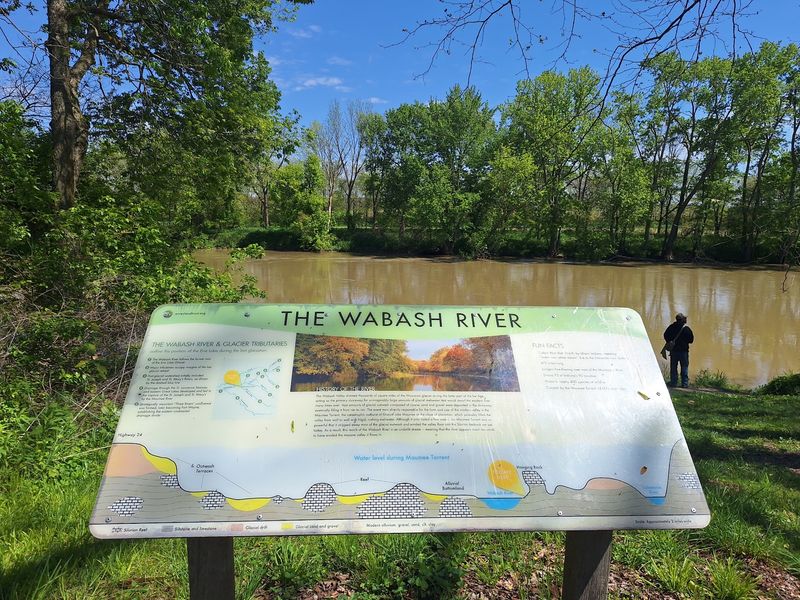
An information board near the trail explains the geology in plain language, and plenty of visitors report learning something unexpected there. Reading it before walking to the rock makes the whole visit click.
Preservation comes with rules. Climbing on the formation is off limits, graffiti and litter are ongoing frustrations for caretakers, and packing out everything brought in helps enormously.
Small courtesies add up at a place this fragile. Stay on marked paths, keep voices reasonable, and leave the rock exactly as found.
Knowing a landmark carries national significance shifts the mood of a visit slightly. Curiosity gains a little reverence, and a short walk starts feeling like a privilege.
Generations Of Travelers Used This Rock As A Compass
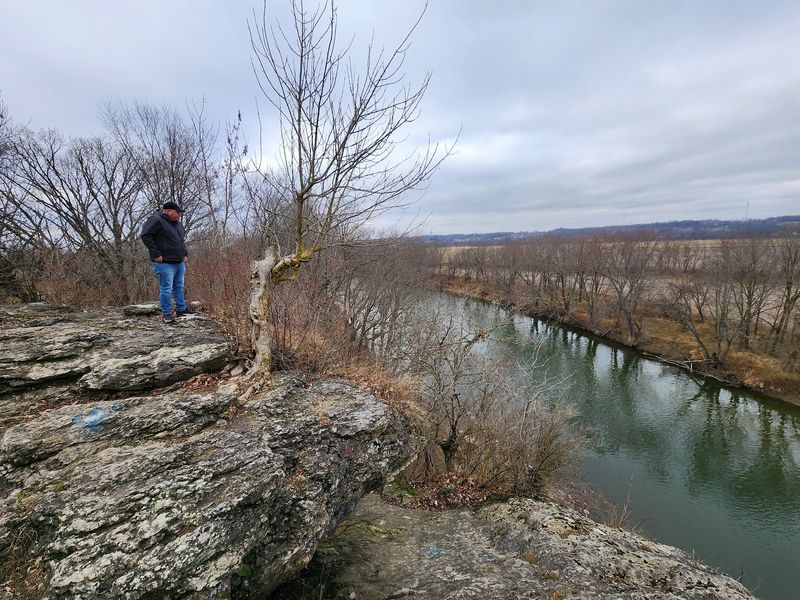
Long before parking lots and interpretive signs, Hanging Rock served a practical purpose. Its height and visibility made it a natural marker along the Wabash River, useful to anyone traveling by water.
Indigenous peoples of the region, including the Miami, are documented as having used the formation for navigation, as a lookout, and for observing the sky. A landform that tall and distinctive functions as a fixed point in a changing landscape.
Early European American settlers relied on it in similar ways, treating the cliff as a dependable landmark when charting routes and describing locations.
Legends attached themselves to the site over the years, adding a layer of mystique that still lingers in local storytelling. Whether or not the tales hold up, they show how firmly the rock sits in regional memory.
Local families have also treated it as a tradition, returning across generations to show children the same limestone wall their parents once showed them.
Reading the history board before walking the trail makes that human layer easier to feel. Stone becomes a meeting point rather than just scenery.
Very few places let visitors stand where ancient sea creatures, river travelers, and modern hikers all converge on the same spot. Hanging Rock manages it in about ten minutes of walking.
Short Trail, Big Payoff, No Serious Hiking Required
Anyone allergic to long hikes will appreciate the layout here. The main out-and-back path runs roughly 0.2 miles, moving through woods and along a fence line before opening up beside the limestone wall.
It is short enough for young kids, casual walkers, and travelers squeezing in a stop between destinations. Sturdy shoes still help, since the ground gets muddy after rain and genuinely slick under snow.
Gates open at sunrise and the preserve closes in the evening, which leaves plenty of flexibility for early risers and sunset chasers alike.
Speaking of sunsets, light hitting the river at the end of the day is a local favorite. Warm color spreads across the water while the cliff darkens into silhouette.
Birdwatchers have another reason to linger. Bald eagles are spotted along this stretch of the Wabash, so binoculars earn their space in the bag.
Climbing the rock is not allowed, a change some longtime visitors still adjust to, but views from the trail and riverbank remain excellent.
Pack a small picnic and use the scenic seating for a quiet break. Restrooms are not on site, so plan accordingly before arriving.
Low effort, high reward. That combination makes this preserve one of the easiest wins in the region.
Paddle The Wabash, Then Chase Waterfalls At Kokiwanee

Seeing the cliff from a kayak flips the whole experience. On the water the formation towers overhead, and the undercut base reads far more dramatically than it does from land.
The Wabash flows right past the landmark, making it a natural highlight for paddlers exploring this stretch of river. Calm conditions and a camera make for excellent photos looking up at the stone.
Anyone planning to paddle should check river levels and weather beforehand, bring a life jacket, and arrange launch and takeout points in advance.
For hikers wanting more mileage, Kokiwanee Nature Preserve sits a short drive away. A loop trail of about 1.6 miles winds through woods and past several small waterfalls, which run best in spring or after steady rain.
Pairing the two makes a satisfying half-day route. One stop delivers ancient geology, the other delivers ravines, moving water, and a longer stretch of walking.
Trail shoes handle Kokiwanee better than sneakers, since the terrain includes slopes and creek crossings.
Stack them together and northern Indiana starts looking a lot less flat than its reputation suggests. River, cliff, forest, and falls all fit into one unhurried day.
Address: 4552 E Hanging Rock Rd, Lagro, IN 46941
