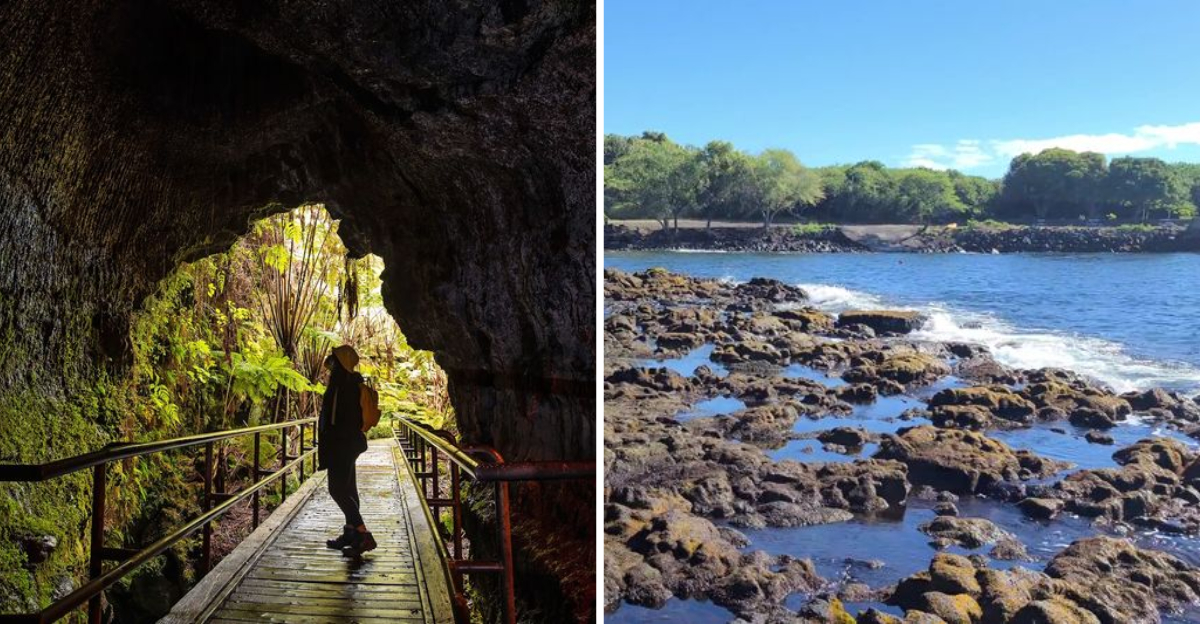
A 500-year-old tunnel carved by molten rock, a rainforest path that leads into cool darkness, and a shore of jet-black sand where green sea turtles bask in the sun. That is what awaits you on Hawaii’s Big Island, where volcanic forces have shaped a landscape so raw it feels alive beneath your feet.
The trail to the lava tube winds through a lush fern forest, native birds calling from the canopy above, before you descend into the ancient passageway. The walls still hold the memory of the fire that forged them, and the stillness inside is the kind that makes you lower your voice without thinking.
A short drive away, the coastline turns black, basalt sand stretching out against the blue Pacific, a striking contrast that feels almost otherworldly. Together, these two places show you just how wild and restless this island truly is.
If you only have a day to explore, make sure both are on your list.
The Ancient Origins of N?huku Lava Tube
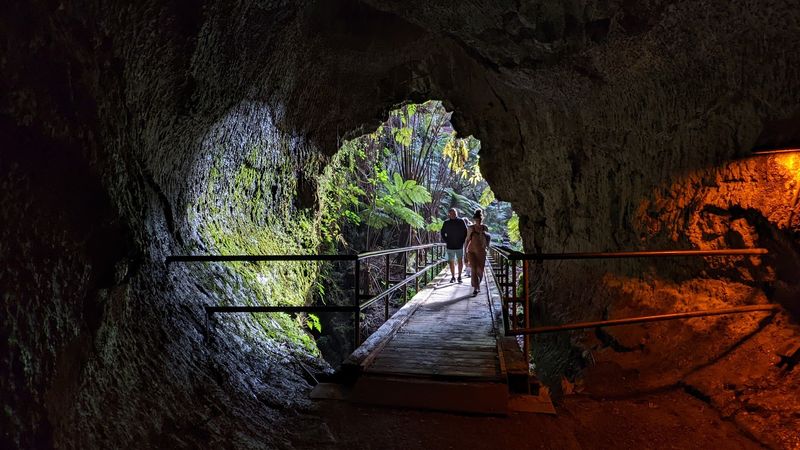
About 500 years ago, something extraordinary was happening beneath what is now one of Hawaii’s most visited national parks. Molten lava was rushing through underground channels, and when the outer layers cooled and hardened, the still-liquid lava inside kept draining away.
What it left behind was N?huku, a hollow volcanic tunnel stretching roughly 600 feet through solid basalt rock.
The Hawaiian name N?huku translates to “the protuberances,” a reference to the lava drippings that once hung from the ceiling like rocky stalactites. Sadly, those formations disappeared after the cave was discovered in 1913, taken by souvenir collectors who had no idea what they were destroying.
Lorrin Thurston, a local newspaper publisher, is credited with the discovery, and the tube carried his name for decades before being restored to its original Hawaiian identity.
What makes this place feel so remarkable is not just its size, but the sheer geological storytelling on every wall. The rock formations, the smoothed floor, the moisture hanging in the cool air, all of it is evidence of a volcanic event frozen in time.
The tube is part of a much longer lava system that once stretched for miles across the island.
Geologists consider lava tubes like N?huku to be some of the most important volcanic features on Earth. They form fast, they preserve the record of past eruptions, and they create ecosystems unlike anything found above ground.
Visiting one is genuinely unlike any other nature experience out there.
How to Get There and What to Expect on the Trail
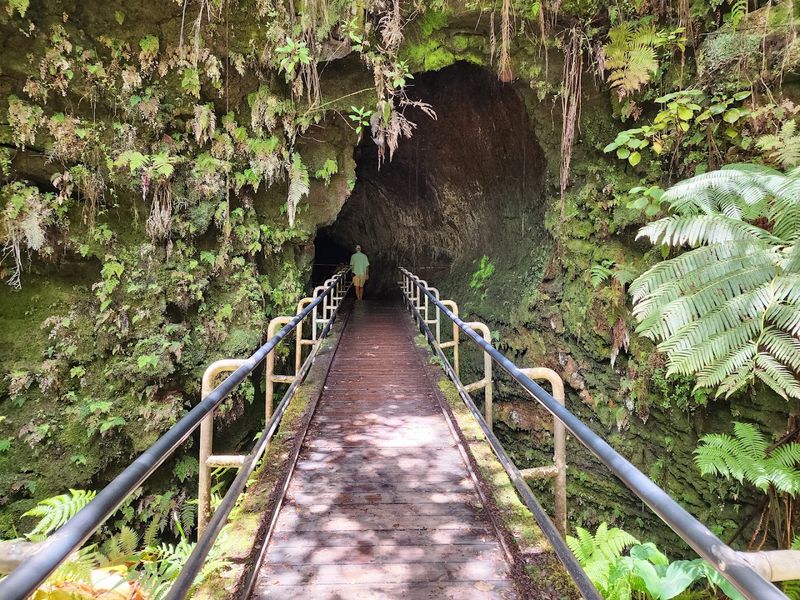
Getting to N?huku is straightforward, but a little planning goes a long way. The trailhead sits directly off Chain of Craters Road inside Hawai?i Volcanoes National Park, and there is a small parking area right at the site.
The catch is that the lot fills up fast, often by mid-morning, especially since it also serves as a trailhead for the popular K?lauea Iki Trail.
Arriving early, ideally before 9 a.m., gives you the best shot at snagging a spot without stress. If the lot is full, the K?lauea Iki Overlook parking area sits about half a mile away and connects to the lava tube via trail.
It adds a bit of distance, but honestly the extra walk through the rainforest is not a bad thing at all.
The main loop itself is only about 0.4 to 0.5 miles long, which surprises a lot of first-time visitors who expect something more demanding. The path is paved but includes some steps and a noticeable descent toward the tube entrance, so it is not considered ADA accessible.
Good shoes matter here. Sandals and flip-flops make the wet, sometimes muddy sections genuinely unpleasant.
The National Park Service estimates the loop takes around 20 minutes to complete at a relaxed pace. Some people zip through in 10 minutes.
Others linger, listening to the native birds and studying the plants. Either way, the short distance makes it accessible to almost everyone, including families with young kids.
Inside the Tube: What You Will Actually See and Feel
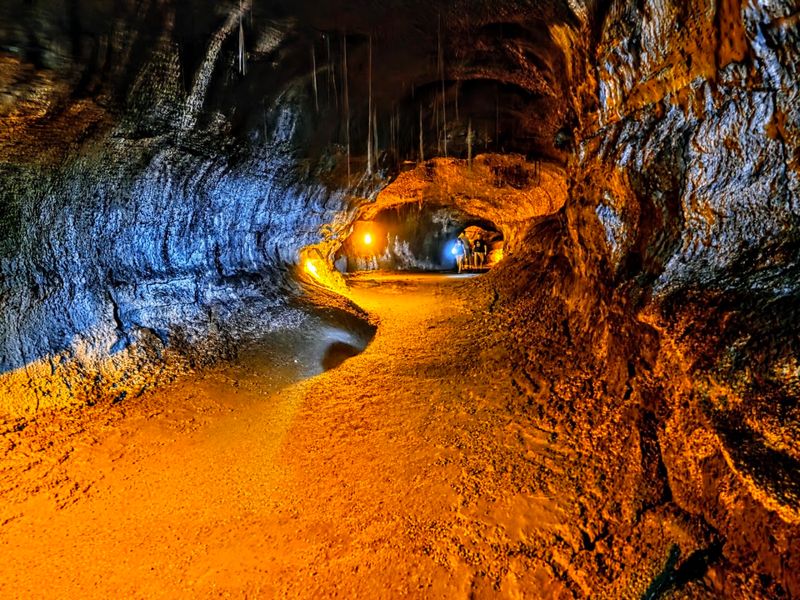
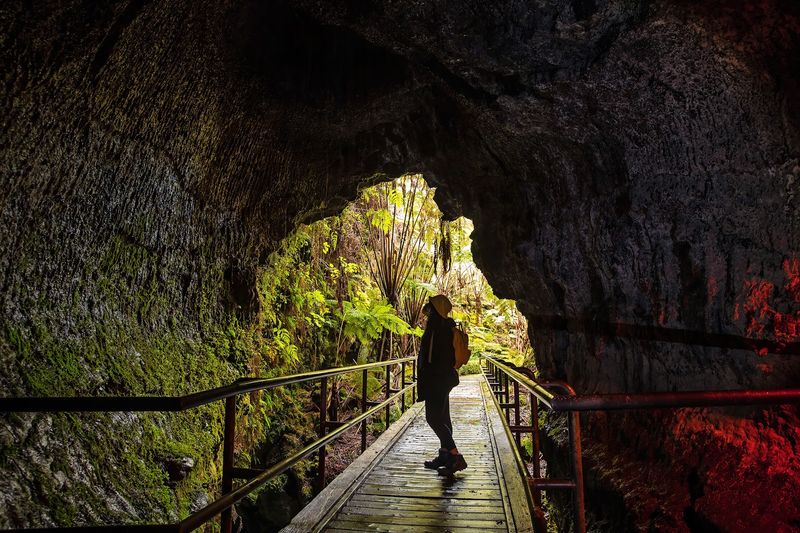
The moment you step down into the tube, the temperature drops noticeably. It is cool and damp inside, a stark contrast to the warm, humid air of the rainforest just above.
The walls are dark basalt, rough and layered, and the floor is wet in spots, with small puddles forming after rain. It feels ancient in the best possible way.
Lighting is installed inside and runs from 8 a.m. to 8 p.m. daily. The orange glow illuminates the basic shape of the tunnel but does not make it bright.
Bringing a flashlight or headlamp is genuinely useful, especially for spotting details on the walls and ceiling. Visitors who show up after 8 p.m. will find the tube completely dark, so a light source becomes essential rather than optional.
One thing worth knowing before you go: some sections have low ceilings. Taller visitors have bumped their heads in the dimmer stretches, so looking up as you move through is a smart habit to develop quickly.
The National Park Service asks that nobody touch the walls or the hanging tree roots dangling from above. Those roots belong to the living rainforest ecosystem directly overhead, and they are more fragile than they look.
The accessible section of the tube runs about 600 feet before turning around. Currently, portions of the tube are under construction following a cave-in, so part of the tunnel may be blocked off.
Even in its partial state, the experience is genuinely unforgettable and worth every step of the short trail to reach it.
The Rainforest Walk That Frames the Whole Experience
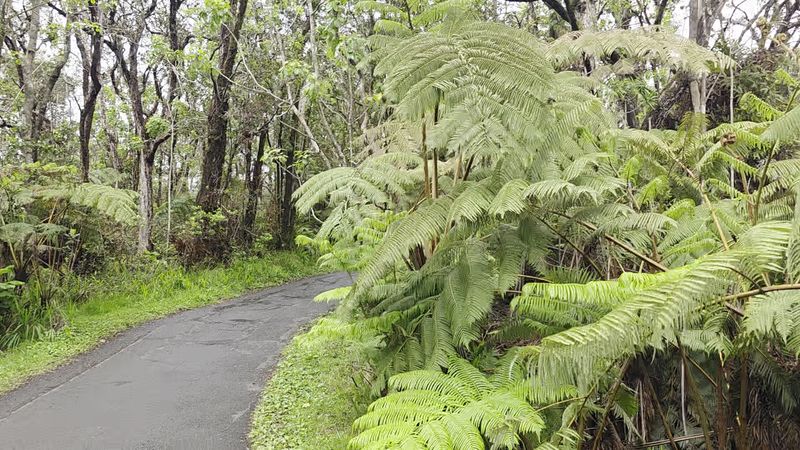
A lot of visitors focus entirely on the lava tube and almost overlook the trail that leads to it, which is a genuine shame. The short loop through the surrounding rainforest is one of the most beautiful and peaceful walks in the entire national park.
Native ohia lehua trees stretch overhead with their bright red blossoms, and massive tree ferns line the path in every direction.
The air smells earthy and clean, the kind of freshness that only comes from a forest that has never been paved or manicured into submission. Native birds call out from the canopy above, and if you slow down even a little, you might spot an apapane, a small crimson honeycreeper that feeds on ohia blossoms.
Hearing one while standing in a rainforest on an active volcanic island is a moment that is hard to put into words.
The path is shaded for most of its length, which makes the morning hours especially pleasant. Temperatures inside the forest feel noticeably cooler than in open areas of the park.
Mist sometimes hangs low between the trees after rain, giving the whole scene a moody, otherworldly quality that no photograph quite captures.
The National Park Service has worked hard to protect this ecosystem, and it shows. The vegetation feels dense and undisturbed, full of species found nowhere else on Earth.
Even if the lava tube were closed entirely, the rainforest loop alone would be worth the drive to this trailhead. It is that good.
Practical Tips for Visiting N?huku Like a Pro
A visit to N?huku rewards people who show up prepared. The single most useful thing you can do is arrive early.
By 9:30 a.m. on most days, the small parking lot near the trailhead is already full, and by midday, tour buses line the roadside. Getting there right as the park opens gives you a quieter, more personal experience that is hard to replicate later in the day.
Wear real shoes. Sneakers or trail runners are ideal for the paved but sometimes slippery path.
The inside of the tube gets wet, and the steps leading down to the entrance can be slick after rain. A light rain jacket is also worth tossing in your bag, since afternoon showers are common in this part of the island and the rainforest does not offer much shelter when the sky opens up.
Bring a flashlight or headlamp even if you are visiting during daylight hours. The tube lighting provides enough visibility to navigate, but a personal light source lets you see the rock textures and ceiling details that the ambient glow misses entirely.
Phone flashlights work fine for most people.
If you are planning to combine N?huku with the K?lauea Iki Trail, parking at the overlook lot and doing both in one loop is a smart move. The K?lauea Iki loop is 3.6 miles and crosses a solidified lava lake, making it one of the most dramatic hikes on the Big Island.
Doing both stops in a single morning is very doable and deeply satisfying.
Punalu?u Black Sand Beach, The Perfect Companion Stop on the Big Island
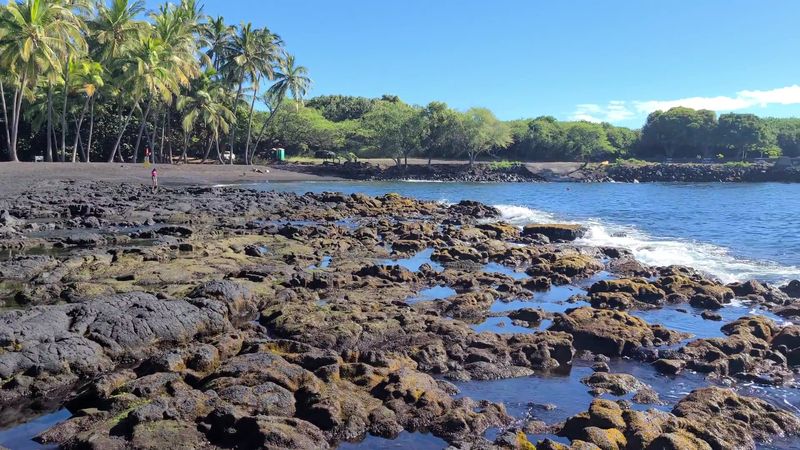
After the cool darkness of N?huku, the contrast of Punalu?u Black Sand Beach hits differently. This stunning stretch of shoreline sits along the southern coast of the Big Island, not far from the national park, and it is one of those places that genuinely makes you stop and stare.
The sand is jet black, formed entirely from volcanic basalt that has been shattered and smoothed by centuries of wave action.
Hawaiian green sea turtles, known locally as honu, are a regular presence here. They haul themselves onto the black sand to bask in the sun, and seeing one up close, even from a respectful distance, is the kind of wildlife encounter that stays with you.
The contrast of their dark shells against the black sand and turquoise water is visually extraordinary.
The beach itself is not ideal for swimming due to strong currents and rough surf, but it is absolutely perfect for walking, photographing, and simply absorbing the atmosphere. The dark sand absorbs heat quickly, so mornings are more comfortable for extended visits.
Shade is limited, so sunscreen and a hat are not optional here.
Pairing N?huku with Punalu?u on the same day gives you a full cross-section of the Big Island’s volcanic personality, underground tunnels carved by ancient lava on one end, and a black sand coastline shaped by the same forces on the other. Few places on Earth offer that kind of geological storytelling in a single afternoon of driving.
Address: #52, Hawaii Volcanoes National Park, HI 96718
