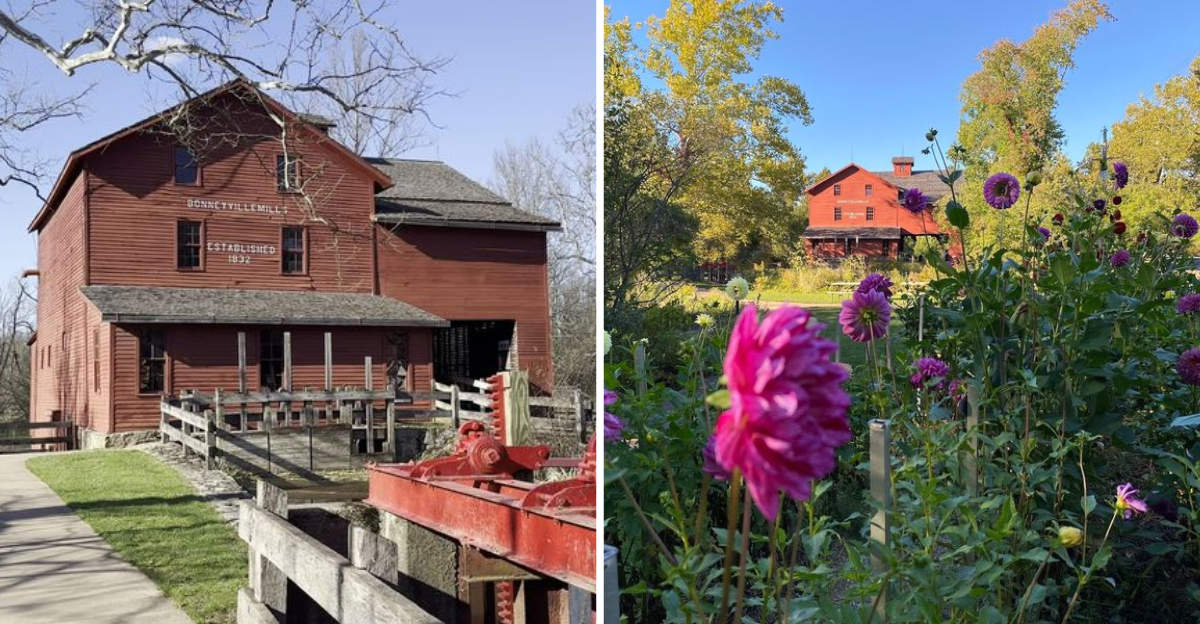
Historic places can feel surprisingly alive when you can hear the water moving, see old machinery working, and experience the past in motion. Indiana has destinations that offer more than a quick photo stop, with scenic surroundings and stories that make you want to stay longer. Old mills, peaceful trails, and preserved landscapes create the perfect mix for anyone who enjoys local history and outdoor escapes.
It is the type of place where a simple afternoon visit can turn into a memorable trip filled with fresh air, interesting sights, and a glimpse into another era.
A Whisper from the Past: The Mill’s Enduring Story
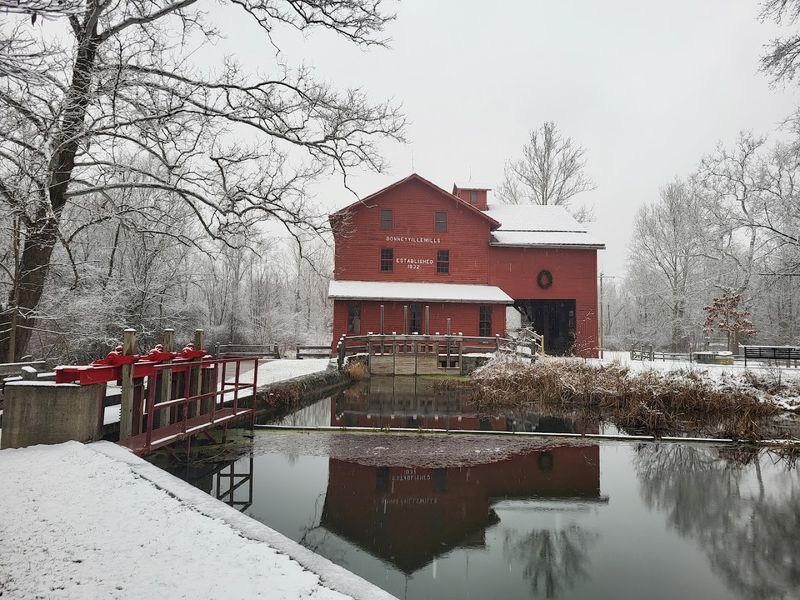
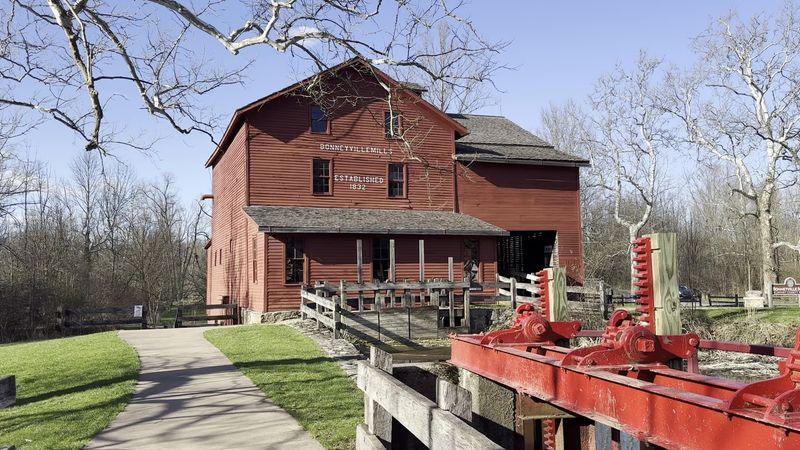
Few buildings in Indiana carry as much quiet weight as the red mill at Bonneyville Mill County Park. It holds the distinction of being the state’s oldest continuously operating gristmill, a title that feels almost unbelievable until you are actually standing inside it.
The structure traces its origins to the early 19th century, with its establishment commonly cited between 1832 and 1837.
Edward Bonney, a determined pioneer, chose this specific bend along the Little Elkhart River with remarkable intention. He recognized the river’s steady flow as a reliable power source and built a mill that would quickly become the heartbeat of the surrounding community.
Farmers traveled up to fifty miles to have their wheat, oats, and corn ground here.
Ownership changed hands many times over the decades, yet the mill kept running. A conversion to electric power came in 1919, and a water wheel was added in the 1930s to generate electricity for nearby farms.
In 1968, the Elkhart County Chapter of Michiana Watershed acquired the property, and it was deeded to Elkhart County just a year later. Significant renovations during the 1970s used traditional methods to restore it, ensuring that visitors today experience the mill much as it stood nearly two centuries ago.
The Grinding Art: How 19th-Century Machinery Still Works Today
The moment you step inside the mill, a rich, earthy scent of ground grain wraps around you like a memory you never actually had. It is instantly grounding, and it makes the historical accounts feel less like facts and more like something lived.
The machinery inside is a layered marvel of wooden gears, leather belts, vertical drive shafts, and stone grinding units all working in quiet coordination.
Two turbine water wheels sit submerged in the basement, and when the gates open, river water rushes through and spins a horizontal wheel. That rotation travels upward through vertical shafts, powering the grinding stones on the floors above.
Grain arrives at the top of the mill via elevator legs, which are belts fitted with small buckets that carry kernels upward to be cleaned and stored before grinding.
From the storage area, grain drops through funnel-shaped hoppers into the eye of the runner stone, which turns against a stationary bottom stone. The gap between those two stones determines the texture of the final product.
Corn, wheat, buckwheat, and rye are all ground here, with hard spring wheat sourced from Montana since it does not grow well in Indiana’s climate. Demonstrations run from mid-April through mid-November, Tuesday through Sunday.
A Breath of Fresh Air: Exploring the Expansive Park Grounds
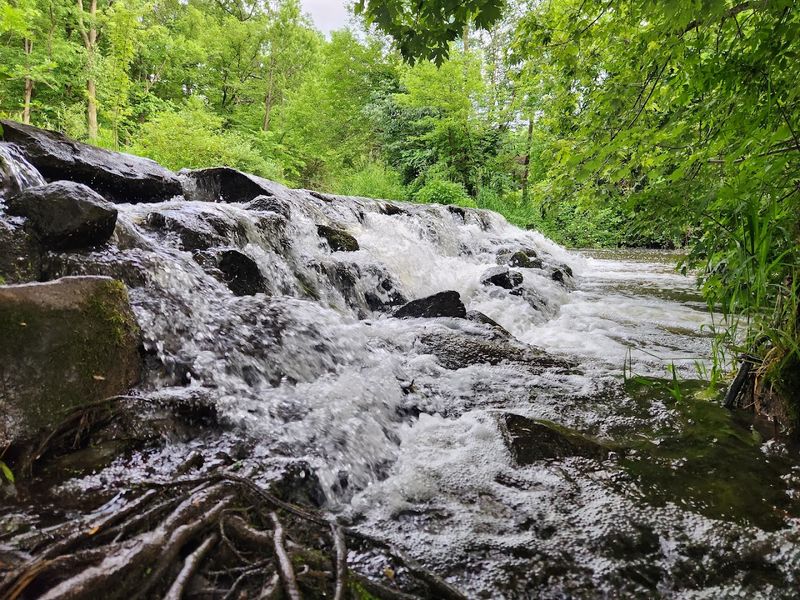
Once you pull yourself away from the mill’s mechanical spell, the park itself opens up in every direction with a generosity that surprises most first-time visitors. Bonneyville Mill County Park stretches across more than 200 acres, offering a layered mix of rolling hills, tranquil wetlands, open meadows, and thick, shaded forest.
The Little Elkhart River winds through the whole property, tying every corner of the landscape together.
Seven miles of hiking trails meander through these varied ecosystems, with the 2.5-mile South Loop Trail being a popular choice for those who want a bit of everything without overcommitting. The paths shift from sunny meadow stretches to cool, tree-covered corridors, and the river appears and disappears alongside you as you walk.
I found myself stopping often, not from fatigue but from wanting to actually look at things.
Picnic shelters and open green spaces are scattered throughout, making the park equally appealing for families who just want to spread out and relax. The park is pet-friendly in all outdoor areas, though dogs are not allowed inside the mill building itself.
Restrooms are clean and well-placed, and parking is straightforward. It is the kind of park that feels genuinely thought through rather than just maintained.
Nature’s Canvas: Gardens, River Views, and an Observation Tower
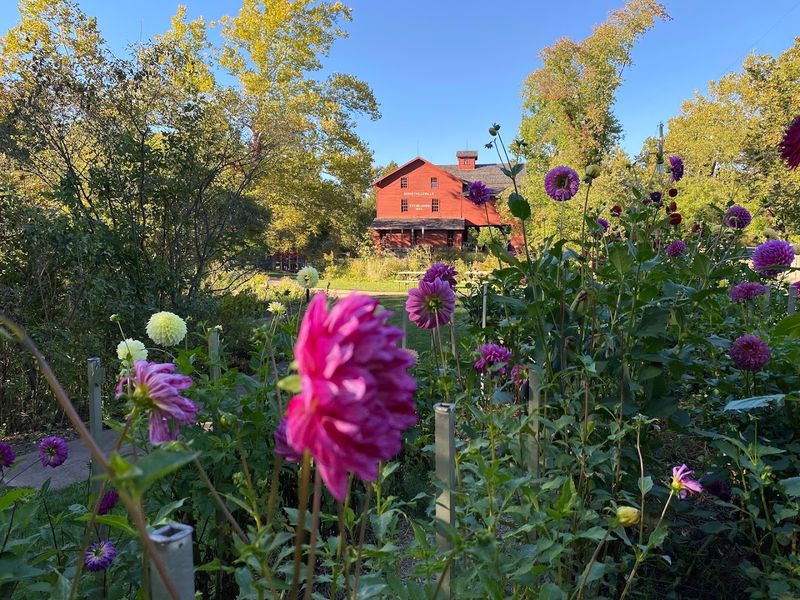
Not everything at Bonneyville Mill is old and mechanical. Near the entrance, a stunning Dahlia Garden bursts into color during the warmer months, maintained with care by the Elkhart Dahlia Society.
The blooms are enormous, some reaching the size of small pie pumpkins, and the range of citrus oranges and deep magentas makes the garden feel almost theatrical against the park’s green backdrop.
Beyond the garden, the Little Elkhart River provides the kind of scenery that makes people reach for their cameras without thinking. The mill’s red exterior reflected in the ponded water is a genuinely striking image, and the riverbanks are lined with mature trees whose branches arc over the surface in lazy, generous curves.
I spent more time there than I planned, which seems to be a common outcome.
An observation tower sits within the park and offers a panoramic view of the surrounding landscape. Climbing to the top gives you a full sense of how the park’s elements fit together, the river threading through the green, the mill anchoring the scene, and the forest stretching out to the edges.
There is also a herb garden on the grounds, adding another quiet, sensory layer to an already rich visit. Each corner of this park rewards a slower pace.
A Sense of Place: Community, History, and Living Heritage
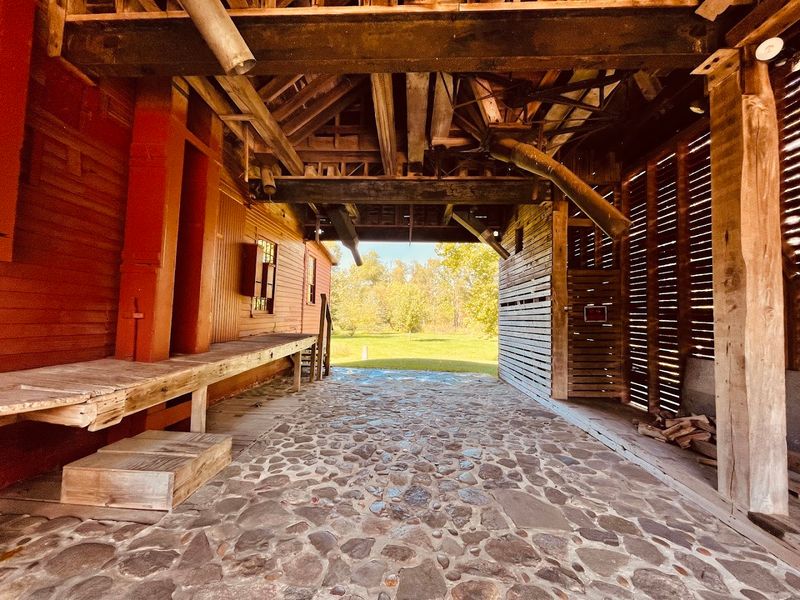
What sets Bonneyville Mill apart from a standard historical display is that it is not static. The millers on site are genuinely enthusiastic about what they do, and that enthusiasm is contagious.
More than one visitor has mentioned being surprised when a miller simply opened the mill up and started running it, even outside of official demonstration hours, just because people showed up curious and interested.
For families, the mill offers something increasingly rare: a direct, tangible connection to where food actually comes from. Watching grain drop into a stone and emerge as flour on the other side is a simple process, but it lands differently than any classroom explanation.
Children tend to go quiet in the best possible way when the machinery starts moving.
The park also hosts events throughout the warmer months, drawing the local community together around its shared history. An old restored schoolhouse sits across the road, adding another layer of historical context for those who want to linger.
Elkhart County Parks has maintained this site with clear dedication, and the result is a place that feels genuinely alive rather than preserved behind glass. That distinction matters more than it might sound, and it is the reason people keep coming back.
Beyond the Grind: Trails, Biking, and Year-Round Outdoor Adventure
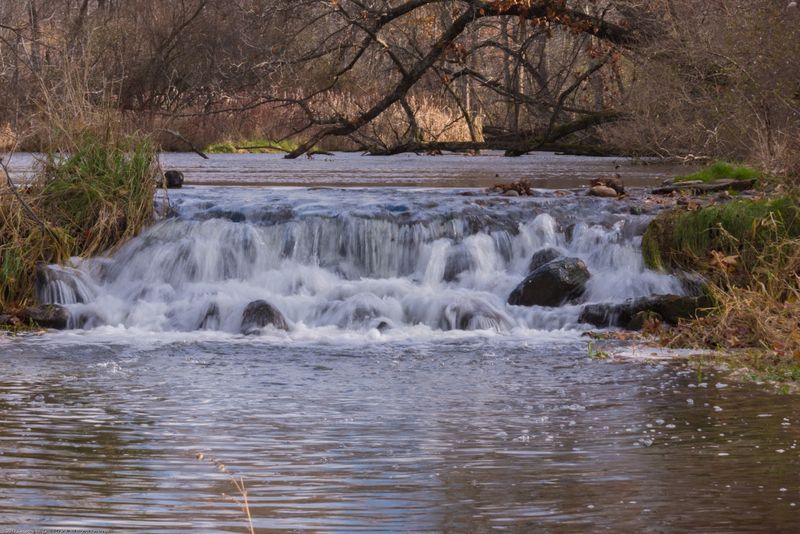
The seven miles of hiking trails at Bonneyville Mill County Park are genuinely varied, and that variety is what keeps them interesting. Some sections follow the curves of the Little Elkhart River closely, offering soft light and the sound of moving water as a constant companion.
Other stretches open up into meadows where you can see the sky properly and feel the shift in temperature as the shade breaks.
For mountain bikers, the park has a dedicated trail spanning over five miles with sections designed for beginner, intermediate, and expert riders. The terrain moves through wooded areas and rolling hills, and the trail is well-marked, which is more than can be said for some of the hiking paths where carrying a map is genuinely recommended.
The contrast between the two trail systems is actually useful to know before you arrive.
Winter does not shut the park down. When snow covers the ground, the trail network becomes a destination for cross-country skiing and snowshoeing, and two dedicated sledding hills draw families looking for a few hours of uncomplicated outdoor fun.
Fishing is also popular along the Little Elkhart River, with trout drawing anglers during the season. The park functions as a year-round outdoor resource, not just a warm-weather attraction, and that commitment to accessibility across seasons is one of its quieter strengths.
Bringing a Piece of History Home: The Mill Store Experience
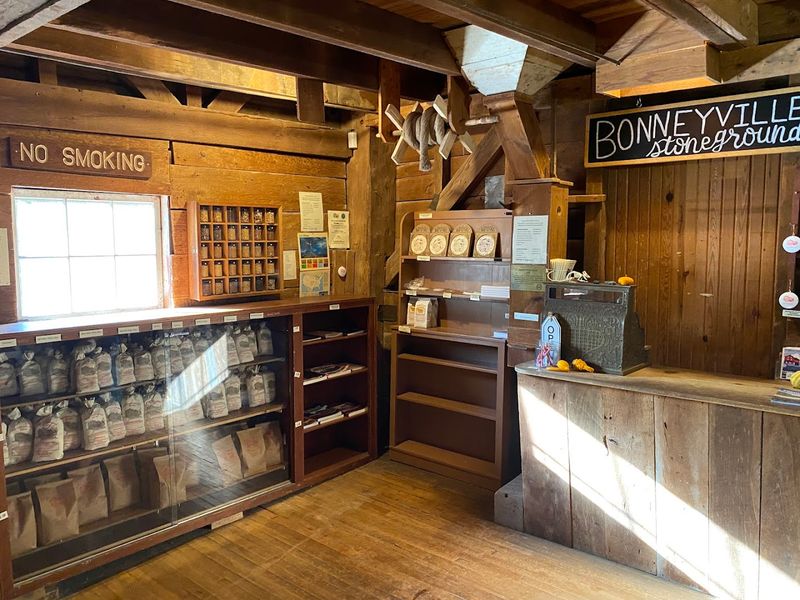
Before leaving the mill, most visitors end up in the small store tucked inside the building, and it is worth the stop. This is where the mill’s working purpose becomes something you can actually take home.
Freshly ground corn, wheat, buckwheat, and rye products are available for purchase, and knowing that the flour in your bag was processed on stones from the 1800s gives it a weight beyond the physical.
The selection includes whole wheat flour, buckwheat flour, and cornmeal in both sifted and unsifted varieties, depending on what you plan to make. Because these products contain no preservatives, the staff recommend storing them in an airtight container in the freezer to keep them fresh.
That small piece of practical advice reflects the honest, straightforward character of the whole operation.
There are also occasional local crafts and small souvenirs available, though the milled products are clearly the main draw. Buying a bag of cornmeal here feels different from picking one up at a grocery store, not because of any marketing, but because you just watched it being made.
It is a genuinely satisfying way to close out a visit, carrying something useful and real back into your everyday life. Address: 53373 County Road 131, Bristol, IN 46507.
