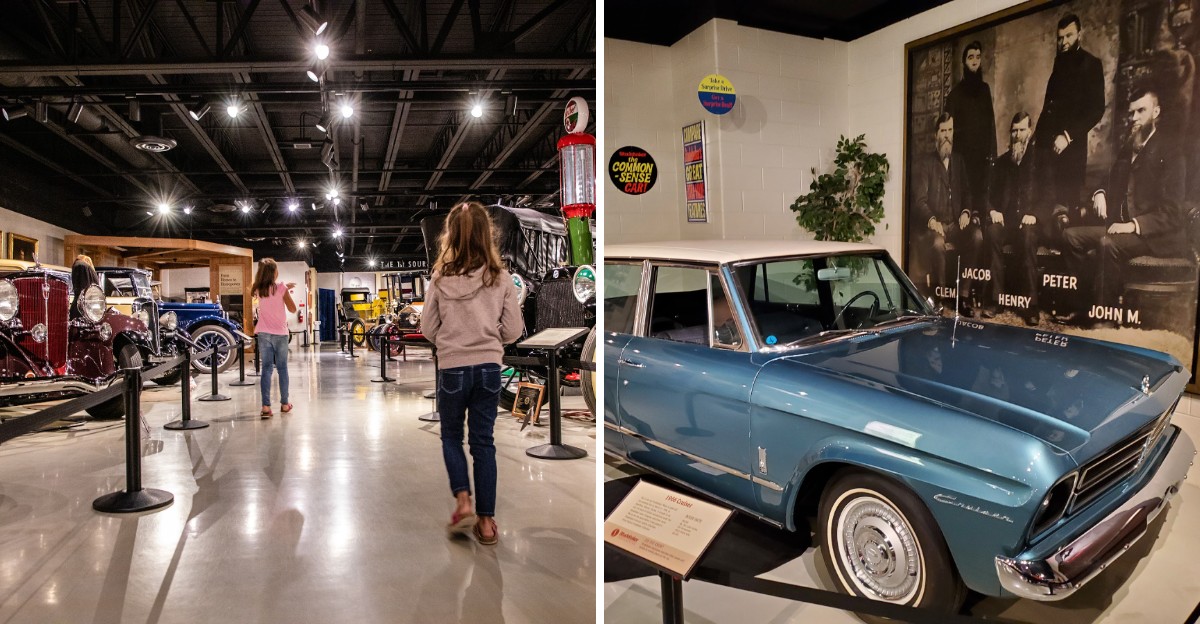
The weirdest car in the room may be the one nobody could buy. There are several like that here.
They were designed. They were built.
Some got frighteningly close to production. Then something changed, and the cars disappeared from the road entirely.
This Indiana museum keeps those forgotten experiments alongside military vehicles, presidential carriages, Conestoga wagons, and other pieces of transportation history. One floor can feel like the nineteenth century.
Another suddenly looks like somebody’s idea of the future. The building itself has its own twist, tracing back to a blacksmith shop from 1852.
So the collection does something unusual. It makes the past look futuristic.
Then it makes the future look like something we almost had.
The Avanti Family Sedans Hiding in the Basement
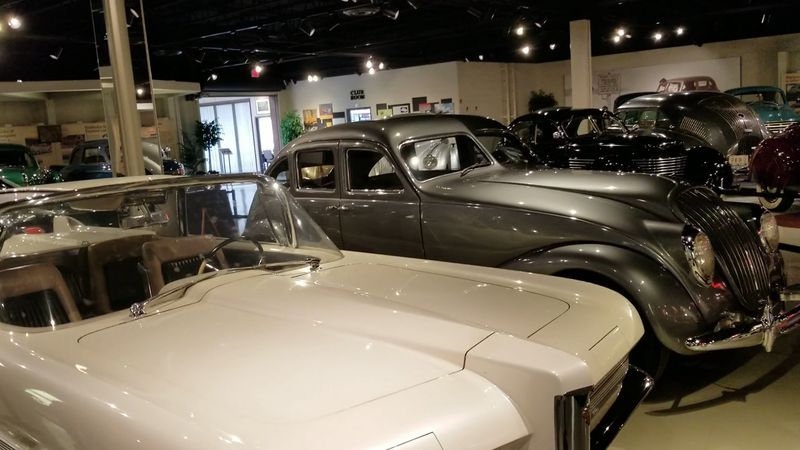
Down on the lower level, past the military vehicles, sit large steel shelves built to hold cars instead of boxes. On them rest the 1963 Avanti family sedan styling prototypes, in both notchback and fastback shapes.
Studebaker already had the Avanti, a sleek two-door designed by Raymond Loewy’s studio. The question inside the company was simple.
Could that sporty look stretch into something a family with three kids could actually use?
Loewy’s designers answered fast. Reports credit the team with pulling the concept together in roughly six weeks, which is remarkably quick for a full styling study.
A 1964 four-door Avanti proposal exists as well, adding another layer to the what-if story. Seen side by side, the shapes feel familiar and strange at the same time, like a favorite song played in a different key.
Visitors often walk right past the storage area without realizing what is parked there. Slow down instead.
Read the small labels, look at the roof lines, and notice how designers wrestled with turning a halo car into a practical sedan.
These vehicles never reached dealerships, never carried a price tag, and never met a customer. That is exactly what makes them worth the trip.
Photography is easier here than in bright galleries, since the lighting is softer and the crowds thinner. Bring patience and a curious eye.
Brooks Stevens and the Sceptre That Almost Replaced the Hawk
Some concept cars look dated the moment they roll out. The Sceptre is not one of them.
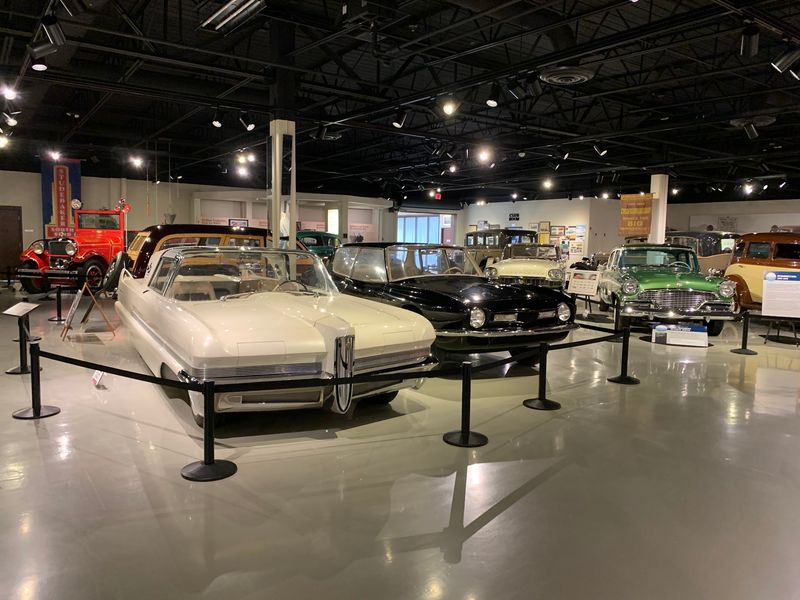
Created under industrial designer Brooks Stevens, the Sceptre show car was planned as the 1966-67 replacement for the Studebaker Hawk. Had it reached production, it would have ranked among the most modern-looking cars of its era, with a boldly clean face and confident proportions.
Stevens left other fingerprints on the collection too. His proposals include work tied to the 1964 Wagonaire and a 1965 sedan study, showing how hard designers pushed while the company’s future grew shaky.
Standing in front of the Sceptre, it is easy to imagine a different timeline for Studebaker. The design speaks the language of the late 1960s years before the late 1960s arrived.
Details reward a second lap. Look at how the lighting stretches across the front, how the glass meets the body, how nothing feels fussy or over-decorated.
Museum staff rotate exhibits, and roughly 85 vehicles from a collection of more than 120 are out at any one time. Checking studebakermuseum.org before arriving helps confirm what is on the floor.
For anyone who loves design history, the Sceptre is the section to linger in. It is proof that a company running out of time was not running out of ideas.
Lincoln’s Carriage and the Presidential Fleet
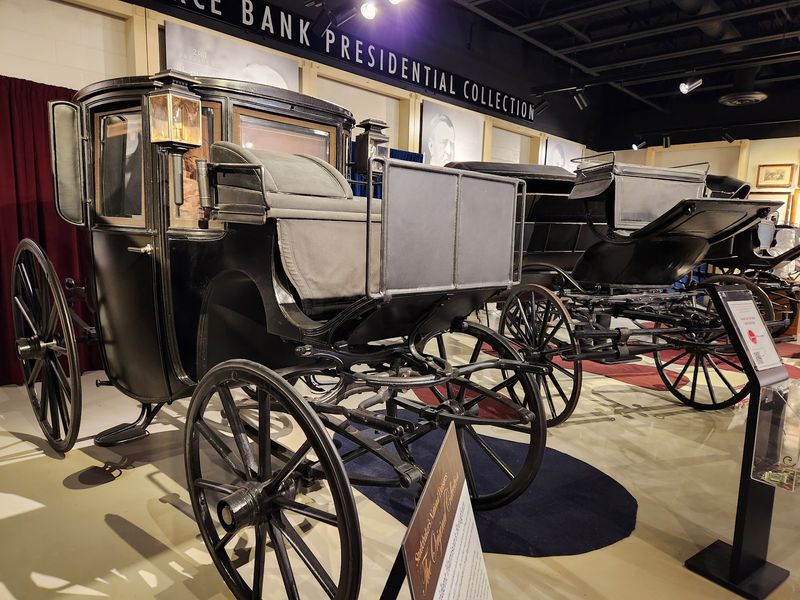
Visitors expecting only cars tend to freeze in this gallery. The museum holds the world’s largest collection of United States presidential carriages, and the centerpiece is the barouche Abraham Lincoln rode to Ford’s Theatre on the night of his assassination.
It sits there, polished and still, closer than most people expect. The room goes quiet around it.
Carriages once used by Ulysses S. Grant, William McKinley, and Benjamin Harrison share the space, each one a rolling snapshot of nineteenth century travel.
A carriage used by the Marquis de Lafayette during his 1824 farewell tour of the country is also part of the collection and carries National Treasure designation.
Many guests arrive knowing the Lincoln story and leave equally struck by Lafayette’s carriage, a reminder of how tangled early American history is with France.
The presidential group traces back to 1966, when Studebaker Corporation donated its 33-vehicle collection to the City of South Bend. That gift also included the Studebaker family’s Conestoga wagon and became the seed of everything here.
Plan extra minutes for this area. Read the panels, note the upholstery, and consider how differently people measured distance when a horse set the pace.
It is the kind of exhibit that shifts a car museum into something far bigger.
From Blacksmith Shop to Bullet Nose, the Whole Timeline
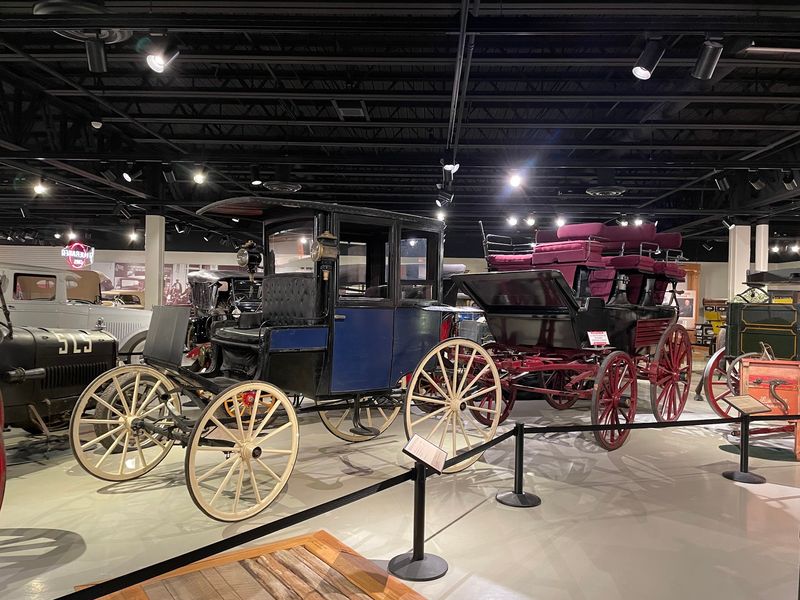
Two brothers, a blacksmith shop, and the year 1852. That is where the Studebaker story starts, and the main level of the museum follows it forward from the 1800s through 1934.
The company became the world’s largest maker of wagons and buggies, sending Conestoga wagons west during a period of restless American expansion. Durability built the reputation, and the reputation built the business.
Then the ground shifted. Studebaker built its first electric automobile in 1902 and its first gasoline-powered car two years later, an early pivot that surprises plenty of visitors who assume electric cars are a recent idea.
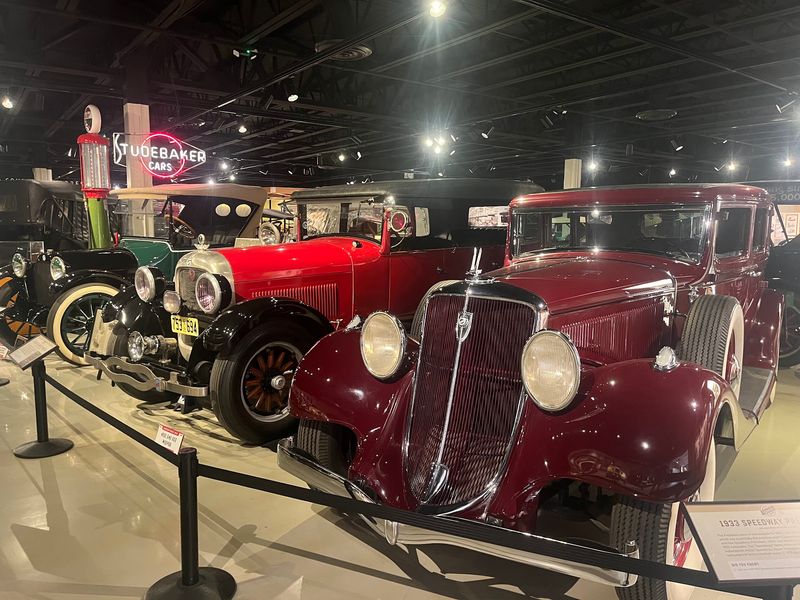
Head upstairs and the story picks up from 1934 onward, moving through the bold bullet nose styling of the early 1950s, the Champion, the compact Lark, and the Avanti.
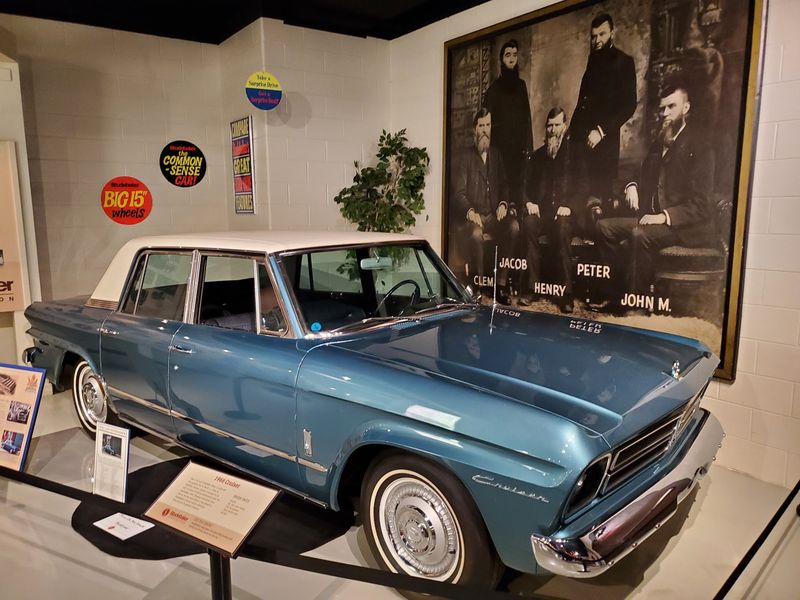
A Cruiser sedan marks the end of the line, the last car the company produced. A 1951 Commander in the collection earned its own kind of fame after appearing with Fozzie Bear in The Muppet Movie.
Walking the floors in order gives the whole arc a rhythm, from wagon wheels to tailfins to the final quiet stop in 1966.
Most guests finish the main galleries in one to two hours. An audio tour can easily stretch that into a full, satisfying afternoon.
Military Machines, Including a Weasel in the Desert
The lower level has a different mood. Lights drop, backdrops appear, and Studebaker’s long record of military work takes over the room.
Government supply wagons came first, back in 1857, well before engines entered the picture. From there the company’s contributions stretch across the Mormon War era, both World Wars, and on through Vietnam.
One favorite display sets a Studebaker Weasel against a desert combat scene, staged so the tracked vehicle looks caught mid-mission. Kids tend to stop cold in front of it.
Trucks, equipment, and support gear round out the exhibit, filling in a side of the company that gets forgotten next to the flashy coupes upstairs. At its peak the South Bend factory employed thousands of workers, and wartime contracts were a huge part of that story.
Also tucked into this level is the viewable storage area where prototypes and rarely-shown concepts wait between exhibits. Military hardware and dream cars end up as neighbors, which feels oddly fitting for a company that built whatever the moment demanded.
Give the lower floor real time instead of a quick sweep on the way out. Reading a few labels here changes how the rest of the museum lands.
Bring a light jacket. Lower levels in old-industrial-style buildings run cool.
Hands On Fun at the Super Service Center
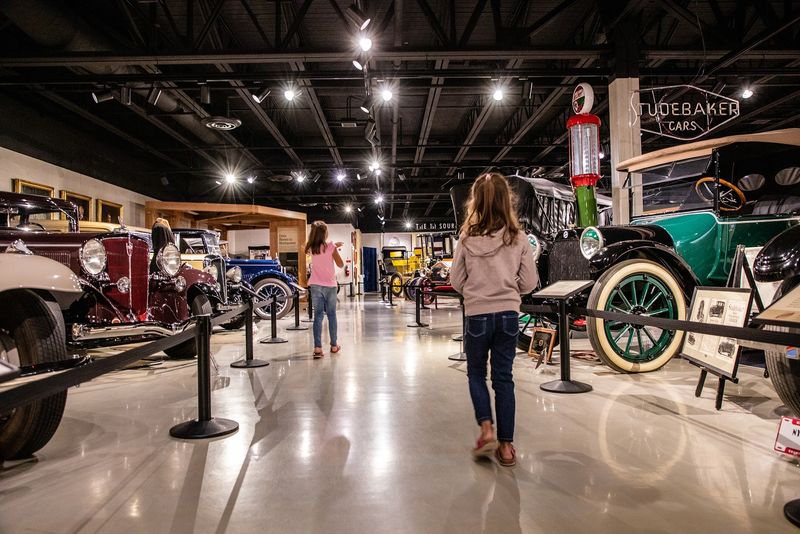
Museums and restless kids do not always mix. This one plans for it.
The Studebaker Super Service Center lets young visitors, and plenty of grown ones, try real car-care tasks in a play setting. Checking brake fluid, changing a wheel, poking around under a hood.
It is all fair game.
Another display walks through how road surfaces changed since the 1800s, which sounds dry until a child realizes people once bounced along on dirt and gravel in vehicles with almost no suspension.
There is also a car set up for sitting in and taking photos, a small touch that turns into a family favorite. Kids of all ages line up for it.
Elsewhere the museum mixes in exhibits on women drivers, dollhouses, and area history, giving groups with different interests plenty of room to split up and meet back at the middle.
A small gift shop carries everything from children’s toys to higher-end collectibles, and a cafe on site offers a place to sit with coffee when legs get tired.
Doors open at 10 AM most days, with Sunday starting at noon and closing at 5 PM. Mornings tend to feel calm, which suits families who want space to explore without hurrying anyone along.
Wheels of Time, Archives, and the Oliver Mansion Next Door
Guided tours can be forgettable. The Wheels of Time tour goes another direction entirely, blending storytelling and performance with the collection itself.
Costumed interpreters share personal stories from more than a century of American history, using Studebaker’s ambitions, wins, and hard losses as the thread. The cars stop being objects and start being evidence.
Behind the galleries sit archives holding tens of thousands of engineering drawings. Proposals for the 1952 Model N, postwar Champion and Commander styling ideas, and a sports car concept sketched by designer Bob Bourke all live in that paper trail.
There is even a roughly 1945 rendering by Virgil Exner, a pie-in-the-sky vision never meant for the assembly line. Add the 1956 Packard Predictor show car and the Studebaker-Packard Astral nuclear concept, and the what-if list grows long.
The building itself, located at 46601 deserves a look. Opened in 2005 and designed by James Childs Architects of South Bend, the 55,000-square-foot facility borrows details from old Studebaker factories.
The museum shares a campus and entrance with The History Museum, and the nearby Oliver Mansion offers guided tours through its three ornate levels.
Mansion tour spots can sell out, so grab those first. Then wander back to the cars with the whole story in mind.
