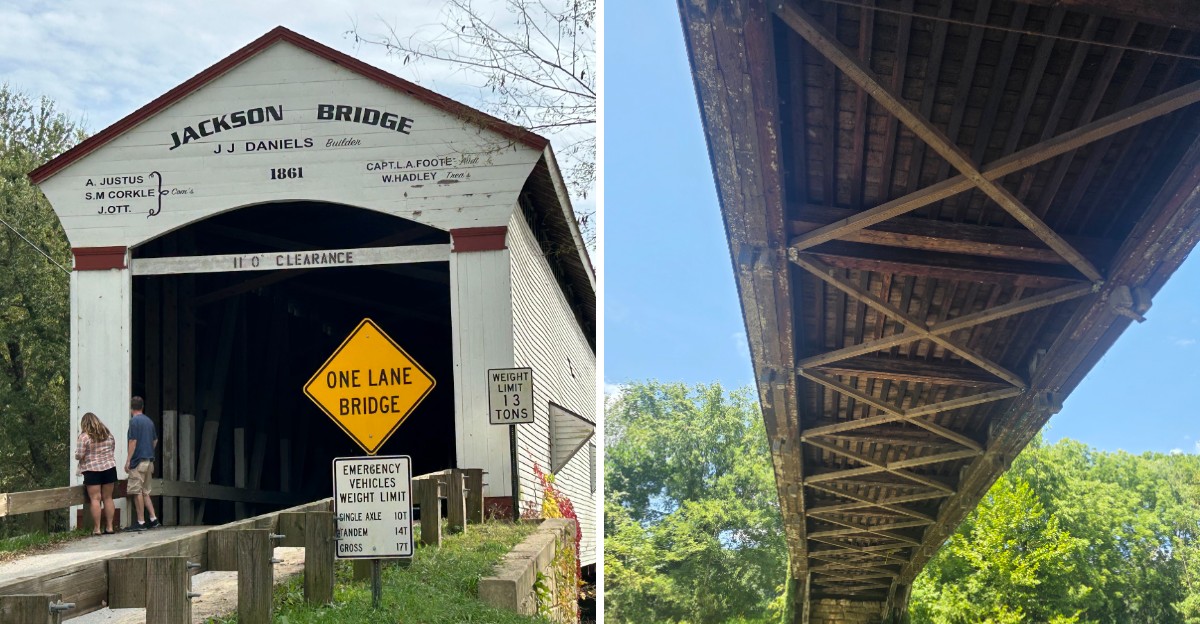
A wooden bridge built in 1861 stretches 207 feet across a creek without a single middle support. Cars still drive across it today.
No other covered bridge in the country has a single span that long while still carrying traffic. It even survived a flood that tore off its roof in 1913.
That same year, a tornado took its own shot at it.
I like how this old giant keeps doing its everyday job in rural Indiana. It never retired or became a museum piece.
It just keeps working.
I can’t imagine a better way to feel history than rolling through it in your own car. The boards rumble and the creek slides by below.
So how does a Civil War-era bridge pull that off?
207 Feet of Wood With Nothing Holding Up the Middle
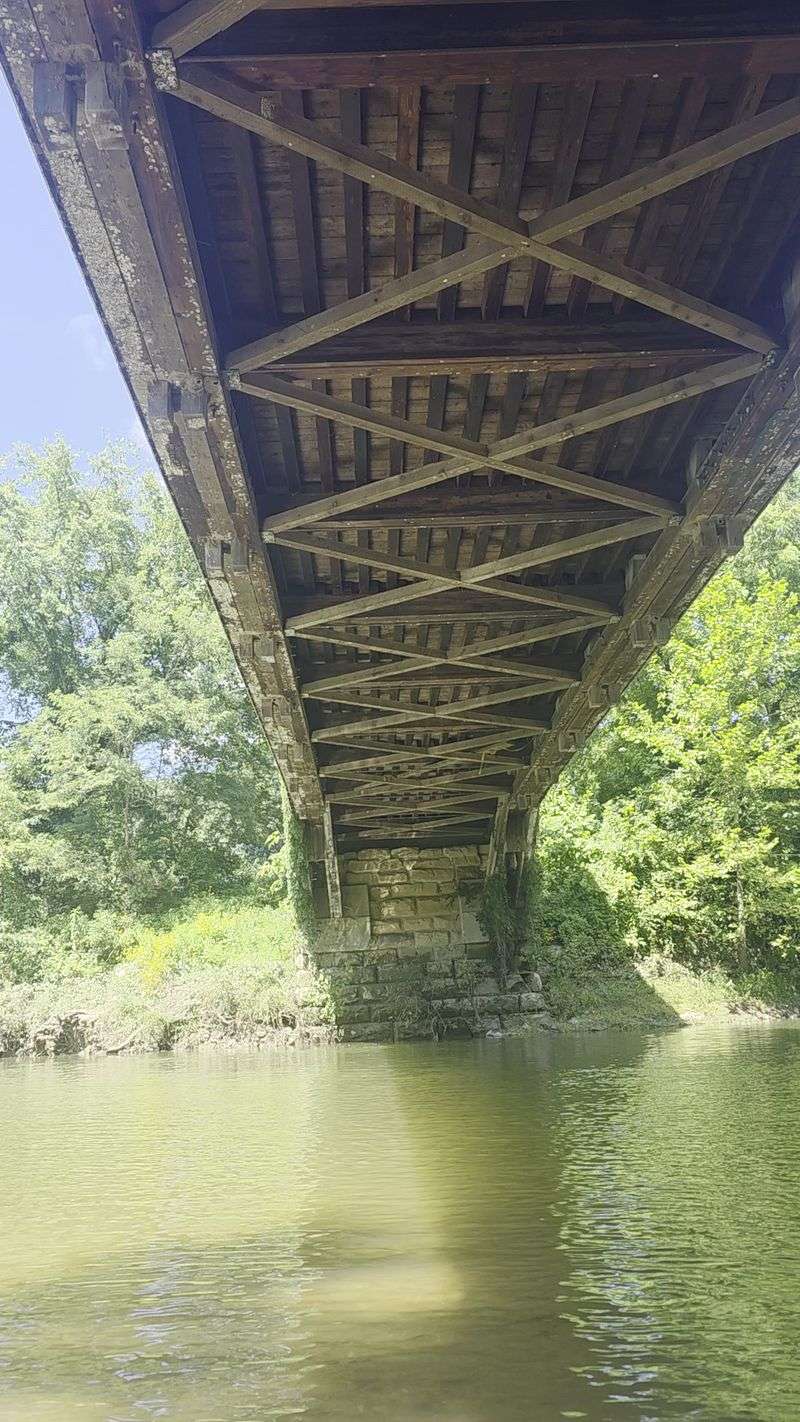
The Jackson Covered Bridge crosses Sugar Creek in one giant leap of 207 feet. There are no piers in the water and no posts propping up the middle.
That number earns it a national title. It’s the longest single-span covered bridge in the United States still carrying vehicles.
It also holds the top spot within Indiana for single-span length. Counting the 9-foot overhangs at each end, the full structure reaches 225 feet.
Why does a single span matter so much? Every extra foot without support makes the engineering harder.
Wood has to bend, carry weight, and stay strong across that whole gap.
Builders in the 1800s did this without computers or steel beams. They used careful math, smart truss designs, and plenty of hand labor.
The result still works more than 160 years later.
Other names have floated around for this bridge too. You might see it called the Rockport Covered Bridge or Wright’s Mill Bridge.
Same bridge, same record, just different labels from different eras.
Bring a friend and try pacing it out from one end to the other. You’ll understand that 207 feet much better on foot than on paper.
It feels a lot longer than it sounds.
Meet the Builder Who Signed His Work in Stone
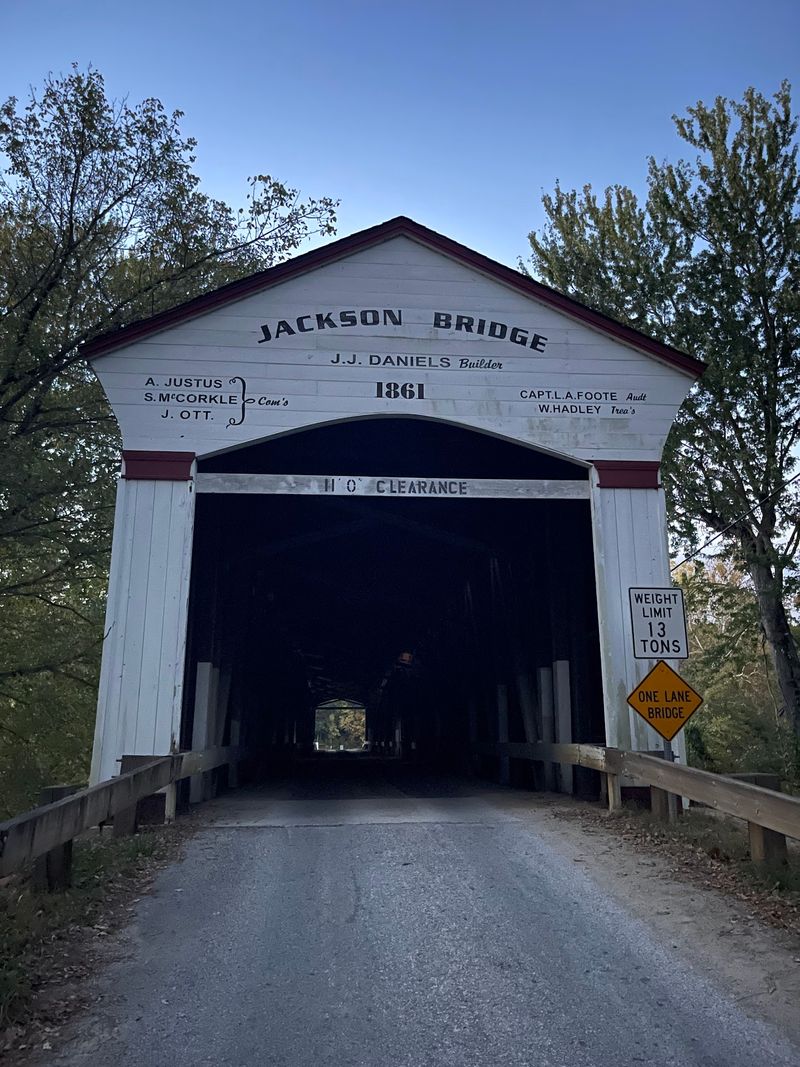
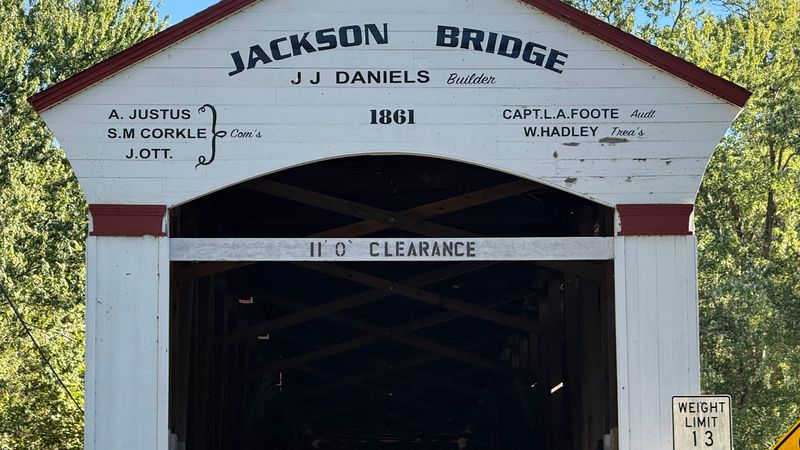
Bridge builders don’t usually leave autographs, but J.J. Daniels did.
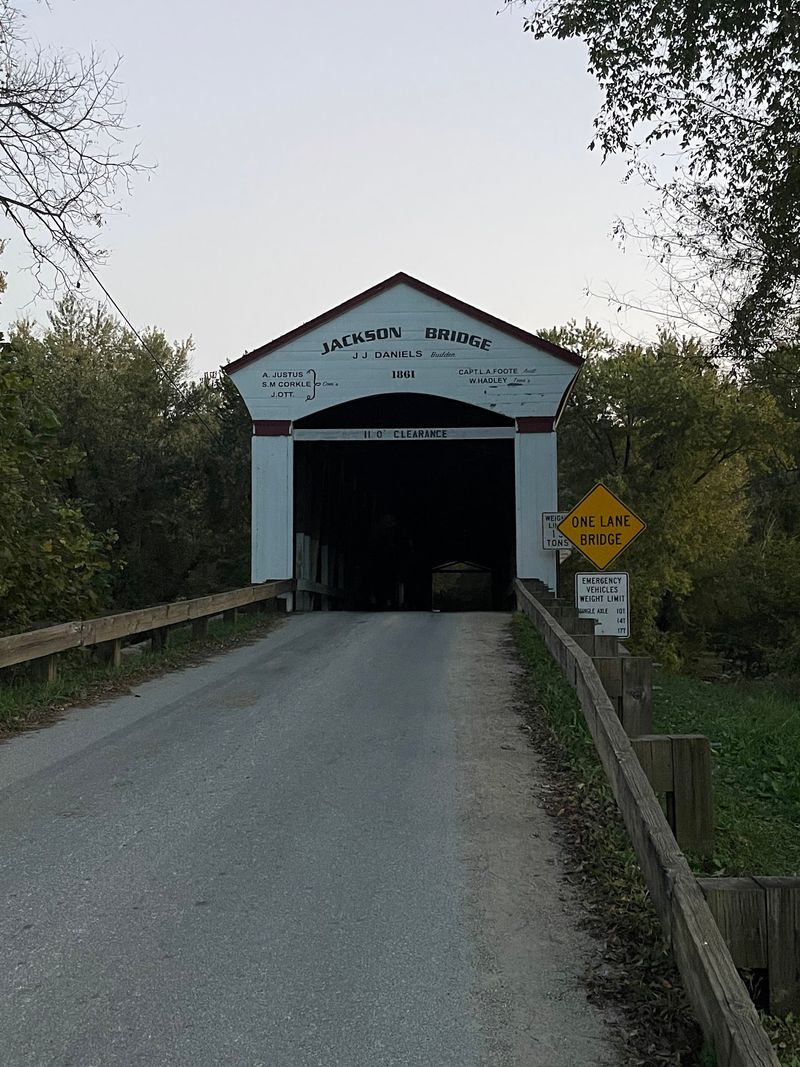
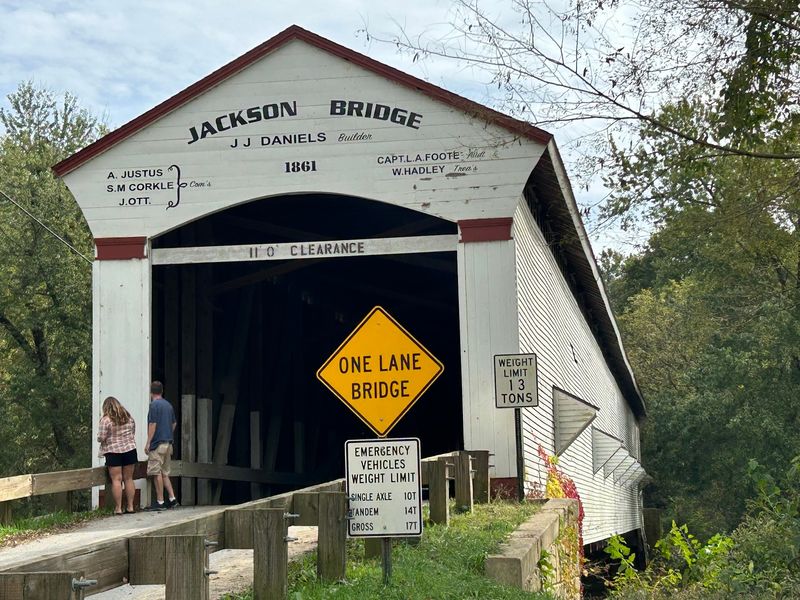
A cornerstone on the bridge reads “Builder J.J.
Daniels 1861.”
Daniels was one of the best-known covered bridge builders in Indiana history. He put up many bridges across the state during his long career.
Out of all of them, this one stands as the oldest surviving example of his work. That makes it a bit like finding an artist’s earliest painting still hanging on the wall.
Spotting that cornerstone is a fun little scavenger hunt for visitors. Kids especially enjoy finding a real date carved by hand so long ago.
Think about what 1861 meant for the country. The Civil War was just beginning, and the nation felt uncertain.
Daniels was building something meant to last through all of that.
His craftsmanship clearly paid off. The bridge has outlasted floods, storms, and well over a century of traffic.
When you visit, take a moment with that carved stone. It connects you directly to the person who planned and built this crossing.
Few roadside spots let you meet the maker this way. Snap a photo of it before you head inside the bridge.
A Bridge Name With a Political Message
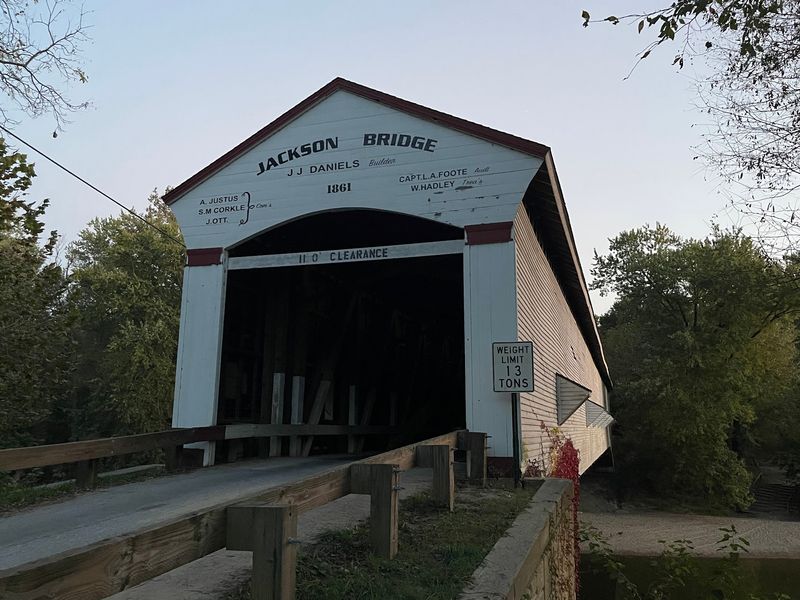
Naming a bridge can be a quiet way to say something loud. Daniels reportedly chose the name Jackson to make a point during the Civil War era.
The name honors President Andrew Jackson. It’s tied to Jackson’s famous call to keep the Union together and preserved.
In 1861, that idea carried huge weight. States were splitting apart, and loyalty to the Union was a hot topic everywhere.
A bridge name was one way to show where you stood.
It’s a neat reminder that history shows up in unexpected places. A rural creek crossing in Indiana became a small public statement about the nation’s future.
Bridges themselves are all about connection. They join two sides that would otherwise stay apart.
Naming one after a Union message feels pretty fitting, doesn’t it?
This is a great story to share with kids during your visit. It turns a wooden structure into a history lesson they’ll actually remember.
So when you read the name over the entrance, think beyond the lumber. You’re looking at a choice made during one of the hardest moments in American history.
That adds real depth to a simple drive across the creek.
Peek Up at the Double Burr Arches Inside
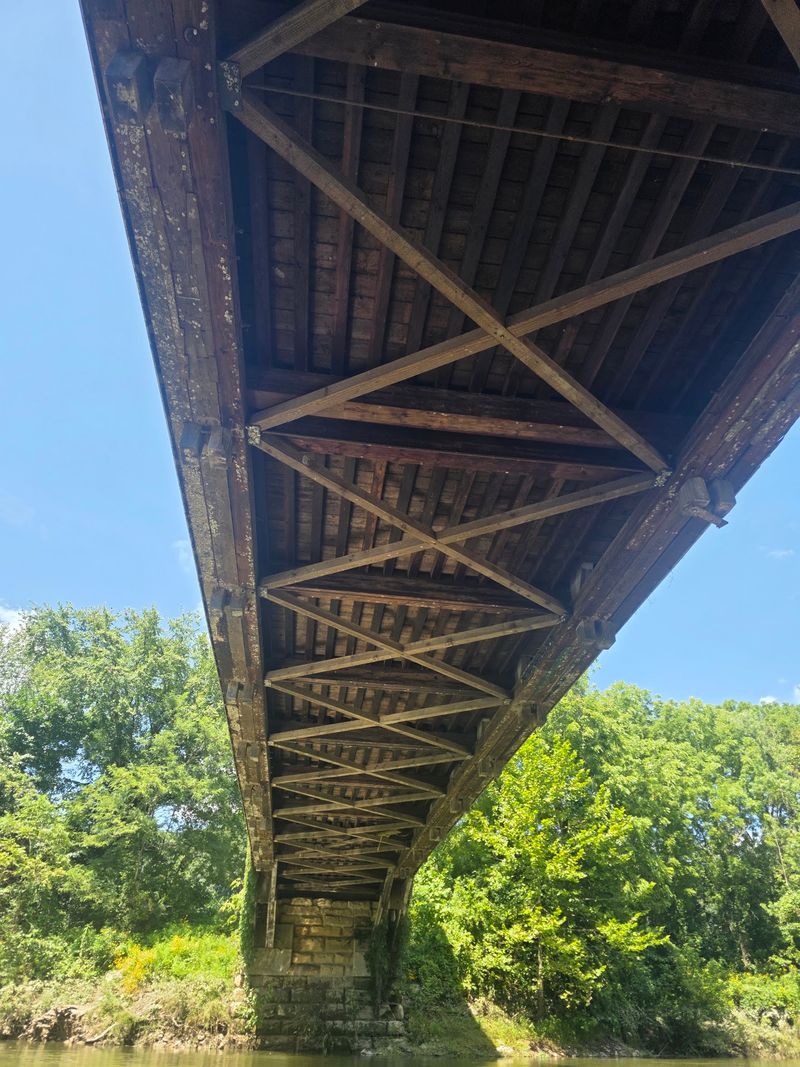
Look up once you’re inside, because the real magic hangs overhead and along the walls. The bridge uses a Burr arch truss design, and it’s a double Burr.
A Burr arch combines a wooden truss with a big curving arch. The arch helps spread heavy loads toward each end of the bridge.
Doubling it up adds extra strength. That’s how the structure manages such a long span without any help from the creek bed.
The curving timbers create a striking view from the roadway. They sweep along the sides like giant wooden ribs.
It’s easy to see why engineers and photographers both love this place.
You’ll also notice cross bracing high above. That bracing keeps the whole frame stiff and steady.
Here’s a practical tip for walkers. Stay alert and step aside when cars roll through, since this is a working road.
The bridge is narrow enough that sharing space takes a little attention.
Bring a camera with a wide lens if you have one. The long tunnel of beams and arches makes for some dramatic shots.
Morning or late afternoon light through the openings can look especially nice.
Check Your Height Before You Roll Through
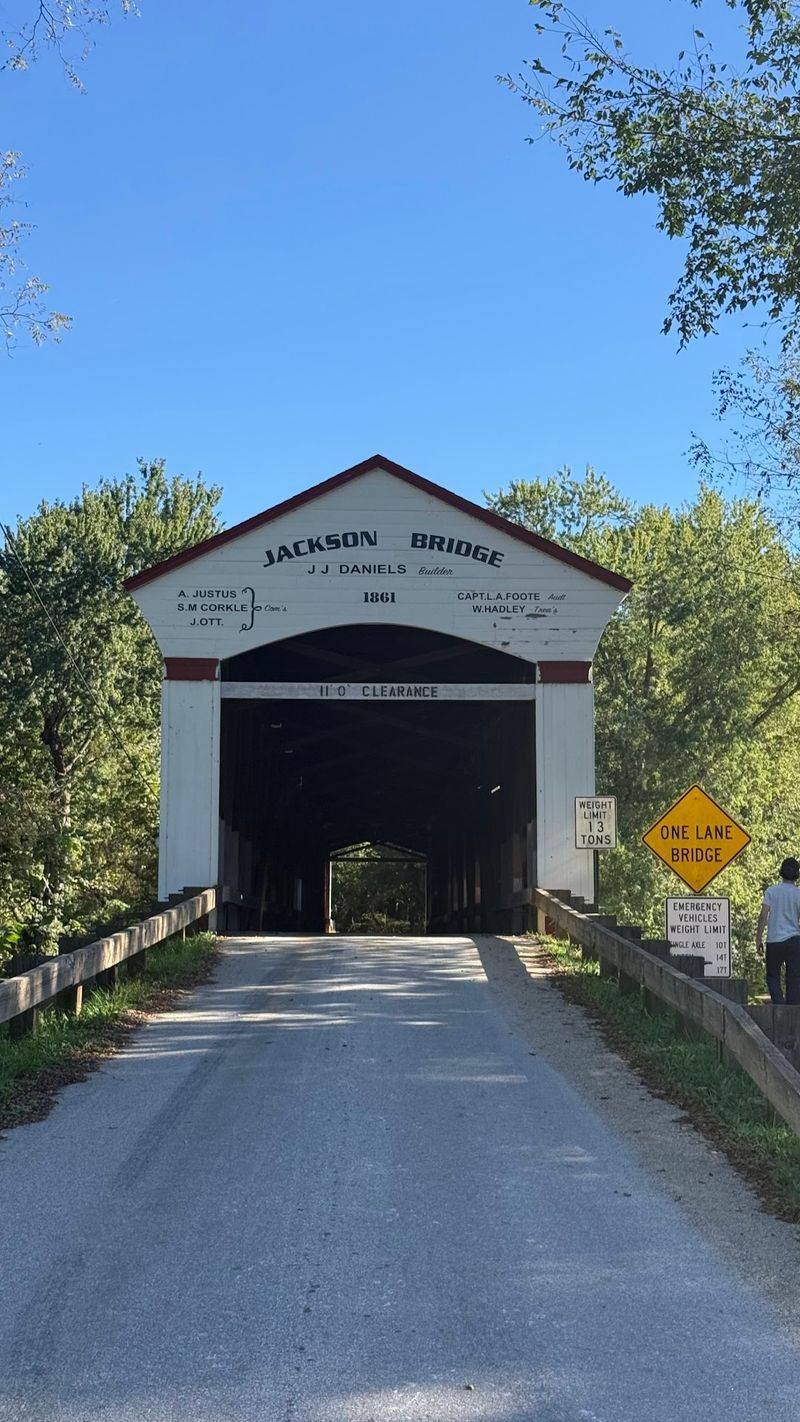
Here’s a fun twist for drivers. From outside, the clearance looks like 18 feet, but the inside tells a different story.
Cross bracing inside the bridge lowers the usable height to 10 feet, 6 inches. Some taller trucks have learned that lesson the hard way over the years.
Most cars and SUVs pass through without any trouble. Driving across is honestly one of the coolest parts of visiting.
The boards rumble beneath you and the arches glide past your windows.
The roadway is 16 feet wide. That’s enough for one vehicle at a time, so be patient if someone is already crossing.
Thanks to restoration work, the bridge carries loads up to 13 tons. Still, it’s smart to obey any posted signs at the entrance.
Going slowly makes sense here for a few reasons. You’ll protect the old structure, stay safe around walkers, and actually enjoy the ride.
Got a camper, tall van, or roof rack loaded with gear? Measure before you go.
Parking nearby and walking across is a great backup plan. You’ll see more detail on foot anyway, and nobody ends up with a scraped roof.
Floods, a Tornado, and a Roofless Year
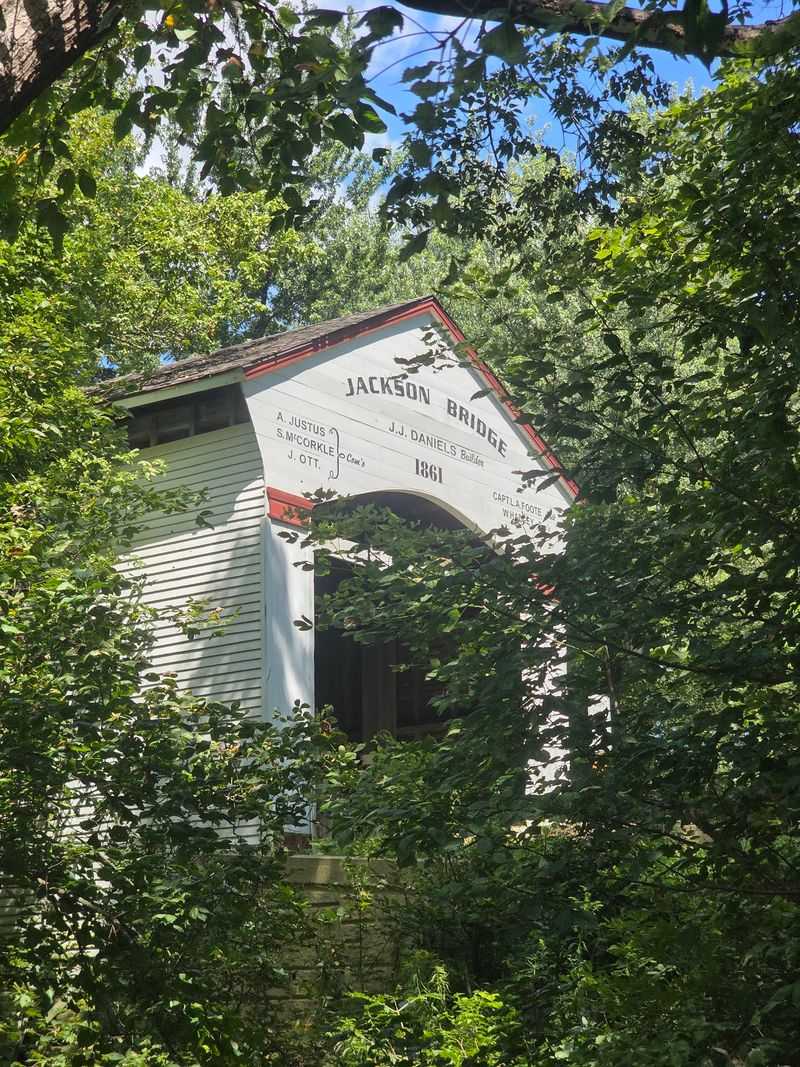
March 1913 was rough on this bridge. A major flood roared down Sugar Creek and stripped off its roof.
Then the same year brought a tornado. Most wooden structures would have called it quits after that combo.
The Jackson Covered Bridge didn’t. Its sturdy frame held on, and crews eventually got it back in shape.
It has also made it through several other big floods across its long life.
That toughness is a big part of its story. Sugar Creek can look calm on a sunny afternoon, yet it has real power when the water rises.
Standing near the bank gives you a feel for the setting. You can see how the bridge clears the creek in one sweep, high above the water.
The covered roof isn’t just for looks, either. Covered bridges got their roofs to protect the wooden trusses from rain and snow.
A dry frame lasts far longer than an exposed one.
So that roof lost in 1913 mattered a lot. Replacing it helped keep the bridge going for generations.
Next time it rains during your trip, you’ll know exactly what that roof is doing.
An Old Bridge With a Very Modern Makeover
Old doesn’t mean frozen in time. The bridge has had several rounds of care, including major work in 1977 and a total restoration in 2007.
One reconstruction project went especially deep. Crews replaced timber floor beams, stringers, and most of the upper and lower chords.
Many of those new parts are glue-laminated wood members. Builders also added fresh timber cross bracing and steel tie rods.
Together, these upgrades helped raise the load capacity to 13 tons.
Here’s the wild part. During that reconstruction, the whole bridge was temporarily moved off its abutments.
Picturing a 225-foot wooden bridge being shifted is a lot to take in. It shows just how much effort people put into saving it.
Restoration is a careful balance. Engineers want modern strength, yet they also want to keep the historic look and design.
This project managed both.
The bridge also earned a spot on the National Register of Historic Places in 1978. That listing recognizes its value to American history.
Thanks to all this work, today’s visitors can still drive across instead of just reading about it on a sign.
Once a Busy Mill Town Called Rockport
Quiet countryside surrounds the bridge now, but this spot used to hum with work. The area was once a small industrial and trading center called Rockport Mills.
A flour mill operated here. There was also a boatyard along the creek.
That history explains the bridge’s other nickname, the Rockport Covered Bridge. You may also hear Wright’s Mill Bridge, another nod to the milling past.
Back then, a bridge like this was a lifeline. Farmers needed to haul grain to the mill and goods to market.
A reliable crossing made daily life much easier.
Today, the mill and boatyard are gone. What remains is a peaceful setting along Sugar Creek with the bridge as the star.
You’ll find it at 7911 N Bdale Rd, Bloomingdale, IN 47832, on the road also known as County Road 775N. GPS works well, though cell signal in rural areas can be spotty, so plan your route ahead.
Take a moment to look around the banks and imagine the old activity. It’s a fun way to picture how busy this little corner of Indiana once was.
Pair It With Festival Crowds and Canyon Trails
Parke County calls itself the Covered Bridge Capital of the World. With so many bridges scattered around, that nickname isn’t an exaggeration.
Each fall, the annual Parke County Covered Bridge Festival draws visitors from all over. The Jackson Covered Bridge is one of the standout stops during that event.
If you go during the festival, plan for extra traffic on rural roads. Starting early in the day gives you more breathing room at each stop.
Prefer a calmer trip? Visiting outside festival season lets you enjoy the bridge at a slower pace.
You can take photos without waiting your turn.
Nature lovers have great options close by. Turkey Run State Park and Shades State Park are both nearby.
They’re known for rugged sandstone ravines, forest trails, and beautiful creek views.
Combining a bridge tour with a hike makes a full, satisfying day. Pack water, snacks, and sturdy shoes for the trails.
A simple map of Parke County bridges helps you hop from one to the next. Just save Jackson for a highlight moment.
After all, it’s the longest single-span covered bridge in Indiana, and it deserves a starring role in your day.
