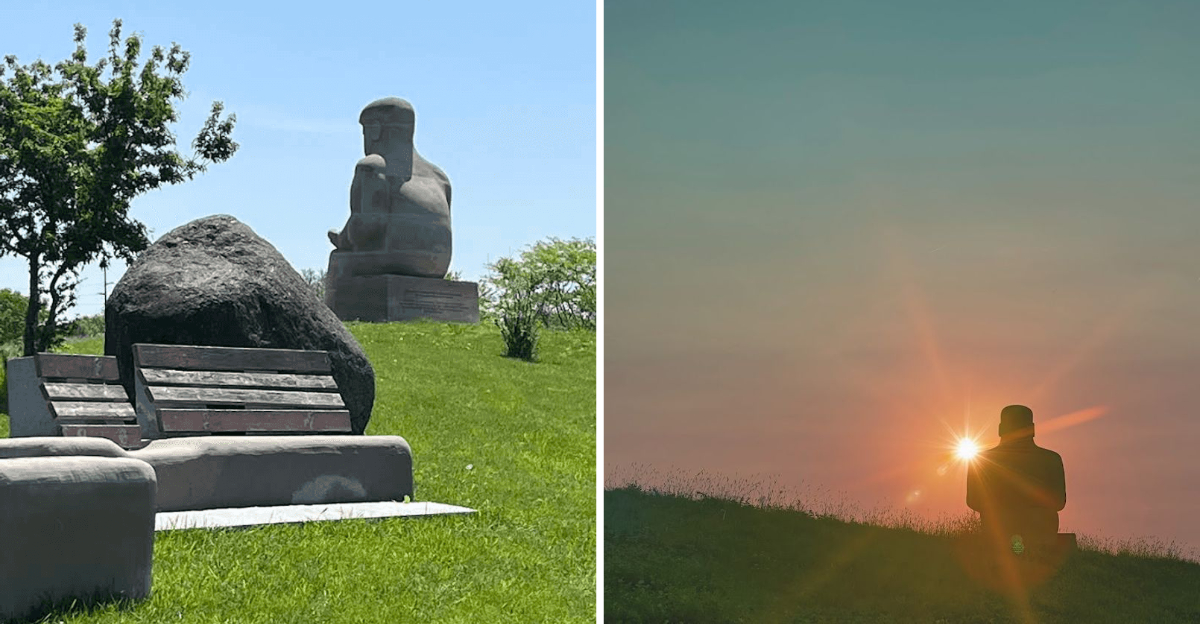
There is something quietly extraordinary about driving down this Iowa City street and suddenly catching sight of a massive figure just sitting there, calm and still, like he has been waiting for you all along.
The first time I saw him, I actually slowed my car down without thinking.
He is enormous, carved from limestone, and radiating this strange, peaceful energy that stops you mid-thought.
Nobody told me about him before I spotted him, yet somehow he felt familiar, like a figure from a half-remembered dream.
He sits there year after year, weathering storms and seasons, while the rest of the city hurries past without a second glance. That is the magic of this place.
The Sitting Man needs no introduction, no sign, and no explanation, because the moment you see him, you already feel like you know him. Pull over, take a moment, and let the quiet settle in.
A Giant With No Official Introduction
Most landmarks come with a sign, a plaque, or at least a tourist brochure. This one just sits there, massive and silent, letting you figure things out on your own.
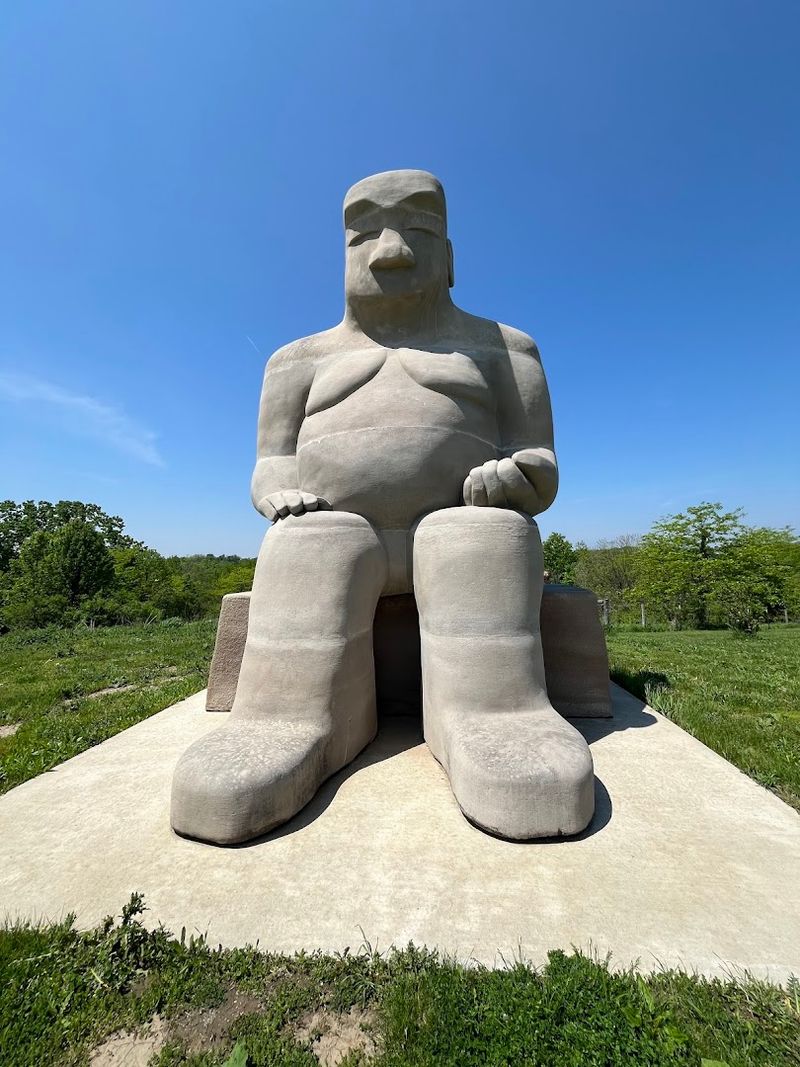
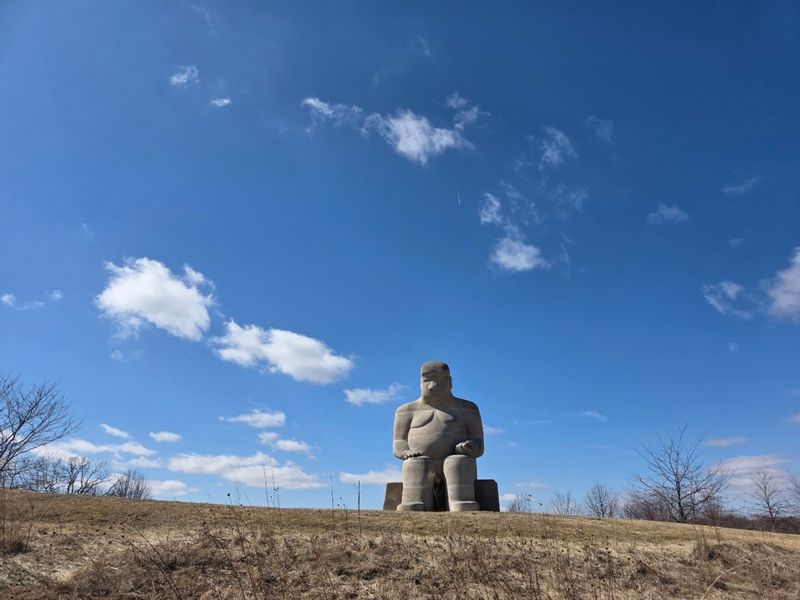
The Sitting Man on North Scott Boulevard in Iowa City stands over 20 feet tall and weighs more than 110 tons, making him one of the most physically impressive roadside sculptures in the entire Midwest.
He is composed of eleven blocks of Indiana limestone, carefully pinned together with stainless-steel rods. The craftsmanship alone is worth slowing down for.
Sculptors Doug Paul and J.B. Barnhouse completed the work around 2013, and the level of detail in every curve and fold of stone is genuinely impressive.
Locals have given him all kinds of nicknames. Some call him the Buddha, others call him the Big Buddha, and a few people just call him “that guy on Scott.” His official name is simply Sitting Man, which feels both perfectly accurate and wonderfully open-ended.
There is something freeing about a landmark that refuses to explain itself. You get to decide what he means to you, and somehow that makes the whole encounter feel more personal and memorable than any museum exhibit ever could.
The Story Behind the Stone
Every great sculpture has a backstory, and this one is genuinely fascinating. The Sitting Man was built from eleven massive blocks of Indiana limestone, a material known for its durability and warm, sandy texture.
The blocks are held together by stainless-steel pins, which is a detail that becomes more impressive once you realize the whole thing weighs over 110 tons.
Sculptor Doug Paul designed the piece with a specific philosophy in mind. Rather than attaching a fixed meaning or narrative to the work, he wanted each visitor to form their own personal connection.
That approach feels rare and refreshing in a world where art is usually explained to death before you even get to look at it.
On the back of the statue, there is an inscription of a prayer dedicated to Paramahansa Yogananda, the founder of the Self-Realization Fellowship Church. That detail adds a quiet spiritual layer to the whole experience.
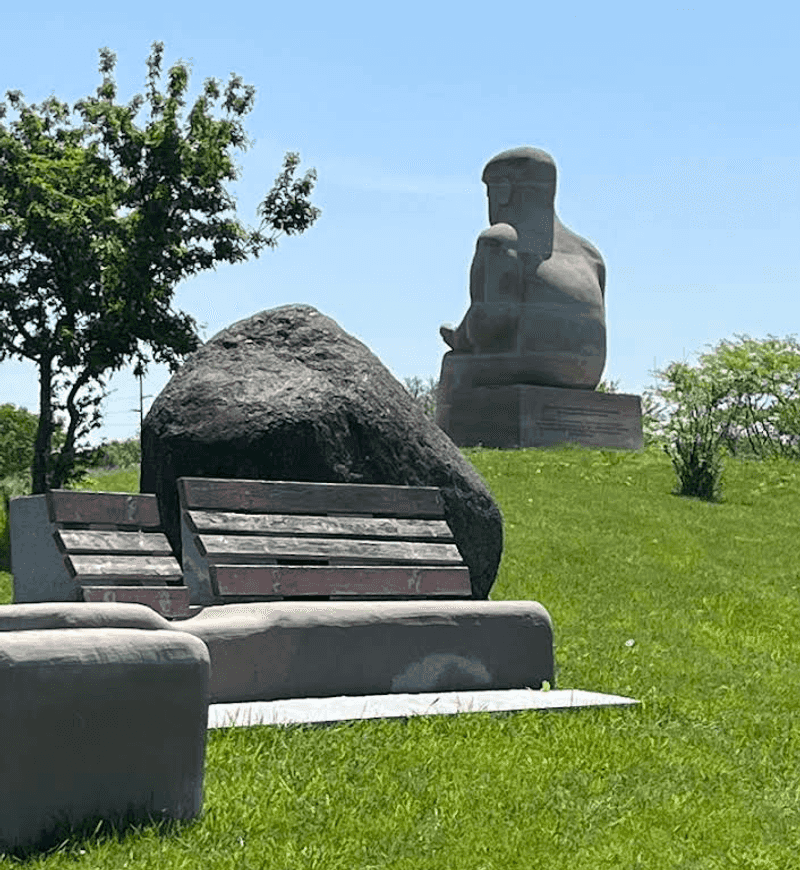
Nearby, a Visionary Stone carries an inscription honoring a person named Dee Norton. These small textual touches give the site depth without overwhelming it.
The sculpture sits on Harvest Preserve land, and the surrounding natural setting makes the spiritual tone feel completely at home.
How a 110-Ton Statue Moved Across a Road
Here is a fun piece of trivia that sounds completely impossible until you hear the full story. In 2020, the Sitting Man was moved.
Not a few feet, not a small adjustment, but an actual relocation across Scott Boulevard, block by block, because of a land exchange.
The sculpture was never designed to be moved. At over 110 tons, moving it was a serious logistical challenge that required careful planning and specialized equipment.
Each of the eleven limestone blocks had to be separated, transported, and reassembled on the new site without damaging the overall form.
The fact that it happened at all says a lot about how much people in Iowa City value this strange, beloved landmark. Nobody shrugged and said it was too difficult.
Instead, the community found a way to bring him along. The new location on Harvest Preserve still sits along North Scott Boulevard, so if you are driving by, the visual impact is almost identical to what it was before.
He is still there, still calm, still watching the road. The move is one of those stories that makes you appreciate both the engineering involved and the quiet determination of a community that refused to leave their guy behind.
What It Actually Feels Like to Visit
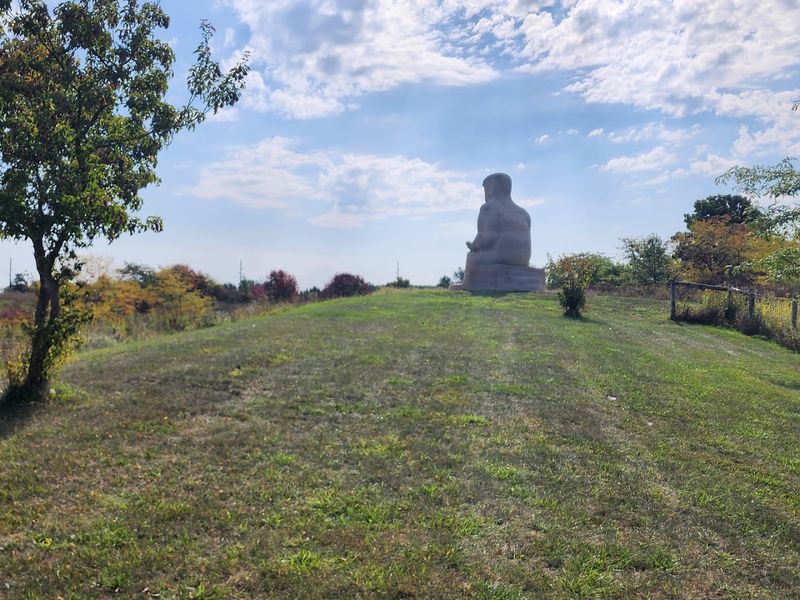
Seeing the Sitting Man from a car window is one thing. Getting close enough to really take him in is something else entirely.
The scale of the sculpture does not fully register until you are standing at his feet looking up, and at that point, the word “big” stops feeling adequate.
The site sits on Harvest Preserve, a natural green space on the east side of Iowa City. There is a multi-use path that runs past the statue, and a bench nearby where you can sit and absorb the surroundings.
The natural setting makes the whole experience feel calm and unhurried, which matches the statue’s energy perfectly.
Parking is the one catch worth knowing before you go. There is no parking directly along Scott Boulevard, so the best approach is to leave your car at a nearby business parking lot near the intersection of Scott and Rochester, then walk back along the sidewalk.
It is not a long walk at all, maybe a few minutes. The path is pleasant and the payoff is absolutely worth it.
Once you are there, the stillness of the place has a way of slowing everything down. It feels like the kind of spot where you end up staying longer than you planned.
Why Everyone Calls Him the Buddha
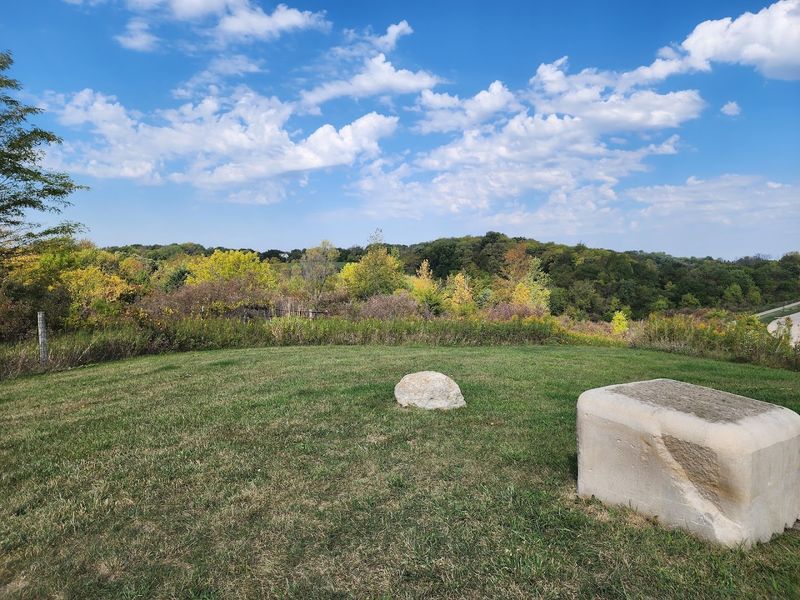
The nickname stuck almost immediately. Long before most people knew the official name, locals were already calling him the Buddha or the Big Buddha, and honestly, it is easy to understand why.
The posture is unmistakably meditative. He sits with a composed stillness that radiates something close to peace, and that quality comes through regardless of your personal beliefs or background.
The dedication on the back of the statue to Paramahansa Yogananda deepens that spiritual connection. Yogananda was an influential spiritual teacher who brought yoga and meditation philosophy to Western audiences in the early twentieth century.
The connection between the statue’s posture and that dedication feels intentional and meaningful.
Still, sculptor Doug Paul has been clear that he did not want to lock the figure into a single interpretation. The open-ended nature of the work is part of the point.
Some visitors feel a sense of calm. Others feel curiosity, or even a little awe.
A few people just think he looks like a really chill dude, which is also a completely valid reaction. The Buddha nickname captures something real about the figure’s presence, even if it is not technically his name.
Sometimes the name a community gives something tells you more than any official title ever could.
The Harvest Preserve Setting That Makes It All Work
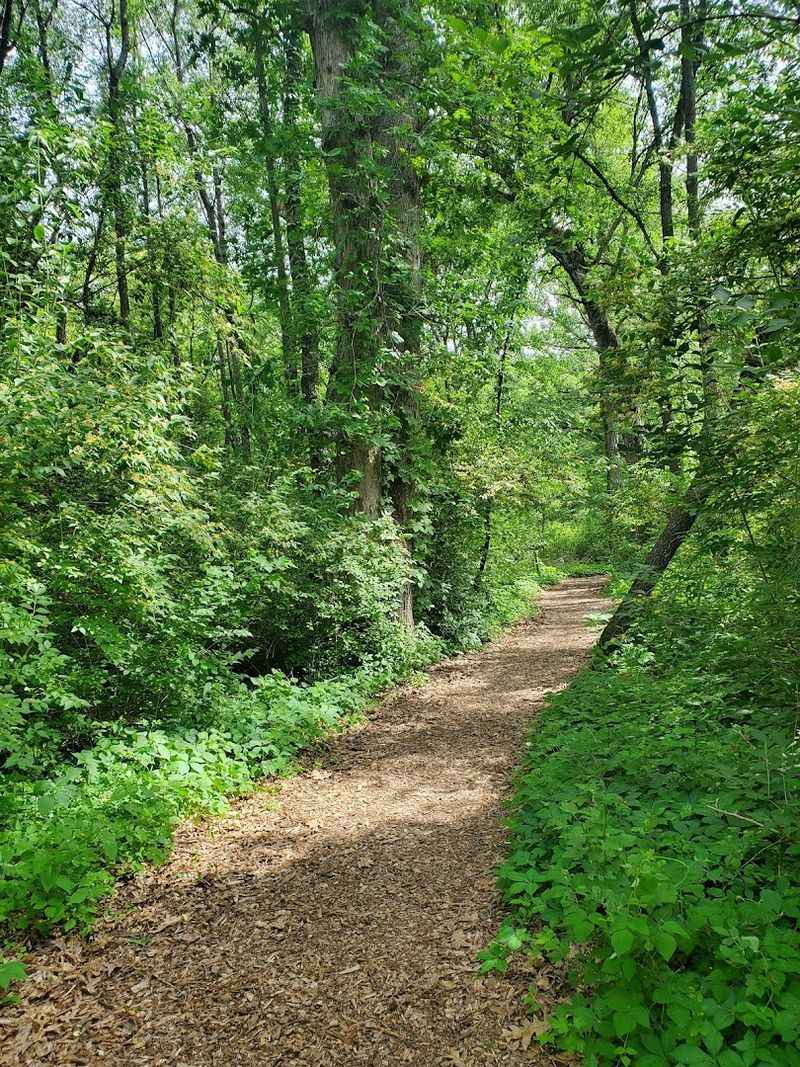
The Sitting Man does not exist in isolation. He is part of a larger natural space called Harvest Preserve, and that context matters more than you might expect.
The preserve sits on the far east side of Iowa City and offers a quiet stretch of trails, open land, and natural scenery that feels genuinely removed from the bustle of everyday life.
When you approach the statue through the preserve, the experience builds slowly. The trees and open grass create a kind of visual calm before you even reach the sculpture.
By the time the figure comes into full view, you are already in a slower, more receptive headspace. That transition is not accidental.
The bench positioned to the north and northwest of the statue is a small but thoughtful detail. It gives you a place to sit and actually absorb the surroundings rather than just snapping a photo and moving on.
The multi-use path that runs through the area also means the spot is accessible to walkers, joggers, and cyclists passing through. Harvest Preserve can be reached via the Harvest Preserve website at harvestpreserve.org, and it is worth checking before you visit to understand current access conditions.
The preserve itself is worth exploring beyond just the statue.
Why This Spot Deserves a Spot on Your Iowa Road Trip
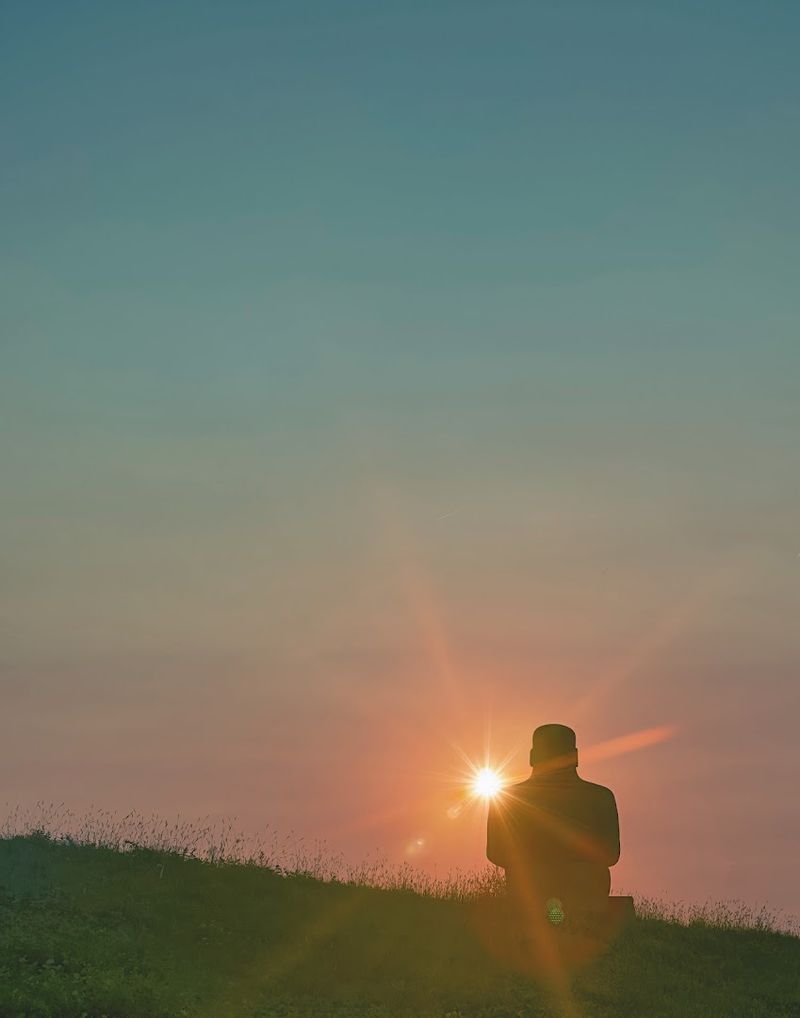
Iowa does not always get credit for its unexpected surprises, but the Sitting Man is exactly the kind of discovery that makes a road trip feel worthwhile. He is not in a museum.
There is no admission fee. You do not need a reservation or a guided tour.
You just show up, park nearby, and walk over to meet him.
That accessibility is part of what makes the experience special. It feels genuinely unfiltered, like stumbling onto something real rather than something packaged for visitors.
People have driven hours just to see this statue, including at least one visitor who made the trip from Boston by way of Chicago.
The statue earns a 4.3-star rating on Google Maps, which is impressive for something that is essentially just sitting on a hillside with no staff, no amenities, and no official visitor center. Most people who make the trip seem genuinely glad they did.
It is the kind of place that is hard to explain to someone who has not been there, but easy to remember long after you have left. If you are passing through Iowa City, or even just considering it, the Sitting Man is reason enough to make the detour.
Address: 1645 N Scott Blvd, Iowa City, IA 52245
