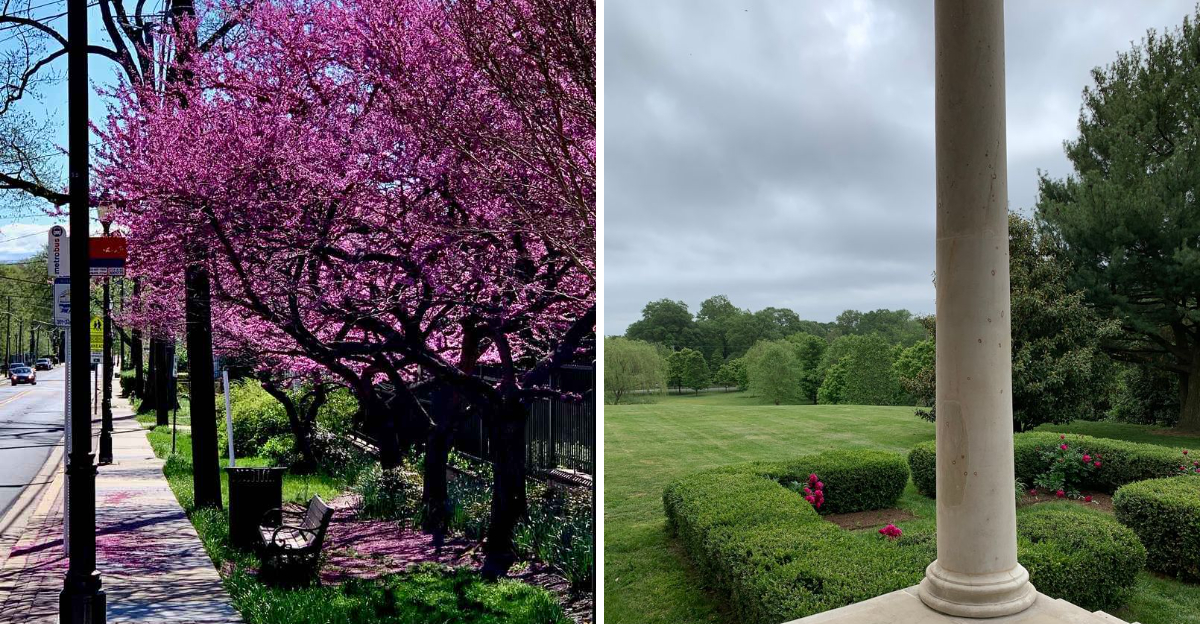
History feels considerably less distant when the house, gardens, and landscape are still sitting right where the story unfolded.
This Maryland National Historic Landmark dates to the early 1800s and preserves more than 200 years of stories connected to the Stier and Calvert families as well as enslaved people, including Adam Francis Plummer, whose lives and labor shaped the estate.
Visitors can explore the historic grounds and interpretive gardens, including spaces highlighting Indigenous plants, native species, children’s gardening, and crops associated with enslaved African Americans in Maryland.
The result is much more layered than simply touring an attractive old house and admiring the flowers.
This is a Maryland stop where even a quiet walk across the grounds keeps revealing reasons to pay attention.
A Flemish Dream Built in Maryland Clay
Henri Stier wanted a piece of Belgium in Maryland, and honestly, the resemblance is easy to picture once you know the backstory. He and his wife Marie Louise Peeters reached the United States in 1794, having left behind the chaos of the French Revolution’s Reign of Terror.
By 1801 he was sketching out plans for a house that echoed his Belgian residence, the Chateau du Mick.
Designs from the well-known architect Benjamin Henry Latrobe were considered early on, but Stier moved forward with builder William Lovering instead. Construction stretched from 1801 to roughly 1807, which was a serious commitment for a family still finding its footing in a new country.
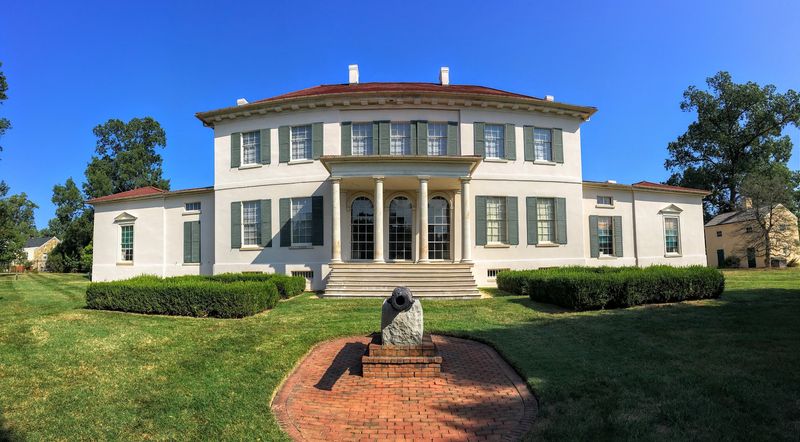
What strikes visitors most is the shape of the thing. Riversdale is a five-part Federal mansion, with a two-story central block joined by hyphens to smaller one-and-a-half-story pavilions at each end.
Stucco covers the brick, softening the whole structure into a warm, buttery color that looks especially good in late afternoon.
Here is the twist though. Stier never lived in the finished house at all, returning to Belgium in 1805 and handing the unfinished estate to his daughter, Rosalie Stier Calvert.
She and her husband George Calvert, grandson of Maryland’s 5th Baron Baltimore, took over the finishing and furnishing. Over the years the place picked up other names too, including Baltimore House and Calvert Mansion.
Stand near the entry porch with its Tuscan columns and fanlight, and the ambition behind it all becomes pretty obvious.
The Harder History Held in These Fields
Something shifts when a guide explains that these lawns were once part of a plantation covering somewhere between 739 and 749 acres. That number takes a moment to absorb.
Riversdale ran on the labor of enslaved people, and the museum does not soften that fact.
Records show Henri Stier enslaved at least fifteen people while the house was being built. Rosalie and George Calvert later enslaved close to eighty individuals, and their son Charles Benedict Calvert enslaved at least fifty-five by 1850.
Those figures are printed plainly in the interpretation, not buried in a footnote.
Exhibits inside have been reworked in recent years to center the experiences and contributions of enslaved workers, along with efforts to reconstruct their family histories. One moment on the tour lingers longer than the rest for many visitors.
A Calvert family portrait includes an enslaved boy standing in the background, easy to overlook if nobody points him out.
Once you see him, the whole painting reads differently, and that seems to be exactly the point.
Riversdale also carries recognition as a National Park Service National Underground Railroad Network to Freedom site, which signals how seriously the staff treat this layer of the story.
Both domestic servants and enslowed workers kept the household running day after day, and their labor built the elegance that visitors admire today.
Come here ready to think, not just to admire the millwork and the garden beds.
Adam Francis Plummer and the Diary That Survived
A ten-year-old boy arrived at Riversdale from the Calvert family’s Mount Albion plantation, and his name was Adam Francis Plummer. He could read and write, a skill taught to him quietly by a traveling pastor, and that changed everything about what we know today.
From 1841 until his death in 1905, Plummer kept a diary.
The pages are remarkable for how ordinary they are. He recorded births, deaths, and marriages, listed the names of free Black neighbors and enslaved people, took inventory of possessions, and noted things happening around the community.
Daily life, written down by someone living inside slavery, in his own hand.
After he died, his daughter Nellie Arnold Plummer kept writing in the diary and later published a memoir called Out of the Depths or Triumph of the Cross, tracing her family’s path from bondage to freedom.
Those writings now sit in collections including the Smithsonian Anacostia Community Museum.
Because of them, researchers have pieced together the story of Adam, his wife Emily, and their nine children, a family often separated until Emancipation came in 1864.
Descendants still return to Riversdale, sometimes holding reunions on the same grounds their ancestors worked. That detail always gets me.
Ask about Plummer specifically when you tour the house, since his story threads through the property in ways that maps and floor plans cannot convey.
It is the human center of the whole place.
Eight Garden Plots Full of Color and Crops
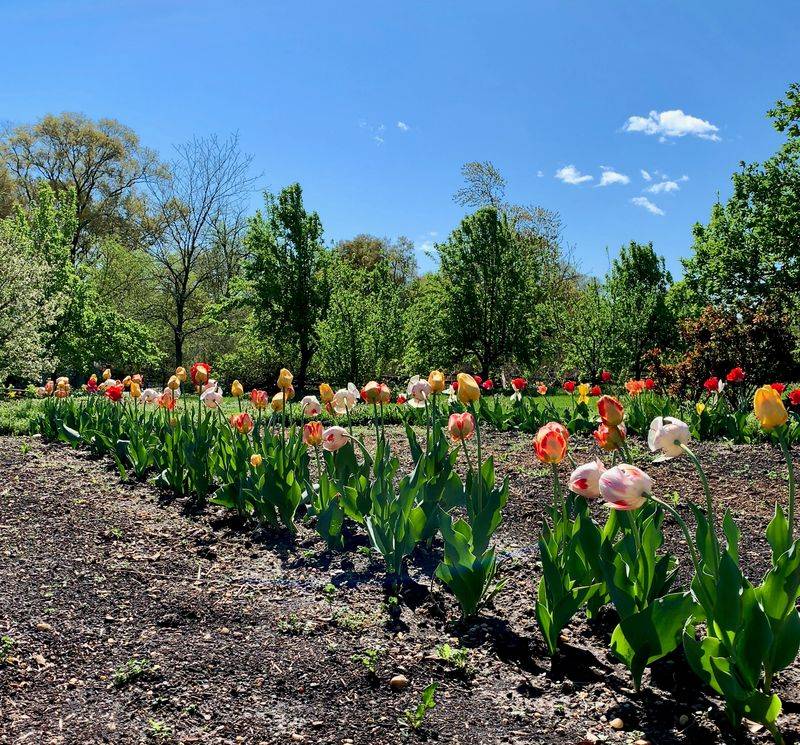
Zinnias, marigolds, and rudbeckia spilling over the edges of neat rectangular beds greeted me on my walk toward the house. Eight plots make up the historic garden here, and they mix flowers with real food crops.
Asparagus, pumpkins, beans, and tomatoes all grow in the same rows the Calvert family would have eaten from.
Field crops typical of the early 1800s round out the planting, including corn that was once grown for sale rather than the dinner table. The garden tradition started with Henri Stier, who planted thousands of tulips and hyacinths while the house was still under construction.
Imagine that scale of bulb planting before the roof was even finished.
Rosalie Stier Calvert’s letters return again and again to her garden plans, which tells you how much of her attention this ground received. Over the generations, both enslaved and free workers cared for these beds.
Adam Francis Plummer had real horticultural talent and kept his own private garden on the estate.
After the Civil War, he continued growing roses on land he owned and named Mount Rose. Knowing that, the flowers here feel less decorative and more like a continuing thread.
Today volunteers from the Prince George’s County Master Gardeners work alongside a professional gardener, using organic methods throughout.
Best part for casual visitors? The interpretive gardens and grounds stay open daily from dawn to dusk at no cost, so an early morning stroll among the tomato vines is entirely possible.
Symmetry, Fanlights, and Federal Style Details
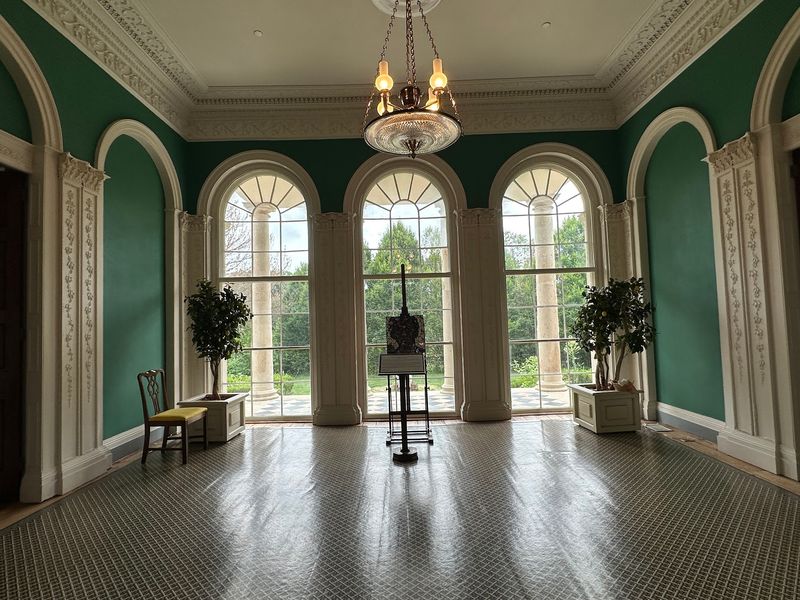
Architecture buffs will want to slow down out front. Riversdale is a five-part, large-scale late Georgian mansion carrying a distinctly Federal interior, and the details reward a close look.
The Federal style flourished in America from the 1780s through the 1840s, favoring balance and restraint over heavy decoration.
Count the bays across the central block and you land on seven, capped by a hip roof. Flanking pavilions rise only one and a half stories, linked to the main block by hyphens that keep the whole composition from feeling top-heavy.
Stucco over brick gives the exterior a smooth, almost sculptural quality.
The entry porch deserves a minute of your time, with its Tuscan columns and modest pediment sheltering double doors crowned by a fanlight. Classical order and careful proportion are the whole idea here, and the builders clearly understood the assignment.
European taste filtered through American materials and hands.
Inside, restoration work aims to reflect how the Calverts actually lived in the early nineteenth century rather than presenting a generic period look. One long-repeated claim deserves correction, though.
The design has often been attributed to William Thornton, but available evidence does not support that attribution.
Because so much of the original fabric survives, Riversdale ranks among the more important Federal-era houses in the region. Photographers should aim for late day light, when the stucco warms up and the columns cast long shadows across the porch floor.
Bring a wide lens if you have one.
When the War of 1812 Reached the Front Lawn
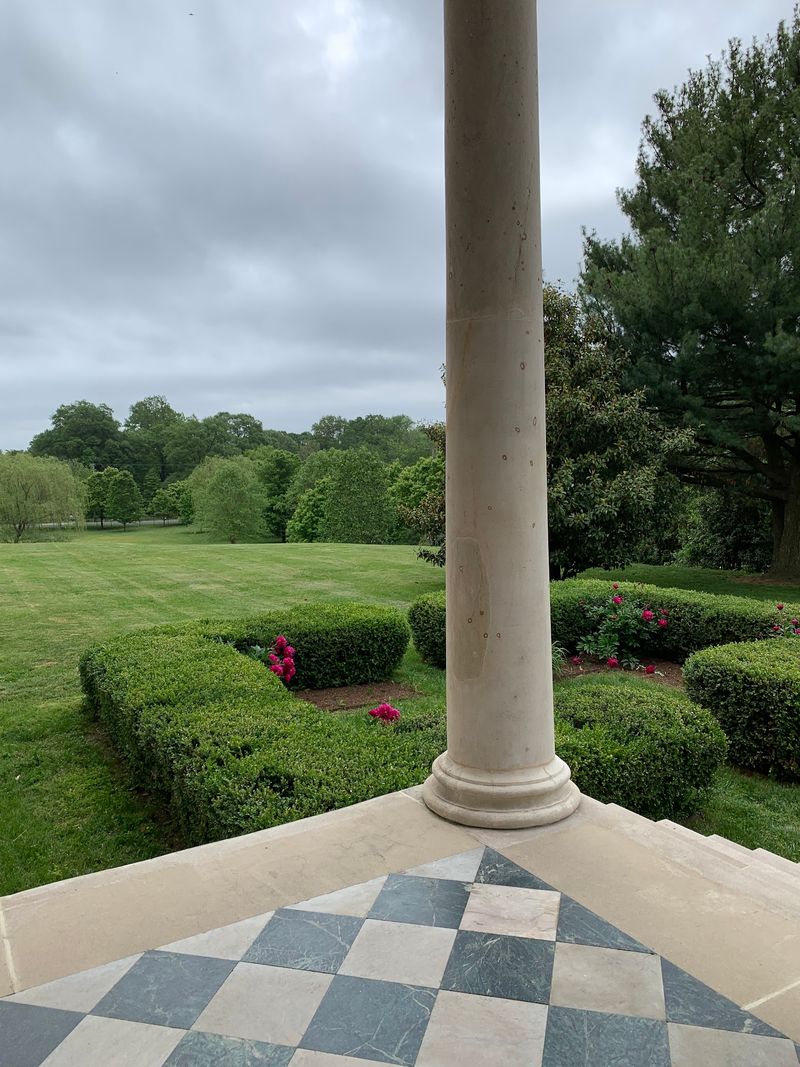
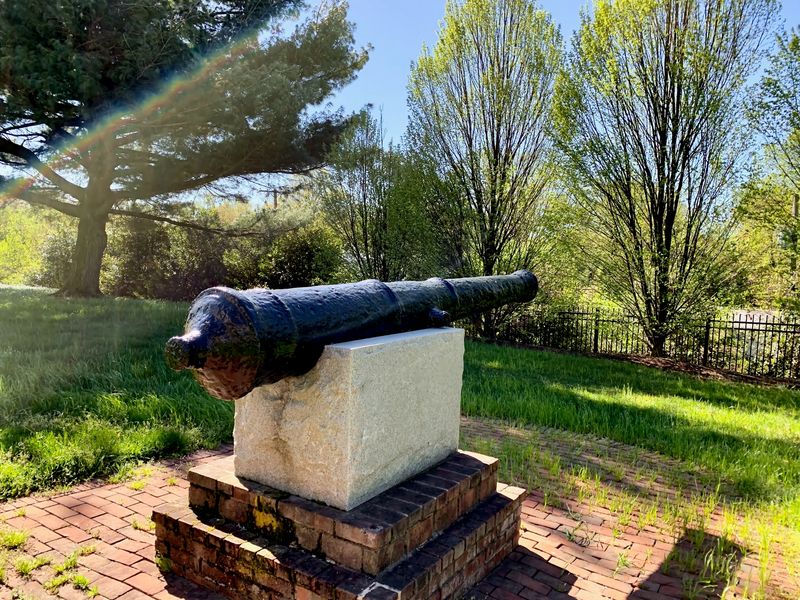
National history brushed right up against this property in 1814. The Battle of Bladensburg unfolded not far from these grounds, and after Commodore Joshua Barney failed to hold back British forces, the surrounding area was left in complete disorder.
Chaos, essentially, on the doorstep of an elegant country house.
Rosalie Stier Calvert responded with striking practicality. She directed the enslaved people on the property to bury the dead left on the battlefield.
She also organized the collection of weapons and other items abandoned by retreating troops.
Reading about it later, the details stuck with me more than any battle map would. War history usually spotlights generals and ship movements, yet here the aftermath fell to a woman managing an estate and to enslaved laborers handling grim work nobody chose.
That is a very different angle on 1814.
Riversdale now interprets this chapter as part of its broader War of 1812 story, and it fits naturally into a wider tour of sites across the region. Ask a docent where the battlefield sits in relation to the house and the geography suddenly clicks.
Everything happened closer together than you might assume.
Walking the open lawn afterward feels different. The grass looks the same as any suburban park, but the ground carries a heavier history than its appearance suggests.
For anyone tracing the Chesapeake campaign, this stop adds texture that battlefield markers alone cannot provide, especially regarding the people who cleaned up once the shooting stopped.
How a Calvert Son Started a University
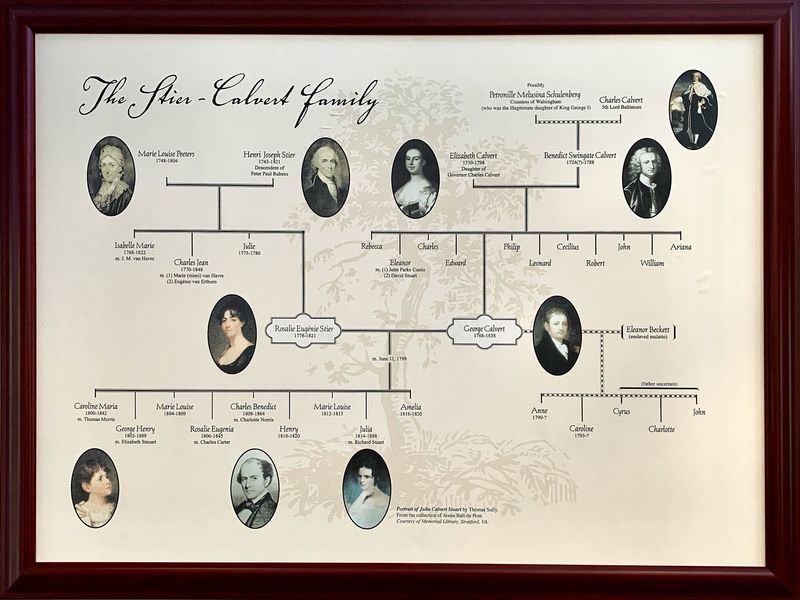
Terrapin fans might not realize their school’s origin story starts on this estate. George and Rosalie Calvert raised nine children at Riversdale, and five of them reached adulthood.
One son, Charles Benedict Calvert, went on to found the Maryland Agricultural College.
That institution grew into the University of Maryland, College Park. Part of the original Riversdale property became the seedbed for it, which means the campus and the mansion share literal ground in their histories.
Pretty wild connection for a house museum hidden into a residential neighborhood.
Charles Benedict’s interest in agricultural science and education was not a side hobby. Establishing a college devoted to farming knowledge in the mid nineteenth century required real vision, and the Calvert name carried enough weight to make it happen.
Family connections mattered enormously in Maryland politics of that era.
The Calverts were a founding family of the Maryland colony and among the most powerful households in the state, so their decisions rippled outward. Riversdale sits at a crossroads of political influence, social standing, and educational history rather than functioning as just a preserved home.
Layers on layers, in other words.
Students and alumni sometimes visit specifically for this link, and it makes a nice pairing with a College Park campus trip since the two sites are close neighbors. Mention the college connection to a docent and the conversation usually opens up.
History that still touches thousands of people every semester feels surprisingly present here.
Archaeology, Archives, and a Spear Point Under the Portico
Here is the fact that reframed the entire visit for me. Beneath the south portico, someone uncovered a spear point dating to the Late Archaic Period, around 1000 BC.
Thousands of years of human presence, sitting quietly under a Federal-era porch.
Indigenous peoples lived on this land long before any European surveyed it, and that artifact is a tangible reminder of how shallow the mansion’s two centuries really are by comparison. The museum treats archaeology as an active tool rather than a finished project.
Digs, archival research, and oral histories all feed into what gets shared with visitors.
Interpretation covers nineteenth century American life broadly, following the Stier and Calvert families, their descendants, and the enslaved and free workforce who kept the estate functioning. New findings shift the story over time, which is part of what makes return trips worthwhile.
Exhibits are not frozen in place.
Several specific themes get real attention here, including women’s history, African American history, and the War of 1812. Rosalie Stier Calvert’s surviving letters make the women’s history angle unusually rich, since her own words describe managing a household and a landscape.
Few estates from this era offer that kind of documentation.
Curious visitors should ask what researchers are currently working on, because staff tend to be genuinely enthusiastic about ongoing questions. Nothing about Riversdale feels settled or fully explained.
The ground itself keeps offering up new chapters, and the museum seems happy to admit the story is unfinished.
Planning a Visit, Tours, Picnics, and Leashed Dogs
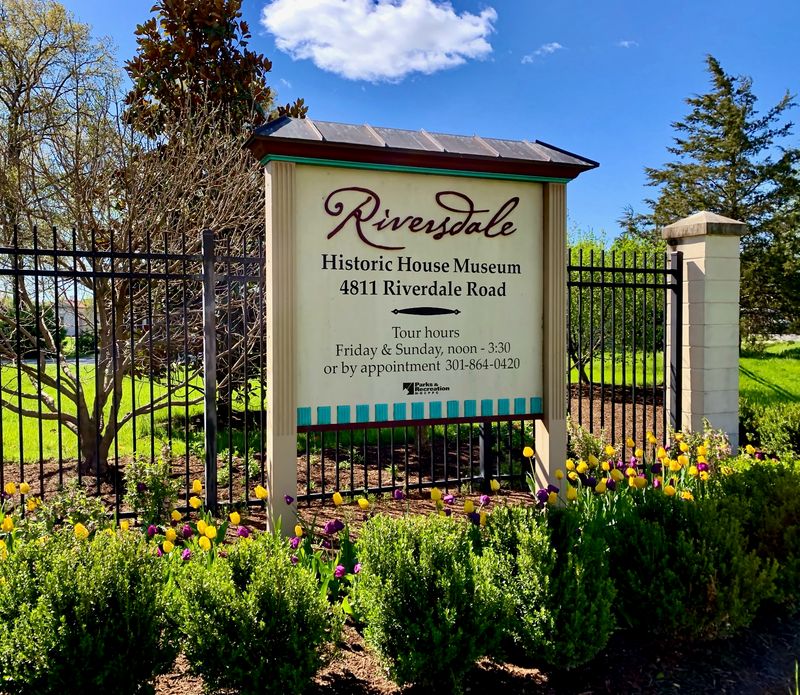
Practical details make or break a museum trip, so here is what to expect. Docent-guided tours of the historic house run about one hour and cover the period from construction in 1801 through Emancipation in 1864.
Guides use facilitated dialogue, meaning questions are welcome rather than tolerated.
Prefer exploring at your own pace? Self-guided outdoor options include an Architecture and Grounds Tour along with a Compass Rose tour aimed at children.
Full-color pamphlets for both sit near the garden, which is a nice touch for spontaneous visits.
Accessibility gets real consideration. Spanish language tours are available with advance request, and an elevator serves the first floor and basement for mobility-challenged visitors.
Sensory-friendly kits can be picked up at the Visitor Center.
Grounds and gardens stay open daily from dawn to dusk, and picnic tables mean you can turn a quick stop into a lazy lunch. Leashed pets are welcome outdoors as long as owners clean up after them.
My advice? Pack sandwiches and plan to linger.
Special events fill the calendar throughout the year, including interpretive garden programs and period cooking demonstrations that fill the air with woodsmoke and simmering pots. Checking the schedule before you drive over is worth the two minutes.
A living-history day turns a good visit into a memorable one.
Comfortable shoes handle the lawn and garden paths easily, and morning light suits photographers best. Give yourself two hours minimum to do the house and grounds justice.
Address: 4811 Riverdale Rd, Riverdale, MD 20737
