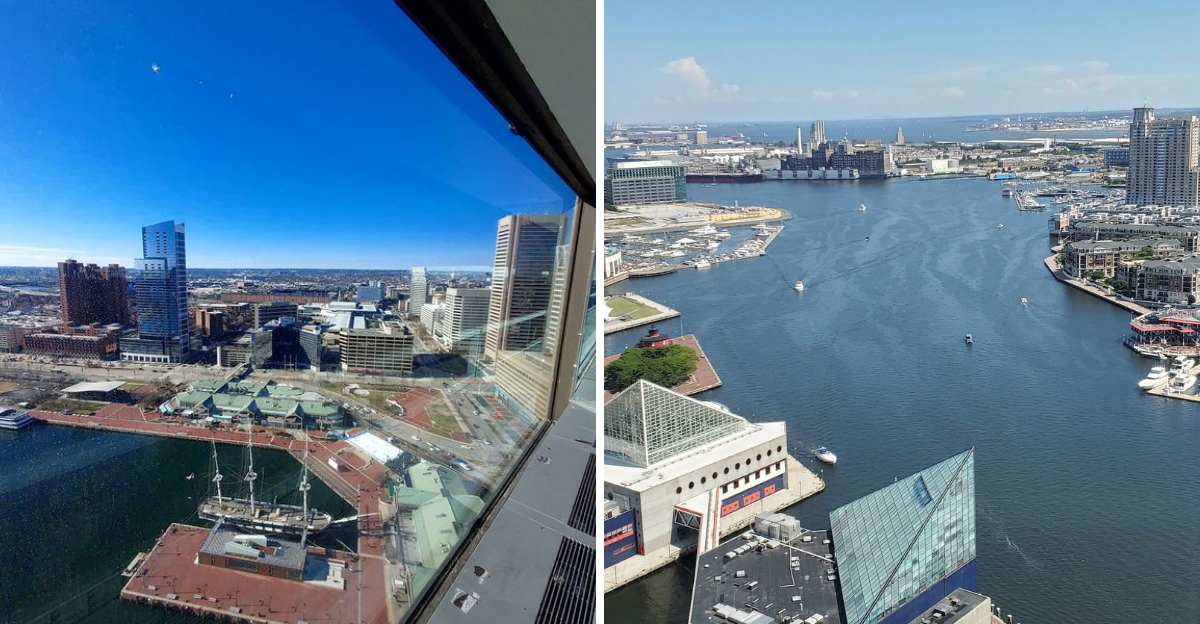
Sometimes a change in perspective is all you need to see a place differently. This Maryland observation deck offers exactly that.
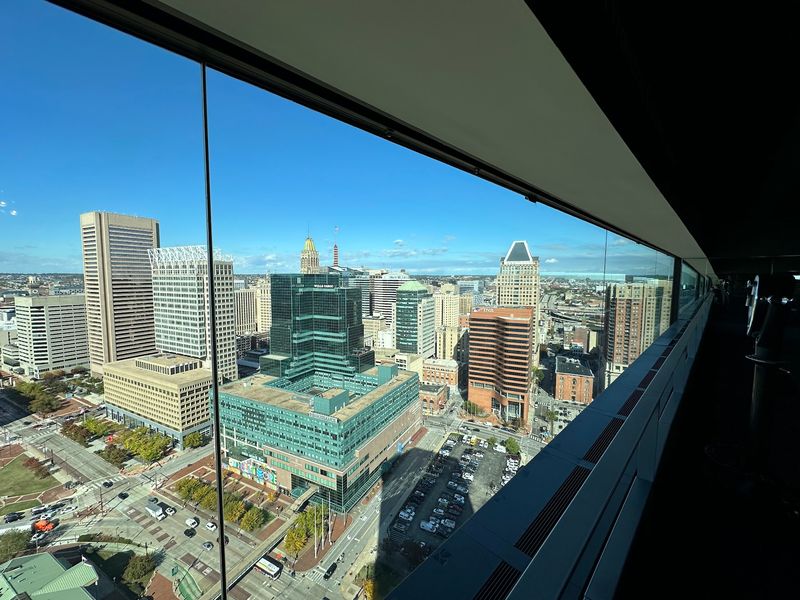
Twenty-seven floors above the city, you can look out and take in the skyline, the harbor, and the surrounding landscape. The view is incredible, the kind that makes you appreciate the scale of a city.
It is a simple experience, but one that leaves an impression. You can see the water, the bridges, and the architecture from a perspective most people miss.
The deck is comfortable and easy to access, making it a perfect stop on a day out. A reminder that looking at the city from the top is a different way to experience it.
A Building That Broke Records Before You Even Go Inside
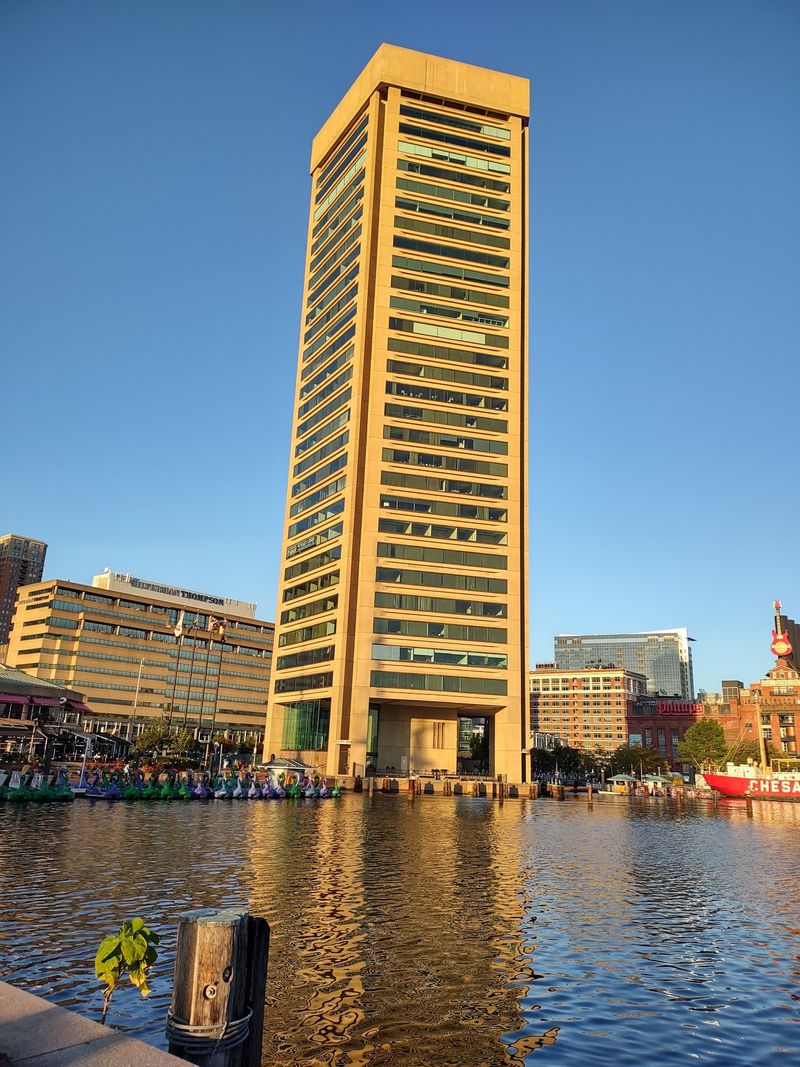
Most people walk past the World Trade Center Baltimore without realizing they are standing next to architectural history. The building was completed in 1977 and designed by the legendary architect I.M.
Pei, whose work also includes the iconic glass pyramid at the Louvre in Paris. That alone should give you pause before you even step through the front door.
What makes this structure genuinely remarkable is its shape. It holds the title of the world’s tallest regular pentagonal building, meaning its five-sided design is not just a style choice but a structural achievement that architects still reference today.
Rising roughly 423 feet above the harbor’s edge, it commands attention from nearly every angle of downtown Baltimore.
The pentagonal layout is actually what makes the observation deck so special. Because the building has five sides instead of four, the windows curve around in a way that gives you a more complete sweep of the city than a standard rectangular tower would.
You are not just looking out from one flat wall. You are rotating through a wide arc of Baltimore’s skyline, harbor, and neighborhoods all at once.
Knowing this history before you go adds a layer to the whole experience. It is not just a tall building with a nice view.
It is a thoughtfully designed landmark that has been part of Baltimore’s identity for nearly five decades. Getting up there feels less like a tourist activity and more like visiting something that genuinely matters to the city.
The 360-Degree View That Makes Baltimore Make Sense
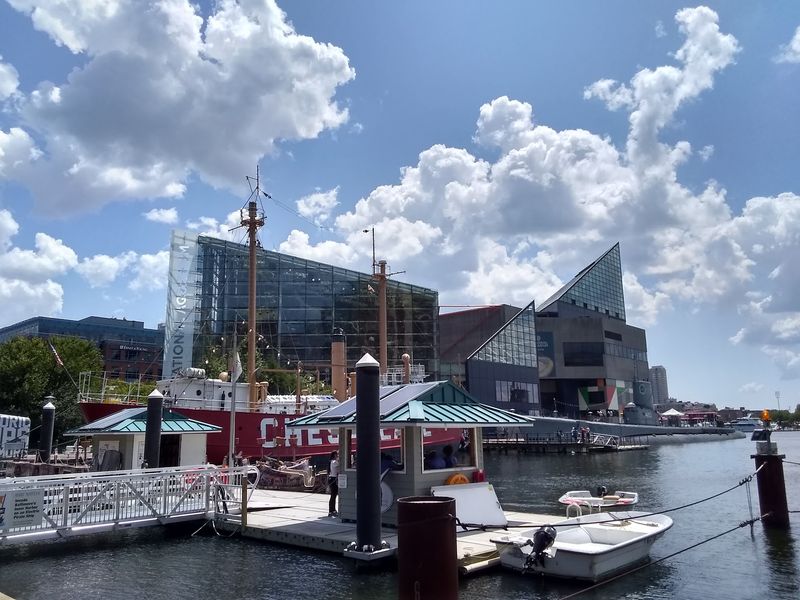
Up on the 27th floor, Baltimore stops being a collection of streets and starts being a whole picture. The view from the Top of the World Observation Level stretches a full 360 degrees, and on a clear day, you can see up to 30 miles in every direction.
That kind of visibility puts the entire region into perspective in a way that no map ever could.
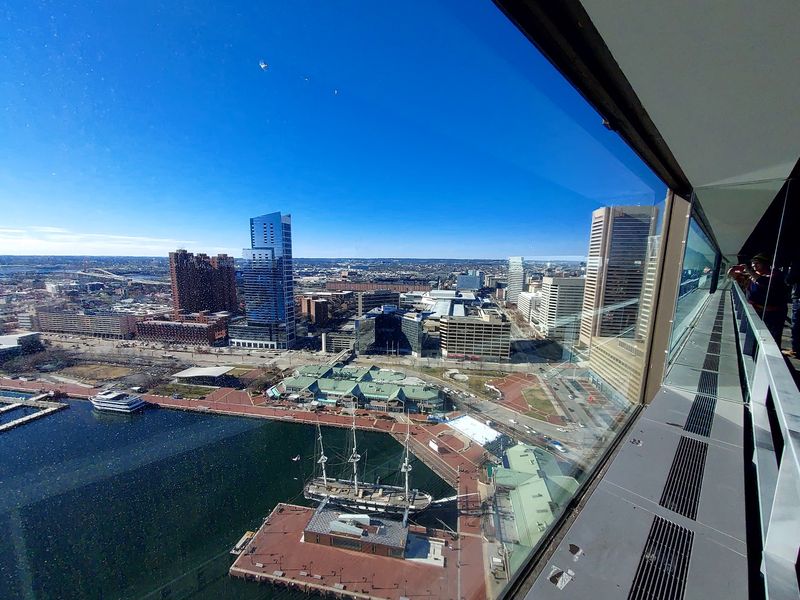
The Inner Harbor sits directly below, its water catching the light in shifting patterns depending on the time of day. You can spot the National Aquarium almost immediately, its distinctive blue roof standing out against the waterfront.
Further along, the USS Constellation, one of the last sail-powered warships built by the United States Navy, sits docked and visible from above.
Look west and the stadiums come into view. Oriole Park at Camden Yards and M&T Bank Stadium sit side by side, and seeing them from this height gives you a real sense of how close they are to the heart of the city.
Federal Hill rolls up in green just south of the harbor, and the famous Domino Sugar sign glows red across the water.
What gets me most about this view is how it connects things. You can trace a neighborhood from its edge to its center.
You can see how the water shapes everything. Baltimore has a reputation that does not always do it justice, and from up here, the city just looks beautiful.
Plain and simple.
Binoculars, Photo Maps, and Every Tool to Find What You Are Looking At
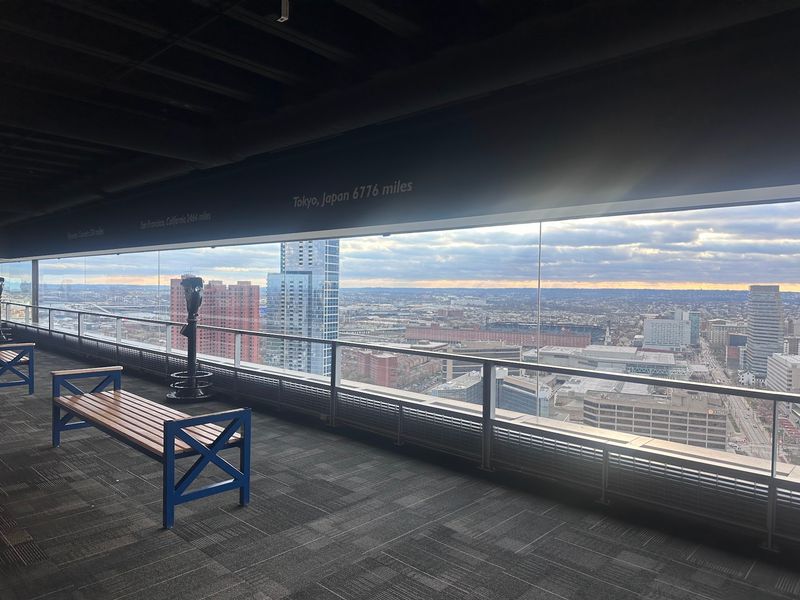
One thing that separates a great observation deck from a forgettable one is whether it helps you understand what you are seeing. The Top of the World does this really well.
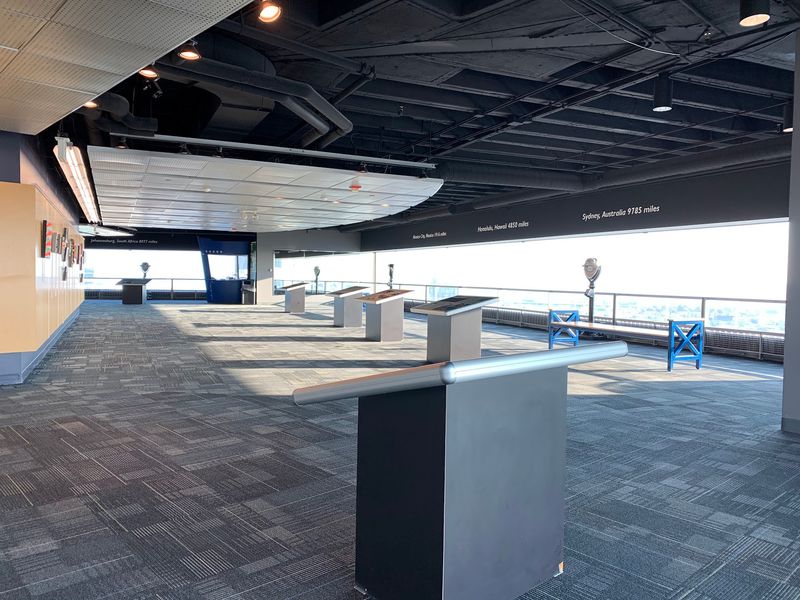
Stationed binoculars are set up around the perimeter so you can zoom in on specific landmarks without needing your own gear. They are free to use and genuinely fun, especially when you start picking out details you would never notice from street level.
The informational panels placed throughout the space are thoughtfully designed. They do not overwhelm you with text.
Instead, they point out key landmarks, explain a bit of the history behind them, and help orient visitors who are new to Baltimore. Photo-map guides match what you see through the windows to labeled aerial photographs, making it easy to identify neighborhoods, waterways, and buildings at a glance.
This kind of layered experience matters because it transforms a passive activity into something more engaging. You are not just standing there looking out a window.
You are learning the city’s layout, connecting what you see to what you read, and building a mental picture of how Baltimore fits together.
For families, this setup works especially well. Kids who might lose interest in a plain view stay curious longer when they have tools to interact with.
Adults who think they already know the city often find something new. The deck manages to be educational without feeling like a classroom, and that balance is harder to pull off than it looks.
The Maryland 9/11 Memorial Hidden in Plain Sight Above the Harbor
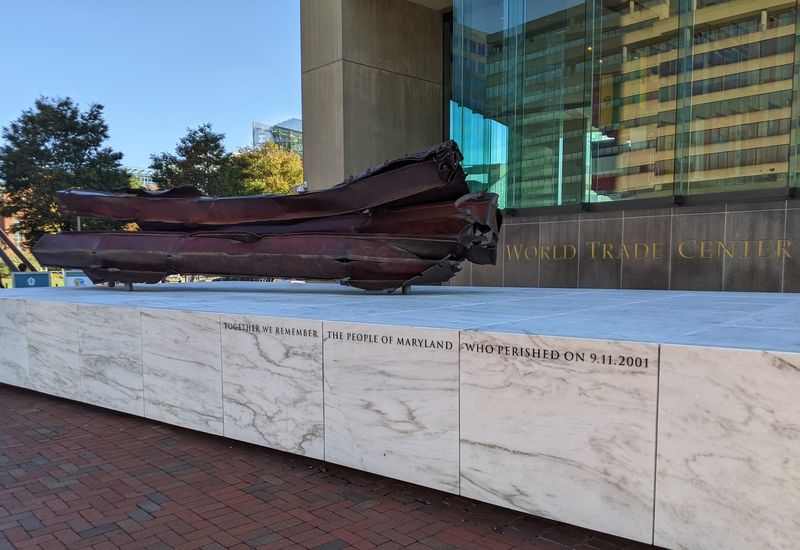
Hidden within the observation level is one of the most quietly powerful memorials I have ever encountered. The Maryland 9/11 Memorial is a permanent exhibit that honors the Marylanders who lost their lives in the September 11, 2001 attacks.
It is not a grand monument. It is understated, deliberate, and deeply moving in a way that sneaks up on you.
The exhibit features actual artifacts recovered from the Twin Towers, the Pentagon, and the Flight 93 National Memorial in Pennsylvania. Seeing physical remnants of those sites displayed with such care, above a city that keeps moving below, creates a strange and affecting contrast.
The world outside the windows is busy and alive, while the memorial asks you to be still.
What makes this memorial truly singular is the sundial effect. Because of the way the World Trade Center Baltimore is positioned, the building’s shadow moves across window inscriptions at the precise times that key events unfolded on September 11th.
It is not a digital display or a programmed light show. It is the actual geometry of the building doing something meaningful and unrepeatable every single day.
The names of the victims are inscribed on the windows, and reading them while looking out over the harbor gives the experience a weight that stays with you. This is not a stop on the way to the view.
For many visitors, it becomes the most memorable part of the entire visit, a reminder that beautiful places can also hold serious stories.
Gallery in the Sky, Where Local Art Meets an Unforgettable Backdrop
Not every observation deck doubles as an art gallery, but this one does, and it works surprisingly well. The Top of the World hosts rotating art exhibits as part of what is sometimes called the Peak Artist Series.
Local Baltimore artists get their work displayed at 27 floors above the city, which is not a bad way to show off your portfolio.
The combination of original artwork and panoramic windows creates something genuinely interesting. You move between pieces, glancing up at the city outside, and the two things start to inform each other.
A painting of the harbor looks different when you can turn around and see the actual harbor through the glass behind you. It is a layered viewing experience that most galleries simply cannot replicate.
The exhibits rotate, which means repeat visitors have a reason to come back. What you see on one visit might be completely different six months later.
That kind of programming keeps the space feeling alive rather than static, which is important for a destination that could easily rely only on its view and call it done.
Supporting local artists in a space this visible is also worth appreciating. The city benefits when its creative community gets prominent platforms.
For visitors, it is a chance to discover Baltimore-based talent they might not encounter anywhere else. Picking up something from the gift shop, which features works by local artists, is a way to bring a piece of that experience home.
It is a small thing that adds up.
What the Inner Harbor Looks Like From Way Up High
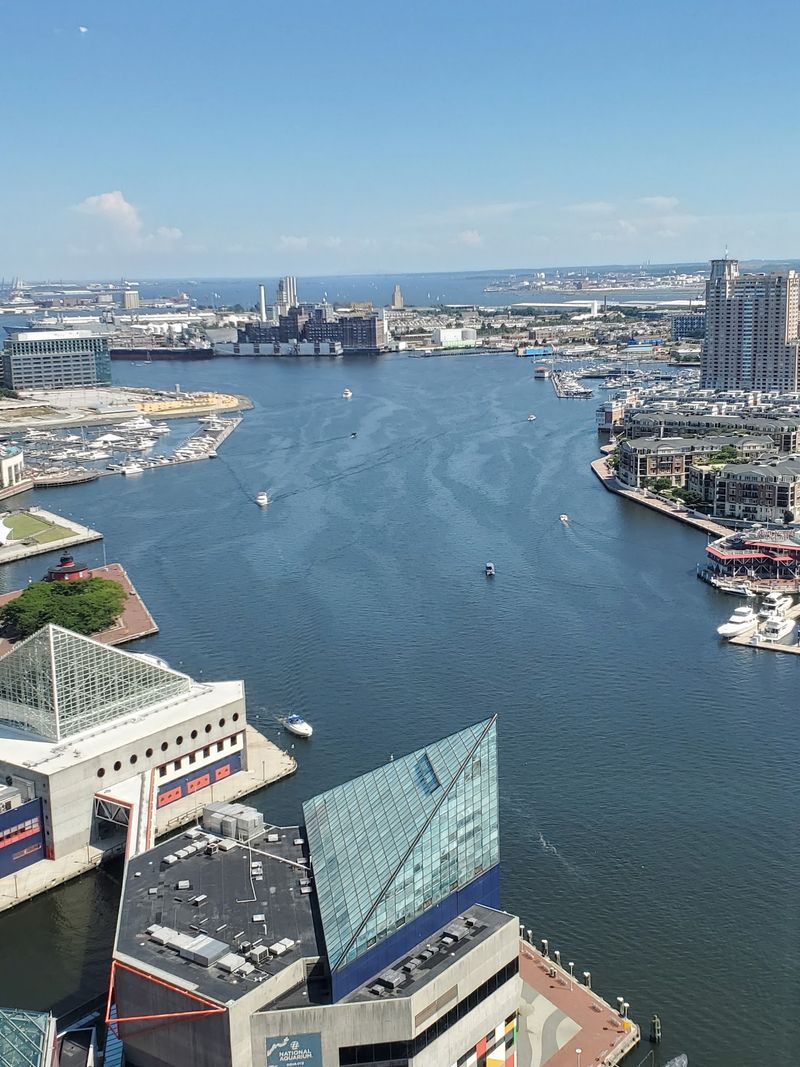
The Inner Harbor is Baltimore’s most recognizable feature, and seeing it from above completely reframes the experience of being there at street level. From the 27th floor, the water takes on a different quality.
It looks calmer, more geometric, almost like a mirror set into the city’s center. The boats moving across it look small and purposeful, and the whole basin feels like the organizing principle around which everything else arranges itself.
The National Aquarium’s distinctive roofline is easy to pick out, and the waterfront promenade curves around the basin in a way you simply cannot appreciate when you are walking along it. Seeing the layout from above makes you realize how deliberately the harbor was designed as a public space.
Everything faces inward toward the water.
Historic ships docked along the waterfront, including the USS Constellation, look almost toy-like from this height, which is a strange thing to say about a vessel that is 179 feet long. But scale does funny things when you are 423 feet in the air.
The detail you lose is replaced by context, and context is often more interesting anyway.
For anyone who has spent time wandering the Inner Harbor at ground level, this view is a kind of revelation. You start connecting streets to piers, neighborhoods to waterfronts, and landmarks to each other in ways that feel almost like solving a puzzle.
The city becomes legible. That is a rare and satisfying feeling, and the deck delivers it every single time.
Fully Accessible and Genuinely Welcoming for Every Visitor
Accessibility at observation decks is something that does not get talked about enough. A lot of elevated viewpoints involve stairs, narrow walkways, or outdoor platforms that can be difficult for people with mobility challenges.
The Top of the World Observation Level takes a different approach. The entire space is fully handicapped accessible, which means the experience is genuinely open to everyone.
The enclosed design plays a big role in making this work. Because the observation level is entirely indoors, with floor-to-ceiling windows rather than open-air railings, visitors who might feel uneasy on traditional outdoor decks can enjoy the full view without that exposure.
It is a much more comfortable environment for people with a fear of heights, young children, or anyone who finds outdoor platforms difficult to navigate.
The layout itself is spacious and easy to move through. There are no tight corners or cramped viewing areas.
You can take your time, move at your own pace, and find a spot that works for you without feeling rushed or crowded out by other visitors. That kind of thoughtful design makes a real difference in how relaxed the whole experience feels.
Families with strollers, older visitors, and anyone using a wheelchair or mobility aid can access everything the deck has to offer. The binoculars, the informational panels, the memorial, and the gallery are all reachable.
It sounds like a basic standard, but it is not always the reality at elevated attractions, and getting it right here matters more than most places might acknowledge.
Practical Tips for Getting the Most Out of Your Visit
Timing your visit makes a bigger difference than you might expect. Clear days obviously offer the best visibility, and on those days, the 30-mile view is not an exaggeration.
Morning visits tend to be quieter, and the light hitting the harbor from the east creates a soft, warm quality that photographs well without trying too hard. Late afternoon brings longer shadows and a different kind of drama to the skyline.
The observation level is operated by Create Baltimore, which also handles programming and events for the city. Checking their schedule before you go is a smart move because the gallery exhibits rotate and special programming occasionally takes place on the floor.
You might arrive during an opening or a featured artist event without even planning for it.
Wear comfortable shoes, even though you will mostly be standing still. You will naturally want to walk the full perimeter of the deck more than once, moving from the harbor view to the stadium view to the neighborhoods to the north.
Give yourself at least an hour. Rushing through it means missing the details, and the details are where the experience actually lives.
The gift shop near the exit is worth a look before you leave. Local artists contribute work specifically for this space, so what you find there tends to be more interesting than standard tourist merchandise.
It is a good spot to pick up something that actually connects to Baltimore rather than something you could buy anywhere. The whole visit, from the elevator ride up to the gift shop on the way out, feels complete.
Address: 401 E Pratt St, Baltimore, MD
