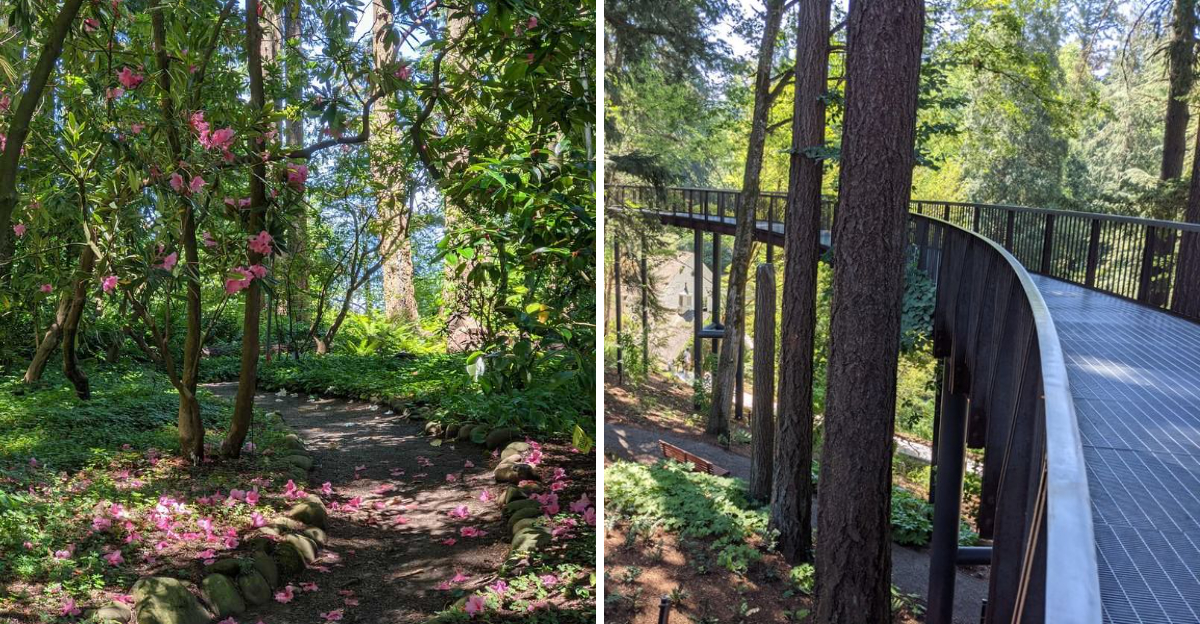
First impressions can be deceiving. Walk through the entrance here and you might think, well, this is nice, nothing more. That thought doesn’t survive very long.
Paths keep curving deeper, revealing sections most visitors never expect. A creek appears out of nowhere, then a canopy walk lifts you above the treetops entirely. Each turn feels like discovering a completely different garden, not just another corner of the same one.
Oregon has grander, more advertised gardens competing for attention, yet this one wins people over through patience instead of spectacle. Nothing gets revealed all at once.
Oregon locals often admit they underestimated it on their first visit, only to return specifically because they wanted to see what they’d missed. Some places show you everything immediately. This one makes you earn it, step by step.
A Modest Gate That Hides A Whole Hillside
The first thing that surprised me was how quiet the arrival feels. A small parking area, a gate, a friendly greeting, and that is about it. Nothing shouts for attention.
From there the ground begins to tilt. Paths curve past clipped beds and rock plantings in the Upper Garden, then slip toward the trees, and each bend reveals something the last one hid.
Visitors often say the place feels much bigger once they start walking, and that matches my experience. What looks like a tidy neighborhood garden opens into a wooded ravine holding more than two thousand plant species.
Give yourself permission to go slow here. Benches appear at useful moments, usually right where a view deserves a pause. Sound changes as you descend too. Traffic on SE 122nd fades, birds take over, and eventually water joins in from below.
Even on a bright weekend afternoon the layout spreads people out, so it rarely feels busy. That alone makes it worth the drive. Wear shoes with grip, because gravel and stone steps do most of the work of getting you around. Trail maps at the entrance help.
Up Among The Cedars On The Aerial Tree Walk
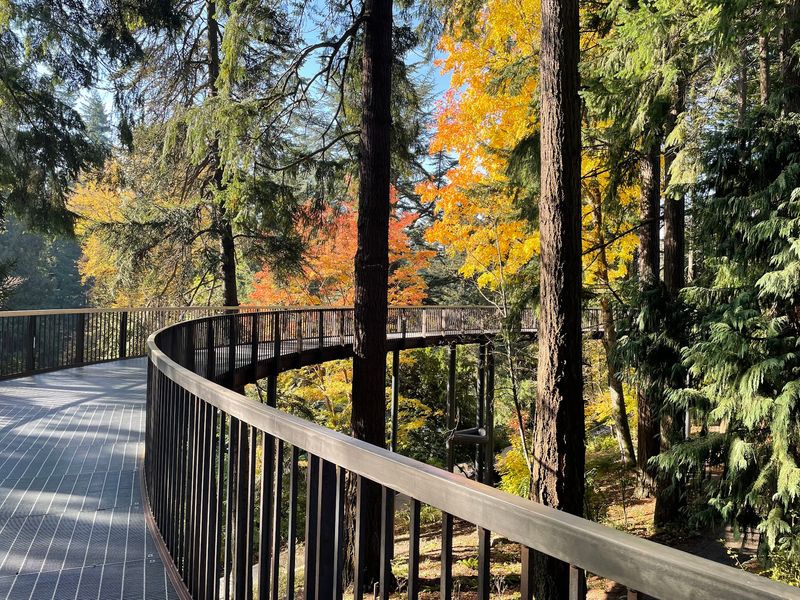
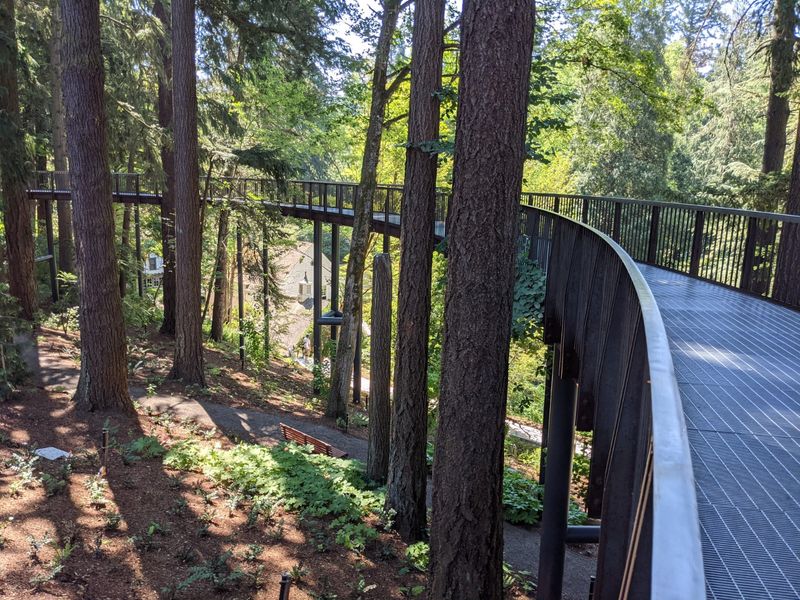
Halfway through the Upper Garden the path lifts off the ground. The Aerial Tree Walk is a steel walkway that curls out over the slope, carrying you into the canopy of towering western red cedars.
It is smooth, wide, and step free, which makes it one of the most accessible parts of the property. Wheelchairs and strollers roll through easily.
Up there, the perspective flips. Instead of looking up at branches, you look straight into them, close enough to notice moss patterns, cones, and the way light filters through needles in thin bright lines. The floor of the ravine drops away below, quietly reminding you how steep this hillside really is.
I lingered longer than planned, mostly because the whole thing sways slightly with your steps in a way that feels alive rather than alarming.
Photographers seem to love this section, and it is easy to see why. Framing a shot with a cedar trunk in the foreground and green depth behind it takes almost no effort. Bring a light jacket, since the shade up here stays cool even in July. Mornings are especially still among the branches.
The Leach Home And The Little Stone Cabin
Down near the bottom of the ravine sits the old Leach home, a 1930s house that reads more like a well loved cottage than a mansion. John and Lilla Leach built their life around plants, he as a pharmacist, she as a botanist who traveled rugged corners of Oregon collecting specimens.
Guided house tours run at set times during the day, and staff share stories about the couple and the collections they left behind.
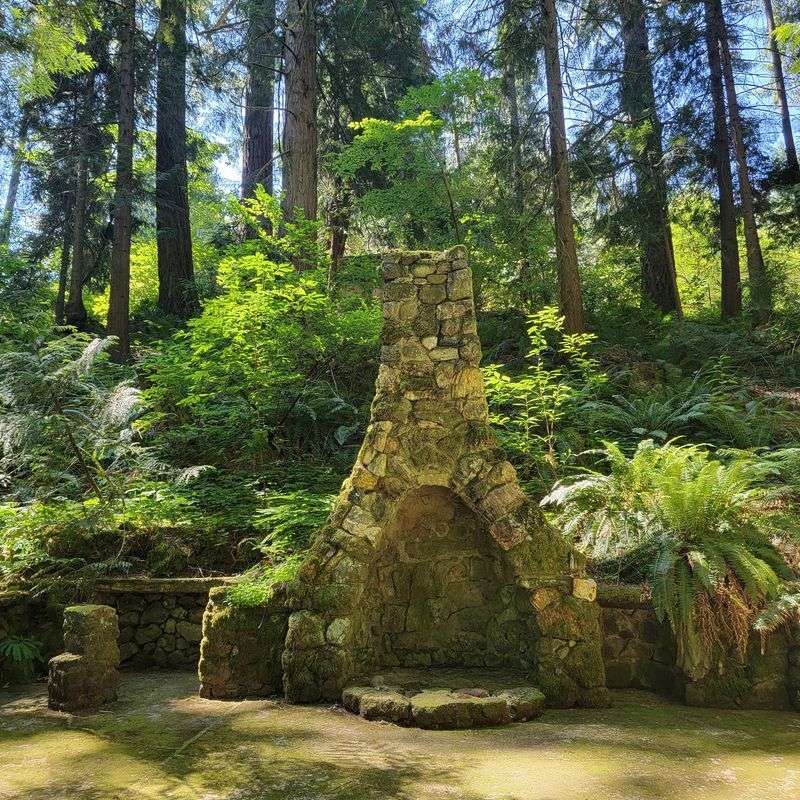
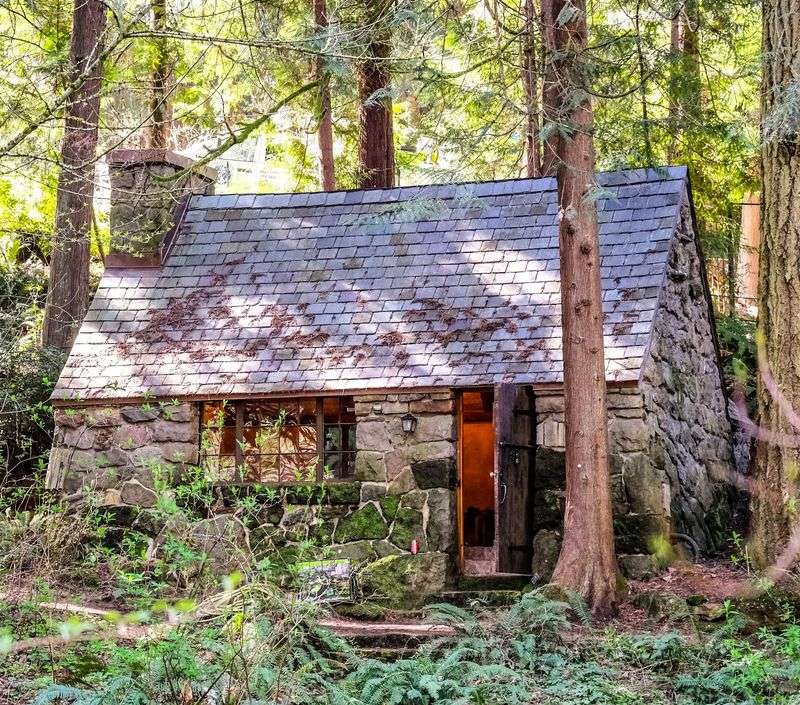
Nearby stands the small stone cabin the Leaches built themselves. The terrazzo floor inside is the detail worth crouching down for, a patterned surface that feels handmade in the best way.
Their generosity is part of the story too. The property became a public garden after it passed to the city in 1980, which is why anyone can wander through it today. A giant ginkgo grows near the house, wide and old and impossible to miss in autumn when its leaves turn gold.
Check tour times when you arrive, since the house is small and groups stay modest. The manor still anchors the whole lower garden.
Johnson Creek, Ferns, And A New Footbridge
Water is the sound that pulls you downhill. Johnson Creek runs along the base of the garden, shallow and clear over stones, with alders and ferns crowding the banks. A newer footbridge crosses to the south side, opening a stretch of path that earlier visitors never got to see.
From the middle of the bridge the creek looks like something out of a Coast Range hike, not a city garden minutes from a busy avenue. Kids gravitate straight to the railing. Hard to blame them.
Damp air near the water carries cedar and wet earth, that specific Northwest forest smell that sticks in your memory. Trilliums appear along these lower trails in spring, small white blooms that arrive before much of the garden wakes up.
Listen for the shift in pitch as the current runs over a shallow riffle, then flattens into a slow pool. Footing turns slick after rain, so take the stone steps slowly and use the handrails where they exist. Rain gear beats an umbrella here.
Sit a while if you can. A few benches face the water, and ten quiet minutes there resets a whole day.
Pollinators, Natives, And Plants You Can Take Home
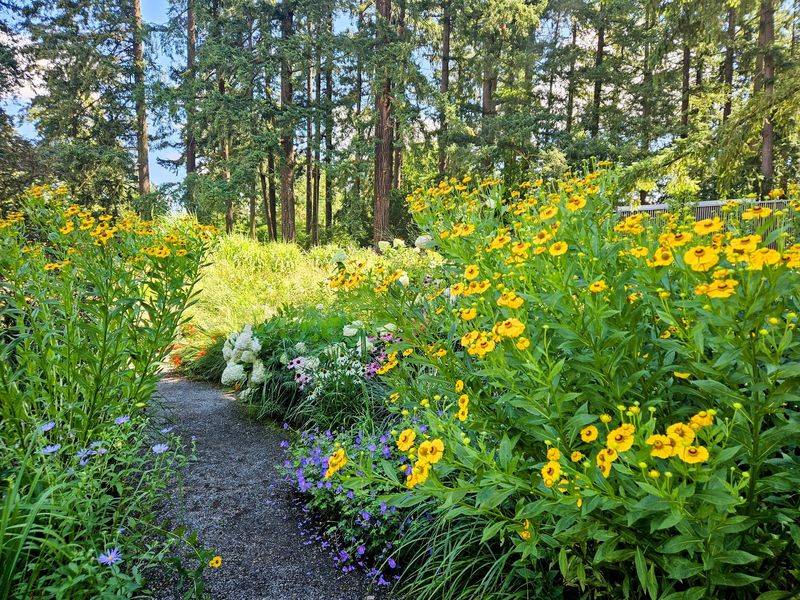
Bees do the talking in one particular corner. The pollinator garden hums through summer, planted thick with blooms that keep insects busy from opening until closing. Watching a bumblebee work its way across a patch of flowers is oddly satisfying, and free entertainment for anyone with patience.
Native plant collections spread through other sections, showing off species that belong in this region rather than ones shipped in for show. Oregon grape, salal, sword ferns, and camas all get their moment.
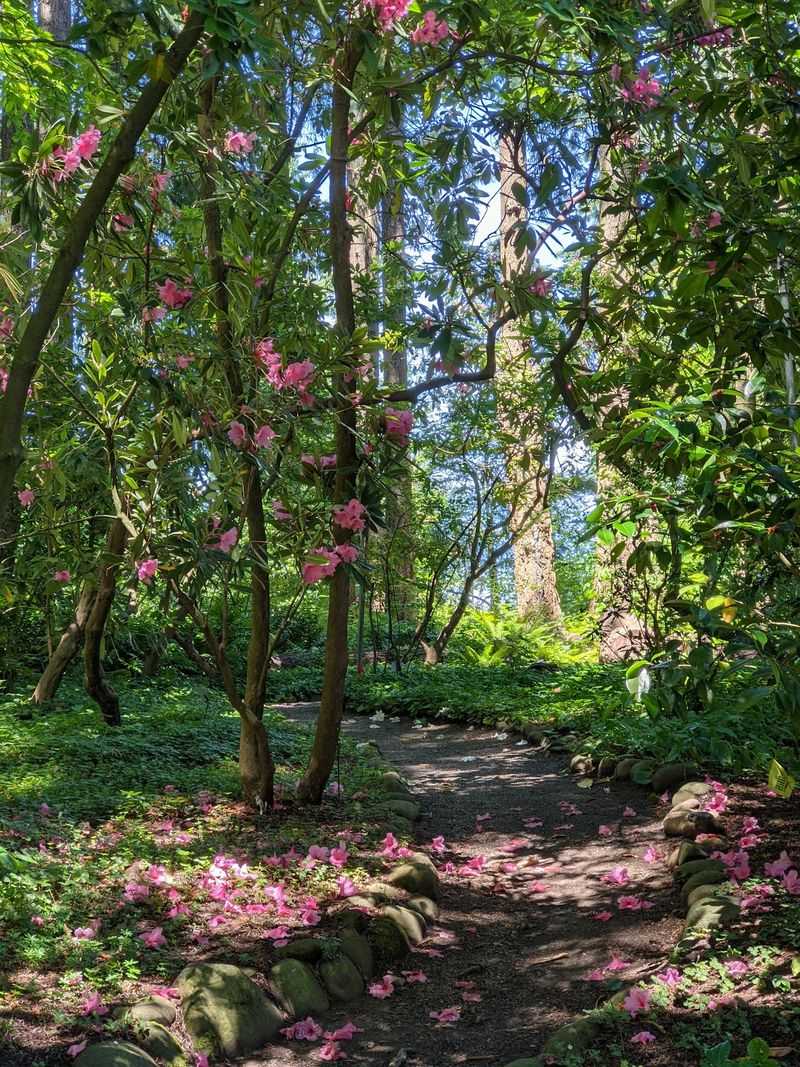
Labels help, and staff clearly know their plants, so questions are welcome. Ask what is peaking that week. Rhododendrons and heritage plantings from the Leach era still hold their ground, some of them decades older than the trails around them. Old roots, new signage.
A small nursery area sells native plants, handy if the visit leaves you itching to rework your own yard. Buying something you just admired growing on the hillside feels like a fitting souvenir. The gift shop on the lower level is compact and worth a peek.
Something blooms in every season here, so a February visit and an August visit look like two different places.
Small Explorers In The Children’s Garden
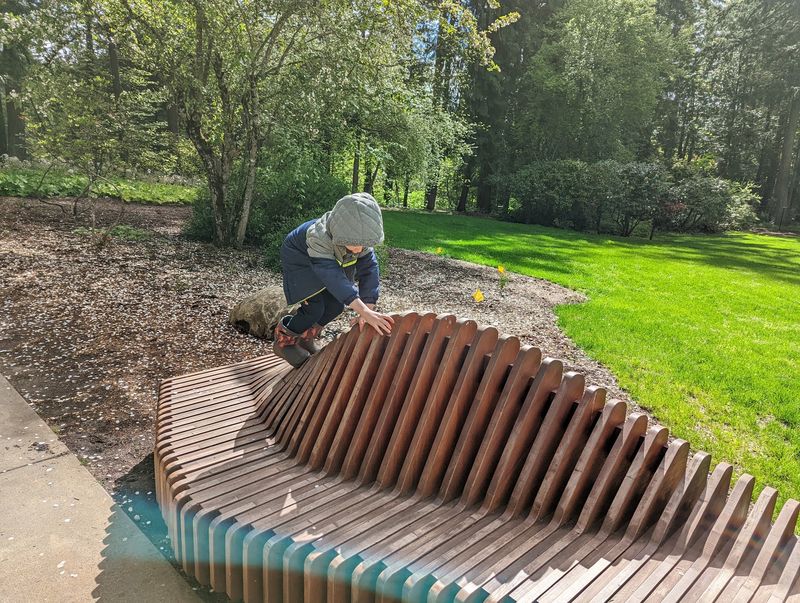
Families get a real advantage here, and it starts near the Claybourne entrance where a children’s garden gives small kids room to poke around. Nothing about it feels like a standard playground, which is the point. Discovery happens through stumps, plants, and paths built at kid height.
Guided toddler hikes hand out little backpacks stocked with exploration tools to borrow during the walk. Magnifying lenses turn a plain leaf into a whole event. The Upper Garden suits short legs since those paths stay gentle and looped.
Picnics fit naturally into a visit too, especially with a book and a shaded bench. Two hours disappears quickly. Parents managing strollers should know the lower trails include plenty of stone steps and steep pitches, so the Upper Garden and the Aerial Tree Walk are the smoother bet.
Staff leading the family programs stay patient with endless questions, which any parent will appreciate. Snacks still help. Older kids tend to head for the creek and the bridge, then argue about which route to take back up. Everyone leaves a little muddy.
Hours, Trails, And How To Plan The Visit
Timing matters more than at most gardens, mainly because the gates stay closed early in the week. Thursday through Sunday, ten in the morning until four in the afternoon, is the window. Weekday mornings feel the quietest, with mist still hanging in the ravine.
Plan on roughly ninety minutes to two hours for the full loop, which lands somewhere near a mile and a half once the trails link together. Shorter versions work fine when time is tight. A half hour in the Upper Garden still gives you the tree walk and a few good views.
Weddings and events take place here, so an occasional area may be reserved. A quick call clears up questions about tour times or trail closures. Memberships and donations support daily upkeep, and the garden has leaned on community help through recent funding cuts.
Parking is limited but usually manageable outside peak weekend hours. Restrooms sit near the lower entrance. Layers beat a single heavy coat.
The garden waits at 6704 SE 122nd Ave, Portland, OR 97236, United States, an address that gives away nothing about the ravine hiding behind it.
