Someone once decided the world needed a better place to live and tried to build it here.
That experiment eventually left behind one of Indiana’s most unusual historic communities, where quiet streets, preserved buildings, gardens, and old homes now create an atmosphere that feels almost too picturesque to be real.
The European-looking charm is only half the story. Beneath those peaceful surroundings is a fascinating history of people who arrived with ambitious ideas about creating an ideal society.
Today, you can wander through the same community and see what remains of that extraordinary experiment, making the whole place feel like a history lesson disguised as a storybook village.
Two Utopian Dreams Layered On One Small Town
History here is not tucked away behind glass. It is the street you are walking on, the doorway you duck through, the orchard row you pass on the way to lunch.
New Harmony started in 1814 when the Harmony Society, a group of German Lutheran separatists led by George Rapp, moved into the Indiana Territory looking for a place to build a perfect Christian community.
They worked hard and shared everything, raising more than 180 log, frame, and brick buildings while producing goods that traded far beyond the river.
Then in 1825 they sold the entire town to Robert Owen, a Welsh social reformer with a completely different idea. Owen wanted a community built on science, education, and equality, and his experiment pulled in scholars and researchers from around the world.
That second wave left a mark on American schooling, on early geology, and on the women’s suffrage movement, which still surprises me for a village this size.
Walk the same block and you can feel both dreams pressing against each other. One quiet and devotional, one restless and experimental.
The whole district is on the National Register of Historic Places and carries National Historic Landmark status, but it is not a frozen museum. Real people live here, mow their lawns here, and wave when you pass.
Give yourself time. The story rewards slow feet.
The Atheneum, A Gleaming White Landmark You Do Not Expect
My first reaction was a laugh, honestly. A bright white modernist building sitting on a green lawn in rural Posey County is the last thing you picture when someone says Indiana history.
The Atheneum opened in 1979 and was designed by Richard Meier, who later won the Pritzker Prize. It picked up a Progressive Architecture Award in 1979 and an American Institute of Architects Honor Award in 1982, and once you see the ramps spiraling up through all that light, you understand why.
Inside, exhibits and a short film lay out who the Harmonists were and what Robert Owen tried to do next. That context matters more than you think, because without it the rest of the town reads like scattered puzzle pieces.
Climb to the upper level and step outside onto the deck. From there the fields, the treeline, and the roofs of the old village spread out below, and the whole layout suddenly makes sense.
It also functions as the practical starting point. Guided walking tours generally begin here, restrooms are easy to find, and staff can point you toward whatever you are most curious about.
I would start your visit at this building even if you are not an architecture person. It sets the mood, orients you geographically, and gives the rest of the day a shape.
Address: 401 N. Arthur Street, New Harmony, IN 47631
A Church With No Roof And Gates That Shine
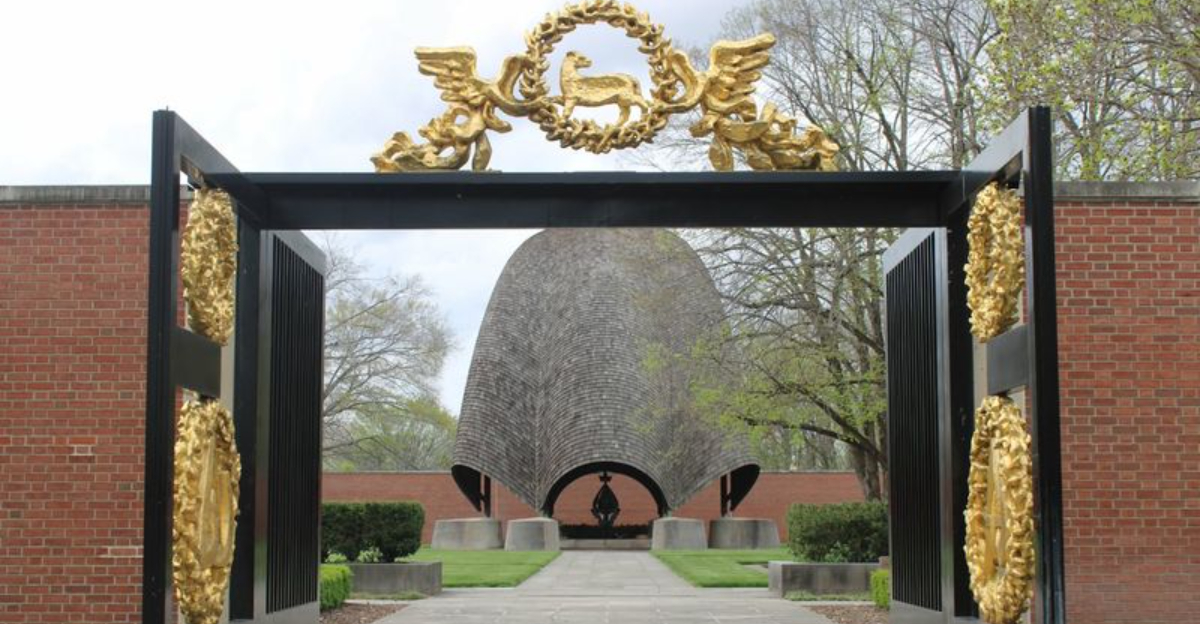
Sunlight, birds, and a breeze doing whatever it wants. That is the ceiling here.
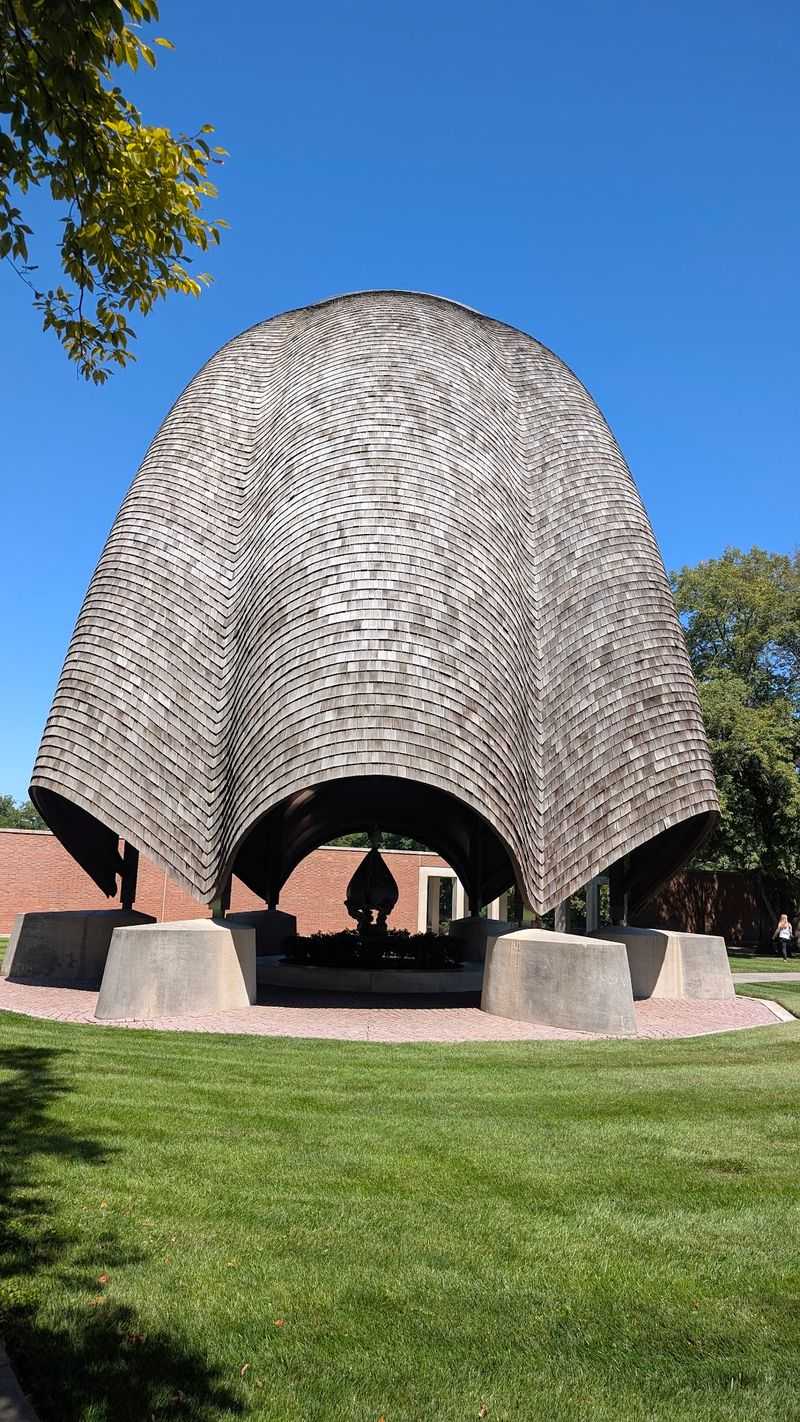
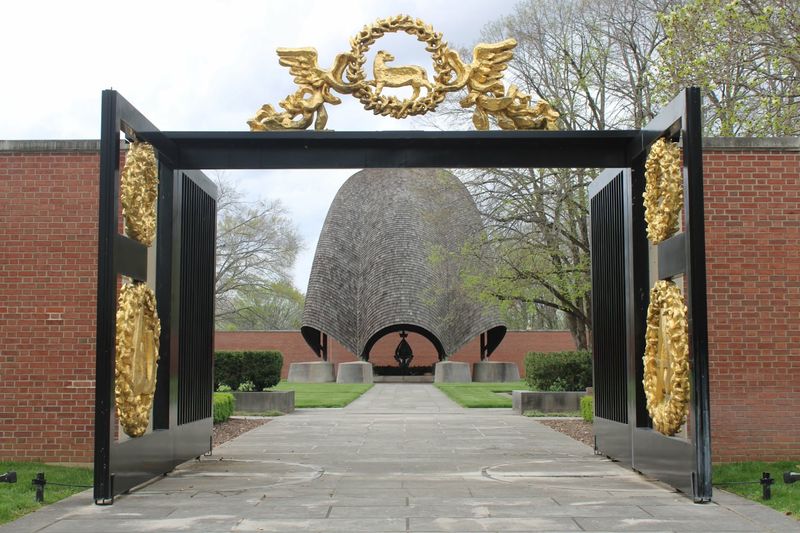
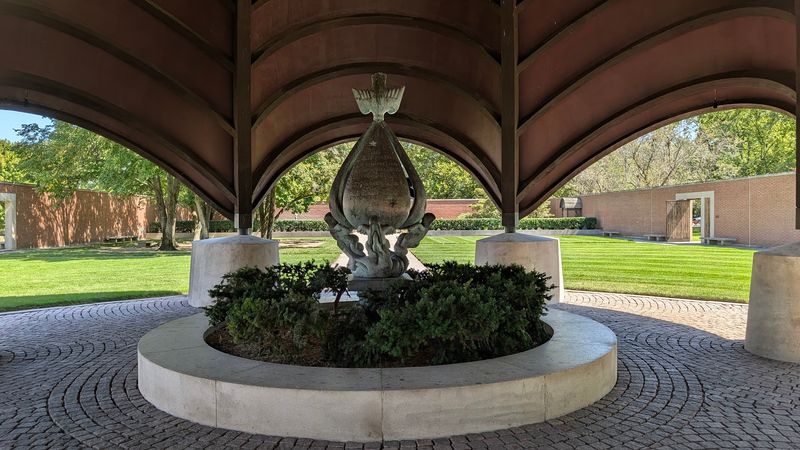
The Roofless Church was commissioned in 1957 and designed by architect Philip Johnson as an open-air, interdenominational sanctuary. Tall walls, roughly twelve feet high, wrap the space, and dramatic gilded gates mark the entrance.
The idea behind it is simple and kind of beautiful: only the sky is big enough to be the roof over a place where everyone is welcome. Inside the walls sits a shaped shrine sheltering a sculpture by Jacques Lipchitz.
I sat on a bench near the edge for longer than I planned. Shadows kept shifting across the paving, and the noise level dropped to almost nothing.
It is one of those spaces where people naturally lower their voices without being told to. Kids seem to sense it too, which I found sort of remarkable.
Photographers will love the contrast between the warm brick, the gold, and whatever the sky is doing that day. Cloudy afternoons actually work in your favor here.
Practical note from experience: the ground is stone and brick, so comfortable shoes help, and there is very little shade in the middle of the day. Morning light is softer and cooler.
Of everything I saw in New Harmony, this is the image that stuck with me on the drive home.
Walking The Labyrinths, Slowly And On Purpose
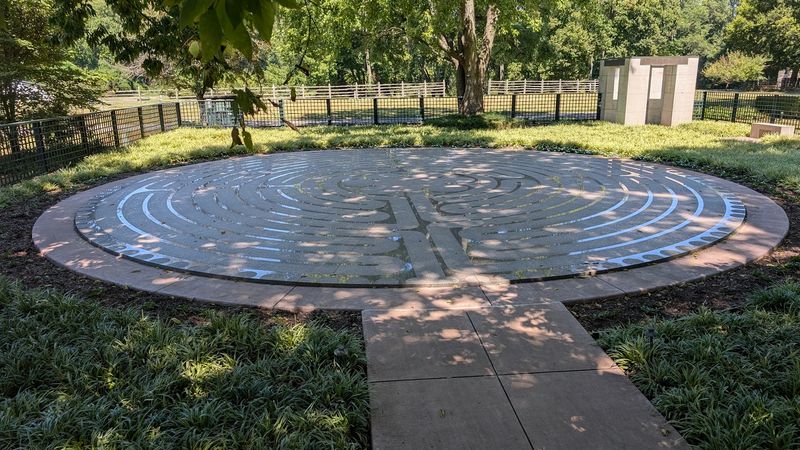
Nobody hands you instructions, which felt oddly freeing. You just step onto the path and follow it.
New Harmony has more than one labyrinth, and they are not mazes trying to trick you. Each one is a single winding route in and back out again, meant for thinking rather than problem solving.
The Harmonist Labyrinth traces back to the Rappites in the early 1800s, who used it as a symbol of the twisting choices in life and the reward waiting at the center. It was carefully restored in 2008 to reflect its original form, and a small stone temple sits at its heart.
You will find it along Main Street, framed by hedges that hide the turns until you reach them.
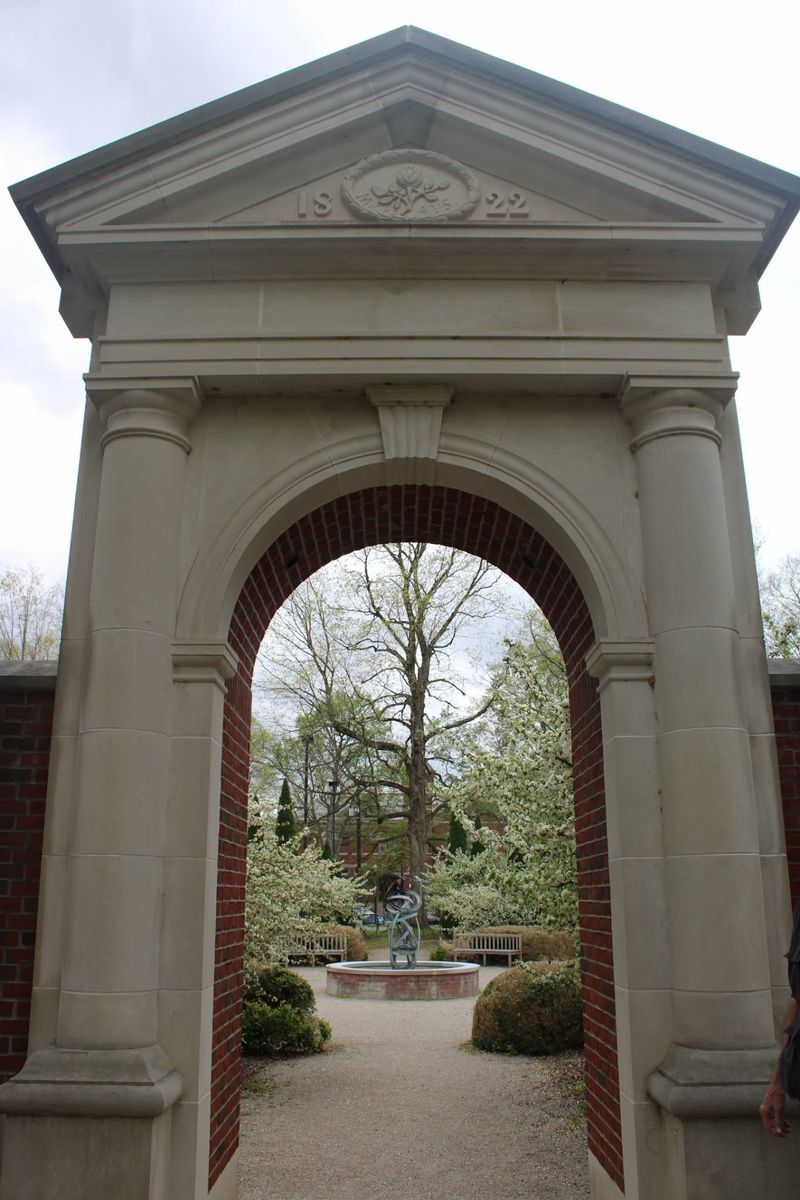
A short stroll away, the Cathedral Labyrinth copies the famous 12th-century pattern from Chartres Cathedral in France. It is laid in carnelian granite and set inside a quiet sacred garden with a fountain nearby.
My honest advice is to walk one without your phone out. The pattern only really works if you let your brain wander with your feet.
Ten or fifteen minutes is plenty for a full circuit. Wear flat shoes, since the granite can be slick after rain, and take a minute on a garden bench afterward before you rush off to the next stop.
Sculpture Around Every Corner
I kept stopping mid-sentence to look at things. That is the effect of a town that treats its sidewalks like gallery space.
Sculpture shows up in parks, along paths, and in corners you would otherwise walk right past. Works by internationally known names sit alongside pieces by American artists including Stephen De Staebler, Mark Mennin, William Schickel, Ralph Beyer, and Don Gummer.
In Church Park, Gummer’s Fountain of Commitment weaves in the golden rose emblem the Harmonists used, which ties a modern piece straight back to 1814. Small detail, big payoff once you know what you are looking at.
My favorite spot ended up being Paul Tillich Park, designed by Zion and Breen, the firm behind the sculpture garden at New York’s Museum of Modern Art.
Large granite stones lie among the trees, carved with passages from the writings of German-American theologian Paul Tillich, lettered by Ralph Beyer.
A bronze bust of Tillich by James Rosati anchors the space. I sat on the grass and read the stones one by one, which is not something I normally do in a park.
Bring a water bottle and plan on wandering without a route. The art is spread out enough that hunting for it becomes the activity.
Little tip: check the ground and the walls, not just eye level. Some pieces are easy to miss.
Gardens, Orchards, And The Wabash River Beyond
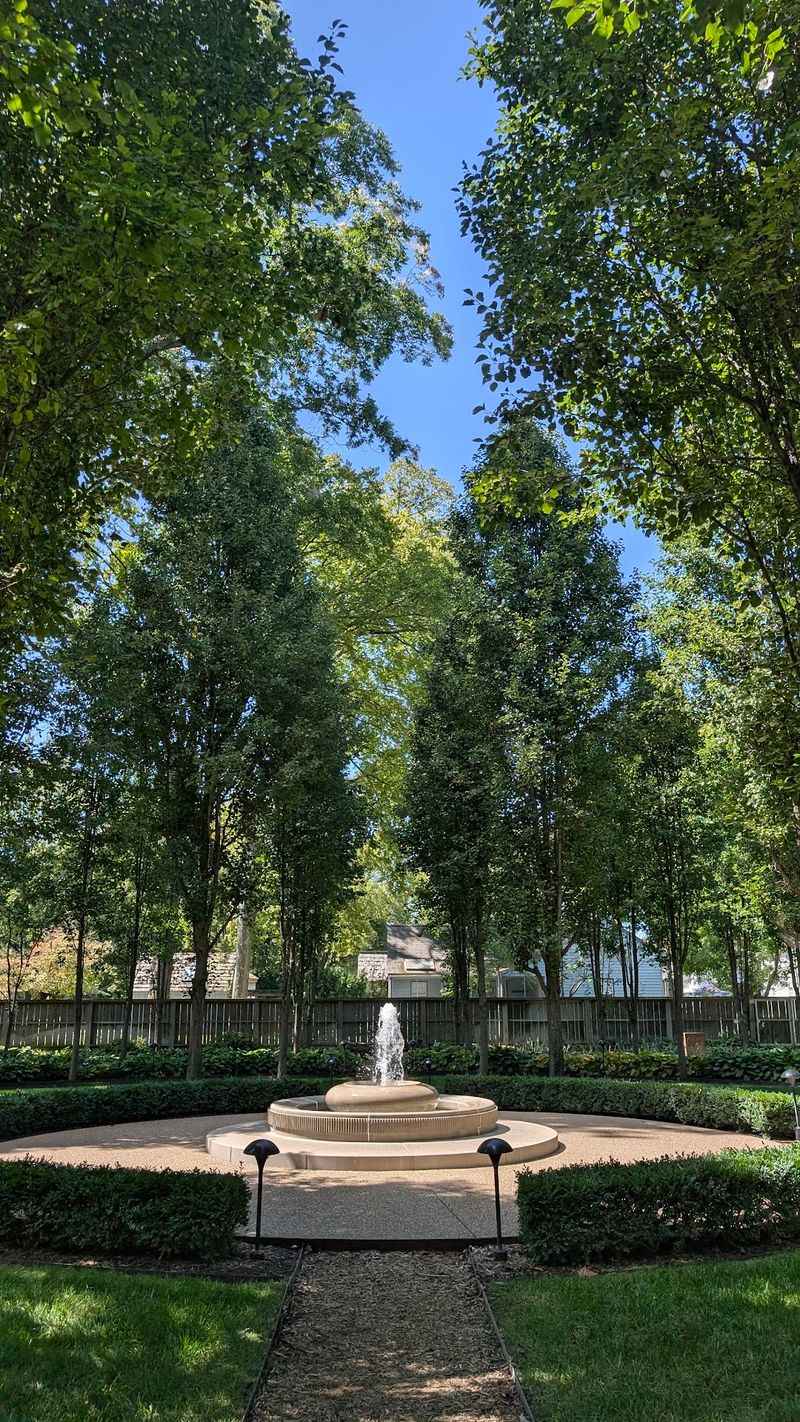
Green space is the connective tissue of this town. You leave one historic building, cut through a garden, and arrive somewhere else entirely.
Carol’s Garden became my unplanned rest stop, a memorial space with a soft-running fountain ringed by pear trees. It is small, shaded, and genuinely peaceful.
The Lenz House Garden and the Harmonist Orchard give you a look at how the early settlers grew food and organized their plantings. Standing among fruit trees planted in that tradition makes the whole self-sufficient community idea feel real rather than theoretical.
Near the Cathedral Labyrinth, a trimmed sacred garden gives you somewhere to land after your walk. Murphy Park, now more than a century old, adds another patch of shade and a bit of local history.
Just outside the village, Harmonie State Park opens up rolling hills, wooded trails, and overlooks toward the Wabash River. If you want actual hiking rather than strolling, that is where to go.
The JBO Sanctuary grounds also feature gardens, fountains, and unusual purpose-built structures, with many areas open for self-paced visits.
Spring blossoms and October color are the two windows I would aim for. Bug spray helps near the river in summer, and a light jacket is smart in fall, since the shade holds the chill longer than you expect.
Guided Tours, An Old Library, And A Golf Cart Pace Of Life
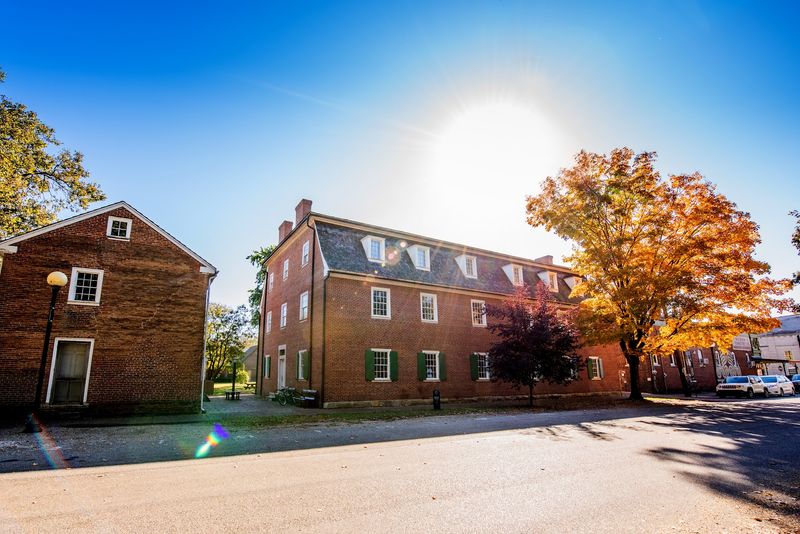
Take the guided tour. I almost skipped it and I am glad I did not.
Historic New Harmony runs walking tours that usually set out from the Atheneum and lead through a set of restored historic buildings scattered across the village. Ours ran around ninety minutes, and the guide filled in details I never would have picked up from signs alone.
The Workingmen’s Institute, founded in 1838, is Indiana’s oldest continuously operating library, museum, and archive. Nearly two centuries of readers have passed through that door, which is a strange and wonderful thing to think about while standing on the sidewalk outside.
Certain times of year bring the place further to life. Heritage Artisans Week has demonstrators showing early trades like shoemaking and candle dipping, and A Walk into the Past each October puts costumed interpreters inside the historic sites.
The restored 1924 Ribeyre Gymnasium now works as a community center, so the town keeps evolving instead of just preserving.
What I remember most is the rhythm. Plenty of residents get around by golf cart, and nothing feels rushed.
Plan for Wednesday through Sunday, since the historic site is closed Monday and Tuesday. Hours run 10 AM to 5 PM.
Address: 410 Main St, New Harmony, IN 47631
