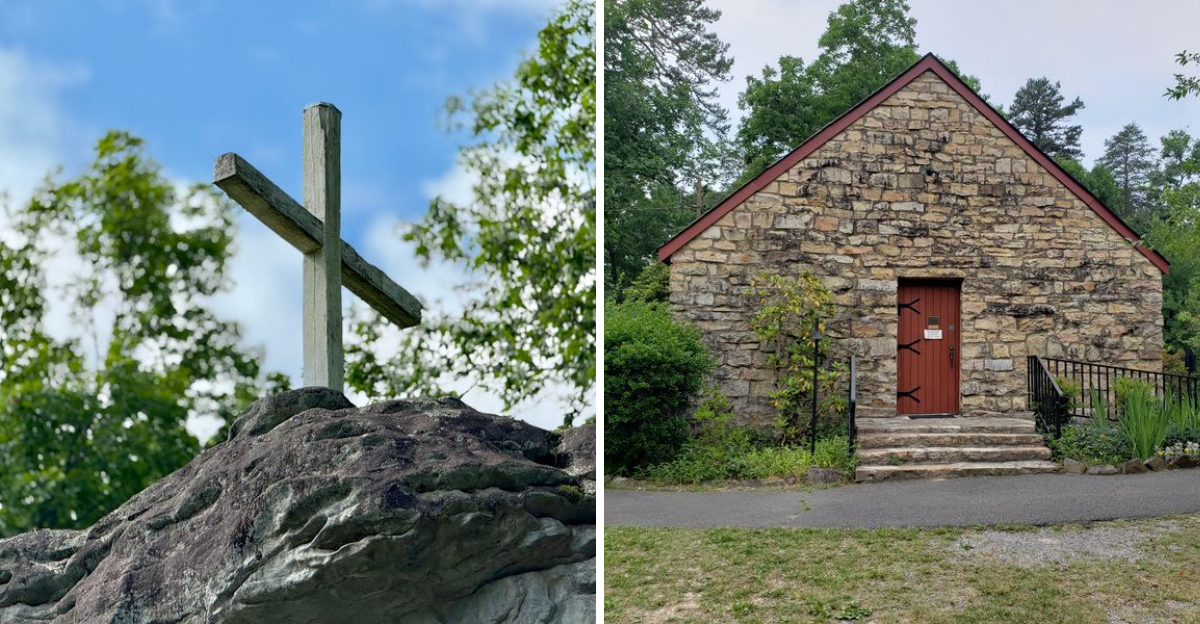
The wall has a boulder going through it. Not beside it.
Not behind it. Through it.
That is the sort of thing that makes a driver hit the brakes, back up, and wonder whether the first look was somehow misleading.
But the enormous sandstone rock is exactly where it appears, pushing into this Alabama chapel and sitting beside the pulpit as though the building was simply constructed around it.
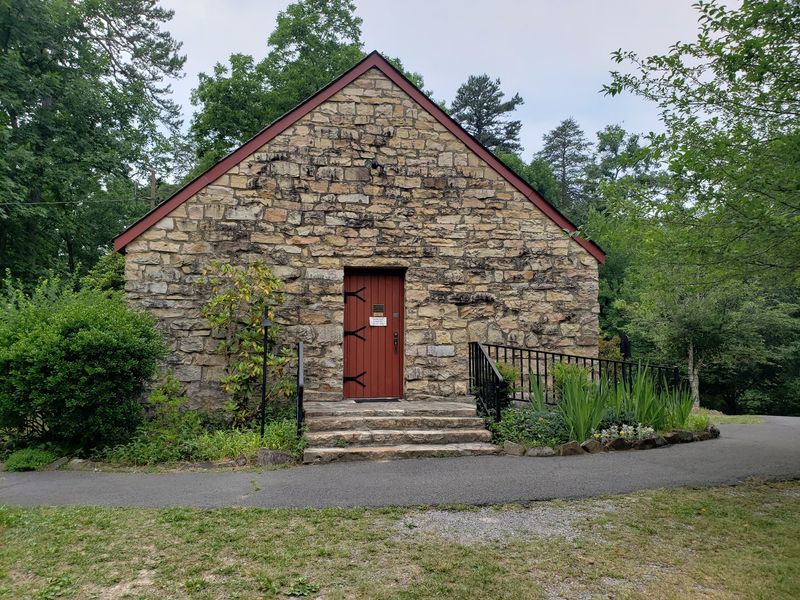
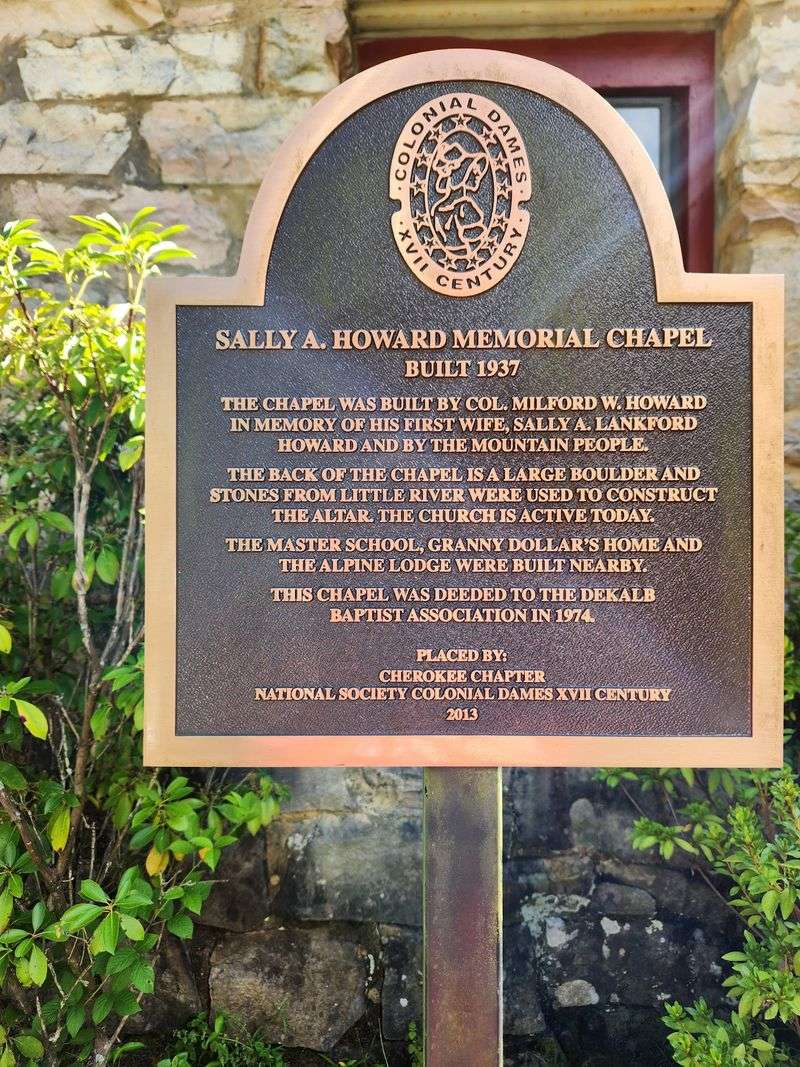
That was the plan. The chapel was built in 1937 as a memorial to the builder’s wife, with the boulder deliberately left in place rather than removed.
Inside, wooden pews, river stones, and a line from a handwritten letter make the little sanctuary feel remarkably intimate. The strangest part is that the rock is not an accident.
It is the centerpiece.
A Boulder That Refused To Move
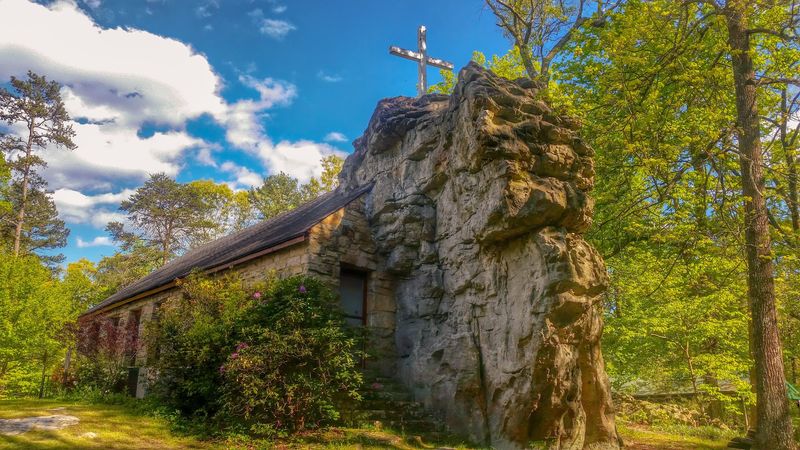
The first thing that grabs attention is the sheer nerve of it. A sandstone boulder, enormous and unbothered, makes up most of the chapel’s rear wall and then keeps going, pushing indoors until it looms behind the pulpit area.
Nobody drilled it. Nobody trimmed it down to a polite size.
Colonel Milford Wriarson Howard, a self-taught lawyer, former U.S. Representative, and author, decided in 1937 that the rock would stay exactly where nature left it.
Walls of local stone were fitted snugly around its rough edges, so the seams between building and mountain blur together in a way modern construction rarely allows.
Visitors tend to reach out and touch the surface, half expecting it to feel like drywall. It feels like a mountain, because it is one.
Light from the small windows falls across the boulder’s ridges at different angles through the day, and the texture shifts from gray to warm tan depending on the hour. Photographers who show up in late afternoon often get the best contrast between the pale stone and the dark wood pews.
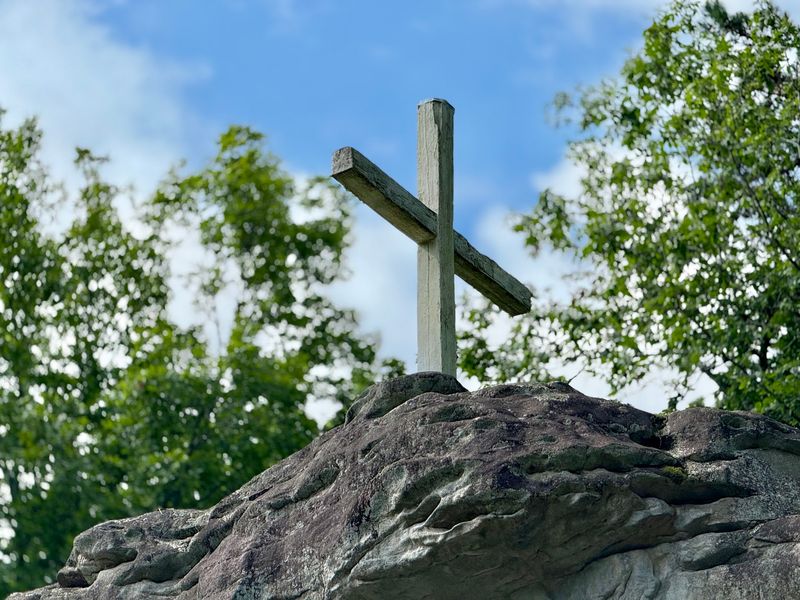
A cross stands on top of the boulder outside, visible from the road before the chapel itself comes into view. The pulpit sitting at the base of all that rock was built from stones gathered out of the nearby Little River, which ties the building to the landscape twice over.
The Love Story Carved Into The Beams
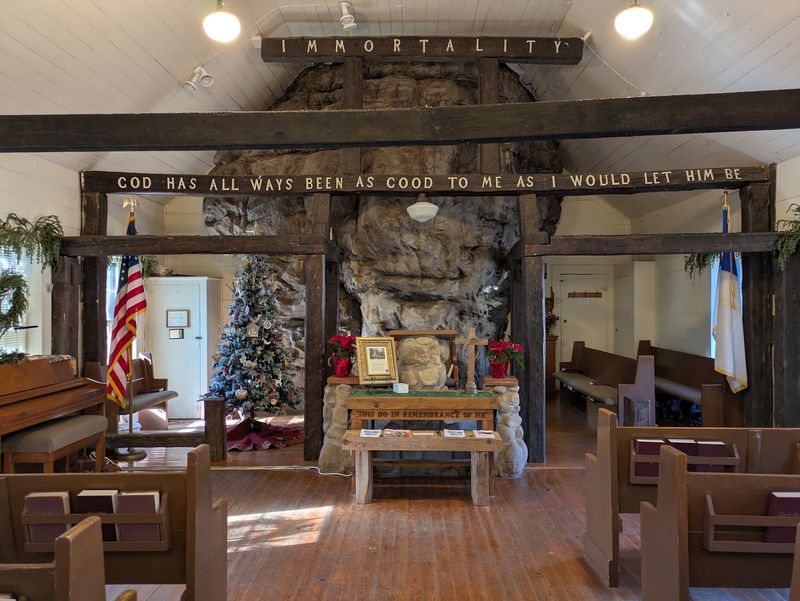
Look up once seated and the story changes from architectural oddity to something far more tender. An interior beam above the pulpit carries the words, God has always been as good to me as I would let him.
Those words came from the last letter Sallie A. Lankford Howard wrote to her husband before she died in California in 1925.
Colonel Howard kept them, then had them carved where every future congregation would read them.
On an upper beam sits a single word, Immortality, chosen by Howard himself. Two short inscriptions, decades of meaning packed into them.
Construction of the rustic chapel began in 1937, and it was dedicated on June 27 of that same year, a remarkably quick build for a stone structure wrapped around a mountain. Grief clearly moved fast.
Knowing the backstory reshapes the whole visit. What looks like a quirky roadside curiosity turns out to be one man’s answer to losing the person he loved most, expressed in rock rather than words on paper.
Take a few minutes to sit quietly before reading the beams, then read them again afterward. The second pass usually lands harder.
Details like these are easy to miss in a rushed stop, so plan for at least twenty unhurried minutes inside the building.
Colonel Howard’s Final Resting Place Inside The Rock
Here is the detail that stops conversations mid-sentence. After Colonel Howard died on December 28, 1937, just months after the chapel’s dedication, his cremated remains were interred inside that same boulder.
His final wish, granted exactly as asked.
Born in 1862, Howard lived a full and unusual life as a lawyer, congressman, and writer before turning his attention to Lookout Mountain and a memorial for his first wife. The chapel became both her tribute and his tomb, which gives the building a weight no plaque could match.
The cross planted on the boulder above marks the spot for anyone standing in the parking area. Simple, small, easy to overlook until the meaning clicks.
Local mountain residents helped build the chapel, along with workers from the Civilian Conservation Corps, so the labor came from the community that still uses the space today. That shared effort shows in the slightly irregular stonework, where hands rather than machines clearly did the fitting.
Guests often circle the exterior after seeing the interior, tracing where the boulder disappears into the wall. The transition is seamless enough that first-timers sometimes need a second look to figure out what is rock and what is masonry.
Bring a curious kid along. Explaining this one takes a while.
Still An Active Church, Not A Museum Piece
Plenty of historic oddities end up behind velvet ropes. Not this one.
The Sallie Howard Memorial Chapel operates as an active Baptist church with regular Sunday services, which means the pews get used weekly rather than admired from a distance. Hymnals sit where people left them.
In 1974 the chapel became a mission of the DeKalb Baptist Association, and the congregation has grown since then. It supports itself financially and gives generously to mission work, a lot of activity for a building this small.
Being a working church shapes how a visit should go. The doors are generally open to the public and travelers are welcomed warmly, but showing up quietly and respectfully matters, especially on Sunday mornings when worship is underway.
Weekday afternoons tend to be the calmest window for anyone hoping to sit alone with the boulder and the beams. Midweek light through the windows is lovely too.
That living, ongoing use is part of the appeal. The chapel is not preserved as a relic of 1937, it simply kept doing the job it was built for, decade after decade, while the mountain behind it stayed put.
Anyone attending a service will find a congregation used to visitors from far outside DeKalb County. Curiosity about the rock is basically expected at this point.
Where Little River Stones Became A Pulpit
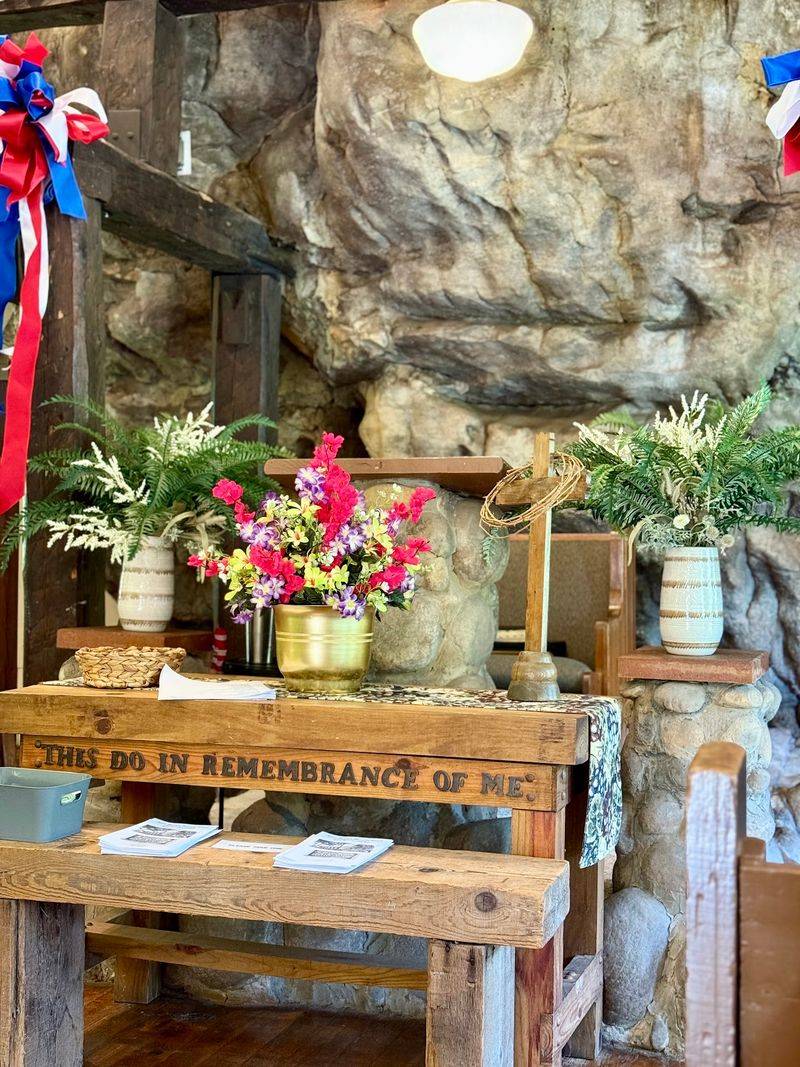
Small details reward slow lookers, and the pulpit is the best example. Rather than ordering finished lumber or cut stone, the builders gathered rocks from the nearby Little River and stacked them into the pulpit that still stands today.
Water-smoothed, rounded, mismatched in color. Perfect.
Set against the rough sandstone boulder behind it, the contrast between river-polished stone and raw mountain rock becomes obvious once noticed. Two different geological stories sharing one small room.
Little River runs nearby through one of the more dramatic canyon landscapes in the eastern United States, so the pulpit essentially brings a piece of that waterway indoors. Anyone planning a full day in the area can visit the river itself and recognize the same stones underfoot.
Wooden pews fill the space in front, worn smooth in places from decades of use. The whole interior stays refreshingly plain, with no stained glass or ornate carving competing for attention.
Simplicity is the point. Every material came from within a short distance of the chapel, gathered by people who lived on this mountain.
Photographers should watch for the moment when sunlight catches the pulpit stones and reveals their color variation. Grays turn to soft browns and faint reds, a quiet payoff for anyone patient enough to wait a few minutes.
Picnic Tables, A Walking Trail, And Room To Breathe
Something about the grounds encourages lingering longer than planned. Picnic tables sit under the trees, and a walking trail winds through the surrounding woods, giving visitors a reason to stay past the initial wow moment inside.
Pack a lunch. Seriously, pack one.
Lookout Mountain scenery does the heavy lifting here, with sandstone outcrops, hardwoods, and that particular quiet that settles over northeast Alabama on a weekday. Birdsong carries.
Traffic does not.
The chapel sits at the intersection of County Road 165 and County Road 617, just outside DeSoto State Park, with a Mentone, AL 35984 post office address. That location makes it an easy add-on to a day of hiking, waterfall chasing, or slow country driving.
Spring brings wildflowers along the trail, while fall turns the whole ridge into a color show worth timing a trip around. Summer shade keeps the picnic area comfortable even in July.
Families with restless children benefit most from the outdoor space. Little ones can burn energy on the trail after the hushed indoor portion of the visit.
Bring water, sturdy shoes, and a camera. The combination of stone chapel, giant boulder, and mountain woods gives photographers plenty to work with from almost any angle on the property.
A Wedding Venue Built By Devotion

Couples searching for a ceremony spot with actual meaning keep finding their way to this address. The chapel’s unusual architecture makes it a popular choice for weddings, and the origin story adds a layer most venues cannot manufacture.
A building raised as a memorial to a marriage. Hard to beat that symbolism.
Space inside is intimate rather than sprawling, which suits small guest lists and keeps the focus on the boulder rising behind the couple. No decorator could invent a backdrop like it.
The inscription about goodness and grace sits overhead during vows, and the word Immortality waits a little higher up. Guests reading those beams mid-ceremony tend to get quiet.
Anyone considering the chapel for a ceremony should contact the church directly, since it remains an active congregation with a regular Sunday schedule to work around. Planning ahead is essential.
Even without a wedding on the calendar, the chapel works as a conversation piece for road trippers. First-time visitors routinely react with astonishment when the boulder comes into view, and that reaction has not worn off in nearly ninety years.
Stop, look up, look around, and let the story sink in. Alabama holds a lot of hidden corners, and few of them combine geology, history, and heartfelt devotion quite this neatly.
