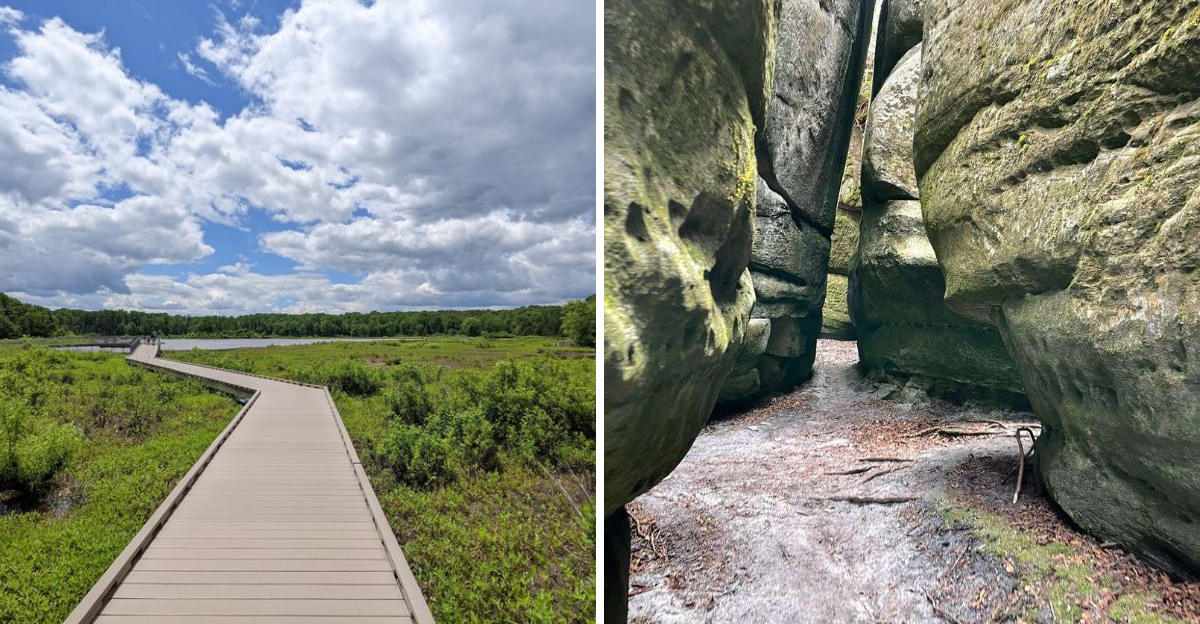
Some trails feel like they have been walked too many times. The wildlife has retreated, the birds are quieter, and the sense of discovery is diminished.
But these Virginia hiking trails are different. They are places where the wildlife still feels untouched, where you can walk for miles without seeing another person and the animals seem less wary.
I have made it to most of them, and each time I have been reminded that there are still wild corners of the state. Some are in remote state parks, others in national forests, a few in preserves that limit the number of visitors.
The trails are not always easy, but the reward is a sense of solitude that is increasingly rare. Virginia has plenty of popular hikes, but these are for people who want to feel like they are truly in the wild.
1. Sand Ridge Trail at False Cape State Park
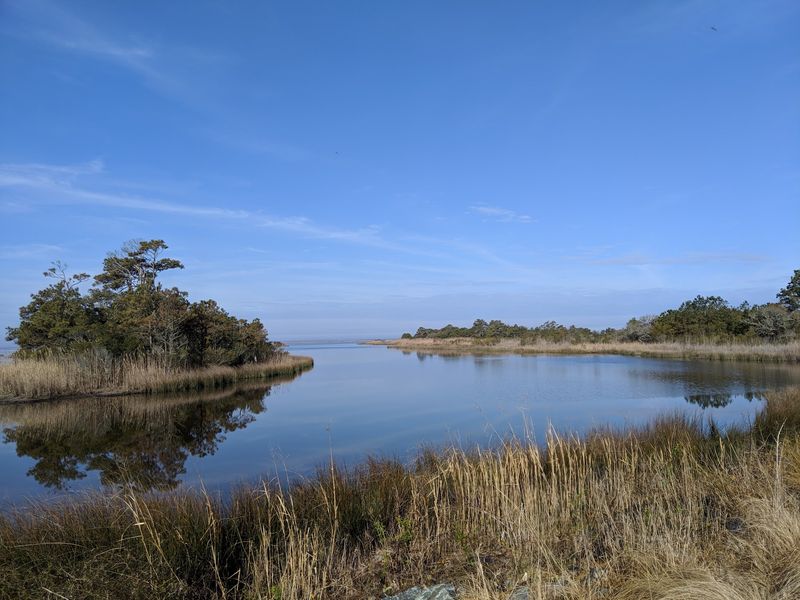
Getting to False Cape State Park is half the adventure, and honestly, that’s exactly why it still feels so magnificently wild. Tucked between Back Bay and the Atlantic Ocean on a narrow barrier spit, this place requires genuine effort to reach, whether by foot, bicycle, or seasonal tram.
That effort pays off the moment you step onto the Sand Ridge Trail and realize the only sounds around you are wind, waves, and birdsong.
Over 300 bird species call this coastal haven home throughout the year. Bald eagles drift overhead with casual authority, shorebirds dart along the waterline, and during migration seasons, swans, herons, and ibises add a theatrical flair to the scenery.
Otters, white-tailed deer, red foxes, and even wild horses have all been spotted here, making every bend in the trail feel like a potential wildlife lottery win.
The landscape itself shifts dramatically as you walk, moving through windswept dunes, salt marshes, maritime woodlands, and shadowy wooded swamps. Primitive campsites let you stay overnight and wake up to a sunrise that belongs entirely to you and the pelicans.
No vehicle traffic ever disturbs this sanctuary, which preserves that electric sense of true isolation.
To start your journey, head to the Back Bay National Wildlife Refuge Visitor Center at 4005 Sandpiper Road, Virginia Beach, VA 23456, where the tram departs seasonally. Alternatively, dedicated hikers can launch from Little Island Park in Sandbridge.
Either way, False Cape delivers a coastal wilderness experience that feels completely, gloriously untouched.
2. Wildlife Loop at Chincoteague National Wildlife Refuge
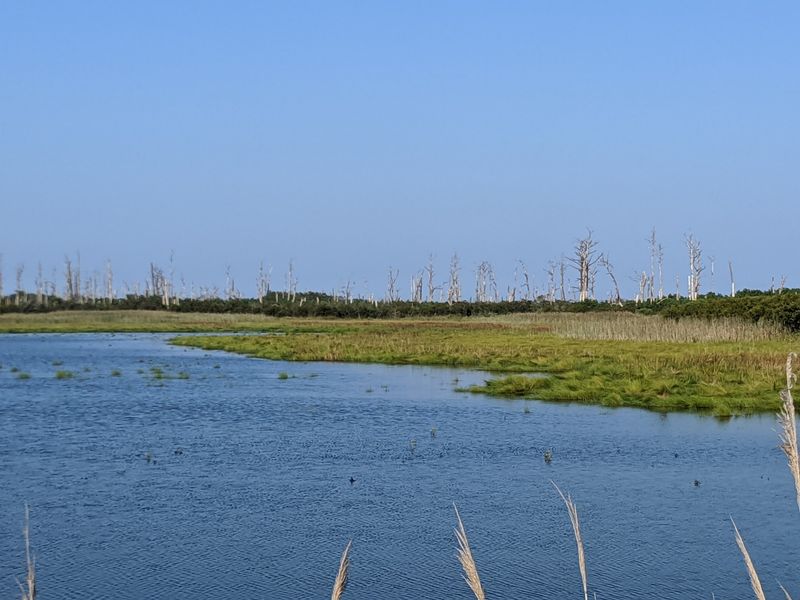
Few wildlife experiences on the East Coast carry the same legendary status as spotting the Chincoteague ponies roaming free across Assateague Island. These compact, shaggy horses have lived here for centuries, and watching them graze against a backdrop of open marsh and sea sky feels genuinely cinematic.
The Wildlife Loop at Chincoteague National Wildlife Refuge puts you right in the middle of that living postcard.
Beyond the ponies, this refuge is an absolute paradise for bird enthusiasts, with over 320 species documented here across the seasons. Fall and winter bring sweeping flocks of geese, ducks, and swans in numbers that will make your jaw drop.
Spring delivers one of nature’s most dramatic spectacles, as spawning horseshoe crabs attract massive concentrations of migrating shorebirds like Ruddy Turnstones and Red Knots along the shoreline.
Threatened and endangered species add another layer of ecological significance to this place. The Piping Plover nests here, the elusive Delmarva fox squirrel forages through the forest, and Atlantic loggerhead sea turtles have been known to visit the surrounding waters.
Sika deer, red foxes, muskrats, raccoons, and otters round out a remarkably diverse cast of permanent residents.
Vehicles can access the Wildlife Loop daily from 3 p.m. until dusk, making it wonderfully accessible for a relaxed evening drive. Pets are not permitted within the refuge, ensuring the animals remain calm and approachable.
Plan your visit at Chincoteague National Wildlife Refuge, located at 8231 Beach Rd, Chincoteague Island, VA 23336, and prepare to be completely enchanted.
3. Bay View Trail at Mason Neck State Park
Mason Neck State Park holds a special distinction that most parks can only dream about. Established specifically to protect the habitat of the American bald eagle, this peninsula park along the Potomac River has become one of the most reliable spots in the mid-Atlantic region to witness these magnificent birds in their natural element.
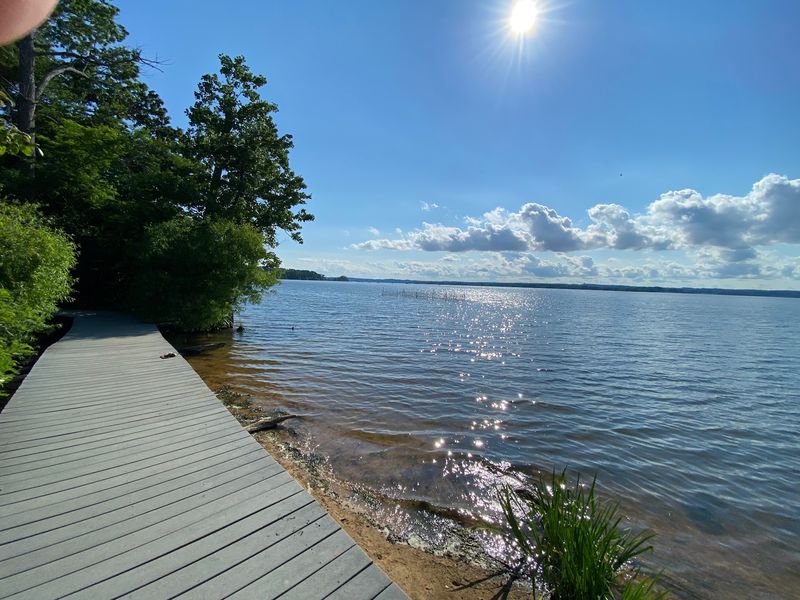
The Bay View Trail puts you right at the heart of that experience.
A charming boardwalk extends over vital marshlands, leading eventually to a peaceful beach area where the river opens up before you. Great blue herons stand in their classic, motionless fishing poses along the water’s edge, while ospreys perform their spectacular dive-bombing fishing technique overhead.
White-tailed deer move quietly through the forest margins, and red foxes occasionally appear with that characteristic mixture of boldness and caution.
The park encompasses over 1,800 acres of wetlands, dense forests, and open water, including Pohick Bay and Belmont Bay. More than 200 bird species have been recorded here, and during warmer months, butterflies and dragonflies add bursts of color to every meadow and marsh edge.
The Kane’s Creek Overlook provides a particularly serene vantage point for eagle watching, especially during the cooler months when the birds congregate near open water.
Mason Neck is a day-use park, so plan your visit accordingly and arrive early for the best wildlife sightings. The park sits at 7301 High Point Rd, Lorton, VA 22079, just a short drive from Washington D.C., making it one of the most accessible genuine wilderness experiences in the entire northern Virginia region.
4. Boardwalk Trail at Huntley Meadows Park
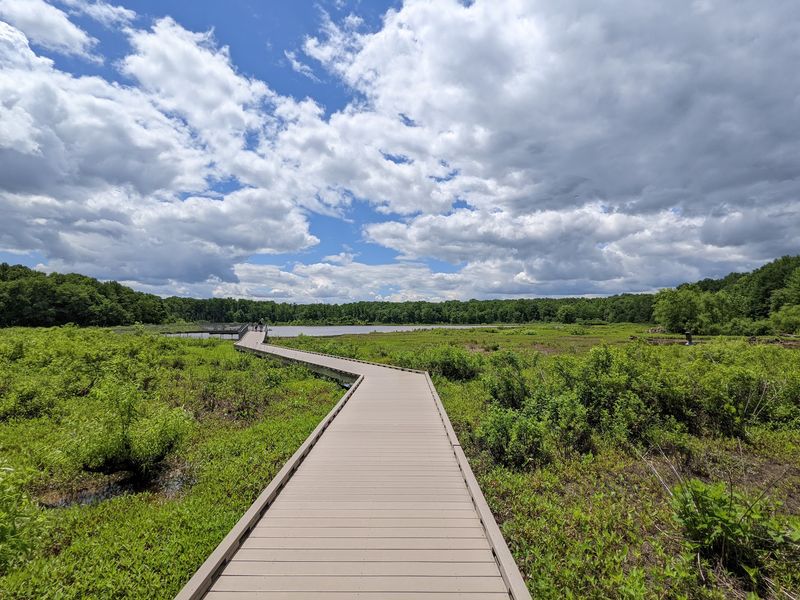
Huntley Meadows Park is the kind of place that makes you forget you’re technically inside Fairfax County, one of the most densely populated counties in the entire country. Step onto the raised Boardwalk Trail and suddenly you’re surrounded by a thriving beaver-created wetland that stretches in every direction, alive with croaking frogs, darting dragonflies, and the prehistoric silhouette of great blue herons.
The half-mile boardwalk winds through this extraordinary ecosystem before arriving at an observation tower where the full scale of the wetland reveals itself in a panoramic sweep. Over 200 bird species have been recorded in the park, ranging from elegant egrets and vibrant warblers to powerful raptors hunting above the cattails.
Beavers are the true architects of this landscape, and their engineering work supports an astonishing cascade of dependent species throughout the wetland.
Reptiles add a thrilling unpredictability to any visit here. Northern water snakes glide through the shallows, five-lined skinks dart across sun-warmed logs, and snapping turtles occasionally surface with a primordial dignity that commands respect.
White-tailed deer browse the park’s upland edges, while colorful dragonflies like the eastern pondhawk and great blue skimmer patrol the open water with impressive speed and agility.
The boardwalk is fully ADA-accessible, making this remarkable ecosystem available to everyone. Pets are not permitted on the boardwalk trails, which keeps the wildlife calm and the experience genuinely immersive.
A visitor center near the entrance provides excellent background on the park’s ecology. Find Huntley Meadows Park at 3701 Lockheed Blvd, Alexandria, VA 22306, and prepare for a wetland encounter that feels completely wild.
5. Wilburn Ridge via Appalachian Trail at Grayson Highlands State Park
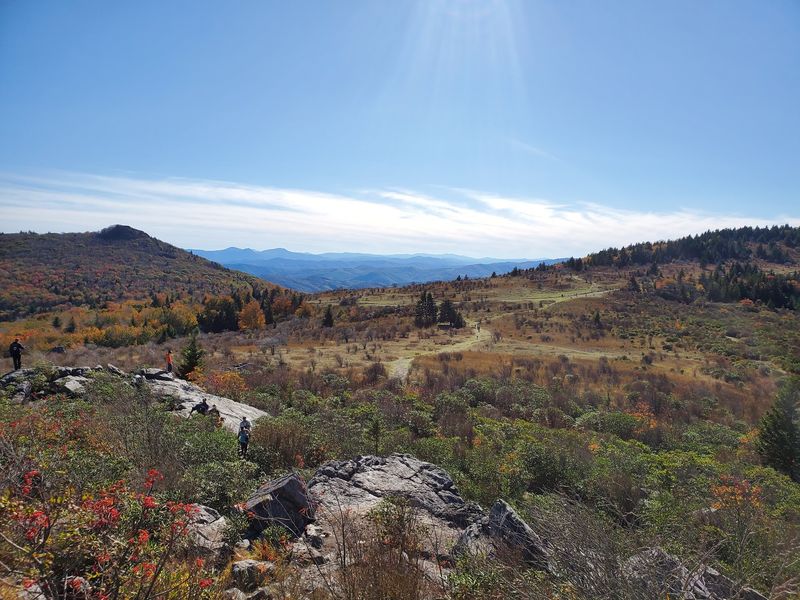
Grayson Highlands State Park operates on a completely different altitude than most of Virginia’s outdoor destinations, and that elevation changes everything. Perched in the southern Appalachians near the North Carolina border, the park’s Wilburn Ridge section of the Appalachian Trail feels more like Scotland than the American South, with open grassy balds, rocky outcrops, and sweeping mountain views that stretch for miles in every direction.
The wild ponies here are the undeniable stars of the show. These sturdy, free-roaming horses graze the open balds with a casual indifference to hikers that makes close encounters feel almost surreal.
Beyond the ponies, the high-elevation ecosystem supports species rarely found elsewhere in the region. Black bears move through the dense spruce-fir forests, native brook trout dart through crystal-clear mountain streams, and elusive bobcats leave only occasional tracks in the mud as evidence of their presence.
Birdwatchers find Grayson Highlands particularly rewarding for its high-elevation specialists. Red crossbills, golden-crowned kinglets, and the distinctive Appalachian subspecies of dark-eyed junco are all regularly spotted here.
The ancient spruce-fir forest, draped in mosses and lichens, creates an almost otherworldly atmosphere as you climb toward the summit zone. This region also hosts one of the world’s highest concentrations of salamander diversity, including the rare Weller’s salamander.
Every season brings a completely different character to this trail. Spring wildflowers carpet the balds, summer storms roll dramatically across the ridgelines, and autumn transforms the hardwood forests below into a riot of color.
Begin your exploration at Grayson Highlands State Park, located at 829 Grayson Highland Ln, Mouth of Wilson, VA 24363.
6. Mount Rogers Trail at Mount Rogers National Recreation Area
Mount Rogers holds the title of Virginia’s highest peak, and the trail leading to its summit rewards hikers with one of the most unusual forest environments in the entire Appalachian chain. Unlike most high peaks in the eastern United States, the summit is completely cloaked in dense, ancient spruce-fir forest, creating a cool, cathedral-like atmosphere even in midsummer.
Mosses and lichens coat every surface, and the air carries that distinctive, resinous scent of an old-growth boreal forest.
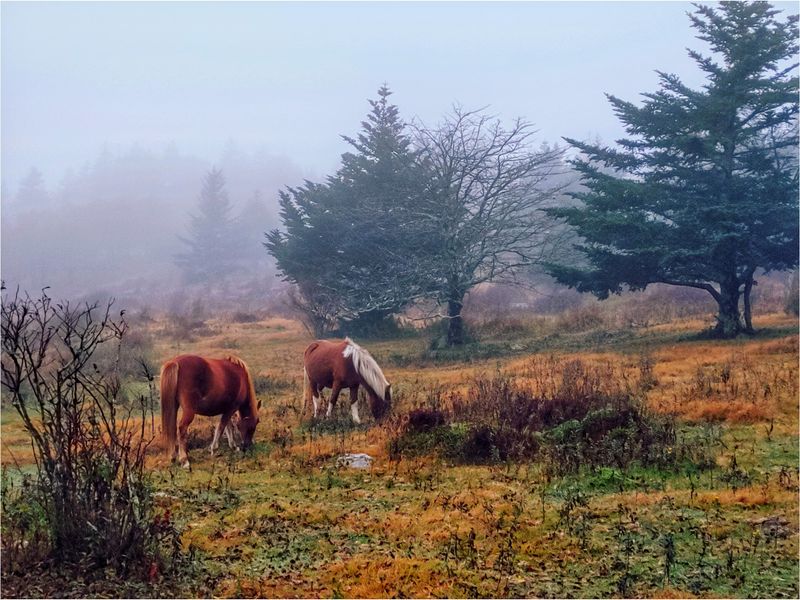
The surrounding Mount Rogers National Recreation Area is vast and wonderfully varied, offering everything from open meadow balds to dense woodland corridors. Wild ponies roam freely across the high-country grasslands, often appearing suddenly from around a rocky bend with a nonchalance that never gets old.
Black bears are year-round residents of these forests, while native brook trout populate the cold, clear mountain streams that tumble down from the high ridges in every direction.
Bird life at these elevations includes species that feel distinctly out of place in a southern state. Common ravens, veeries, and various thrushes fill the forest with complex, melodic calls during spring and early summer.
The diversity of salamanders found throughout this ecosystem is genuinely world-class, with numerous rare and endemic species sheltering beneath rocks and logs throughout the forest floor.
Connecting with the Appalachian Trail at several points, the Mount Rogers area offers loop options of varying lengths and difficulty levels. The primary access point for the Mount Rogers Trail is at Grayson Highlands State Park, 829 Grayson Highland Ln, Mouth of Wilson, VA 24363, with additional trailheads throughout the national recreation area.
7. Bottom Creek Gorge Circuit at Bottom Creek Gorge Preserve
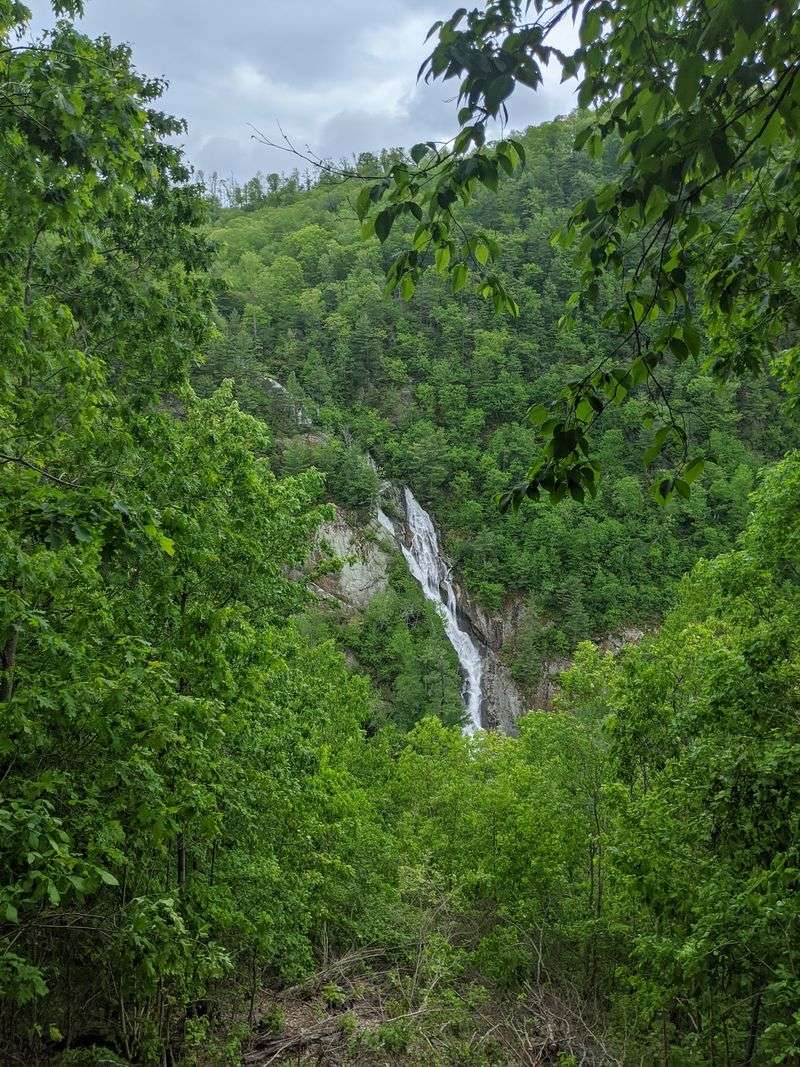
Bottom Creek Gorge Preserve is the kind of place that makes you feel like a genuine explorer, partly because finding it requires some navigation effort, and partly because what awaits inside the preserve is genuinely spectacular. The circuit trail winds through a landscape shaped by one of the most powerful little mountain streams in all of Virginia, a creek that has carved dramatic stair-step waterfalls known locally as The Kettles into the ancient bedrock.
Bent Mountain Falls, the centerpiece of the preserve, drops nearly 200 feet into the gorge below, making it the second highest waterfall in the state. Standing at the overlook and watching that column of white water disappear into the mist-filled gorge below is one of those hiking moments that sticks with you for years.
Ancient, virgin hemlock trees frame the scene with a gravity that reminds you just how long this forest has been growing undisturbed.
The ecological richness of Bottom Creek extends far beyond its dramatic scenery. The creek nurtures four native fish species, including the orangefin madtom and the Roanoke darter, and supports approximately ten percent of all fish species known from Virginia within a single waterway.
A globally rare chestnut lipfern survives in a small shale barren within the preserve, adding botanical significance to an already remarkable destination. White-tailed deer move quietly through the mixed hardwood forest, and historical ruins of an abandoned community add an eerie, fascinating dimension to the experience.
Dogs are not permitted within the preserve, protecting its delicate ecosystem. Navigate carefully, as GPS can sometimes be unreliable in this area.
The general access point is near 2031 Bottom Creek Lane, Bent Mountain, VA 24059.
8. The Great Channels Trail at Channels Natural Area Preserve
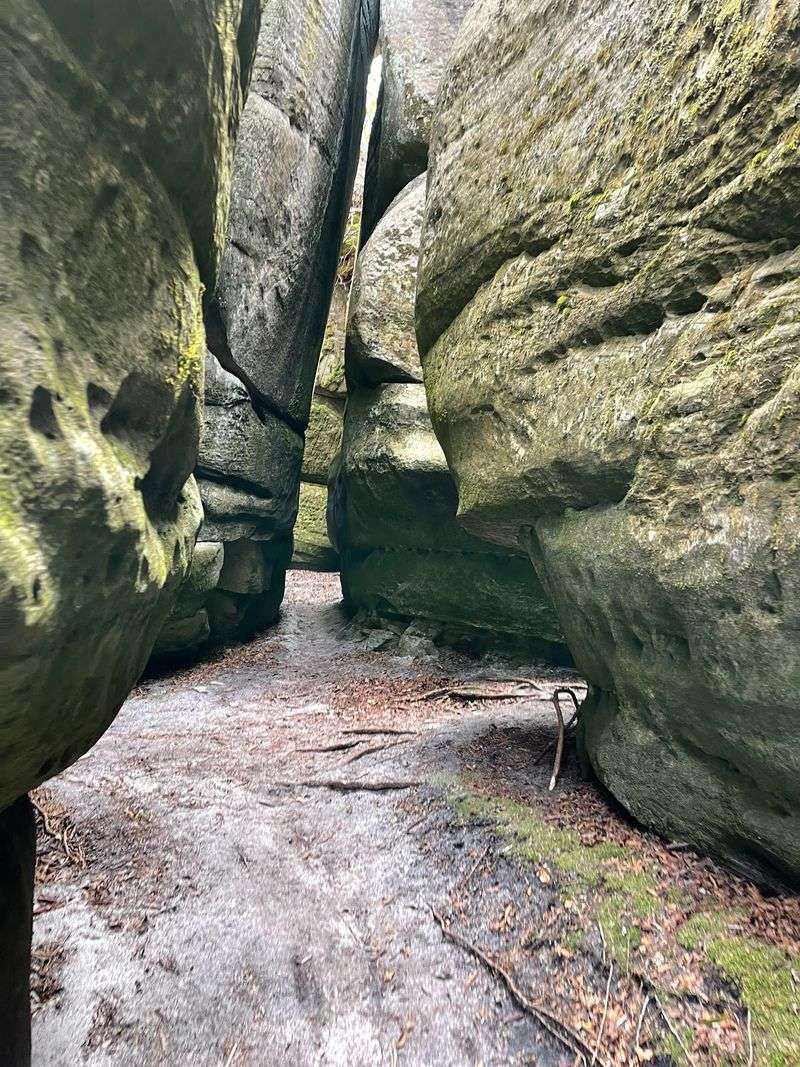
Arriving at The Great Channels feels less like starting a hike and more like discovering a portal to another geological era. This 20-acre sandstone labyrinth in southwest Virginia was sculpted over 400 million years ago by permafrost and ice wedging during the last ice age, creating a maze of enormous boulders and deep, shadowed crevices that stays noticeably cool even on the hottest summer days.
Stepping into those narrow passages between towering rock walls is a genuinely thrilling experience.
The high-elevation forest surrounding the channels, reaching above 4,000 feet, provides rich habitat for a compelling array of wildlife. White-tailed deer and wild turkeys are common sights along the trail, while ruffed grouse burst from the underbrush with startling explosiveness.
Black bears, bobcats, and red foxes all inhabit these woods, though they tend to keep their distance from the trail with characteristic mountain discretion.
Spring and fall migration transforms the canopy above the channels into a warbler superhighway. Scarlet tanagers, veeries, and numerous wood warbler species pass through in waves, filling the forest with color and song.
From the summit of Middle Knob, where the channels are located, a breathtaking 360-degree panoramic view of the surrounding Clinch Mountain landscape opens up as a reward for the climb. Rhododendron thickets add spectacular blooms in late spring, turning the approach trail into a floral tunnel.
The parking area is small, accommodating roughly ten vehicles, so an early start or a mid-week visit is strongly recommended. Access the trailhead via the Brumley Mountain Trail at 4250 Hayters Gap Road, Saltville, VA 24370, and prepare for a geological adventure unlike anything else in the state.
9. Lakeshore Trail at Holliday Lake State Park
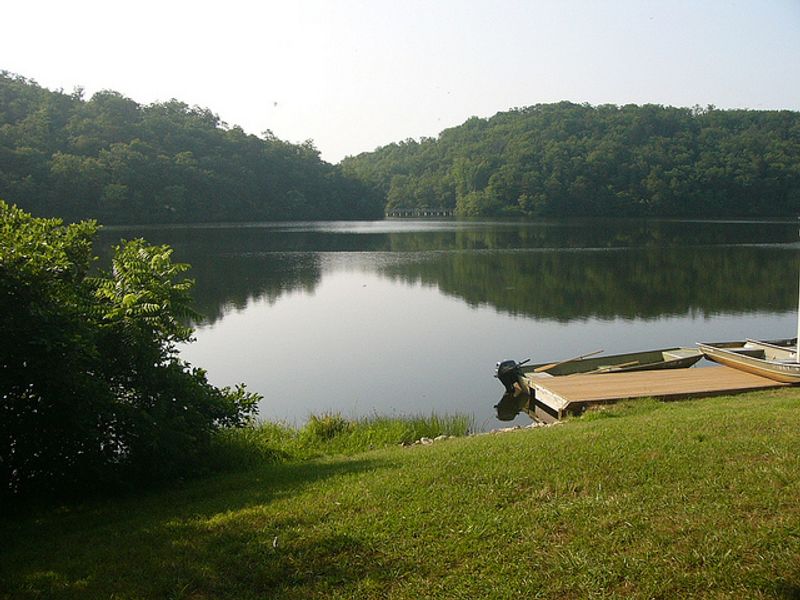
Holliday Lake State Park operates at a gentler frequency than some of Virginia’s more dramatic wilderness destinations, and that’s precisely what makes it so appealing. The Lakeshore Trail circles a pristine 150-acre lake through a beautifully varied landscape of hardwood forests, quiet wetlands, and loblolly pine plantations, offering a hiking experience that feels restorative rather than punishing.
Four scenic overlooks punctuate the 6.5-mile loop, each revealing a slightly different perspective on the lake’s calm, reflective surface.
Birdwatching along this trail rewards patience and quiet movement in equal measure. Wood Ducks and Blue-winged Teal visit the lake during cooler months, while bald eagles occasionally soar overhead with their characteristic combination of power and effortless grace.
Eastern Bluebirds and Cedar Waxwings perch in the lakeside trees, and deep within the forest, the resonant drumming of the Pileated Woodpecker announces itself long before the bird comes into view.
Warmer months bring a spectacular dragonfly show to the water’s edge. Eastern amberwings, slaty skimmers, and numerous other species patrol the shoreline with aerobatic precision, adding flashes of iridescent color to every stretch of the trail.
Gray Catbirds call from the underbrush, migrating Swainson’s Thrushes pass through in spring and fall, and Carolina Wrens maintain their enthusiastic vocal presence throughout the year. For those wanting an additional perspective on the lake’s ecology, the Sunfish Aquatic Trail provides a fascinating self-guided water-based experience.
This park strikes a wonderful balance between accessibility and genuine natural immersion. Holliday Lake State Park sits at 2759 State Park Rd, Appomattox, VA 24522, making it a perfect destination for families and solo hikers alike who want calm, rewarding wildlife encounters without extreme terrain.
10. Tye River Overlook via Cabell Trail at James River State Park
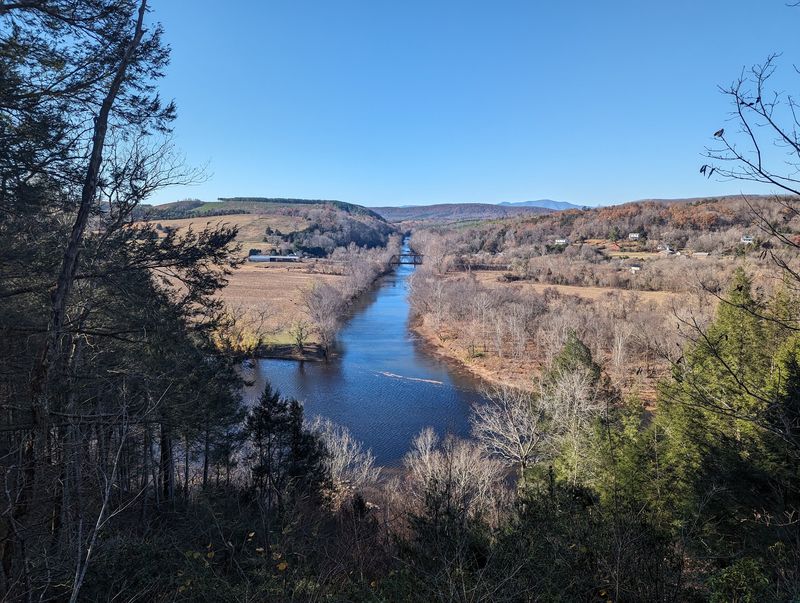
James River State Park occupies a stretch of Virginia’s heartland that feels genuinely timeless, where rolling Blue Ridge foothills meet three miles of pristine James River shoreline in a landscape that seems entirely untouched by modern urgency. The Cabell Trail leads to the Tye River Overlook, a short, ADA-accessible path covered in smooth crushed gravel that delivers one of the most uniquely satisfying views in the entire state park system.
Watching the Tye River join the James at a distinctive right angle is oddly mesmerizing.
Wildlife activity around this park is impressively diverse across every habitat type. Bald eagles soar above the river corridors with commanding regularity, joined by red-shouldered hawks, red-tailed hawks, and northern harriers quartering the open grasslands.
The James River itself teems with smallmouth bass, catfish, and the occasional river gar, while muskrats and river otters work the quieter backwater sections with busy, purposeful energy.
Wetland impoundments and three freshwater ponds scattered throughout the park attract green herons and great blue herons during summer, while wintering juncos and chipping sparrows move through the meadows in cheerful, foraging flocks. Overgrown field edges hide indigo buntings and common yellowthroats during the breeding season, and widow skimmer dragonflies add bold graphic beauty to the air above every open water surface.
James River State Park carries an additional distinction as an International Dark Sky Park, making it a superb destination for stargazing after the sun goes down.
The park entrance is located at 104 Green Hill Dr, Gladstone, VA 24553. Plan a full day here because between the trails, the river views, and the wildlife, leaving early feels almost impossible once you’ve settled into the park’s extraordinary natural rhythm.
11. Potomac Heritage Trail, Arlington and Fairfax Sections
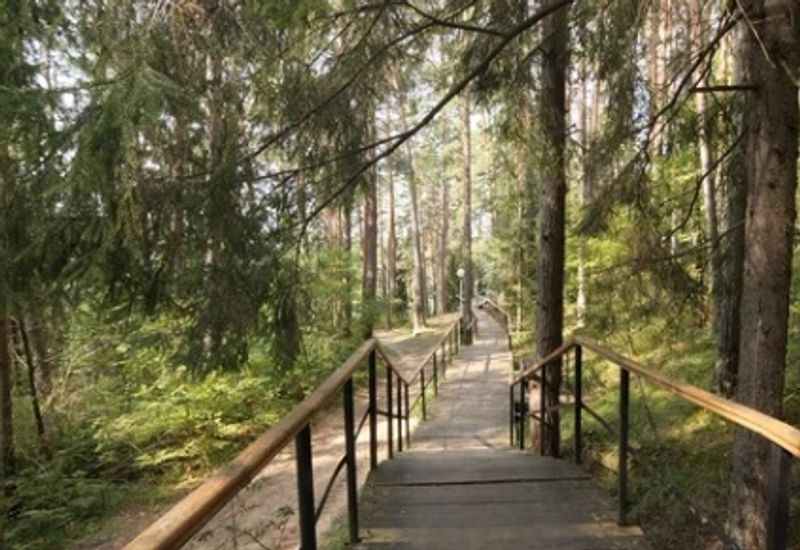
The Potomac Heritage Trail’s Arlington and Fairfax sections represent one of the great underappreciated outdoor escapes in the mid-Atlantic region, threading along the Potomac River’s Virginia shore through terrain that feels genuinely remote despite being minutes from one of the world’s most famous cities. This 10-mile pedestrian-only footpath crosses pristine streams like Turkey Run and Dead Run, passes alongside fascinating historic sites, and offers intimate river views that shift constantly as the trail rises and falls with the natural topography.
Wildlife activity along this corridor is remarkably rich for such an urban-adjacent environment. Over 150 bird species have been recorded in the area, including great blue herons and great egrets hunting along the riverbanks with elegant patience.
Conn Island hosts a massive cormorant rookery that is genuinely impressive in scale during nesting season. Buffleheads and common mergansers grace the river during winter, while year-round residents like Eastern Kingbirds, Northern Cardinals, and several woodpecker species maintain a constant, lively presence throughout the canopy.
Snapping turtles, Eastern box turtles, beavers, and white-tailed deer all inhabit this surprisingly wild river corridor. The trail itself offers a satisfying mix of terrain, from challenging scrambles over rocks and roots to smoother stretches that connect with the flat C&O Canal towpath for easy walking.
This dynamic pathway beautifully bridges the landscapes of the Chesapeake Bay and the Allegheny Plateau in a single linear journey.
Start your exploration at the Theodore Roosevelt Island parking lot, off George Washington Memorial Pkwy, Arlington, VA 22209. Additional access points include Potomac Overlook Regional Park at 2845 N George Washington Memorial Pkwy, Arlington, VA 22207, and Gulf Branch Nature Center at 3608 N Military Rd, Arlington, VA 22207.
Lace up your sturdiest boots for this one.
