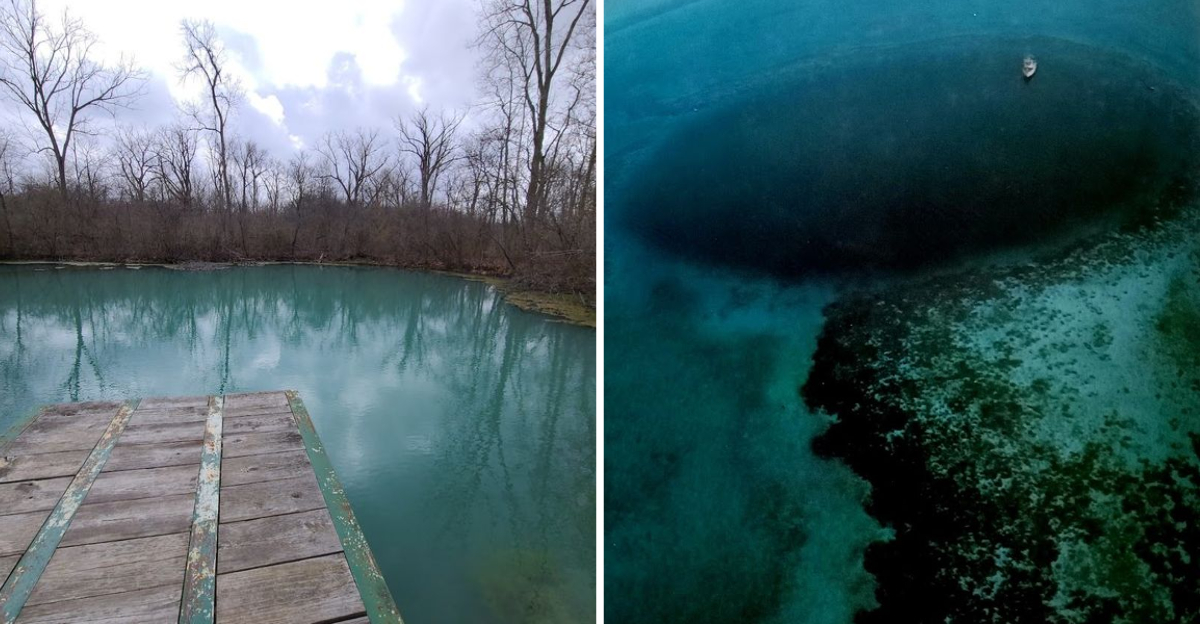
A spot in Ohio where the water never gets the memo that summer has arrived. Even when the air is thick and sticky, this spring sits cool and unbothered.
I remember reading about it and not believing it at first, because that kind of consistency feels almost impossible in nature. The pool glows with an eerie blue green color and sits perfectly still despite constantly pumping out thousands of gallons of water every single minute.
It draws in curious visitors, geology nerds, and anyone who has ever wondered what hides beneath the quiet Ohio countryside. What keeps this spring so cold, so stable, and so strangely beautiful is a story that goes deep underground.
The Underground Source That Never Stops Giving
Most springs dry up a little in summer, or warm up, or slow down. The Blue Hole does none of those things, and the reason starts far below your feet.
It is fed entirely by deep subterranean groundwater held under natural pressure, which means the water does not sit around near the surface long enough to absorb any heat from the sun or the warm air above.
This pressurized water rises through an extensive network of underground channels carved into the rock over thousands of years. The depth of the source is what makes all the difference.
Deep underground, temperatures stay remarkably stable year-round, hovering right around that 48-degree mark regardless of what season is happening above ground.
Think of it like a refrigerator that never needs plugging in. The earth itself keeps the temperature locked in place.
That constant upward push of cold, pressurized water means the Blue Hole never gets a chance to warm up, no matter how long a heat wave sticks around. It is one of the most reliable natural cooling systems you will ever encounter in the Midwest.
Karst Geology, The Rock Beneath Ohio That Made All of This Possible
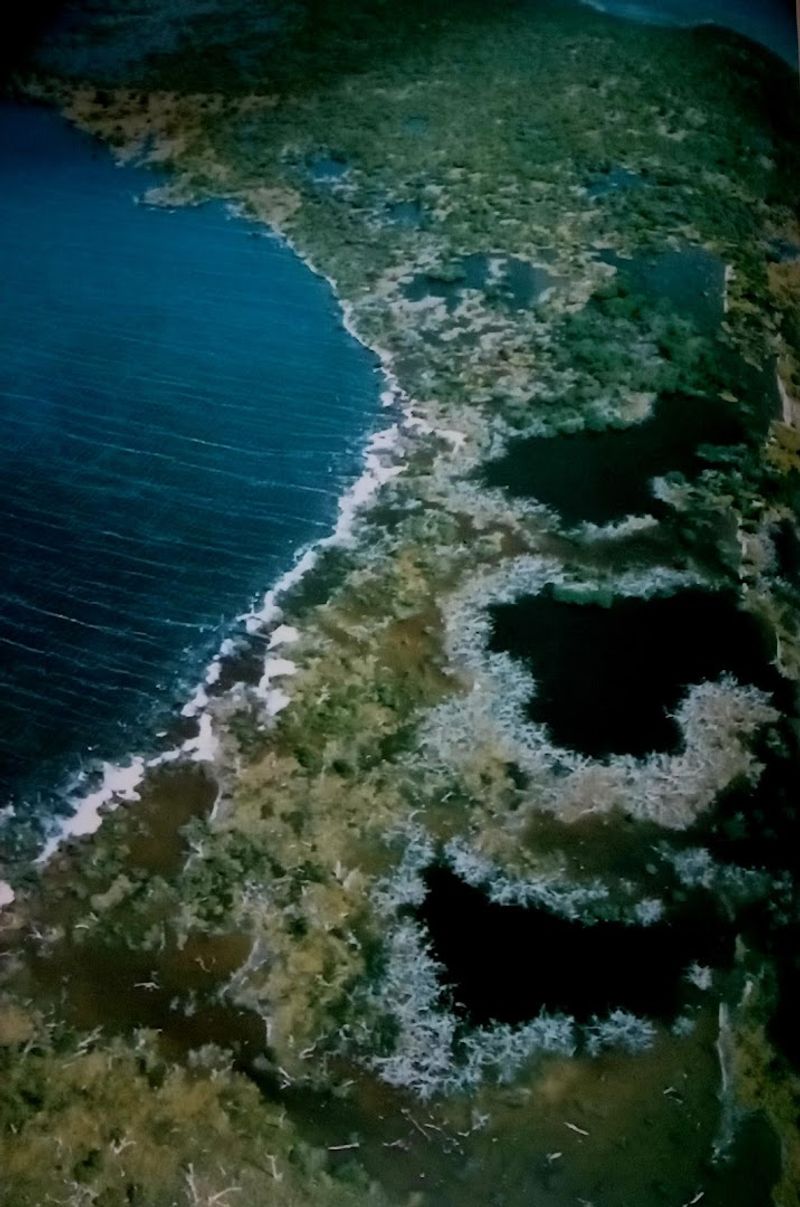
Ohio does not exactly have a reputation for dramatic geology, but the ground beneath Castalia tells a completely different story. The Blue Hole sits within a karst plain in north-central Ohio, a landscape shaped by the slow dissolution of carbonate rocks over millions of years.
Specifically, the Columbus Limestone and Monroe Formation are the two rock units responsible for what you see today.
Carbonate rocks dissolve when slightly acidic groundwater moves through them over long periods of time. That process carves out hollow passages, tunnels, and cavities deep underground.
Eventually, those cavities grow large enough that the ceiling collapses, and when that happens near the surface, you get a feature exactly like the Blue Hole.
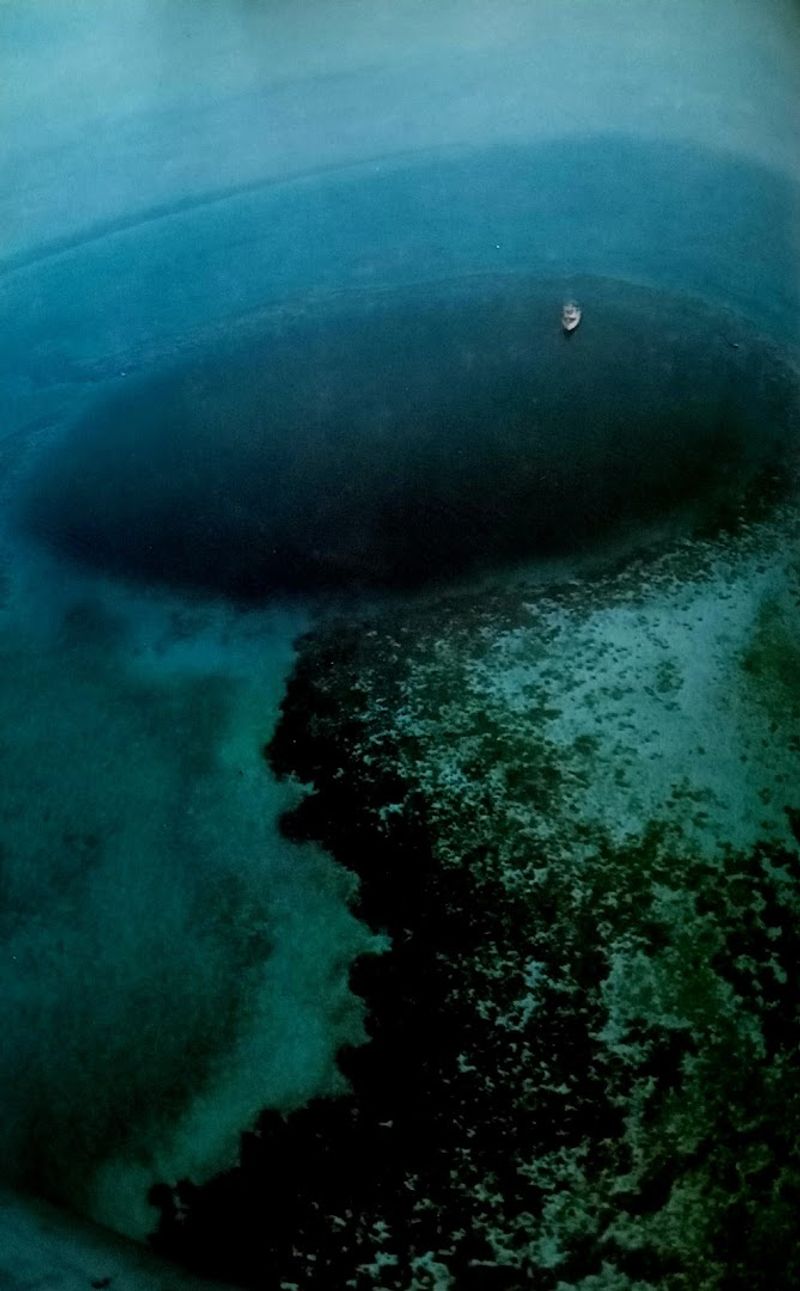
The pool itself formed from a cavern collapse, which is why it has that striking near-circular shape. Karst landscapes are found all over the world, but most people do not realize Ohio has its own version quietly sitting in Erie County.
The geology here is not flashy or mountainous, but it produced something genuinely rare. A spring that flows with almost mechanical consistency, shaped entirely by ancient rock and water chemistry working together over an unimaginable stretch of time.
Five Thousand Gallons Per Minute and Why That Number Actually Matters
Numbers can feel abstract until you picture them in real life. The Blue Hole discharges roughly 5,000 gallons of water every single minute, which works out to around 7 million gallons every day.
All of that water flows out into Cold Creek and eventually makes its way to Sandusky Bay. That is not a trickle.
That is a full, forceful, non-stop surge of cold water coming straight from deep underground.
The sheer volume of that flow is a huge part of why the temperature stays so consistent. There is simply too much cold water moving too fast for surface heat to make any real impact.
By the time a tiny bit of warmth might start affecting the top layer, millions more gallons of 48-degree water have already pushed through from below.
Surface conditions have zero influence here. Droughts do not shrink it.
Floods do not swell it. A brutal heat wave does not nudge the temperature even a single degree.
That kind of stability is genuinely rare in any natural water system, and it is exactly what made the Blue Hole famous long before the internet existed to spread the word about unusual places.
The Anoxic Water Chemistry That Keeps Fish Out of the Pool
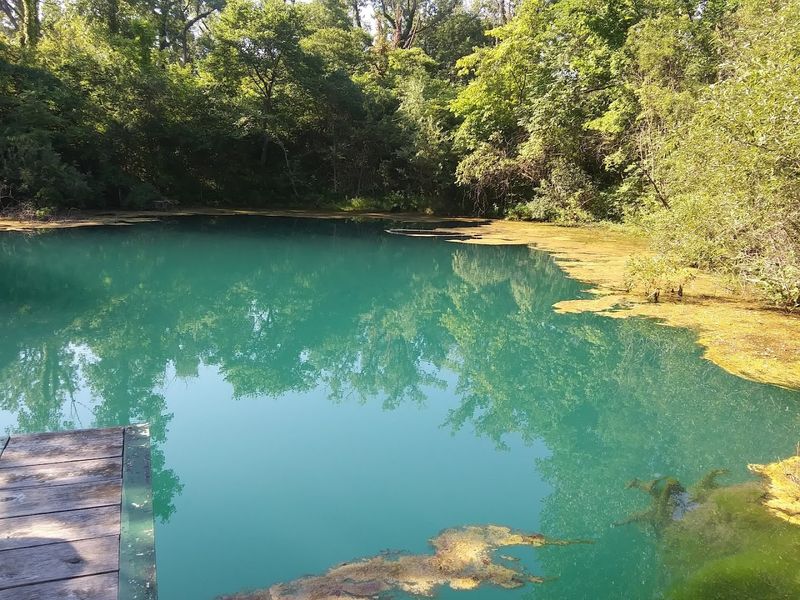
One of the strangest things about the Blue Hole is that no fish live in it naturally. That might seem odd for a large, flowing body of fresh water, but the chemistry here makes it nearly impossible for most aquatic life to survive.
The water is anoxic, meaning it carries very little dissolved oxygen. Fish need oxygen in the water to breathe, and the Blue Hole simply does not provide enough of it.
The mineral content tells its own story too. The water is loaded with iron, calcium, lime, soda, and magnesia, all pulled from the rock formations it travels through underground.
That mineral cocktail gives the water its famously vivid blue-green color, which looks almost artificial in photographs but is completely natural. The color comes from how light interacts with those dissolved minerals and the unusual depth of the pool.
The low oxygen environment is directly tied to the spring’s deep underground origin. Water that spends long periods moving through sealed rock formations does not pick up much oxygen along the way.
So what arrives at the surface is cold, mineral-rich, and almost entirely oxygen-depleted. It is a reminder that beauty in nature does not always come packaged in a welcoming, life-filled form.
How the Blue Hole Became a Tourist Attraction and Then Went Quiet
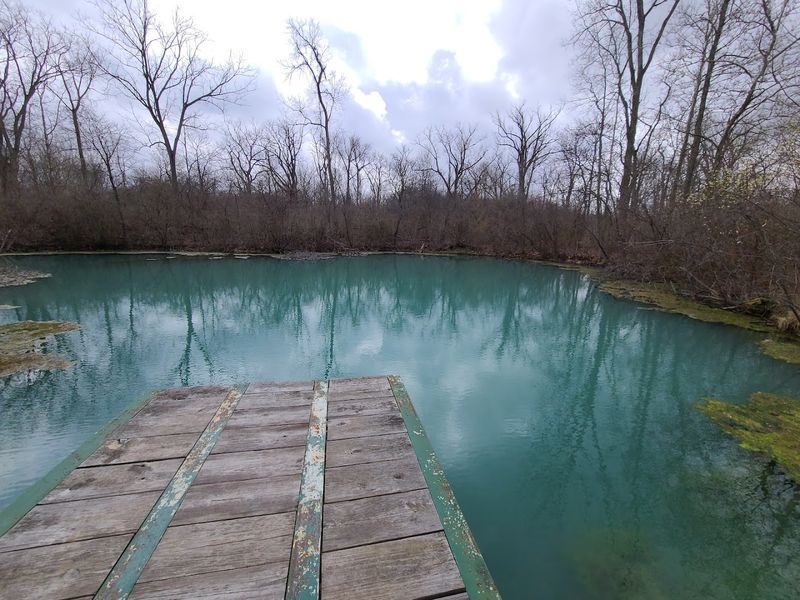
For decades, the Blue Hole was one of those classic American roadside attractions that families would plan entire detours around. People came from all over Ohio and beyond just to stand at the edge of that impossibly blue pool and watch the water churn up from below.
It was the kind of place that became a childhood memory for an entire generation of Midwesterners.
At its peak, the site operated as a proper attraction with viewing areas and visitor facilities. It was often paired with nearby stops like Mystery Hill, turning a single day trip into a full Ohio adventure.
The combination of a genuinely unexplainable natural feature and the quirky charm of a small-town attraction made it unforgettable for anyone who visited.
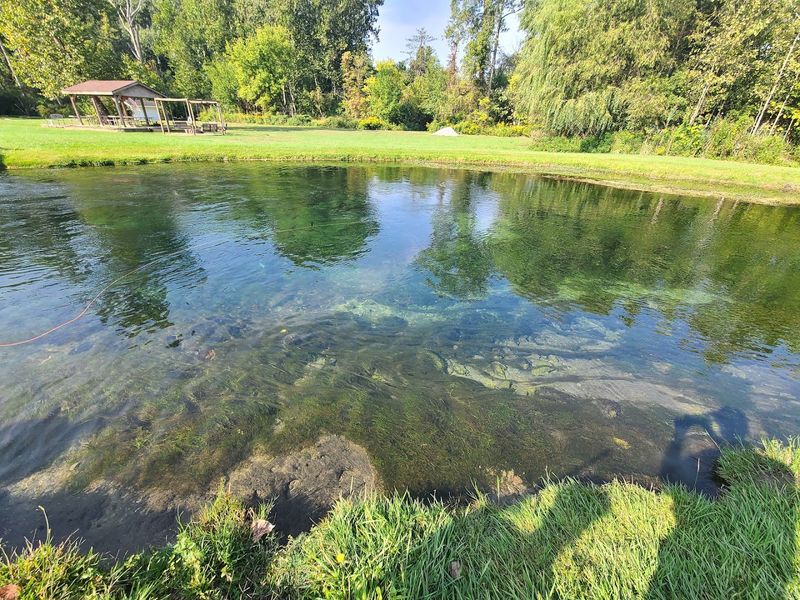
The original Blue Hole attraction eventually closed to the public, which left a lot of people with a nostalgic ache and not much else. The good news is that the ODNR fish hatchery located right next door has its own smaller version of the blue hole that visitors can still view today.
It is not quite the same experience, but it gives curious travelers a real glimpse of what made this place so special in the first place.
Visiting the Area Today, What You Can Actually See and Do
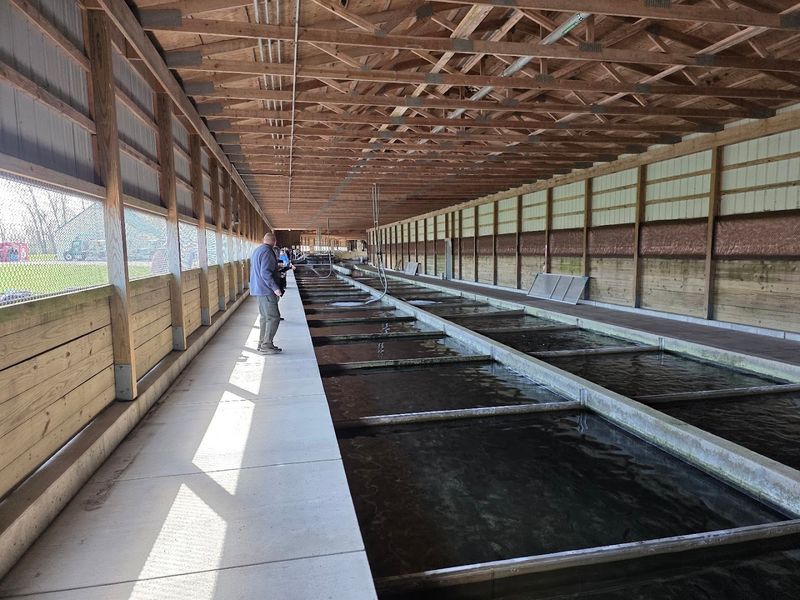
The original Blue Hole site is closed, but a trip to Castalia does not have to feel like a dead end. The Castalia State Fish Hatchery sits right next door, and it is run by the Ohio Department of Natural Resources.
Inside, you will find a smaller blue hole that is open for viewing and gives a genuine sense of what the geology and water chemistry look like up close.
The hatchery itself is worth exploring even beyond the spring. It uses the cold, consistent spring water to raise fish, which makes perfect sense given that the temperature never fluctuates.
Watching the operation while understanding why the water works so well for fish farming adds a layer of context that makes the visit feel educational without being dry or boring.
Castalia is a small, quiet town, and that is part of its charm. There is no overwhelming tourist infrastructure here, which means the experience feels genuine rather than packaged.
The surrounding Erie County area has plenty to offer if you want to extend the trip, including Lake Erie access and the attractions of nearby Sandusky. But the spring itself, even in its current limited form, is still the kind of thing that sticks with you long after you drive home.
Why 48 Degrees Is More Than Just a Number
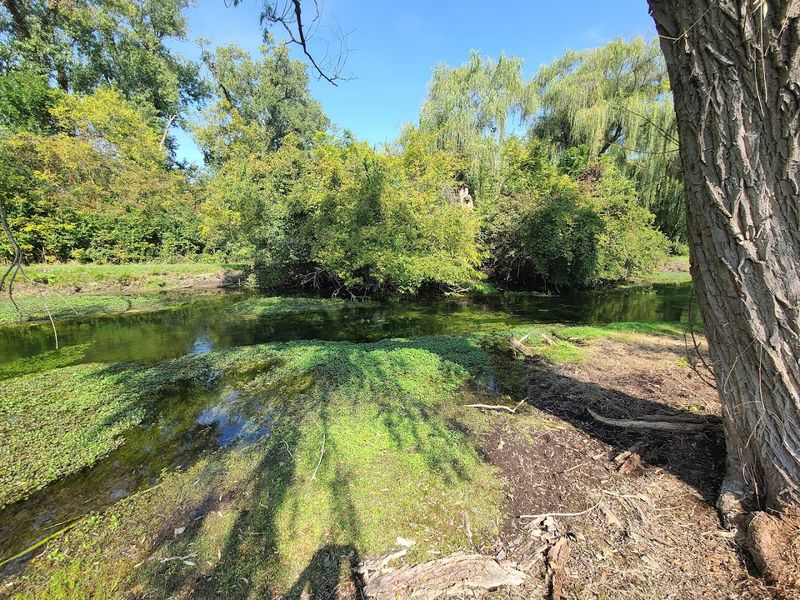
Forty-eight degrees Fahrenheit sounds like a precise, almost arbitrary figure, but it carries real meaning when you understand where it comes from. That temperature reflects the average year-round temperature of deep groundwater in this part of Ohio.
It is not a coincidence or a quirk. It is the direct result of where the water has been and how long it has been traveling underground before it reaches the surface.
That specific temperature is also why the Blue Hole was so commercially valuable for so long. Before modern refrigeration, the cold spring water was used to keep fish alive and fresh.
The nearby hatchery still benefits from the same principle today, using the reliably cold water to maintain healthy conditions for the fish it raises year-round.
There is something quietly profound about a number that does not budge. While everything around it shifts with the seasons, the Blue Hole holds its 48 degrees like a quiet, stubborn fact about the world.
It is a reminder that some of the most interesting things in nature are not loud or dramatic. Sometimes the most remarkable thing is simply something that stays exactly the same, no matter what the rest of the world is doing around it.
Address: Castalia, OH 44824
