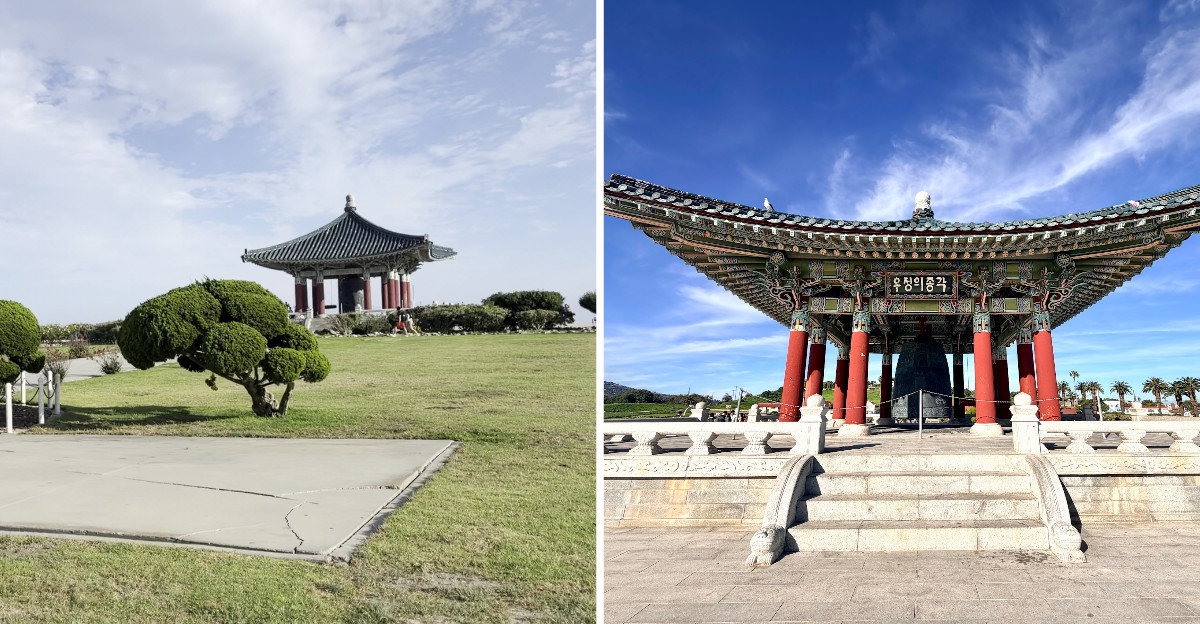
Glowing bronze and painted columns rise above the ocean in California, where a 17-ton bell traveled across the Pacific to rest on a hilltop. Wind tugs at jackets and kites dance over the grass like they own the sky.
Something this heavy has no business being so peaceful. I remember thinking that when I first saw it, standing there with the breeze in my face and the sea stretched out below.
Every carving, color, and column tells a piece of a story about two countries and the friendship between them. The bell was cast in Korea and shipped across the water as a gift, and it has been ringing over this coast for decades.
Visitors come to sit on the grass, fly kites, and watch the sun drop behind the horizon. The spot stuck with me long after I left, and it stays with anyone who takes the time to climb the hill.
A Birthday Present for a Whole Country
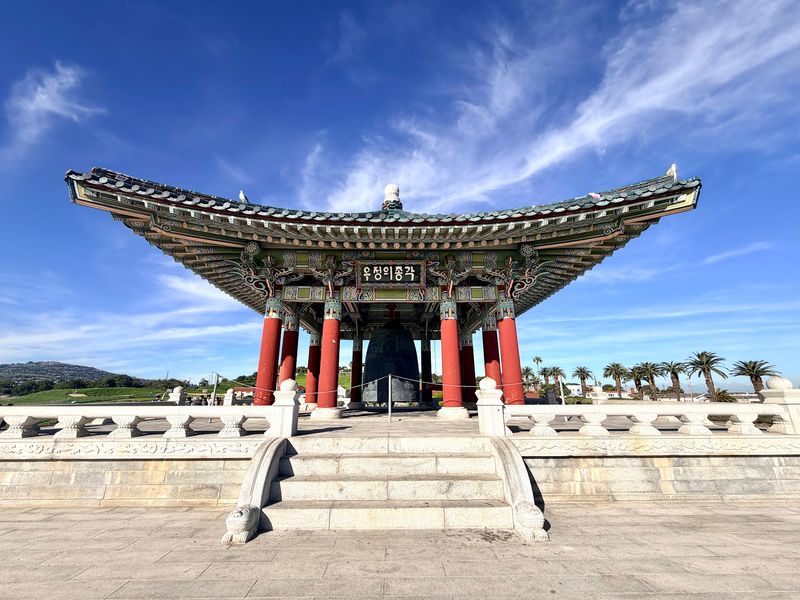
Most birthday gifts fit in a box, but mine never weighed 17 tons. I laughed a little when I learned the bell was a present from the Republic of Korea to the United States for its 200th birthday in 1976.
The bicentennial was a huge celebration, and Korea wanted to mark it with something that would last for centuries. The gift also honors the veterans of the Korean War, which gives the place a quiet, respectful feeling.
Once I knew that, I noticed how many visitors paused in silence under the pavilion.
The bell was dedicated on October 3, 1976. A Korean American actor named Philip Ahn helped coordinate the whole project, which is a fun bit of trivia to share with friends on the drive home.
Only a couple of years later, on May 3, 1978, the city named it Los Angeles Historic-Cultural Monument No. 187. That official title helps protect it for future generations.
In 2014, after a big round of restoration work, the bell was re-dedicated on January 10, so the colors you see today look fresh and bright.
My advice is simple. Take a minute to read the plaques before snapping photos, because knowing the history makes every detail feel more meaningful.
I found myself looking at the bell differently once I understood it was really a promise of friendship cast in metal.
Sized Like a Small Room, Tuned Like an Instrument
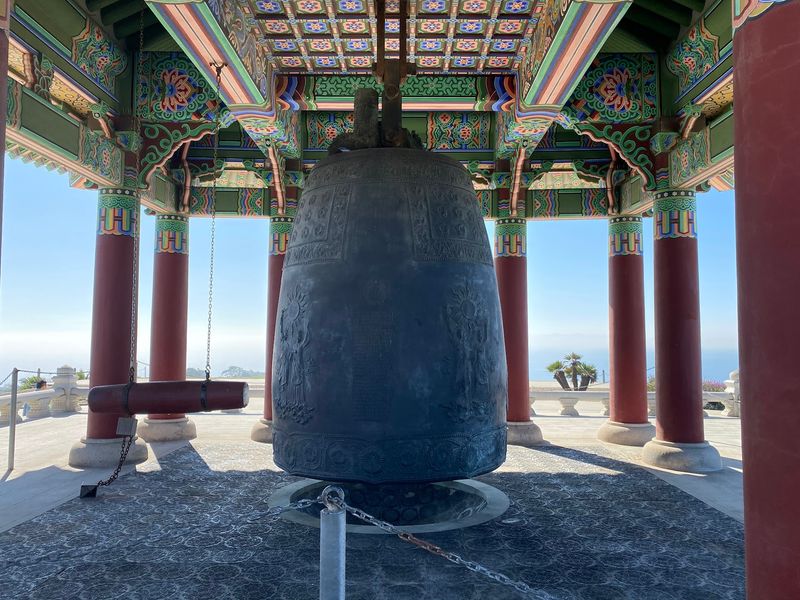
Numbers usually bore me, but these ones made my jaw drop. The bell stands about 12 feet tall and measures roughly seven and a half feet across, with walls about eight inches thick.
Picture a basketball player standing on another basketball player’s shoulders, and you still would not quite reach the top. I stood next to it and felt pleasantly tiny, like a kid next to a school bus.
Its design comes from a famous ancient treasure called the Divine Bell of King Seongdeok the Great, also known as the Emille Bell. That older bell was cast in the year 771 for Bongdeok Temple and now lives at the National Museum of Gyeongju in Korea.
Both bells rank among the largest in the world.
The metal mix is fascinating too. It is mostly copper and tin, with small amounts of gold, nickel, lead, and phosphorus added in to shape the tone.
Think of it like a recipe where each ingredient changes the flavor, except here it changes the sound.
Here is a tip I wish I had known sooner. Walk slowly all the way around the bell at different distances, because the curves catch light in surprising ways.
From far away it looks smooth and heavy, but up close you start to see the craftsmanship hiding in every inch.
Liberty and Korean Spirits Share the Same Bronze
My favorite moment came when I realized the bell was covered in tiny stories. Four pairs of figures wrap around the outside, and each pair blends American and Korean ideas side by side.
One figure in every pair looks a lot like the Statue of Liberty, holding her torch high. Her partner is a Seonnyeo, a graceful spirit from Korean tradition, often shown floating with flowing robes.
Seeing them together felt like watching two friends pose for a photo.
Each Korean spirit holds something special. One carries the Taegeuk, the red and blue circle found on the South Korean flag.
Another holds a branch of the Rose of Sharon, which is Korea’s national flower. A third carries laurel leaves, a symbol of victory, and the fourth gently holds a dove for peace.
I turned it into a little scavenger hunt, and honestly it was more fun than I expected. If you visit with kids, challenge them to find all four objects before anyone gets a snack.
They will look closer than they ever would otherwise.
Bring a camera with a decent zoom if you can. The carvings sit high on the bell, and a closer shot lets you appreciate the flowing lines and facial details that are hard to catch with bare eyes on a bright afternoon.
Master Builders Flew In to Raise the Belfry
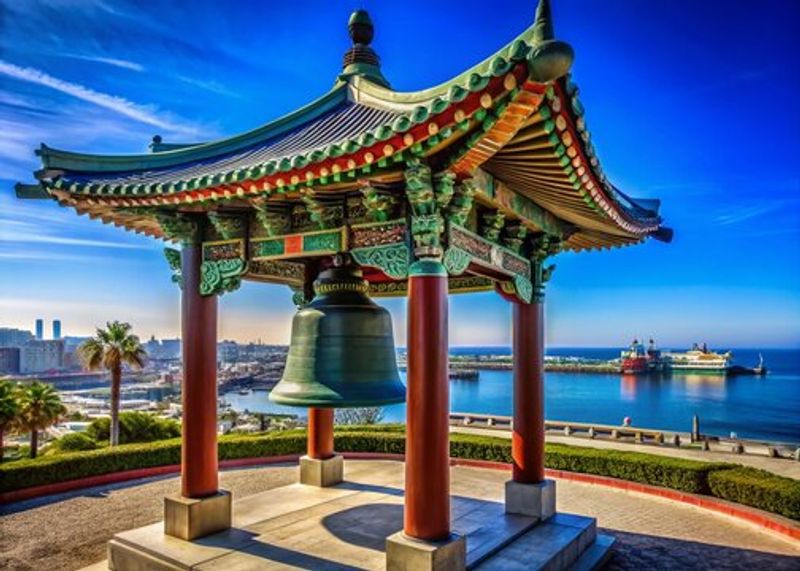
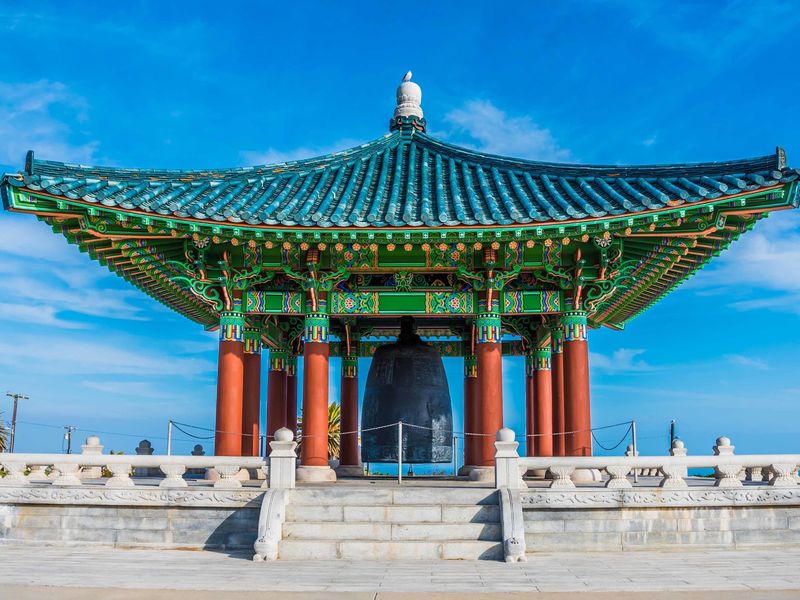
Getting a giant bell across the ocean was only half the adventure. The pavilion that holds it, called the Belfry of Friendship, has a travel story that honestly impressed me even more.
Around three dozen skilled craftsmen came from Korea to San Pedro to build it by hand. Stonemasons, tile setters, and carpenters worked on the site for about ten months.
They brought traditional materials with them, including 435 tons of stone and the striking blue roof tiles you see today. I kept tilting my head back to study the roof, and my neck complained later, but it was worth it.
Twelve carved columns hold everything up, and each one stands for a sign of the Korean zodiac. Look down at the base of the columns and you will spot animal figures standing guard.
I went hunting for my own zodiac animal right away, and I bet you will too.
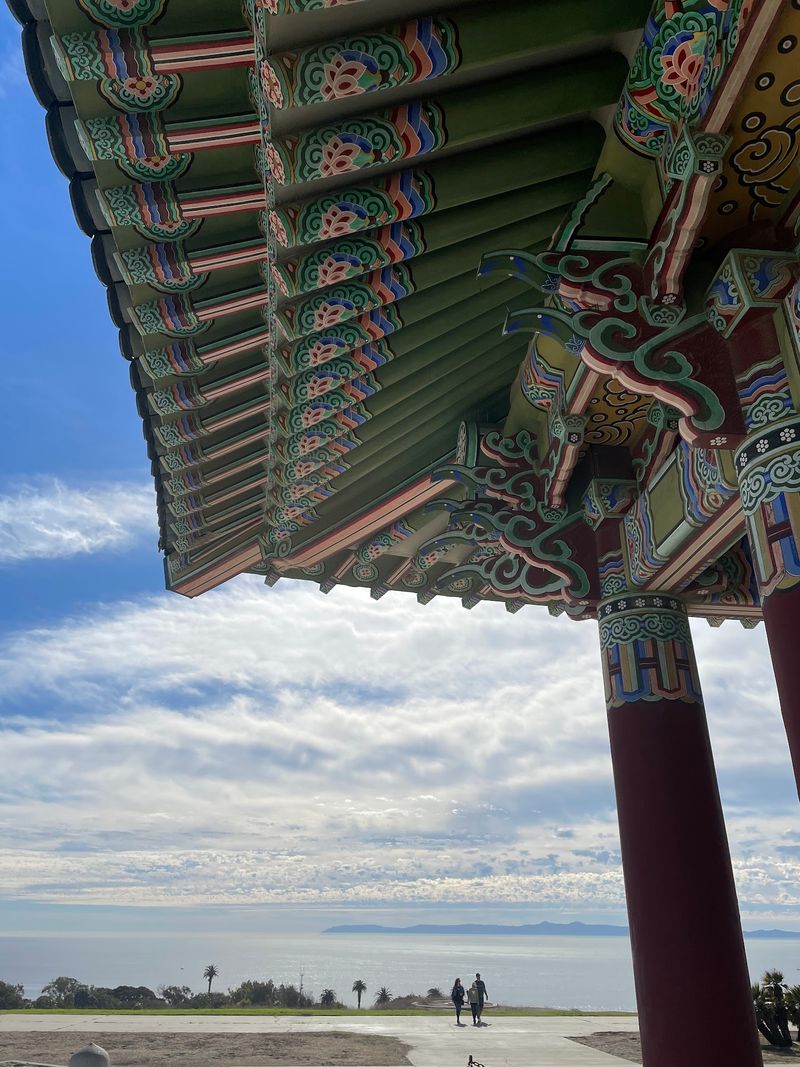
The painted eaves are the real showstopper. That colorful style is called dancheong, a traditional Korean art form using bold reds, greens, and blues in careful patterns.
It brightens the whole structure and protects the wood at the same time.
For the best photos, stand under the roof and aim your camera upward. The painted beams frame the bell beautifully, especially when soft afternoon light spills in from the sides.
A Bell With No Clapper and a Very Special Schedule
Surprise number one for me was the lack of a clapper inside. Instead, a big wooden log hangs nearby, and people swing it to strike the bell from the outside.
The sound is deep and rolling, the kind you feel in your chest more than hear with your ears. The bell does not ring every day, which makes each strike feel like an event.
It rings on New Year’s Eve and on Korean American Day, which is January 13. It also rings on the Fourth of July, on Korean Liberation Day on August 15, and during Constitution Week in September.
There is good news for regular travelers too. The bell also rings on the first Saturday of each month, usually around noon.
If your trip lines up, plan to arrive a bit early so you can grab a good spot near the pavilion.
Of course, I cannot promise the exact timing will never change, so checking with the park before you go is smart. A quick phone call to 310-548-7705 can save you from showing up on the wrong day.
Even if you miss a ringing, look closely at the log striker and imagine the swing. Knowing that one push sends that huge voice rolling out over the harbor makes the silence feel full of possibility.
Kites, Ships, and Catalina on the Horizon
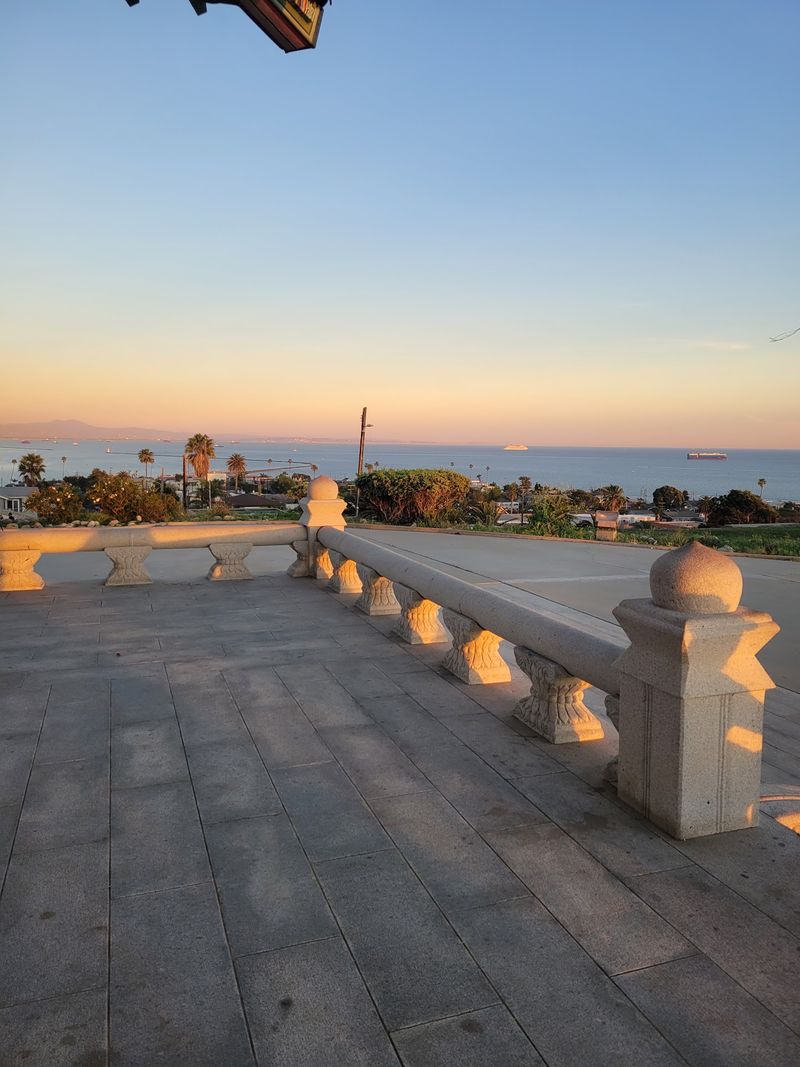
Wind is the first thing that greets you up here, and it does not hold back. The hilltop in Angel’s Gate Park catches steady ocean breezes, which is why so many families show up with kites.
I watched a dragon kite climb higher than any I had seen before, and I wanted one immediately.
The views stretch in almost every direction. You can see the busy Port of Los Angeles, the wide Catalina Channel, and on a clear day Catalina Island floating on the water.
The rolling coastline of California adds soft green curves to the scene.
The park sits on land that was once part of Fort MacArthur’s Upper Reservation, which adds a layer of history under your feet. Today it feels relaxed, with big lawns, a playground, and a basketball court nearby.
Sunset is my top recommendation. The sky turns pink and orange behind Catalina, and the pavilion colors seem to glow as the light fades.
The grounds are open from 7 AM to 7 PM, so plan your visit around those hours.
Pack a picnic blanket, some snacks, and a warm layer. That breeze gets chilly fast, even on sunny days.
Parking is free, restrooms are available, and there is plenty of grass to spread out and simply watch the ships glide by.
Why I Keep Thinking About This Hilltop
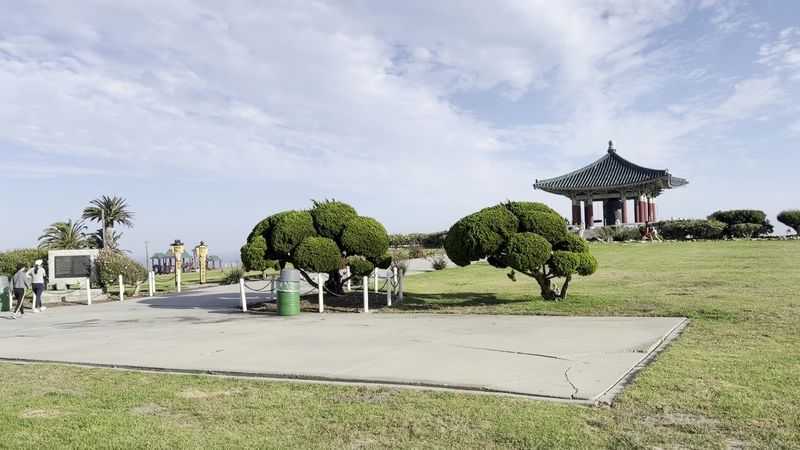
Weeks later, the memory still pops into my head at random moments. It usually shows up as the image of that bronze bell hanging still while the ocean moved endlessly behind it.
Some places are fun, and some places stay with you. This one managed to be both, which does not happen often.
I came for a quick photo and ended up staying for hours.
Part of the magic is the contrast. Here is an object heavy enough to crush a car, yet the whole setting feels light, calm, and open.
People walk dogs, kids chase each other across the lawn, and nobody seems to be in a hurry.
The bigger idea also stuck with me. Two countries separated by an entire ocean chose to mark their friendship with something beautiful and lasting.
Standing near it, I felt a little more hopeful about how people can connect across distance.
If you are planning a Los Angeles trip, I would carve out a slow afternoon for this spot rather than squeezing it in. Bring a book, a friend, or just your curiosity.
Afterward, a drive along the Palos Verdes coast makes a lovely way to stretch the day.
Admission is free, so there is really no reason to skip it.
Address: 3601 S Gaffey Street, San Pedro, California 90731
