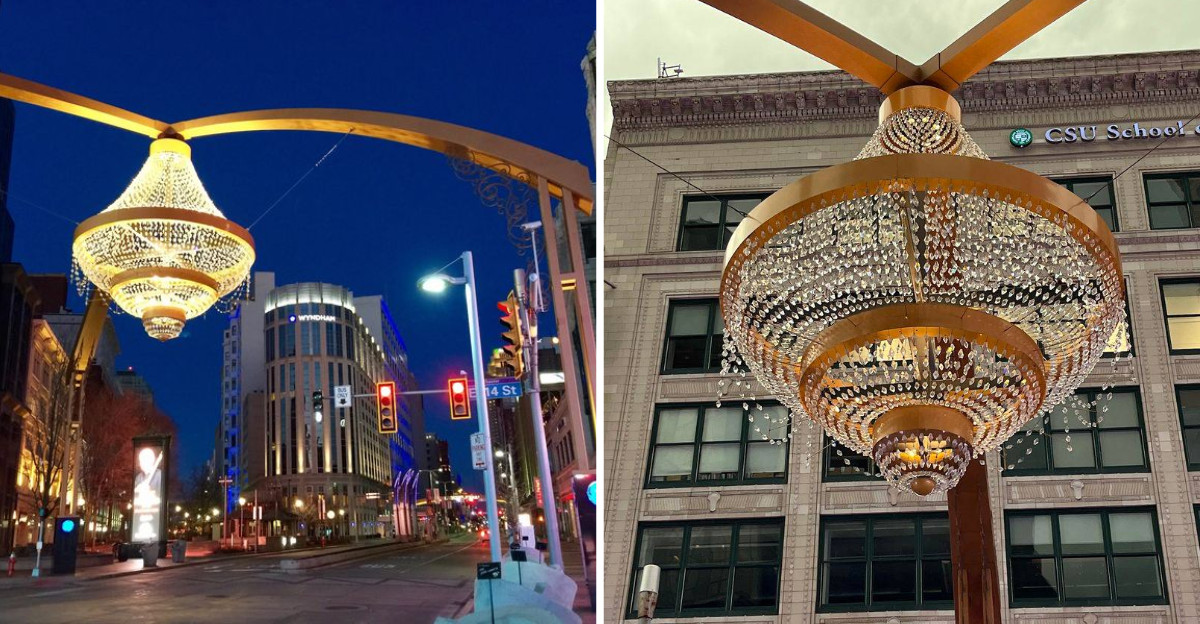
Marquees and a good dinner were what I expected in an Ohio downtown, not a chandelier the size of a small house hanging over the intersection. The avenue was busy in that easy weeknight way, people heading to a show, buses hissing at the curb, and then I looked up.
Hanging above the street, glowing like something out of a palace ballroom, was a chandelier so large it seemed to belong indoors. I stopped walking.
So did about six other people, all of us tilting our heads back like we had just spotted a comet. The first glimpse stuck with me longer than I expected, and I ended up circling back twice before I left the city.
It turns out the chandelier is a restored piece that once hung in a grand old theater, now suspended there as a nod to the city’s past. History you can walk under without even trying is rare, and this Ohio street delivers it.
The First Look Up on Euclid Avenue
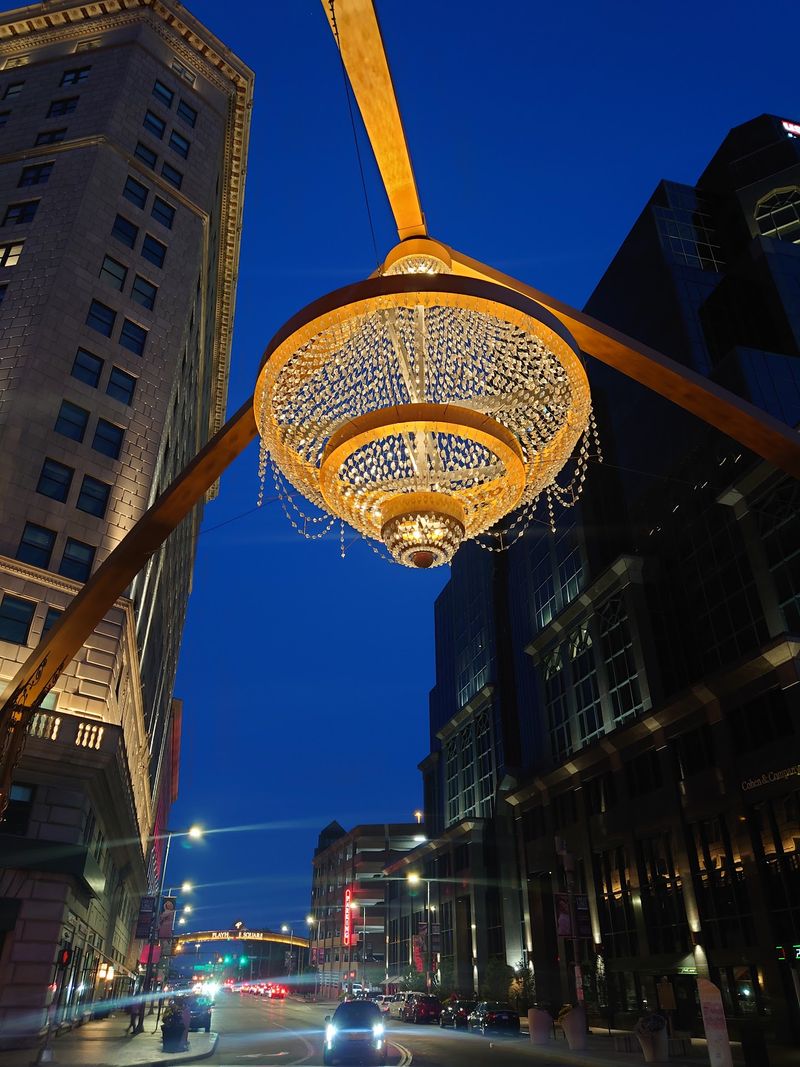
My neck actually got sore. That is the honest detail nobody mentions about the GE Chandelier at the corner of Euclid Avenue and East 14th Street, because once you look up, you stay looking up.
The scale is what gets you first. It stands 20 feet tall, measures 17 feet across, and floats 44 feet above traffic, which means it reads as enormous even from a block away.
During daylight it behaves differently than I expected. The crystals catch sunlight in scattered flashes, throwing little points of white against the brick and stone of the surrounding buildings, and the whole thing looks almost like frozen rain.
Then dusk arrives and the personality shifts completely. The fixture warms up, the facets start trading light back and forth, and the intersection takes on this soft golden hum that makes ordinary crosswalks feel cinematic.
Here is my practical suggestion. Cross to the sidewalk before you raise your camera, because the best angles tempt people into the street and the traffic there is real.
What surprised me most was the reaction of strangers around me. Locals slow down too, which tells you something about how a piece of art can still catch a city off guard years after installation.
4,200 Crystals, Placed One at a Time
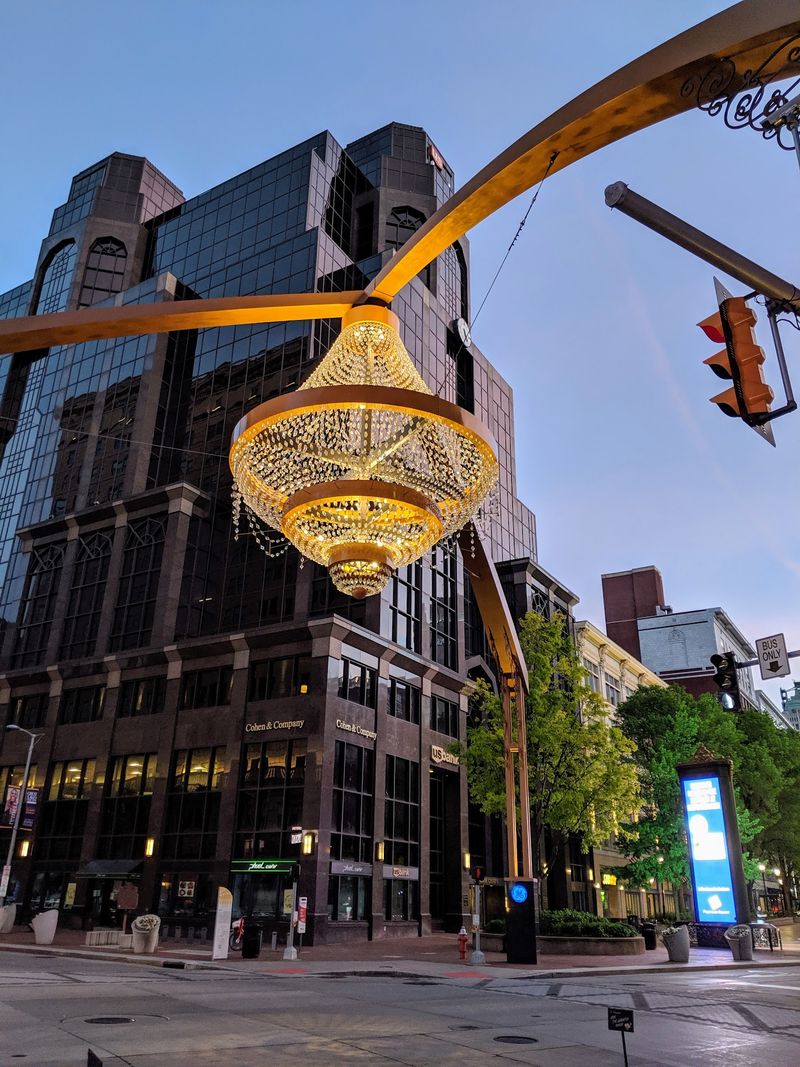
Four thousand two hundred crystals. I read that number before my visit and it meant nothing until I stood underneath and tried to follow a single strand with my eyes.
Each crystal was placed by hand, a slow job that took roughly twenty minutes per piece according to Playhouse Square. Do that math and the patience involved becomes genuinely impressive.
They are not glass, and that detail matters more than it sounds. Acrylic resin was chosen so the fixture could survive Ohio winters, lake winds, freezing rain, and summer heat without shattering across a public street.
Up close the crystals have a slightly softer glow than glass would give. Instead of sharp knife-edge sparkle, you get a rounder, warmer shimmer that spreads out rather than stabbing at your eyes.
I found myself thinking about maintenance. Somebody has to check thousands of individual pieces hanging four stories above moving cars, and that quiet, unglamorous work keeps the whole spectacle running.
A small tip for photographers: overcast evenings actually flatter it. Heavy cloud cover cuts the harsh contrast and lets the crystal layers separate in a photo instead of blurring into one bright blob.
It is craftsmanship disguised as decoration, and worth a few extra minutes of staring.
Engineering That Holds 8,500 Pounds in Midair
Beauty is the easy part of this story. The harder part is the steel.
The chandelier weighs about 8,500 pounds, which is roughly the heft of a couple of pickup trucks dangling over a public intersection. Knowing that number changes how you look at it.
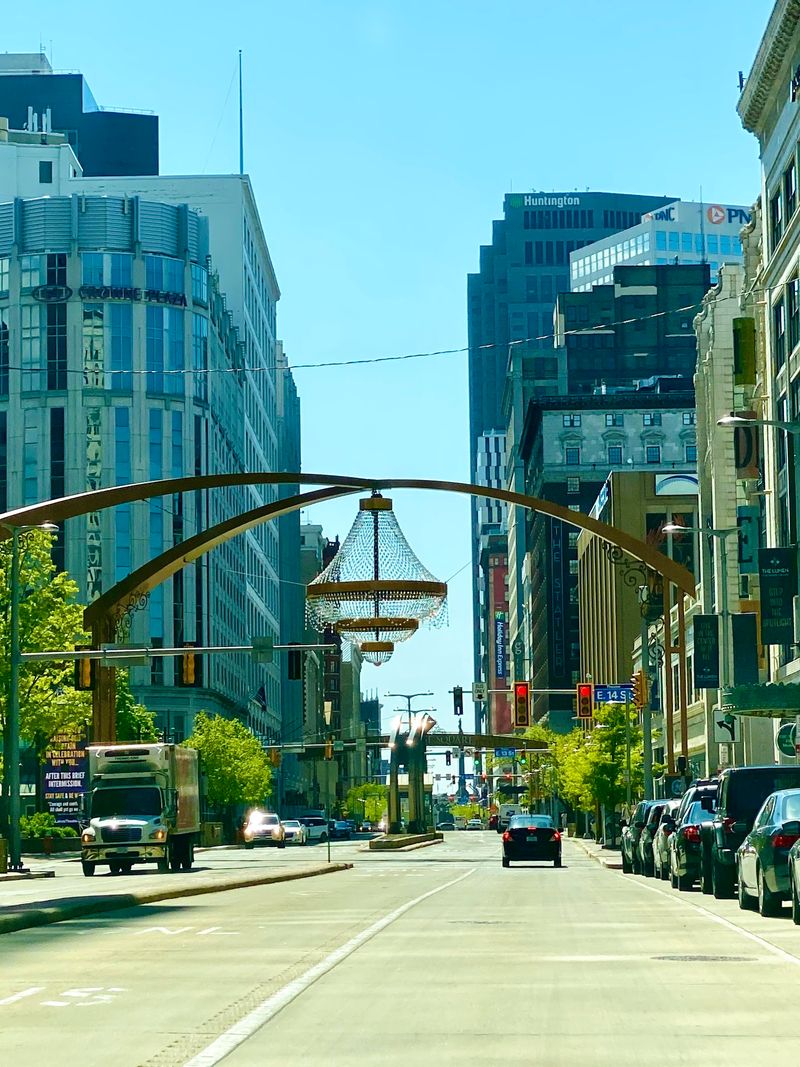
Holding all of that is a 44-foot steel structure with three sweeping arms, engineered to carry five times the actual load. That safety margin exists because Cleveland gets serious wind coming off Lake Erie.
I walked around the base of the supports for a while, mostly because the arms are elegant in their own right. They curve rather than jut, so the hardware reads as part of the design instead of an afterthought bolted on later.
On the windy evening I visited, the strands barely moved. That stillness is deliberate, and it says a lot about the planning that went into keeping something this delicate stable outdoors year round.
Designer Danny Barnycz of Baltimore developed the concept, and Montreal lighting manufacturer Lumid built it over the course of a full year.
If you like architecture and engineering, give the supports a proper look before you leave. They are the unsung half of the whole trick.
The Night It Switched On in 2014
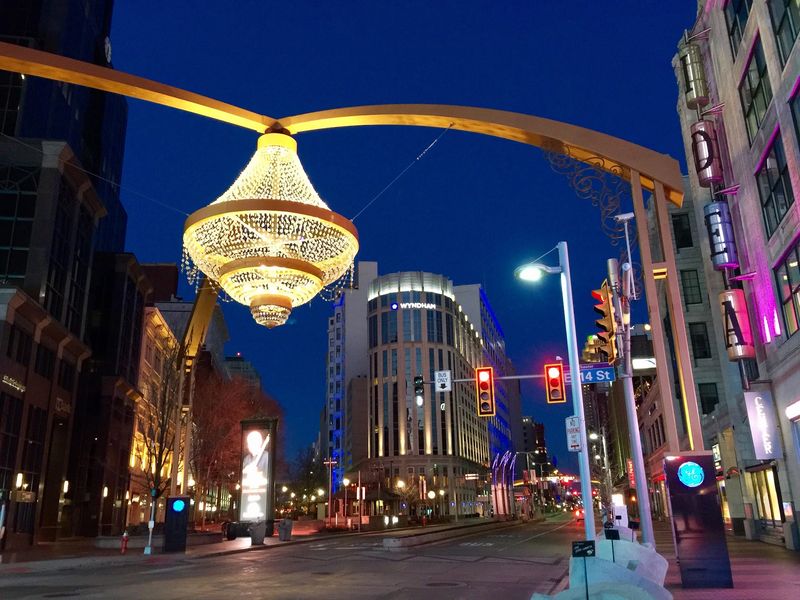
May 2, 2014 is the date locals will tell you about. That evening, the GE Chandelier was lit for the first time during a street celebration called Dazzle The District, and roughly 25,000 people packed the avenue to watch.
Picture that for a second. A crowd the size of a small town standing shoulder to shoulder on Euclid Avenue, waiting for a light switch.
Before that night, the streetscape outside the theaters did not match the opulence hiding inside them. Grand lobbies, gilded ceilings, painted murals, all of it tucked behind doors while the sidewalks stayed fairly plain.
The chandelier flipped that logic on its head. Instead of keeping the glamour indoors, Playhouse Square hung it over the street where anyone could enjoy it for free, no ticket required.
I like that decision a lot. It turns a cultural district into something open rather than exclusive, which feels very much in keeping with how Cleveland presents itself.
Ask around and you will hear plenty of people describe exactly where they were standing that night.
Anniversaries and holidays still bring color changes to the lighting, so the fixture keeps marking time for the neighborhood rather than just hanging there decoratively.
Five Restored 1920s Theaters Right Underneath
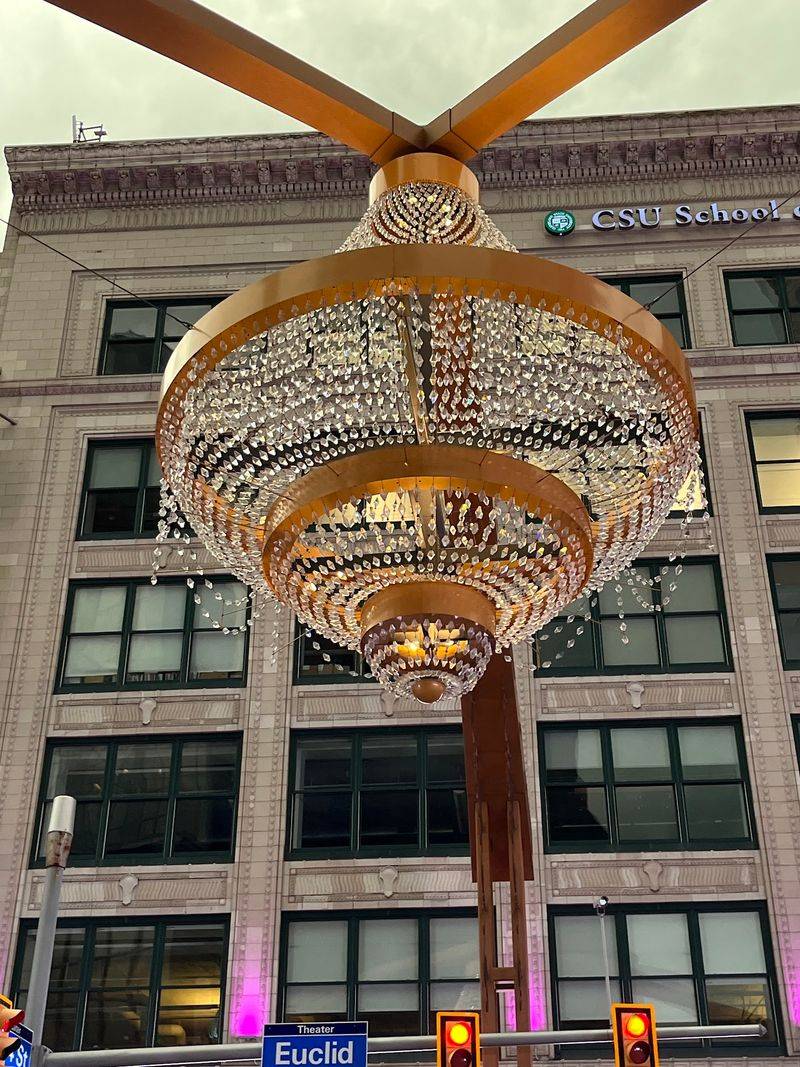
The chandelier is the doorway, not the destination. Once you notice it, your eyes drift down to the marquees glowing along Euclid Avenue, and that is where things get really interesting.
Playhouse Square holds ten performance spaces, including five grand theaters restored to their 1920s appearance: the Ohio, Palace, State, Allen, and Hanna.
Walk the block and you can peek through lobby glass at painted ceilings and sweeping staircases that belong in a different century. I did exactly that, nose practically pressed to the window, before deciding to come back for a proper tour.
Free public tours are offered, which is a genuinely good deal for anyone curious about architecture or stagecraft. You get the backstory on the murals, the restoration work, and the details most ticket holders rush past.
The district ranks among the largest performing arts centers in the country outside New York, hosting over 1,000 events a year and drawing more than a million visitors.
Broadway tours, concerts, dance, comedy, all of it happens here.
Even if you skip a show entirely, the exterior architecture rewards a slow walk. The buildings and the chandelier were clearly designed to be read together.
How Neighbors Saved These Theaters From the Wrecking Ball
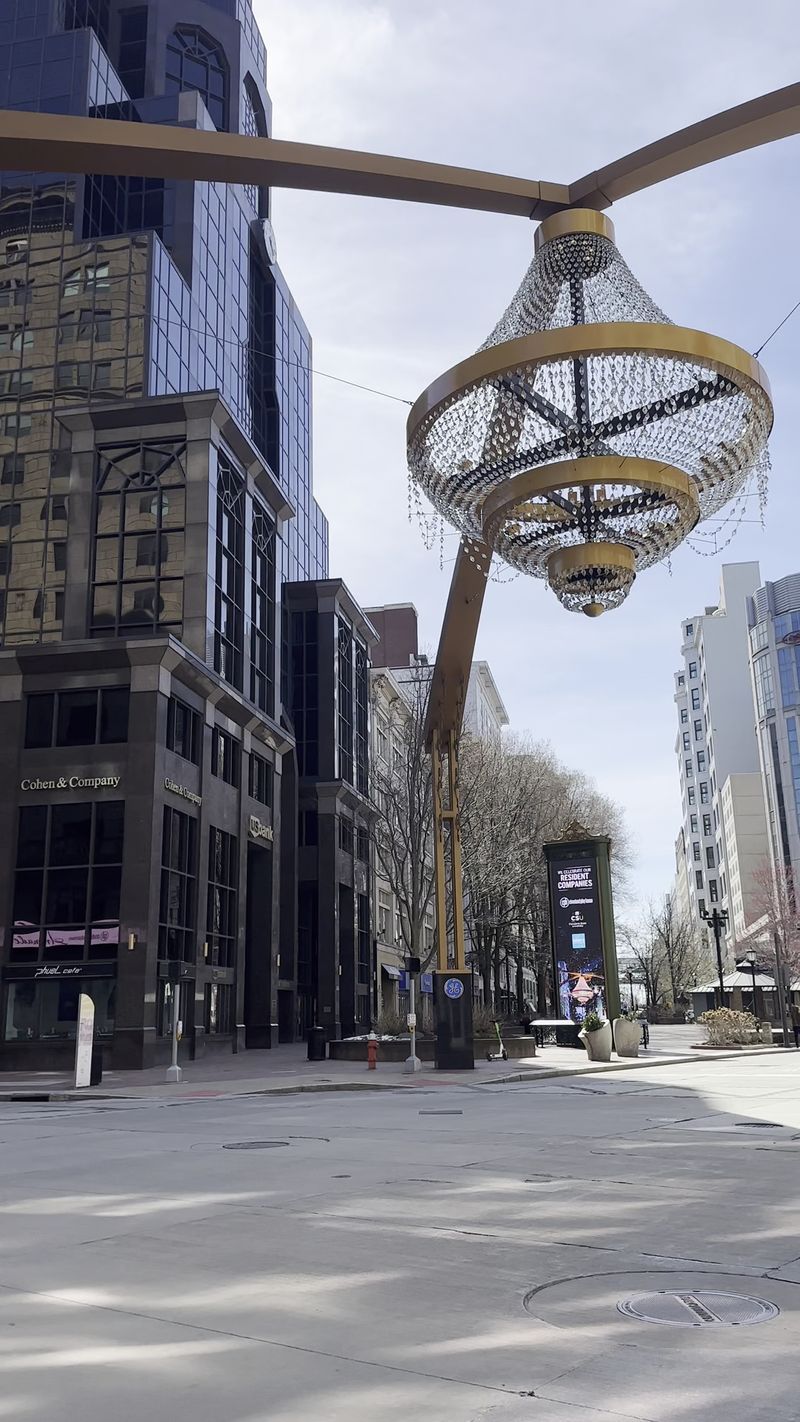
Here is the part of the history that genuinely moved me. In the 1970s, these theaters were nearly demolished.
Downtown had declined, the buildings sat dark, and the economics pointed toward tearing them down. That was the practical answer at the time.
A grassroots effort pushed back instead. Ordinary people organized, raised support, and fought to keep the theaters standing, which eventually launched what became the largest theater restoration project in the world at that point.
Think about how close it came. Without that stubbornness, there would be no ornate lobbies, no thousand annual events, and almost certainly no chandelier hanging over Euclid Avenue today.
Standing at the intersection with that context in mind changes the whole experience for me. The sparkle above reads less like decoration and more like a scoreboard for a fight the city won.
Restoration work brought back gilded plaster, murals, seating, and stage systems that had been abandoned for years.
I would recommend reading a bit of that history before you visit, or catching it on one of the tours. Knowing the near miss gives the entire district extra weight and makes the crystals overhead feel earned rather than merely expensive.
Parking, Walkways, and Getting There Without Stress
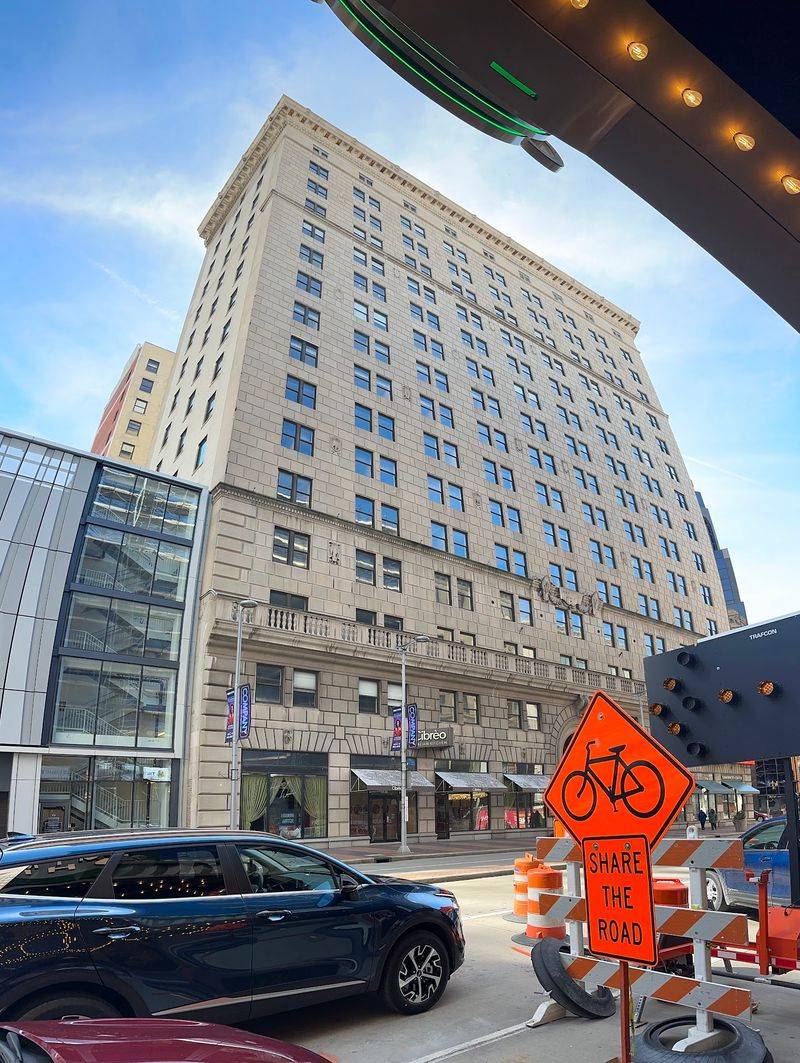
Parking is the one thing visitors grumble about, so plan for it. Street spots near the intersection disappear fast, especially on performance nights.
The good news is that garages are plentiful. The Playhouse Square Parking Garage at 1450 Chester Avenue connects to the theaters through covered walkways, which is a small mercy during a Cleveland snow squall or a sudden downpour.
Valet service operates on both sides of Euclid Avenue during evening and weekend performances, another option if you would rather hand over the keys.
Public transportation serves the district as well, and honestly it removes the whole parking puzzle from your evening.
My personal approach was simple. Park once, walk everywhere, and treat the entire district as a single stop rather than hopping between spaces.
Arriving thirty to forty minutes early solved most of my problems. That buffer covered the garage, the walk, a coffee, and a proper look at the chandelier before anything started.
The chandelier itself is accessible around the clock, so a late-night detour after dinner works perfectly.
Comfortable shoes help more than you would think, since the sidewalks invite a longer wander than most people plan for.
Why It Sticks With You Long After You Leave
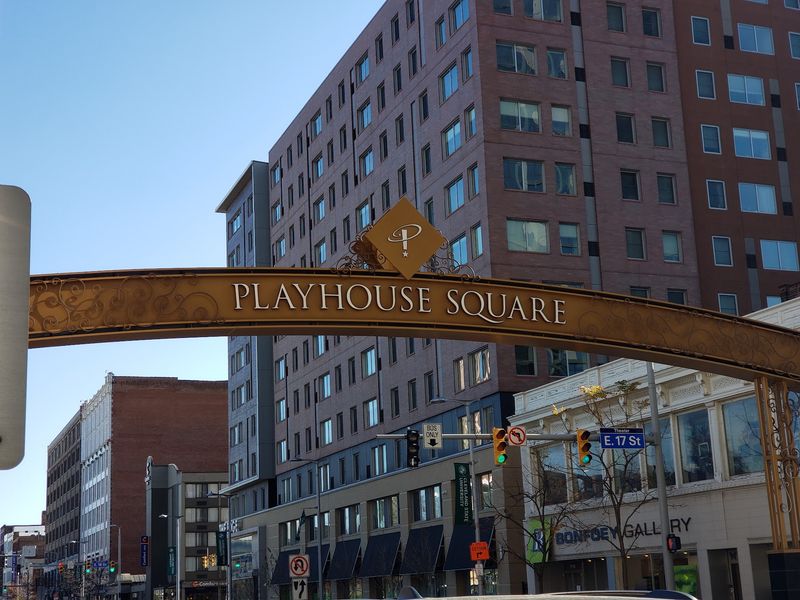
Two days after leaving Cleveland, I was still describing this thing to people. That rarely happens with a single landmark.
Part of it is the surprise factor. Chandeliers belong in ballrooms and lobbies, not swaying gently above a crosswalk, and that misplacement is exactly what makes it memorable.
The rest is what it represents. A city that nearly lost its historic theaters chose to hang its fanciest object outdoors, in public, where anyone walking by gets to enjoy it without paying a cent.
That is a confident move, and confidence looks good on Cleveland.
I keep coming back to the image of strangers stopping mid-stride, heads tipped back, briefly united by something shiny overhead. Public art rarely earns that reaction so consistently.
Visit during the day and it is handsome. Visit at night and it becomes unforgettable, so if you can only manage one trip, make it after dark.
Give yourself permission to stand there longer than feels reasonable. Cities move fast, and this is one of the few spots that politely insists you slow down and look up.
Address: 1501 Euclid Avenue, Cleveland, Ohio 44115
