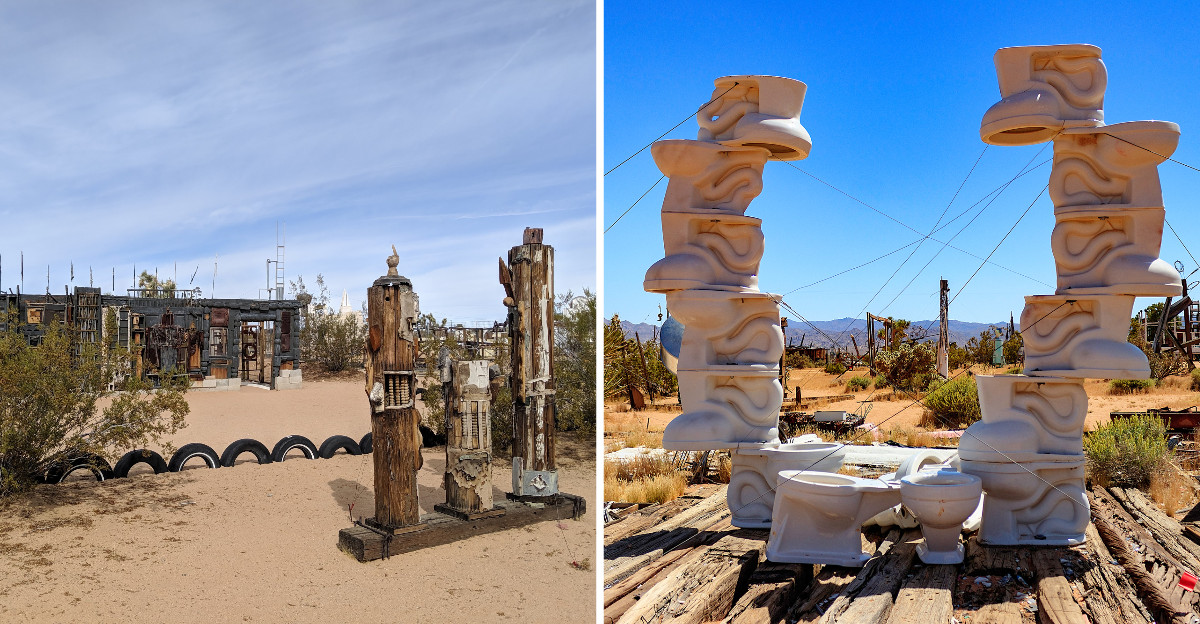
Towers of doors and rusted bicycle parts stand in the open sand, and nobody greets you at the gate. I took a wrong turn twice before the dirt road finally spat me out in front of a field full of sculptures.
For a few minutes I just stood there wondering whether I was allowed to walk in at all. That is the strange magic of this California desert art museum, where an artist spent the last fifteen years of his life building sculptures out of things the rest of us throw away.
The wind did most of the talking, rattling loose metal somewhere near a stack of old tires. I ended up staying far longer than I planned, looping back to pieces I thought I had already seen.
It remains one of the most honest, unpolished, and quietly moving places I have wandered through in the state.
The Man Who Traded Los Angeles for the Mojave
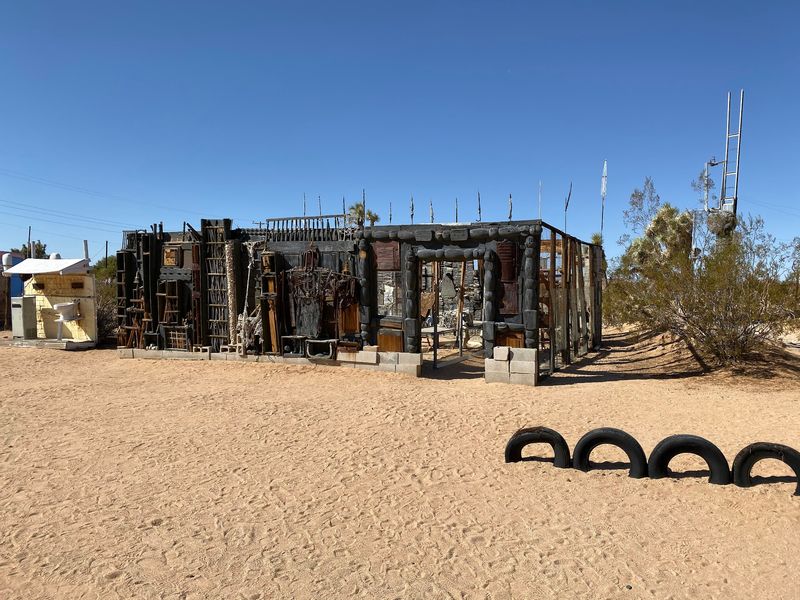
Noah Purifoy was seventy-two years old when he packed up his life in Los Angeles, California and moved out to the high desert in 1989. Most people that age are slowing down.
He started building.
Born in Snow Hill, Alabama, in 1917, Purifoy trained as an artist and worked as a teacher and social worker before becoming known as a sculptor. In 1964 he helped found the Watts Towers Arts Center, putting art directly into the hands of a neighborhood that had few other outlets for it.
The Watts Rebellion in 1965 changed the direction of his work permanently. He gathered melted signage and charred debris from the streets and turned that wreckage into an exhibition called 66 Signs of Neon.
From that point on, discarded material became his language. Joshua Tree simply gave him room to speak at full volume, with ten acres of open ground and nobody telling him what a sculpture was supposed to look like.
He kept working here until his passing in 2004, which means nearly everything you walk past was made by a man in his seventies and eighties.
Ten Acres With No Fences, No Ropes, No Ticket Booth
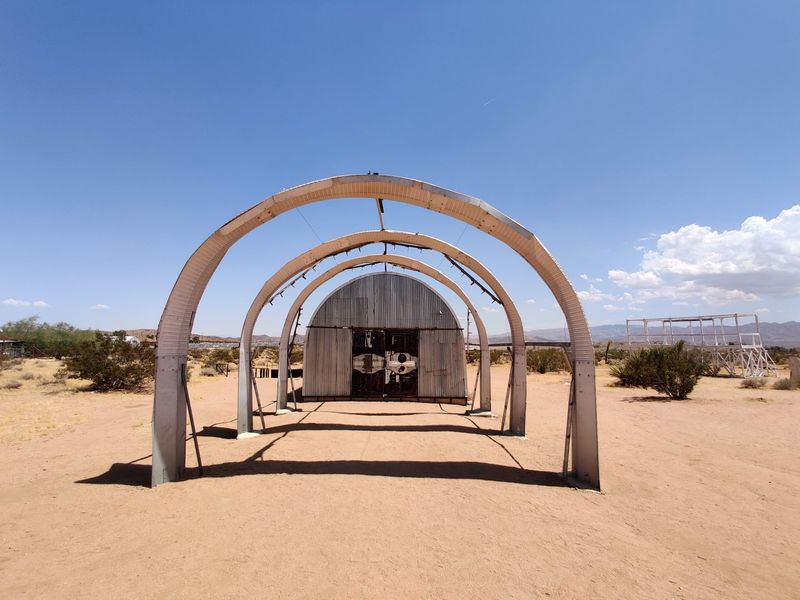
Arriving here feels nothing like arriving at a museum. There is no lobby, no attendant, no gift shop, and nobody scanning your bag.
You park on the dirt at the side of Blair Lane, walk past a sign, and you are in. Admission is free, and the site is open daily from sunrise to sunset.
Near the entrance there is a small box with brochures inside, which is genuinely worth grabbing before you start walking. It explains what several of the pieces are and gives you Purifoy’s own thinking behind them, which changes how the whole field reads.
What surprised me most was the lack of barriers. You can walk right up to the work, peer inside doorways, and look up through gaps in the structures.
That closeness does come with responsibility. The sculptures are fragile after decades of sun and wind, so climbing on them or leaning against them is off limits.
There is also a donation box on site, tucked near the sign-in area. It funds the upkeep of a place that asks nothing of you at the gate.
Morning Light, Golden Hour, and the Hours to Skip
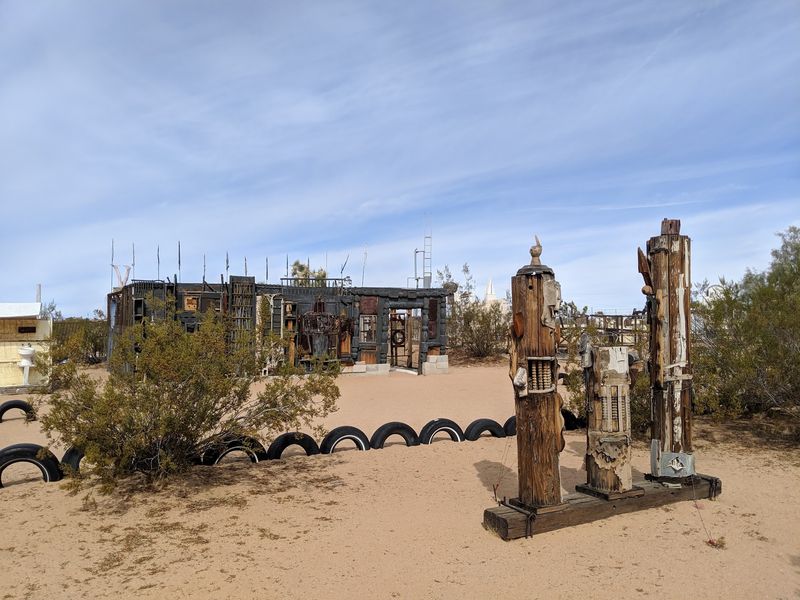
Timing changes this place more than you might expect. Early morning, around nine or nine thirty, the light is soft and you may share the whole ten acres with only a handful of other people.
Late afternoon delivers something different. Shadows stretch long across the sand, rusted surfaces glow orange, and the sky behind the sculptures turns into a proper show as the sun drops.
Midday in summer is the version I would avoid. There is almost no shade anywhere on the property, and no benches or shelters to duck under.
Winter mornings can be genuinely cold out here too, so the high desert swings in both directions. Checking the forecast before driving over is not overcautious, it is sensible.
Most people spend somewhere between forty minutes and two hours walking the site. A fast loop is possible in about twenty minutes, but you will miss half of it.
I gave it roughly ninety minutes and still felt rushed at the end. Bring more time than you think you need, and let yourself double back.
What to Pack Before You Step Onto the Sand
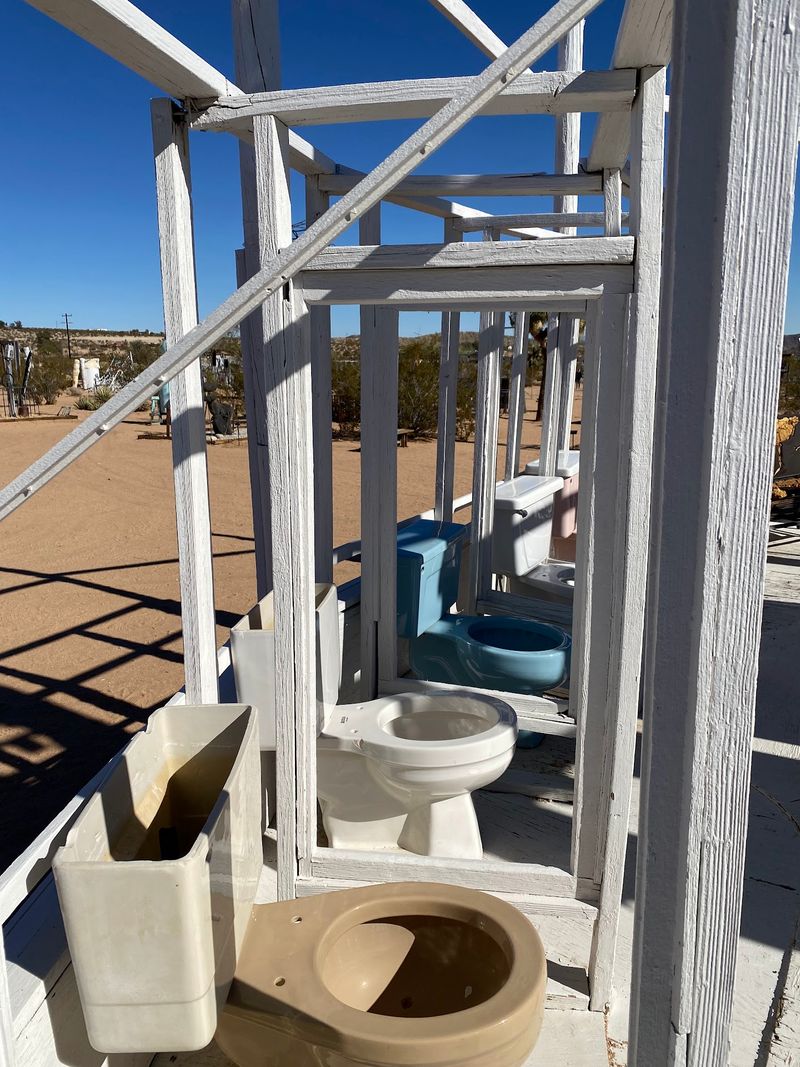
Water first. There is nowhere to buy anything on site, and the desert pulls moisture out of you faster than you notice.
A wide-brimmed hat and sunscreen belong in the same category as the water bottle. Shade is essentially nonexistent across the whole property.
Closed-toe shoes make a real difference. The ground is sandy and uneven, with bits of metal, wire, and broken material scattered around the bases of some pieces.
There are no public restrooms anywhere on the grounds, which catches people out regularly. Sorting that in town before you drive over saves an uncomfortable walk back to the car.
Cameras and phones are welcome, and the site is a photographer’s playground. Drones, however, are not permitted.
Leashed, well-behaved dogs can come along, though the sand gets scorching in warm months and paws burn easily. Cooler mornings are far kinder for four-legged company.
One more practical note from other visitors: bees have settled inside some of the hollow structures. Give any loud buzzing a wide berth and carry on walking.
More Than a Hundred Installations to Wander Between
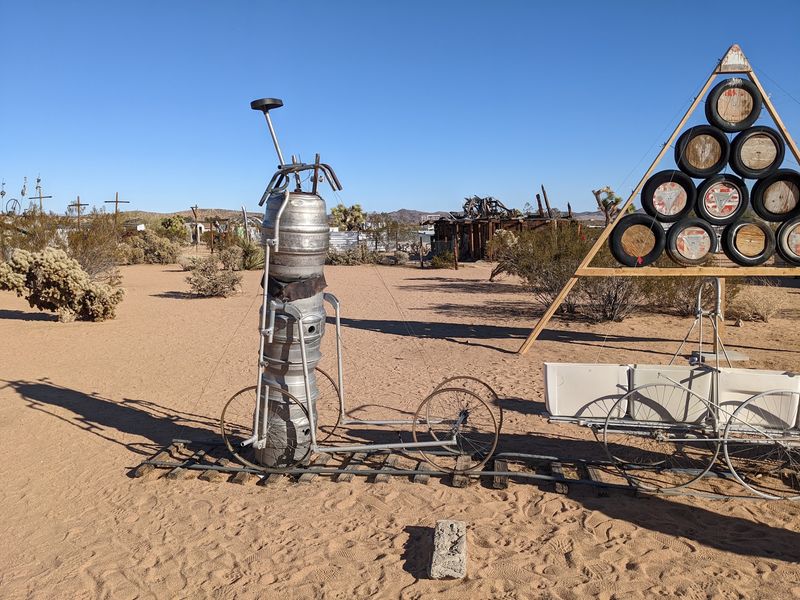
Counting the sculptures properly is harder than it sounds, since many of them blur together into larger environments. The site holds more than one hundred works across the ten acres.
Some are enormous, walk-through structures with corridors and rooms. Others are small clusters you could easily stride past without noticing.
Purifoy built passageways, towers, arches, and low mazes, so the experience is genuinely three-dimensional rather than a row of objects on plinths. You duck, step over, and peek around things constantly.
What I liked was the total lack of a prescribed route. No arrows, no numbered order, no suggested path through the field.
You wander, backtrack, and find things you missed the first time. Two people visiting together will often see completely different sequences.
Scale sneaks up on you as well. From the parking area the whole site looks modest, then you start walking and realize how far back the installations continue toward the open desert.
Give yourself permission to sit with one piece for a while. The slow pace suits this place far better than efficiency.
The Foundation Keeping It All Standing
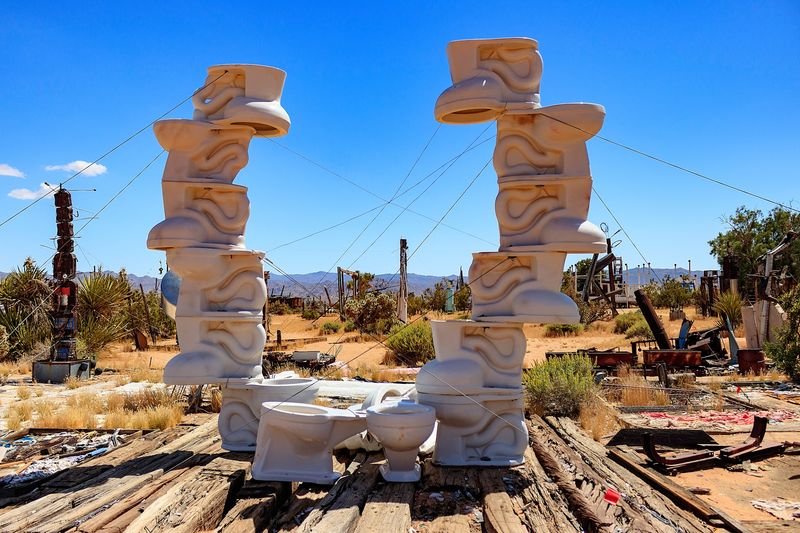
Purifoy set up the Noah Purifoy Foundation in 1998, six years before he died, together with his longtime colleague Sue Welsh. It was a practical move by someone who clearly thought about what would happen to the work after he was gone.
The foundation is a nonprofit run by volunteers. Its job goes beyond propping up sculptures, extending to building public recognition for Purifoy’s role as both an artist and an educator.
A conservation plan guides how the site is cared for, and the emphasis sits firmly on preservation over rebuilding. Replacing weathered material with shiny new parts would contradict everything the work stands for.
Keeping ten acres of open-air sculpture stable in a climate this harsh is not cheap, which is what that modest donation box near the entrance is for.
I dropped something in on my way out and felt it was the least I could do after an hour and a half of free wandering.
The fact that anyone can show up, any day, at no cost, reflects exactly how Purifoy wanted his art to reach people.
Pairing the Visit With the Rest of Joshua Tree
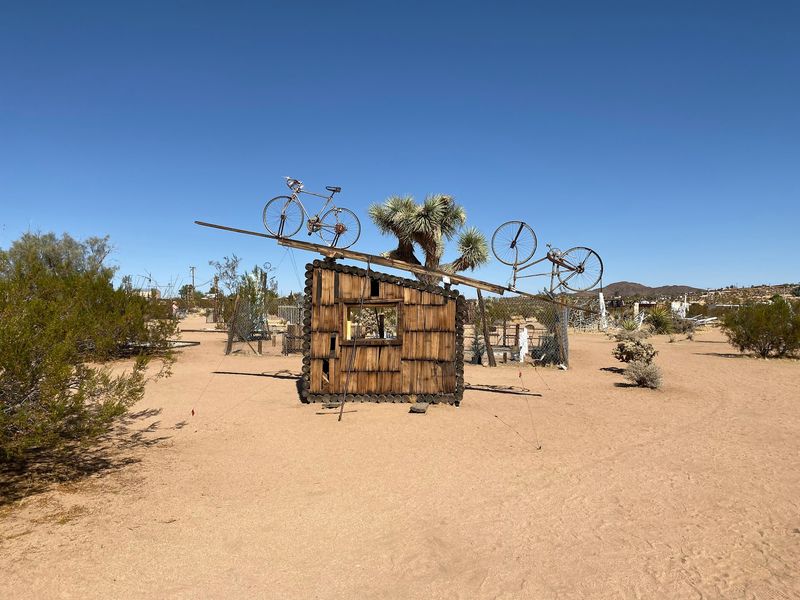
Most people who end up here are already in the area for the national park, and the two pair together nicely. The museum sits just outside the town of Joshua Tree, a short detour off Twentynine Palms Highway.
Doing the sculptures first thing in the morning, then heading into the park afterwards, worked well for me. The light is kinder early and the crowds have not built up at either spot.
Alternatively, save the museum for late afternoon after a day of hiking among boulders. Arriving as the sun drops gives the rusted metal a completely different character.
Joshua Tree town itself is full of independent shops, galleries, and cafes worth a slow browse. The whole area has an offbeat creative streak that the museum fits into perfectly.
Cell service can be patchy along the back roads, so downloading directions beforehand is a smart move.
Honestly, plenty of visitors who describe themselves as not being art people still walk away impressed. The place does not require any background knowledge to hit you.
Why the Dust Stays With You Afterwards
Driving back toward the highway, I kept thinking about how much of this was built by one person who simply decided to start.
No gallery commissioned it. No committee approved the layout.
A man in his seventies collected what nobody wanted and spent fifteen years arranging it in the sand.
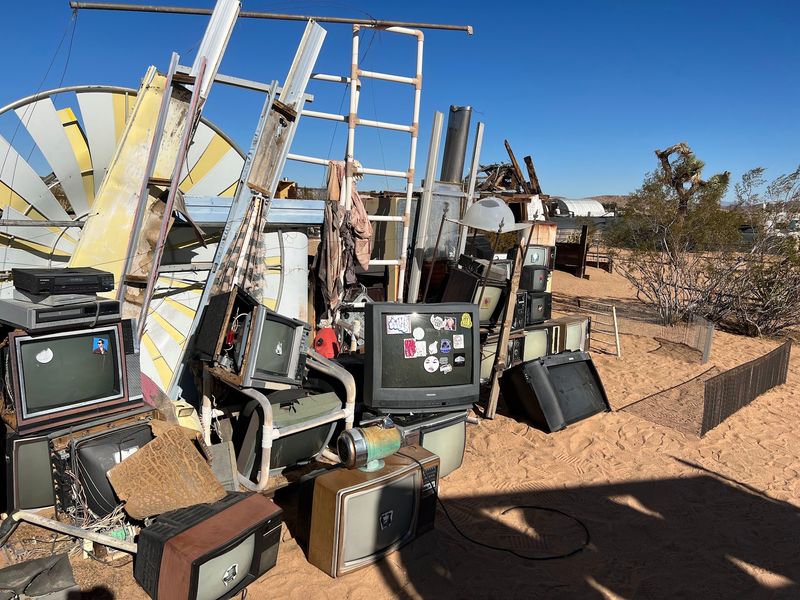
The museum asks you to look harder at ordinary things, which is a surprisingly durable takeaway from an afternoon in the desert. Old doors, destroyed televisions, broken furniture, all of it carrying more meaning than we usually grant it.
It also refuses to be tidy. The work is dusty, cracked, occasionally confusing, and all the better for it.
Some visitors find it thought-provoking, others find it strange, and a fair few find it both at once. Very few people leave feeling nothing.
If you are heading toward Joshua Tree with an hour to spare, take the bumpy road. Ten acres of somebody’s lifelong conviction is waiting at the end of it, free to walk through, open from sunrise to sunset.
Address: 62975 Blair Ln, Joshua Tree, California 92252
