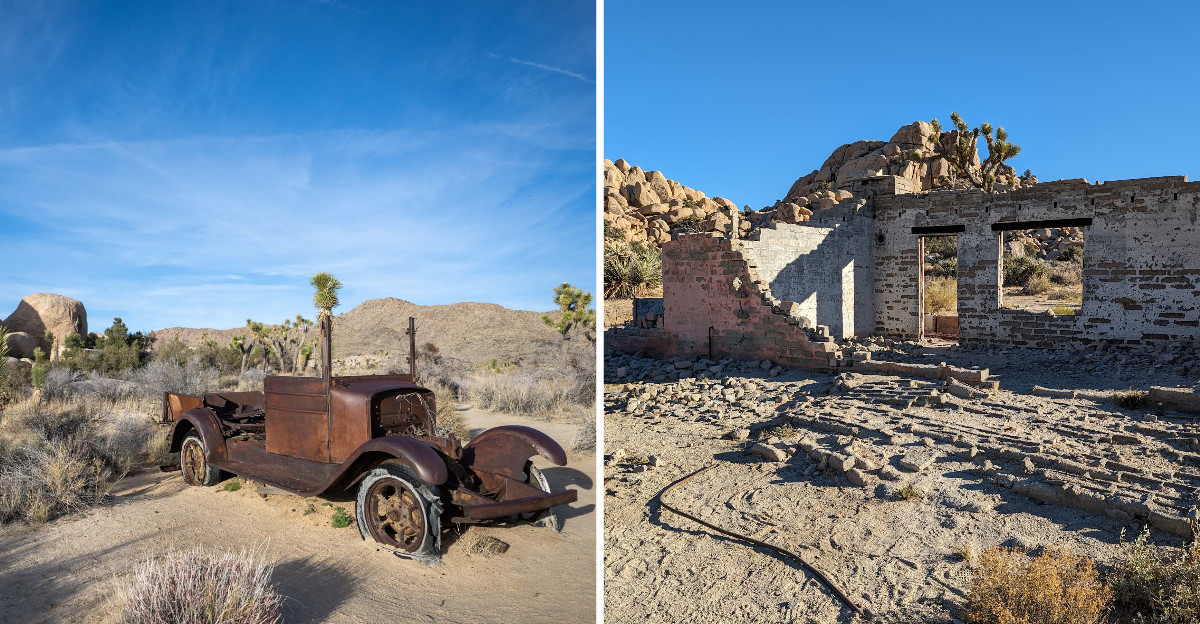
Rusted car doors half swallowed by creosote bushes are not what a desert hike usually delivers, but sand crunches under boots and Joshua trees throw crooked shadows across the wash. Wandering into somebody’s forgotten backyard is what it felt like at first.
Then the mill came into view, sitting low against a slope with corrugated metal walls still holding together after more than ninety years. Ruins are common in California’s high desert, but this one feels different because so much of the machinery is still bolted in place, waiting for someone to flip a switch.
The rancher and miner behind it knew this desert better than almost anyone, assembling the works starting in 1930 and keeping them running on and off until 1966. Mining equipment, a well, and the old mill sit along a short trail that rewards curiosity.
Of all the easy hikes in the region, this one is worth recommending to friends who want history and scenery in the same mile. Boots stay dusty, the camera stays busy, and the past stays right where it was left.
Bill Keys and the Gold Mill He Pieced Together
Bill Keys was a rancher first, a miner second, and a scavenger of useful metal always. He picked up the Wall Street Mill site in 1930 and had ore moving through it by about 1931.
What surprised me most is that the machinery is older than the mill itself. Keys gathered up equipment built in the late 1800s, hauled it into this rocky basin, and fitted the pieces together into one working operation.
He ran it as what miners called a custom mill. Small-time prospectors brought their ore here, Keys crushed it, and he kept a share of whatever gold came out as payment.
His own Desert Queen Mine fed the mill too, which made the setup even more useful for him.
Standing near the building, I kept thinking about the sheer stubbornness involved. There was no easy road, no power line, and no hardware store nearby.
Keys kept the place going in fits and starts until 1966, which means people alive today remember it running. That detail alone changed how I looked at the rust, since it suddenly felt recent rather than ancient.
Two Stamps, One Jaw Crusher, and a Lot of Noise
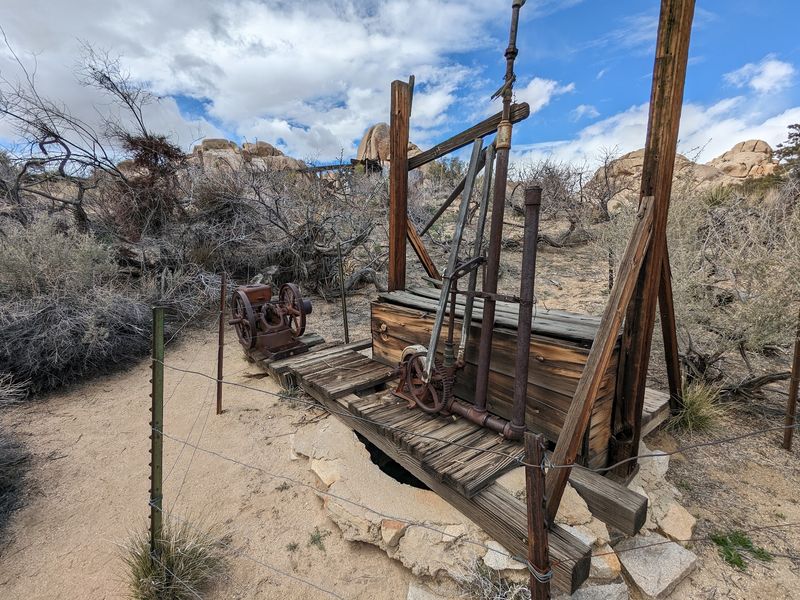
Here is the part that gearheads and history nerds both love. The heart of the operation is a two-stamp mill made by Baker Iron Works, and right beside it sits a jaw crusher from Fulton Engine Works dated 1891.
Ore came in chunky and had to be broken down before any gold could be separated out. The crusher handled the first rough smashing, then the stamps pounded the rock into something closer to coarse sand.
After that came a Myer concentrating table, which used water and motion to separate heavy gold particles from worthless material.
I stood there for a while trying to imagine the racket. Two heavy stamps dropping over and over in a metal-sided shed, in a valley where the loudest thing now is wind through the Joshua trees.
A twelve-horsepower Western gasoline engine powered everything, connected to the moving parts by a web of shafts, belts, and pulleys.
Plenty of those components are still where Keys bolted them. A 1931 blueprint displayed at the site helps you match the drawings to the actual iron in front of you.
Water in a Place That Has None
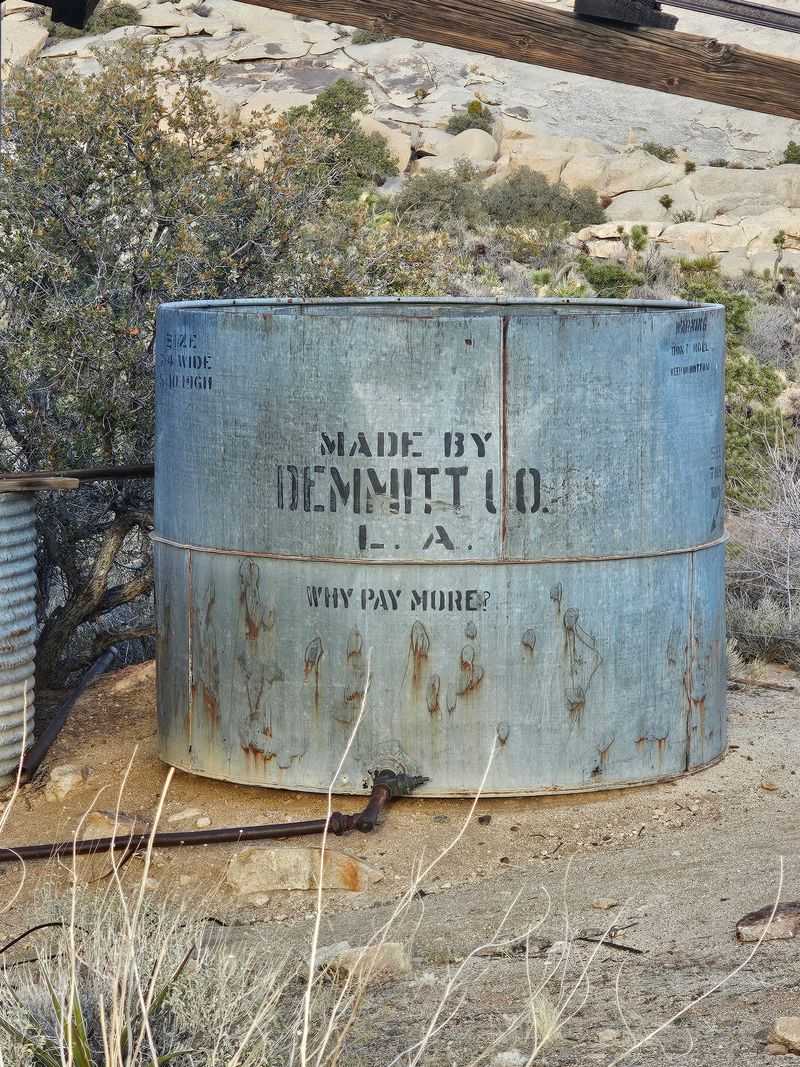
About halfway along the trail, you pass a windpump and some big galvanized tanks that look like they were dropped from another century. I almost walked past them before realizing they were the reason the whole mill could function.
Crushing gold ore takes water, and lots of it, since the concentrating table needs a steady flow to wash and sort the material.
Keys solved that problem with a hand-dug well near the mill. A three-horsepower Fairbanks Morse engine pumped the water up into those large iron tanks so it would be ready when the stamps were running.
Think about that for a second. Someone dug a well by hand in ground this dry and rocky, then trusted a small engine to keep the operation alive.
Water shaped everything out here, including the arguments between neighbors. In a landscape where a well meant survival, access to one was worth fighting over.
I found the tanks oddly moving, more than the machinery in some ways. They are plain, dented, and completely essential, which sums up desert life pretty well.
Without that stored water, even the toughest equipment was useless, a reminder that survival here depended as much on careful planning as it did on hard physical work.
Rusted 1930s Cars Parked Forever in the Wash
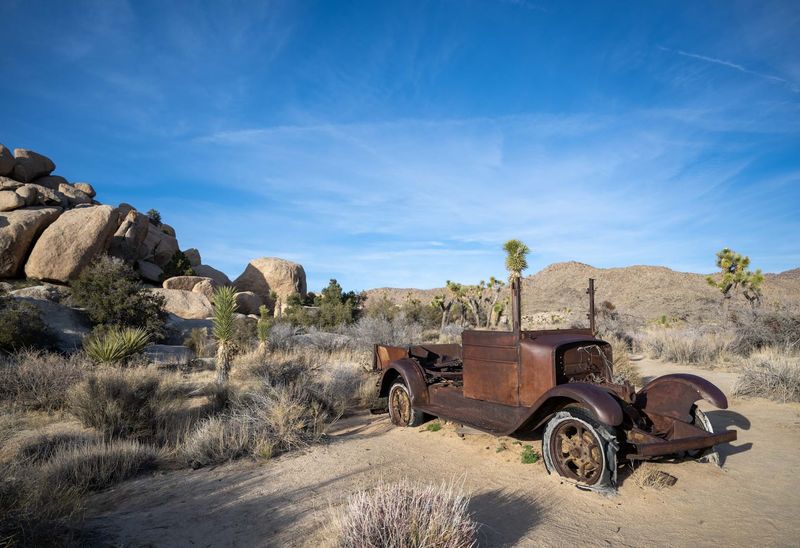
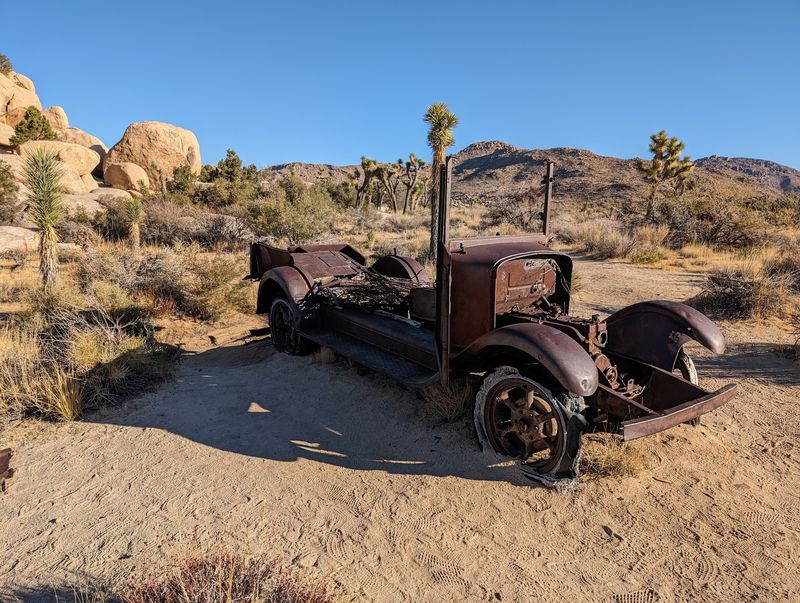
Nothing on this California hike gets more camera attention than the old cars. Several vehicles from the 1930s sit scattered around the area, stripped down to frames, fenders, and the occasional hollow headlight socket.
Some sit near the mill, and others hide off to the north of the main trail, which means a little wandering pays off. A few visitors miss them entirely by keeping their eyes on the path.
The paint is long gone, replaced by that deep orange-brown color metal turns after decades of sun.
Photographers, this is your spot. Rust against pale sand, with Joshua trees and dark monzogranite boulders behind, makes for pictures that barely need editing.
Keys reportedly kept a lot of machinery and vehicles around because parts were valuable in a place this remote. Whatever the reason, the result is a strange open-air collection nobody curated.
One tip from experience: look but do not climb or collect. Everything here is protected, and the sharp edges on ninety-year-old metal are no joke.
The Worth Bagley Stone and a 1943 Dispute
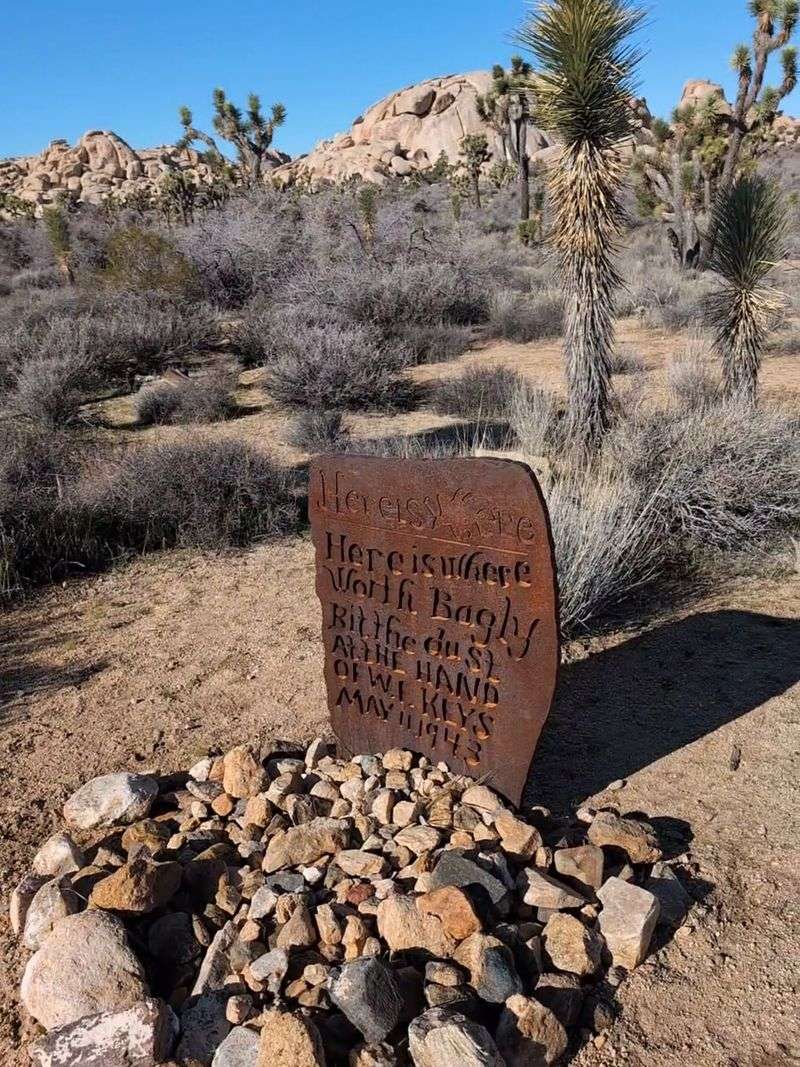
A small marker sits beside the trail, and it carries the heaviest story on the whole route. In 1943, a disagreement over water rights and access to the mill ended with Bill Keys fatally shooting his neighbor Worth Bagley.
Keys later placed a stone monument at the spot where it happened. That original stone was removed after being vandalized, and a replica now stands in its place.
Keys was convicted and sent to prison, then eventually received a full pardon.
Reading the marker in the middle of all that quiet made me pause longer than I expected. Two neighbors, miles of empty land between them, and still not enough room to share a road and a well.
Hikers often use the marker as a navigation checkpoint, since the trail is not heavily signed. If you reach the stone, you are on the correct path toward the mill.
It is a grim footnote, but it explains something real about this landscape. Scarcity made people territorial, and the desert kept the receipts.
Standing there also puts the isolation into perspective, because help, water, and even another neighbor were never close at hand when tensions began to rise between people.
Wonderland Ranch Ruins, the Detour Worth Taking
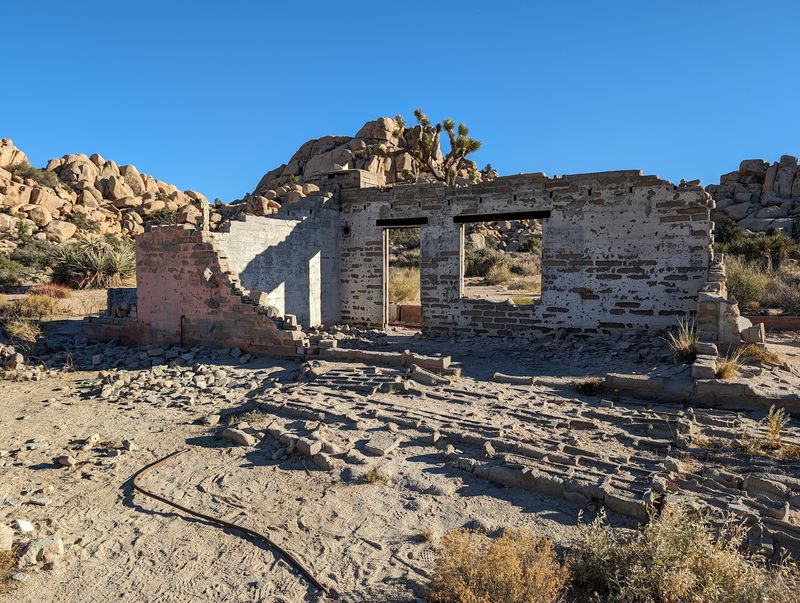
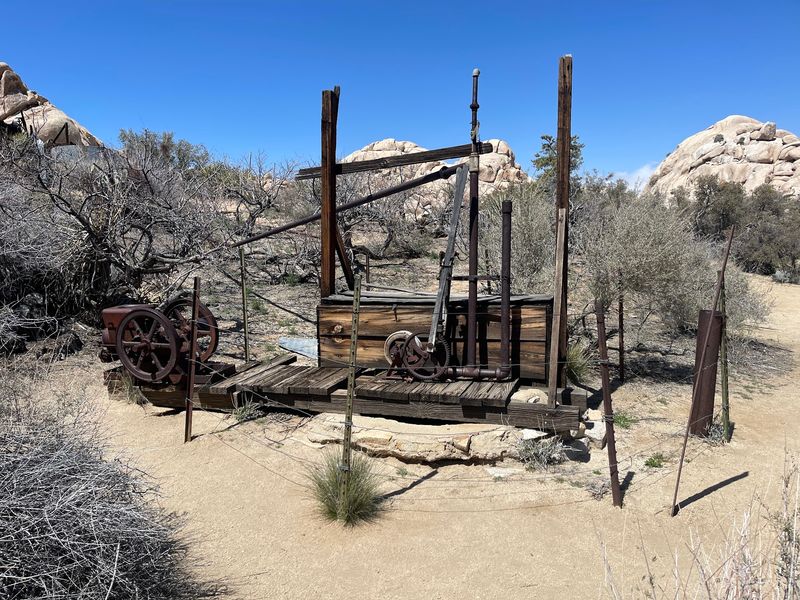
Just off the main route, a short spur leads to the remains of the former Wonderland Ranch, and I would feel bad not mentioning it. What is left is a shell of a house with a chimney and fireplace still standing among enormous boulders.
Plenty of hikers accidentally end up here first and think they have found the mill. The ruins are impressive enough that nobody seems to mind the mix-up.
Boulders around the site are easy to scramble onto for a wider view of the basin.
My favorite thing about this detour is how it changes the mood. The mill is all industry and iron, while the ranch feels domestic, like someone tried to build a normal life inside a rock pile.
Give yourself an extra twenty minutes if you want to poke around both spots. The distance is tiny, but the scrambling slows you down.
Keep off the fragile walls and leave everything where it sits. These ruins survive on visitors being gentle with them.
Hiking the Trail Without Getting Turned Around
Short, flat, and sandier than you expect. The full walk from the main Wonderland of Rocks trailhead runs roughly 2.1 to 2.2 miles round trip, with barely any elevation gain.
A second dirt parking area up the road trims a bit of walking off each end. Both lots fill quickly, so arriving early helps more than anything else.
Loose sand is the only real challenge, and it feels heavier on the way back than on the way in.
Signage is thin, which trips people up. I would download a map before you go, since cell service is unreliable and side paths branch off toward the various ruins.
Shade is basically nonexistent, so bring more water than feels necessary and wear a hat. Restrooms sit at the trailhead, which regular park visitors will recognize as a small luxury.
Pair it with the nearby Barker Dam loop for a relaxed half day. Watch for bighorn sheep on the slopes, and remember dogs are not allowed on park trails.
Address: Twentynine Palms, California 92277, United States
