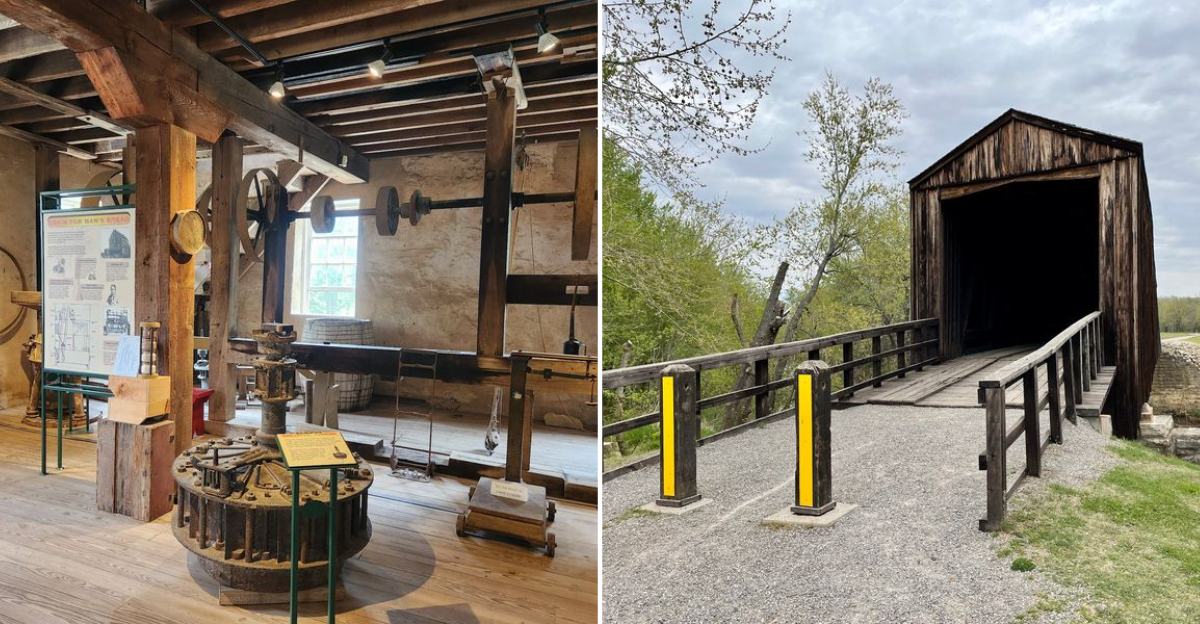
The water still turns the wheel, just as it has for more than a century. A massive four-story mill of stone and brick rises beside the river, its griststones still grinding corn into meal.
The mill was rebuilt after Union troops burned its predecessor during the Civil War, and it has stood ever since. Just a few steps away, a wooden covered bridge stretches across the water, one of only four such bridges left in the state.
Built with a Howe truss framework, it has carried travelers across the river since the eighteen sixties. Together, they form a rare pairing, a water-powered mill and a covered bridge side by side.
It is a scene that feels frozen in time, a place where the past is not just preserved but still in motion. In Missouri, history is not something you read about, it is something you can still walk through.
The Four-Story Brick Mill That Stops You In Your Tracks
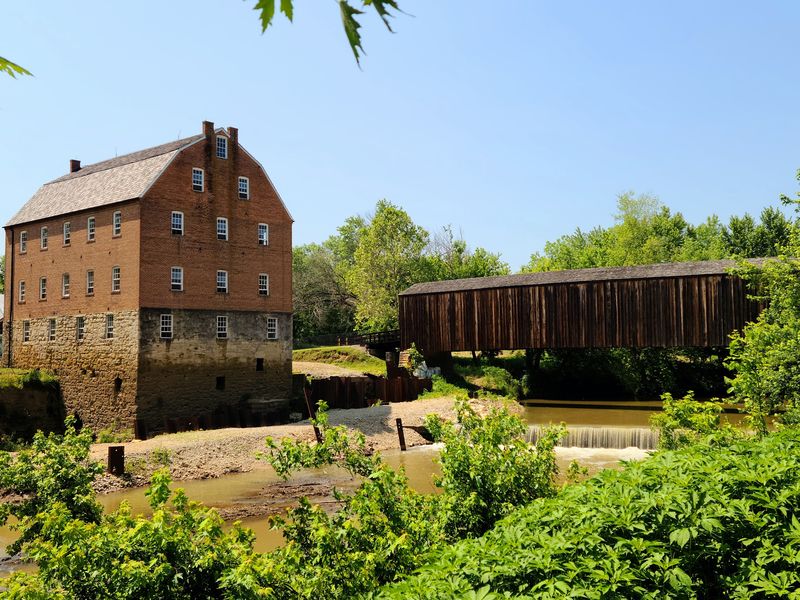
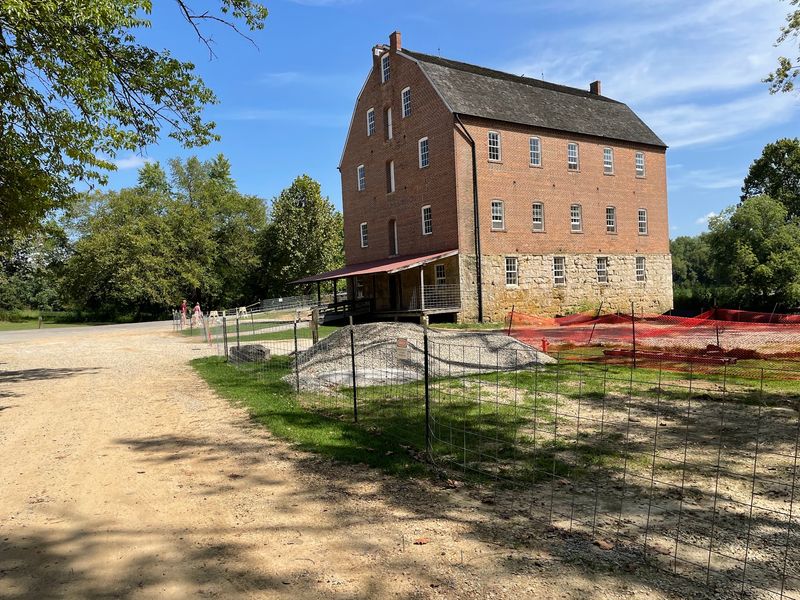
You come around the bend and suddenly there it is, this enormous brick building rising up out of the trees like it has every right to be there. Four stories is taller than you expect for an old country mill, and the scale of it really lands once you are standing at the base looking up.
What makes the story interesting is that the mill you see today was rebuilt after the original one on this spot was burned during the Civil War. Solomon R.
Burford put this version up, and he built it right on top of the limestone foundation from a much earlier mill, so the bottom of the building is older than the top.
I love that detail because it means you are looking at layers of time stacked on each other, not just one moment frozen in place. The brickwork has that weathered, uneven color that only comes from decades of weather doing its thing.
Bring a camera, because the mill photographs beautifully from just about every angle, especially from down near the water where you can get the whole height of it in one frame. Give yourself time to just look at it before you go inside.
Where To Actually Find The Place
Let me save you some wandering around, because this one sits out in the countryside and your phone signal may get a little moody on the way there. The address is Bollinger Mill State Historic Site, 113 Bollinger Mill Road, Burfordville, MO 63739, and it is worth punching that in before you leave the main highway.
The drive out is genuinely pleasant, all rolling farmland and tree lines and the occasional barn that looks like it has stories of its own. Once you turn onto the road toward the site, things get narrow and quiet in the best possible way.
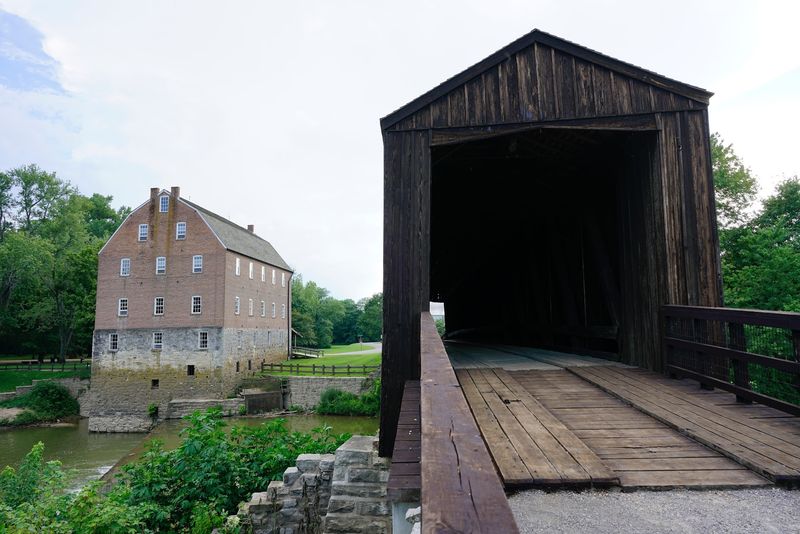
Parking is right there near the buildings, so you are not hiking in from some distant lot, which I always appreciate. From the moment you step out of the car you can see both the mill and the bridge, which is honestly a little startling the first time.
My advice would be to treat this as a slow stop rather than a quick photo grab, because the whole appeal is how unhurried it feels. Wear shoes you do not mind getting a little dusty, since the ground around the site is grass and gravel rather than paved walkways.
Old Milling Machinery You Can Walk Right Up To
Stepping inside the mill is where things get really fun, because the machinery is still in there waiting for you. Not replicas or models behind glass, but actual equipment that once turned wagonloads of grain into flour for the whole area.
You will see separators, roll stands, purifiers, and bolters, and even if those words mean nothing to you right now, the shapes and belts and wooden chutes tell the story on their own. There is something about the smell and the light inside an old mill that photographs never quite capture.
Visitors can take a self-guided walk through the first floor and the basement, which is plenty if you are just curious and passing through. If you want the full picture, guided tours of the whole building are available, and that is the option I would push you toward.
Going up through all four floors gives you a sense of how the grain moved downward through the process, which is the part that finally makes the whole system click in your head. Ask questions while you are in there, because the mechanics are genuinely clever once somebody explains the flow.
Missouri’s Oldest Surviving Covered Bridge
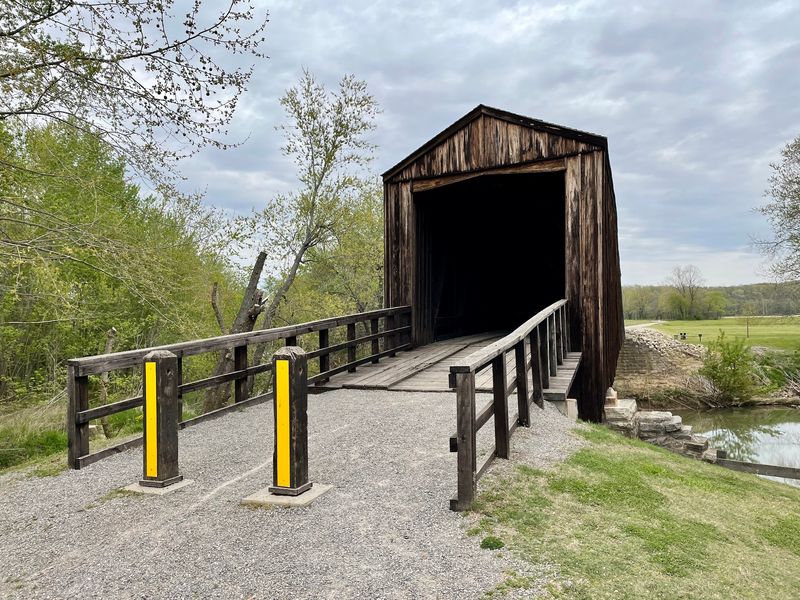
Right beside the mill, stretching across the Whitewater River, sits the Burfordville Covered Bridge, and this is the piece that makes the site truly rare. Out of the handful of covered bridges still standing anywhere in Missouri, only four remain, and this one is the oldest of the bunch.
Work on it began before the Civil War broke out, and construction dragged on through those years before it was finally finished afterward. Knowing that the bridge sat unfinished through such a rough stretch of history makes the timbers feel a little heavier when you look at them.
The wood has that gray, silvery look that only decades of sun and river air produce, and the roof line against the trees is exactly the picture you have in your head when somebody says covered bridge. It is longer than most people expect, too.
Photographers, take note that the light coming through the open sides creates striped shadows across the floorboards, and that shot alone is worth the trip. Stand at one end and look straight through for the classic tunnel-of-wood view that everybody wants.
Walking Through On Foot Instead Of Driving
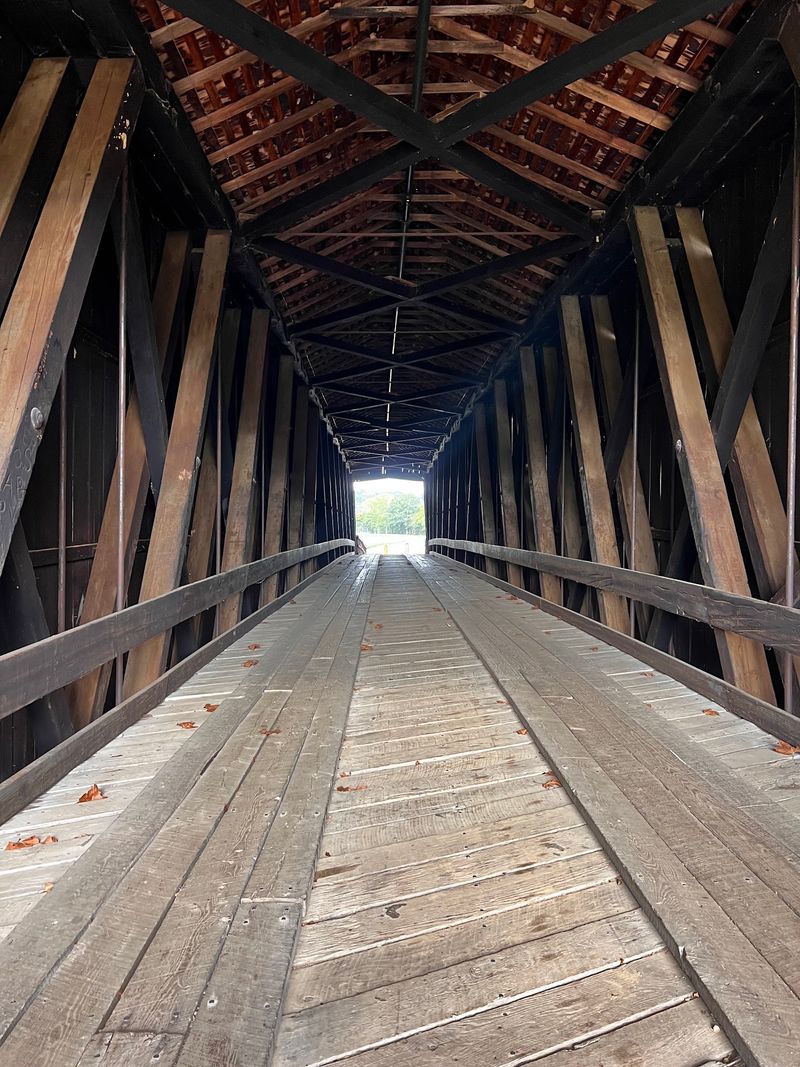
Here is something worth knowing before you get excited about driving across it, because those days are long gone. Wagons and buggies once rolled through here as part of a toll road, but now the bridge is reserved for people on foot only, which honestly makes for a better experience.
Walking through slowly lets you actually study the structure, and that is where you notice the Howe truss design holding everything together. The system pairs diagonal wooden beams with vertical iron rods, and the combination is what gave the bridge its strength.
Once you spot the pattern you cannot unsee it, and you start appreciating just how much thought went into a structure built without any of the tools we take for granted. Run your eyes along the joints and you will see hand-cut work everywhere.
The sound changes when you step inside, too, since the roof and walls muffle the outside world and the river noise takes over. Take your time in there rather than rushing across, because standing still in the middle is the whole point of a covered bridge in Missouri or anywhere else.
That Quiet Stretch Of The Whitewater River
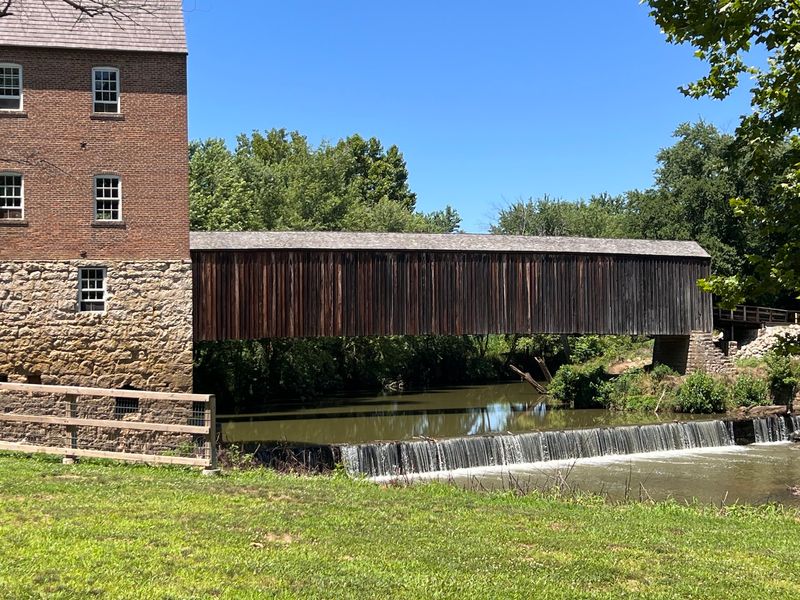
The river is the reason any of this exists, so it deserves more than a passing glance. Water from the Whitewater River powered the mill, first through a water wheel and later through a more efficient water-driven turbine that squeezed more work out of the same current.
Standing near the water and watching it move past the base of the mill, you get why somebody looked at this exact bend and decided to build here. The whole setup makes sense in a way that maps and photos never quite convey.
There is a tree-shaded picnic area near the site, and if you packed anything to eat, this is where I would tell you to settle in for a while. Eating lunch with a covered bridge in your line of sight is a pretty solid way to spend part of a day.
The sound of moving water does something to the atmosphere here, softening everything and making the buildings feel older and calmer at the same time. Bring a blanket or a folding chair if you like sitting low, and just let the river do its thing for a bit.
A Short Trail And An Old Cemetery
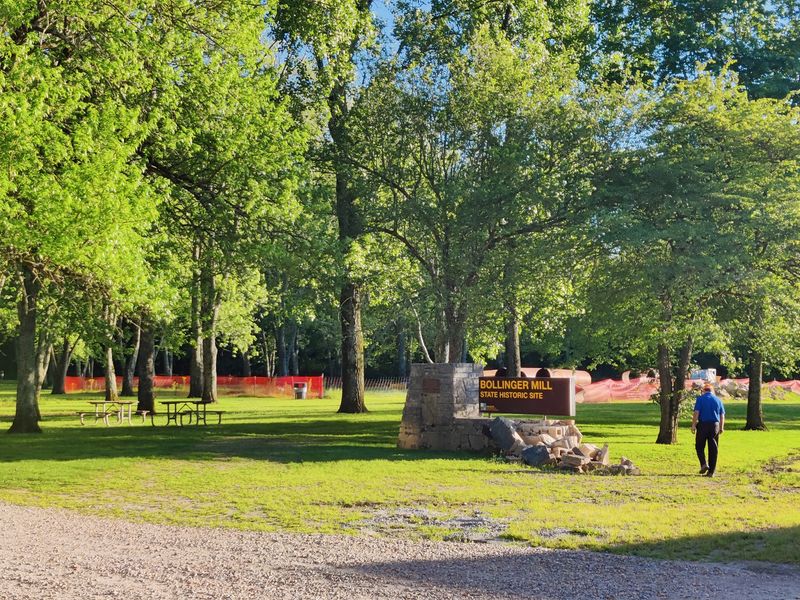
Most people show up for the mill and the bridge and then leave, but there is more ground here to cover if you have the time. A short and easy hiking trail runs from the site, and following it takes you to a historic cemetery tucked back in the trees.
It is a somber stop, no question about that, but old cemeteries carry a certain weight that pairs well with a place like this. The names on the stones connect straight back to the families who settled around the mill.
The walk itself is not demanding, so you do not need hiking boots or a water bottle strategy or any of that. Comfortable shoes and a little curiosity will get you there and back without any trouble.
What I like about this part is how quiet it gets once you step away from the buildings, with the trees closing in and the sound of the river fading behind you. Go slowly, read a few of the markers, and let the whole visit sink in a little deeper before you head back toward the parking area.
Milling Demonstrations When The Water Cooperates
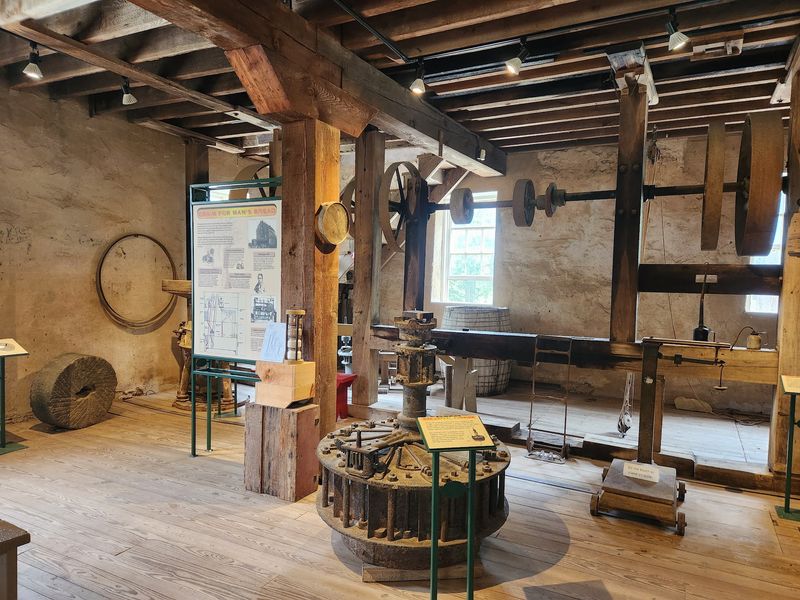
Now here is the thing that would make me plan a trip around the calendar if I could. When river levels are just right, the site sometimes runs milling demonstrations using the original equipment inside the building, which is not something you get to see most places.
Watching the stones turn and the belts move and grain actually working its way through the machinery is a completely different experience than looking at silent equipment. The whole building comes alive, noise and vibration and all.
It depends entirely on the water, though, so nobody can promise you a demonstration on any given visit. Calling ahead or checking with the site before you drive out is the smart move if seeing the machinery run matters to you.
Even without a demonstration, the equipment is impressive enough to justify the stop, so do not let uncertainty talk you out of going. If you do luck into one, you will walk away with a much clearer picture of how communities across Missouri actually got their flour before grocery stores existed, and that connection sticks with you longer than photos do.
Two National Register Landmarks Standing Together
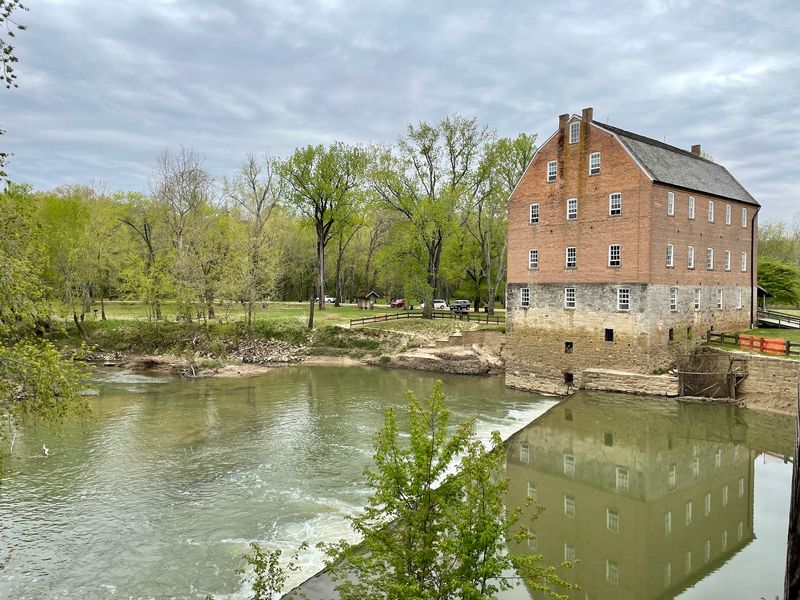
Both the mill and the covered bridge are listed on the National Register of Historic Places, and once you see them together you understand why. Having two recognized landmarks of this caliber sitting within a stone’s throw of each other is genuinely unusual.
Usually you have to drive across half a state to see a covered bridge and an intact old mill, and here they share the same view. That combination is what makes photographers and history folks keep coming back.
The pairing also tells a complete story, since the bridge existed to get people and grain to the mill, and the mill existed because the river ran through here. Neither one makes full sense without the other.
If you are putting together a road trip through southeast Missouri, I would slot this in as an afternoon anchor rather than a quick detour. Give yourself a couple of hours to tour inside, walk the bridge, wander the grounds, and sit by the water for a while.
Places that stay this intact are getting harder to find, so go see it while the light is good and take somebody with you who appreciates old craftsmanship.
