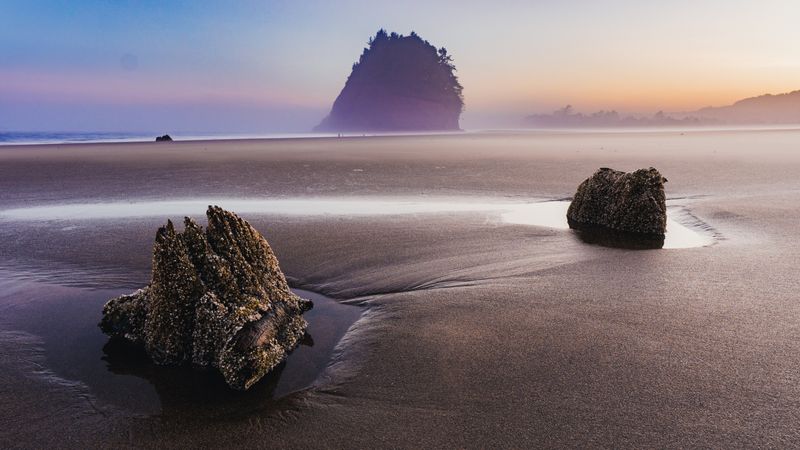
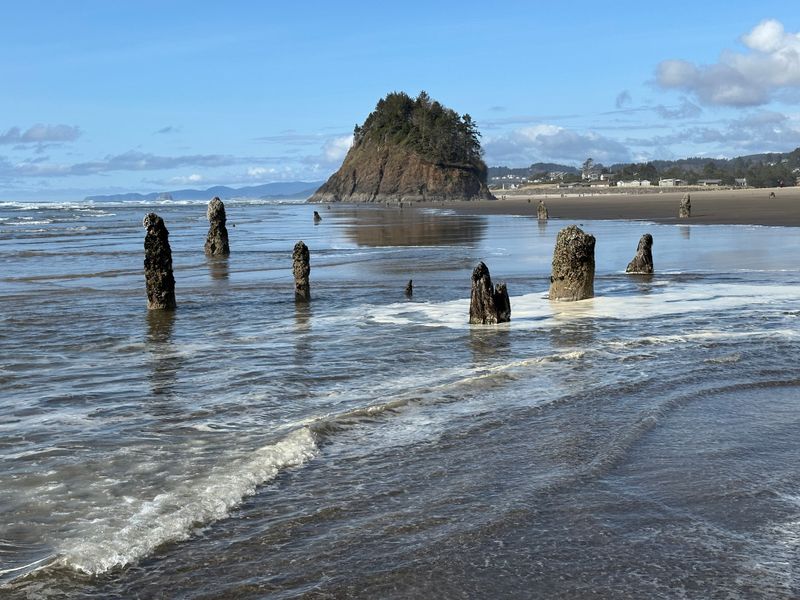
Walking along the Oregon coast, I never expected to stumble upon something that felt like stepping into another world. The Neskowin Ghost Forest appears like ancient sentinels rising from the sand, their barnacle-covered stumps telling stories from two millennia ago.
These aren’t just any old tree remains. They’re the preserved remnants of towering Sitka spruce that once stood over 150 feet tall, now reduced to weathered stumps that emerge from beneath the Pacific during winter’s lowest tides.
Every February, when storms strip away layers of protective sand, these ghostly figures become visible again at Neskowin Beach State Recreation Site.
Located just south of Cascade Head near Pacific City, this remarkable natural phenomenon draws curious visitors who time their trips with tide charts, hoping to witness these prehistoric survivors before the ocean reclaims them once more.
Trees That Witnessed Ancient History
Standing before these stumps felt surreal, knowing they sprouted when woolly mammoths still roamed parts of North America.
The Neskowin Ghost Forest dates back over 2,000 years, making these trees older than many historical civilizations we study in textbooks.
Scientists determined their age through carbon dating and geological studies of the surrounding sediment layers. When these Sitka spruce first took root, the Roman Empire was just beginning its expansion across Europe.
The forest thrived for centuries in what was likely a coastal lowland area, similar to forests found slightly inland today along the Oregon coast. These trees witnessed countless seasons, storms, and changes to the landscape before their sudden burial.
What makes their preservation so remarkable is how quickly they were entombed.
Rather than rotting away naturally, they were buried so rapidly that decomposition couldn’t occur, creating a time capsule that would remain hidden for two millennia until modern storms revealed their existence to beachcombers like me.
Giants of the Coastal Forest
Imagine trees so massive they towered nearly 200 feet into the coastal sky. The original Sitka spruce that now exist as stumps were absolute giants, dwarfing most buildings you’d see in a typical town.
Sitka spruce naturally grow to impressive heights, but these particular specimens reached the upper limits of their species’ potential. Their thick trunks, now reduced to weathered bases, once measured several feet across, supporting enormous crowns of evergreen branches.
Walking among the stumps today, I tried visualizing the forest canopy that once blocked out the sun overhead.
These trees would have created a dense, cathedral-like environment where light filtered through in scattered beams, supporting an entire ecosystem of plants, animals, and fungi beneath their protective cover.
The stumps themselves, though dramatically smaller than the original trees, still measure impressive diameters. Some reach three to four feet across, giving just a hint of the massive scale these forest giants once possessed before their catastrophic burial beneath sand and saltwater.
The Storm That Changed Everything
For centuries, these stumps lay completely hidden beneath layers of protective sand. Then came the winter of 1997-1998, when particularly fierce storms battered the Oregon coastline with unusual intensity.
Those powerful waves and winds stripped away enormous quantities of sand that had covered the ghost forest for generations. Locals who had walked this beach their entire lives suddenly discovered dozens of mysterious stumps emerging from the sand like something from a fantasy novel.
The discovery sparked immediate curiosity and scientific investigation. Researchers rushed to study these newly exposed artifacts, recognizing them as an incredibly rare geological and biological phenomenon worth documenting and protecting.
While the stumps had technically always been there, buried just beneath beachgoers’ feet, the 1997-1998 storms marked their official revelation to the modern world.
Since then, they’ve become a beloved attraction at Neskowin Beach State Recreation Site, drawing visitors from across the country who want to witness this eerie, beautiful reminder of Oregon’s dynamic coastal history and the powerful forces that continue shaping it today.
When the Earth Moved
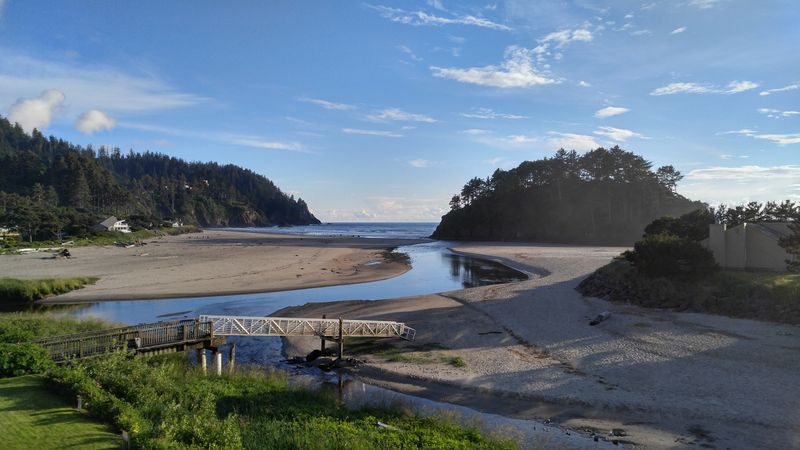
What could bury an entire forest of 200-foot trees almost instantly? Scientists believe a catastrophic geological event caused the land to suddenly drop, allowing the Pacific Ocean to rush in and drown the forest where it stood.
The leading theory points to a massive Cascadia subduction zone earthquake, the kind that strikes the Pacific Northwest every few hundred years. These megaquakes can cause entire sections of coastline to drop several feet in seconds, permanently altering the landscape.
When such an earthquake occurs, areas that were once dry land can suddenly find themselves below sea level. The forest would have been quickly inundated with saltwater, killing the trees almost immediately while simultaneously beginning their preservation process.
Some researchers also consider the possibility of a tsunami following the earthquake, which would have brought additional sand and sediment to bury the dead trees.
Another theory suggests slower dune encroachment gradually buried the forest, though the rapid preservation suggests a more sudden event.
Whatever the exact mechanism, the result was the same: a thriving forest transformed into a submerged graveyard in geological moments.
Finding the Ghost Forest
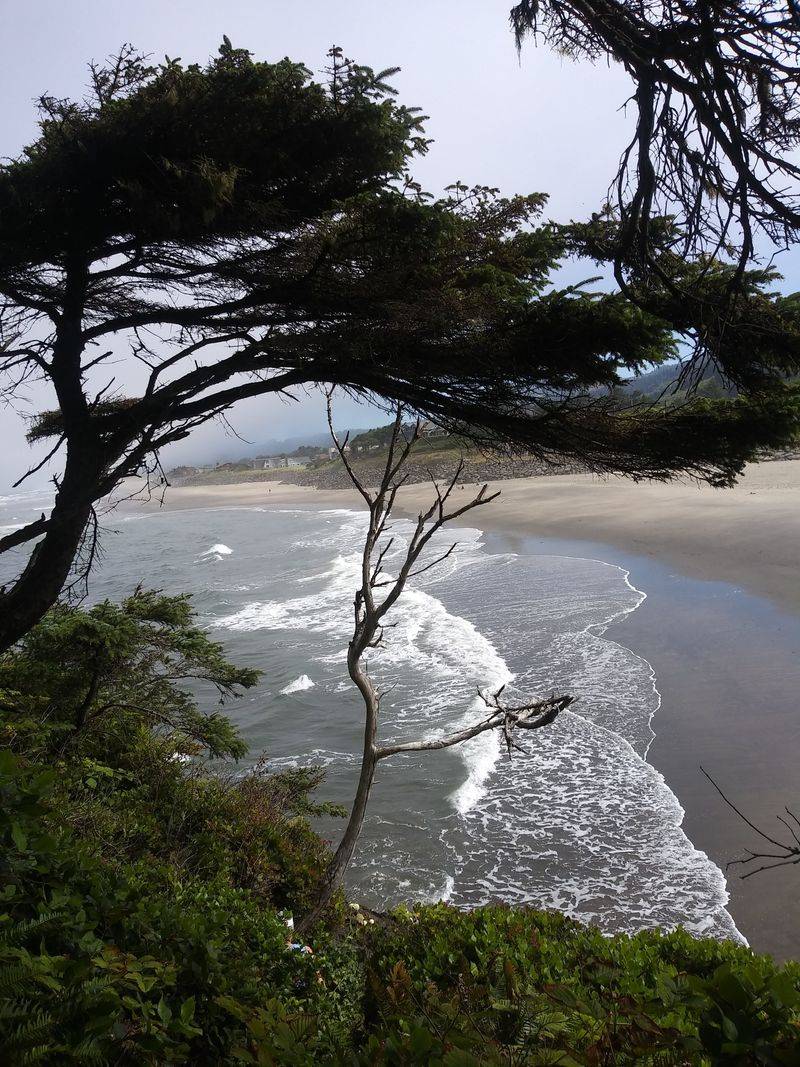
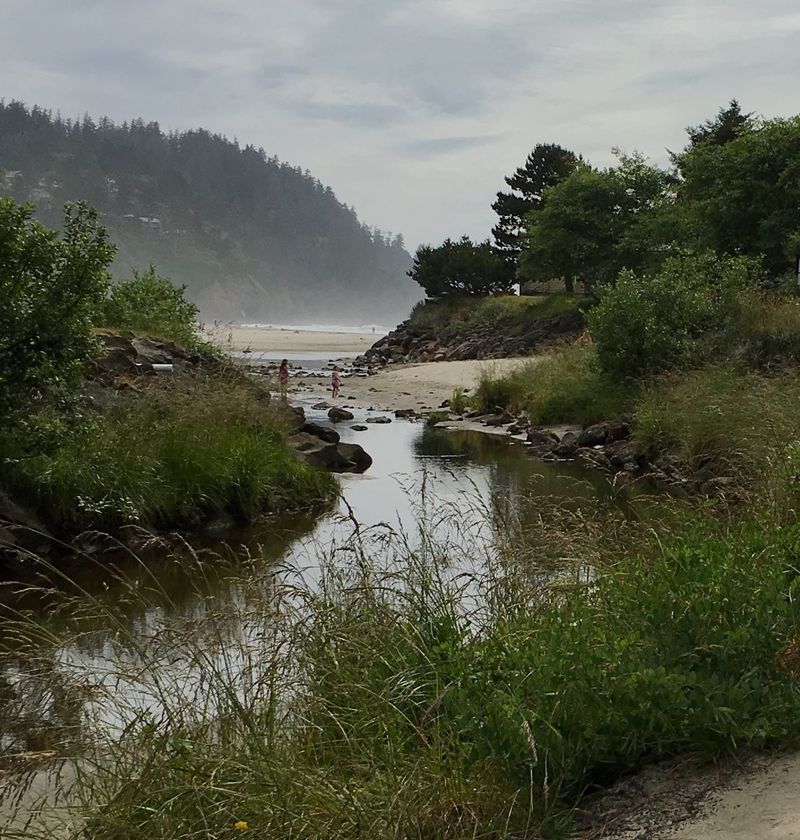
Located at Beach State Recreation Site in Neskowin, OR 97149, this remarkable natural feature sits along one of Oregon’s most scenic coastal stretches. The site lies just south of Cascade Head and near the charming community of Pacific City.
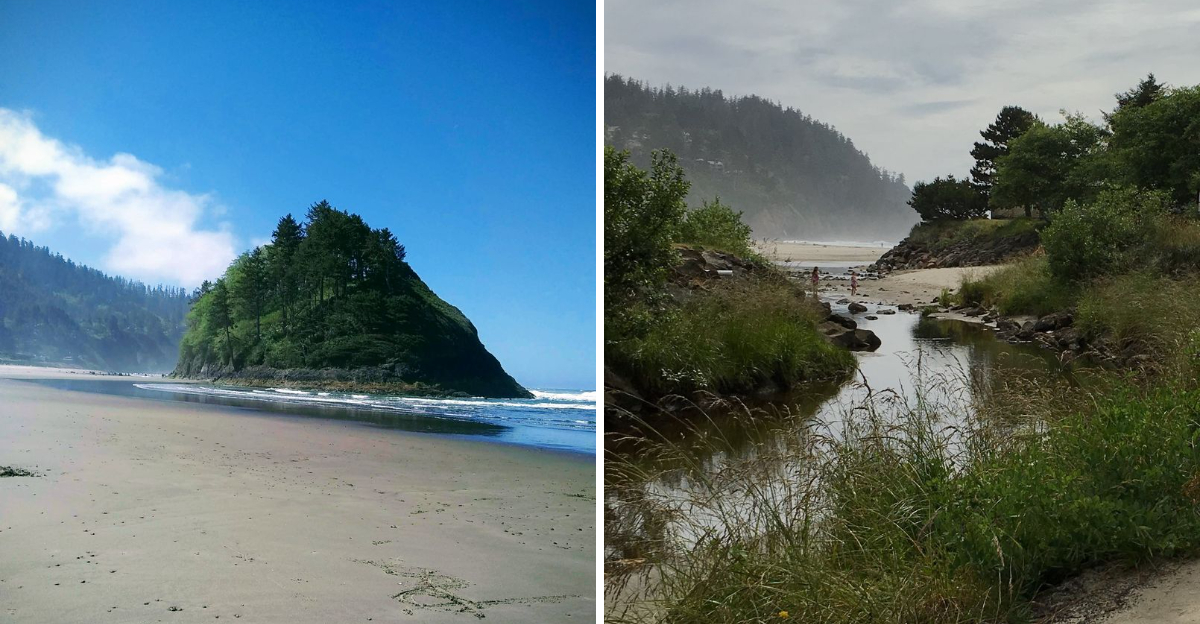
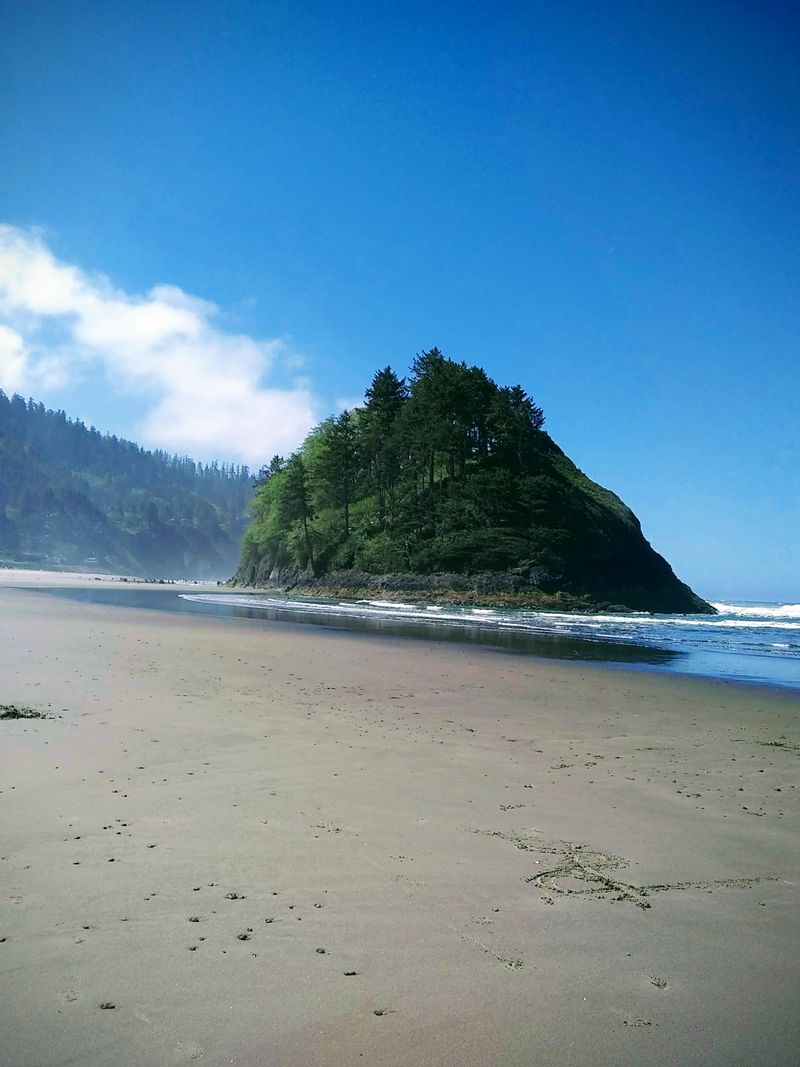
Getting there is straightforward, with the recreation site offering convenient parking and beach access. The address places you right at the starting point for your ghost forest adventure, though the stumps themselves are scattered along the beach south of Proposal Rock.
When I visited, I found the recreation site well-maintained with clean restroom facilities and clear pathways to the beach.
The parking area fills quickly during peak times, especially when tide conditions are favorable for viewing the stumps, so arriving early helps secure a spot.
The location’s proximity to other Oregon coast attractions makes it perfect for a day trip or part of a longer coastal exploration. Pacific City lies just minutes north, offering dining and lodging options, while the entire area provides stunning views of the Pacific coastline that make the journey worthwhile even beyond the ghost forest itself.
Timing Your Visit With the Tides
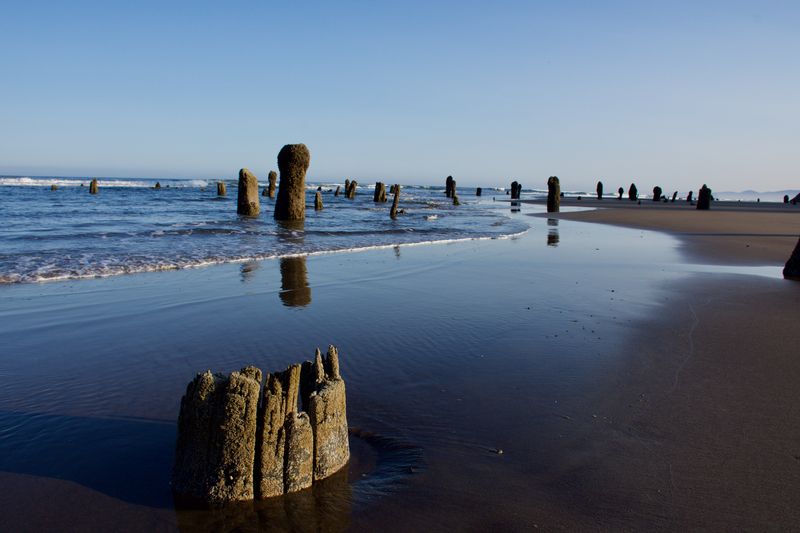
Here’s something crucial I learned: these stumps play hide-and-seek with visitors based on the ocean’s rhythm. During high tide, the Pacific completely covers them, making them invisible beneath several feet of water.
Only when the tide retreats do the stumps gradually emerge from the surf, their barnacle-encrusted surfaces dripping with seawater. The lower the tide, the more stumps become visible and the farther you can safely explore among them.
I checked tide tables before my visit, targeting the lowest tide of the day for maximum viewing opportunity. Winter months, particularly February, tend to offer the best combination of low tides and storm activity that removes covering sand.
Even with perfect tide timing, the amount of sand covering the stumps varies throughout the year. After significant winter storms, more stumps appear as protective sand gets washed away.
During calmer summer months, sand accumulation can bury them again, even at low tide.
Bringing a tide chart or checking online resources before visiting prevents disappointment and ensures you arrive when the ghost forest is actually visible rather than submerged beneath the Pacific’s waters.
February’s Special Revelation
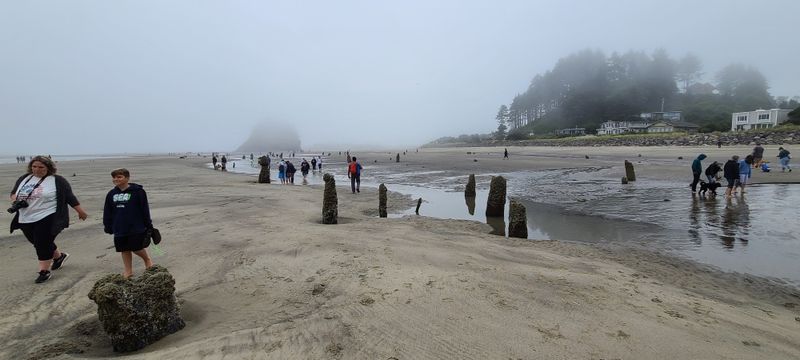
While the stumps can appear year-round during favorable conditions, February holds special significance for ghost forest enthusiasts. Winter storms peak during this month along the Oregon coast, creating ideal conditions for viewing these ancient remnants.
The combination of seasonal low tides and active storm systems works together to strip away protective sand layers. Strong waves and winds remove sediment that accumulated during calmer months, gradually exposing more of the preserved wood.
During my February visit, I witnessed firsthand how recent storms had revealed stumps that might be partially or completely buried during summer visits.
The dramatic winter weather adds to the ghostly atmosphere, with grey skies and crashing waves providing a suitably moody backdrop.
Temperature-wise, February requires bundling up in layers, but the cooler weather means fewer crowds competing for viewing spots. I found the beach relatively peaceful despite the stumps being prominently visible, a stark contrast to summer’s busy beach days.
Planning a February trip means accepting unpredictable Oregon coastal weather, but the reward is potentially seeing the ghost forest at its most dramatic and accessible state of the entire year.
Nature’s Perfect Preservation
Why didn’t these trees simply rot away like fallen timber normally does? The answer lies in the unique preservation conditions created by their sudden burial beneath saltwater and sand.
When the forest was submerged, the combination of salt and sand created an oxygen-poor environment. Decomposition requires oxygen, so the bacteria and fungi that normally break down dead wood couldn’t survive in these anaerobic conditions.
The salt itself acted as a natural preservative, similar to how salt has been used for centuries to preserve food. It prevented microbial growth while the sand provided physical protection from waves and currents that might otherwise have scattered the wood.
For hundreds of years, this protective burial kept the stumps in a state of suspended animation. They weren’t growing, but they weren’t decomposing either, existing in a strange limbo beneath the beach.
Now that they’re exposed again, ironically, the same forces that revealed them are slowly destroying them.
Wave action, exposure to air, and weathering gradually erode the ancient wood, meaning future generations might not see the ghost forest as prominently as visitors can today.
Watching the Forest Disappear
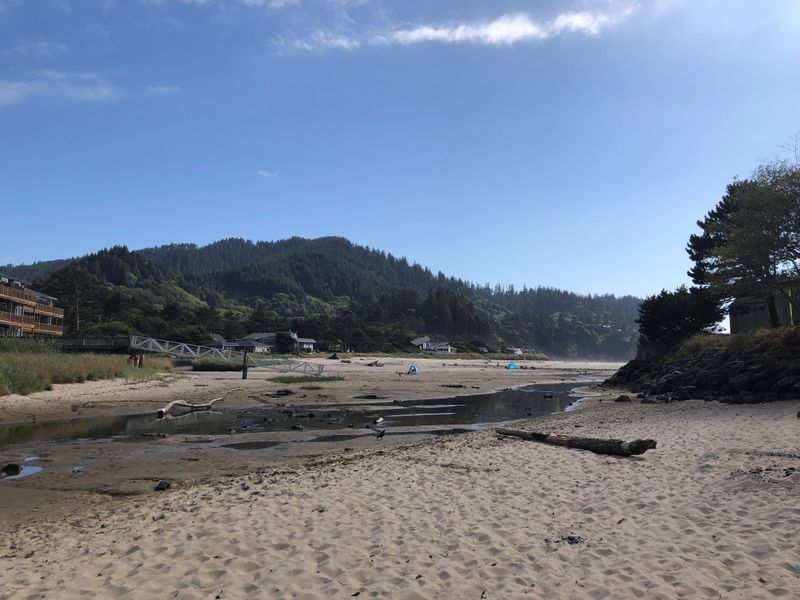
There’s something bittersweet about visiting the ghost forest, knowing each wave that crashes against these stumps wears them down a little more. The same exposure that allows us to see them today is gradually destroying them.
Since their revelation in the late 1990s, researchers have documented measurable erosion of the stumps. Photographs from different years show how individual stumps have shrunk, lost pieces, or even disappeared entirely as the Pacific reclaims them.
The wood, preserved for two millennia in its protective burial, now faces constant assault from saltwater, wind, sand abrasion, and the sheer mechanical force of waves.
Each winter storm accelerates the erosion process, particularly for stumps positioned in areas with heavier wave action.
Some visitors carve initials or remove pieces as souvenirs, further contributing to the destruction of these irreplaceable artifacts. Signs at Neskowin Beach State Recreation Site remind people to look but not touch, preserving what remains for future visitors.
This gradual disappearance adds urgency to visiting the ghost forest sooner rather than later. Within a few more decades, many of these stumps may be reduced to nothing, leaving only photographs and memories of this remarkable window into Oregon’s prehistoric past.
Dear Reader: This page may contain affiliate links which may earn a commission if you click through and make a purchase. Our independent journalism is not influenced by any advertiser or commercial initiative unless it is clearly marked as sponsored content. As travel products change, please be sure to reconfirm all details and stay up to date with current events to ensure a safe and successful trip.
