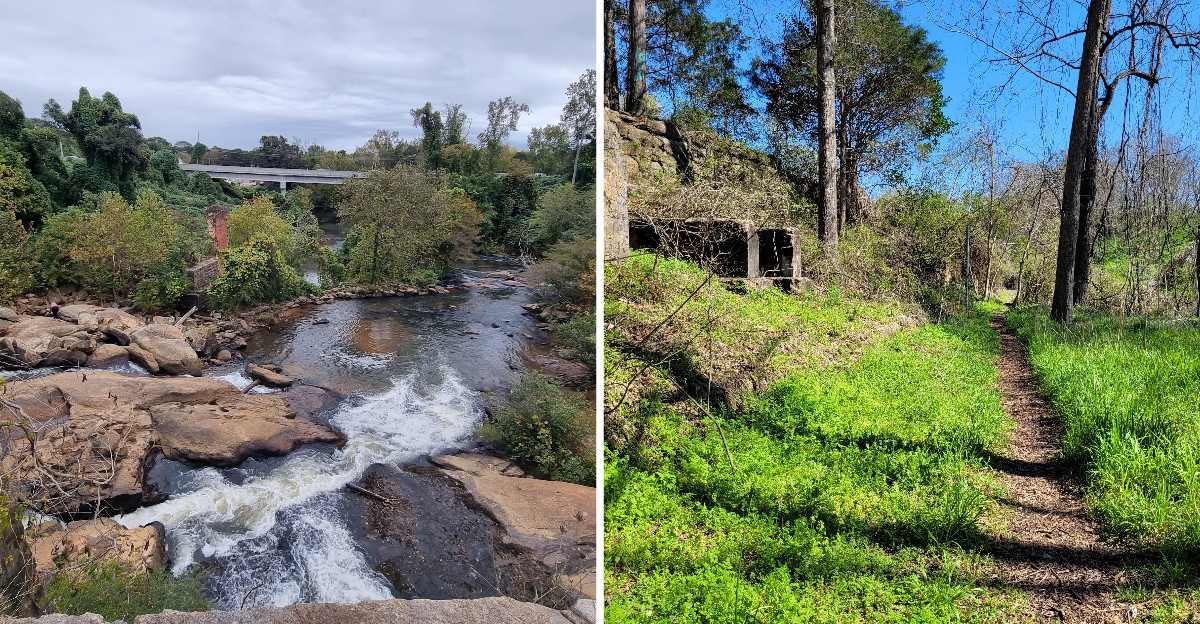
Water pouring over a long stone dam is loud enough to hear before you see it, and the trees along the river do that late-afternoon flicker thing where the light keeps moving. I had stopped expecting a quick stretch of the legs and got a history lesson instead.
Down among the rocks sit the leftovers of a cotton mill that burned not once, not twice, but three separate times across more than a century. Brick foundations, smokestack bases, an old office building that later became a post office, all sitting quietly in the grass like nobody told them the factory closed.
This is South Carolina, where nature and old industry are tangled together in ways that reward a slow walk. I spent about an hour there and kept finding one more thing to look at.
The place does not need a velvet rope to tell its story. The stones and the water do it for you.
The Stone Dam That Still Holds the Enoree
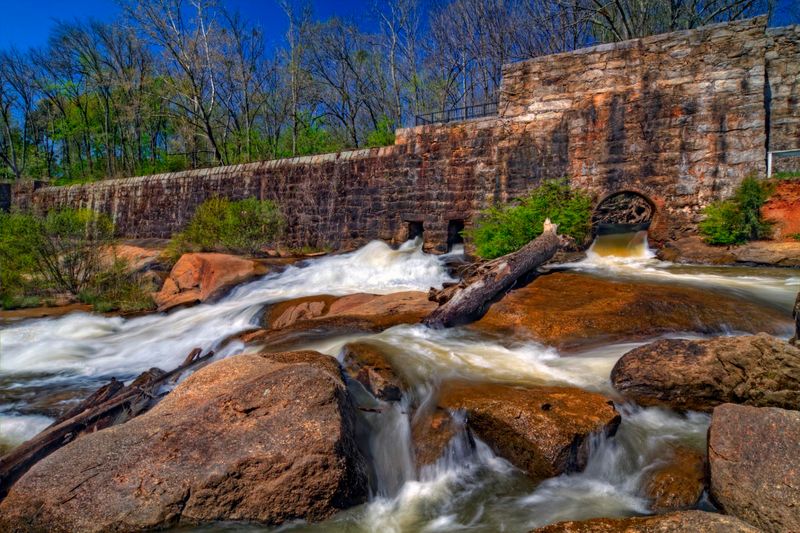
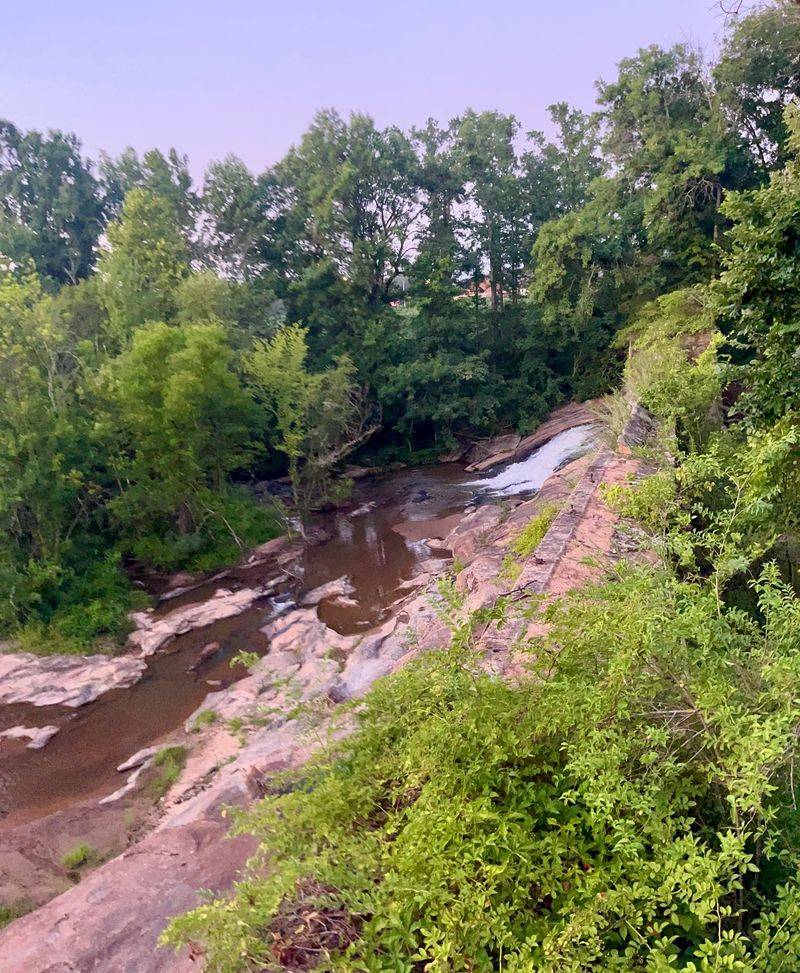
Water hitting stone is the first thing you notice here, before the ruins, before anything else. The dam stretches across the Enoree River in a broad line of mortared rock, and the river spills over it in wide sheets that crash onto the shoals below.
Built somewhere between 1880 and 1890, it was designed with six sluice gates so mill workers could control exactly how much water flowed toward the machinery. That kind of control was everything back then.
No water meant no power, and no power meant no cloth.
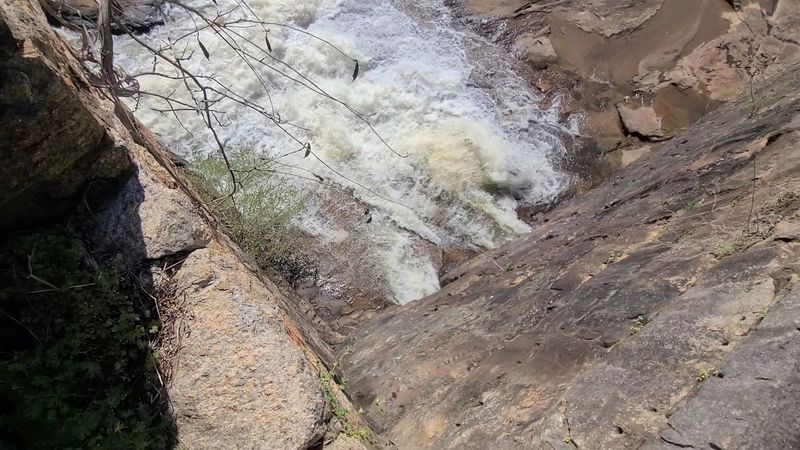
People on the trail call it a waterfall, and honestly it does look like one from certain angles. The drop is not huge, but the width makes up for it, and the sound carries surprisingly far into the woods.
I climbed partway onto the flat rocks below to get a better look, which I would only recommend if the stone is dry and you have decent shoes. Wet granite is slick in a way that sneaks up on you.
What struck me most was how solid the structure still feels after well over a century of water pressure. The factory it powered is mostly gone, burned and scattered, yet the dam keeps doing its job without anyone asking.
Sit on the rocks a while and you will understand why so many visitors linger here longer than they planned.
Three Fires, One Stubborn Piece of Ground
Bad luck followed this spot for more than a hundred years. Reverend Thomas Hutchings, who came south from Rhode Island, put up a cotton factory here in 1820, and it is generally counted as the first cotton mill in the Greenville District.
Fire number one arrived almost immediately. Only months after the machinery started running, flames took the building down, which must have been a brutal way to start a business.
The property later passed to Philip C. Lester and operated as the Lester Factory.
In 1853 it burned again, the second time the same patch of riverbank went up in smoke.
The final blow came much later. Operations had already stopped in the 1930s and the complex sat mostly empty when a fire in 1943 wiped out nearly everything that was left standing.
Three fires on one site is the kind of detail that sticks with you as you walk around. Every brick pile you pass is a survivor of at least one of them.
What I find fascinating is that people kept rebuilding anyway. The river was too valuable to walk away from, so each time the ashes cooled, somebody decided to try again.
That stubbornness is basically the story of the whole piedmont textile industry compressed into a few acres of Greenville County ground.
Brick Foundations, Smokestack Bases, and the Old Powerhouse
Hidden in the grass on the far side of the path, the actual bones of the factory are easy to miss if you are only chasing the waterfall view. Stone and brick foundations run in long lines, marking where walls and machinery rooms once stood.
Two round bases are all that remain of the steam smokestacks. Standing next to them gives you a real sense of scale, because those stacks would have towered over everything for miles.
Scattered brick pilings dot the ground nearby, along with remnants of the mill’s main powerhouse and steam generator. Once the river alone could not keep up with demand, steam took over the heavy lifting.
The whole ruin complex is listed on the National Register of Historic Places, and it is valued as much for what is buried as for what shows above ground. Archaeologists consider it physical proof of how the textile industry took root in this part of the state.
I would say wear long pants. Grass gets tall in warm months, the footing is uneven, and there is poison ivy in places, so keep an eye on where you step.
Go slow and let your eyes adjust to the pattern of rectangles in the undergrowth. Once you see the outlines, the vanished building starts assembling itself in your head.
The Mill Office That Became a Post Office
A modest building near the parking area quietly outlasted everything around it. Thought to have been built around 1870, it served as the Pelham Mill office, the place where records were kept and workers were paid.
Pay is a heavy word in this context. Employees were often billed for company housing and for goods bought at the mill store, and whatever remained came back as tokens that could only be spent at that same store.
Children worked in the mill too, some of them younger than twelve. Historians have drawn hard comparisons between that arrangement and indentured servitude, and it is worth holding that in mind while admiring the pretty stonework outside.
After the textile plant shut down, the little building found a second life. It operated as a United States Post Office all the way until 1996, which means people in Pelham, South Carolina were mailing packages from a former mill office within living memory.
It was eventually moved and renovated, and it still anchors the historic side of the park today.
I liked that detail more than almost anything else here. Fires took the factory, time took the workers, and yet the small office where the whole operation was managed is the piece that kept finding new work to do.
Short Trails, Deep Shade, and a Bit of Overgrowth
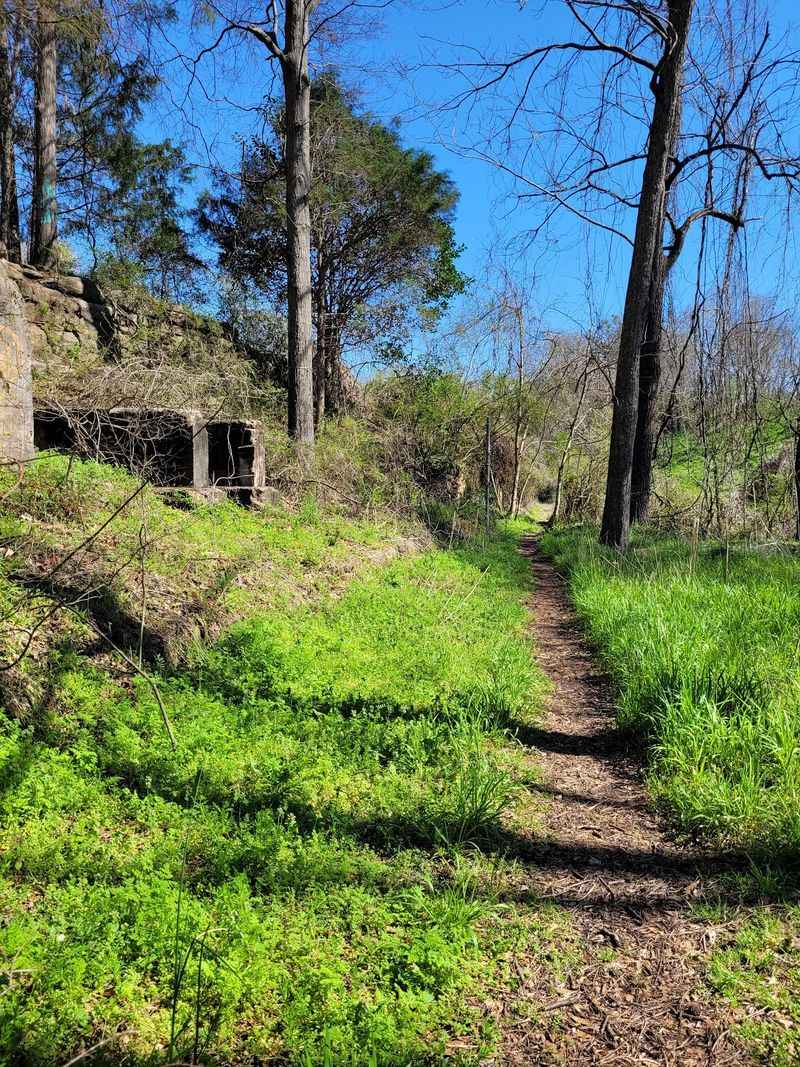
Do not come here expecting a long workout loop. The walking paths are short, roughly a quarter mile in places, and they wind through thick woods rather than opening into wide clearings.
What they lack in distance they make up for in atmosphere. Tree cover is generous, the river noise follows you the whole way, and in summer the shade makes a real difference.
Some sections are paved and easy, while others turn into packed dirt with roots and loose rock. A few side paths get overgrown between maintenance rounds, so vegetation can crowd the trail edges.
Runners tend to be disappointed, and I understand why. Footing changes too often to settle into a rhythm, and one branch path drops toward the rocks below the dam over genuinely rough ground.
Families with small kids should plan for a stroll rather than a hike. Strollers will struggle once the pavement ends.
My advice is simple. Bring closed shoes, check yourself for ticks afterward, and treat the whole thing as a slow wander instead of a mileage goal.
Most visitors can see everything in about thirty minutes, though if you stop at the overlook, poke around the ruins, and sit by the water, an easy hour disappears without effort. It is a small park that rewards patience.
The Overlook, the Swings, and the Picnic Spot
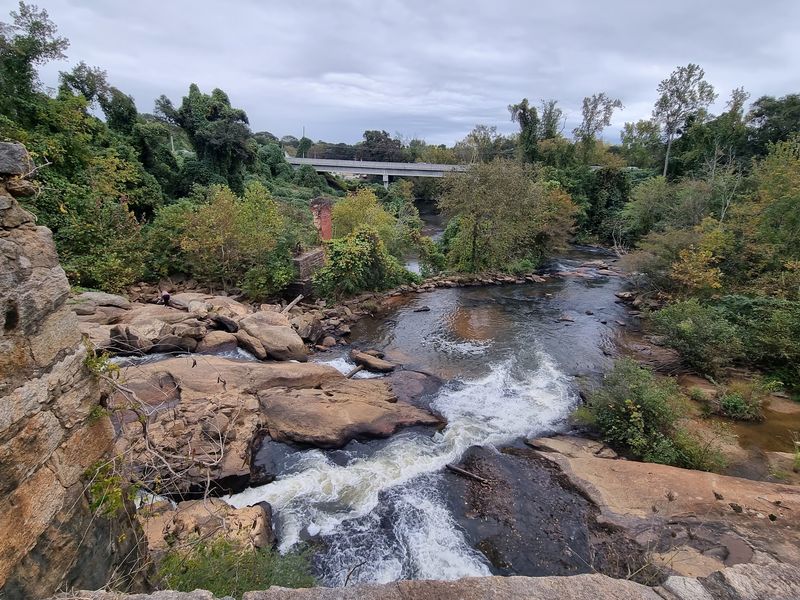
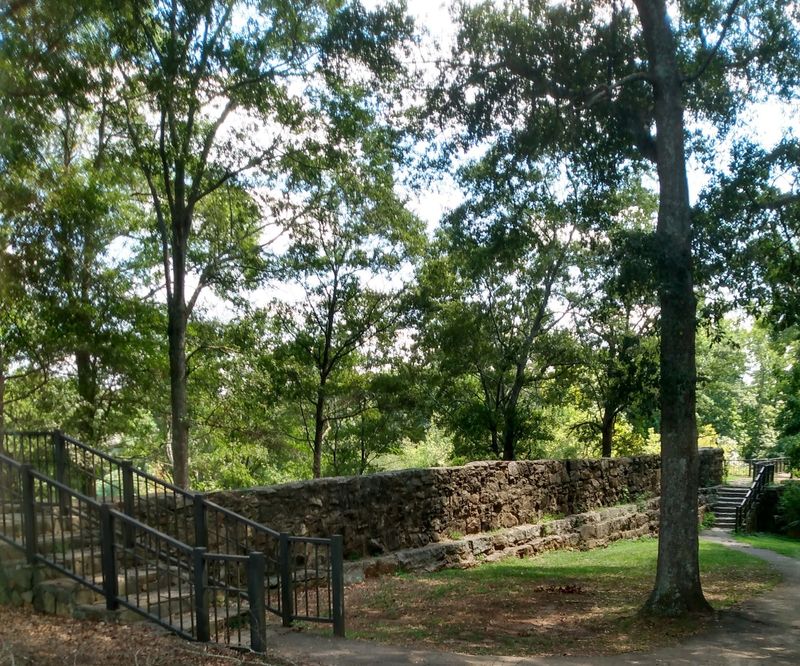
Tucked partway along the main path, a stone-walled overlook opens toward the dam, the shoals, and the ruins on the opposite bank. Two benches sit inside the little circular area, along with a historical marker explaining what you are looking at.
Shrubbery does creep into the view depending on the season, so the sightline is better in cooler months when the leaves thin out. Early morning light tends to be kinder for photos than harsh midday sun.
Near the top of the park there are swing benches, which turned out to be my favorite place to sit and do absolutely nothing. Facing the trees with the river humming below, they make a strong argument for slowing down.
Picnic tables are scattered in shaded spots, and plenty of people bring lunch and stay a while. Pack out whatever you carry in, since litter occasionally shows up along the water and nobody wants that.
Restrooms and playgrounds are not part of the setup, so plan stops accordingly if you are traveling with kids.
The park opens at 7 AM and closes at 7 PM every day, which gives you plenty of daylight to work with. Weekday mornings felt calmest to me, with just birdsong, moving water, and the occasional dog barking happily in the distance.
A Dog Park Behind the Ruins
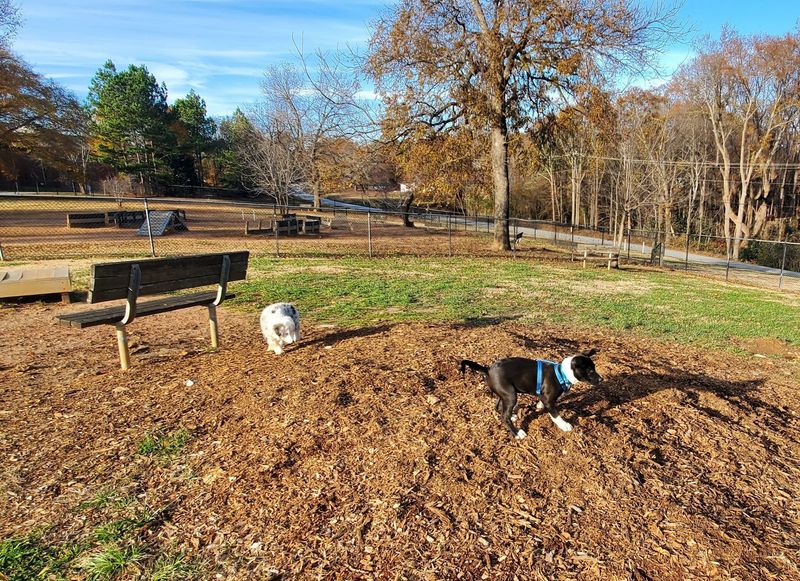
Behind the old mill area sits something the 1800s workers never could have pictured: a fenced play yard built entirely for dogs. It is enclosed, grassy, and comes with obstacle equipment for pups who like a challenge.
Locals clearly love it. On the day I visited, the dog area had more activity than the trails did, with owners standing around chatting while their dogs sprinted circles.
Even people who are not particularly dog-obsessed tend to admit this section is well done. Shade trees help on hot afternoons, and there is enough room that larger breeds can actually stretch out.
If you are bringing your own dog, water is worth packing, and keep the leash on until you are inside the fence. The nearby trails have uneven rock and poison ivy, so paws deserve the same caution your ankles get.
Combining a history stop with a dog run is a strange mix on paper, but it works. You can read about 1820s cotton spinning, walk down to a stone dam from the 1880s, then let your dog burn off energy fifteen steps from a National Register site.
Greenville County Recreation manages the park, and the phone number is 864-288-6470 if you need current details before heading over.
Address: 2770 E Phillips Rd, Greenville, South Carolina 29615
