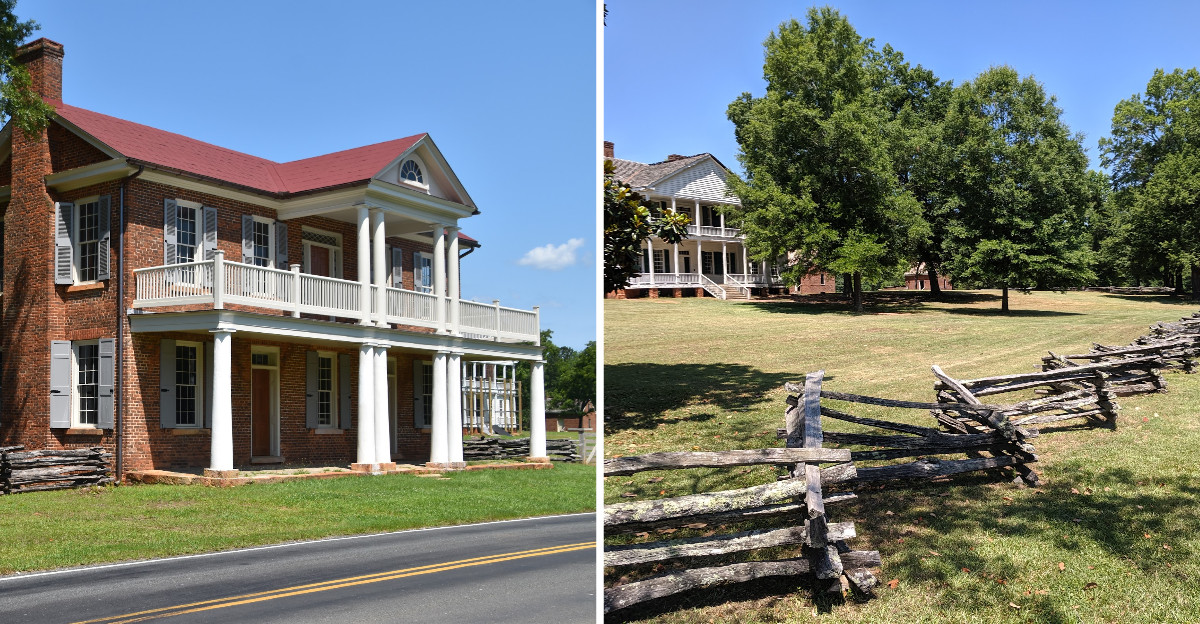
In July 1780, Loyalist soldiers rode up to a South Carolina plantation looking for a colonel who had been a thorn in their side. His wife stood her ground and refused to reveal where he was hiding.
That act of defiance set the stage for a battle that erupted on the neighboring land, a fast and fierce fight that ended in a Patriot victory. Today, hundreds of acres preserve that story.
Log cabins, open pastures, and a shaded trail lead to the battlefield itself, where the ground still holds the shape of the past. Walking those paths feels like stepping into the middle of a family’s most dangerous week.
South Carolina keeps this history alive without fanfare. The site is quiet, the cabins are original, and the trail ends at the exact spot where the fighting happened.
It is the kind of place that stays with you long after you leave.
The Land the Brattons Chose in 1766
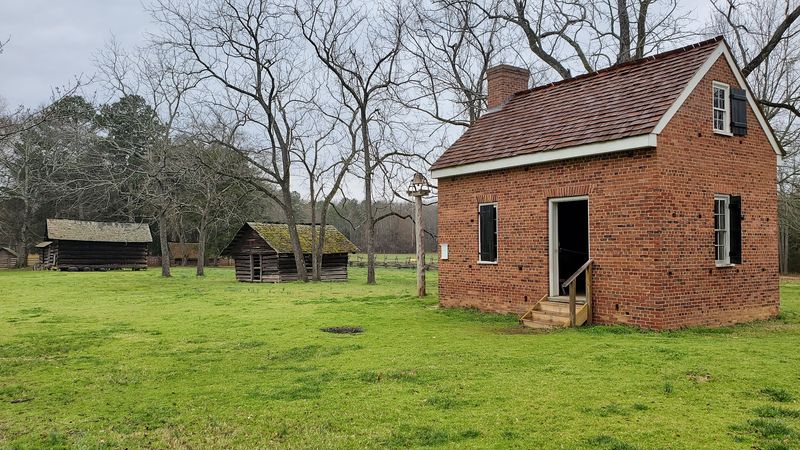
My first surprise came from the size of the place. Historic Brattonsville covers roughly 775 acres of rolling Carolina Piedmont, and the quiet hits you almost as soon as you leave the parking lot.
Back in 1766, William and Martha Bratton bought 200 acres along the South Fork of Fishing Creek. They were Scots-Irish Presbyterians, part of a wave of families who moved into the South Carolina backcountry looking for good soil and a fresh start.
Their farm slowly grew into a small community that would later carry the family name.
Today, more than 30 historic structures dot the grounds, and together they trace life here from the 1760s to the late 1800s. You will pass log cabins, farm outbuildings, grand family homes, and the cabins where enslaved people lived and worked.
Each building adds a new piece to the story, and some of those pieces are hard to sit with.
I found it helpful to grab a site map at the visitor center before heading out. The buildings are spread out, and a little planning saves your legs for the good stuff.
Wear sturdy shoes, because the paths are mostly unpaved and wind through fields and shady patches of woods.
The land itself deserves your attention too. Old fence lines, open pastures, and tall trees make it easy to picture a family clearing this ground by hand.
The Revolutionary House and a Mother Who Would Not Talk
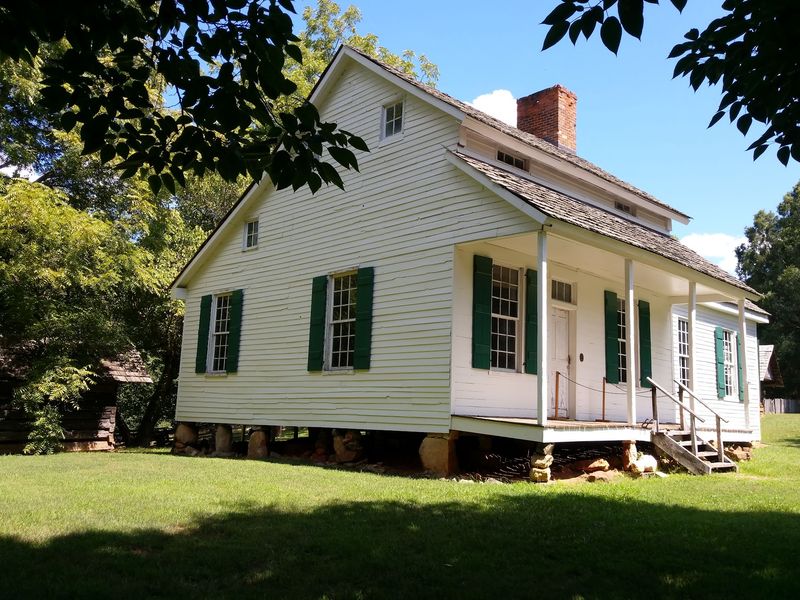
Some houses look grand, but the William Bratton House wins you over by being modest. Staff and visitors often call it the Revolutionary House, and it started life as a simple log home with one room and a small porch.
Over time, the family added onto it, and clapboard siding eventually covered the original logs. It was heavily remodeled in 1838, yet the heart of that early backcountry home still shows.
The house sits within the Brattonsville Historic District, which is listed on the National Register of Historic Places.
Here is where the war got personal. In July 1780, Loyalist forces under Captain Christian Huck came looking for Colonel William Bratton, a Patriot militia officer who was away from home.
Martha Bratton stayed behind with the household. When Huck’s men demanded to know where her husband was, she refused to tell them, even under threat.
Her stubborn silence is one of the most repeated stories in the Carolina backcountry, and it still gives me chills.
My tip is to linger near the porch for a minute before moving on. Picture armed soldiers riding up that path while a mother decided she would not give in.
Moments like that remind me that history is not only made by generals. Sometimes it depends on one person refusing to budge in her own front yard.
Why Captain Huck Became the Most Unwanted Guest in the Backcountry
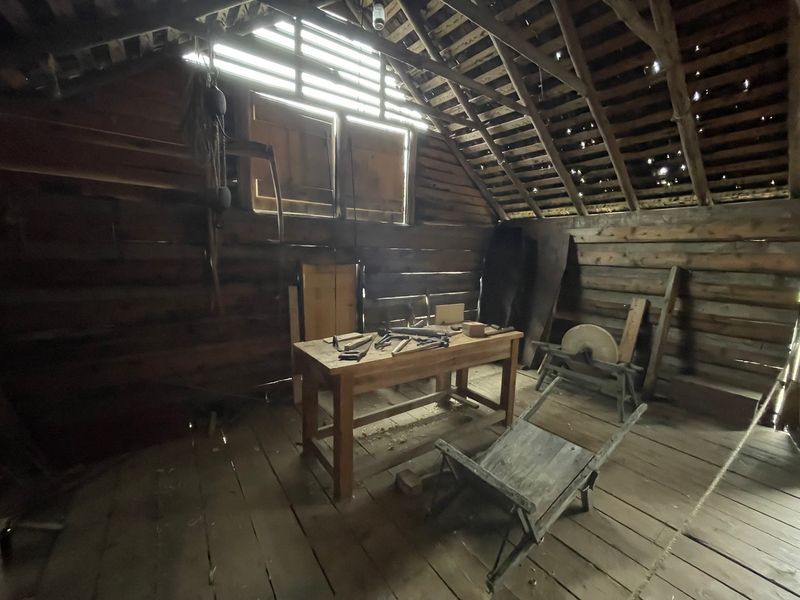
To understand why people here still talk about July 1780, you have to picture how bleak things looked. Charleston had fallen to the British in May of that year, and many South Carolinians feared the fight for independence was slipping away.
British and Loyalist troops patrolled the backcountry, trying to crush any spark of rebellion. Captain Christian Huck led one of those patrols, and he earned a harsh reputation for threatening families and taking their property.
Scots-Irish Presbyterian families like the Brattons often felt the sharp end of that pressure.
After his stop at the Bratton home, Huck moved on and camped for the night at the nearby plantation of James Williamson. That choice put him just a short distance from the Bratton land.
Meanwhile, Patriot leaders were quietly gathering their neighbors.
Colonel William Bratton teamed up with Colonel Edward Lacey and Colonel William Hill. Together they pulled together a militia force of about 133 men who knew these woods and fields far better than any outsider could.
The visitor center film lays out this buildup clearly, and I would put it at the top of your list. It takes the confusing swirl of names and dates and turns it into a story you can actually follow.
Once you have that background, every building and field on the property starts to make more sense. You stop seeing old wood and start seeing the stakes.
Fifteen Minutes That Changed the Mood of a War
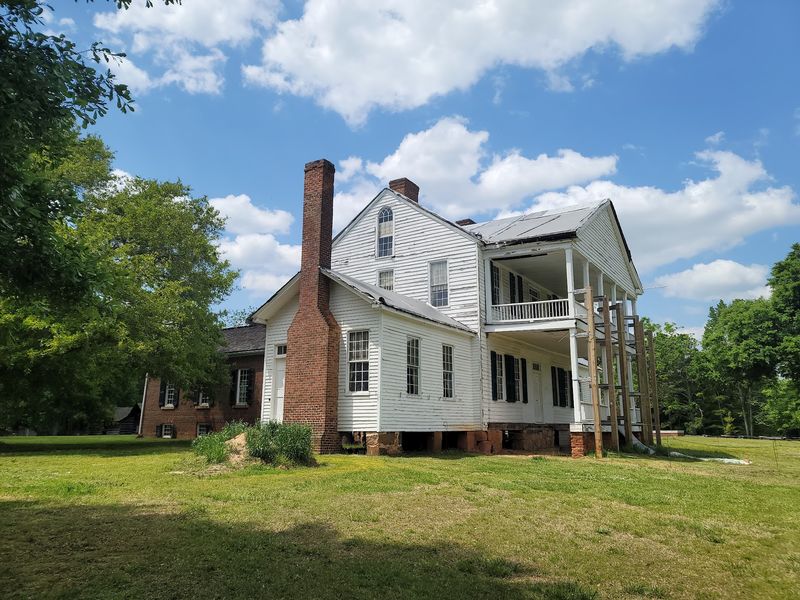
Early on the morning of July 12, 1780, the Patriot militia crept toward Huck’s camp at the Williamson plantation. Huck had around 120 British Provincials and Loyalist militia with him, and they were not expecting company.
The attack came fast. In roughly 15 minutes, the fight was over, and Huck himself was shot, falling from his horse, and passing away.
The numbers still surprise people. The Patriots lost only one man, while about 30 Loyalists were terminally injured, around 50 were lightly wounded, and many others were taken prisoner.
Historians call it Huck’s Defeat, or the Battle of Williamson’s Plantation. It was not a huge battle by size, but it mattered enormously.
It was the first major defeat of British forces by rebel militia after Charleston fell, and news of it spread hope across the region.
That boost in spirit helped inspire more backcountry men to take up the fight. Later Patriot victories at Kings Mountain and Cowpens followed, carried along by the same stubborn energy that showed up at Williamson’s Plantation that morning.
I love that such a small clash could shift the mood of an entire war. It is a good reminder that turning points do not always look dramatic on a map.
If you plan a trip around history, Kings Mountain is a natural pairing with Brattonsville. Visiting both helps you see how these local fights built on each other during the Southern Campaign.
A Quiet Trail to a Once-Noisy Field
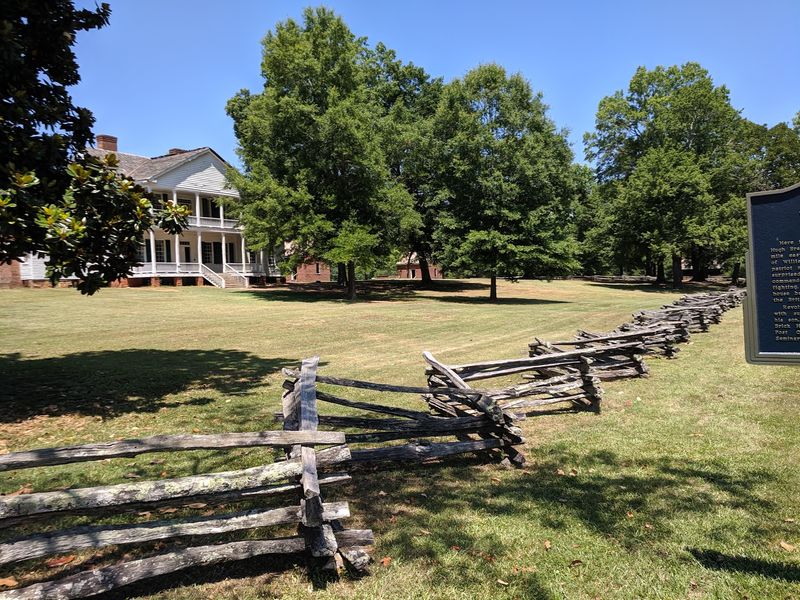
Birdsong was the loudest thing I heard on the path to the battlefield, which felt almost funny given what happened there. The interpretive trail runs about 0.3 miles on gravel, passing through grass, wildflowers, and a stretch of woods before opening onto a wide field.
Signs along the way explain the battle step by step. They make it easy to picture militiamen slipping between the trees in the gray light before dawn.
Near the spot where Huck spent the night before the battle, a ghost structure outlines the shape of the house that once stood there. Flat wooden silhouettes painted red and blue mark where Loyalist and Patriot troops were positioned.
Seeing those figures scattered across the grass made the whole event suddenly feel close.
For the richest experience, check the daily schedule for a guided Huck’s Defeat tour. A good guide can point out details you might walk right past on your own.
The trail is short, but I suggest slowing down anyway. Stop at the edge of the field, look back toward the trees, and think about how quickly those 15 minutes must have passed for the men here.
South Carolina summers get hot, so bring water and try to visit earlier in the day. A hat helps too, since the open field offers very little shade once you step out of the woods.
Heritage Pigs, Quill Pens, and Everyday Life
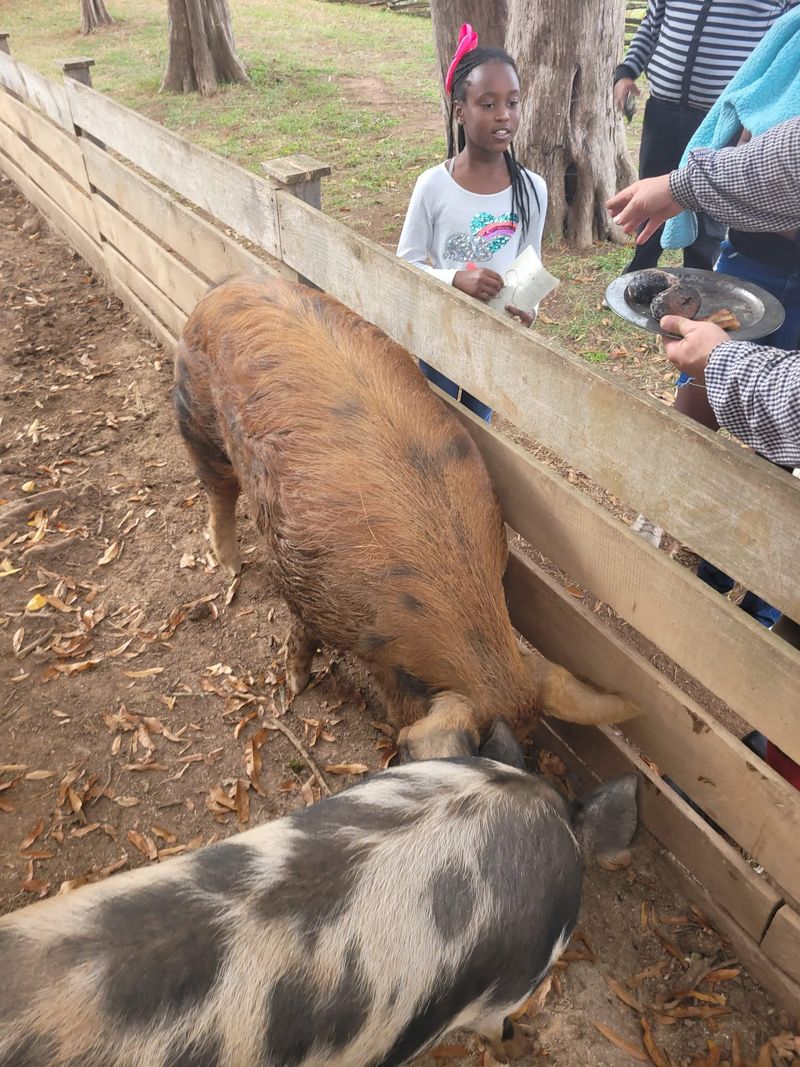
A pig flopped happily in the mud as I passed its pen, and I will admit it stole the show for a few minutes. Historic Brattonsville raises heritage breed livestock, including pigs, sheep, and horses, chosen to resemble the animals local families would have kept long ago.
The site works as a living history museum, so you might meet costumed interpreters cooking over an open hearth or working in the gardens. Some visitors get to try writing with a real quill and ink.
Others watch blacksmithing, candle making, or musket firing demonstrations.
The number of interpreters changes by day and season, since the grounds are large and spread out. I recommend checking the schedule before you go so you can catch the demonstrations that interest you most.
Special events bring even more energy. Every July, around the anniversary of the battle, reenactors recreate Huck’s Defeat with muskets, horses, and plenty of smoke.
During the holiday season, the Christmas candlelight tours turn the buildings into scenes of a moving story. Guests travel from house to house as each stop reveals a new chapter, often with crafts like corn husk dolls along the way.
My best advice is simple. Talk to the interpreters, ask the questions you think are silly, and let them show you how ordinary people cooked, farmed, and got through each day without anything we would call modern comforts.
The Brick House and a Community That Kept Growing
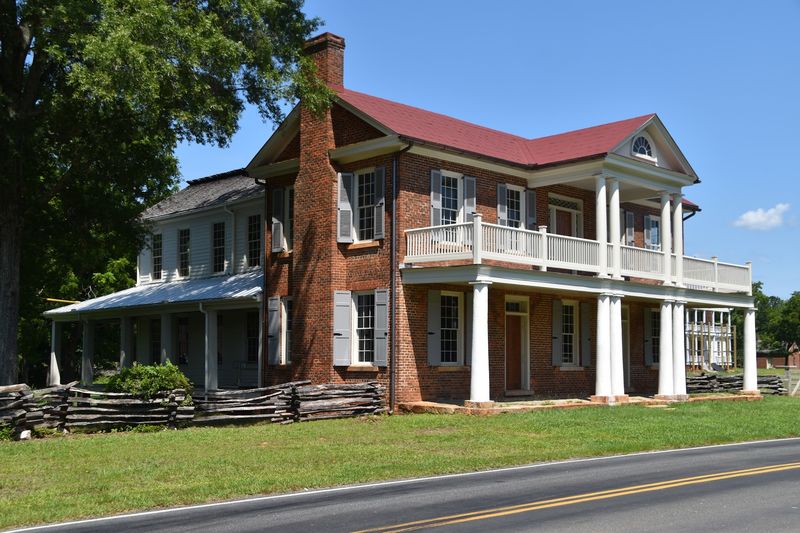
History here does not stop when the Revolution ends, and I loved that. The site shares the stories of both Scots-Irish settlers and African Americans who lived in the South Carolina upcountry across more than a century.
Inside the restored Brick House, an exhibit called Liberty and Resistance: Reconstruction and the African-American Community at Brattonsville, 1865-1877 looks at life after the Civil War. It explores how the struggle for liberty continued long after 1780, now led by African Americans in the community.
Those stories give the word liberty a much deeper meaning.
The restored general store is another stop worth your time. Its shelves hold period goods that hint at how people shopped and traded in a rural crossroads town.
Fun fact for movie fans: parts of the film The Patriot were filmed on the property. Keep your eyes open and see if any scenes look familiar.
Plan on at least half a day, and consider going back in a different season. The site is open Tuesday through Saturday from 10 AM to 5 PM and Sunday from 1 to 5 PM, and it is closed on Mondays.
Picnic tables and a gift shop make it easy to stretch your stay. I left thinking about the Bratton family, whose home and fields became part of a much larger story.
Address: 1444 Brattonsville Rd, McConnells, SC 29726
