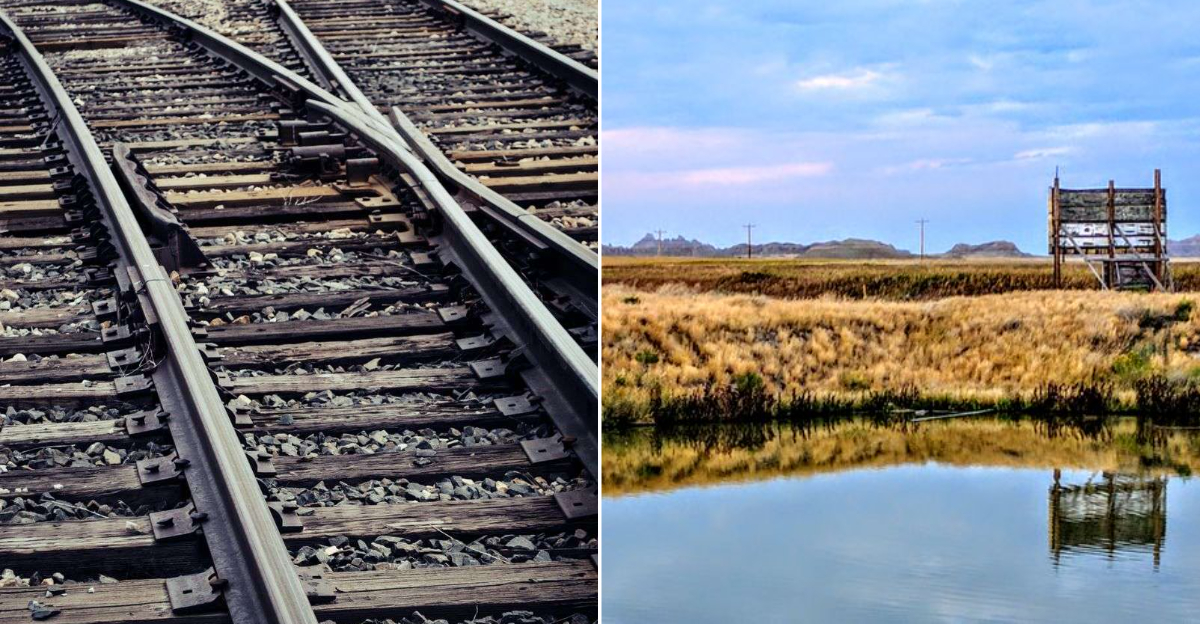
Ever wonder what happens to a town when the trains stop coming?
That’s the story of Interior, South Dakota.
Once a small but steady railroad stop, Interior grew around the tracks that connected it to the rest of the state.
The trains brought workers, supplies, and a sense of movement that kept the town alive.
But when the railroad faded, Interior didn’t disappear, it just slowed down.
The station may be quiet now, but the town still stands, carrying the history of a place built on steel rails and long journeys.
Walking through Interior today, you can still feel that railroad past.
Old routes, weathered buildings, and the layout of the town all point back to the days when trains were the heartbeat here.
I like towns like this because they remind me how much railroads shaped everyday life, how a single line could connect a small community to the wider world.
Interior may be a railroad town time forgot, but it remains, holding onto its place in South Dakota’s story.
Born From The Rails, Not The Highway
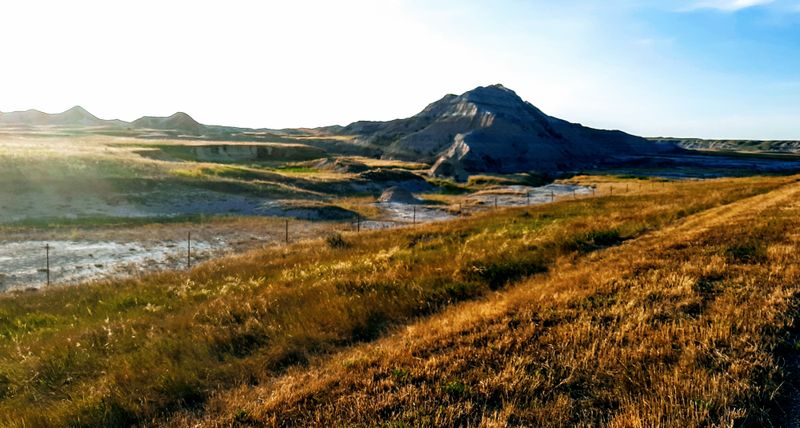
Interior came to life because the railroad needed a stop, not because tourists needed one.
The tracks shaped the town’s purpose and pace from day one.
When rail traffic faded, Interior did not reinvent itself.
I like how it simply stayed put, quietly intact.
If you pull into Interior along US Highway 44, you can feel that original intent in the layout.
Everything lines up with the old corridor like the town is still listening for a whistle.
Walk the stretch near 3rd Street and Main Street, Interior, South Dakota, and you will notice how compact it feels.
Buildings face the wind with a kind of steady patience.
The park boundary sits close, but the town’s pulse is older than the visitor traffic.
It is a rhythm set by shipments, sidings, and schedules that no longer arrive.
You do not need a plaque to explain any of it, it’s amazing.
The angles of the streets and the spacing between structures speak for themselves.
If you listen, you hear trucks on gravel, not the rush of passing lanes.
That sound tells you the town still works on small needs.
Stop for a moment and watch the light slide across tin roofs and pale paint.
The scene looks unchanged because it does not need convincing.
Interior sits with its back to history and its face to the prairie, it is not frozen, just unhurried.
That is the difference you feel when you step out of the car.
A Main Street That Refuses To Rush
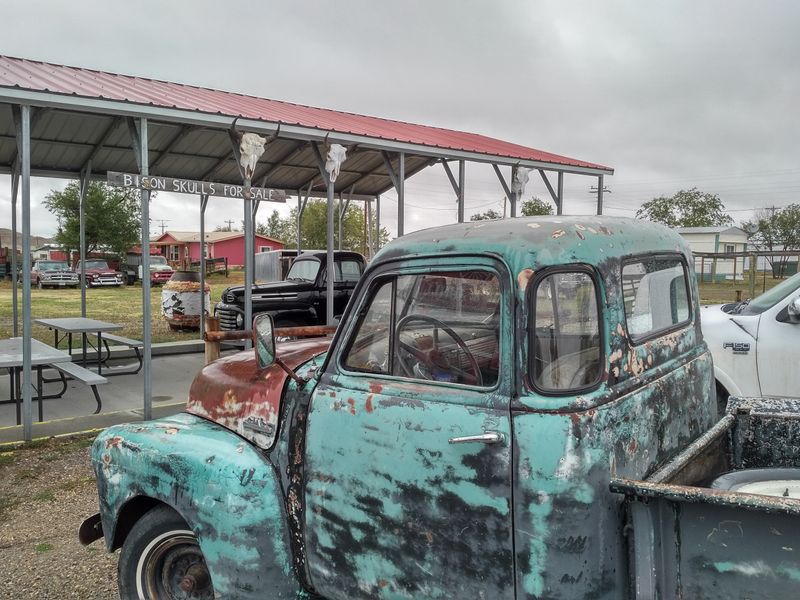
The town’s small main stretch feels paused mid sentence.
Buildings sit close together, worn but standing, nothing is polished for show.
That stillness is exactly what draws people in.
Roll down Main Street near 2nd Avenue, Interior, South Dakota, and you will spot a few signs that have outlived their original paint.
They are not trying to be vintage, they just are.
The fronts are square to the street like they were built with a carpenter’s eye and a rancher’s budget.
You can park, step out, and hear your shoes on packed dust, there is no brochure voice preaching at you from a kiosk.
Just a street that lets you make up your own mind.
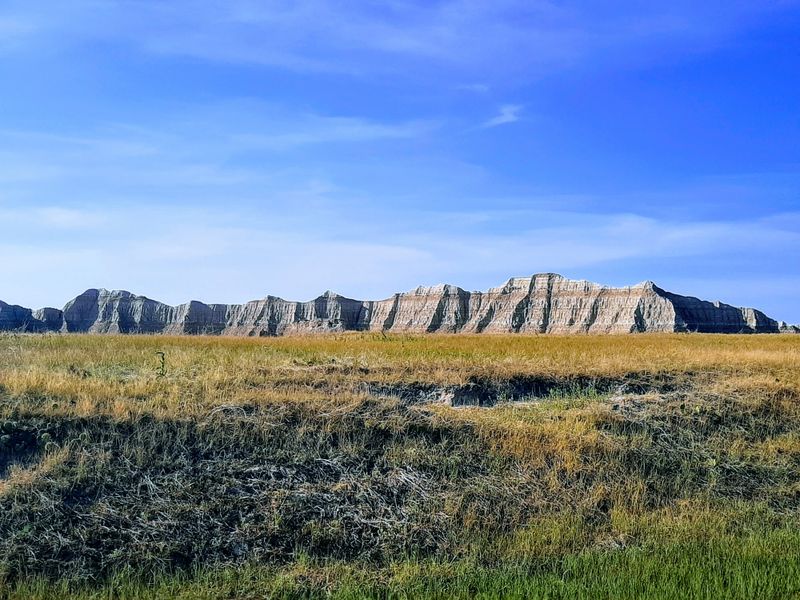
Look toward the Badlands edge and the horizon feels close enough to tap.
Turn back and the storefronts hold the line against the wind.
It is a short walk that takes longer than it should because you slow down without noticing, I really like that about it.
Details reveal themselves when you stop scanning and start looking.
A faded bracket, an old mailbox, a shade that still rolls up by hand, the rhythm of daily life runs cooler here.
You can tell by how the pickups are parked with no rush in their angle.
Conversations carry across the street without raising a voice.
That is how you know you are welcome to stay.
Railroad Ghosts You Can Still Feel

You will not see bustling platforms anymore, but the railroad presence lingers.
Locals talk about trains the way others talk about weather.
The tracks remain a reminder of why the town exists at all.
It feels lived in, not abandoned, and I really like that.
Walk near the old grade by Main Street and 1st Avenue, Interior, SD, and you will notice a straight swale through town, it is like a shadow of the past laid across the present.
The line might be quiet, but the town still keeps its posture from those days.
Freight once set the tempo, and some of that timing stays in the bones.
You can stand there and picture lanterns swinging on a cold night.
People here do not make a show out of history, they keep stories in their pockets and share them when the moment fits.
Ask a short question and you might get a nod toward the old right of way.
Listen, and you will hear how routine kept everyone steady; no reenactments, no costumes, just memory set in place.
The prairie absorbs noise and leaves room for thought, that quiet makes the past feel close without turning heavy.
You are not trespassing on nostalgia, you are walking through a town that learned to carry its own origin.
Where Locals Still Know Everyone
This is a town where faces become familiar fast.
Locals greet strangers with curiosity instead of sales pitches, and tourists notice the lack of performance.
What you see is what it is, and it’s beautiful.
Stop by the block around Main Street and 2nd Avenue, Interior, SD, and you will likely get a nod.
Maybe a small wave that says you are fine to pass through or pause.
No one hurries the exchange because time stretches a little here, it is not small talk for show, it is just how people move.
Names stick faster when the days run steady.
You will remember a hat, a truck, a dog that always rides in the back.
Ask for directions and you will get a landmark answer.
Turn where the fence leans, not where the sign sits, I think that style works when everyone shares the same mental map.
Give it an hour and you will start to carry that map too.
It is South Dakota hospitality without stage lights, and it feels steady, not sweetened.
People look you in the eye and keep their word short.
You leave a conversation feeling lighter than when you arrived, that is plenty on a long drive.
It is nice to be known, even for a day, and you carry that feeling down the road.
Old Buildings With No Interest In Reinvention
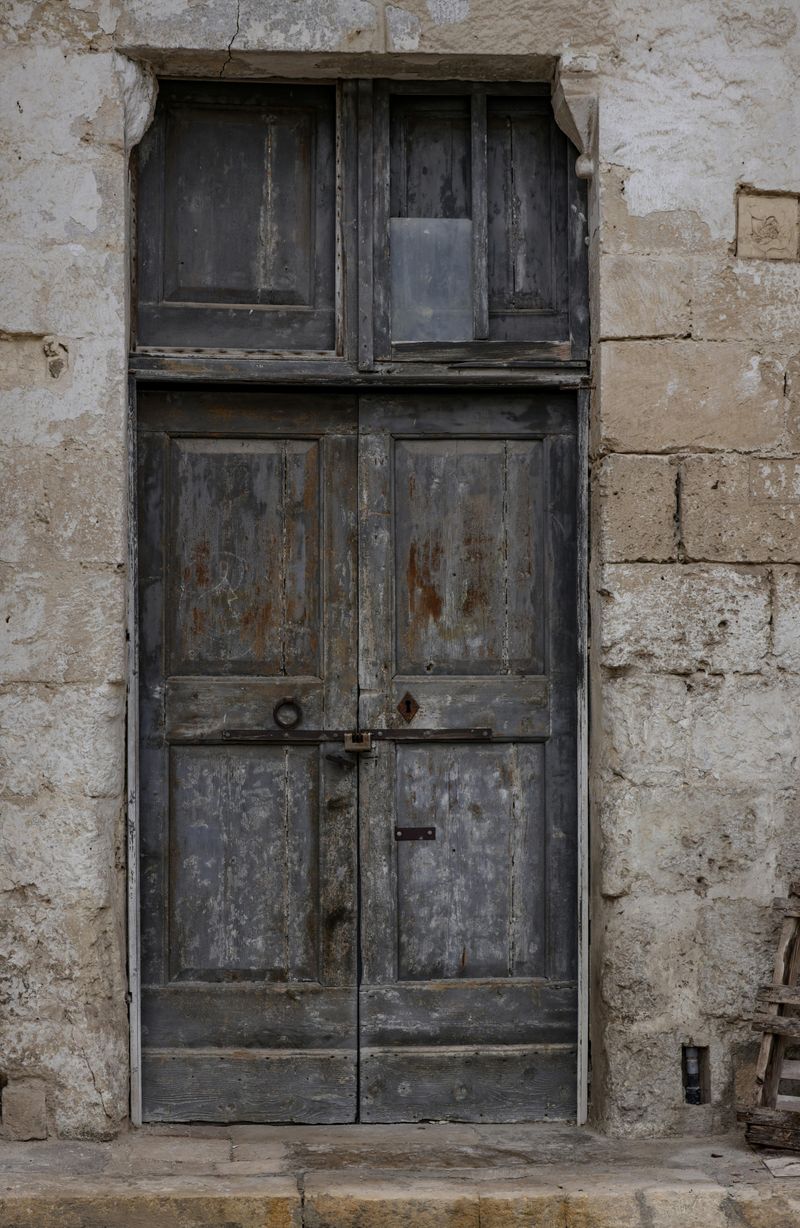
Interior’s structures have not been turned into themed attractions.
They remain practical, slightly rough, and honest, that authenticity matters to locals.
Visitors sense they are seeing something real, and I agree with that.
Walk by the corners around Main Street and 3rd Street, Interior, South Dakota, and notice the small fixes that keep things going.
A fresh hinge here, a patched step there, always with a steady hand.
Nobody is polishing for the camera because the camera is not the point, the point is use.
Doors swing and bells ring when someone needs something, simple as that, and it works.
You can trace the years by the layers of paint and the way boards lift at the edges.
Every line shows weather and patience standing side by side, there is a calm trust in function first.
I think it takes the pressure off and makes you breathe easier.
The buildings feel like people who keep showing up, not loud, not trying, just steady.
That steadiness puts a shape on your day without you noticing, and I love it.
You slow your steps to match the doorways.
Look up and the eaves make their own quiet pattern against the sky, it is a simple comfort to find in a road town.
South Dakota can feel vast, but these walls bring the scale back down, they remind you that lasting does not mean untouched.
It means cared for in a way that fits the place.
You carry that idea into the rest of your trip.
A Railroad Town That Didn’t Collapse
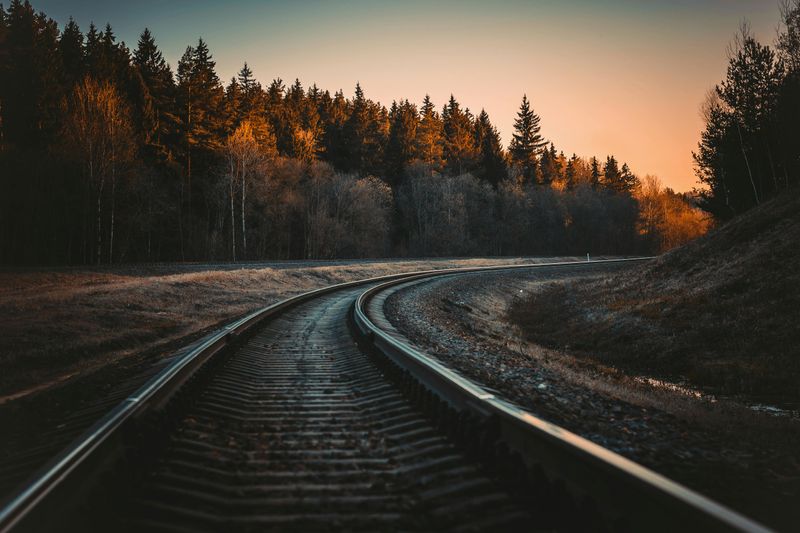
Interior adapted just enough to survive without losing its identity, which feels both fragile and strong to me.
That kind of balance is rare, and it makes the town quietly remarkable.
It is a place that endured instead of transforming into something unrecognizable, and I admire that resilience.
Standing near Main Street and County Road 535, you can sense both directions of Interior’s future.
One road points toward the park, while the other leads back to ranches and open range.
That split keeps the town honest about who it serves, and I find that honesty refreshing.
It serves both sides without bending to either, which feels like a stubborn kind of dignity.
There is pride in that stance because it comes from daily work, not empty slogans.
The town runs on simple needs that repeat every day, and I respect that rhythm.
Weather arrives, chores get done, and the town remains steady in its place.
Travelers pass through, yet the rhythm of life does not break, which feels grounding.
You can sense the difference in how quiet rests on the street, almost like a presence.
It is a confident quiet that does not need proving, and I find that deeply calming.
Interior’s edges reveal practical thinking, while its center holds steady with purpose.
That is how a place keeps its shape when the big engine leaves.
No reinvention binge, just steady hands on small tasks that matter.
Those tasks stack up into a town that continues to stand.
You notice its steadiness, and slowly you begin to trust it.
Trust turns into time spent, and time spent becomes memory.
Night Skies That Feel Untouched

When the sun drops, the sky takes over with a calm authority.
With minimal light pollution, the stars feel close and overwhelming, almost like they lean toward you, and it’s stunning.
Visitors often linger outside longer than they planned, caught by the spell of the night.
Locals treat it as normal, which somehow makes the experience even better.
Head a block from Main Street toward 1st Street in Interior, SD, and the dark settles quickly.
The town’s small glow barely lifts off the ground, leaving the heavens wide open.
Every constellation steps forward as if you called its name, and it feels personal.
The horizon stays clean while the Milky Way draws a soft path across the sky.
You do not need fancy gear to feel it land in your chest.
Just tilt back and keep still for a few breaths, and it arrives.
Silence hangs in the air with a weight that feels kind.
I think it is the kind of silence that makes room for the thoughts you carry.
Now and then a coyote’s thread might rise from the flats.
It is more lullaby than alarm in a place like this.
The night teaches patience without ever giving a lecture.
You learn to wait between moments and let your eyes catch up.
South Dakota knows how to do big sky without bragging.
A Town That Doesn’t Explain Itself
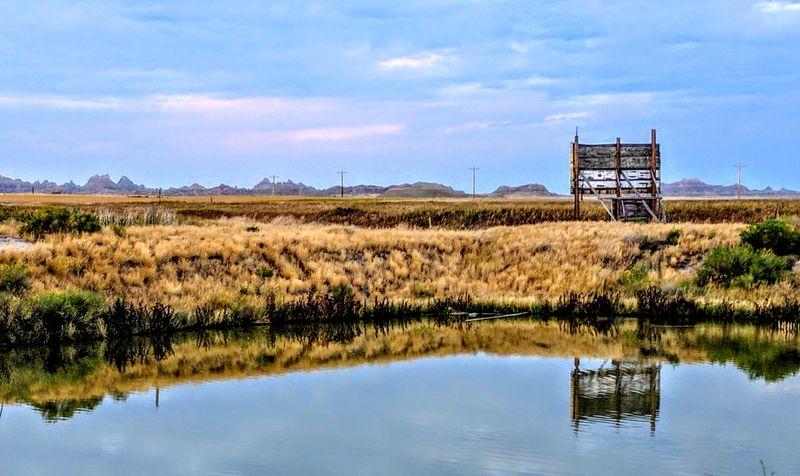
Interior does not offer plaques or long backstories on every corner.
You learn instead by walking, listening, and paying attention to what is already there.
That slow discovery becomes part of the experience, and it feels more genuine.
Tourists who enjoy mystery tend to love it, because nothing is handed over too quickly.
Start at Main Street and drift toward 2nd Avenue in Interior, South Dakota, and let your senses do the work.
Notice how the wind sorts the cottonwoods and how gravel talks under tires.
Look for small signs of use that tell more than any display could.
A worn step means more feet than a brochure ever will, and that feels honest.
The town keeps its stories on a need-to-know basis, which makes them precious.
You earn them by being present, not by reading a plaque.
Ask a question and you might get a short answer with a smile.
Ask a better question and you might get a longer pause first.
I feel like that pause is the good part because it means someone is thinking.
It means they care how the story lands, and that care is rare.
Places like this are not guarded, they are careful.
Careful is its own kind of welcome out here, and it feels sincere.
Where Silence Is Part Of The Appeal
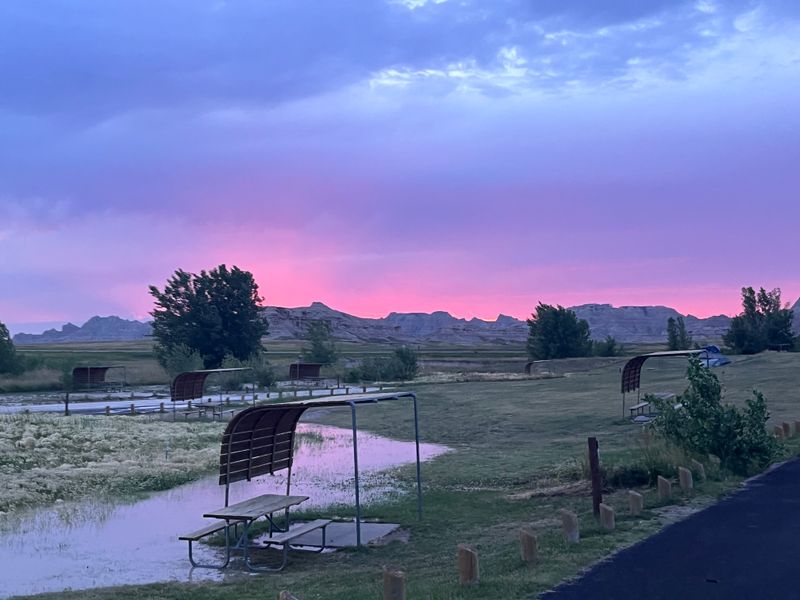
This town does not compete for attention, and that restraint feels deliberate.
Long pauses and empty streets are expected, shaping the rhythm of the place.
Road trippers either lean into that rhythm or move on quickly.
Those who stay usually do not forget the experience, because it lingers.
Stand near Main Street and 4th Street in Interior, South Dakota, and let the wind do the talking.
Your shoulders drop without you asking them to, as if the town insists on calm.
The day spreads out and loses its edges, becoming softer.
You start noticing small movements like shade crawling across wood.
I like how the silence here is not empty, it is full of cues.
It tells you when to walk and when to wait.
It draws a ring around interruptions and lets them fade.
Cars pass softly, and then the quiet fills back in.
There is no push to fill the space with noise.
You leave it open, and it rewards you with clarity.
Time in a town like this can feel earned.
You trade hurry for awareness and come out ahead.
That is a good deal on any road day.
Dear Reader: This page may contain affiliate links which may earn a commission if you click through and make a purchase. Our independent journalism is not influenced by any advertiser or commercial initiative unless it is clearly marked as sponsored content. As travel products change, please be sure to reconfirm all details and stay up to date with current events to ensure a safe and successful trip.
