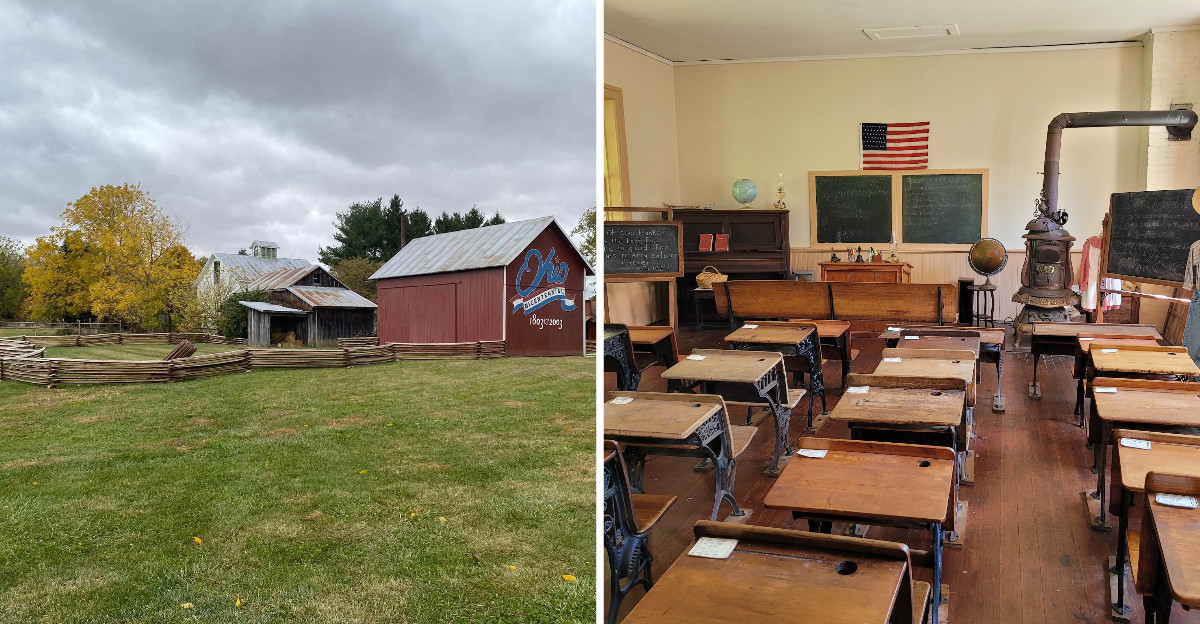
Sixteen buildings sit along quiet gravel paths under the trees, and most of them were not born here at all. They were lifted, hauled, and rebuilt piece by piece because the alternative was a bulldozer.
That detail stuck all afternoon, the idea that a log church or a one-room school could have simply vanished if nobody had bothered. What makes the place feel alive is how ordinary it all looks, like the families stepped out for a minute.
A state route promised a single old house and a gift shop, but an entire village waited instead. Ohio has plenty of historic sites, but this one carries the fingerprints of the people who refused to let it disappear.
Dusty shoes and a notebook full of scribbles were the souvenirs. Volunteers keep this place standing, and their work is worth every mile of the drive.
The John Wright Mansion Anchors the Whole Property
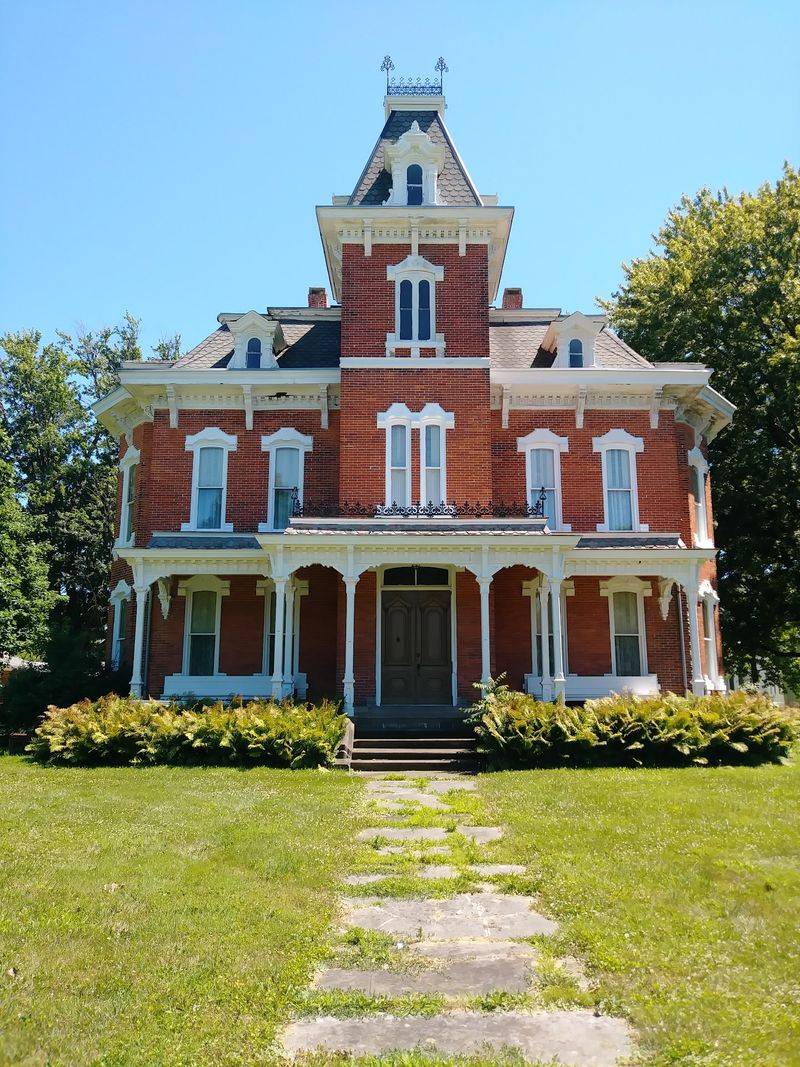
My first look at the John Wright Mansion came through a gap in the trees, and the mansard roof gave it away instantly. Built between 1880 and 1882, it is the one major building here that never moved an inch.
Everything else was hauled in. The mansion simply stayed put, which makes it the anchor the rest of the village grew around.
Second Empire Victorian style loves height and detail, and this house delivers both. Tall windows stretch toward that distinctive curved roofline, and the brickwork has the kind of small flourishes builders added when they wanted a home to be noticed.
It sits on the National Register of Historic Places, which is a nice bit of validation for a farmhouse-turned-showpiece out in Huron County.
Inside, the rooms tell you how a prosperous family in the Firelands lived once the frontier days had passed. There is a real contrast between this house and the log dwellings a short walk away, and I think that gap is the point.
Within a few decades, life in the region shifted from bare survival to parlors and patterned wallpaper. Seeing both on one property makes the change feel less like a textbook chapter and more like something you can measure in footsteps.
Start your visit here if you can.
Log Houses and a Working Church Built From Hewn Timber
Three log houses sit on the property, and each one feels smaller inside than you would guess from the doorway. Low ceilings, dark corners, one main room doing the work of five.
Families cooked, slept, mended clothes, and raised children in spaces barely bigger than a modern garage. That realization hit me harder than any placard could.
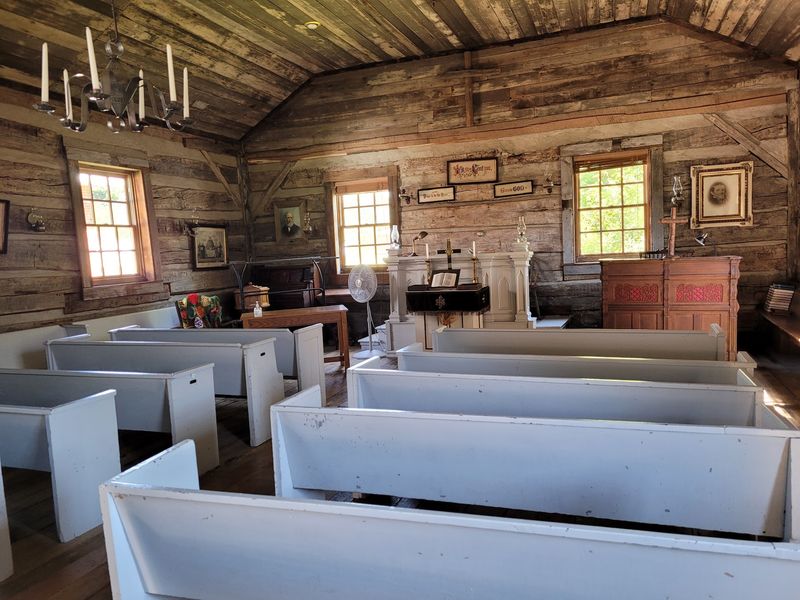
Nearby stands the Detterman Log Church, and this one is not just a display piece. Services and gatherings still happen inside, which means the benches keep getting used the way they were meant to be used.
There is something satisfying about a building that never fully retired.
The craftsmanship is worth a close look. Notched corners hold the logs together without nails, and you can still see the marks left by the tools that shaped each beam by hand.
No two logs match exactly, because trees do not grow to a standard size.
An 1836 farm home and several barns fill out this part of the village, giving you a sense of how a working property fit together. Animals, storage, shelter, and faith all within shouting distance.
If you visit on a breezy day, listen for how much sound those log walls swallow. It is remarkably quiet inside.
Merry School House Puts You Behind a Wooden Desk Again
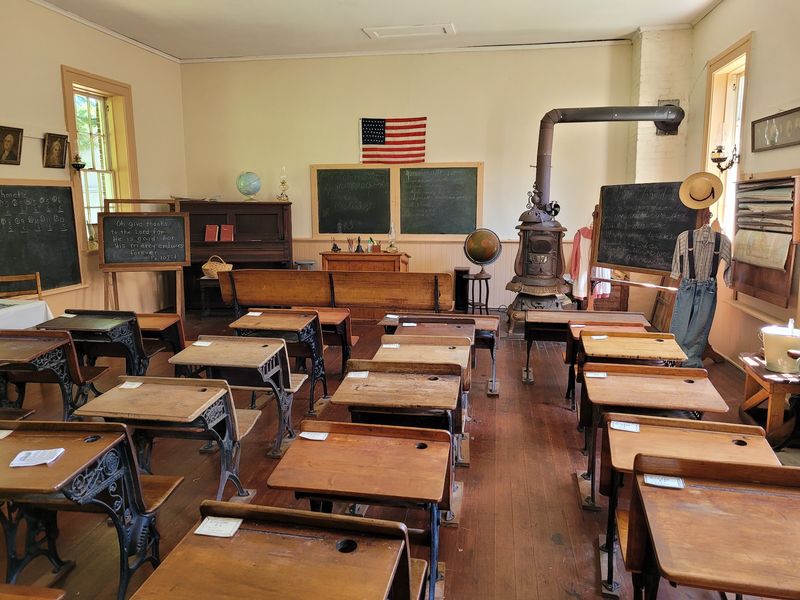
Slide into one of the wooden desks at the Merry School House and you immediately understand why kids sat up straight. There is no slouching in furniture like that.
Built in the 1860s, the schoolhouse was moved to the village in 1991. One room, one teacher, and students of every age learning together.
Chalk dust, a stove for winter, rows of desks facing a single board at the front. Older students often helped the younger ones, partly out of kindness and partly because the teacher had eight grades to manage at once.
Honestly, it sounds exhausting and kind of wonderful.
School groups get the best of this building, since hands-on lessons here line up with Ohio Social Studies standards covering state history and early Firelands settlement. Kids practice writing on slates and hear what discipline looked like when the rules were posted on the wall.
Adults tend to get just as curious, judging by the questions I overheard.
My favorite detail was the scale of everything. The room is compact, the windows do most of the lighting work, and the whole design assumes you are there to pay attention.
Compare it to any modern classroom and the difference in resources is stunning. Compare the goals, though, and they are not so far apart.
Shops Where Trades Happened, From Shoes to Woodworking
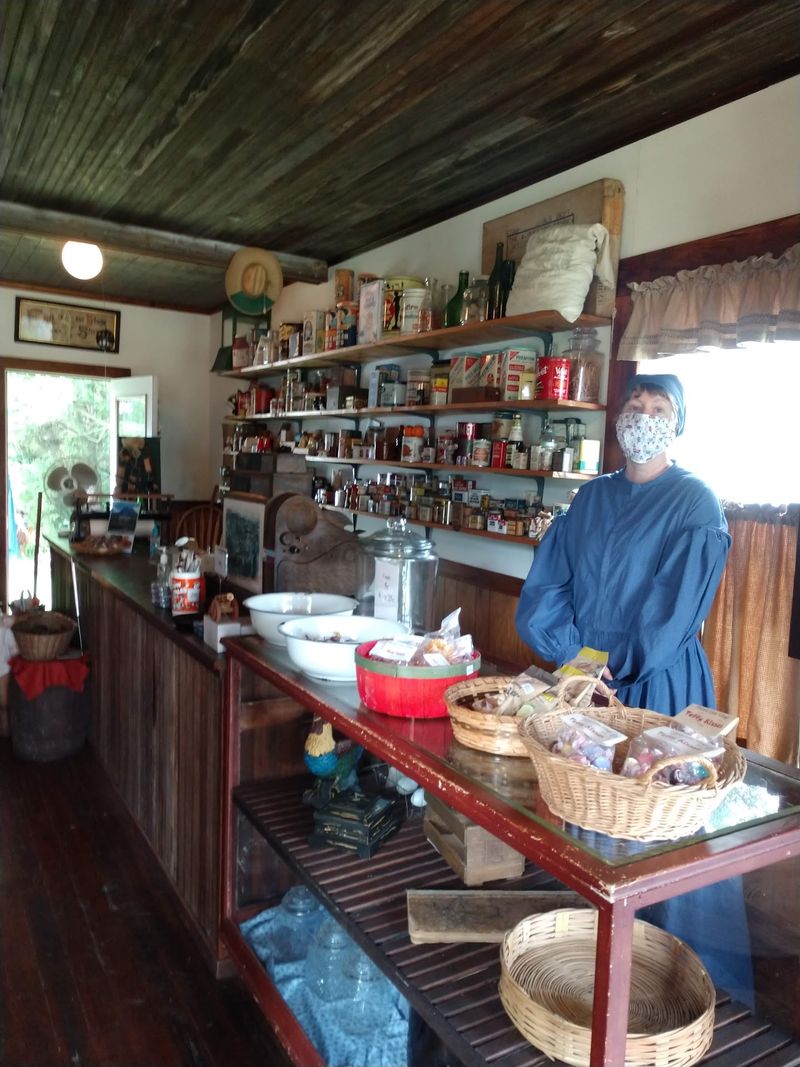
Small towns once ran on the skills of a handful of people, and the shop buildings here make that obvious. A general store, a woodworker’s shop, and a shoe shop sit within easy walking distance of each other.
Shelves in the store hold tins, bottles, and dry goods arranged the way a shopkeeper would have stacked them. It doubled as the local news hub.
The woodworker’s shop won me over with its tools. Hand planes, chisels, saws with wooden handles worn smooth, all lined up for work that required patience instead of electricity.
Every joint on a chair meant real time at a bench.
Shoes fascinated me most, maybe because we take them so thoughtlessly now. A cobbler measured your foot, cut leather, and built footwear meant to be repaired again and again rather than tossed out.
Those lasts and awls look almost surgical.
During living history days, crafters and interpreters set up in these spaces and actually demonstrate their trades. Watching someone shape wood or stitch leather beats reading about it by a mile, and you can ask questions as they work.
Bring curiosity and you will leave with a new appreciation for handmade things. I certainly looked at my own boots differently on the drive home.
Three Museums You Would Never Expect to Find Side by Side
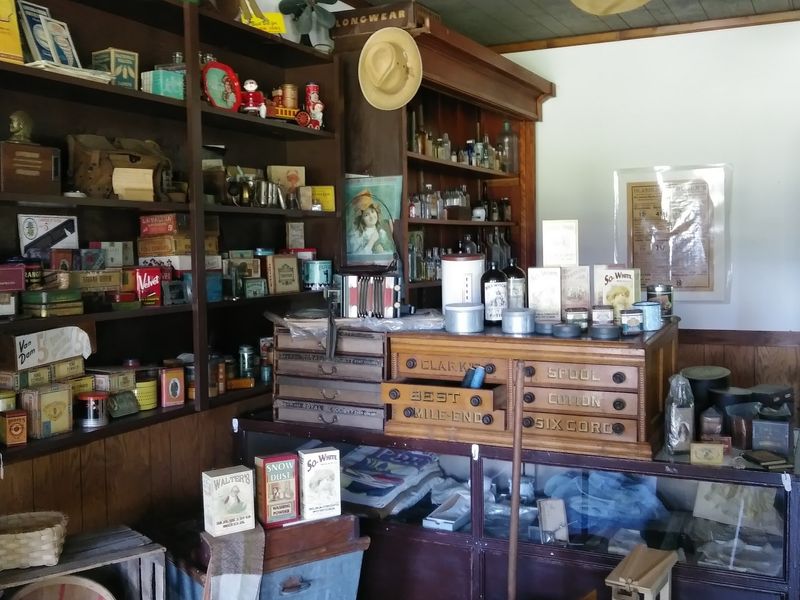
Tucked among the historic homes are museums that go deep on subjects most people have never considered collecting. The Schug Hardware Museum comes first, packed with the nuts, bolts, latches, and gadgets that built the region.
It sounds dry until you see the variety. Hundreds of small objects, each solving a problem someone actually had.
Then there is the National Postmark Collectors Museum and Research Center, housed in the visitor’s center. Postmarks turn out to be tiny historical records, marking where mail traveled and which post offices existed before towns faded off the map.
Researchers use this collection seriously, which surprised me.
The Veteran’s Military Museum opened in 2017 inside the old Groton Township Hall, and it leans heavily toward the Civil War and World War I. Uniforms, equipment, and personal items connect Ohio families to conflicts far from home.
Reading the displays slowly is worth the extra minutes.
What I liked about this trio is how local it all feels. None of it was assembled to impress tourists from far away, and that gives the cases an honest, homemade quality.
Volunteers from the Historic Lyme Village Association keep the whole nonprofit operation running, museums included. Their fingerprints are all over the labels and arrangements, and the place is better for it.
The Kromer Barn Hid a Wartime Secret in Plain Sight
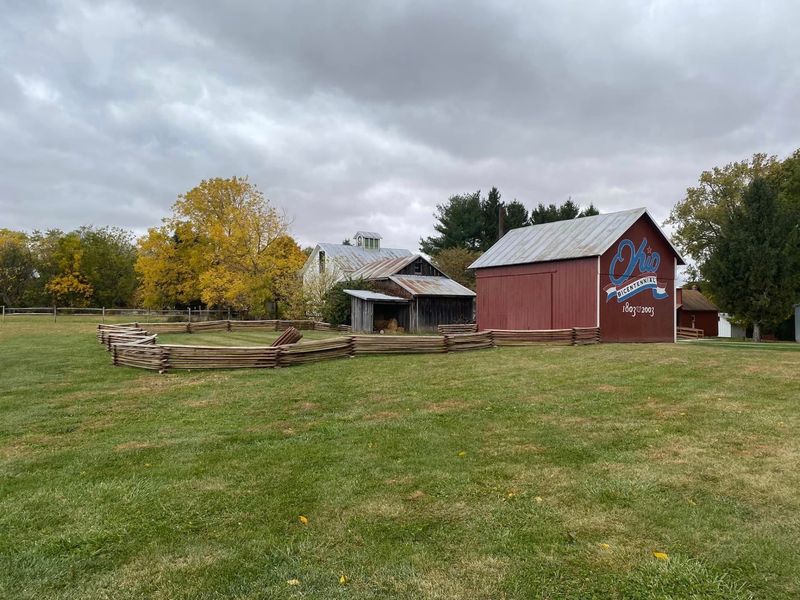
Here is the story that surprised me most on the entire tour. The Kromer barn, an ordinary-looking farm building, was used for TNT production during one of the World Wars.
The reason came down to geography and camouflage. Its position made it possible to conceal the structure from aerial view.
Picture that for a second. While the rest of the countryside grew corn and hay, this barn quietly handled something far more dangerous.
From the road it would have looked like nothing at all, which was exactly the plan.
Barns rarely get much attention at historic sites, treated as background scenery next to the fancy houses. This one flips that completely, proving that the plainest building on a property can hold the wildest history.
I walked around it twice just taking in how unremarkable it appears.
Standing beside it made me think about how much of rural America pitched in during wartime in ways nobody advertised. Farms became factories, families adjusted, and the work happened without fanfare.
The barn survives because people here decided it mattered.
Ask a guide about it when you visit, since the details are more interesting spoken aloud than read off a sign. It is the kind of fact you end up repeating to friends later.
Events That Bring the Village Out of Its Quiet Season
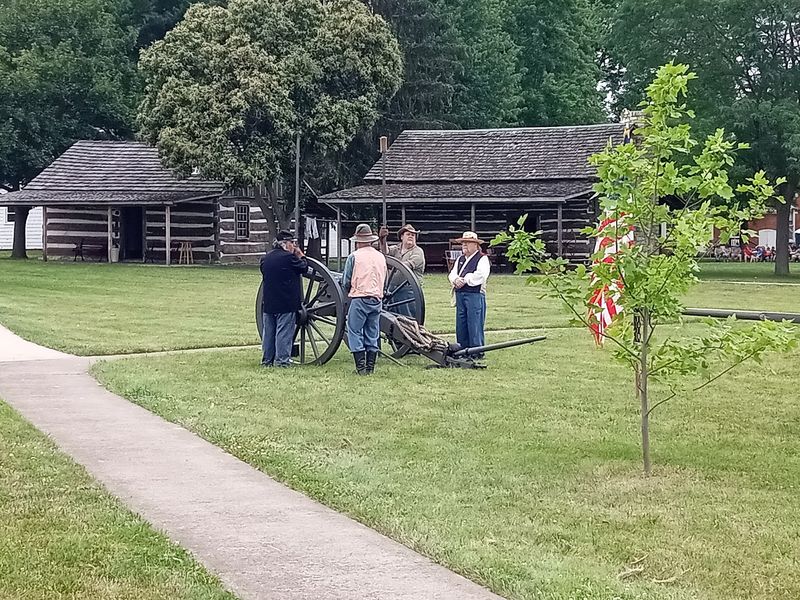
Timing your visit around an event changes the experience entirely. Pioneer Days, Pioneer Camp, A Night at the Village, Victorian Christmas Dinners, and Christmas of Yesteryear fill the calendar through the year.
Civil War re-enactments, a Victorian Tea, and Halloween programs turn up as well. Each one uses the buildings differently.
The Christmas tours draw a lot of praise, and it is easy to see why once you imagine candlelight against those Victorian windows. Interpreters in period clothing move between the houses, and the whole place slows down in the best way.
Evening light does something special to old glass and painted wood.
Tours run guided or self-guided depending on your mood. I lean toward guided, because the connections between buildings only make sense when someone explains which ones were moved and why.
Self-guided works fine if you like reading at your own pace.
Practical details matter here. The village is open Wednesday through Saturday from 11 AM to 5 PM, sits about four miles east of Bellevue and four miles south of Ohio Turnpike Exit 110, and the visitor’s center includes a gift shop worth a browse.
Call ahead at (419) 483-4949 if you want to confirm event schedules.
Address: 5001 State Route 4, Bellevue, Ohio
