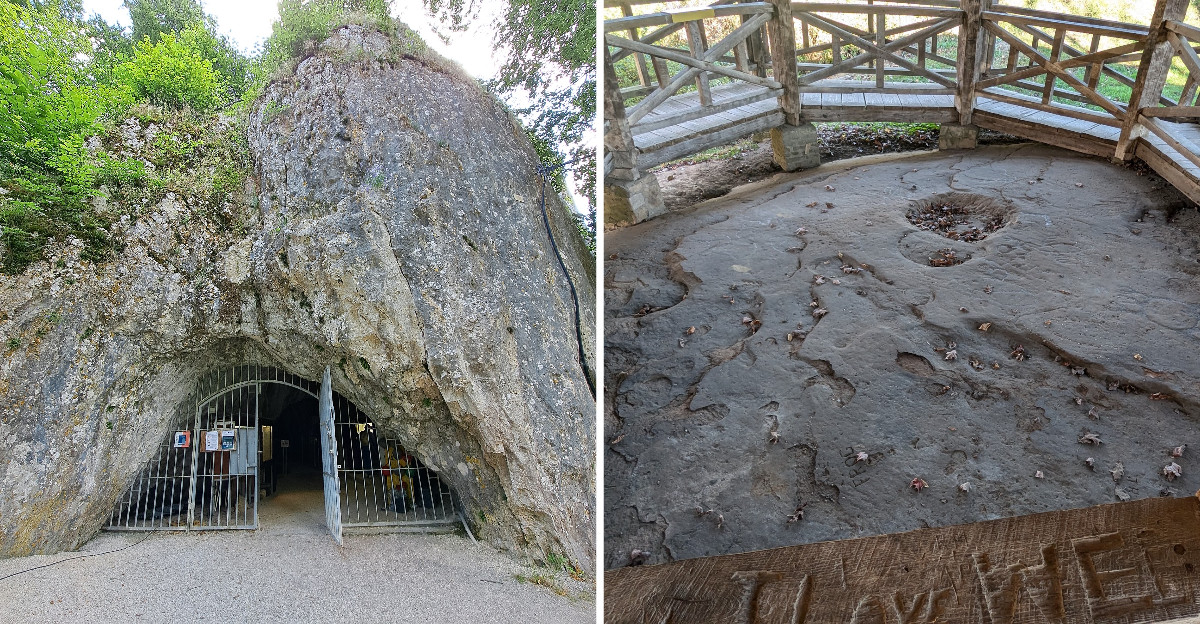
I found this place almost by accident, driving past soybean fields and barns in Jackson County until the road narrowed and the GPS stopped sounding confident.
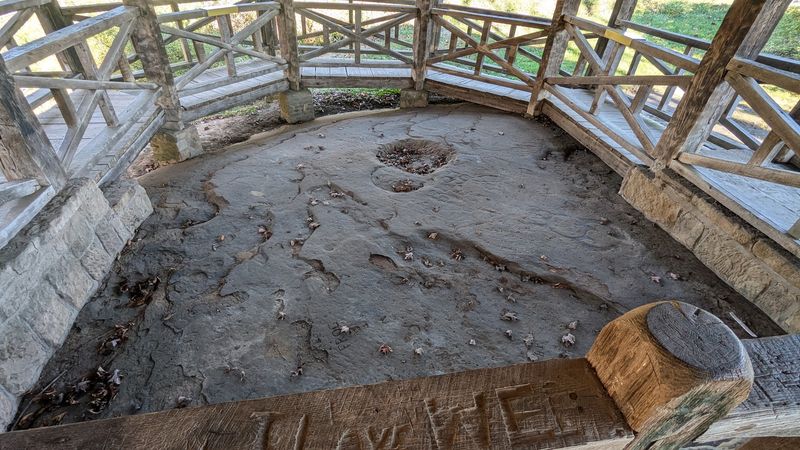
Then a small gravel lot appeared, a wooden shelter sat quietly under the trees, and underneath it was a slab of sandstone covered in carvings older than almost anything I had seen in Ohio.
Birds, footprints, a fish, and one strange figure with antlers growing out of its head, all pressed into rock by hands that left no name behind. I stood on the walkway for a long while just trying to make sense of them, and honestly I never did.
Behind the shelter, a short trail drops into a shady gorge with hemlocks, little waterfalls, and cliffs that feel far taller than the map suggests. It ended up being one of the most quietly memorable stops I have made in southern Ohio, and it costs nothing to see.
The Sandstone Slab That Started Everything
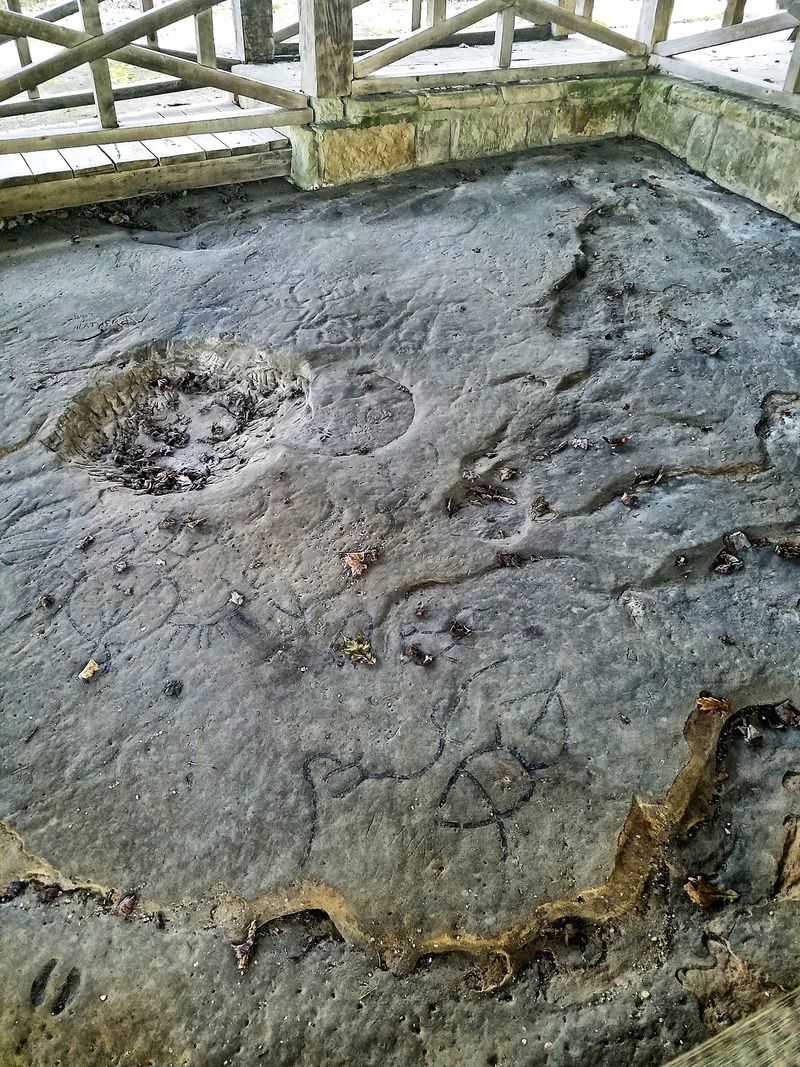
My first look at the carvings came from about six feet away, leaning over a wooden railing with my head tilted sideways. The rock itself is Black Hand sandstone, a soft, grainy stone that breaks and wears easily.
That softness is exactly why the carvings exist. Ancient artists could work the surface without metal tools, scratching and pecking shapes into the stone with harder rocks.
Roughly 37 separate figures cover the panel, though counting them is harder than it sounds. Some overlap, some have faded, and a few only appear when the light hits at the right angle.
I learned pretty quickly that time of day matters more than anything else here. Midday sun flattens everything out, while lower morning or late afternoon light throws shadows into the grooves and suddenly the figures pop.
What surprised me most was the scale. The panel is not a towering cliff face but a broad, mostly level slab, almost like a giant stone tabletop laid out in the woods.
Standing above it, you get the odd sense of reading a page rather than looking at a wall, which makes the whole thing feel oddly personal.
Who Left These Marks Behind
Nobody signed the rock, and that is the part I keep thinking about. Archaeologists generally credit the Fort Ancient peoples, a late prehistoric Native American culture that lived across Ohio from roughly 1000 A.D. to 1650 A.D.
The estimate for the carvings themselves sits somewhere between 700 and 1,000 years old. That number comes largely from studying how much the soft sandstone has weathered, not from a date stamped anywhere.
So there is real uncertainty baked into the whole site. Researchers can narrow the window, but naming the individual carvers or even the exact community is beyond reach.
I find that gap strangely appealing rather than frustrating. We know people lived nearby, farmed, hunted, told stories, and at some point walked to this rock with a purpose.
The Fort Ancient culture is well documented elsewhere in Ohio through village sites and pottery, which gives the guess solid footing.
Still, the connection between those villages and this particular slab remains an educated conclusion rather than a proven fact.
Reading the interpretive signs while the creek murmured behind me, I appreciated that the wording stays honest about what is known and what is not.
Antlers, Bird Feet, and One Very Odd Figure
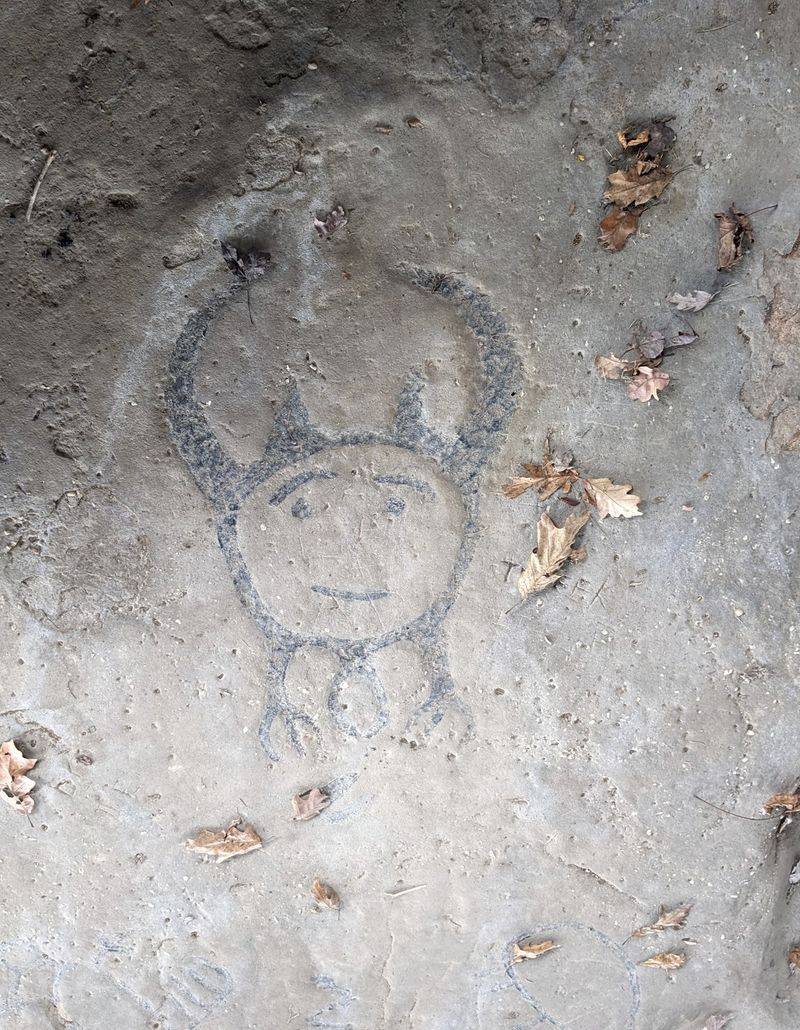
One carving gets photographed more than all the others combined, and once you spot it you understand why. A human head appears in profile with antlers rising from the skull and what look like bird feet attached below.
It is genuinely strange. Not crude, not accidental, but deliberately assembled from parts that do not belong together.
Some researchers interpret the figure as a shaman, a spiritual leader who might have been shown wearing ceremonial antlers. Others read it as a supernatural being from a belief system we simply do not have written records for.
Both explanations are educated guesses, and the site does not pretend otherwise.
I stared at that one for far longer than the rest. Something about mixing human, deer, and bird into a single shape feels intentional in a way the footprints and animals do not.
Elsewhere on the panel you will find a fish, a snake, several birds, and paired footprints that look almost like someone tracing their own steps.
Taken together, it reads less like decoration and more like a message. What that message actually says, nobody can tell you with confidence.
A 1930s Roof Doing a Big Job
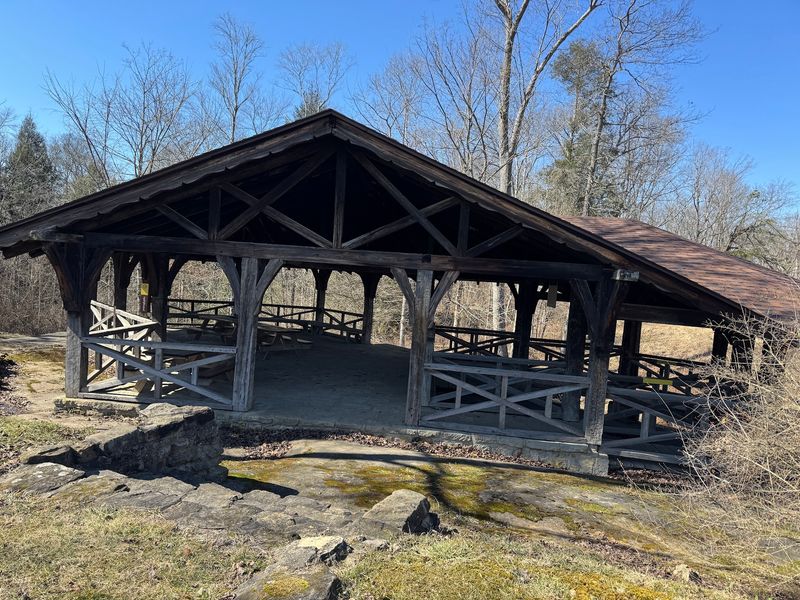
Credit where it is due: someone in the 1930s realized this rock was not going to survive another century of Ohio weather unprotected. A Works Progress Administration crew built the open-walled wooden shelter that still stands over the panel today.
No walls, just posts and a roof. Rain and snow stay off the carvings while air moves freely and light still reaches the stone.
An elevated walkway wraps around the panel so visitors can lean in close without ever setting foot on the sandstone. Given how soft the rock is, that boardwalk does more preservation work than it gets credit for.
There are interpretive signs and seating under the shelter too, which makes it easy to linger. I sat for a while just watching the light shift across the grooves.
Sadly, some modern visitors have carved initials into both the rock and the shelter railings over the years. Seeing recent scratches beside 900-year-old figures is a genuinely deflating moment.
Curators once traced the ancient carvings with charcoal to help visitors see them, though that tracing has faded considerably.
The structure remains simple, functional, and quietly heroic.
The Gorge Trail Hiding Right Behind the Rock
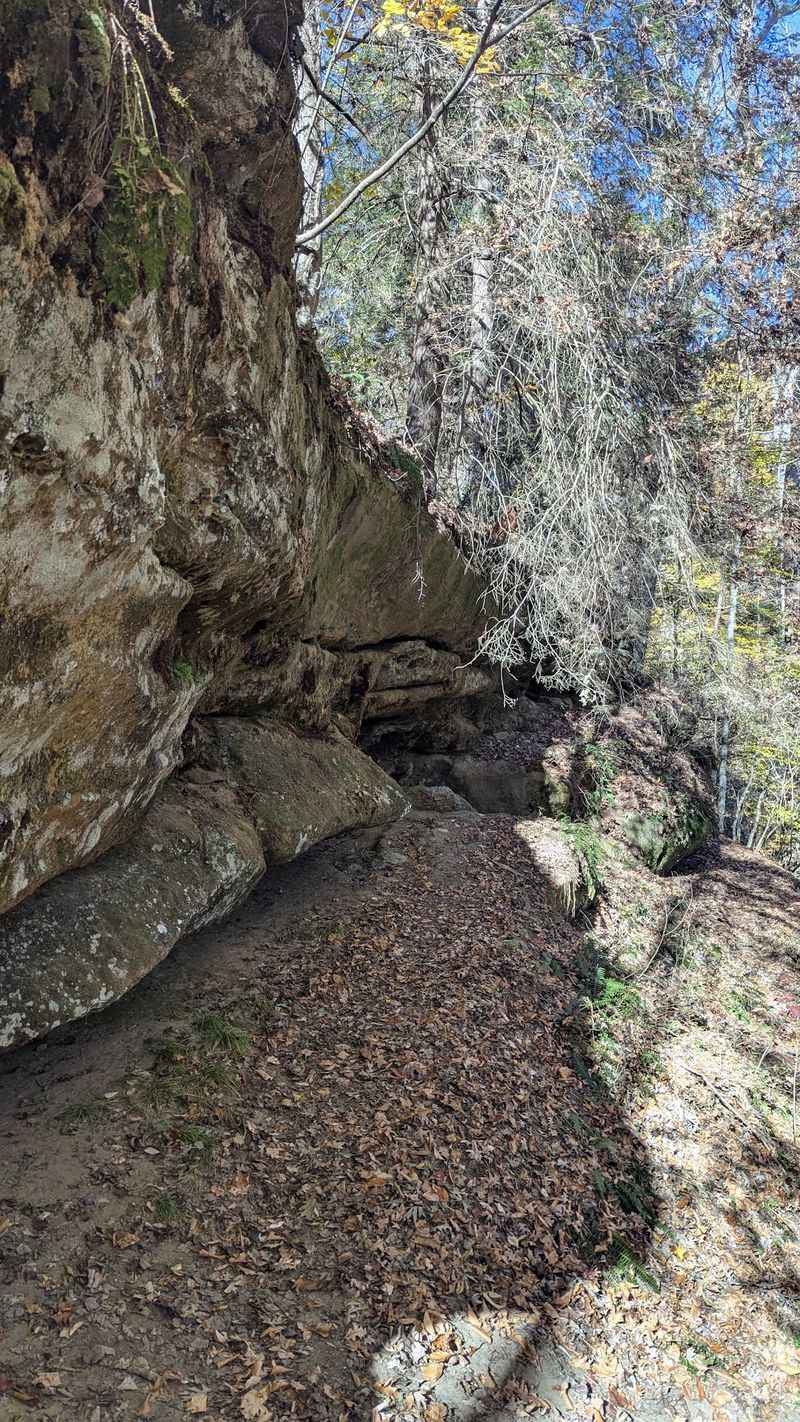
Plenty of people pull in, look at the carvings, and drive away without realizing there is a whole second attraction back there. The loop trail runs somewhere between half a mile and 0.7 miles depending on which route you take.
It drops off the ridge behind the shelter and descends into a narrow gorge that feels completely separate from the farmland above.
The path is packed dirt with roots, stone steps, and a few sections where the footing gets uneven. After rain it turns slick in spots, so shoes with grip make a real difference.
I would call it easy to moderate rather than strenuous, but a walking stick genuinely helps on the descents.
Fallen trees sometimes block sections of the route, since the preserve is unstaffed and maintenance depends on volunteers. Usually you can step around or duck under without much trouble.
Interpretive signs along the way point out native plants and rock features, which turns the walk into something more educational than expected.
The whole loop took me under an hour with plenty of stopping to gawk at cliffs and photograph moss.
Cliffs, Waterfalls, and a Rock Shelter Worth the Detour
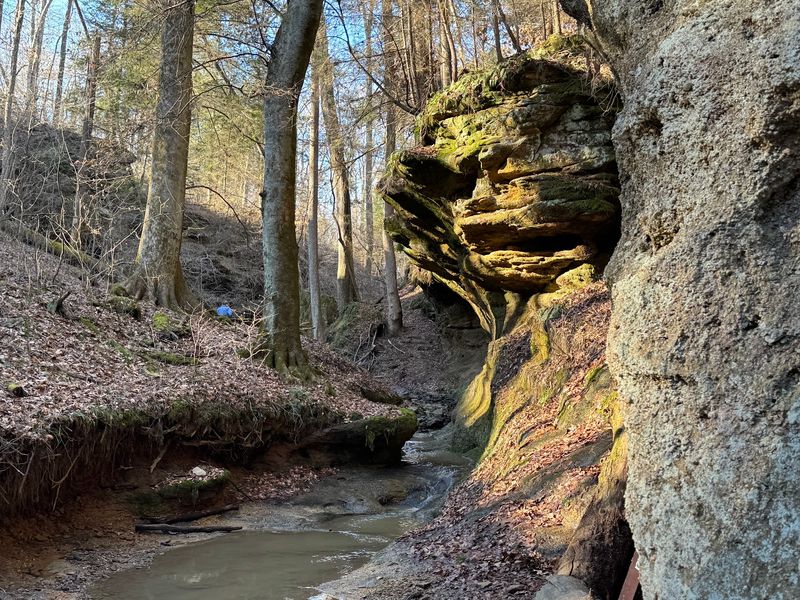
The gorge is the part I did not expect to love as much as I did. Sandstone walls rise anywhere from about 20 to 65 feet, streaked dark with water and softened by moss.
These are unglaciated Mississippian sandstone formations, meaning the glaciers that flattened much of Ohio never reached this corner. The landscape stayed rugged as a result.
A creek threads through the bottom and spills over several small waterfalls. None of them are dramatic, but after a good rain they add a steady rush of sound that carries through the whole ravine.
The highlight for me was a large recessed rock shelter carved back into the cliff, the kind of overhang that reads like a shallow cave.
Eastern hemlocks grow thick down here, keeping things cool and green even in summer heat. Spring brings trilliums, violets, and spring beauties across the slopes.
If you have hiked Hocking Hills and loved the rock houses, this offers a similar feel with a fraction of the foot traffic.
Bring bug spray in warm months. Ticks are a legitimate concern in these woods.
Getting There Without Losing Your Nerve
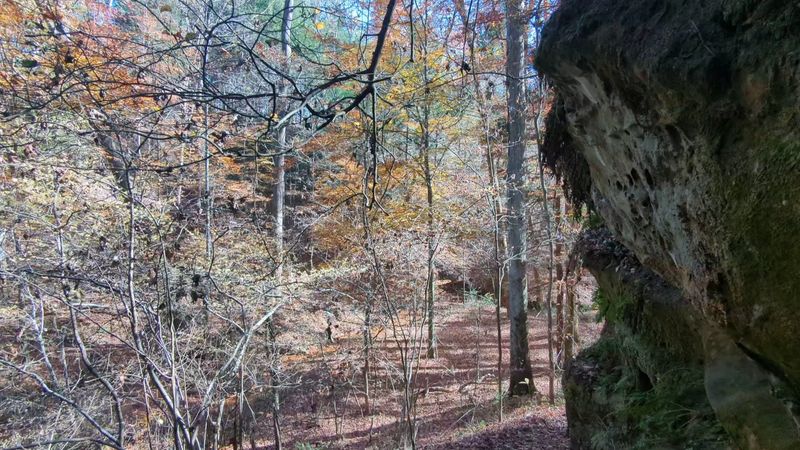
Fair warning: the drive out here goes properly rural. You will pass farms, pastures, and long stretches where cell service gets patchy enough to make you question your route.
Download the directions before you leave the highway. That single step saves a lot of second-guessing.
The site sits near the village of Leo in Jackson County, and the turnoff is easy to miss if you are not watching for signs. When you finally arrive, a small gravel lot sits right beside the shelter.
Parking is free and rarely full, which is part of the charm.
One of the genuinely great things about this stop is accessibility. You can park, walk a few steps, and be looking at the petroglyphs within a minute, no hiking required at all.
Admission costs nothing, and the grounds stay open during daylight hours year-round.
There are no staff on site, no gift shop, and no restrooms, so plan accordingly and bring water. I would treat it as a self-contained stop rather than a place to resupply.
Pack a lunch if you can. The shelter seating makes a fine picnic spot.
Why the Mystery Is the Best Part
Most historical sites hand you an answer. This one hands you a shrug, and I left thinking that might be the better souvenir.
We can say roughly when the carvings were made and roughly who made them. Beyond that, the meanings stay locked away.
Was the panel a map, a calendar, a record of hunts, a sacred marker, or something no modern category covers? Every serious guess is just that, a guess built from careful study.
I walked the loop afterward with those questions rattling around, watching water slide over sandstone ledges that have looked more or less the same for centuries.
Standing where someone once knelt with a stone tool does something to your sense of time. The distance shrinks in a way photographs never quite capture.
If you go, give yourself an hour minimum. Twenty minutes at the shelter and forty on the trail is a solid rhythm.
Morning visits offer the best light and the fewest people, which is saying something at a place this quiet.
Come curious, leave puzzled, and consider that a win.
Address: 357 Township Hwy 224, Ray, OH 45672
