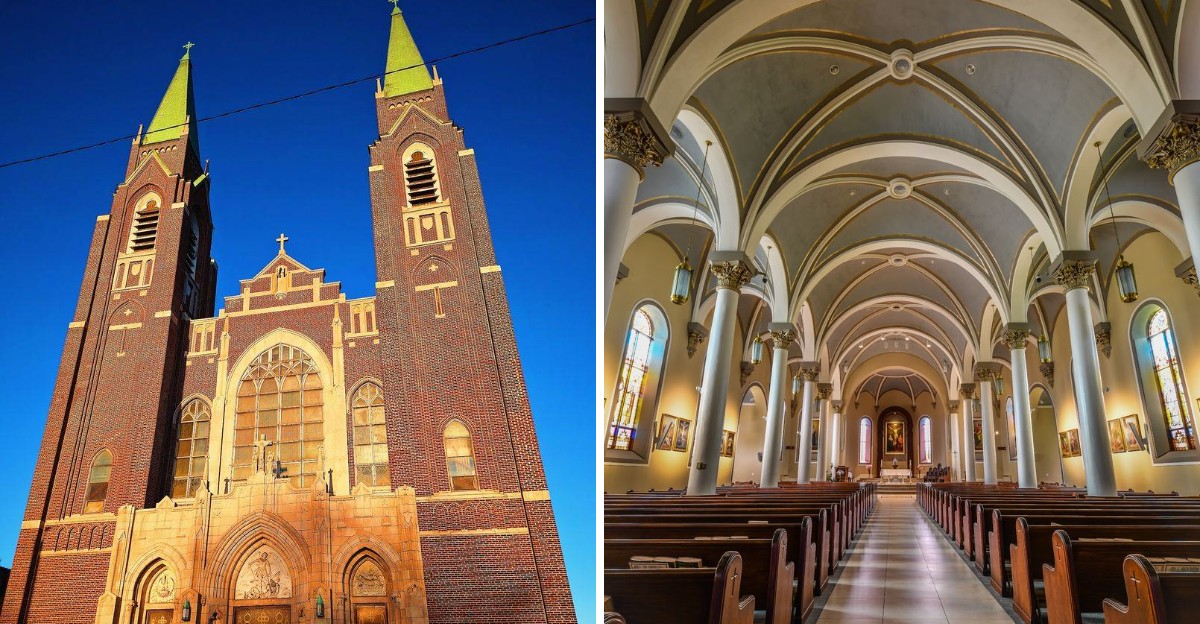
The first reaction is usually confusion. The second is a photo.
The third is, “How is this here?” Good question. Indiana has churches that look like they were lifted from medieval Europe and dropped into farm country.
Stone towers dominate quiet streets. Stained glass fills dark interiors with color.
Carved saints line the walls. Many were built by immigrant communities.
German. Polish.
Irish. Austrian.
They brought pieces of home with them. The architecture stayed.
Now you can drive past cornfields and suddenly find yourself staring at a church that looks like it belongs in an old European city. That is a pretty good reason to take the next turn.
1. St. Mary’s Catholic Church, Indianapolis
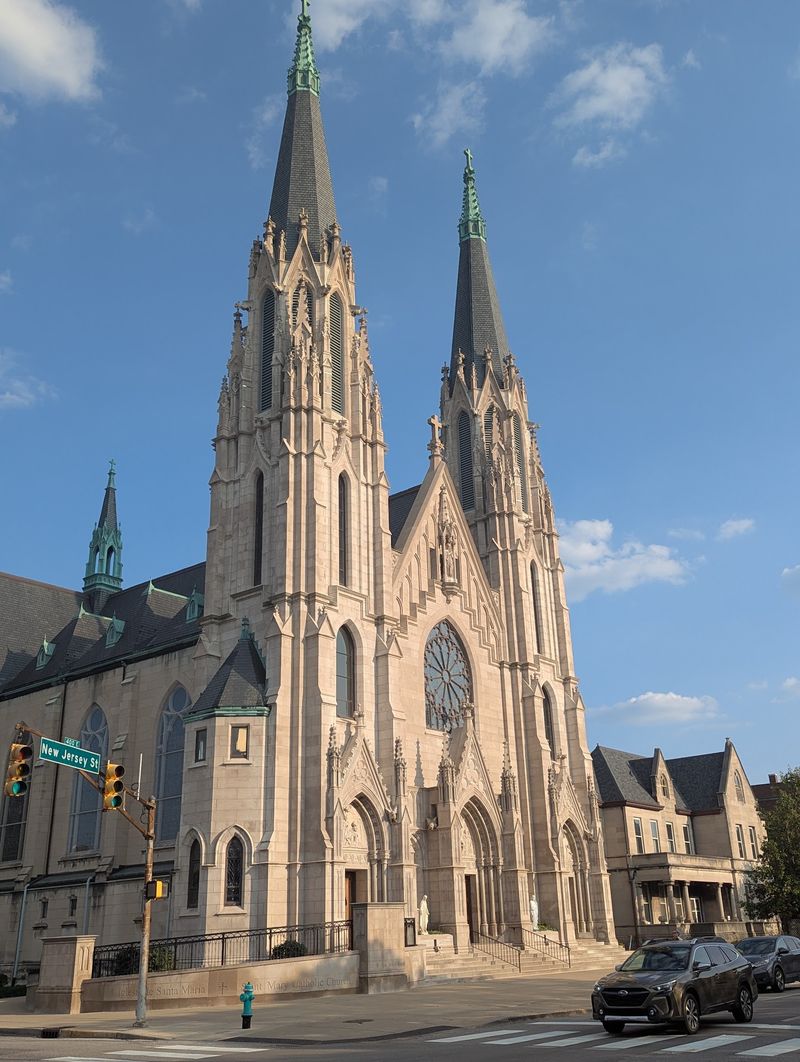
Twin spires shoot up 168 feet above a busy downtown block, and the effect is a little startling for anyone expecting standard city architecture. St. Mary’s sits at 317 N.
New Jersey St. in Indianapolis, close enough to walk to from the heart of the city.
Architect Hermann J. Gaul finished the church in 1912 and shaped its cruciform floor plan after Cologne Cathedral in his native Germany.
That inspiration is easy to spot.
The stone front splits into three parts, with a gabled center section carrying a trefoil motif, a finial, and a statue of the Virgin Mary tucked into a bracketed niche. Buttresses brace the walls, vaulted arches frame the openings, and yes, there are gargoyles worth hunting for.
Above the central doorway, a relief sculpture of the Crucifixion fills the tympanum, backed by a frieze of blind arches. Look closely before heading inside, because the detail work rewards a slow pass.
Inside, a vaulted ceiling lifts the eye toward a semi-octagonal apse ringed with statues. Stained glass windows, including ones honoring Saint Boniface and Saint Henry of Uppsala, wash the nave in warm color when the sun cooperates.
Listed on the National Register of Historic Places, the church remains a strong marker of German heritage in Indiana. It makes a natural first stop before heading out to the smaller towns.
2. St. Adalbert Catholic Church, South Bend
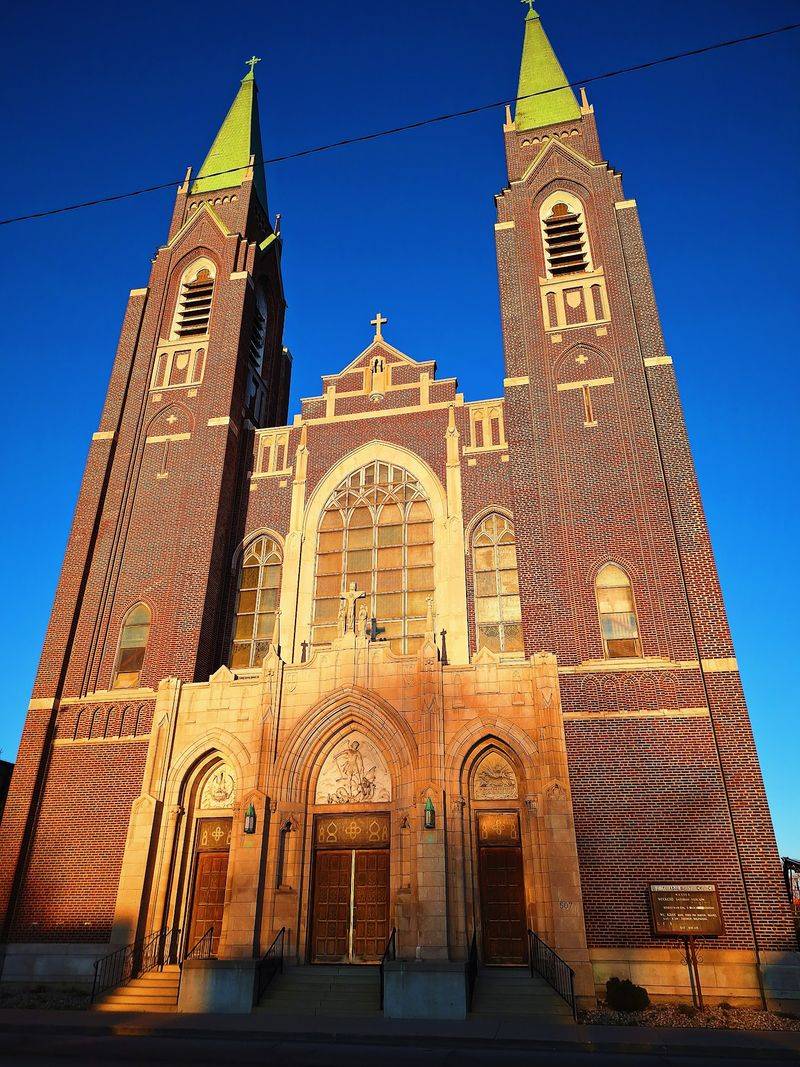
Locals call it the Cathedral of the West Side, and the nickname fits the moment those twin steeples come into view above the rooftops. Reaching 175 feet, they anchor an entire South Bend neighborhood at 2505 West Grace Street.
Polish immigrants founded the parish in 1910, and the church itself went up between 1923 and 1926. Chicago firm Worthmann & Steinbach handled the design.
The style has a name that travelers rarely hear outside the Midwest: Polish Cathedral. Brick masonry trimmed in limestone gives the exterior its weight, while pointed arch windows carry the Gothic rhythm across the facade.
Step through the doors and the cruciform layout opens into a space packed with murals, friezes, and sculpture. John Mallin painted the sanctuary, transept, and aisle murals in 1941, and one of them is genuinely fascinating.
That painting shows Polish immigrants building the very church visitors are standing in, turning swords into plowshares while factory smokestacks rise in the distance. It is history, faith, and hard work compressed into a single wall.
What makes the stop memorable is the sense of ambition. A community with modest means built something meant to last centuries, and it still holds the street together.
Give yourself extra time to circle the exterior and catch the steeples from different angles.
3. Delphi Methodist Episcopal Church, Delphi
Small-town Indiana rarely gets credit for grand architecture, and then Delphi shows up with a three-story bell tower dominating a street corner. The building sits at 118 N.
Union Street, an easy find in a town built for wandering on foot.
Construction of the sanctuary and auditorium dates to 1869, with changes layered on in 1884, 1897, and 1926. Architect Frank Wolever contributed to the design.
Red brick walls carry buttresses, gables, and pointed-arch windows in the Late Gothic Revival manner.
A 1926 education wing brings Collegiate Gothic into the mix, and the 1897 parsonage leans toward Second Empire, so the whole property reads like an architecture lesson stacked in one corner lot.
Inside, stained glass and more pointed arches keep the mood solemn and cool, even on a hot afternoon. The proportions feel generous for a building this far from any city.
These days it operates as Union Hall, also called Union Center, hosting concerts, weddings, and community gatherings. That second life is part of the charm, since the doors open more often than they might for a purely historic site.
Recognized on the National Register of Historic Places, the church rewards visitors who like their landmarks lived-in rather than roped off. Check the event calendar before driving over, since gatherings often mean access.
4. St. Michael the Archangel Church, Madison
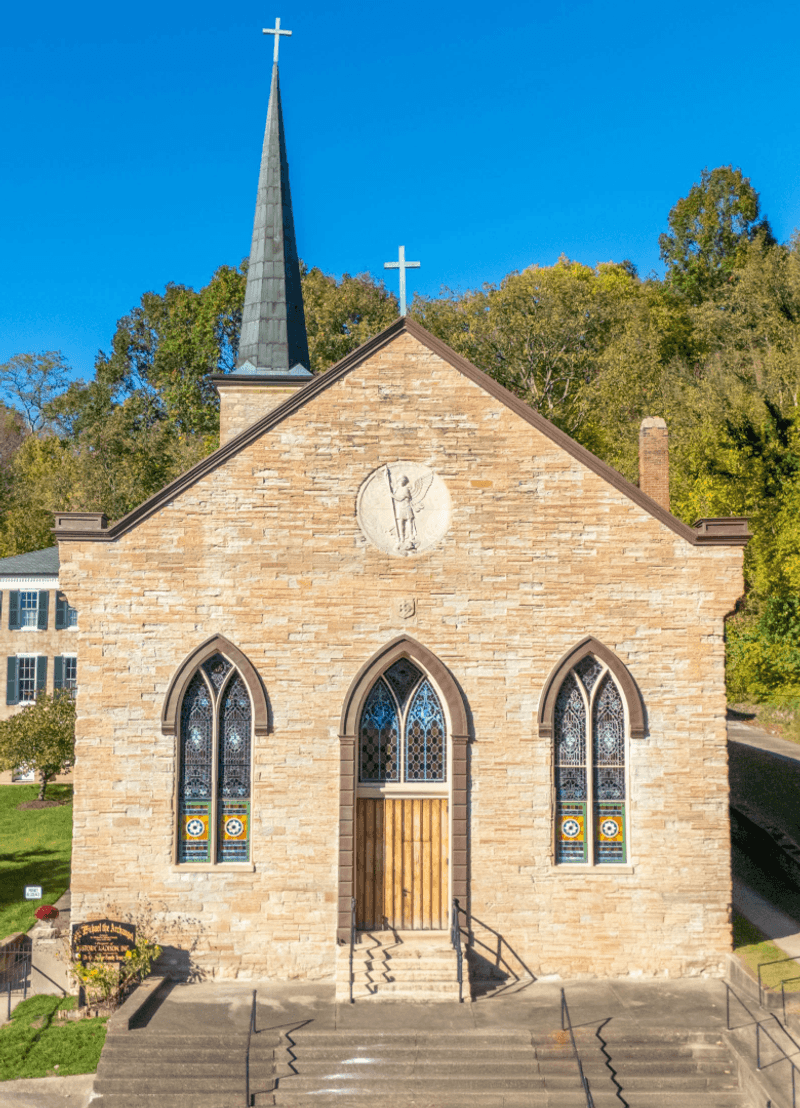
Indiana’s oldest Gothic Revival building does not shout for attention, which somehow makes it more impressive. St. Michael the Archangel stands at 519 East 3rd Street in Madison, a river town already famous for its preserved streetscapes.
Work began in 1838, and the first Mass took place on December 22, 1839. The design is often credited to Francis Costigan, the celebrated architect who happened to be a parishioner.
Stone for the walls may have come from a quarry above the church or from material cut for the railroad incline, and Irish and German immigrant parishioners supplied much of the labor. That story is baked into every block.
Pointed-arched windows set the tone outside, but the interior holds the real surprise: a rare ogee-arch ceiling shaped like an open book, symbolizing the word of God. An 1895 organ, statues, and paintings fill out the space.
Another oddity is the bell tower, tucked at the rear of the structure instead of the front. In 1865 the nave was extended 30 feet north and built into the sloping ground, so the apse stained-glass window sits nearly at ground level outside.
No longer an active parish, the building is carefully maintained by Historic Madison, Inc. Pair the visit with a slow walk through Madison’s historic district.
5. St. Joseph Catholic Church, Jasper
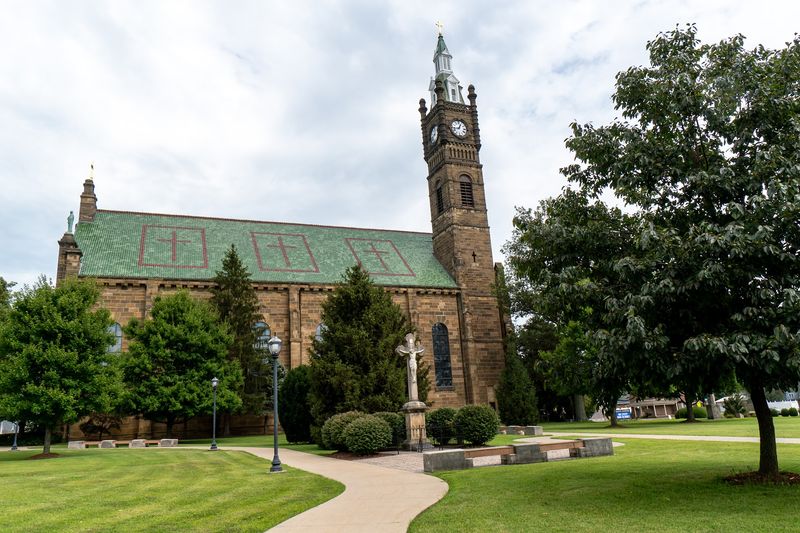
A 235-foot stone tower rising over a southern Indiana town is not something the average road trip prepares you for. St. Joseph Catholic Church commands the view from 1215 N.
Newton Street in Jasper, and the tower’s design is said to draw from the one housing Big Ben in London.
Built between 1867 and 1880, the church came together under Father Fidelis Maute, OSB, who served as both architect and builder. Consecration followed in 1888.
Solid sandstone blocks give the exterior a fortress-like heft typical of Romanesque Revival work. The parish traces back to a community founded by Father Joseph Kundek in 1837, which explains the deep German roots visible everywhere in town.
Inside, German stained-glass windows pour color across the sanctuary, and Austrian-designed mosaics made from roughly 50 million stones cover surfaces in shimmering detail. That number is worth repeating slowly.
Altars carved from Italian marble, pewter and marble statues, and a communion railing of onyx and brass raise the craftsmanship even higher. A vaulted ceiling, terrazzo floor, and fourteen sandstone veneered columns complete the effect.
Listed on the National Register of Historic Places, the church feels closer to a European cathedral than a Midwestern parish. Visit midmorning when light hits the eastern windows.
6. Monastery Immaculate Conception Church, Ferdinand
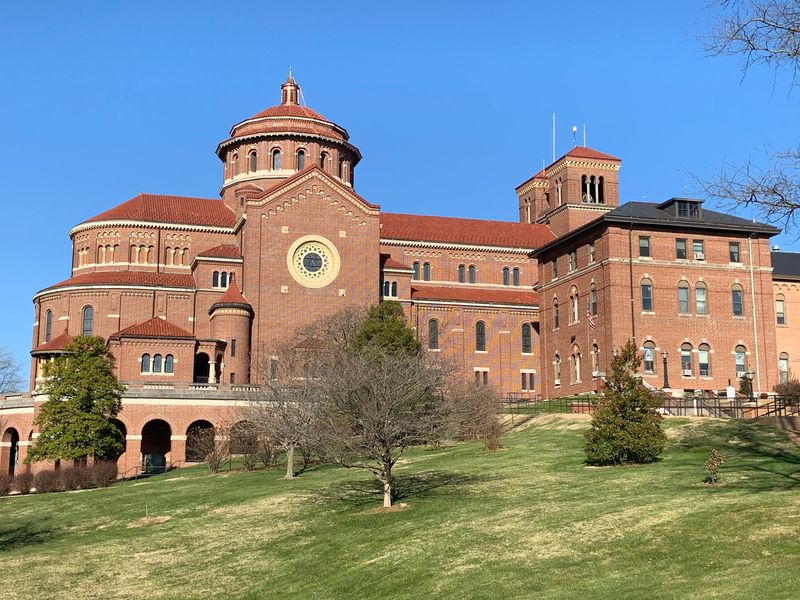
Nicknames stick for a reason, and the Castle on the Hill earns its title from miles away. The dome of Monastery Immaculate Conception rises 87 feet above the sanctuary on a hill east of Ferdinand, at 802 E. 10th St., and it dominates the horizon like something transplanted from central Europe.
This Romanesque Revival complex serves as the mother-house for the Sisters of St. Benedict, one of the largest communities of Benedictine women in the country.
The quadrangle where the sisters live was completed between 1886 and 1888, after construction began in 1883. St. Louis architect Viktor Klutho designed the chapel, started in 1915, with interior work wrapping up in 1924.
A Gothic high altar carries statues imported from Munich representing the Immaculate Conception, Saint Benedict, and Saint Scholastica, along with other Benedictine saints. German artisans hand-carved the wooden pews, and the Stations of the Cross were also carved in Munich.
Outside, the grounds stretch into gardens, outdoor Stations of the Cross, a labyrinth, and small shrines. Quiet comes easily here.
Artifacts and literature preserved on site trace the community’s German heritage, giving context to everything the eye takes in. Allow a full hour or more, because the hilltop views alone slow visitors down considerably.
7. St. Ferdinand Catholic Church, Ferdinand
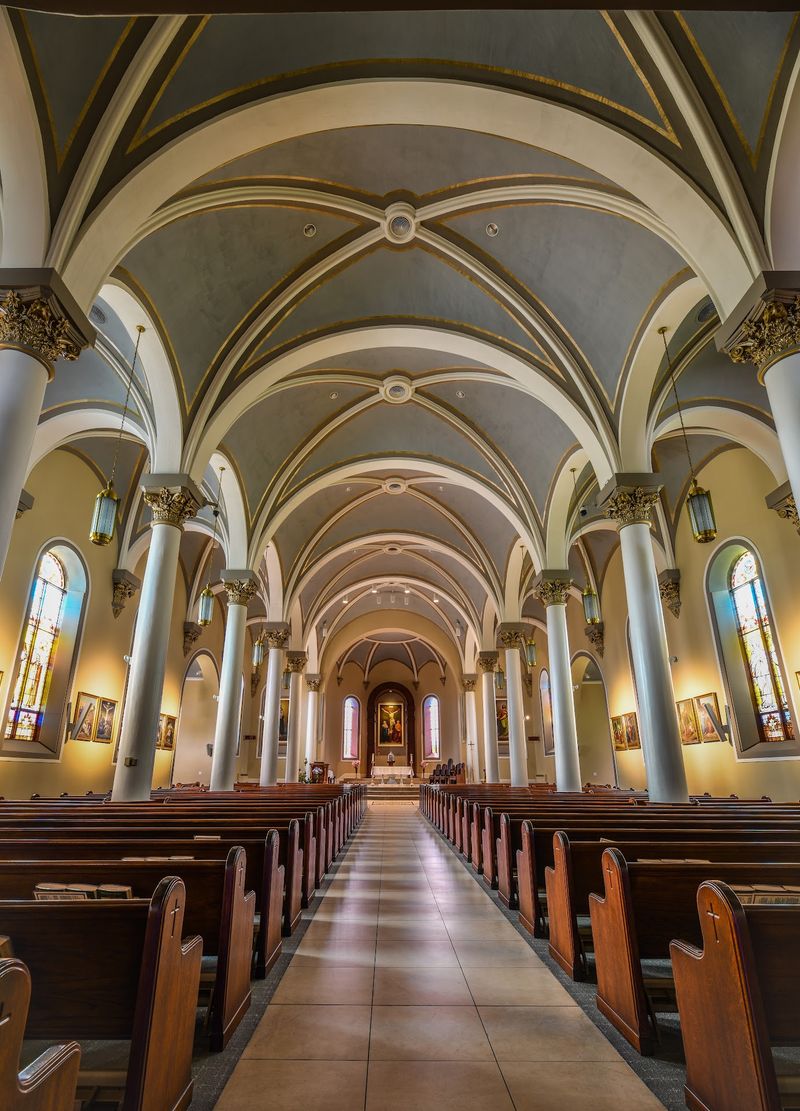
Two great churches in one small village might seem like overkill, yet Ferdinand pulls it off. St. Ferdinand Catholic Church sits at 341 East 10th Street, its 185-foot spire punctuating a skyline already shaped by the monastery up the hill.
Austrian-born Father Joseph Kundek drove the original vision, with the cornerstone laid in 1845 and the stone building finished in 1848.
That first structure measured 112 by 60 feet and still forms the core of today’s church. Its architectural imperfections have long been considered part of the appeal rather than a flaw to hide.
The town itself was platted with the parish square as the central focus, which explains why every street seems to lead back toward the church. Later work extended the building by roughly 50 feet and added the tall spire.
Father Eberhard Stadler oversaw interior remodeling, stained-glass windows, and the clocks mounted on the tower. Small details, big effect.
German Catholic families settled the area, and the surrounding red-brick buildings still give the village a distinctly Bavarian feel. Wandering the blocks around the square takes maybe twenty minutes and delivers more atmosphere than most bigger destinations.
Combining this stop with the monastery makes Ferdinand one of the strongest single-town anchors on the whole route.
8. Holy Family Church, Oldenburg
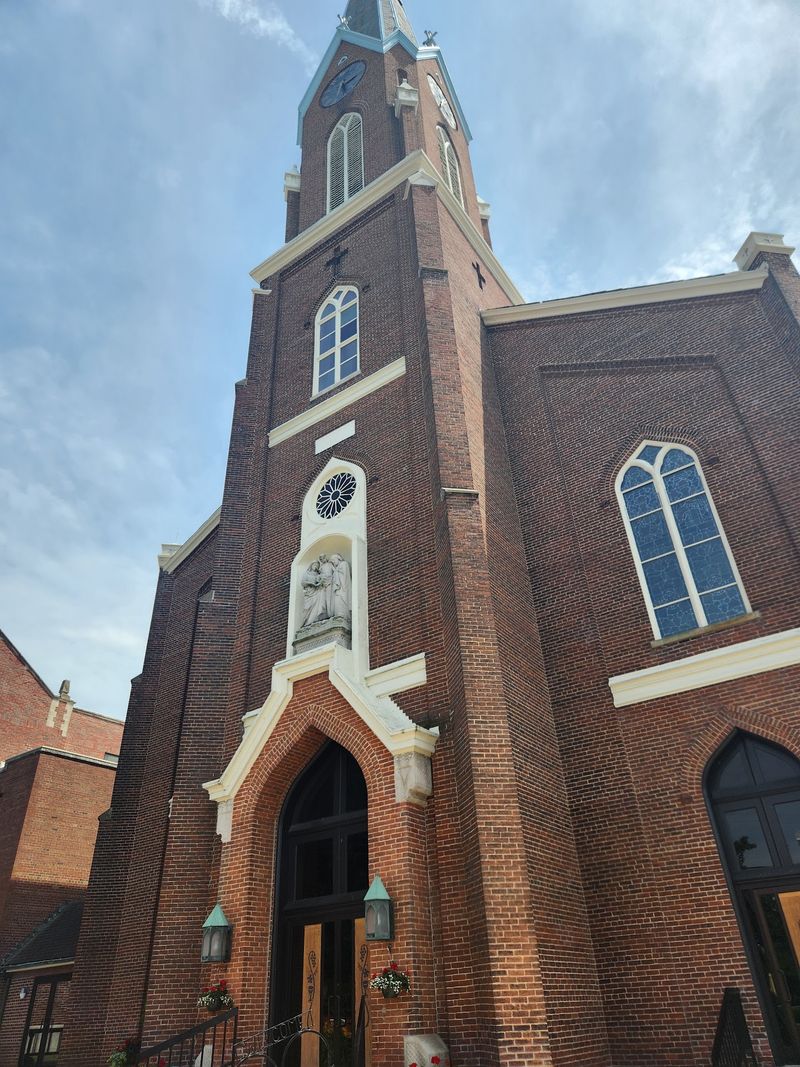
Oldenburg goes by the Village of Spires, and Holy Family Church supplies the tallest of them. Its steeple climbs 187 feet, ranking among the tallest in Indiana and defining the town’s profile from every approach road.
The current brick church went up in 1862, replacing a smaller stone church that had been consecrated in 1850.
Gothic Revival details give the building its vertical pull, and the surrounding streets amplify the effect. German craftsmanship shows in the historic brick and stone homes nearby, and the whole village carries an unmistakably European atmosphere.
Here is a detail worth knowing. The earlier stone church on the site once wore an onion dome, removed in 1949, though the original stone structure still stands as a quiet reminder of the parish’s first years.
Father Franz Joseph Rudolf, the first pastor, is buried in the church basement, which adds a layer of history most visitors do not expect.
Oldenburg’s listing on the National Register of Historic Places helps explain why the streetscape feels so intact, with German street signs and tidy facades reinforcing the mood. Plan to arrive with time for aimless walking rather than a quick photo stop.
Two spires stand within sight of each other here, making this village the densest concentration of old-world architecture in the state.
9. Chapel of the Immaculate Conception, Oldenburg
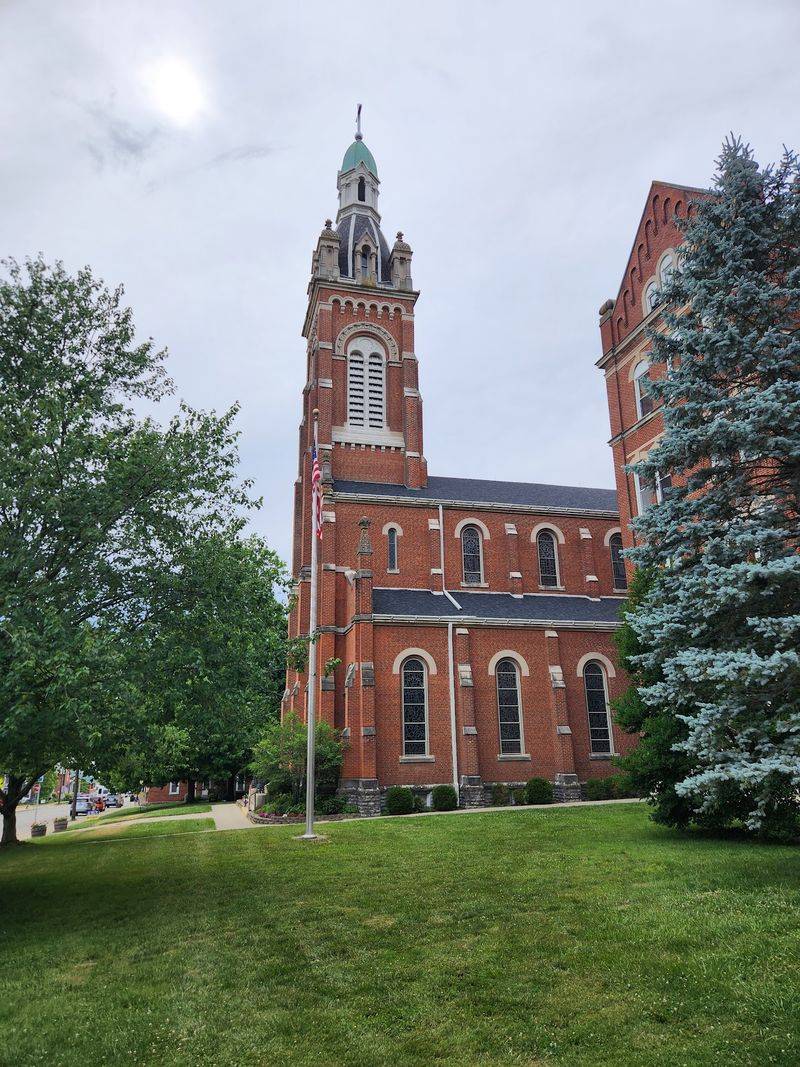
Cross the street from Holy Family and a second spire waits, quieter but no less lovely. The Chapel of the Immaculate Conception belongs to the Convent of the Sisters of St. Francis, and it shares credit for Oldenburg’s Village of Spires nickname.
Construction ran from 1890 to 1891, decades after the convent’s founding in 1851.
Stained-glass windows imported from Munich give the Gothic interior its glow, echoing the German connections found throughout this corner of Franklin County. Craftsmanship traveled a long way to end up in a small Indiana town.
The chapel sits within the larger motherhouse complex, so the setting includes handsome grounds and buildings rather than a single isolated structure. That context matters, because the spire reads differently when framed by the whole campus.
Photographers tend to love the vantage point from the street between the two churches, where both towers line up against open sky. It is a shot that convinces people the picture was taken overseas.
Visiting both Oldenburg landmarks back to back takes little effort and doubles the payoff. The town is compact, walkable, and refreshingly free of crowds most of the year.
For travelers building a route through southeastern Indiana, this stop supplies the strongest old-world feeling per square block anywhere on the list.
10. Scottish Rite Cathedral, Indianapolis
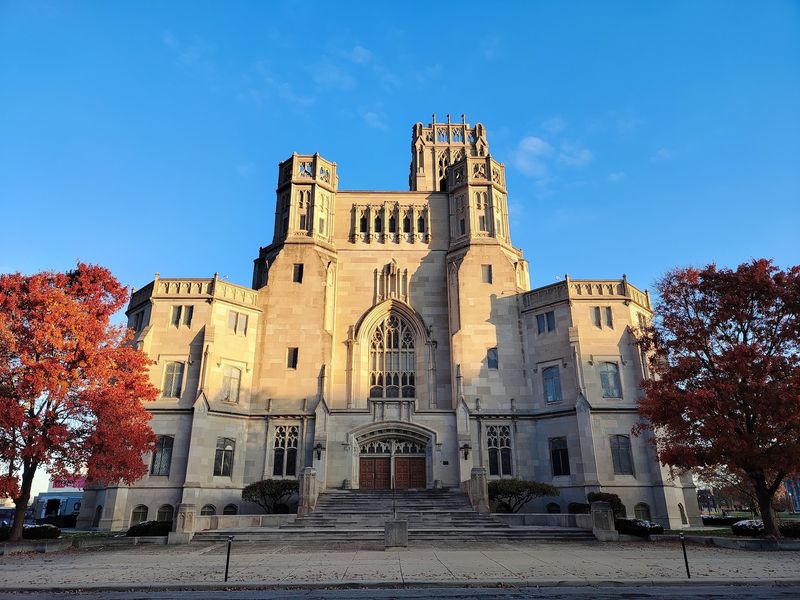
Not every cathedral on this route holds religious services, and the Scottish Rite Cathedral proves how far Gothic ambition can stretch. Rising at 650 N.
Meridian St. in Indianapolis, it was completed in 1929 to designs by architect George F. Schreiber.
Bloomington limestone forms the exterior, and the 212-foot Gothic tower draws partly on Cologne Cathedral for inspiration.
That tower holds a carillon of 54 bells, among the largest collections in the United States. When they ring across downtown, the whole block seems to shift centuries.
The building ranks as the largest Scottish Rite structure anywhere and one of the largest Masonic buildings in the world. The International Association of Architects once named it among the seven most beautiful buildings on earth, which is quite a claim for the Midwest.
Design details follow Masonic principles, with many dimensions divisible by three and thirty-three. Numbers hiding in plain sight.
Interiors bring Russian curly oak woodwork, carved panels, and a vaulted double hammer-beamed ceiling that belongs in an English great hall. Add a floating ballroom set on springs and a stage stocked with more than 50 hand-painted scenic backdrops, and the tour keeps surprising people.
Listed on the National Register of Historic Places, it pairs naturally with nearby downtown landmarks.
11. Christ Church Cathedral, Indianapolis
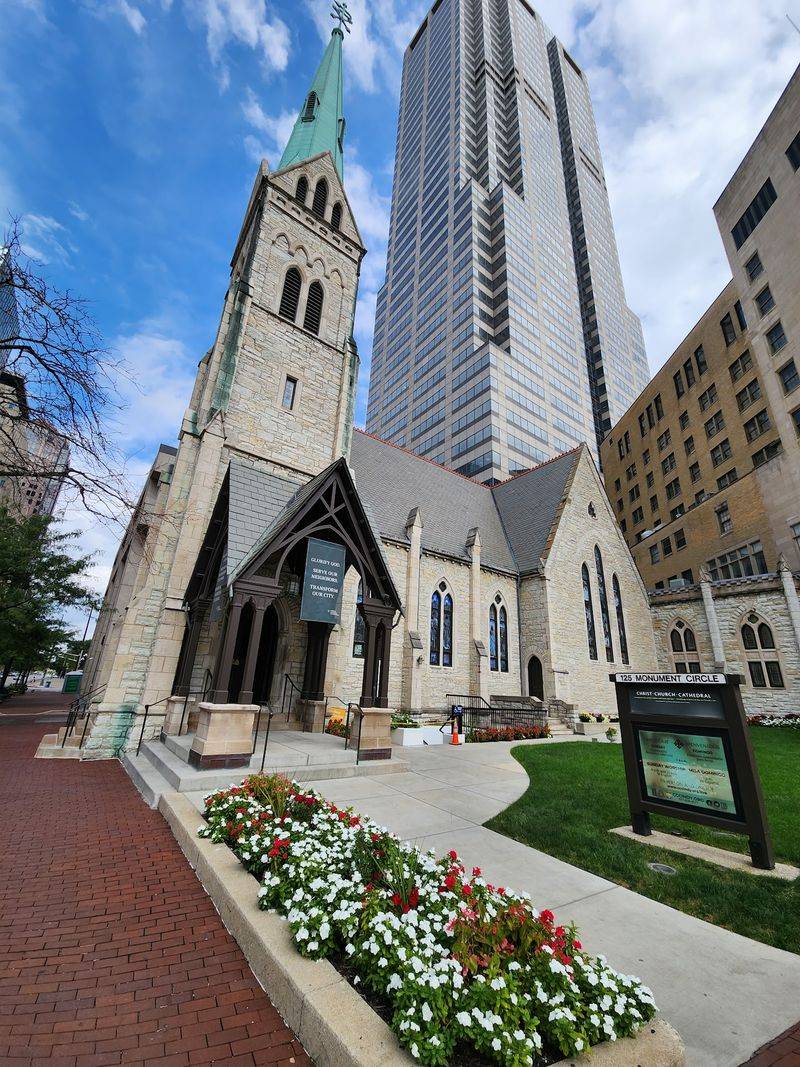
Surrounded by glass towers and city traffic, one small stone church on Monument Circle refuses to blend in.
Christ Church Cathedral occupies 125 Monument Circle in Indianapolis, and it is both the oldest church building in continuous use in the city and Marion County and the oldest structure on the Circle itself.
Irish-born architect William Tinsley designed it, and construction wrapped in 1857.
English Gothic Revival lines give the building its dignity, with rusticated limestone facing that replaced the original red brick exterior. The front tower and octagonal spire arrived in 1867, topped with the Greek letters Chi and Rho.
Inside, stained glass fills nearly every opening, including a Resurrection window and a series tracing the congregation’s own history. Colored light lands on stone and wood in a way that mutes the noise of the street outside.
An expansive wood roof truss system spans overhead, while an intricately carved wood screen separates the altar space. Craft over flash.
A white marble altar, leaded-glass windows, a wooden chancel screen, and bold red inner doors round out the interior. Those doors alone make for a memorable photo.
Listed on the National Register of Historic Places, the cathedral offers a fitting finish to the route, proof that medieval Europe left fingerprints right in the middle of Indiana’s capital.
