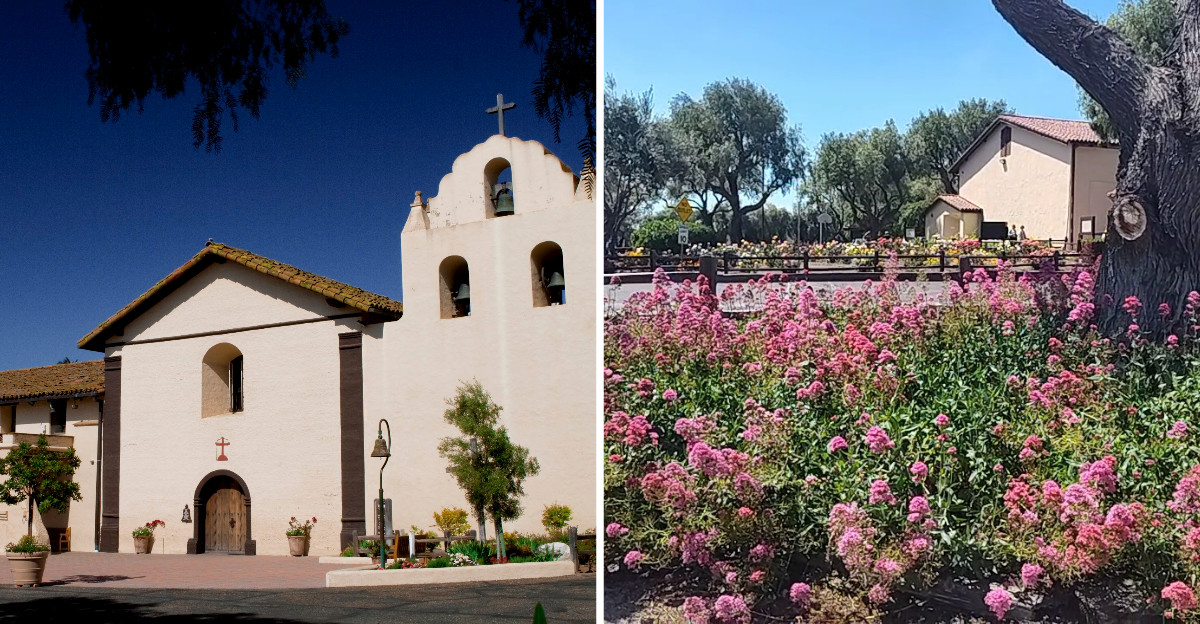
Pastries and windmills were the plan, but a mission courtyard built in 1804 changed everything. Small, worn bells hang in the California sun, and the valley behind them rolls out in soft green folds toward distant mountains.
What surprised me most wasn’t the church, though. Just down the road sit the ruins of a mill complex where a water-powered grist mill was raised in 1820 and a fulling mill followed in 1821.
The fulling mill is the only known water-powered one still surviving on the West Coast, which feels like a wild thing to stumble across between Danish bakeries. Walking between the ruins, it is easy to forget the bustling town just a few blocks away.
The grounds were walked twice that day, once fast and once slow, and the slow walk is the one still thought about. The old millstones sit in the grass, and the water channel still cuts a line through the earth.
Volunteers keep the paths clear, but the buildings themselves are left to the weather. Standing there, it is easy to imagine the noise and the dust and the workers who once filled this quiet corner of California.
The Mission That Filled a Gap in the Chain
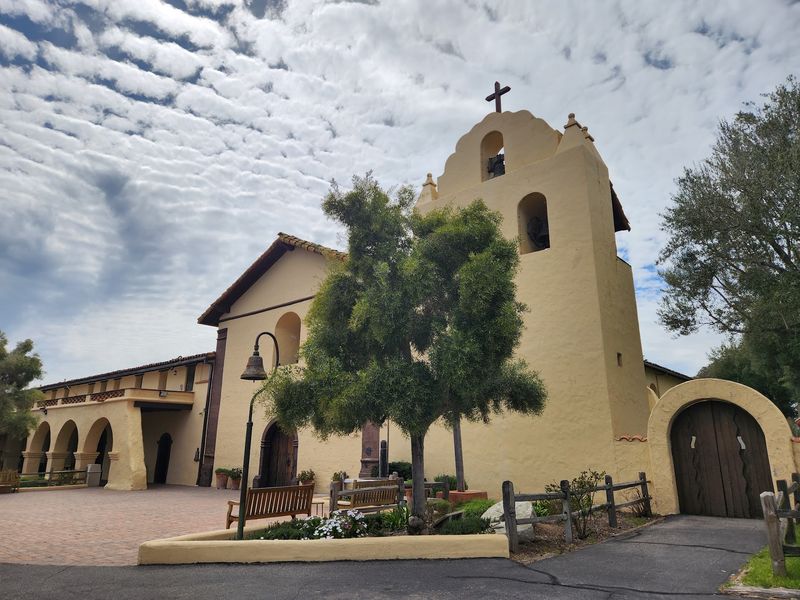
Father Estévan Tapís founded this place on September 17, 1804, and the reason behind it was surprisingly practical. Mission Santa Barbara and Mission La Purísima Concepción had grown crowded, and the stretch between them was long.
Santa Inés became the nineteenth of the twenty-one Alta California missions, sitting roughly halfway as a working link in the chain. It also served the Chumash people of the Santa Ynez Valley, whose villages spread across this land long before any bells rang here.
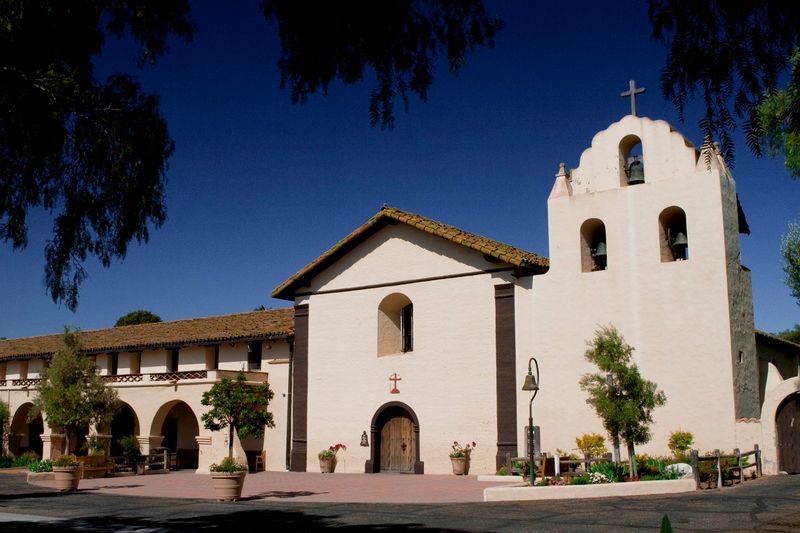
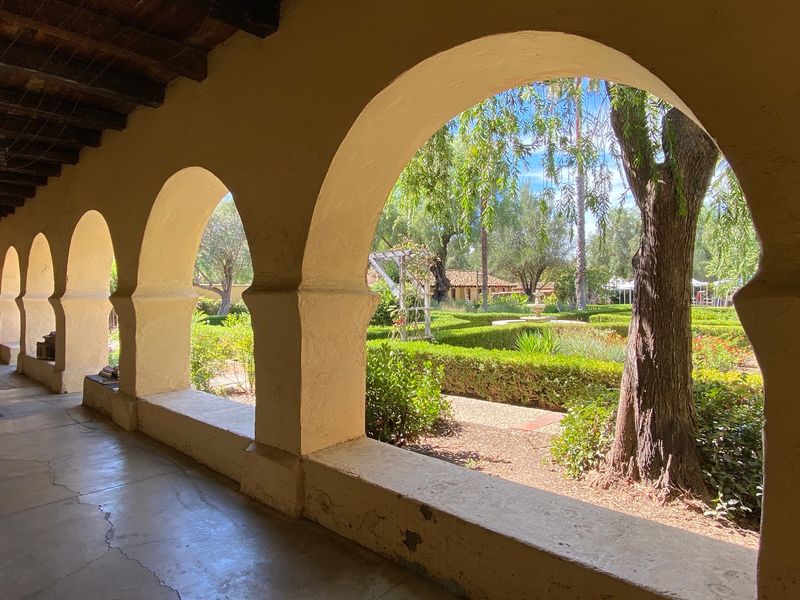
I liked knowing that before I walked through the arches, because the layout suddenly made sense. Everything faces the valley.
The long colonnade, the quadrangle, the gardens, all of it points outward toward water and grazing land and open sky.
The building you see today is not entirely the original, and the staff are upfront about that. An earthquake in December 1812 wrecked most of the first church, and the replacement was dedicated on July 4, 1817.
So the walls you touch are the second try, raised by hand after the first one fell. Somehow that makes the place feel more human, not less.
Why 1821 Still Matters Down at the Mills
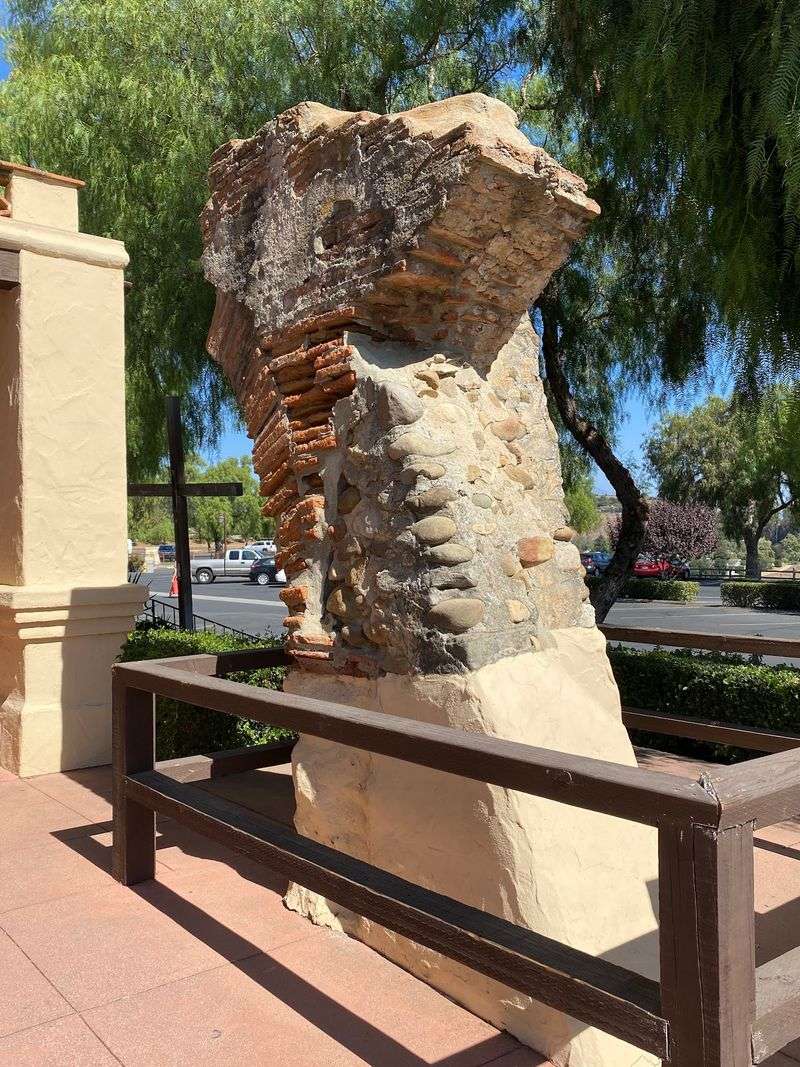
Here’s the detail that hooked me. Construction on the Mission Mills complex started in 1819, a grist mill for grinding corn and wheat into flour went up in 1820, and a fulling mill followed in 1821.
A fulling mill cleans and thickens woolen cloth, which sounds dull until you realize what it means. Santa Inés wasn’t only growing food, it was finishing textiles with machinery driven by moving water.
That 1821 fulling mill is recognized as one of the earliest industrial sites in California, and it is the only known water-powered fulling mill still standing anywhere on the West Coast. Not one of a few.
The only one.
I stood looking at the walls trying to picture damp wool being pounded clean while creek water turned the works below, and honestly it reframed the whole mission for me.
Taken together with the grist mill and the reservoirs, the complex is the largest and most complete milling and reservoir system remaining at any mission in the western United States. For a town best known for pastry, that is a serious piece of history sitting quietly in the grass.
Joseph Chapman, the Unlikely Mill Builder
Some history sticks because the people in it are strange, and Joseph Chapman qualifies. An American who ended up paroled to Mission Santa Inés in 1820, he claimed he knew how to build a fulling mill.
Apparently nobody could prove otherwise, so they let him try. The result is the structure that still survives today, which means his claim held up rather well.
Chapman also helped build a grist mill for Mission San Gabriel, so the man clearly had real skill with water, gears, and stone. I find that oddly encouraging, the idea that someone arriving under awkward circumstances ended up leaving behind the most technically remarkable thing on the property.
What I appreciate is how ordinary it must have felt at the time. No plaque, no ceremony, just a practical solution to a practical problem of processing wool without hauling it somewhere else.
Two centuries later, that practical solution is a National Historic Landmark feature. When the museum mentions his name, do pause on it, because the story behind those walls is stranger and more human than most mission tales.
That unlikely path makes the mill feel less like an anonymous historic structure and more like the lasting work of one resourceful person.
Water Hauled Three Miles by Hand-Dug Ditch
Moving water is the whole trick, and the engineering here deserves more attention than it gets. Two large stone reservoirs fed the mills, and those reservoirs were filled by an earthen ditch called a zanja.
The zanja pulled water from Zanja de Cota Creek, more than three miles away. Three miles, dug by hand, following the slope of the land closely enough for gravity to do the rest.
The grist mill then used a water-propelled horizontal wheel turning a millstone, which is a simple design that works beautifully when the flow is steady. Chumash laborers built these structures, and Chumash workers along with local farmers grew the grain that came through them.
Standing near the valley floor, I kept trying to trace where that ditch would have run, and the landscape gives you hints if you look at the contours.
It made me think differently about every dry creek bed in the area. Long before pipes and pumps, somebody read this terrain carefully enough to bend water toward a wheel, and the stone reservoirs are still here as proof.
Museum Rooms Worth Slowing Down For
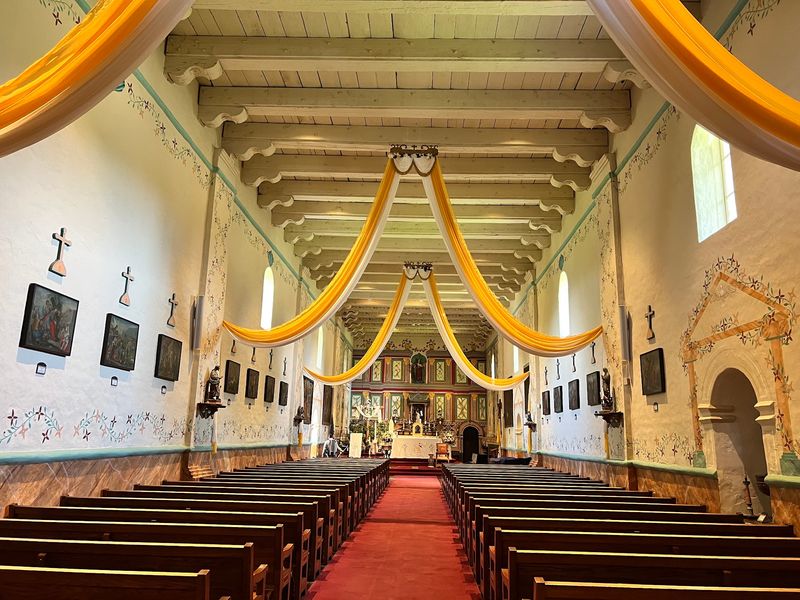
My plan was fifteen minutes in the museum, and I stayed close to an hour. The rooms are small, well lit, and arranged so the story actually builds instead of just displaying objects.
There are 18th and 19th century vestments with embroidery that still holds its color, mission-era paintings, and Chumash artifacts that ground the space in a much older history. Nothing feels crammed in.
A self-guided tour is available daily, and there are audio stops where you press a button and hear about that specific part of the church or quadrangle. I found that format genuinely helpful, because it explains why the quadrangle is shaped the way it is.
Once you understand the quadrangle, you start seeing the mission as a working settlement rather than a single pretty church.
The gift shop is compact but well chosen, and the staff there are happy to point you toward the gardens. If you only have a short window in Solvang, the museum plus the courtyard is the combination I would pick without hesitating.
Gardens, Roses, and a View That Stops You
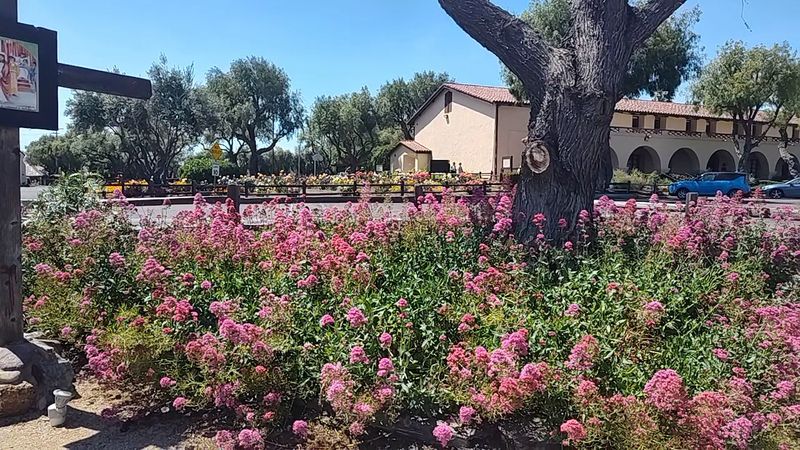
The rose garden caught me off guard with how strongly it smells on a warm afternoon. Bees everywhere, petals dropping onto the path, and the mountains sitting right behind it all.
There are also grapevines on the grounds described as descendants of vines brought to California by Franciscan friars, which is the kind of living detail I always remember longer than a date on a sign.
Behind the church, a Stations of the Cross walk loops through the open ground, and it works as a quiet stroll whether or not you’re religious. Statues, benches, a few oaks, and views of the valley opening wide.
Even the parking lot has a view, and I say that with full sincerity. Early morning, mist sits low across the Santa Ynez Valley and the whole thing looks softened at the edges.
Parking is easy and free, which matters more than people expect when you’re squeezing a stop into a day trip. I brought coffee, sat on a wall, and watched the light shift for a while.
Nobody rushed me.
Planning the Visit, Plus What’s Coming Next
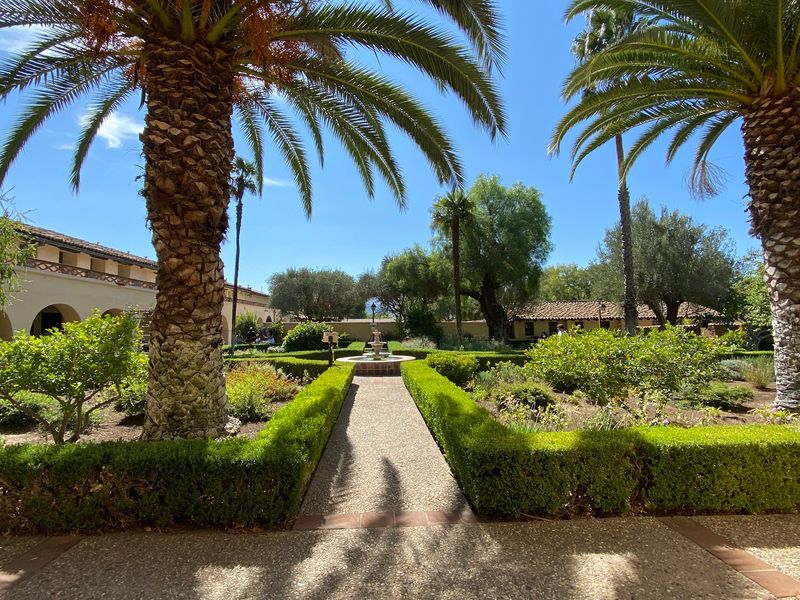
Practical stuff first, since it shapes how the day goes. The mission opens at 9 AM Monday through Saturday and 10 AM on Sunday, closing at 4 PM, and it remains an active Catholic parish alongside the museum.
That mix means services happen while visitors wander, so the church can occasionally be closed or quieter than usual.
The Mission Mills ruins sit adjacent to the mission and are owned by California State Parks. Public access is limited right now, but long-term plans include a new state park in Solvang with walking trails connecting the mission to the mills and interpretive displays about this era.
Preservation work has already included repairing the clay tile roofs on both the grist and fulling mill buildings, which is quietly reassuring news.
Downtown Solvang is a short, pleasant walk away, so pairing history with a bakery stop is easy. Give yourself ninety minutes minimum.
I wish I’d given myself more.
Address: 1760 Mission Dr, Solvang, CA 93463
