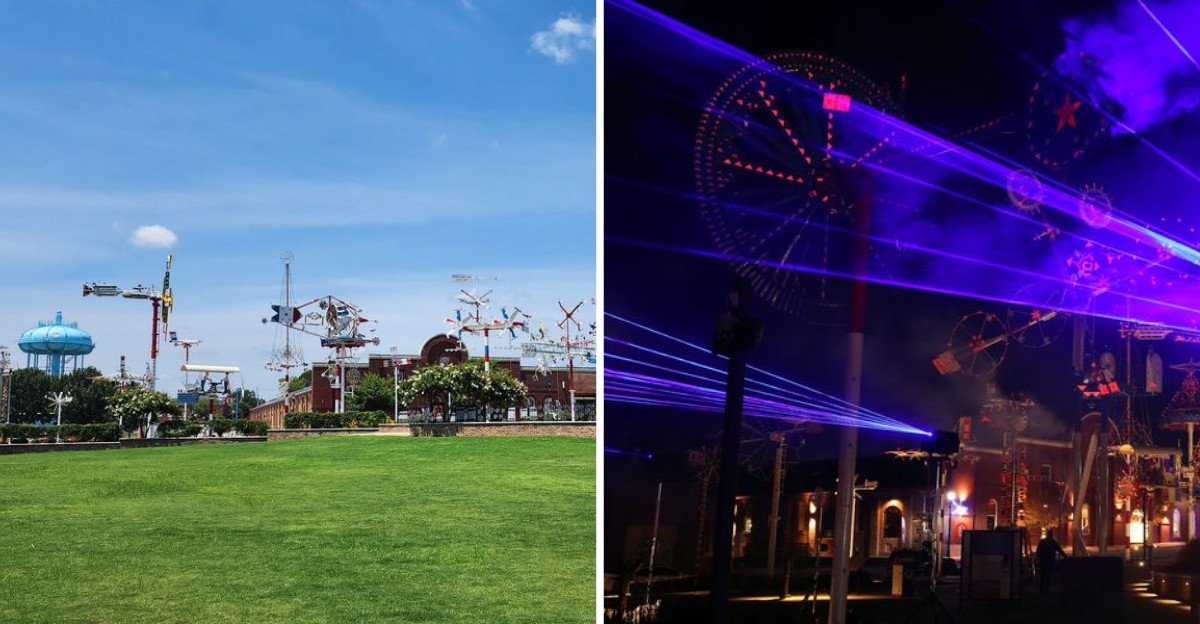
Wheels turning, small metal figures pedaling bicycles in midair, and a soft clatter that followed me across the grass, that is what I found when I turned a corner in a North Carolina town.
A photo online of a metal giant spinning against a blue sky had pulled me there, and nothing quite prepares you for the moment you realize the sky above the park is full of moving machinery.
I kept tilting my head back until my neck complained, and I still did not catch every detail. The man behind it all was a farm machinery repairman who built these things from salvaged parts and old road signs, and he kept adding to the collection for decades.
The wind spins the propellers, the figures rock and turn, and the whole park hums with the kind of motion that makes you slow down and watch.
It is one of the friendliest, strangest, most joyful places I have wandered into in a long while, a testament to one man’s stubborn imagination and a town that decided to keep it.
The Repairman Who Became a Legend Without Meaning To
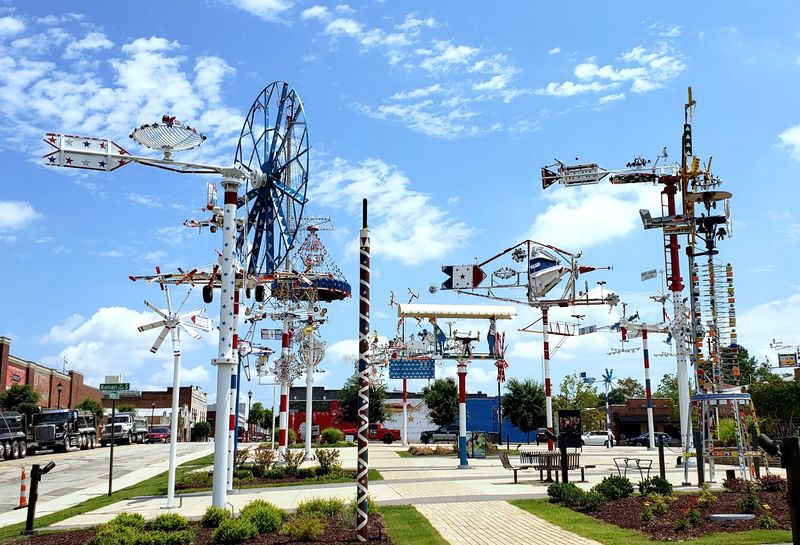
Vollis Simpson never called himself an artist. Born in Wilson County in 1919, he worked as a farm machinery repairman and ran a house-moving business, which meant a lifetime of hauling heavy things and fixing whatever broke.
His first wind machine had nothing to do with beauty. While stationed on Saipan during World War II with the US Army Air Corps, he built a wind-powered contraption to run a washing machine for his company.
That practical streak never left him. Decades later, around age 65 in the early 1990s, he started building the towering pieces that would fill his Lucama farm, still calling them windmills rather than sculptures.
What struck me most is how long he kept at it. He worked nearly every day of the week until a few months before he passed away in 2013 at 94 years old.
His farm became known locally as Acid Park, a nickname earned because headlights sweeping around the curve made thousands of reflectors glitter in the dark. No advertising, no gallery, no marketing plan, and still people drove out just to look.
The windmills still turn, catching the same breeze that guided Simpson’s hands for decades. He never sought fame, only the quiet satisfaction of making something that moved.
That is his real legacy.
Scrap Metal, Road Signs, and a Whole Lot of Imagination
Get close to any one of these pieces and the materials start telling on themselves. Bicycle rims, fan blades, scrap steel, old wheels, school bus mirrors, and highway signs snipped into tiny reflective squares all show up again and again.
Simpson kept salvaged parts around for years from his machine shop and moving work. Nothing was too battered to be useful.
Scale is the part photos never manage. Some of these stand 40 to 50 feet tall and weigh thousands of pounds, yet they turn on a light breeze like they weigh nothing at all.
One called V. Simpson stretches 55 feet, the longest in the park, built with 14 reflector-covered bicycle rims, two school bus mirrors, and a full-size bicycle complete with a rider.
A vane keeps it pointed into the wind.
Another, nicknamed Waffle for the holes punched through its blades, spins better than almost anything else out there.
Look for the little figures too. Farm animals, lumberjacks, a guitar player based on his son, and World War II airplanes all show up in metal.
The park hums with a quiet, rhythmic creak as the pieces turn, and the sound of metal scraping against metal becomes its own kind of music. Standing among them, you realize each sculpture has its own voice and its own way of catching the light.
The breeze does not just move them; it animates them, bringing Simpson’s creations to life in a way photographs can never capture.
The farm feels like a conversation between one man’s hands and the forces of nature. You leave with the feeling that you have witnessed something rare and deeply human, a testament to the stubborn, beautiful impulse to create, no matter what.
How a Farm Full of Windmills Moved Downtown
For years, all of this lived out on a rural property in Lucama, and that is where the trouble started. Rain, sun, and hurricanes had been chewing away at pieces built from salvaged metal, and Wilson County’s biggest attraction was quietly falling apart.
A plan came together in 2010 to bring the whirligigs into Historic Downtown Wilson and give them a permanent home.
The work involved was enormous. Each piece had to be documented, repaired, repainted, and in some cases rebuilt from the ground up before it could be raised again.
Simpson himself was pleased by the idea and helped with the relocation and conservation work until his end in 2013.
The park opened on November 2, 2017, turning about two acres into a public art space anyone can walk through.
The layout is a nod to the farm. A central grass amphitheater called The Green echoes the pond that Simpson originally arranged many of his creations around.
Knowing that history changed how I looked at the place. It is a rescue as much as a display.
Sunlight, Shadows, and the Slow Turn of an Afternoon
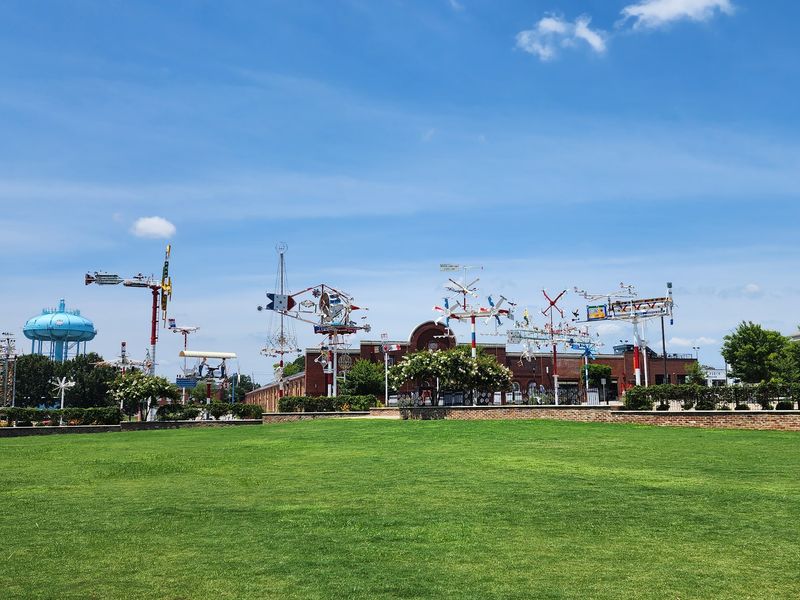
Morning light does something particular here. The paint reads brighter, the metal edges catch, and the whole field looks freshly scrubbed.
I spent longer than planned just sitting on the grass at The Green, which doubles as a venue for concerts and outdoor films when the community puts something on.
Kids seem to figure the place out instantly. They run from one sculpture to the next, pointing at whichever bit is spinning fastest, and the sound of laughter mixes in with all that gentle clanking.
By late afternoon, shadows stretch out and start sliding across the metal, which somehow makes everything look like it is moving twice as much as it really is.
Wind is the wild card. On a still day you get sculpture, and on a breezy day you get a full performance with sound.
The open-air pavilion, designed to echo the old tobacco auction warehouses nearby, gives you cover. I met people who got caught in a downpour there and still had a good time watching from underneath.
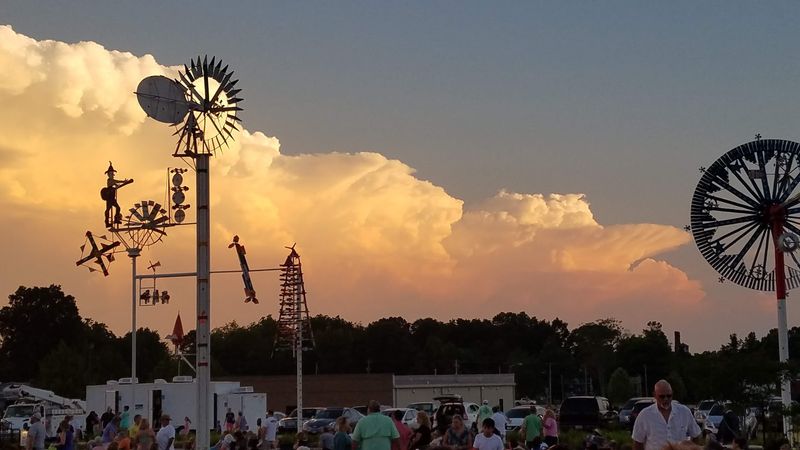
The last hour of light turns the sculptures into silhouettes, and the wind picks up just enough to set everything in motion. Watching the pieces spin and catch the fading sun, I felt a quiet sense of awe settle over me.
Simpson’s work does not just stand; it lives, breathes, and responds to the world around it in real time.
The farm feels less like a museum and more like a living, breathing collaboration between one man’s vision and the forces of nature. I sat there until the sky turned orange, and I realized that the best time to visit is not the morning, but the moment when the day begins to soften and the metal takes on a warm, golden glow.
After Dark, the Whole Field Starts to Glitter
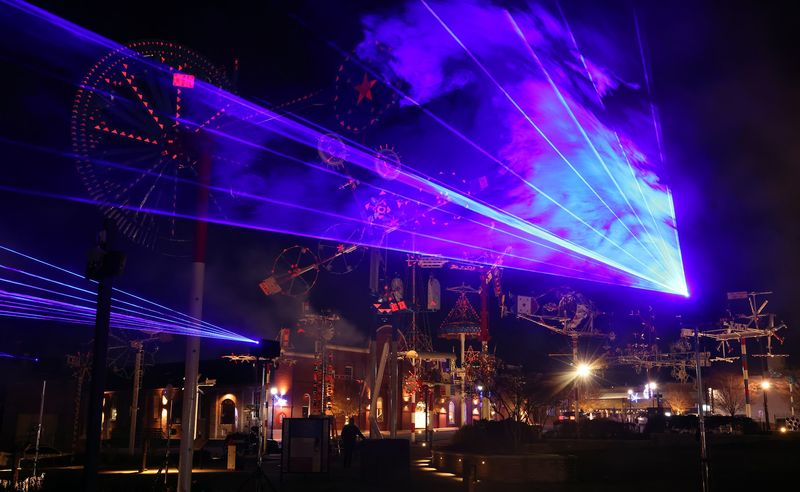
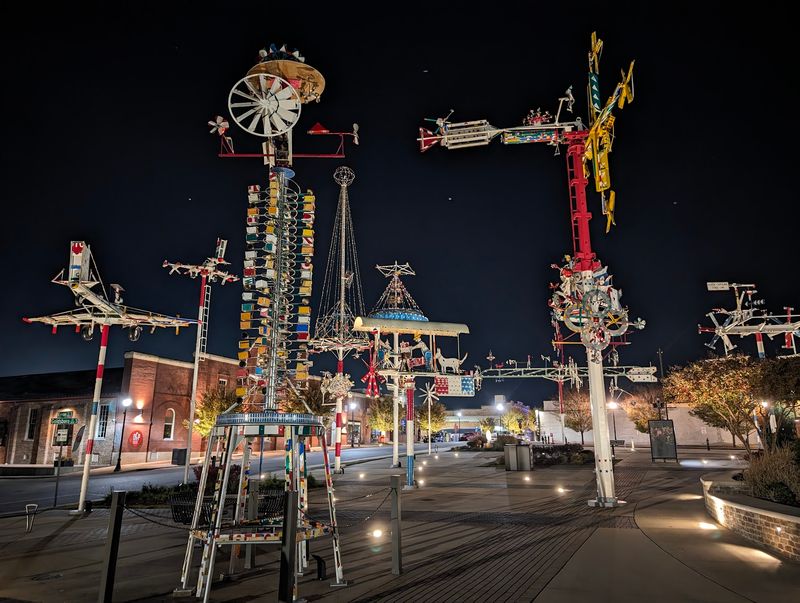
Here is the part I would plan a trip around. Simpson attached thousands of small reflectors to his whirligigs, the same kind used on road signs, and the park’s night lighting is built specifically to wake them up.
The effect recalls what people used to describe out at the Lucama farm, when headlights swung around a bend and a whole field of spinning metal suddenly lit up.
Colors behave differently at night. Instead of paint, you notice pinpricks of light shifting and blinking as each piece rotates at its own pace.
Standing back a bit helps. From across the lawn, the sculptures stop reading as machines and start looking like constellations that cannot sit still.
Hours work in your favor. The park is free and open every day from 5:00 AM until midnight, so an early morning visit and a late evening one are both easy to fit in.
My advice is simple. Come once in daylight to study the details, then circle back after dark for something completely different.
A Museum Across the Street and a Downtown Worth Wandering
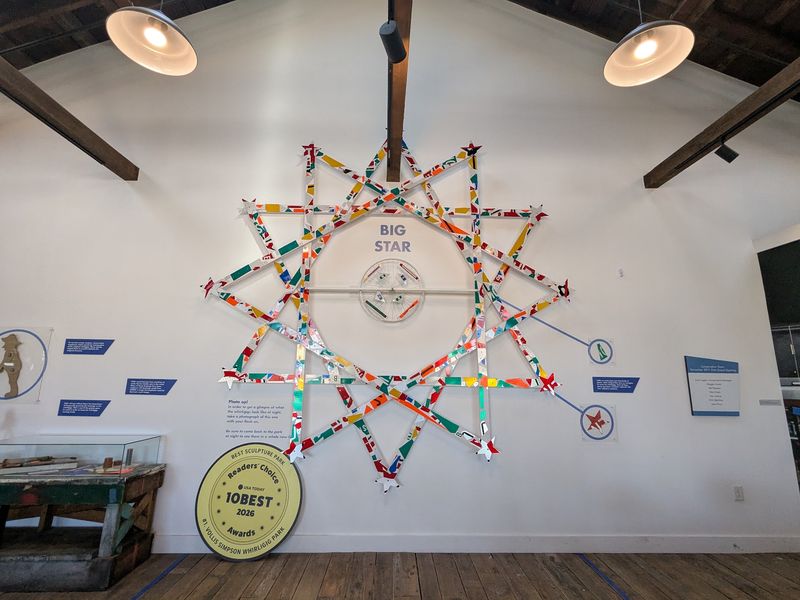
Cross the street and the story fills in. The Vollis Simpson Whirligig Park Museum and Gift Shop holds original whirligigs, including smaller tabletop pieces you can actually study up close, plus a video kiosk covering his life.
That was where I finally understood the reflector trick, which then sent me straight back outside to look again.
Saturdays bring the Wilson Farmers and Artisan Market under the pavilion, with vendors, baked goods, crafts, and live music mixed in. Food trucks show up too.
Downtown Wilson makes the visit easy to stretch out. Coffee shops, a popcorn shop, small galleries, and restaurants sit within a short walk, and parking is straightforward.
Simpson’s reach goes well past this park, for what it is worth. North Carolina named his whirligigs the official folk art of the state in 2013, and his work sits in collections including the American Visionary Art Museum in Baltimore.
Still, Wilson is where it all belongs. Come on a windy day if you can, and give yourself more time than you think you need.
Address: 301 Goldsboro St S, Wilson, North Carolina 27893
